Introduction to General, Organic & Biological Chemistry, 12e (Timberlake)
Chapter 2 Chemistry and Measurement
2.1 Multiple-Choice Questions
1) The amount of space occupied by a substance is its ________.
A) mass
B) density
C) weight
D) length
E) volume
2) Which of the following is the basic unit of volume in the metric system?
A) liter
B) kilogram
C) meter
D) centimeter
E) gram
3) Which of the following is a measurement of mass in the metric system?
A) milliliter
B) centimeter
C) kilogram
D) Celsius
E) meter
4) A value of 25 °C is a measurement of ________.
A) length
B) volume
C) temperature
D) mass
E) density
5) A value of 36 mL is a measure of ________.
A) density
B) mass
C) temperature
D) volume
E) length
6) A value of 345 mm is a measure of ________.
A) density
B) mass
C) temperature
D) volume
E) length
7) The measurement of the gravitational pull on an object is its ________.
A) volume
B) weight
C) mass
D) length
E) size
8) Which of the following measurements has three significant figures?
A) 0.005 m
B) 510 m
C) 0.510 m
D) 0.051 m
E) 5100 m
9) Which of the following numbers contains the designated correct number of significant
figures?
A) 0.04300 5 significant figures
B) 0.00302 2 significant figures
C) 156 000 3 significant figures
D) 1.04 2 significant figures
E) 3.0650 4 significant figures
10) The number of significant figures in the measurement of 45.030 mm is ________.
A) none
B) three
C) four
D) five
E) six
11) How many significant figures are in the number 0.00208?
A) six
B) two
C) three
D) four
E) five
12) Which of the following examples illustrates a number that is correctly rounded to three
significant figures?
A) 4.05438 g to 4.054 g
B) 0.03954 g to 0.040 g
C) 103.692 g to 103.7 g
D) 109 526 g to 109 500 g
E) 20.0332 g to 20.0 g
13) A calculator answer of 423.6059 must be rounded off to three significant figures. What
answer is reported?
A) 423
B) 424
C) 1.7420
D) 423.6
E) 423.7
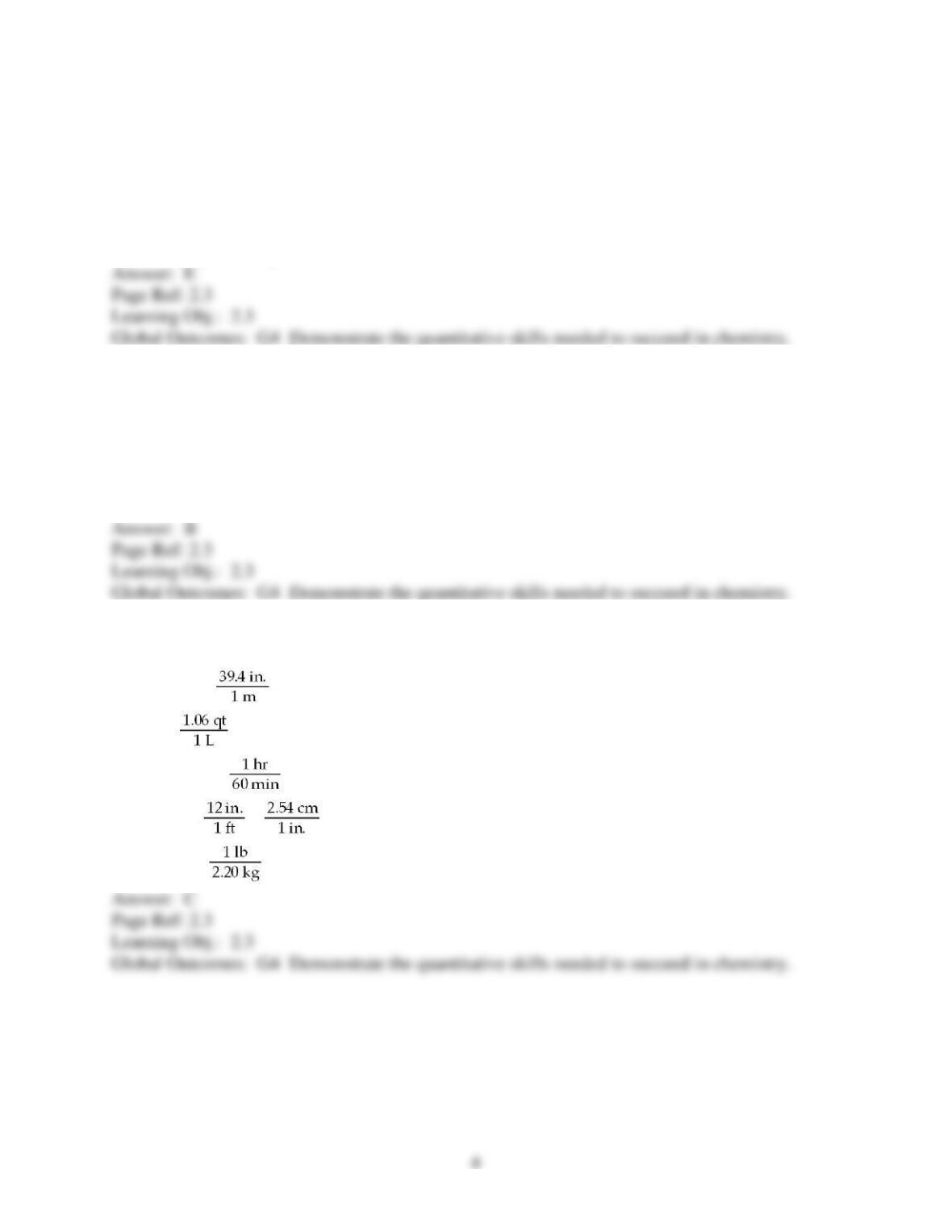
14) Which of the answers for the following conversions contains the correct number of
significant figures?
A) 2.543 m × = 100.1942 in.
B) 2 L × = 2.12 qt
C) 24.95 min × = 0.4158 hr
D) 12.0 ft × × = 370 cm
E) 24.0 kg × = 11 lb
15) What is the correct answer for the calculation of a volume (in mL) with measured numbers
?
A) 0.22 mL
B) 0.223 mL
C) 57 mL
D) 14 mL
E) 14.3 mL
16) When 2610 + 11.7 + 0.22 are added, the answer to the correct number of decimal places is
________.
A) 2621.92
B) 2621.9
C) 2621
D) 2620
17) What is the answer, with the correct number of decimal places, for this problem?
4.392 g + 102.40 g + 2.51 g =
A) 109.302 g
B) 109 g
C) 109.3 g
D) 109.30 g
E) 110 g
18) The correct answer for the addition of 7.5 g + 2.26 g + 1.311 g + 2 g is ________.
A) 13.071 g
B) 13 g
C) 13.0 g
D) 10 g
E) 13.1 g
Global Outcomes: G4 Demonstrate the quantitative skills needed to succeed in chemistry.
19) In which of the following is the metric unit paired with its correct abbreviation?
A) microgram / mg
B) milliliter / mL
C) centimeter / km
D) kilogram / cg
E) gram / gm
20) Which of the following is the largest unit?
A) millimeter
B) micrometer
C) meter
D) decimeter
E) kilometer
21) What is the metric relationship between grams and micrograms?
A) 1 g = 100 μg
B) 1 g = 1 000 000 μg
C) 1 g = 0.000 001 μg
D) 1 g = 1000 μg
E) 1 g = 0.001 μg
22) Which of the following is the smallest unit?
A) gram
B) milligram
C) kilogram
D) decigram
E) microgram
23) The cubic centimeter (c or cc) has the same volume as a ________.
A) cubic inch
B) cubic liter
C) milliliter
D) centimeter
E) cubic decimeter
24) What is the conversion factor for the relationship between millimeters and centimeters?
A) 1 mm/1 cm
B) 10 mm/1 cm
C) 1 cm/1 mm
D) 100 mm/1 cm
E) 10 cm/1 mm
25) Which of the following conversion factors is a measured number?
A) 10 cm/dm
B) 12 in/ft
C) 16 oz/lb
D) 25 miles/gallon
E) 12 eggs/dozen
26) A conversion factor set up correctly to convert 15 inches to centimeters is ________.
A) 100 cm/1 m
B) 1 inch/2.54 cm
C) 1 cm/10 mm
D) 2.54 cm/1 inch
E) 10 cm/1 inch
27) 9.31 g is the same mass as ________.
A) 931 μg
B) 931 kg
C) 93.1 cg
D) 9310 mg
E) 0.0931 dg
28) According to the United States Food and Drug Administration, the recommended daily
requirement of protein is 44 g. This is ________ of protein.
A) 1248.5 oz
B) 320 000 oz
C) 1.6 oz
D) 0.0605 oz
E) 150 000 oz
29) 1.00 pint of milk has a volume of how many milliliters?
A) 473 mL
B) 530. mL
C) 1000 mL
D) 1890 mL
E) 106 mL
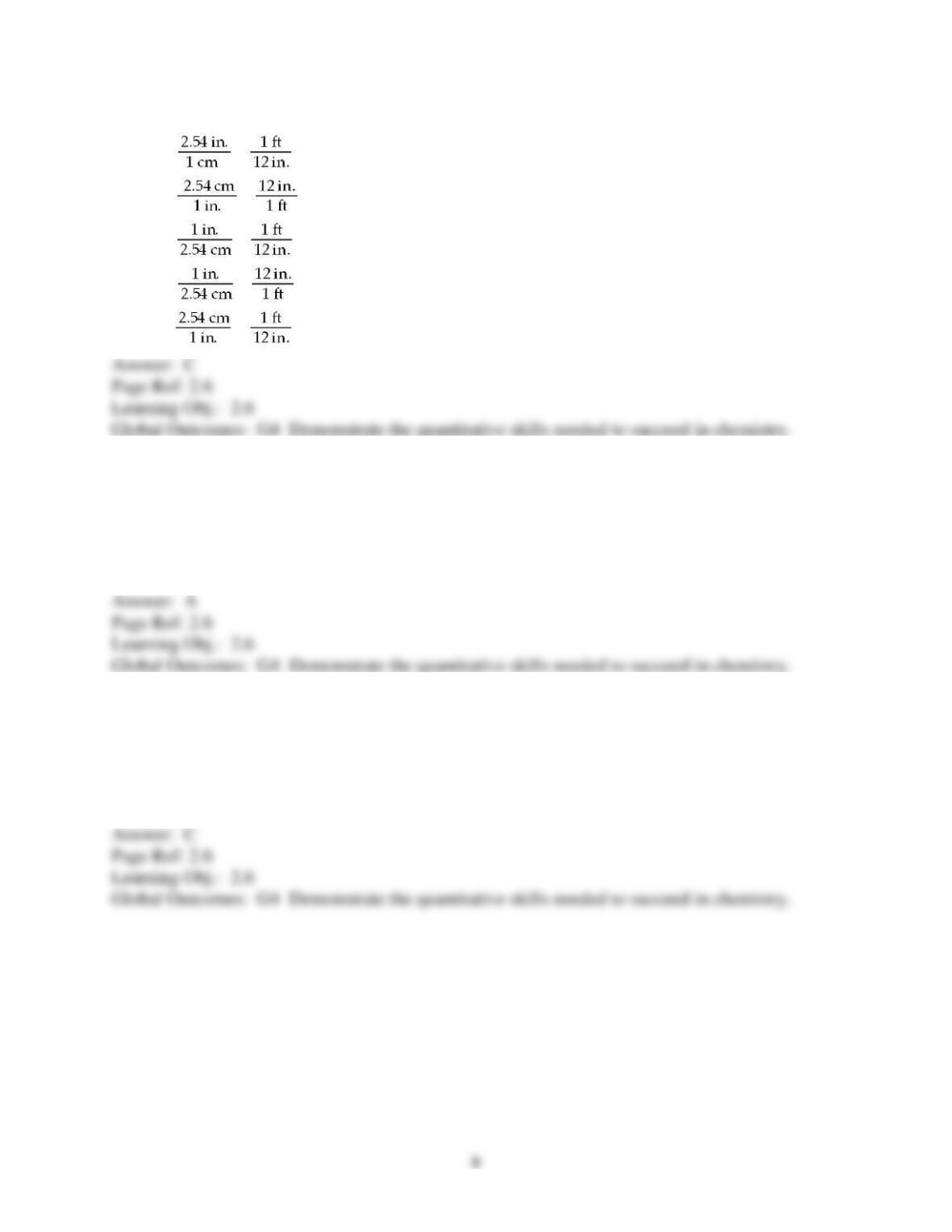
30) Which of the following setups would convert centimeters to feet?
A) cm × ×
B) cm × ×
C) cm × ×
D) cm × ×
E) cm × ×
31) How many pounds are in 3.5 kg?
A) 7.7 lb
B) 1.59 lb
C) 0.629 lb
D) 1.6 lb
E) 7.70 lb
32) How many liters of soft drink are there in 5.25 qt?
A) 4950 L
B) 55.7 L
C) 4.95 L
D) 5.57 L
E) 5.0 L
33) 5.21 cm is the same length as ________.
A) 0.0521 m
B) 52.1 dm
C) 5.21 mm
D) 0.00521 km
E) 5210 m
34) How many centimeters are there in 57.0 in.?
A) 22 cm
B) 0.0445 cm
C) 145 cm
D) 22.4 cm
E) 140 cm
35) What is 6.5 m converted to inches?
A) 1700 in
B) 1651 in
C) 39 in
D) 260 in
E) 255.9 in
36) How many kilograms are in 30.4 lb?
A) 13.8 kg
B) 14 kg
C) 67 kg
D) 66.88 kg
E) 66.9 kg
37) A dose of aspirin of 5.0 mg per kilogram of body weight has been prescribed to reduce the
fever of an infant weighing 8.5 pounds. The number of milligrams of aspirin that should be
administered is ________.
A) 19 mg
B) 53 mg
C) 1.6 mg
D) 5.0 mg
E) 0.59 mg
38) A doctor’s order is 0.125 g of ampicillin. The liquid suspension on hand contains 250 mg/5.0
mL. How many milliliters of the suspension are required?
A) 0.0025 mL
B) 3.0 mL
C) 2.5 mL
D) 6.3 mL
E) 0.0063 mL
39) Which of the following measurements are not equivalent?
A) 25 mg = 0.025 g
B) 183 L = 0.183 kL
C) 150 ms = 0.150 s
D) 84 cm = 8.4 mm
E) 24 dL = 2.4 L
40) Which one of the following substances will float in gasoline, which has a density of 0.74
g/mL? The density of each substance is shown in parentheses.
A) table salt (D = 2.16 g/mL)
B) balsa wood (D = 0.16 g/mL)
C) sugar (D = 1.59 g/mL)
D) aluminum (D = 2.70 g/mL)
E) mercury (D = 13.6 g/mL)
41) What is the mass of 2.00 L of an intravenous glucose solution with a density of 1.15 g/mL?
A) 0.0230 kg
B) 2.30 kg
C) 1.15 kg
D) 0.0150 kg
E) 0.575 kg
42) Mercury has a specific gravity of 13.6. How many milliliters of mercury have a mass of 0.35
kg?
A) 0.0257 mL
B) 0.026 mL
C) 25.7 mL
D) 26 mL
E) 4760 mL
43) What is the density of a substance with a mass of 45.00 g and a volume of 26.4 mL?
A) 1.70 g/mL
B) 1.7 g/mL
C) 0.59 g/mL
D) 0.587 g/mL
E) 45.0 g/mL
44) What is the mass of 53 mL of ethanol, which has a density of 0.79 g/mL?
A) 67.1 g
B) 41.9 g
C) 42 g
D) 67 g
E) 53 g
45) A liquid has a volume of 34.6 mL and a mass of 46.0 g. What is the density of the liquid?
A) 1.00 g/mL
B) 1.33 g/mL
C) 0.752 g/mL
D) 1330 g/mL
E) 0.663 g/mL
46) The density of a solution is 1.18 g/mL. Its specific gravity is ________.
A) 11.8
B) 0.118
C) 0.847
D) 1.18
E) 1.2
47) Diamond has a density of 3.52 g/mL. What is the volume in cubic centimeters of a diamond
with a mass of 15.1 g?
A) 4.3
B) 4.29
C) 0.233
D) 53
E) 53.2
48) The ratio of the mass of a substance to its volume is its ________.
A) specific gravity
B) density
C) buoyancy
D) weight
E) conversion factor
49) A nugget of gold with a mass of 521 g is added to 50.0 mL of water. The water level rises to
a volume of 77.0 mL. What is the density of the gold?
A) 10.4 g/mL
B) 6.77 g/mL
C) 1.00 g/mL
D) 0.0518 g/mL
E) 19.3 g/mL
50) A 50.0 mL urine sample has a mass of 50.7 g. The specific gravity of the urine is ________.
A) 1.014 g/mL
B) 0.986 g/L
C) 1.01
D) 0.986
E) 50.7
2.2 Short Answer Questions
Round off each of the following to three significant figures.
1) 504.85
2) 8.3158
3) 25 225
4) 6.3477 ×
5) 399870
6) 58.5422
7) 0.003 4088
8) 0.705 m
9) 680 000 km
10) 0.008090 cm
11) 28.050 km
12) 0.0005 L
13) 75.00 m
14) 2.043 × mm
15) 6.1 × mL
16) 9.00 × g
17) If there are 14 books on the shelf, 14 is a(n) ________ number.
2.3 True/False Questions
1) The basic unit of mass in the metric system is the pound.
2) The liter is a unit of volume in the metric system.
3) The number 0.0500 has four significant figures.
4) The number 650 000 has two significant figures.
5) When the measured number 0.0090 is multiplied by the measured number 87.10, the answer
has two significant figures.
6) When the measured number 675 is added to the measured number 87.10, the answer should be
rounded to the ones place.
7) A μg is larger than a mg.
8) There are 1000 μg in a mg.
9) A cubic centimeter is a unit of length.
10) 1 kg equivalent to 1000 mg.
11) 1 mL is equivalent to 1000 L.
12) The density of water is 1 kg/mL.
13) Specific gravity has no units.

19
2.4 Matching Questions
Match the type of measurement to the unit given below.
A) mass
B) volume
C) temperature
D) length
E) density
1) milliliter
Page Ref: 2.1
Learning Obj.: 2.1
Global Outcomes: G7 Demonstrate the ability to make connections between concepts across
chemistry.
2) mm
Page Ref: 2.1
Learning Obj.: 2.1
Global Outcomes: G7 Demonstrate the ability to make connections between concepts across
chemistry.
3) gram
Page Ref: 2.1
Learning Obj.: 2.1
Global Outcomes: G7 Demonstrate the ability to make connections between concepts across
chemistry.
4) 125 K
Page Ref: 2.1
Learning Obj.: 2.1
Global Outcomes: G7 Demonstrate the ability to make connections between concepts across
chemistry.
5) kilometer
Page Ref: 2.1
Learning Obj.: 2.1
Global Outcomes: G7 Demonstrate the ability to make connections between concepts across
chemistry.
6) milligram
Page Ref: 2.1
Learning Obj.: 2.1
Global Outcomes: G7 Demonstrate the ability to make connections between concepts across
chemistry.
Are the numbers in each of the following statements measured or exact?
A) exact
B) measured
7) In the U.S. system there are 12 inches in one foot.
Page Ref: 2.2
Learning Obj.: 2.2
Global Outcomes: G4 Demonstrate the quantitative skills needed to succeed in chemistry.
8) The patient’s blood sugar level is 350 mg/dL.
Page Ref: 2.2
Learning Obj.: 2.2
Global Outcomes: G4 Demonstrate the quantitative skills needed to succeed in chemistry.
9) There are 452 pages in a book.
Page Ref: 2.2
Learning Obj.: 2.2
Global Outcomes: G4 Demonstrate the quantitative skills needed to succeed in chemistry.
10) The rabbit weighs 2.5 pounds.
Page Ref: 2.2
Learning Obj.: 2.2
Global Outcomes: G4 Demonstrate the quantitative skills needed to succeed in chemistry.
11) 1L is equal to 1.06 quarts.
Page Ref: 2.2
Learning Obj.: 2.2
Global Outcomes: G4 Demonstrate the quantitative skills needed to succeed in chemistry.
12) There are 100 capsules in the bottle.
Page Ref: 2.2
Learning Obj.: 2.2
Global Outcomes: G4 Demonstrate the quantitative skills needed to succeed in chemistry.
13) The patient’s temperature is 100.1 °F.
Page Ref: 2.2
Learning Obj.: 2.2
Global Outcomes: G4 Demonstrate the quantitative skills needed to succeed in chemistry.
14) I lost 14 pounds on my diet last month.
Page Ref: 2.2
Learning Obj.: 2.2
Global Outcomes: G4 Demonstrate the quantitative skills needed to succeed in chemistry.
Select the correct prefix to complete the equality.
A) 10
B) 1000
C) 1
D) 100
15) 1 mL = ________ L
Page Ref: 2.4
Learning Obj.: 2.4
Global Outcomes: G4 Demonstrate the quantitative skills needed to succeed in chemistry.
16) 1 m = ________ mm E) 0.001
Page Ref: 2.4
Learning Obj.: 2.4
Global Outcomes: G4 Demonstrate the quantitative skills needed to succeed in chemistry.
17) 1 cm = ________ mm
Page Ref: 2.4
Learning Obj.: 2.4
Global Outcomes: G4 Demonstrate the quantitative skills needed to succeed in chemistry.
18) 1 dL = ________ mL
Page Ref: 2.4
Learning Obj.: 2.4
Global Outcomes: G4 Demonstrate the quantitative skills needed to succeed in chemistry.
19) 1 mL = ________ cm3
Page Ref: 2.4
Learning Obj.: 2.4
Global Outcomes: G4 Demonstrate the quantitative skills needed to succeed in chemistry.
20) 1 kg = ________ g
Page Ref: 2.4
Learning Obj.: 2.4
Global Outcomes: G4 Demonstrate the quantitative skills needed to succeed in chemistry.