337)
The opportunity cost of attending college might best be described as
337)
A)
the value that the student attaches to not working.
B)
the money that must be paid in order to attend college.
C)
the highest–valued alternative use of the student’s time.
D)
the lowest–valued alternative use of the student’s time.
338)
An irrigation system is installed on a farm in North Dakota. This is an example of which factor of
production?
338)
A)
labor
B)
human capital
C)
physical capital
D)
land
C
339)
A production possibilities curve will shift outward or to the right for all of the following reasons
EXCEPT
339)
A)
an improvement in production technology.
B)
an increase in the unemployment rate.
C)
an increase in the quality of the labor force.
D)
a discovery of a new source of renewable energy.
B
340)
Juanita has just opened a new business selling pet supplies through the Internet.
340)
A)
Juanita is not providing economic goods since pet supplies are not being sold in a store.
B)
Juanita is an entrepreneur.
C)
Juanita is not providing economic goods since people purchase the goods.
D)
Juanita is not an entrepreneur since there are other businesses that sell pet supplies.
B
C

341)
Generally, if a nation produces more consumer goods than capital goods
341)
A)
about the same amount of capital goods may be produced in the future as are being produced
today.
B)
less of all goods may be produced in the future.
C)
more of all goods may be produced in the future.
D)
society will have to forego future consumption of capital goods.
342)
In the production of goods and services, trade–offs exist because
342)
A)
society has only a limited amount of productive resources.
B)
human wants and needs are limited at a particular point in time.
C)
buyers and sellers often must negotiate prices.
D)
not all production is efficient.
A
343)
Samia has decided that with the two hours in between classes she can do one of 3 things. She has
ranked her choices, from highest to lowest as, (1) chat with her friends, (2) study economics or (3)
take a nap. The opportunity cost of chatting with her friends is
343)
A)
the value of chatting with her friends.
B)
the combined value of studying economics and taking a nap.
C)
zero since she does not pay her friends to talk to her.
D)
the value of studying economics, the next best use of time.
D
344)
Bonnie is a self employed. She makes floral arrangements in a building she rents. She owns the
delivery vehicle and has hired a delivery driver. She is an example of
344)
A)
entrepreneurial ability.
B)
labor.
C)
human capital.
D)
physical capital.
A
B
345)
Which of the following is held constant when constructing a production possibilities curve?
345)
A)
the amount of total resources used
B)
the income level
C)
combination of goods produced
D)
the price level
346)
Which of the following items would be considered scarce?
346)
A)
potato chips
B)
water
C)
diamonds
D)
All of the above are scarce.
347)
Which of the following is TRUE with respect to specialization?
347)
A)
Individuals and nations specialize in their areas of comparative advantage in order to reap
the gains of specialization.
B)
Adam Smith in The Wealth of Nations referred to specialization and division of labor.
C)
With a given set of resources, specialization results in higher output.
D)
All of the above are correct.
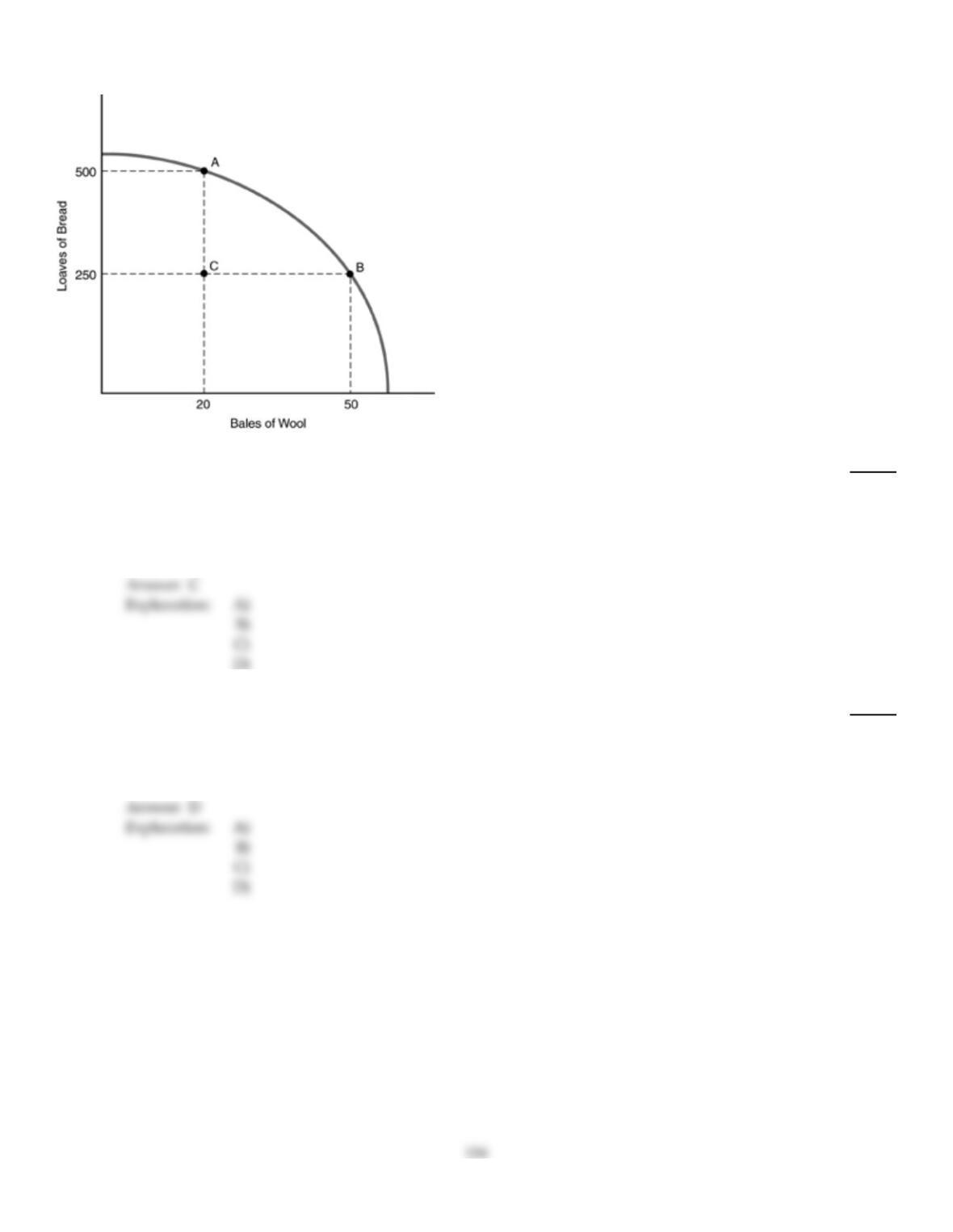
348)
Refer to the above figure. How do you describe what is happening as the economy moves from
point A to point C?
348)
A)
The technology for growing wheat has improved.
B)
Land that was once used to graze sheep is now being used to grow wheat.
C)
Resources are becoming unemployed.
D)
The economy has acquired new resources that are well suited for producing bread.
349)
All of the following would cause the production possibilities curve to shift outward EXCEPT
349)
A)
an increase in the level of capital stock.
B)
an improvement in technology.
C)
an increase in the amount of labor available.
D)
a decline in the unemployment rate.
Explanation:
Explanation:
350)
Carlos is an executive of a major corporation. Boris is a baker. Carlos earns a salary ten times as
large as the salary Boris earns, and Carlos has a much larger oven for baking break. Carlos can
make a loaf of bread that tastes better than Boris’s bread but Boris can bake faster.
350)
A)
Carlos has an absolute but not comparative advantage over Boris in making bread.
B)
Carlos has an absolute and comparative advantage over Boris in making bread.
C)
Carlos does not have an absolute or comparative advantage over Boris in making bread.
D)
Carlos had a comparative but not absolute advantage over Boris in making bread.
351)
Economic growth can be pictured in a production possibilities curve diagram by
351)
A)
making the production possibilities curve more bowed out.
B)
shifting the production possibilities curve out.
C)
making the production possibilities curve less bowed out.
D)
shifting the production possibilities curve in.
352)
If a country is currently producing inside its production possibilities curve
352)
A)
it is experiencing efficient production of one good but not the other.
B)
it can increase the production of one of the goods only if it reduces the production of the other
good.
C)
it can increase the production of both goods by putting unemployed resources to work.
D)
None of the above are correct.
353)
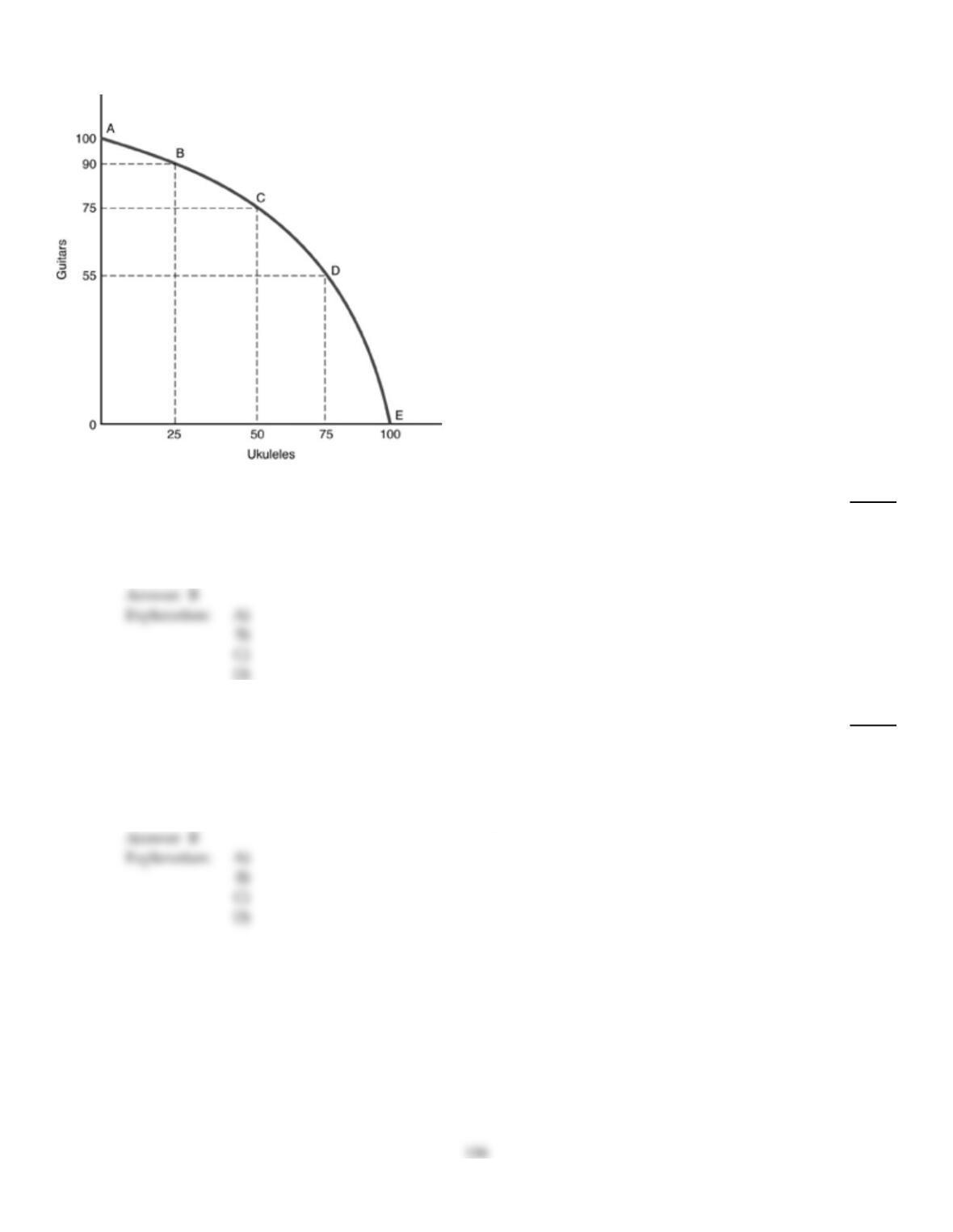
In the above figure, the production of 25 guitars and 25 ukuleles is
353)
A)
impossible production.
B)
inefficient production.
C)
not possible since production always occurs along the PPC.
D)
efficient production.
354)
Extremely cold winter weather has destroyed oranges in Florida. The freeze has caused
354)
A)
scarcity because there are less oranges now than people want.
B)
a shortage because people cannot obtain as many oranges as they wish to buy at the
pre–freeze price.
C)
a shortage because the orange growers will have less income.
D)
scarcity because people have to switch to other types of citrus fruits.
355)
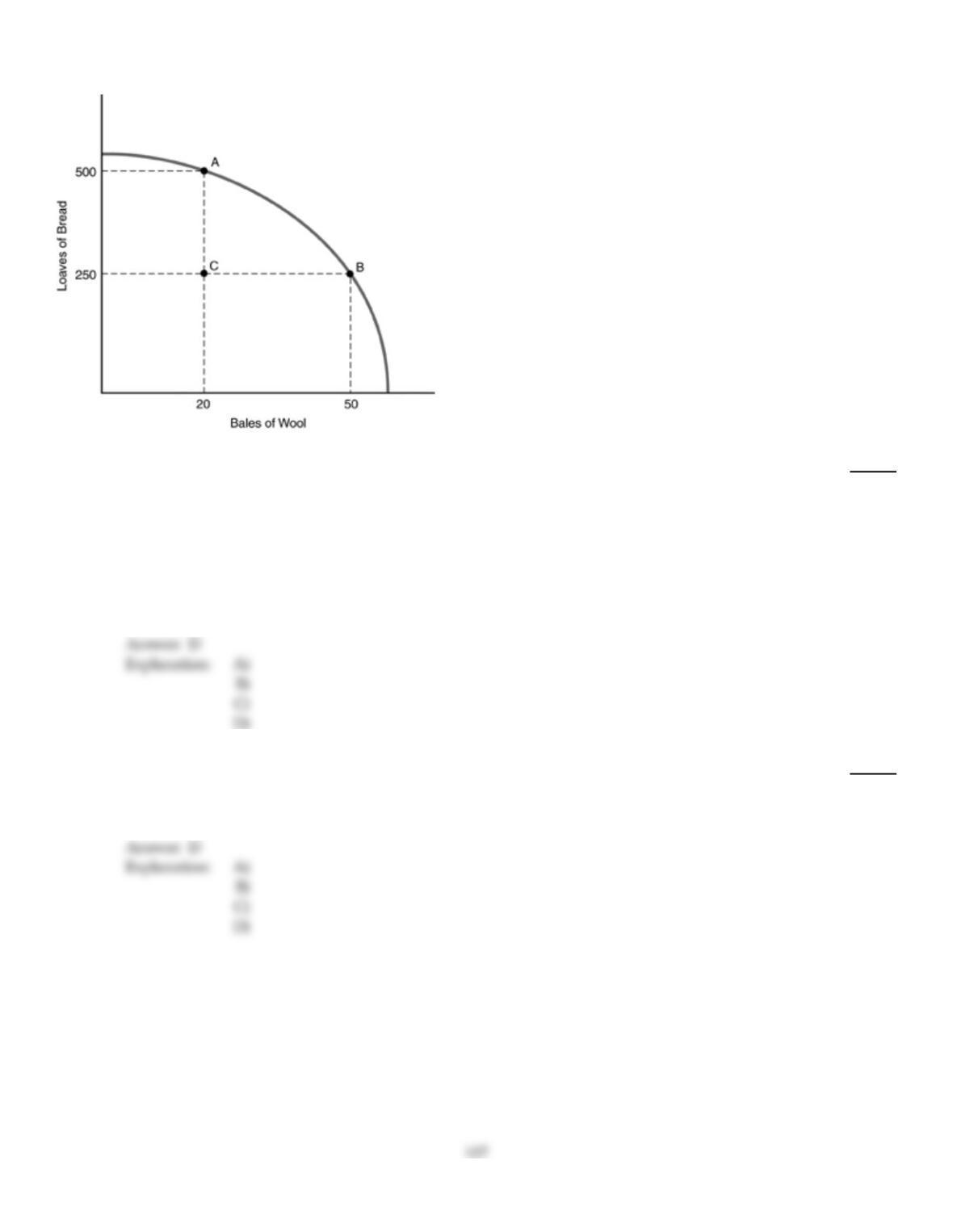
Refer to the above figure. Which one of the following statements is TRUE with regard to the
economy depicted in the graph?
355)
A)
Starting from point A, this economy does not incur any opportunity cost in producing more
wool.
B)
In moving from point A to point B, the economy is experiencing economic growth.
C)
Starting from point A, this economy does not incur any opportunity cost in producing more
bread.
D)
In moving from point A to point B, the economy produces 30 additional bales of wool at an
opportunity cost of 250 loaves of bread.
356)
There are not enough of four goods to satisfy the wants of people. For good A, this is true when the
price is $100. This is true for good B at a price of $10, for good C at a price of $1, and for good D at a
price of zero. Which situation reflects scarcity rather than shortage?
356)
A)
A
B)
B
C)
C
D)
D
357)
If a CEO can type faster than her secretary, then
357)
A)
the CEO has a comparative advantage in typing.
B)
the CEO should still continue performing CEO duties since the CEO has a comparative
advantage in management, and the secretary should continue typing.
C)
the CEO should still continue performing CEO duties as well as typing since he has a
comparative advantage in both management, and typing.
D)
the CEO has neither a comparative advantage in typing, nor in management.
358)
When Adam Smith’s ten pin workers specialized, they were able to increase output of pins in a day
from 200 to 48,000. One reason for the increase in pin output was due to
358)
A)
the time saved when workers do not need to shift from one task to another.
B)
new machinery.
C)
the bonus they received when they produced more pins.
D)
the boredom the workers suffered when they stopped making a whole pin and only
concentrated on one task such as painting the heads white.
359)
The production possibilities curve shows all possible combinations of
359)
A)
two goods that can be efficiently produced with a given set of resources.
B)
two goods that two countries can trade with each other.
C)
two goods that can be purchased given the prices of the goods.
D)
two goods that are desired by society.
360)
John and Mary work eight hours at a bakery. John can decorate either 10 ice–cream cakes or 4
wedding cakes; Mary can decorate either 8 ice–cream cakes or 2 wedding cakes. According to this
scenario
360)
A)
John has the comparative advantage in decorating ice–cream cakes.
B)
Mary has the absolute advantage in decorating wedding cakes.
C)
Mary has the comparative advantage in decorating wedding cakes.
D)
John has the absolute advantage in decorating wedding cakes.
361)
Activities designed to convert resources into goods and services is known as
361)
A)
scarcity.
B)
consumption.
C)
production.
D)
supply.
362)
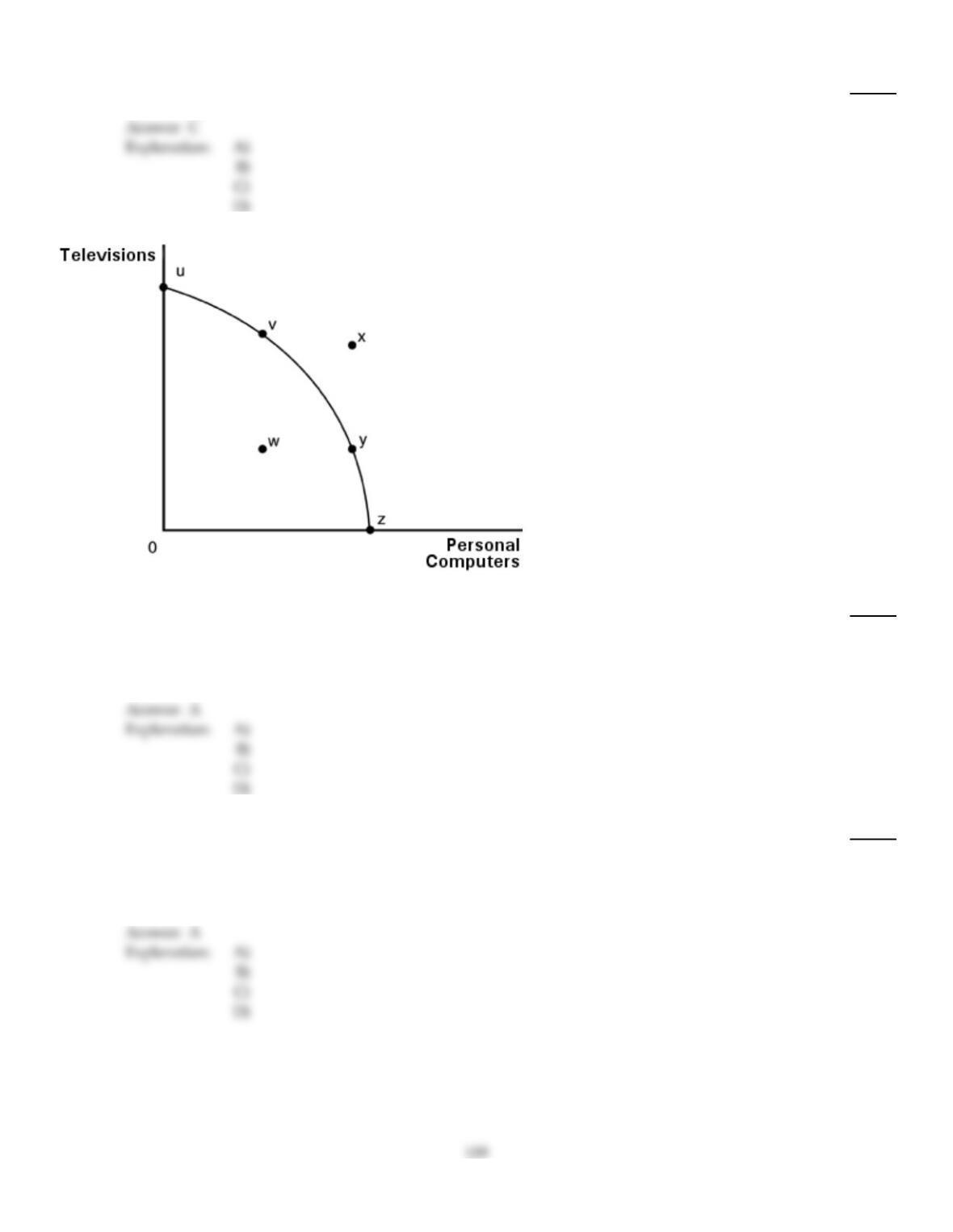
In the above figure, points u, v, y, and z show
362)
A)
possible combinations of televisions and personal computers.
B)
that society prefers more televisions than computers.
C)
a constant trade–off between televisions and personal computers.
D)
an inefficient allocation of society’s scarce resources.
Explanation:
363)
Economists are concerned with an individual’s
363)
A)
wants because the existence of wants leads to scarcity.
B)
needs because economists define needs to be the goods people need to survive.
C)
needs because needs represent the most important goods to an individual.
D)
wants because, unlike needs, wants lead to shortages in the economy.
Explanation:
Explanation:
364)
Scarcity implies that people must
364)
A)
be miserable.
B)
not be selfish.
C)
be selfish.
D)
make choices.
365)
The production possibilities curve bows outward because
365)
A)
opportunity costs are decreasing as the production of a good increases.
B)
resources are of uniform quality.
C)
opportunity costs are increasing as the production of a good increases.
D)
opportunity costs are fixed as the production of a good increases.
366)
The making and selling of a pencil for ten cents would likely NOT be possible, but for
366)
A)
relative advantage.
B)
the division of labor.
C)
absolute advantage.
D)
the production possibilities curve.
367)
Human capital is
367)
A)
the accumulation of skills, training and education of workers.
B)
the human resources that perform the function of raising capital.
C)
what people get from physical capital.
D)
the value obtained from selling stocks and bonds.
368)
In order for an economy to increase its production possibilities, the economy must
368)
A)
reduce output.
B)
increase its wants.
C)
increase inputs.
D)
be very efficient.
369)
Scarcity is caused by
369)
A)
shortages.
B)
an individual’s budget that is insufficient to cover the expenses of certain goods or services.
C)
unlimited wants running up against limited economic resources.
D)
lazy workers.
370)
When an economy is operating efficiently, which is TRUE?
370)
A)
It would be possible to increase the output of 1 good without decreasing the output of the
other.
B)
This economy is operating to the right of its production possibilities curve (PPC).
C)
All resources are fully employed.
D)
Resources are not fully employed or current technology is not being fully utilized.
C
371)
Explain the concept of the law of increasing additional cost.
372)
Both an NBA basketball player and a fast–food cook are going to graduate school. Who has a higher
opportunity cost? Explain.
373)
Explain: “The law of increasing additional cost is an inevitable phenomenon in economics.”
374)
What is the “division of labor“? How is the division of labor related to production?
C
375)
It is not uncommon for people to say something like, “If we can put someone on the moon we should be able to .
. . ,” followed by the person’s favorite project. What response can an economist make to this person?
376)
For a country that produces two goods: Environmental clean–up goods and space program goods. What
economic information is contained in its production possibility curve?
377)
Briefly explain the difference between the concepts of scarcity and shortage.
378)
Distinguish between scarcity and shortages.
379)
Why do most people specialize in their work?
380)
What happens to overall living standards when countries trade with other countries?
381)
“Economics is the study of how people eliminate scarcity.” Do you agree or disagree? Why?
382)
How can the concepts of opportunity costs, scarcity and choice be illustrated by the production possibilities
curve?
383)
Are all goods economic goods? Are all economic goods also goods? Explain.
384)
Distinguish the concepts of comparative advantage and absolute advantage.
385)
Would a country with an absolute advantage in the production of all goods and services trade with other
countries? Explain.
386)
Suppose you order a slice of pepperoni pizza and a soda at a shopping mall food court. What are examples of
the opportunity costs of this decision?
387)
Why does the trade–off between consumption goods and capital goods represent a trade–off between the
present and the future?
388)
Briefly explain why people make choices.
389)
“Economics deals with human needs.” Do you agree or disagree? Why?
390)
Politicians often argue that a country’s standard of living is reduced when it allows imports into the country.
Offer an economically sound counter–argument.
391)
What does the slope of the production possibilities curve represent? Explain.
392)
Explain why even the most affluent people, businesses and counties never solve the problem of scarcity.
393)
How are scarcity, choice, and opportunity cost related?
394)
What does scarcity have to do with the fact that people must make choices?
395)
What is production? What economic factors are involved in production?
396)
Briefly explain how specialization and trade can benefit nations.