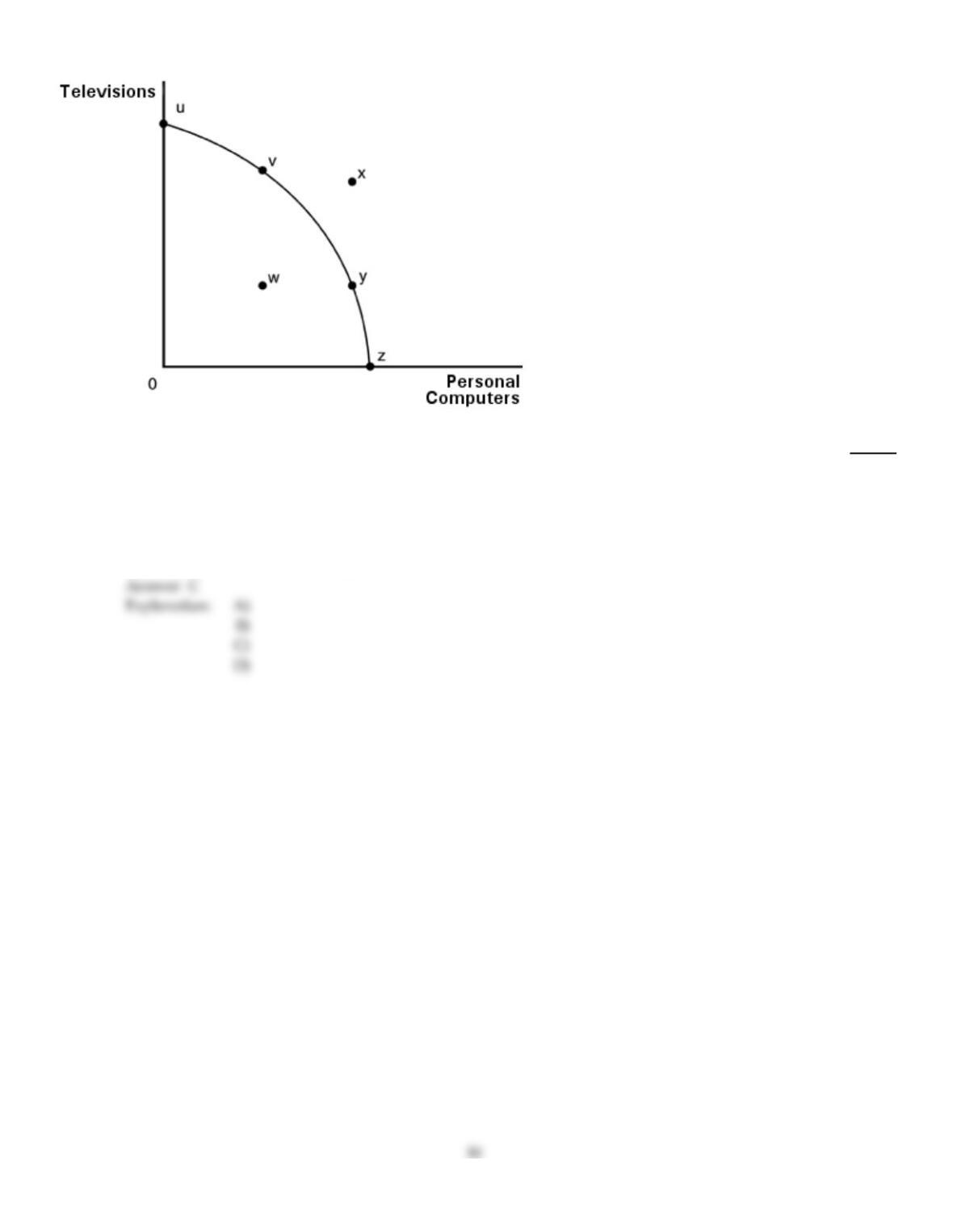
276)
Which of the following statements about a movement along the production possibilities curve in
the above figure is FALSE?
276)
A)
An additional computer can be produced only if fewer televisions are produced.
B)
Society cannot have more of both goods at the same time.
C)
There are no opportunity costs involved in choosing one point on the curve over all other
points.
D)
The trade–off between computers and televisions is not constant.
277)
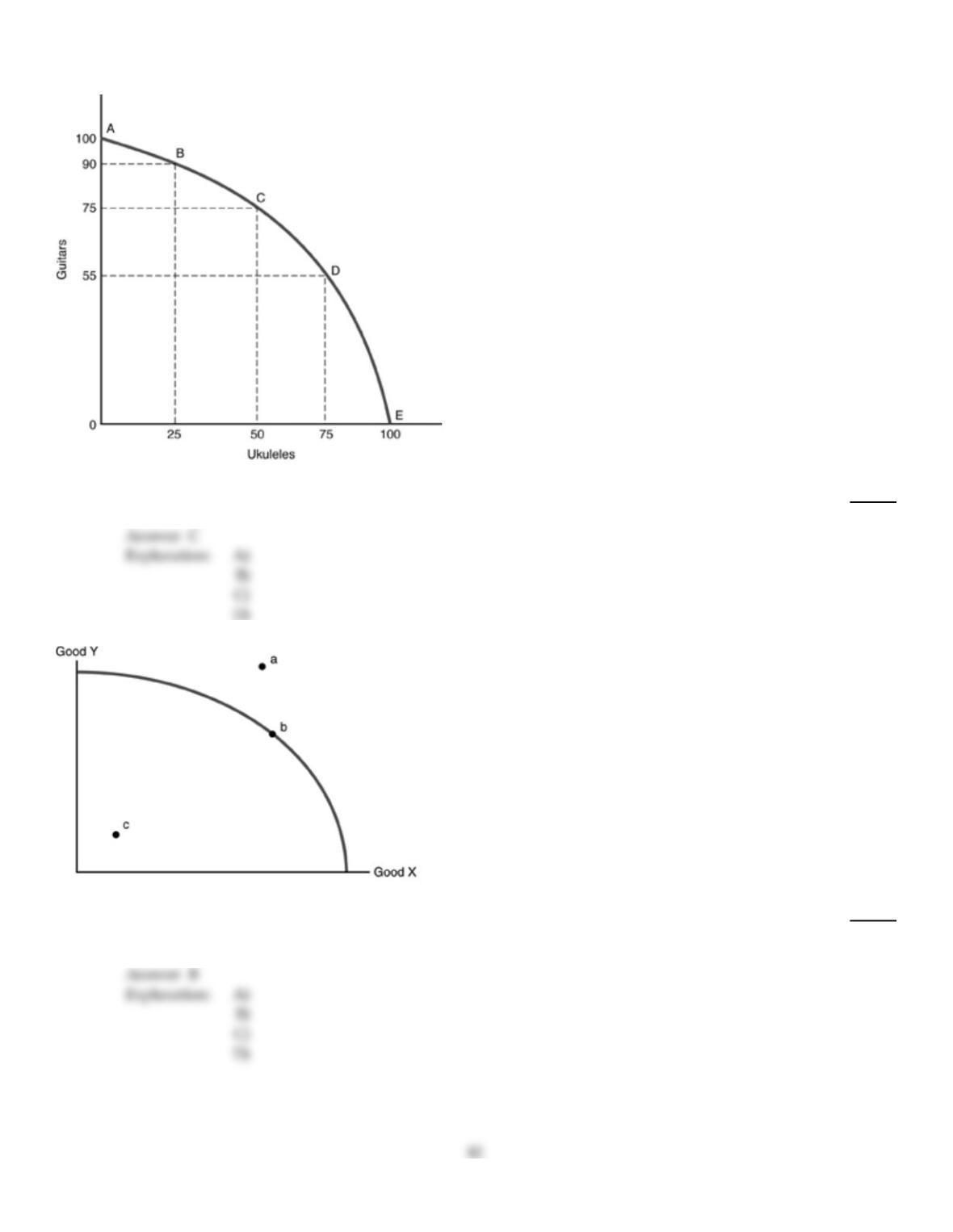
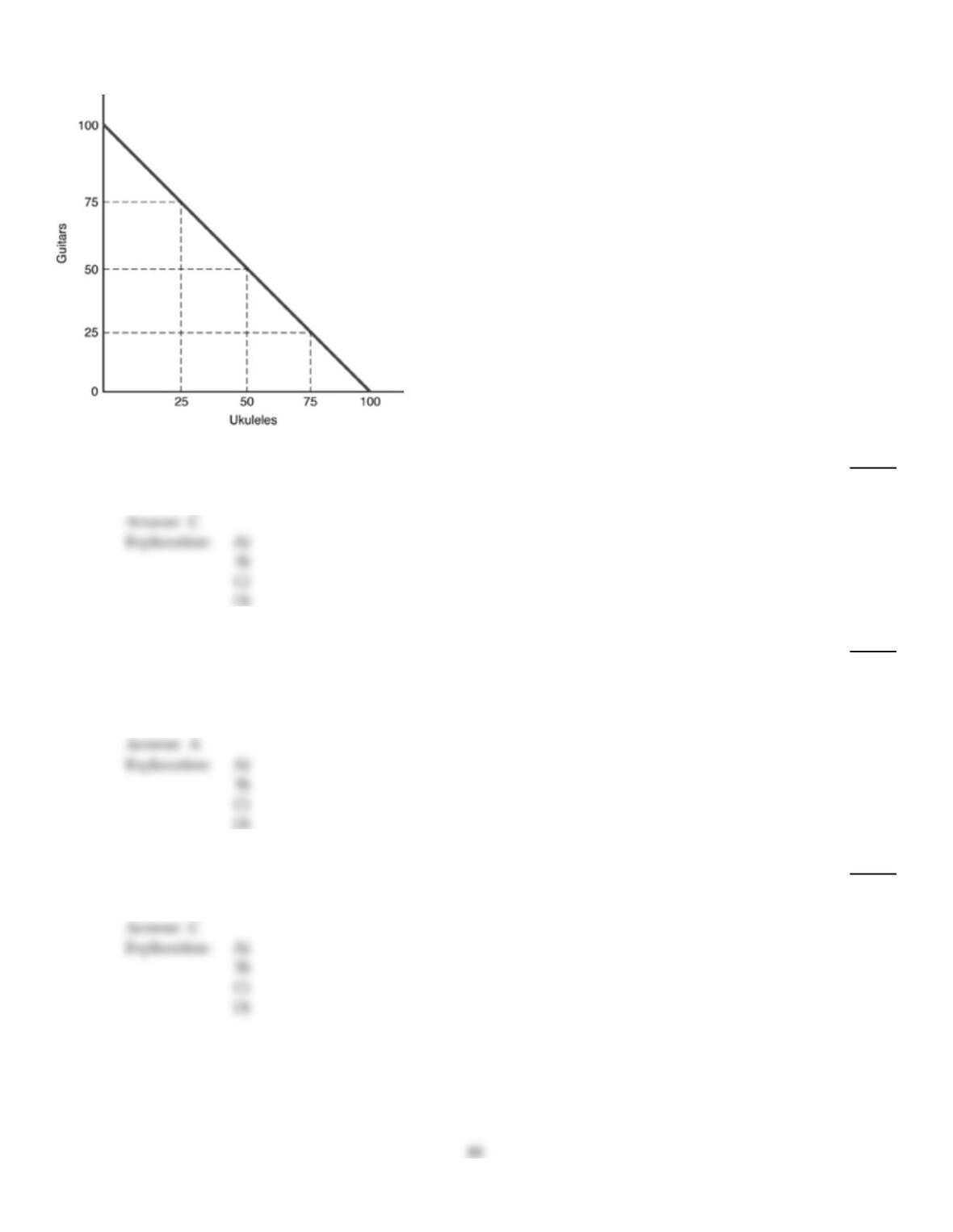
In the above figure, the opportunity cost of moving from point A to point C is
277)
A)
50 ukuleles.
B)
0 guitars.
C)
25 guitars.
D)
50 guitars.
278)
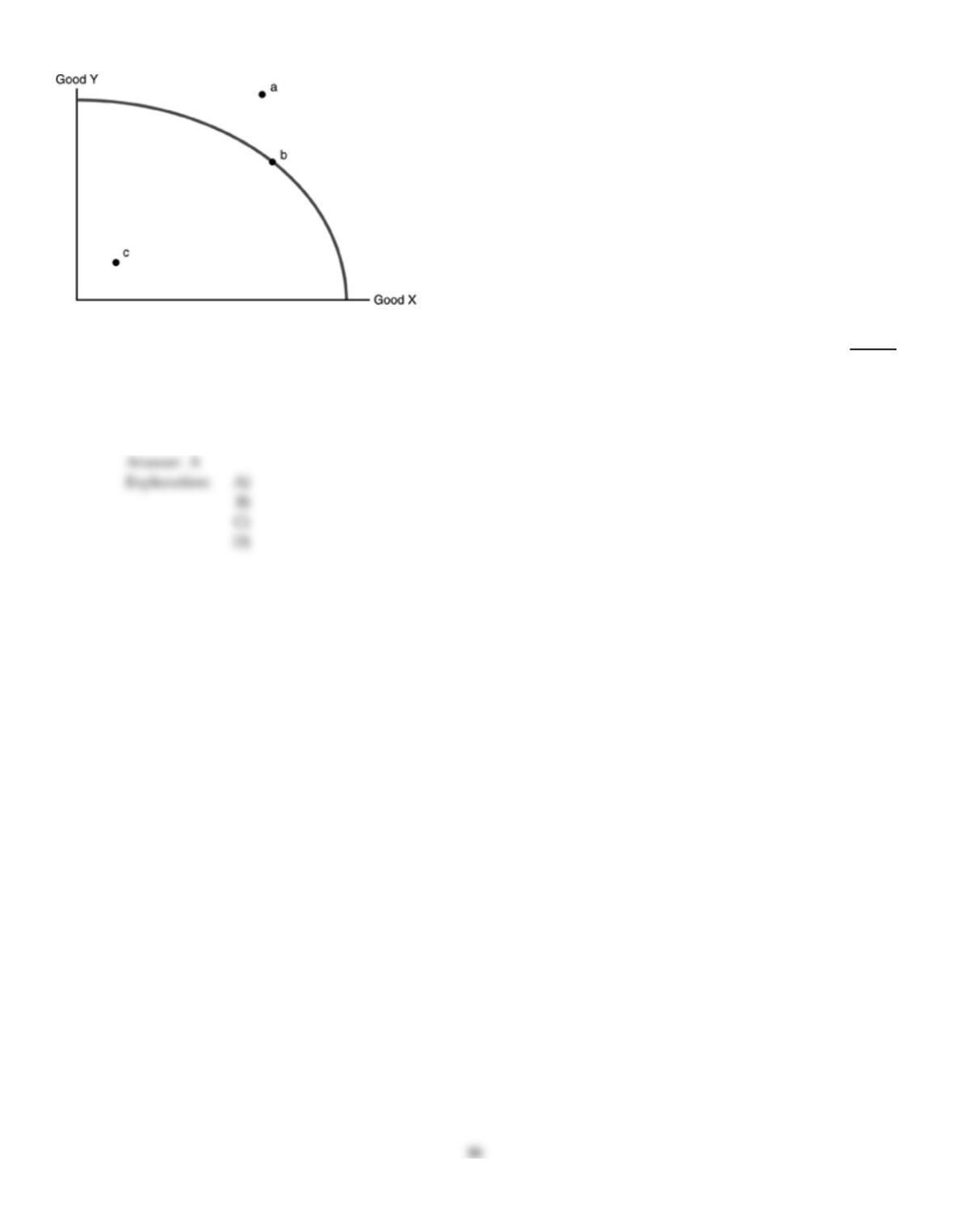
Refer to the above figure. Given our current level of technology and resources, the unobtainable
point(s) of production would be
278)
A)
points a and c.
B)
point a.
C)
point b.
D)
point c.

279)
At a zero price, which of the following conditions is TRUE for an economic good?
279)
A)
Its quantity demanded equals its quantity supplied.
B)
Its quantity demanded exceeds its quantity supplied.
C)
Its quantity supplied exceeds its quantity demanded.
D)
Scarcity disappears.
280)
Economic growth can be pictured in a production possibilities curve diagram by
280)
A)
making the production possibilities curve straighter.
B)
moving from a point inside the production possibilities curve to a point on the curve.
C)
shifting the production possibilities curve out.
D)
shifting the production possibilities curve in.
281)
A technological improvement can cause the production possibilities curve to shift outward because
281)
A)
production will fall, but jobs will be saved.
B)
it causes increases in unemployment.
C)
it increases costs and contributes to lower production rates.
D)
maximum feasible outputs of both goods increase.
282)
One opportunity cost associated with going to college is
282)
A)
purchasing text books.
B)
giving up employment possibilities while in college.
C)
paying tuition.
D)
paying for room, board, and other living expenses.

283)
In 2006, hurricanes damaged many parts of Texas, destroying homes, businesses, schools, and
infrastructure. In strictly economic terminology, these hurricanes are said to have caused
283)
A)
tradeoffs, because some areas of the country were damaged when others were not.
B)
scarcity, because some goods were difficult to get.
C)
shortages, because supplies were cut off and goods were destroyed.
D)
scarcity, because the damages made food and shelter scarce.
284)
Technology is
284)
A)
computers and lasers.
B)
society’s pool of knowledge of how to produce goods and services.
C)
not obtainable by engaging in activities that increase human capital.
D)
a resource like land or physical capital.
285)
The problem of economic scarcity applies
285)
A)
only to an economy with an insufficient supply of money.
B)
to the economies of all nations, regardless of their level of development.
C)
only in developed countries, because resources are scarce in these nations.
D)
only in underdeveloped countries, because there are no productive resources in these nations.
286)
The concept of opportunity cost exists because
286)
A)
the value of services is hard to determine.
B)
of shortages.
C)
goods have different prices.
D)
of scarcity.

287)
Opportunity cost exists because
287)
A)
prices must adjust to eliminate shortages.
B)
the value of economic goods is positive while the value of goods is zero.
C)
production could not occur without the opportunity cost of using resources.
D)
of scarcity.
288)
Comparative advantage is the ability to
288)
A)
convince others of the best choices to make in their own self–interest.
B)
determine who your best trading partners are.
C)
determine the best use of capital goods.
D)
perform an activity at a lower opportunity cost.
289)
The term “labor” for an economist includes
289)
A)
all skilled workers, but not the unskilled workers.
B)
all employees who have high school diplomas.
C)
only the value of the work done by scientists.
D)
all productive contributions of humankind.
290)
Refer to the above figure. Assume that only two goods can be produced in the economy. Which of
the following statements is TRUE?
290)
A)
Points b and c are obtainable points of production.
B)
Points a and b are obtainable points of production.
C)
Points a, b, and c are all obtainable points of production.
D)
Only point b is an obtainable and efficient point of production.
291)
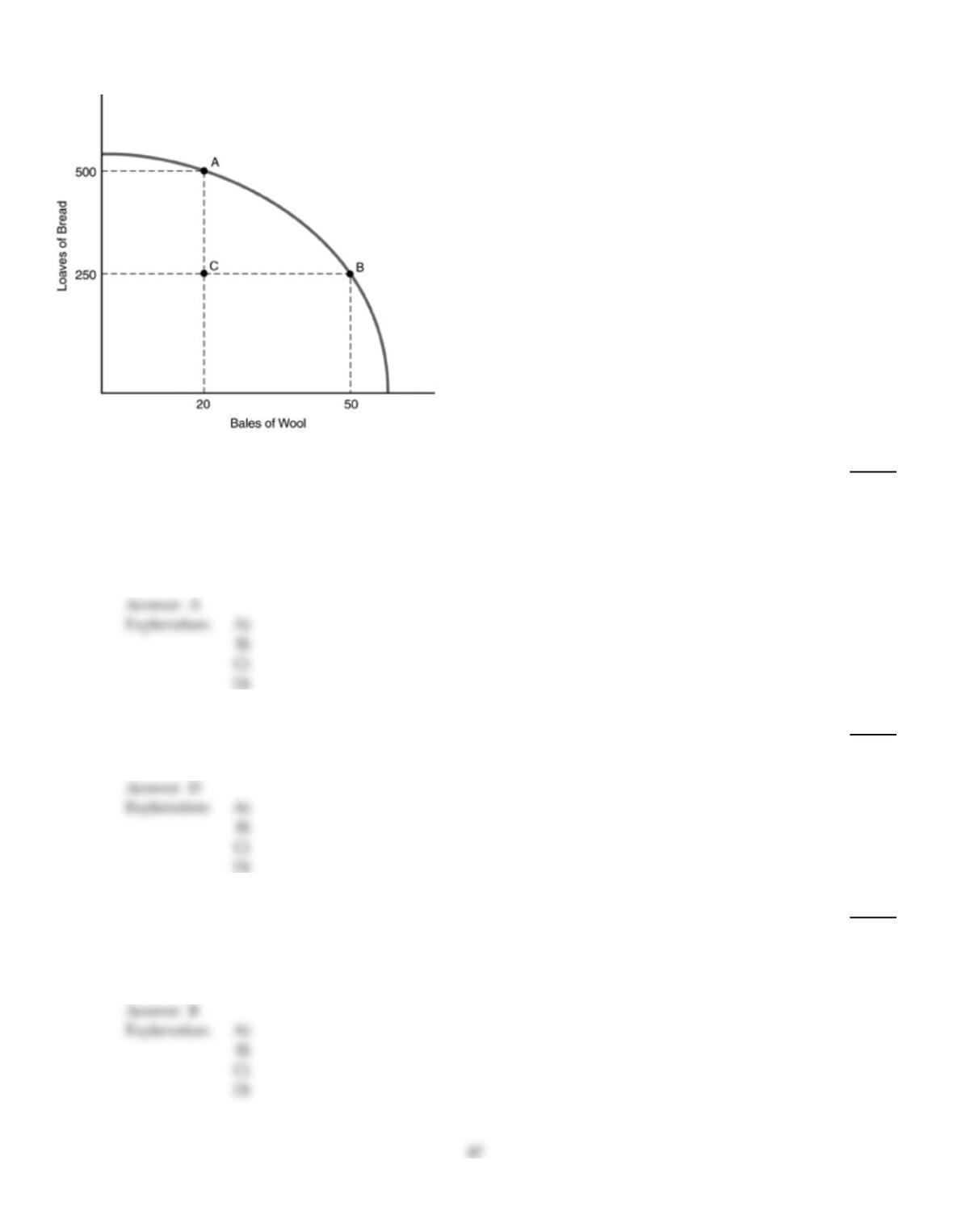
Refer to the above figure. How do you describe what is happening as the economy moves from
point C to point B?
291)
A)
Previously unemployed resources are now being devoted to the production of wool.
B)
The economy has acquired new resources for making bread.
C)
Previously unemployed resources are now being devoted to the production of bread.
D)
The economy has increased its wool production by 30 bales at an opportunity cost of 250
loaves of bread.
292)
A factory can be thought of as
292)
A)
a land and labor combination.
B)
a type of entrepreneurship.
C)
a trade–off with land.
D)
physical capital.
Explanation:
293)
A straight–line production possibilities curve has
293)
A)
an increasing opportunity cost between the two goods.
B)
a constant opportunity cost between the two goods.
C)
no opportunity cost between the two goods.
D)
a decreasing opportunity cost between the two goods.
Explanation:
Explanation:

294)
All of society’s applied knowledge on how to produce goods and services is
294)
A)
opportunity cost.
B)
efficiency.
C)
held by university professors.
D)
called technology.
295)
Which of the following is NOT an economic resource?
295)
A)
money
B)
low–skilled labor
C)
an engineer
D)
coal
A
296)
The curve that represents all possible combinations of goods that can be produced is called
296)
A)
the efficiency curve.
B)
the supply curve.
C)
the production possibilities curve.
D)
the resource allocation curve.
C
297)
When nations specialize in their areas of comparative advantage and then trade with the rest of the
world, the result is that
297)
A)
the world will move from a point on the production possibilities curve to a point inside the
curve.
B)
the average standard of living in the world will go down.
C)
the average standard of living in the world will go up.
D)
worldwide economic efficiency will decrease.
C
D
298)
In the above figure, moving from producing 50 guitars and 50 ukuleles to producing 25 guitars and
75 ukuleles, the opportunity cost of one ukulele is
298)
A)
25 guitars.
B)
25 ukuleles.
C)
1 guitar.
D)
75 ukuleles.
299)
Economic growth appears on a production possibilities curve as
299)
A)
the curve shifting out away from the origin.
B)
the points outside the production possibilities curve.
C)
the curve shifting in toward the origin.
D)
a change in the slope of the curve.
300)
A person goes to college to become an engineer. This is an example of an
300)
A)
investment in physical capital.
B)
increase in entrepreneurship.
C)
investment in human capital.
D)
increase in labor.

301)
All of the following are examples of physical capital EXCEPT
301)
A)
machinery.
B)
buildings.
C)
company stocks and bonds.
D)
a hydroelectric power plant.
302)
When an economy sacrifices production of consumption goods to produce more capital goods, we
would expect that the production possibilities curve will
302)
A)
become a straight line.
B)
shift outward.
C)
shift inward.
D)
shift about in random fashion.
303)
Suppose the current unemployment rate is 15 percent. If it rises to 20 percent
303)
A)
the economy will move up along the production possibilities curve.
B)
the economy will move closer to the production possibilities curve.
C)
the economy will operate farther inside the production possibilities curve.
D)
the production possibilities curve will shift inward.
304)
Production is efficient when
304)
A)
the maximum output possible is being produced given current levels of resources and
technology.
B)
it generates a point beyond the production possibility curve.
C)
technological change occurs.
D)
the maximum amounts of the most important good are produced.

305)
Scarcity
305)
A)
afflicts greedy people only.
B)
used to be a problem, but is not an issue for modern industrial nations.
C)
exists in all human societies.
D)
is a problem for less–developed nations only.
306)
All of the following are economic resources, or factors of production EXCEPT
306)
A)
physical capital.
B)
land.
C)
money.
D)
entrepreneurship.
C
307)
If the production possibilities curve is a downward sloping straight line, then
307)
A)
production is efficient only when producing at the mid–point.
B)
resources are highly specialized, making it difficult to use them for alternative uses.
C)
all resources must be perfectly adaptable for alternative uses.
D)
technological change has increased.
C
308)
When two countries specialize in the production of different goods and trade with each other, it is
most likely each country will
308)
A)
export the goods in which it has an absolute advantage.
B)
import the goods in which it has a comparative advantage.
C)
export the goods in which it has a comparative advantage.
D)
import the goods in which it has an absolute advantage.
C
C

309)
Suppose that Canadian farmers can grow wheat more cheaply than can U.S. farmers. In the interest
of efficiency, what is the desirable outcome?
309)
A)
Pass a law in Canada mandating a minimum price for wheat equal to what is charged by U.S.
farmers.
B)
Pass a law in the United States mandating a maximum price for wheat equal to what is
charged by Canadian farmers.
C)
Have U.S. citizens boycott Canadian wheat.
D)
Allow the Canadian farmers to sell their wheat for a lower price.
310)
Whenever a society forgoes current consumption to invest in capital goods,
310)
A)
that society can consume more in the future.
B)
it will have less to consume next year.
C)
it will be forced to produce fewer capital goods in the future.
D)
it will be easier for that society to consume less in the future because people will become
accustomed to less.
Explanation:
311)
Assume that Economy A and Economy B have the same resources, but that individuals in Economy
A have specialized whereas individuals in Economy B have not. Given this information, you can
determine that
311)
A)
individuals in Economy A will have lower incomes than individuals in Economy B.
B)
Economy A will have a higher output than Economy B.
C)
Economy A will have a lower output than Economy B.
D)
Economy A and Economy B will have identical outputs.
Explanation:
312)
Which of the following is NOT a factor of production?
312)
A)
a product
B)
entrepreneurship
C)
labor
D)
land
Explanation:
Explanation:

313)
Bill Bonecrusher graduates from college with a choice of playing professional football at $2 million
a year or coaching for $50,000 a year. He decides to play football, but eight years later he quits
football to make movies for $3 million a year. His opportunity cost at graduation was ________ and
eight years later was ________.
313)
A)
$2 million; $2 million
B)
$2 million; $3 million
C)
$50,000; $2 million
D)
$50,000; $50,000
314)
Generally, specialization leads to
314)
A)
the production of fewer capital goods.
B)
greater productivity.
C)
greater self–reliance.
D)
constant opportunity costs.
315)
For every choice a person makes it can be assumed that
315)
A)
some opportunity cost was involved.
B)
a good is involved and satisfaction is gained.
C)
there is a fifty–fifty chance the choice was the wrong one.
D)
the chooser has full knowledge of the situation.
316)
Which of the following statements about scarcity is TRUE?
316)
A)
Scarcity is no longer a problem for industrialized countries.
B)
Scarcity exists in all societies.
C)
Scarcity is a problem only in countries that do not use markets to organize economic activity.
D)
Scarcity is a problem only for greedy people.
317)
You have the option of consuming one cup of coffee or two donuts or three oranges. You picked the
cup of coffee. Therefore the opportunity cost of this cup of coffee is
317)
A)
the price of the cup of coffee.
B)
the price of the donuts as they are usually consumed with coffee.
C)
the difference in the prices of these three products.
D)
either the donuts or the oranges, whichever you like more.
318)
In every economic system, choices must be made because resources
318)
A)
are unlimited, and so are human desires and wants.
B)
are unlimited, but human desires and wants are limited.
C)
are limited, and so are human desires and wants.
D)
are limited, but human desires and wants are unlimited.
319)
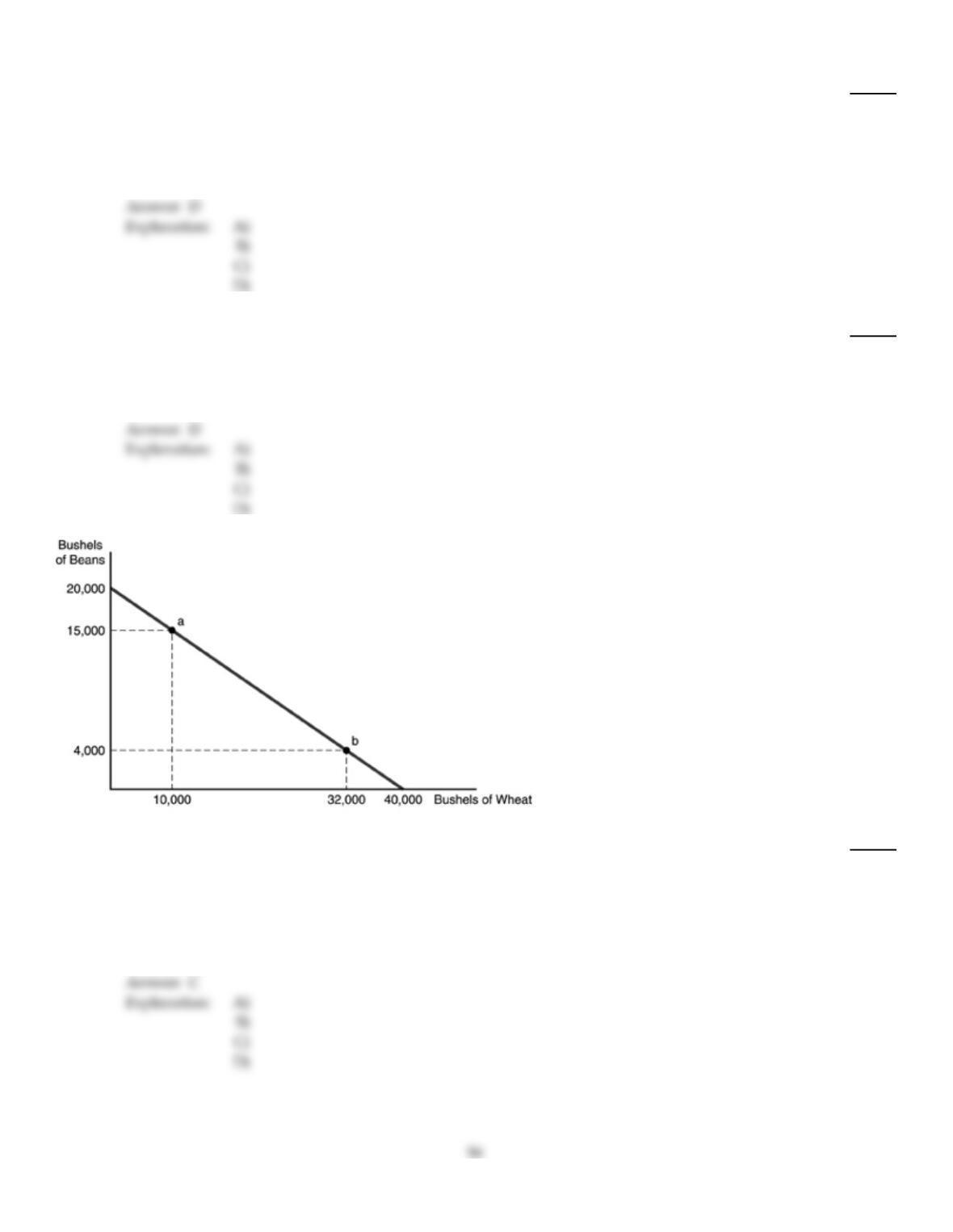
Refer to the above figure. A farmer has 50 acres of land on which to grow wheat or beans. An acre
of land yields 400 bushels of beans or 800 bushels of wheat. Which of the following is a possible
combination of beans and wheat that can be grown, assuming the land is farmed efficiently?
319)
A)
30,000 bushels of each
B)
20,000 bushels of beans and 40,000 bushels of wheat
C)
16,000 bushels of beans and 8,000 bushels of wheat
D)
5,000 bushels of beans and 5,000 bushels of wheat

320)
According to the concept of comparative advantage, a good should be produced in that nation in
which
320)
A)
terms of trade are maximized.
B)
domestic opportunity cost is the smallest.
C)
domestic opportunity cost is greatest.
D)
money is used.
321)
Entrepreneurs are important to market economies because
321)
A)
they represent the bulk of employment at large corporations.
B)
they take few risks and thereby, suffer fewer bankruptcies.
C)
they make up a large portion of low–skilled labor.
D)
they engage in risk taking and innovation.
322)
Specialization and the division of labor typically result in
322)
A)
increased output.
B)
decreased output.
C)
cost overruns.
D)
a greater reliance upon imports.
323)
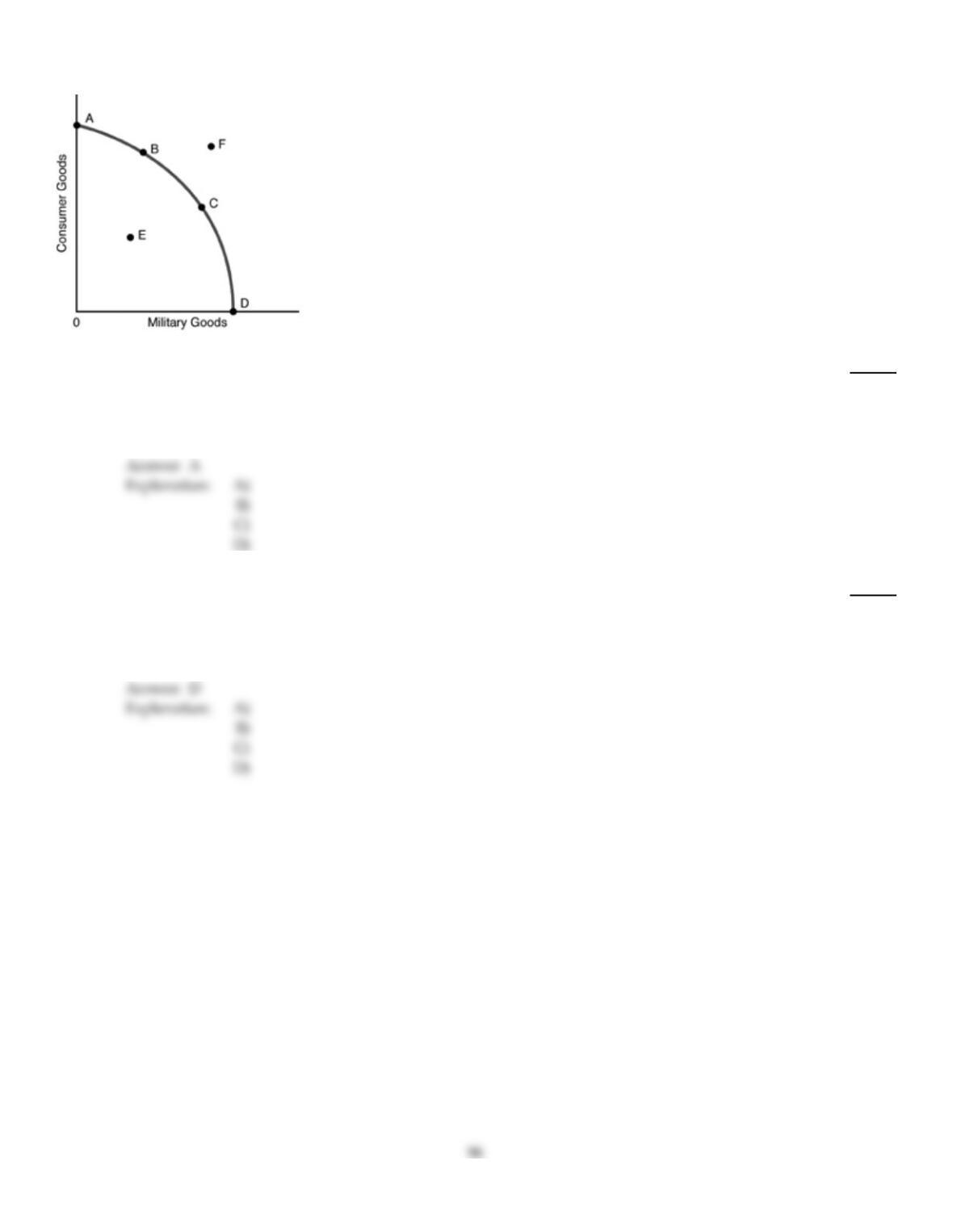
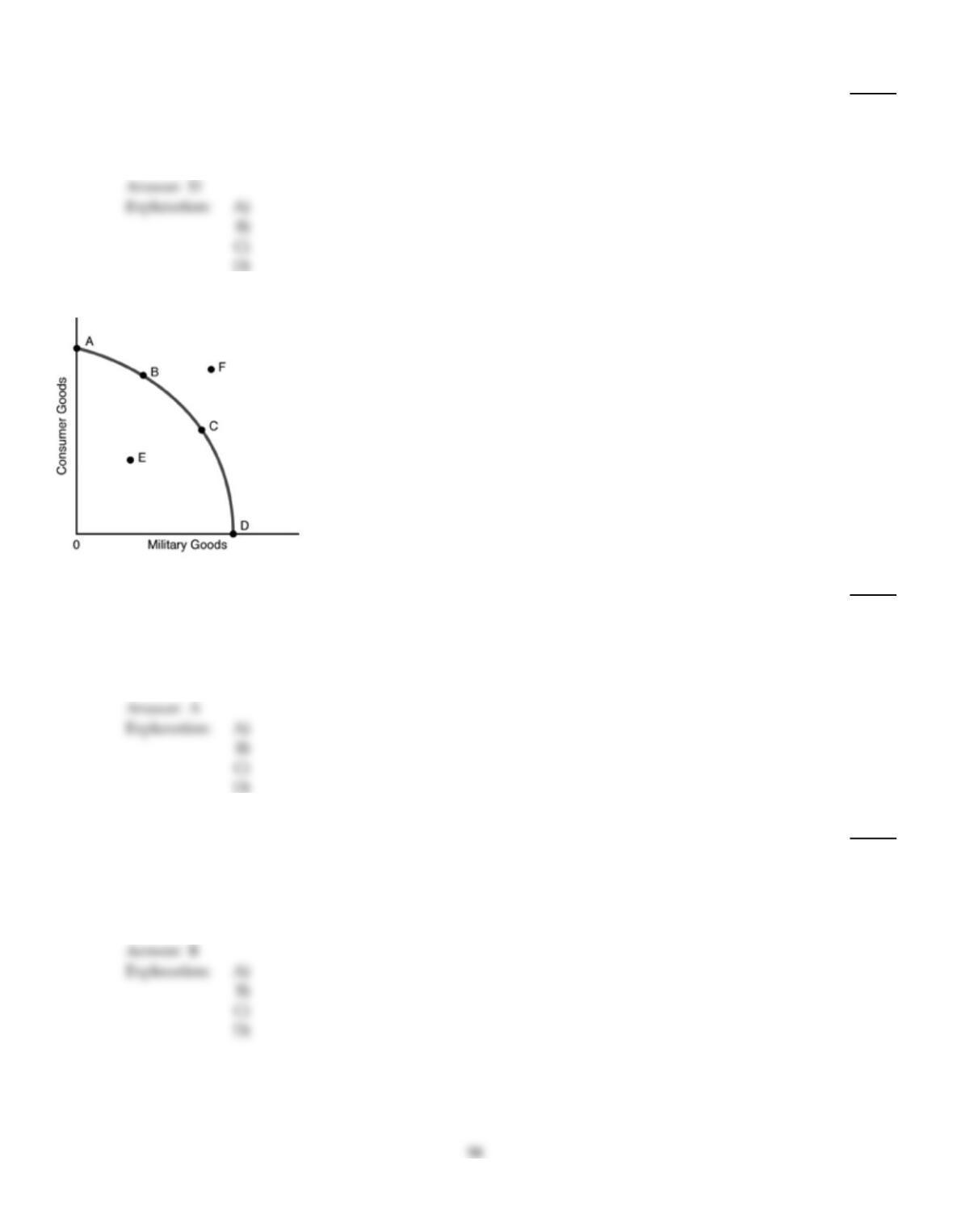
Refer to the above figure. Production at Point E
323)
A)
would indicate production at a level below that which is attainable.
B)
is not attainable with given resources and technology.
C)
would indicate that this economy is producing beyond its capabilities.
D)
would demonstrate a total lack of technical expertise.
324)
Human beings
324)
A)
know what their needs are, but do not know what their wants are.
B)
think they have unlimited wants, but really have limited needs.
C)
have limited wants, but unlimited needs.
D)
have unlimited wants.
325)
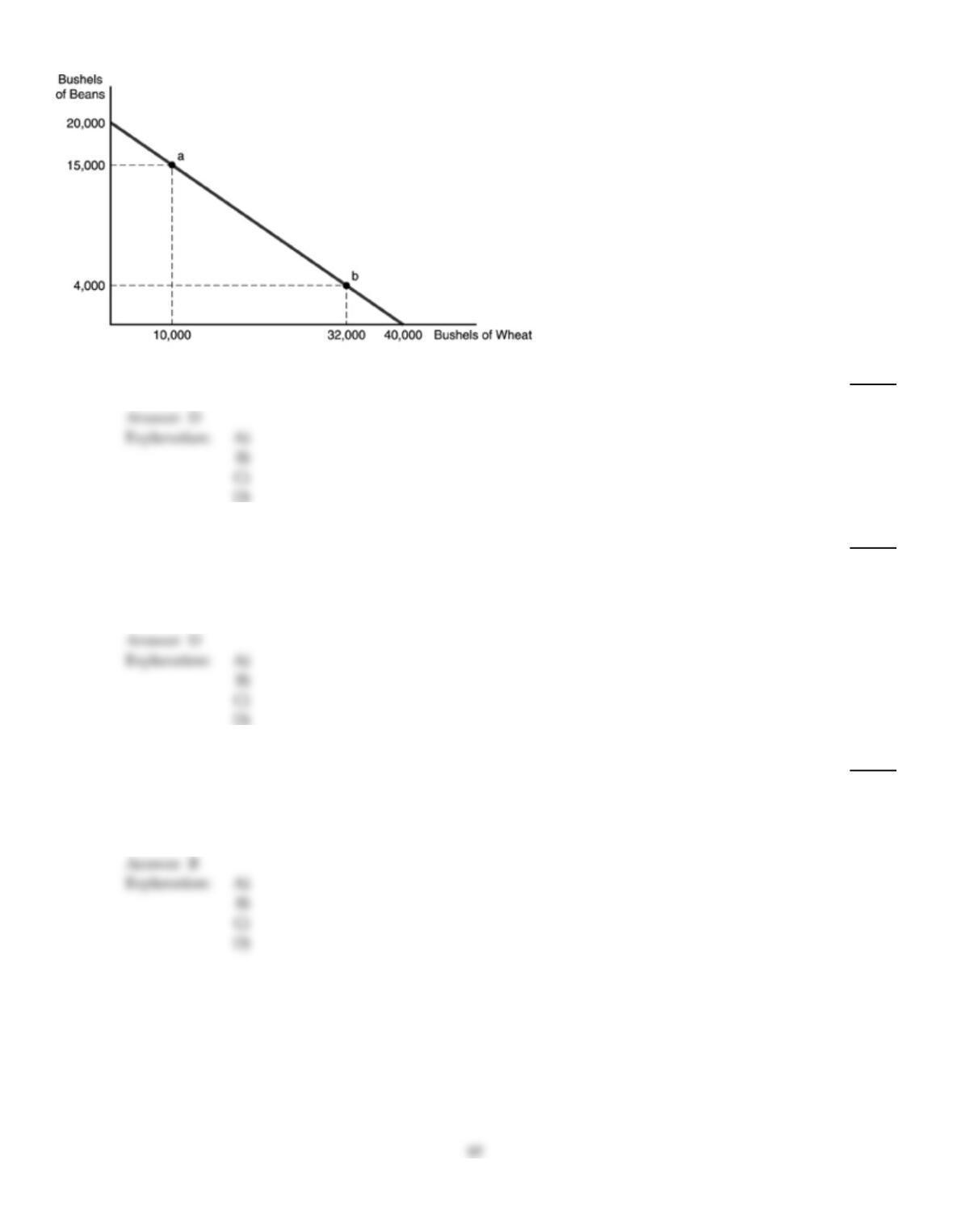
In the above figure, the farmer faces a trade–off between beans and wheat equal to
325)
A)
one–to–one.
B)
three–to–one.
C)
one–to–four.
D)
one–to–two.
326)
Which of the following is an assumption used in deriving a production possibilities curve?
326)
A)
Prices will continue to increase.
B)
Poverty always exists in society.
C)
The wages in an industry increase constantly.
D)
The amount of resources is fixed.
327)
A country that must reduce current consumption to increase future consumption possibilities
327)
A)
must be producing outside the production possibilities curve.
B)
must be producing along the production possibilities curve.
C)
must be allocating resources inefficiently.
D)
must not have private ownership of property.
328)
If an economy is operating at a point inside the production possibilities curve, then
328)
A)
society’s resources are being used to produce too many consumer goods.
B)
economic policy must implemented to slow growth of the economy further.
C)
the curve will move to the left.
D)
society’s resources are being inefficiently utilized.
329)
Refer to the above figure. Production at Point F
329)
A)
is not attainable given the underlying assumptions of the production possibilities curve
(PPC).
B)
can only be attained by giving up Point E.
C)
would not be desirable.
D)
can be attained only if a society desired more goods and services.
330)
The law of increasing additional cost is due to
330)
A)
inefficient use of technology.
B)
the fact that resources are not perfectly adaptable for alternative uses.
C)
scarcity.
D)
the fact that there are always alternatives and it is costly to figure out which alternative is
best.

331)
All points inside the production possibilities curve indicate
331)
A)
the law of decreasing relative cost.
B)
the law of increasing relative cost.
C)
a lack of sufficient supply.
D)
inefficiency in production.
332)
The concept of absolute advantage relies on
332)
A)
the ability to produce more units of an item with a given amount of resources.
B)
the concept of economic efficiency as measured on the production possibility curve.
C)
the idea of opportunity cost.
D)
the idea of comparative advantage.
333)
Which is the best example of specialization?
333)
A)
a person whose job includes accounting, personnel, and maintenance tasks
B)
a high school math teacher who teaches algebra and calculus
C)
a firm that produces both luggage and cooking oil
D)
a high school math teacher who teaches only calculus
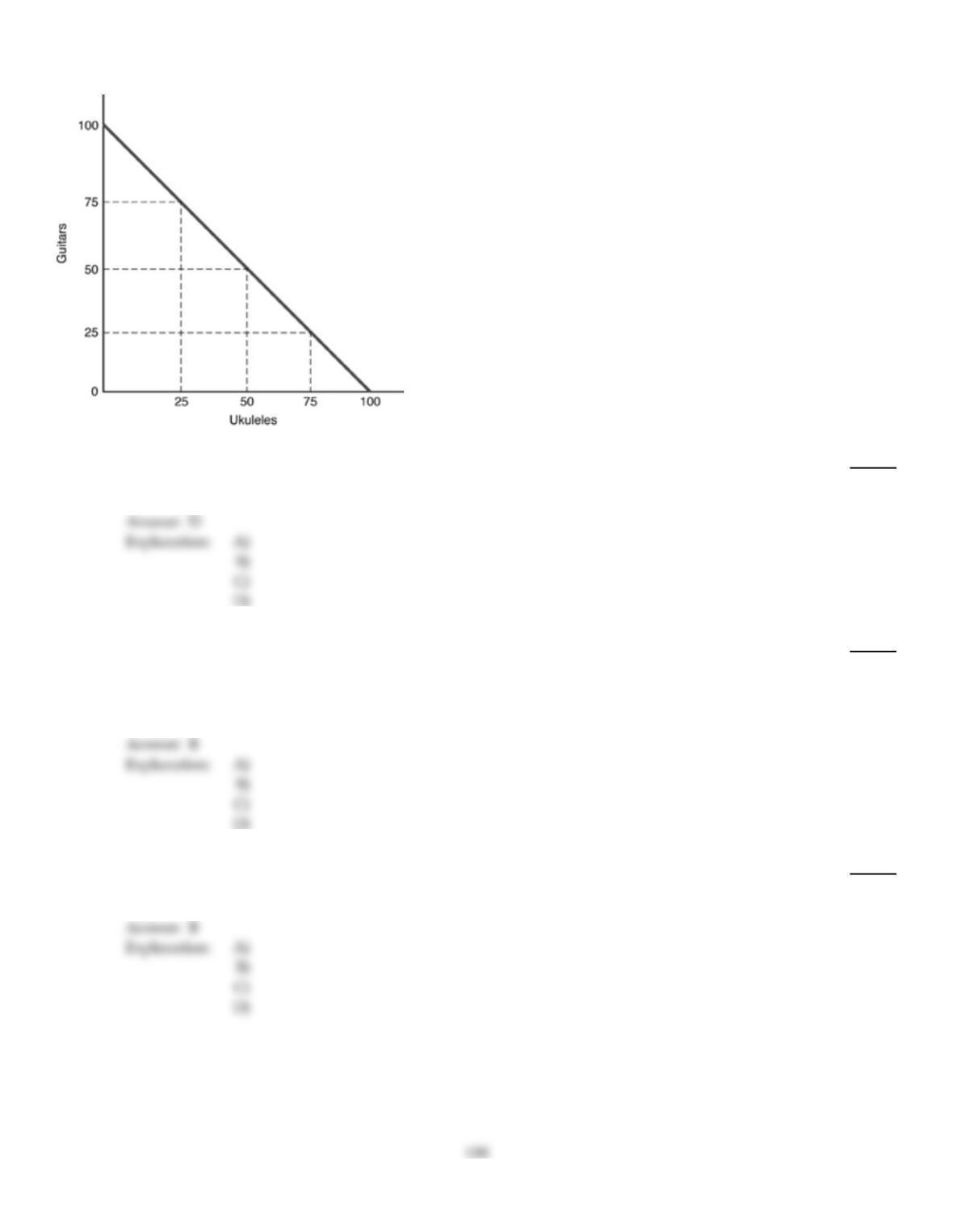
334)
In the above figure, the opportunity cost of moving from producing 50 guitars and 50 ukuleles to
producing 25 guitars and 75 ukuleles is
334)
A)
50 guitars.
B)
75 ukuleles.
C)
25 ukuleles.
D)
25 guitars.
335)
Comparative advantage implies that you
335)
A)
can produce goods with more capital resources.
B)
can produce a good or service at a lower opportunity cost.
C)
can produce more units of a good or service than another.
D)
can produce goods with more human resources.
336)
Services can be thought of as
336)
A)
unvalued goods.
B)
intangible goods.
C)
free goods.
D)
unwanted goods.