91) The chemical formula for chlorous acid is
A) H ClO(aq).
B) H ClO2(aq).
C) H ClO3(aq).
D) H Cl O4(aq).
92) The chemical formula for magnesium nitride is
A) Mg(NO3)2.
B) Mg(NO2)2.
C) Mg3N2.
D) MgN2.
93) In which set do all elements tend to form cations in binary ionic compounds?
A) Na, B, S
B) Ca, Cr, Pb
C) S, As, Bi
D) O, Br, I
94) In which set do all elements tend to form anions in binary ionic compounds?
A) C, S, Pb
B) K, Fe, F
C) Na, Ba, Al
D) N, O, Cl
95) What is the most likely charge on an ion of phosphorus, P?
A) 5-
B) 3–
C) 1+
D) 5+
96) Which element can form more than one kind of monatomic ion?
A) Sr
B) Al
C) Sn
D) O
97) Which element can form more than one kind of monatomic ion?
A) Na
B) I
C) Cr
D) Zn
98) Which one of the following compounds contains ionic bonds?
A) MgS
B) HF
C) NCl3
D) SiO2
99) Which of the following is the correct chemical formula for a molecule of nitrogen?
A) N
B) N–
C) N+
D) N2
100) Which of the compounds, Na3P, PH3, C2H6, IBr3, are ionic compounds?
A) only C2H6
B) only Na3P
C) Na3P and PH3
D) PH3, C2H6, and IBr3
101) Which of the compounds, C5H12, CaF2, Pd(NO3)2, OCl2, are expected to exist as molecules?
A) only C5H12
B) C5H12 and OCl2
C) C5H12, Pd(NO3)2, and OCl2
D) CaF2 and Pd(NO3)2
102) Which of the following elements has the least tendency to form an ion?
A) Ca
B) Li
C) Kr
D) S
103) What is the chemical formula for iron(II) phosphate?
A) Fe2P
B) Fe2PO4
C) Fe3P4
D) Fe3(PO4)2
104) What is the charge on the In in the ionic compound In2Te3?
A) 2-
B) 1+
C) 2+
D) 3+
105) Na2O is named
A) sodium dioxide.
B) sodium oxide.
C) sodium(II) oxide.
D) sodium oxygen.
106) What is the chemical formula for cesium bicarbonate?
A) Cs2HCO3
B) CsHCO
C) CsHCO2
D) CsHCO3
107) What is the chemical formula for calcium chromate?
A) CaCrO2
B) CaCrO
C) CaCrO3
D) CaCrO4
108) The chemical formula for the carbonate ion is
A) C–.
B) CO–.
C) CO32-.
D) CO22-.
109) The compound, Sn(IO3)2, is named
A) tin iodate(II).
B) tin(I) iodate.
C) tin(I) iodate(II).
D) tin(II) iodate.
110) The chemical formula for calcium telluride is
A) Ca(TeO3).
B) Ca(TeO2).
C) CaTe.
D) CaTe2.
111) What are the names of the ions Mn2+, Sn2+, and Se2-?
A) manganese, tin, and selenium
B) manganese, tin(II), and selenide
C) manganese(II), tin(II), and selenium(II-)
D) manganous, stannous, and selenide
In the following drawings, shaded spheres represent cations and unshaded spheres represent anions.
112) Which drawing represents the ionic compound Sr3(PO4)2?
A) drawing (a)
B) drawing (b)
C) drawing (c)
D) drawing (d)
113) Which drawing represents the ionic compound Ag2CO3?
A) drawing (a)
B) drawing (b)
C) drawing (c)
D) drawing (d)
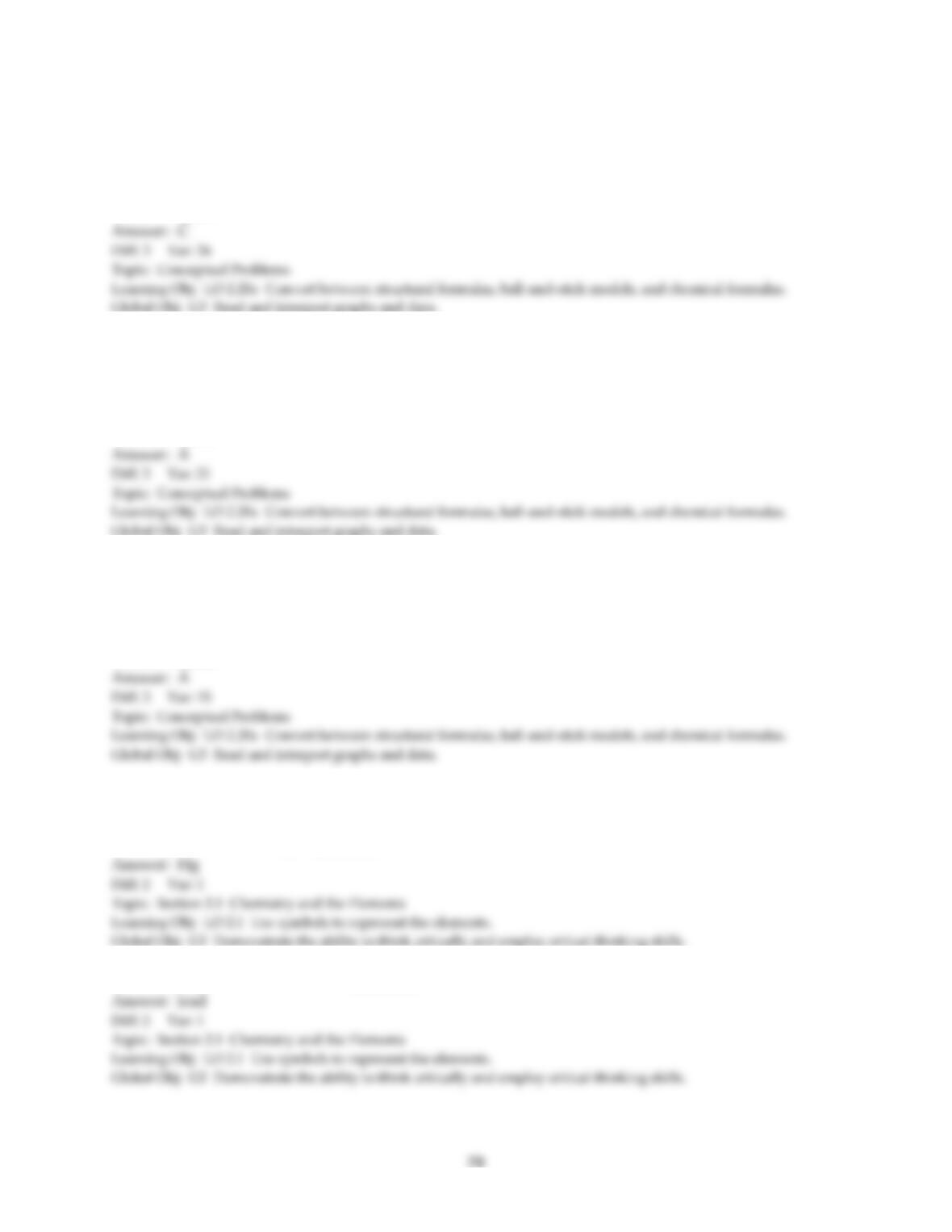
114) Which drawing represents the ionic compound BaF2?
A) drawing (a)
B) drawing (b)
C) drawing (c)
D) drawing (d)
115) Which drawing represents the ionic compound AgClO3?
A) drawing (a)
B) drawing (b)
C) drawing (c)
D) drawing (d)
116) Which drawing represents the ionic compound RbClO4?
A) drawing (a)
B) drawing (b)
C) drawing (c)
D) drawing (d)
2.3 Short Answer Questions
1) The symbol for mercury is ________.
2) Pb is the symbol for the element ________.
3) In a periodic table rows are called ________ and columns are called ________.
4) The element Al can be found in period ________ and group ________ of the periodic table.
5) The element that is in period 5 and group 2A has the symbol ________.
6) A property that depends on the amount of a substance is an ________ property, whereas a property
that is independent on the amount of substance is an ________ property.
7) Elements are classified as metals, nonmetals, or semimetals. At room temperature a certain element
exists as a dull yellow solid that is a poor conductor of electricity and is brittle. This element is most likely
a ________.
8) Sodium is an example of an ________ metal that reacts with water to form hydrogen gas and an
________ solution.
9) 81 g of HBr react with 40 g of NaOH to produce 18 g of H2O, then the number of grams of NaBr
produced is ________.
HBr + NaOH → H2O + NaBr
10) According to the law of multiple proportions, if 12 g of carbon combine with 16 g of oxygen to form
CO, the number of grams of carbon that combine with 16 g of oxygen in the formation of CO2 is
________.
11) The charge to mass ratio of an electron was determined from Rutherford’s cathode–ray tube
experiment to be 1.759 × 10⁸ C/g and the charge on a single electron was determined from the Millikan oil
drop experiment to be 1.602 × 10⁻¹⁹ C, so the mass of a single electron is ________.
12) The subatomic particles contained in the nucleus of an atom are ________ and ________.
13) Atoms of the same element always have the same number of ________ in their nuclei.
14) Isotopes have the same number of ________ but different numbers of ________ in their nuclei.
15) The symbol of the isotope having Z = 88 and A = 226 is ________.
16) The symbol for technetium-98 is ________.
17) The number of neutrons in a neutral atom of uranium-238 is ________.
18) A neutral atom with atomic number 5 and mass number 11 contains ________ electrons.
19) Chlorine has two common isotopes, chlorine-35 and chlorine-37, and an atomic mass of 35.45 amu.
The natural abundance of chlorine-35 is ________ (greater than, less than, the same as) the natural
abundance of chlorine-37.
20) The number of atoms in 1 g of H is ________ (greater than, less than, the same as) the number of
atoms in 12 g of C.
21) To the nearest whole number, the number of grams of Ba in 3.25 mol of Ba is ________.
22) The number of moles of Li in 34.7 g Li is ________.
23) 10% saline solution (sodium chloride dissolved in water) is an example of a ________.
24) The number of electrons in the ion Ca2+ is ________.
25) The number of electrons in the ion C4- is ________.
26) The bonding in NaI is ________, whereas the bonding in NH3 is ________.
27) Phosphate ion has the formula ________.
28) The formula of thallium(III) selenide contains ________ thallium(III) and ________ selenide ions.