Solve the problem.
140)
The U. S. Census Bureau compiles data on population. The population (in thousands) of a southern
city can be approximated by P(x) = 0.08x2– 13.08x + 927, where x corresponds to the years after
1950. In what calendar year was the population about 804,200?
140)
A)
1955
B)
2000
C)
1965
D)
1960
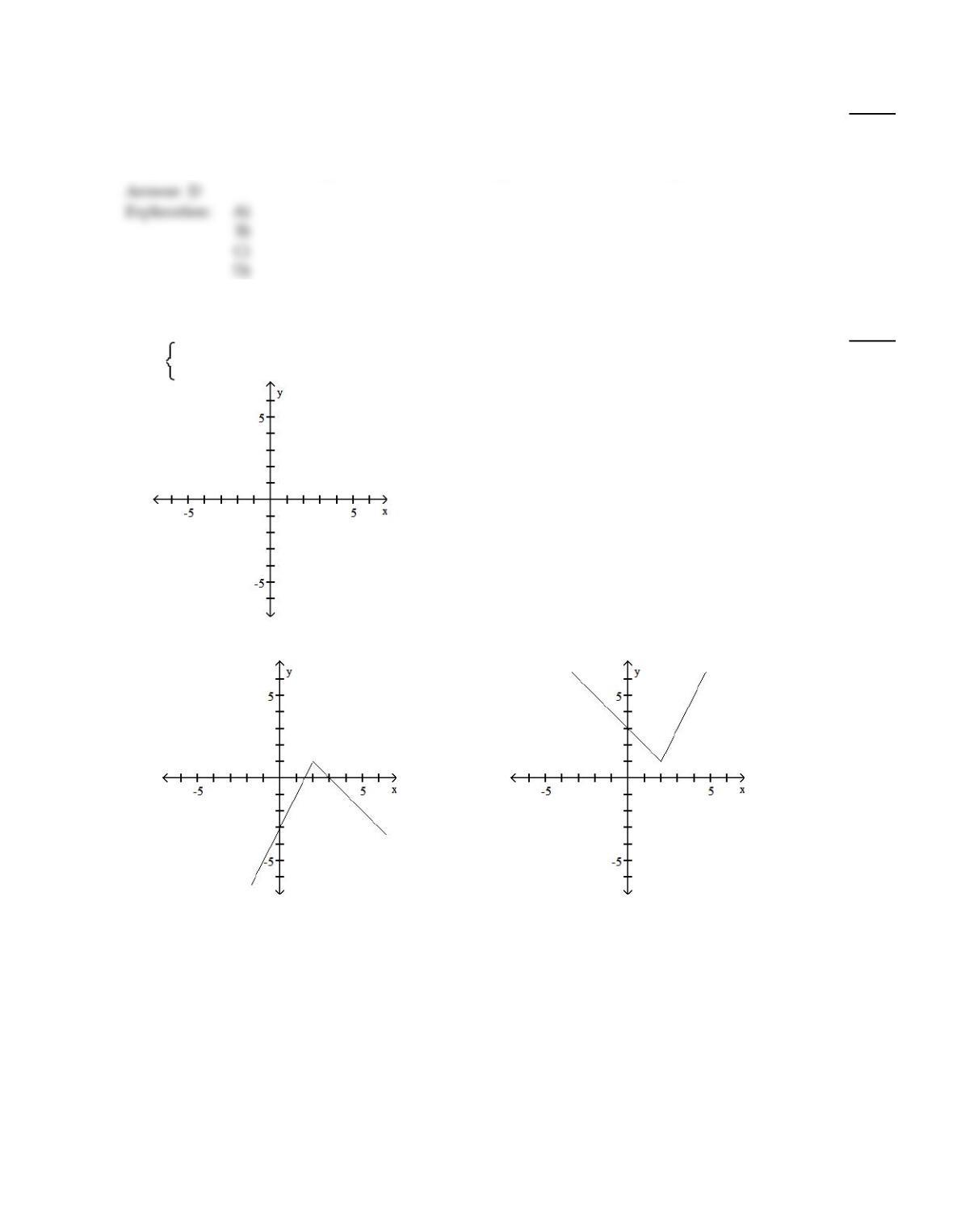
Graph the function.
141)
f(x) =–x + 3 if x < 2
2x – 3 if x 2
141)
A)
B)
61
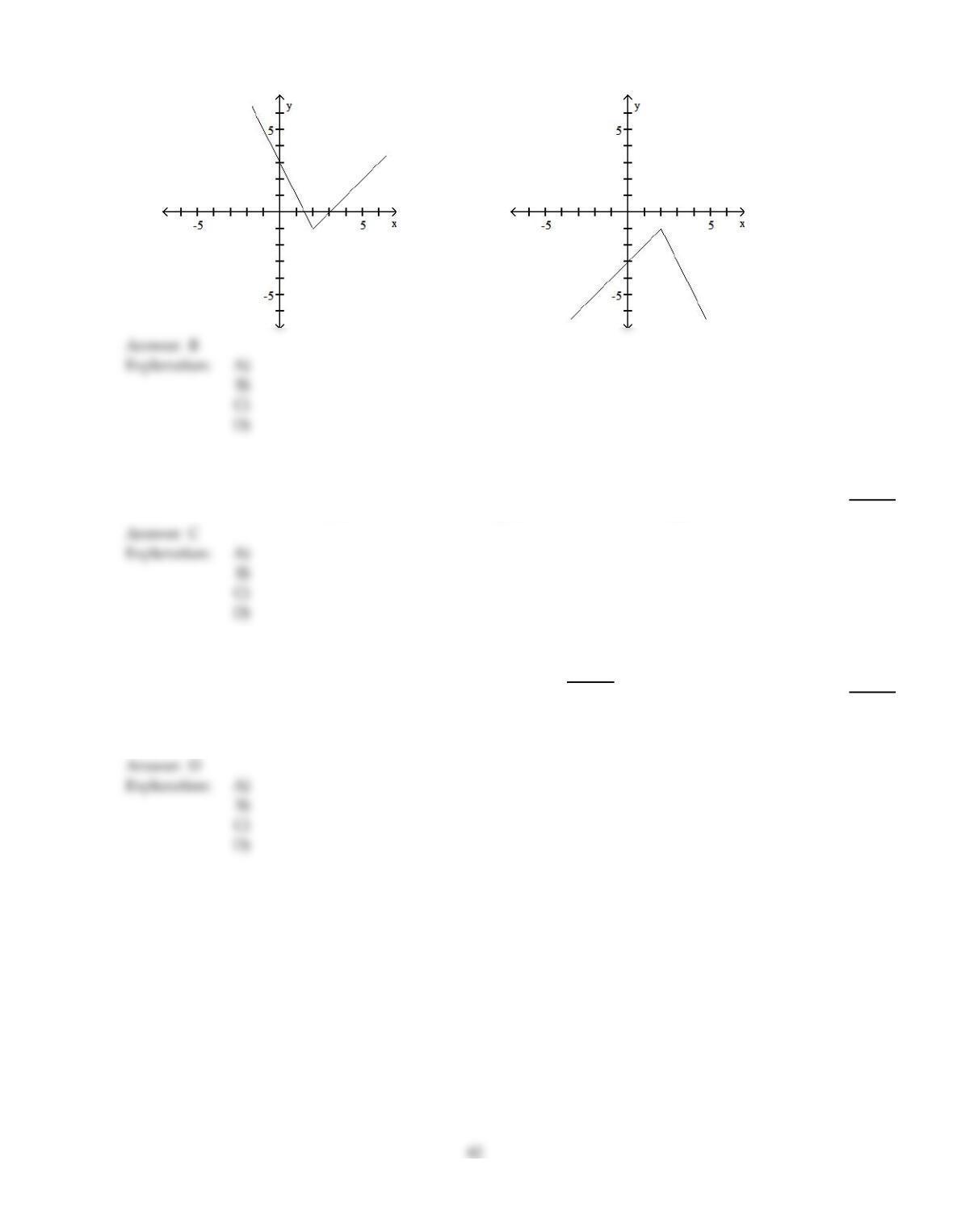
C)
D)
Find the x–intercept(s) if they exist.
142)
6x2= 42x
142)
A)
7
B)
21
C)
0, 7
D)
0
Solve the problem.
143)
The population P, in thousands, of Fayetteville is given by P(t) =300t
2t2+ 7 , where t is the time, in
months. Find the population at 9 months.
143)
A)
7988
B)
30, 769
C)
40,000
D)
15, 976
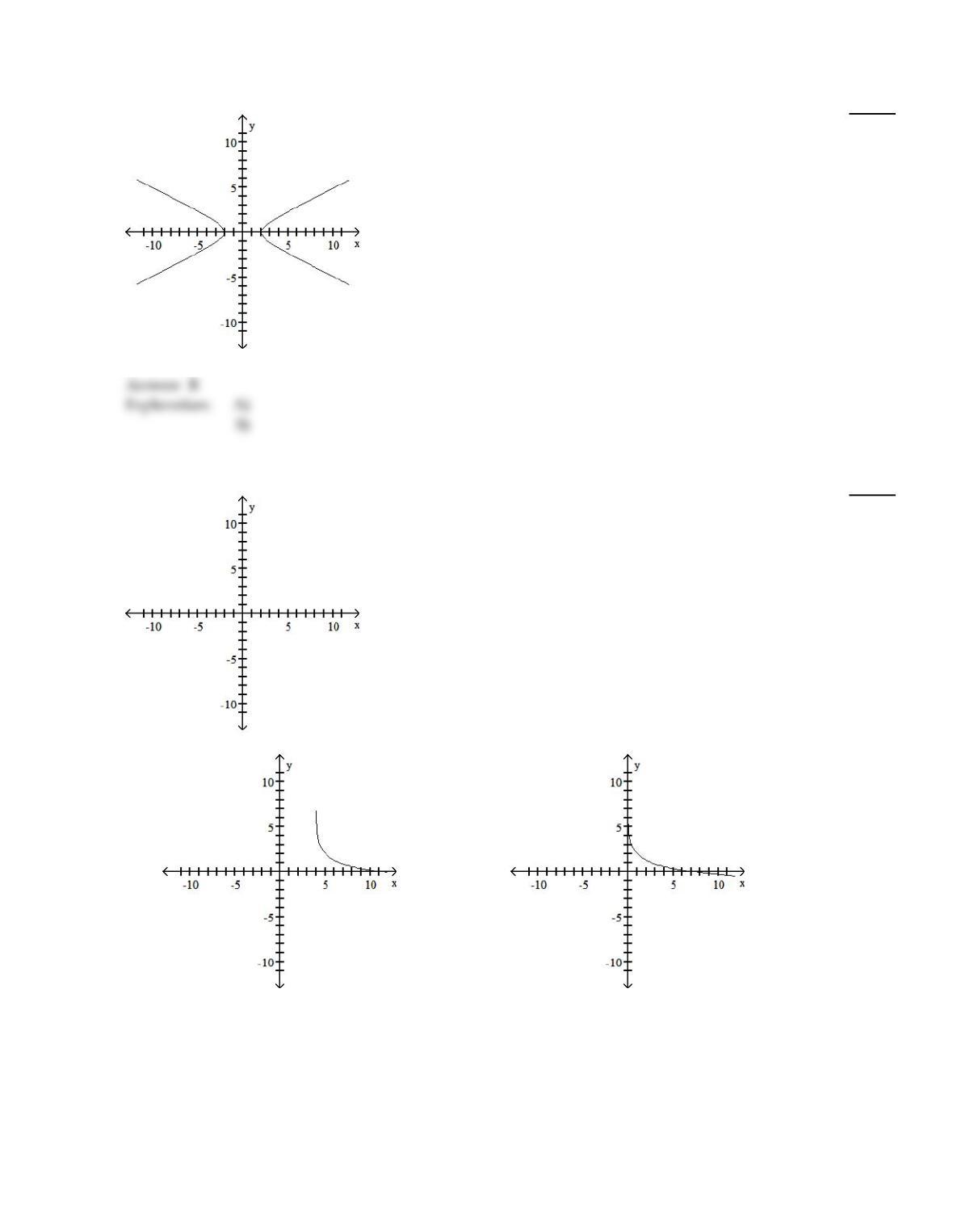
Determine whether the graph is the graph of a function.
144)
144)
A)
function
B)
not a function
Graph the function using a calculator and point–by–point plotting. Indicate increasing and decreasing intervals.
145)
f(x) = 2 – ln(x + 4)
145)
A)
Decreasing: (4, )
B)
Decreasing: (0, )
63
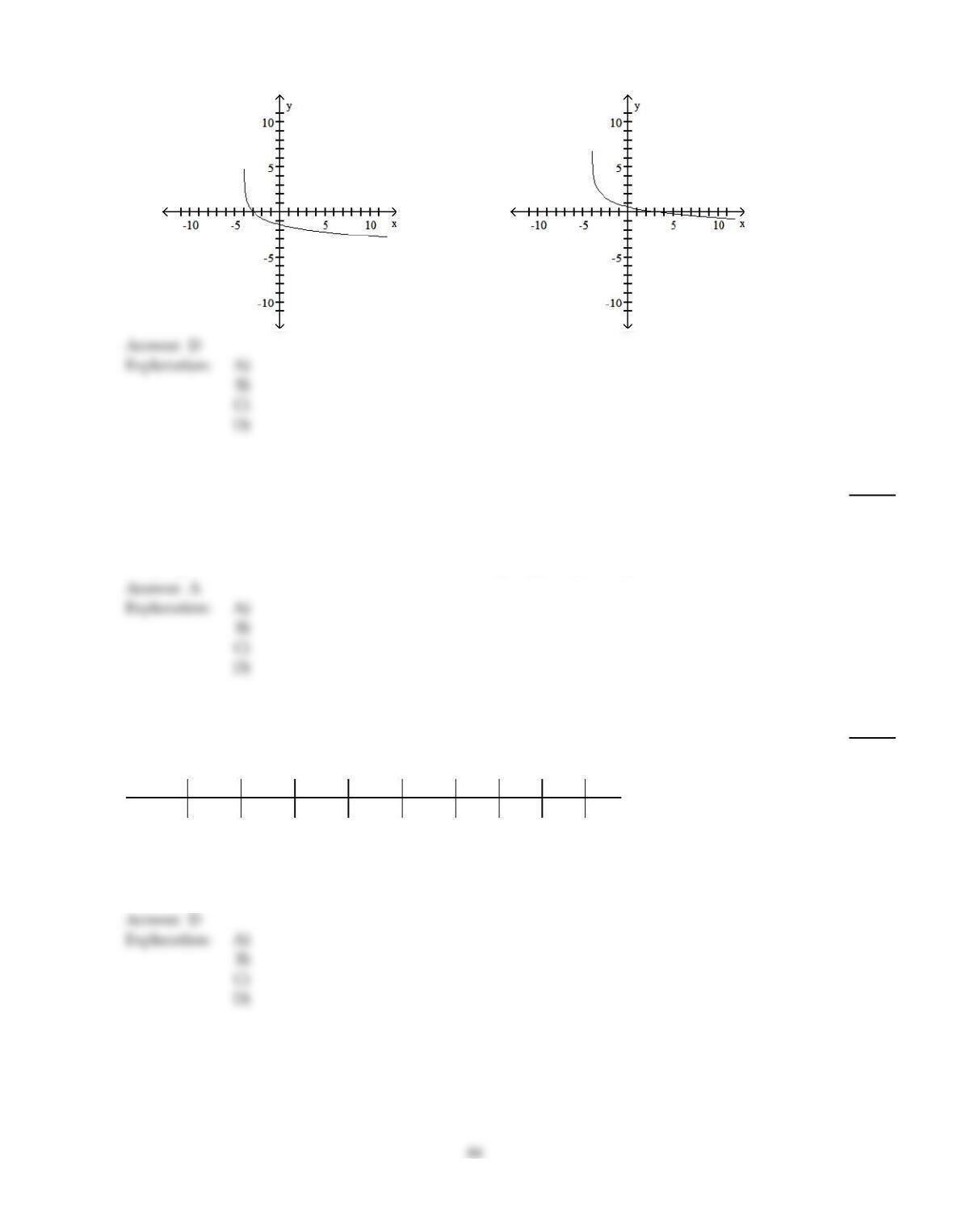
C)
Decreasing: (–4, )
D)
Decreasing: (–4, )
Solve the problem.
146)
To estimate the ideal minimum weight of a woman in pounds multiply her height in inches by 4
and subtract 130. Let W = the ideal minimum weight and h = height. Express W as a linear function
of h.
146)
A)
W(h) = 4h – 130
B)
W(h) = 130h + 4
C)
W(h) = 130
D)
W(h) = 4 (h + 130)
Use the REGRESSION feature on a graphing calculator.
147)
The average retail price in the Spring of 2000 for a used Camaro Z28 coupe depends on the age of
the car as shown in the following table.
Age, x 1 2 3 4 5 6 7 8 9
Price, y 18,325 15,925 13,685 11,805 10,490 8885 8015 6480 5710
Find the quadratic model that best estimates this data. Round your answer to whole numbers.
147)
A)
y = – 9x3+ 235x2– 3134x + 21,252
B)
y = – 1551x + 18,790x
C)
y = 102x2– 2576x
D)
y = 102x2– 2576x + 20,669
For the given function, find each of the following:
(A) Intercepts
(B) Vertex
(C) Maximum or minimum
(D) Range
148)
g(x) =(x – 2)2– 9
148)
A)
(A) x–intercepts: – 1, 5; y–intercept: -5
(B) Vertex (2, -9)
(C) Maximum: -9
(D) y -9
B)
(A) x–intercepts: – 1, 5; y–intercept: -5
(B) Vertex (-2, -9)
(C) Minimum: -9
(D) y -9
C)
(A) x–intercepts: – 1, 5; y–intercept: -5
(B) Vertex (2, -9)
(C) Minimum: -9
(D) y -9
D)
(A) x–intercepts: -5, 1; y–intercept: -5
(B) Vertex (2, -9)
(C) Minimum: -9
(D) y -9
Solve the problem.
149)
Assume that a person’s critical weight W, defined as the weight above which the risk of death rises
dramatically, is given by W(h) =h
11.9
3, where W is in pounds and h is the person’s height in
inches.
Find the tcritical weight for a person who is 6 ft 11 in. tall. Round to the nearest tenth.
149)
A)
339.3 lb
B)
212.4 lb
C)
221.5 lb
D)
377.4 lb
A
Provide an appropriate response.
150)
What is the maximum number of x intercepts that a polynomial of degree 10 can have?
150)
A)
10
B)
11
C)
9
D)
Not enough information is given.
A
C
Use the properties of logarithms to solve.
151)
logb(x + 3) +logb x =logb 54
151)
A)
3
B)
6
C)
–6, –3
D)
–6
Find the equations of any vertical asymptotes.
152)
f(x) =x2+3x
x2–4x –21
152)
A)
x =7, x =-3
B)
x =-7, x =3
C)
x =7
D)
None
Determine if the equation specifies a function with independent variable x. If so, find the domain. If not, find a value of x
to which there corresponds more than one value of y.
153)
xy =4
153)
A)
A function with domain all real numbers except x = 0
B)
Not a function; for example, when x =4, y = ±1
Find the equation of any horizontal asymptote.
154)
f(x) =x2+ 8x – 8
x – 8
154)
A)
y =8
B)
None
C)
y =6
D)
y =-8
For the rational function below (i) Find the intercepts for the graph; (ii) Determine the domain; (iii) Find any vertical or
horizontal asymptotes for the graph; (iv) Sketch any asymptotes as dashed lines. Then sketch the graph of y = f(x).
66
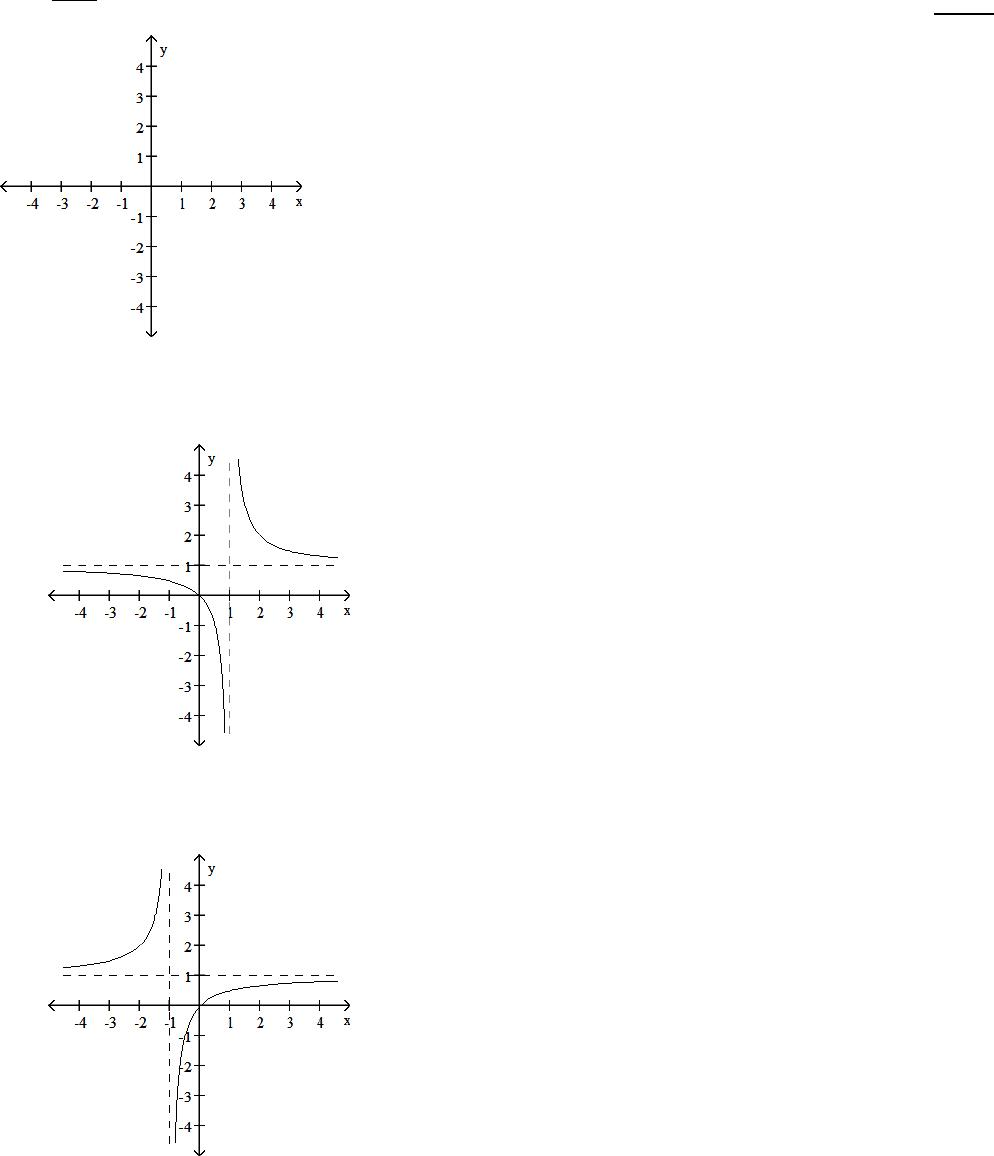
155)
f(x) =x + 2
x + 1
155)
A)
(i) x intercept: 0; y intercept: 0
(ii) Domain: all real numbers except 1
(iii) Vertical asymptote: x = 1; horizontal asymptote: y = 1
(iv)
B)
(i) x intercept: 0; y intercept: 0
(ii) Domain: all real numbers except –1
(iii) Vertical asymptote: x = – 1; horizontal asymptote: y = 1
(iv)
67
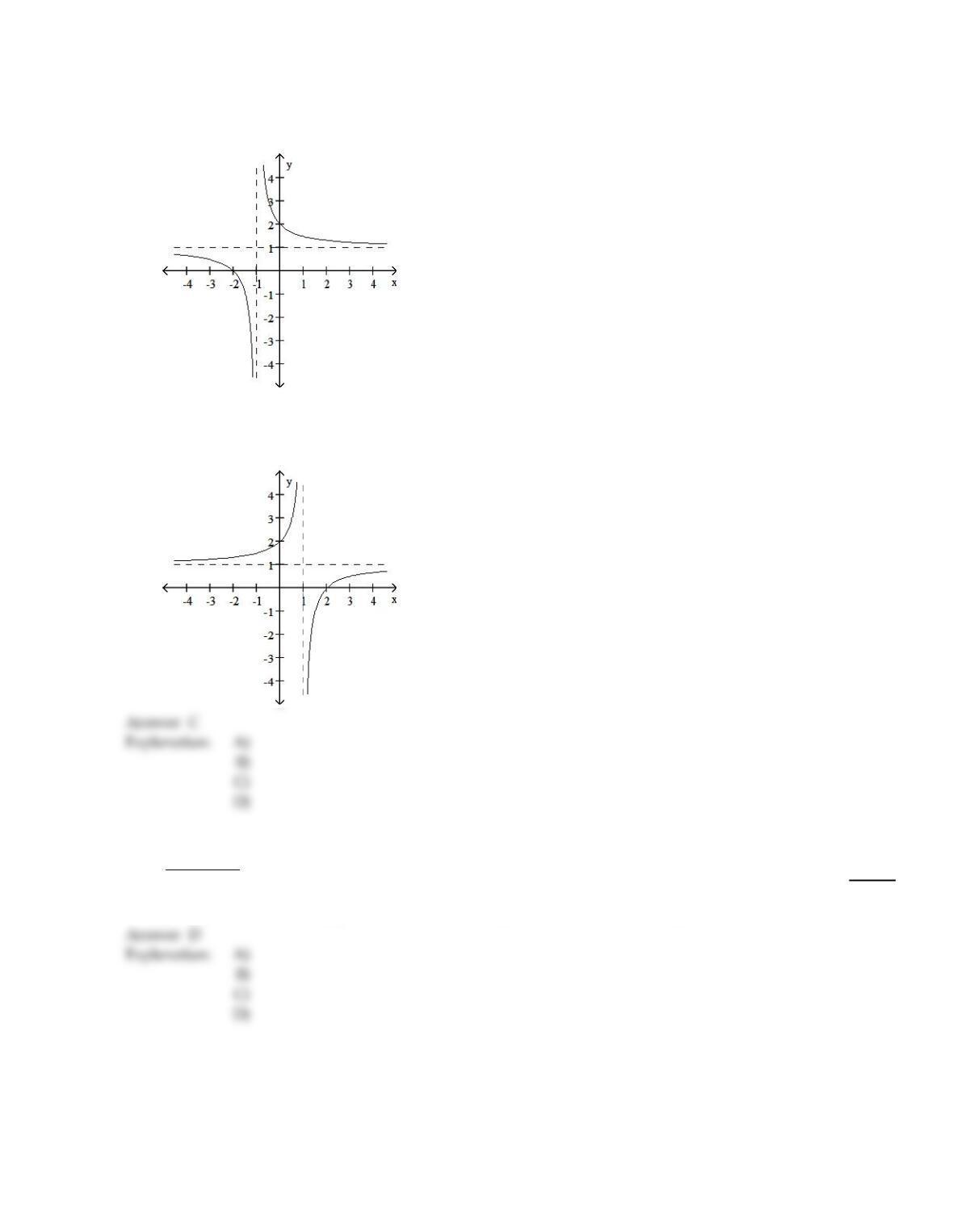
C)
(i) x intercept: –2; y intercept: 2
(ii) Domain: all real numbers except –1
(iii) Vertical asymptote: x = – 1; horizontal asymptote: y = 1
(iv)
D)
(i) x intercept: 2; y intercept: 2
(ii) Domain: all real numbers except 1
(iii) Vertical asymptote: x = 1; horizontal asymptote: y = 1
(iv)
Find the equations of any vertical asymptotes.
156)
f(x) =4x – 11
x2+4x –5
156)
A)
y =1, y = – 5
B)
y =4
C)
x = – 1, x =5
D)
x =1, x = – 5
Solve the problem.
68
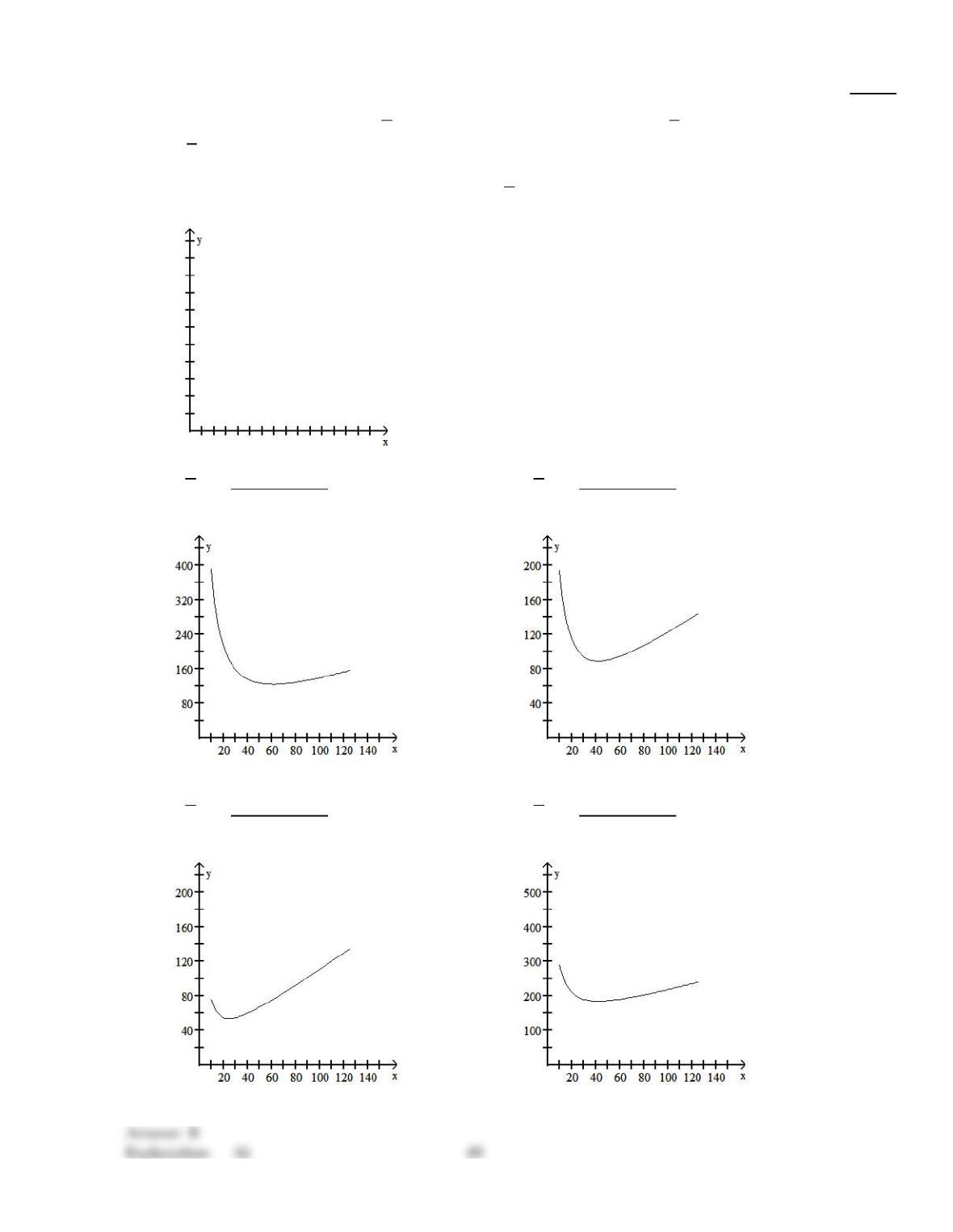
157)
Financial analysts in a company that manufactures ovens arrived at the following daily cost
equation for manufacturing x ovens per day: C(x) =x2+ 4x + 1800. The average cost per unit at a
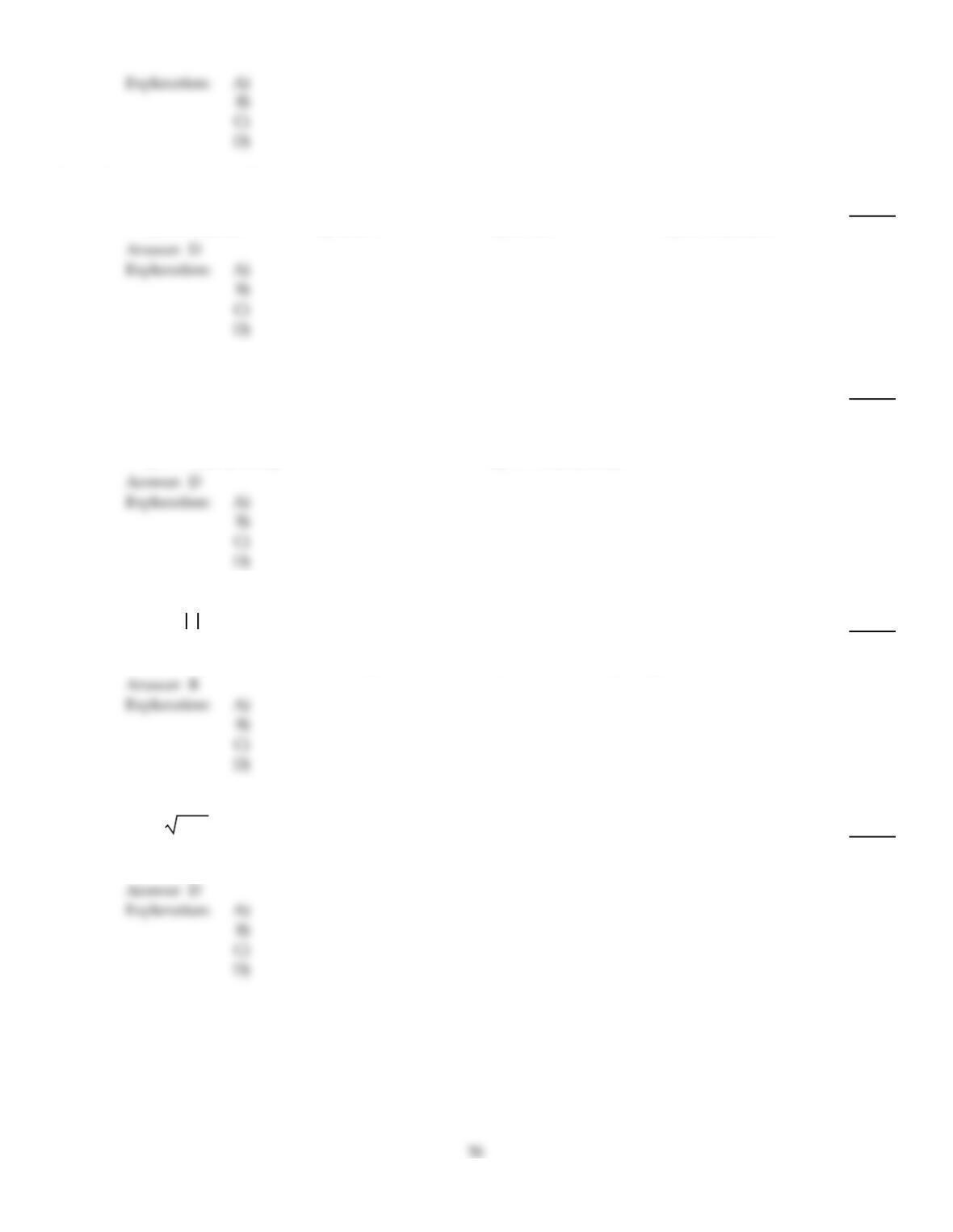
production level of x ovens per day is C(x) = C(x)/x. (i) Find the rational function C. (ii) Sketch a
graph of C(x) for 10
x 125. (iii) For what daily production level (to the nearest integer) is the
average cost per unit at a minimum, and what is the minimum average cost per oven (to the nearest
cent)? HINT: Refer to the sketch in part (ii) and evaluate C(x) at appropriate integer values until a
minimum value is found.
157)
A)
(i) C(x) =x2+ 4x + 1800
x
(ii)
(iii) 61 units; $133.29 per oven
B)
(i) C(x) =x2+ 4x + 1800
x
(ii)
(iii) 42 units; $88.86 per oven
C)
(i) C(x) =x2+ 4x + 1800
x
(ii)
(iii) 22 units; $48.93 per oven
D)
(i) C(x) =x2+ 4x + 1800
x
(ii)
(iii) 44 units; $185.61 per oven
Solve the equation graphically to four decimal places.
158)
Let f(x) =-0.6x2+3x +1, find f(x) =3.
158)
A)
No solution
B)
4.2078
C)
0.7922
D)
0.7922, 4.2078
Solve the problem.
159)
Suppose that $2200 is invested at 3% interest, compounded semiannually. Find the function for the
amount of money after t years.
159)
A)
A = 2200 (1.015)t
B)
A = 2200 (1.03)2t
C)
A = 2200 (1.0125)2t
D)
A = 2200 (1.015)2t
Give the domain and range of the function.
160)
h(x) = – 4 x
160)
A)
Domain: [0, ); Range: [0, )
B)
Domain: all real numbers; Range: (–, 0]
C)
Domain: all real numbers; Range: (–, -2]
D)
Domain: (–, 0]; Range: all real numbers
Determine the domain of the function.
161)
f(x) =3 – x
161)
A)
x < 3
B)
All real numbers except 3
C)
No solution
D)
x 3
Solve the problem.
162)
An initial investment of $12,000 is invested for 2 years in an account that earns 4% interest,
compounded quarterly. Find the amount of money in the account at the end of the period.
162)
A)
$12,979.20
B)
$994.28
C)
$12,865.62
D)
$12,994.28
Determine whether the function is linear, constant, or neither
163)
y =2
3
163)
A)
Linear
B)
Constant
C)
Neither
Find the x–intercept(s) if they exist.
164)
x2+ 6x + 5 = 0
164)
A)
10, –5
B)
–1, –5
C)
1 , 5
D)
5, –5
Graph the function.
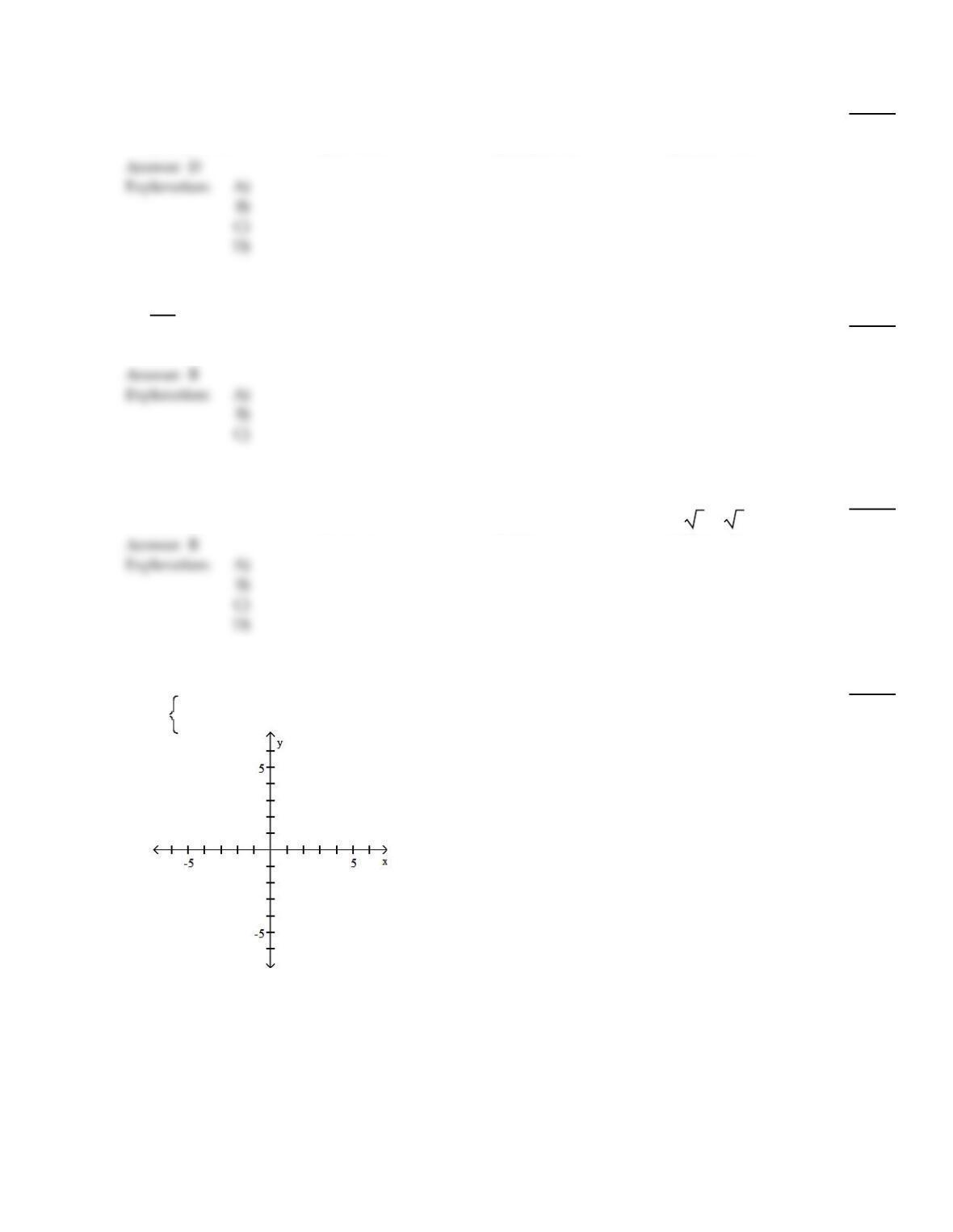
165)
f(x) =x – 2 if x < 1
4if x
1
165)
71
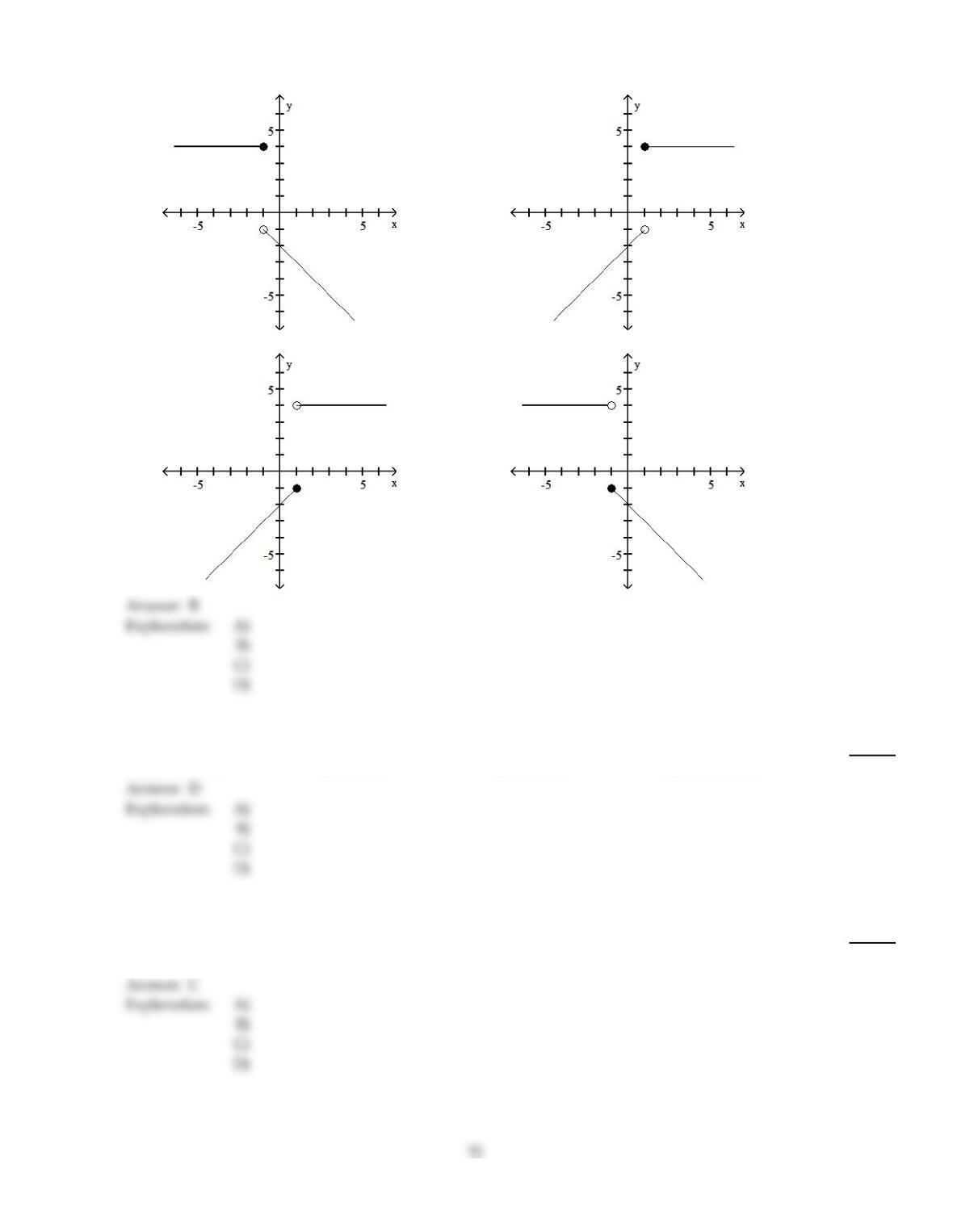
A)
B)
C)
D)
Use a calculator to evaluate the expression. Round the result to five decimal places.
166)
log (–10.25)
166)
A)
–1.01072
B)
2.32728
C)
1.01072
D)
Undefined
Convert to a logarithmic equation.
167)
23= 8
167)
A)
log2 3 = 8
B)
log8 2 = 3
C)
log2 8 = 3
D)
log3 8 = 2
Solve the problem.
168)
In North America, coyotes are one of the few species with an expanding range. The future
population of coyotes in a region of Mississippi valley can be modeled by the equation
P = 59 + 12 · ln(18t + 1), where t is time in years. Use the equation to determine when the population
will reach 170. (Round your answer to the nearest tenth year.)
168)
A)
583.1 years
B)
581.3 years
C)
578.0 years
D)
586.2 years
Write in terms of simpler forms.
169)
4a log4 b
169)
A)
ab
B)
a4b
C)
ba
D)
b4a
Find the function value.
170)
Given that f(x) = 5x2– 2x, find f(t + 2).
170)
A)
t2+ 2t – 6
B)
5t2+ 18t + 16
C)
3t + 6
D)
5t2– 18t + 16
Solve the problem.
171)
Under certain conditions, the power P, in watts per hour, generated by a windmill with winds
blowing v miles per hour is given by P(v) = 0.015v3. Find the power generated by 18–mph winds.
171)
A)
0.00006075 watts per hour
B)
87.48 watts per hour
C)
4.86 watts per hour
D)
58.32 watts per hour
172)
In economics, functions that involve revenue, cost and profit are used. Suppose R(x) and C(x)
denote the total revenue and the total cost, respectively, of producing a new high–tech widget. The
difference P(x) = R(x) – C(x) represents the total profit for producing x widgets. Given R(x) = 60x –
0.4 x2 and C(x) = 3x + 13, find the equation for P(x).
172)
A)
P(x) = 3x + 13
B)
P(x) = – 0.4 x2+ 63x + 13
C)
P(x) = – 0.4 x2+ 57x – 13
D)
P(x) = 60x – 0.4 x2
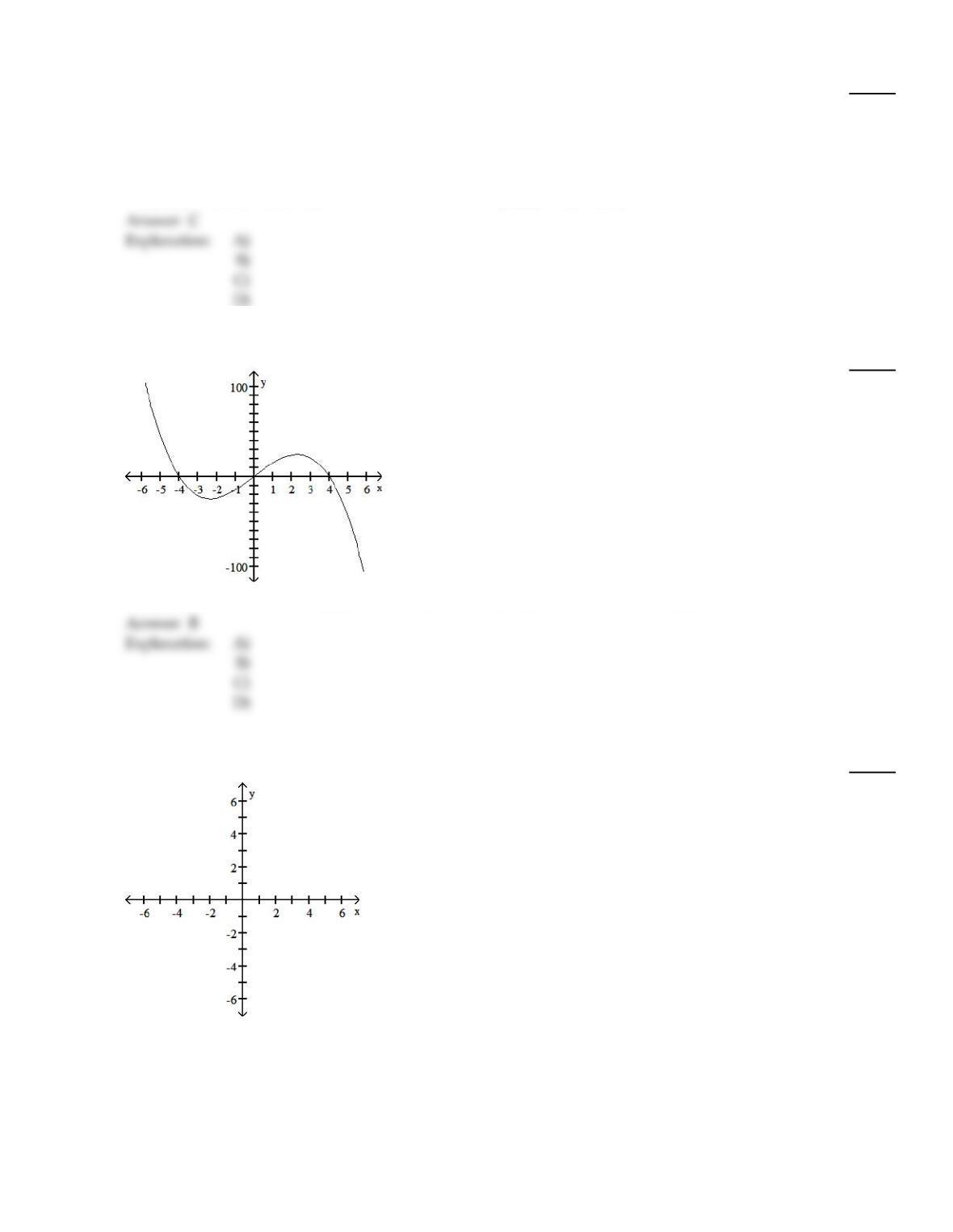
Write an equation for the lowest–degree polynomial function with the graph and intercepts shown in the figure.
173)
173)
A)
f(x) = – x3– 16x
B)
f(x) = – x3+ 16x
C)
f(x) =x3+ 16x
D)
f(x) = – x3– 16x
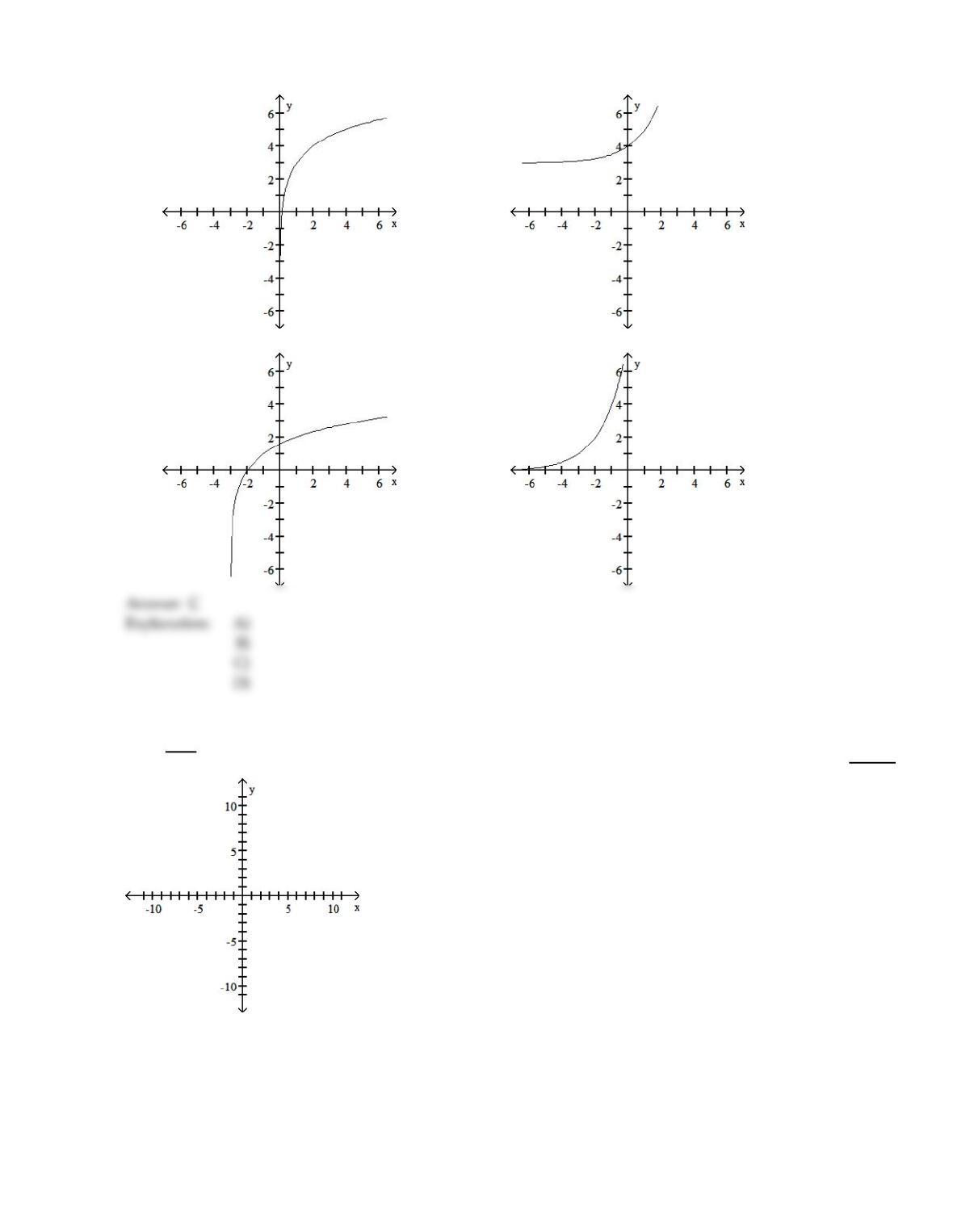
Graph by converting to exponential form first.
174)
y =log 2(x + 3)
174)
74
A)
B)
C)
D)
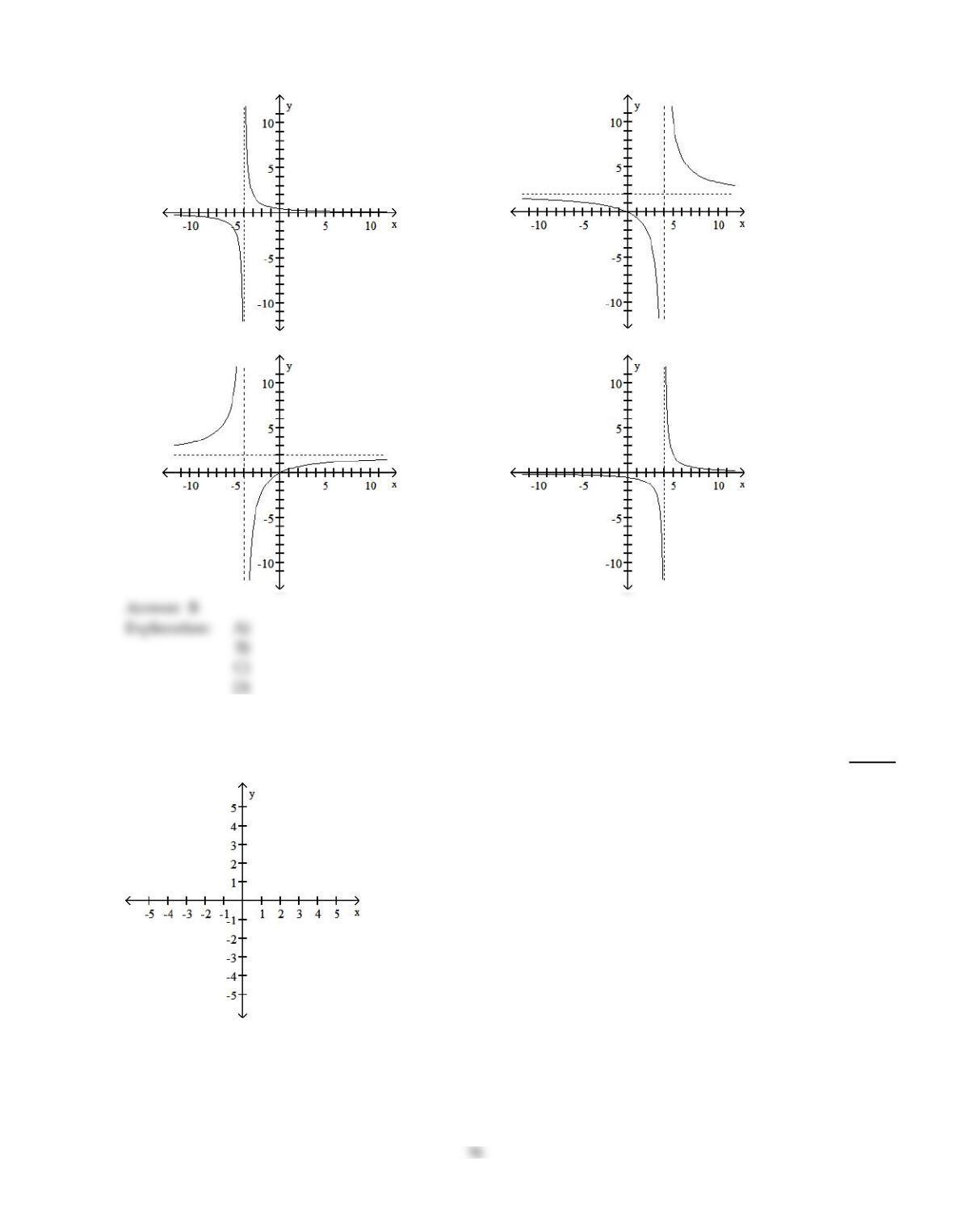
Use point–by–point plotting to sketch the graph of the equation.
175)
f(x) =2x
x – 4
175)
75
A)
B)
C)
D)
Graph the function.
176)
f(x) =2– x –4
176)