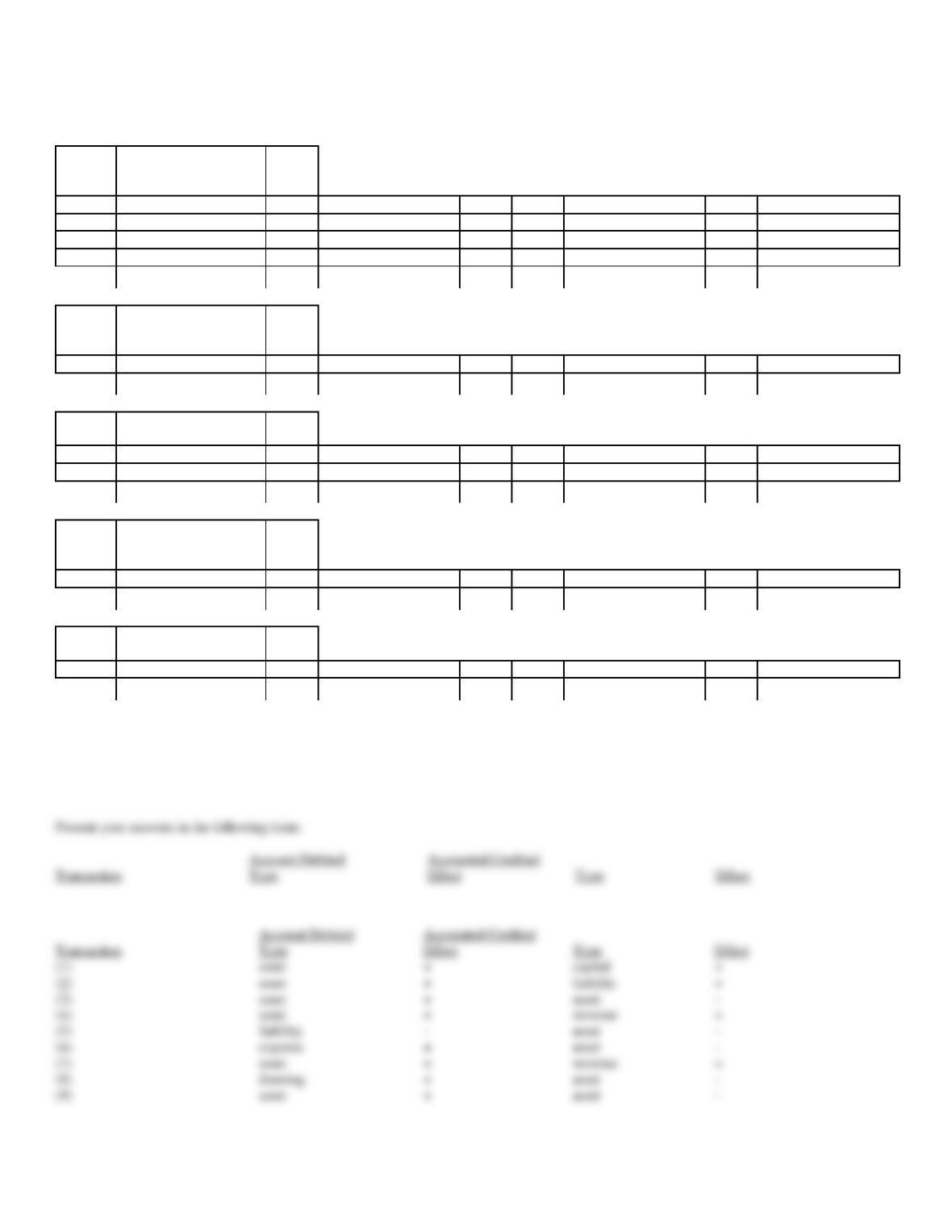
221. All nine transactions for Dalton Survey Company for September, the first month of operations, are
recorded in the following T accounts:
Cash
Michael
Dalton,
Capital
(1)
20,000
(3)
7,500
(1)
20,000
(7)
6,900
(5)
2,600
(9)
4,700
(6)
5,500
(8)
2,000
Accounts
Receivabl
e
Michael
Dalton,
Drawing
(4)
4,900
(9)
4,700
(8)
2,000
Supplies
Fees
Earned
(3)
7,500
(4)
4,900
(7)
6,900
Equipmen
t
Operatin
g
Expense
(2)
4,500
(6)
5,500
Accounts
Payable
(5)
2,600
(2)
4,500
Indicate the following for each debit and each credit:
(a)
The type of account affected (asset, liability, capital, drawing, revenue, or expense).
(b)
The effect on the account, using + for increase and – for decrease.
Account Debited
Accounted Credited
Transaction
Type
Effect
Type
Effect
Account Debited
Accounted Credited
Transaction
Type
Effect
Type
Effect
(1)
asset
+
capital
+
(2)
asset
+
liability
+
(3)
asset
+
asset
–
(4)
asset
+
revenue
+
(5)
liability
–
asset
–
(6)
expense
+
asset
–
(7)
asset
+
revenue
+
(8)
drawing
+
asset
–
(9)
asset
+
asset
–
222. On January 12th, JumpStart Co. purchased $870 in office supplies.
(a) Journalize this transaction as if JumpStart paid cash.
(b) (1) Journalize this transaction as if JumpStart placed it on account.
(b) (2) On January 18th, JumpStart pays the amount due. Journalize this event.
223. On December 1st, JumpStart Company provides $2,800 in services to clients.
(a) Journalize this event as if the clients had paid cash at the time the services were rendered.
(b)(1) Journalize this event as if the clients had placed this on account.
(b)(2) Assume that the clients paid $1,200 of the amount on account on December 30th. Journalize this
transaction.
224. On November 10th, JumpStart Co. provides $2,900 in services to clients. At the time of service, the clients
paid $600.00 in cash and put the balance on account.
(a) Journalize this event.
(b) On November 20th, JumpStart Co. clients paid an additional $900 on their accounts due. Journalize this
event.
(c) Calculate the amount of accounts receivable on November 30th.
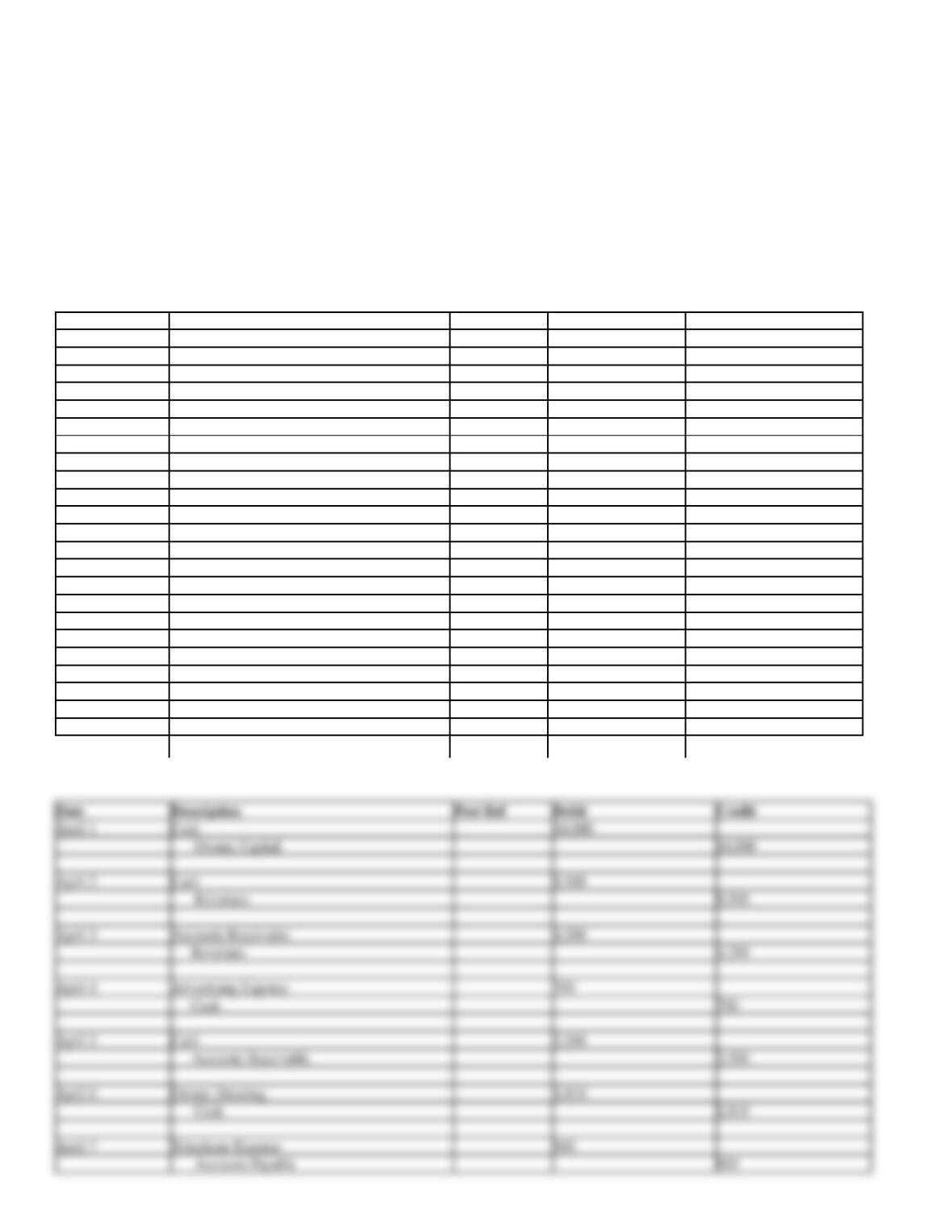
225. Journalize the following selected transactions for April 2011 in a two-column journal. Journal entry
explanations may be omitted.
April 1
Received cash from the investment made by the owner, $14,000.
2
Received cash for providing accounting services, $9,500.
3
Billed customers on account for providing services, $4,200.
4
Paid advertising expense, $700.
5
Received cash from customers on account, $2,500.
6
Owner withdraws, $1,010.
7
Received telephone bill, $900.
8
Paid telephone bill, $900.
Date
Description
Post Ref
Debit
Credit
April 1
Cash
14,000
Owner, Capital
14,000
April 2
Cash
9,500
Revenues
9,500
April 3
Accounts Receivable
4,200
Revenues
4,200
April 4
Advertising Expense
Cash
April 5
Cash
2,500
Accounts Receivable
2,500
Accounts Payable
226. Analyze the following transactions as to their effect on the accounting equation.
(a)
The company paid $725 to a vendor for supplies purchased previously on account.
(b)
The company performed $850 of services and billed the customer.
(c)
The company received a utility bill for $395 and will pay it next month.
(d)
The owner of the company withdrew $145 of supplies for personal use.
(e)
The company paid $315 in salaries to its employees.
(f)
The company collected $730 of cash from its customers on account.
Some of the possible effects of a transaction on the accounting equation are listed below:
(1)
Asset, dr.; Asset, cr.
(2)
Asset, dr.; Owner’s Equity, cr.
(3)
Asset, dr.; Liability, cr.
(4)
Asset, dr.; Revenue, cr.
(5)
Liability, dr.; Assets, cr.
(6)
Drawing, dr.; Asset, cr.
(7)
Expense, dr.; Assets, cr.
(8)
Expense, dr.; Liability, cr.
Put the appropriate letter next to each transaction.
Transaction
Effect on the accounting equation
(a)
5
(b)
4
(c)
8
(d)
6
(e)
7
1
April 8
Accounts Payable
Cash
227. Set up T accounts for Cash; Accounts Receivable; Supplies; Accounts Payable; Clay Potter, Capital; Clay
Potter, Drawing; Professional Fees; and Operating Expenses.
(a)
In the T accounts, record the following transactions of Potter Pool
Services for June, 2011, identifying each entry by number:
(1)
Potter invested $12,500 cash in the business.
(2)
Purchased supplies on account, $6,250.
(3)
Paid operating expenses, $5,500.
(4)
Billed clients for fees, $7,440.
(5)
Received cash from cash clients, $4,700.
(6)
Paid creditors on account, $1,400.
(7)
Received $3,100 from clients on account.
(8)
Withdrew $1,500 cash for personal use.
(b)
Prepare a trial balance as of June 30, 2011 for Potter Pool Services.
(c)
Assuming that supplies expense (which has not been recorded) amounts
to $1,500 for June, determine the following:
(1)
Net income for the month.
(2)
Owner’s equity as of June 30.
(a)
(1)
12,500
(3)
5,500
(1)
12,500
(5)
4,700
(6)
1,400
(7)
3,100
(8)
1,500
e
Drawing
(4)
7,440
(7)
3,100
(8)
1,500
(2)
6,250
(4)
7,440
(5)
4,700
(6)
1,400
(2)
6,250
(3)
5,500
(b)
Cash
11,900
Supplies
6,250
Professional Fees
12,140
228. Prepare a trial balance, listing the following accounts in proper sequence. The accounts (all normal
balances) were taken from the ledger of Sophie Designs Co. on April 30, 2014.
Accounts Payable
$ 4,100
Rent Expense
$11,500
Accounts Receivable
3,450
Salary Expense
14,000
Cash
6,700
Fees Earned
45,425
Sophie Dawson, Capital
17,800
Supplies
3,125
Sophie Dawson, Drawing
7,500
Supplies Expense
1,700
Equipment
14,500
Utilities Expense
4,000
Miscellaneous Expense
850
Cash
6,700
Accounts Receivable
3,450
Supplies
3,125
Equipment
14,500
Accounts Payable
4,100
Sophie Dawson, Capital
17,800
Sophie Dawson, Drawing
7,500
Fees Earned
45,425
Salary Expense
14,000
Rent Expense
11,500
Utilities Expense
4,000
Supplies Expense
1,700
Miscellaneous Expense
850
67,325
67,325
Operating Expenses
5,500
29,490
29,490
(c)
(1) $5,140 ($12,140 – $5,500 – $1,500)
(2) $16,140 ($12,500 + $5,140 – $1,500)
229. Exhibit 2-1
All nine transactions for Ralston Sports Co. for September 2011, the first month of operations, are recorded in
the following T accounts:
Cash
James
Ralston,
Capital
(1)
25,000
(3)
12,500
(1)
25,000
(7)
11,900
(5)
7,600
(9)
9,700
(6)
10,500
(8)
7,000
Accounts
Receivabl
e
James
Ralston,
Drawing
(4)
9,900
(9)
9,700
(8)
7,000
Supplies
Fees
Earned
(3)
12,500
(4)
9,900
(7)
11,900
Equipmen
t
Operatin
g
Expense
(2)
9,500
(6)
10,500
Accounts
Payable
(5)
7,600
(2)
9,500
Refer to Exhibit 2-1. Prepare a trial balance, listing the accounts in their proper order.
Ralston Sports Company
Trial Balance
Cash
9,000
Accounts Receivable
Supplies
12,500
Equipment
9,500
Accounts Payable
1,900
James Ralston, Capital
25,000
James Ralston, Drawing
7,000
Fees Earned
21,800
Operating Expense
10,500
48,700
48,700
230.
(a)
List the errors in the following trial balance. All accounts have normal balances.
(b)
What would be the new balance of the trial balance after errors are corrected? What would be the balance of Accounts
Receivable?
Winslow’s Auto Body
Trial Balance
For Month Ending April 30, 2011
Cash
19,475
Accounts Receivable
?
Supplies
1,000
Equipment
15,000
Prepaid Insurance
500
Accounts Payable
2,500
Thad Winslow, Capital
17,000
Thad Winslow, Drawing
1,000
Fees Earned
49,600
Salary Expense
14,500
Rent Expense
9,000
Utilities Expense
1,400
Supplies Expense
3,900
Miscellaneous Expense
250
55,000
81,575
(a)
(1)
In the heading, the date should be April 30, 2011; not for a period of time.
(2)
The cash balance should be a debit.
(4)
The supplies account should be a debit.
(5)
Prepaid Insurance should be a debit and follow Accounts Receivable.
(6)
Thad Winslow, Drawing should be a debit.
(7)
Rent Expense should be a debit.
(8)
The trial balance does not balance.
(b)
The new balance for credits would be accounts payable $2,500 + fees earned $49,600 + $17,000 for capital = $69,100. Accounts

231. Answer the following questions for each of the errors listed below, considered individually:
(a)
Did the error cause the trial balance totals to be unequal?
(b)
What is the amount of the difference between the trial balance totals (where applicable)?
(c)
Which of the trial balance totals, debit or credit, is the larger (where applicable)?
Present your answers in columnar form, using the following headings:
Error
Totals
Difference in Totals
Larger of Totals
(identifying number)
(equal or unequal)
(amount)
(debit or credit)
Errors:
(1)
A withdrawal of $3,000 cash by the owner was recorded by a debit of $3,000 to Salary Expense and a credit of $3,000 to
Cash.
(2)
A $650 purchase of supplies on account was recorded as a debit of $1,650 to Equipment and a credit of $1,650 to Accounts
Payable.
(3)
A purchase of equipment for $3,450 on account was not recorded.
(4)
A $870 receipt on account was recorded as a $870 debit to Cash and a $780 credit to Accounts Receivable.
(5)
A payment of $1,530 cash on account was recorded only as a credit to Cash.
(6)
Cash sales of $8,500 were recorded as a credit of $8,500 to Cash and a credit of $8,500 to Fees Earned.
(7)
The debit to record a $4,000 cash receipt on account was posted twice; the credit was posted once.
(8)
The credit to record an $300 cash payment on account was posted twice; the debit was posted once.
(9)
The debit balance of $7,400 in Accounts Receivable was recorded in the trial balance as a debit of $7,200.
Error
Totals
Difference in Totals
Larger of Totals
(1)
equal
—-
—-
(2)
equal
—-
—-
(3)
equal
—-
—-
(4)
unequal
$ 90
debit
(5)
unequal
1,530
credit
(6)
unequal
17,000
credit
(7)
unequal
4,000
debit
(8)
unequal
credit
(9)
unequal
credit
232. The bookkeeper for Brockton Industries prepared the following journal entries and posted the entries to the
general ledger as indicated in the T accounts presented. Assume that the dollar amounts and the descriptions of
the entries are correct.
Journal entries:
July 3
Accounts Receivable
1,000
Service Revenue
1,000
Customers were billed for services completed.
11
Cash
500
Service Revenue
500
Payment is received from a customer billed for services on July 3.
12
Office Supplies
600
Accounts Payable
600
Purchased office supplies on credit; payment is due in 30 days.
25
Office Furniture
700
Cash
700
Payment is made for office furniture received on July 25.
ACCOUNTS
RECEIVABL
E
SERVICE
REVENUE
7/3
1,000
|
7/3
1,000
|
|
|
7/11
500
CASH
ACCOUNT
S
PAYABLE
7/11
500
|
7/25
700
7/12
600
|
OFFICE
SUPPLIES
OFFICE
FURNITUR
E
7/12
600
|
7/25
700
|
Required: If you assume that all journal entries have been recorded correctly, use the above information to:
(1) Identify the postings to the general ledger that were made incorrectly.
(2) Describe how the each incorrect posting should have been made.