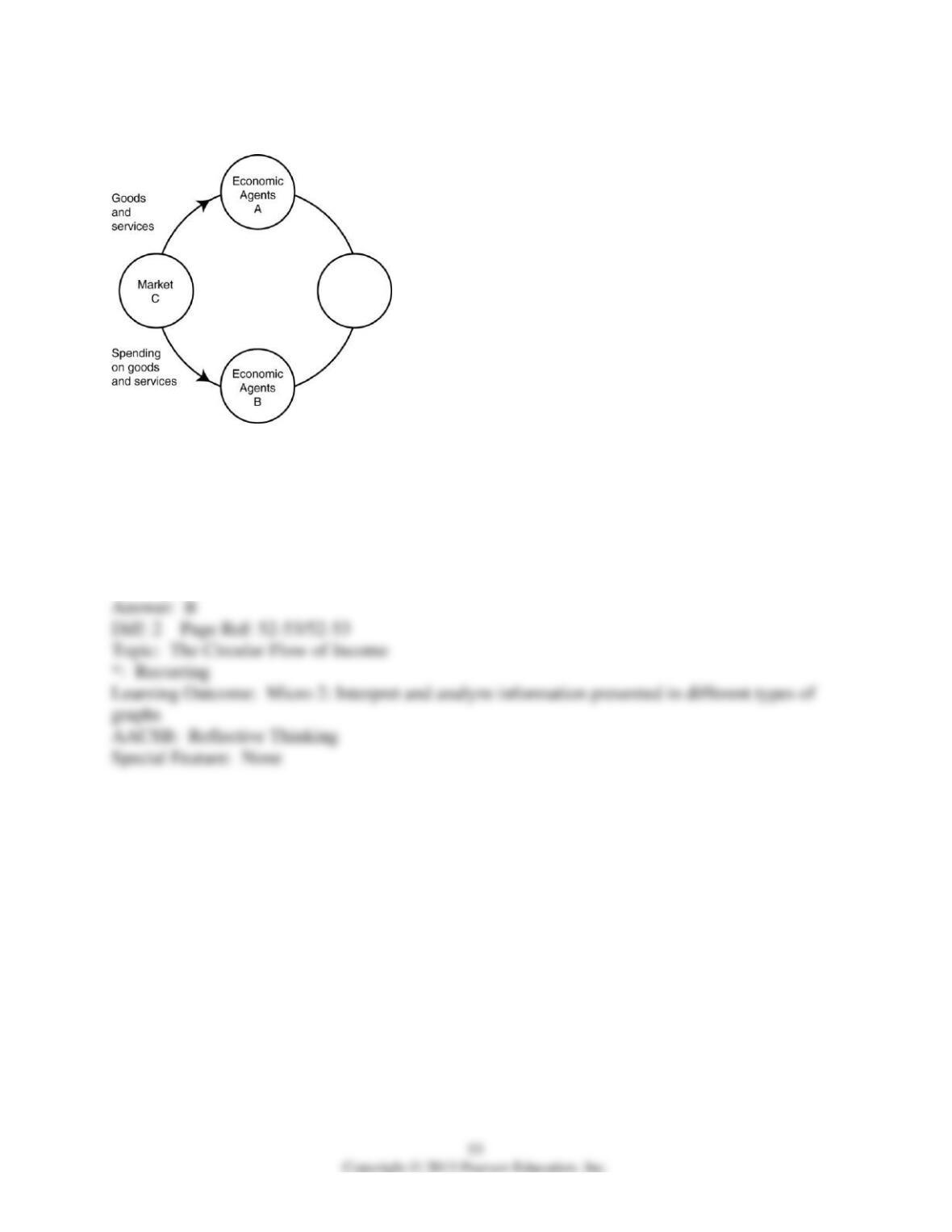
Figure 2-9
17) Refer to Figure 2-9. One segment of the circular flow diagram in the figure shows the flow
of goods and services from market C to economic agents A. What is market C and who are
economic agents A?
A) C = factor markets; A = households
B) C = product markets; A = households
C) C = factor markets; A = firms
D) C= product markets; A = firms
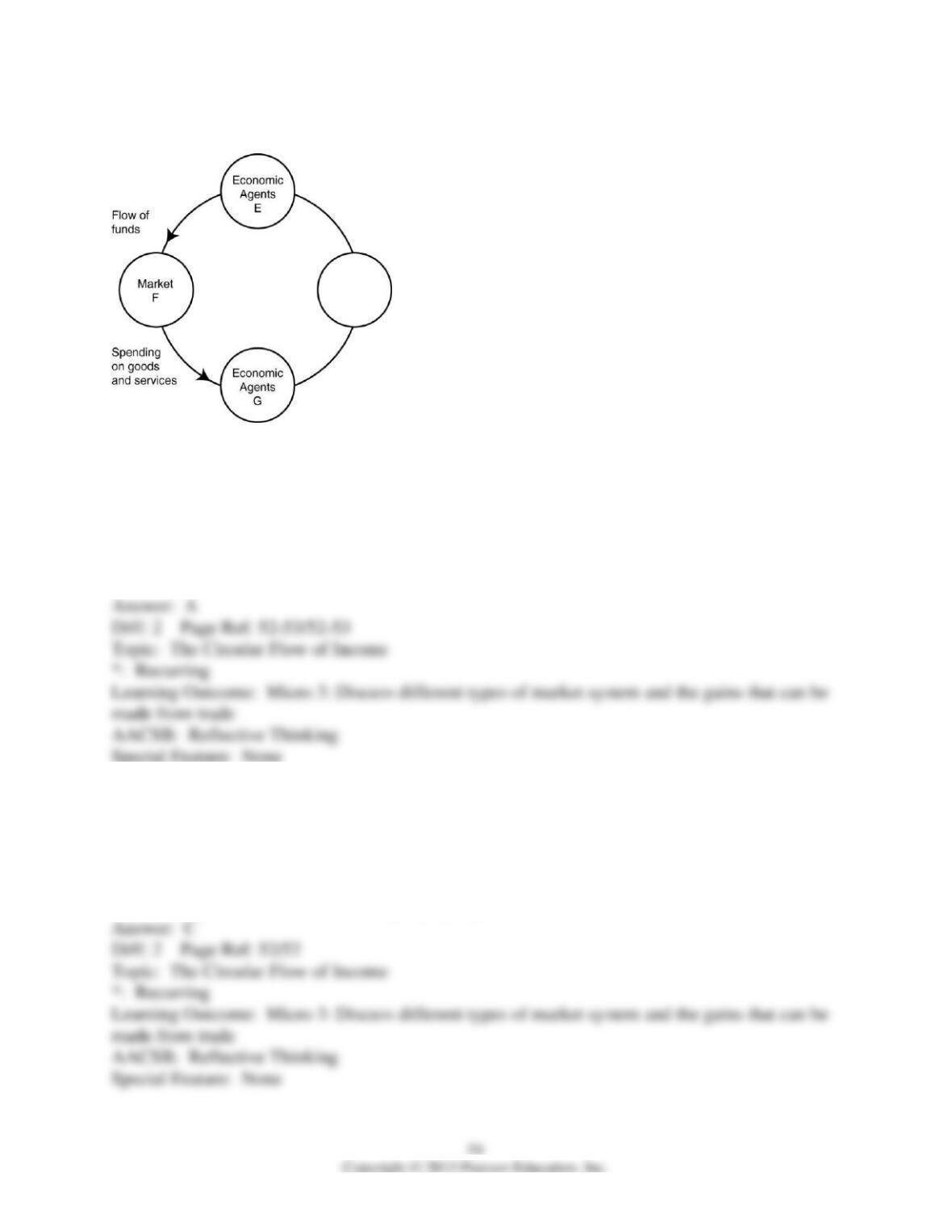
Figure 2-10
18) Refer to Figure 2-10. One segment of the circular flow diagram in the figure shows the flow
of funds from economic agents E to market F. Who are economic agents E and what is market
F?
A) E = households; F = product markets
B) E = firms; F = product markets
C) E = households ; F = factor markets
D) E = firms; F = factor markets
19) All of the following are examples of spending on factors of production in the circular flow
model except
A) Bima hires two students to work at his ice-cream store.
B) “Get Fit Together” purchases 3 new treadmills for its gym.
C) Iris buys a dozen roses for her mother’s birthday.
D) The Banyan Tree rents a much larger property so that it can add a restaurant to its facilities.
20) Which of the following is an example of spending on goods and services in the circular flow
model?
A) Belinda purchases a new computer for her tax-preparation business.
B) Javier buys 800 square feet of wood flooring for his vacation home.
C) Celeste buys fresh herbs at the farmers’ market to use in her restaurant.
D) Timmy purchases a new examination table for use in his veterinary clinic.
21) “An Inquiry into the Nature and Causes of the Wealth of Nations” published in 1776 was
written by
A) John Maynard Keynes.
B) Karl Marx.
C) Alfred Marshall.
D) Adam Smith.
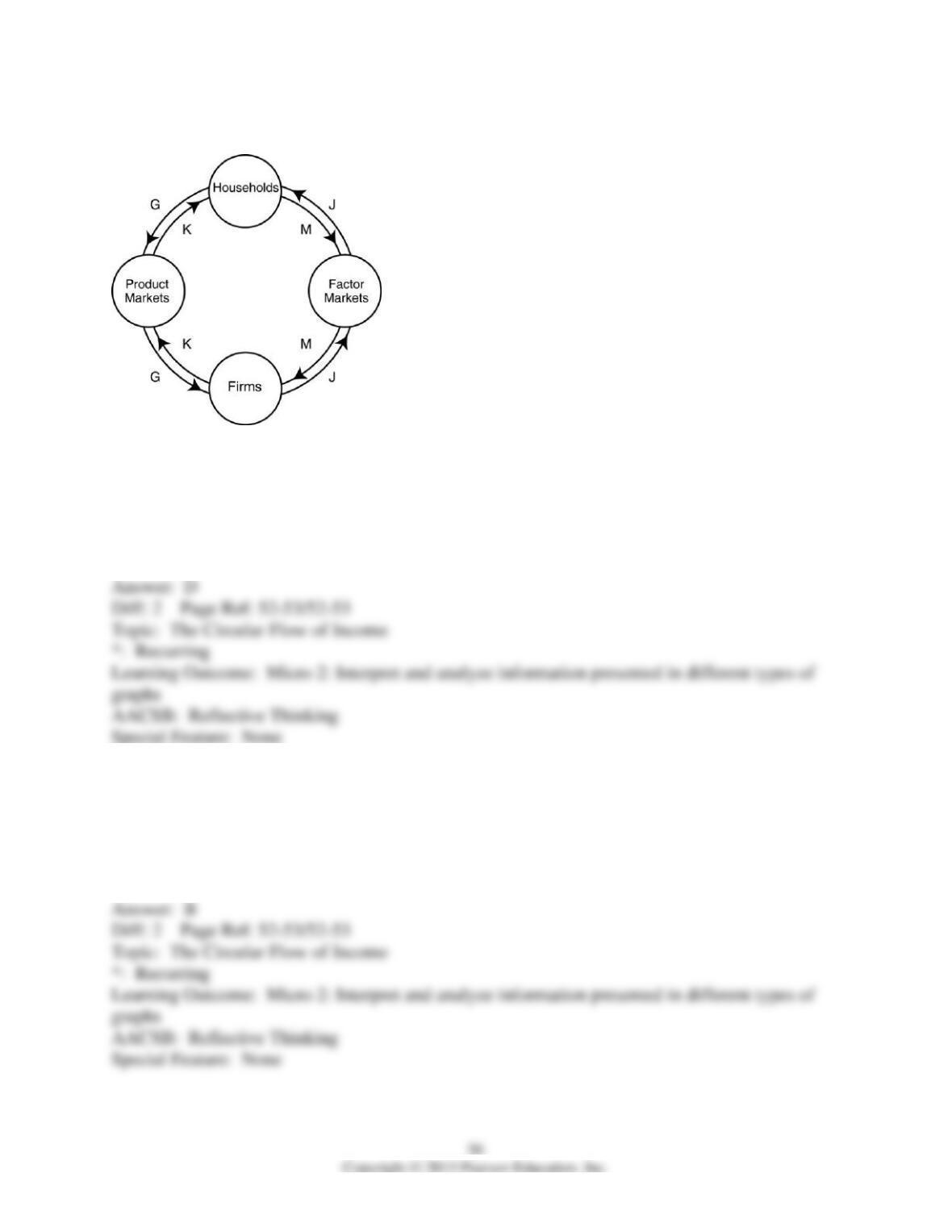
Figure 2-11
22) Refer to Figure 2-11. Which two arrows in the diagram depict the following transaction:
LaDonna sells 20 pairs of sunglasses at the Oakley store.
A) J and M
B) J and G
C) K and M
D) K and G
23) Refer to Figure 2-11. Which two arrows in the diagram depict the following transaction:
Dorian Gray hires “Wild Oscar”, a professional portrait artist, to paint his picture.
A) J and M
B) K and G
C) K and M
D) J and G
24) Refer to Figure 2-11. Which two arrows in the diagram depict the following transaction:
Barney earns $250 for selling scissors and razors to Floyd’s Barber Shop.
A) J and M
B) K and G
C) K and M
D) J and G
25) Adam Smith’s behavioral assumption about humans was that people
A) typically act irrationally.
B) usually act in a rational, self-interested way.
C) are consistently greedy.
D) typically act randomly.
26) All of the following countries come close to the free market benchmark except
A) Canada.
B) North Korea.
C) Germany.
D) Singapore.
27) Adam Smith’s invisible hand refers to
A) the government’s unobtrusive role in ensuring that the economy functions efficiently.
B) property ownership laws and the rule of the court system.
C) the process by which individuals acting in their own self-interest bring about a market
outcome that benefits society as a whole.
D) the laws of nature that influence economics decisions.
28) All of the following are critical functions of the government in facilitating the operation of a
market economy except
A) protecting private property.
B) enforcing property rights.
C) ensuring an equal distribution of income to all citizens.
D) enforcing contracts.
29) The term “property rights” refers to
A) the physical possession of a house or any other property which the owner legally purchased.
B) the ability to exercise control over one’s own resources within the confines of the law.
C) the government’s right to appropriate land from wealthy land owners to redistribute to
peasants.
D) the right of a business not to have its assets confiscated by the government in the event that
the business is accused of committing fraud.
30) The primary purpose of ________ is to encourage the expenditure of funds on research and
development to create new products.
A) centrally planned economies
B) government-run health care
C) nationalizing oil companies
D) patents and copyrights
31) A major factor contributing to the slow growth rate of less developed economies is
A) the lack of well-defined and enforceable property rights.
B) the lack of natural resources.
C) the lack of workers.
D) the high rate of illiteracy.
32) A successful market economy requires
A) a government-controlled banking system and government price controls.
B) well-defined property rights and an independent court system to adjudicate disputes based on
the law.
C) generous unemployment benefits and paid medical leave for everyone in the labor force.
D) an equitable distribution of income and limits on immigration.
33) Consider the following items:
a. the novel “The DaVinci Code” by Dan Brown
b. the “The Spirited Shipper”, an innovative wine shipping box
c. a Swiss chef’s award-winning recipe
d. an original fabric design, for example, the fabric used for “Coach” bags and luggage
Which of the items listed is an example of intellectual property?
A) a and b only
B) a, b, and c
C) a and d only
D) all of the items listed
34) An organization of producers that limits the amount of a good produced is known as a
A) free market organization.
B) guild.
C) collective.
D) co-op.
35) In 18th century Europe, governments gave guilds legal authority to limit production of
goods. Did this authority obstruct or improve the market mechanism and how?
A) It improved the market mechanism by making it more efficient because the guilds were able
to quickly identify and rectify any market shortages and surpluses.
B) It improved the market mechanism because the government’s actions provided the correct set
of signals to the market so that producers can adjust their output to better meet the needs of
consumers.
C) It obstructed the market mechanism because the guild’s actions prevented the forces of
demand and supply from coordinating the self-interested decisions of producers and consumers.
D) It obstructed the market mechanism because with one more party having to coordinate
activities (the guilds) there were delays in getting the products to consumers.
36) Stricter laws and regulations to protect intellectual property rights
A) will help to create a more successful market system.
B) will only benefit those companies whose intellectual property rights have in the past been
ignored.
C) will tend to have little impact on an economy since intellectual property is not tangible.
D) will create a stronger and more successful black market for intellectual property.
37) If a nation changes its laws to more actively enforce intellectual property rights, all of the
following will most likely take place except
A) more software companies will choose to export their products to that country.
B) more film makers will choose to do business in that country.
C) the black market for intellectual property will become more prosperous in in that country.
D) foreign investment in that country will increase.
38) The payment received by suppliers of entrepreneurial skills is called interest.
39) In the circular flow model, households supply resources such as labor services in the product
market.
40) Entrepreneurs bring together the factors of production to produce goods and services.
41) In a free market there are virtually no restrictions, or at best few restrictions on how factors
of production can be employed.
42) Crude oil is not an example of a factor of production, but when crude oil is processed into
gasoline, it is a factor of production.
43) Each person goes about her daily business seeking to maximize her own self interests. In
doing so, she contributes to the welfare of society at large. This is the idea underlying Adam
Smith’s “invisible hand.”
44) What is the difference between product markets and factor markets?
45) How do firms and households interact in markets?
46) What is meant by the term “free market”?
47) How does Adam Smith’s idea of the “invisible hand” apply to the various parts, made by
many different manufacturers in many different countries, that are used by Apple to produce an
iPad?