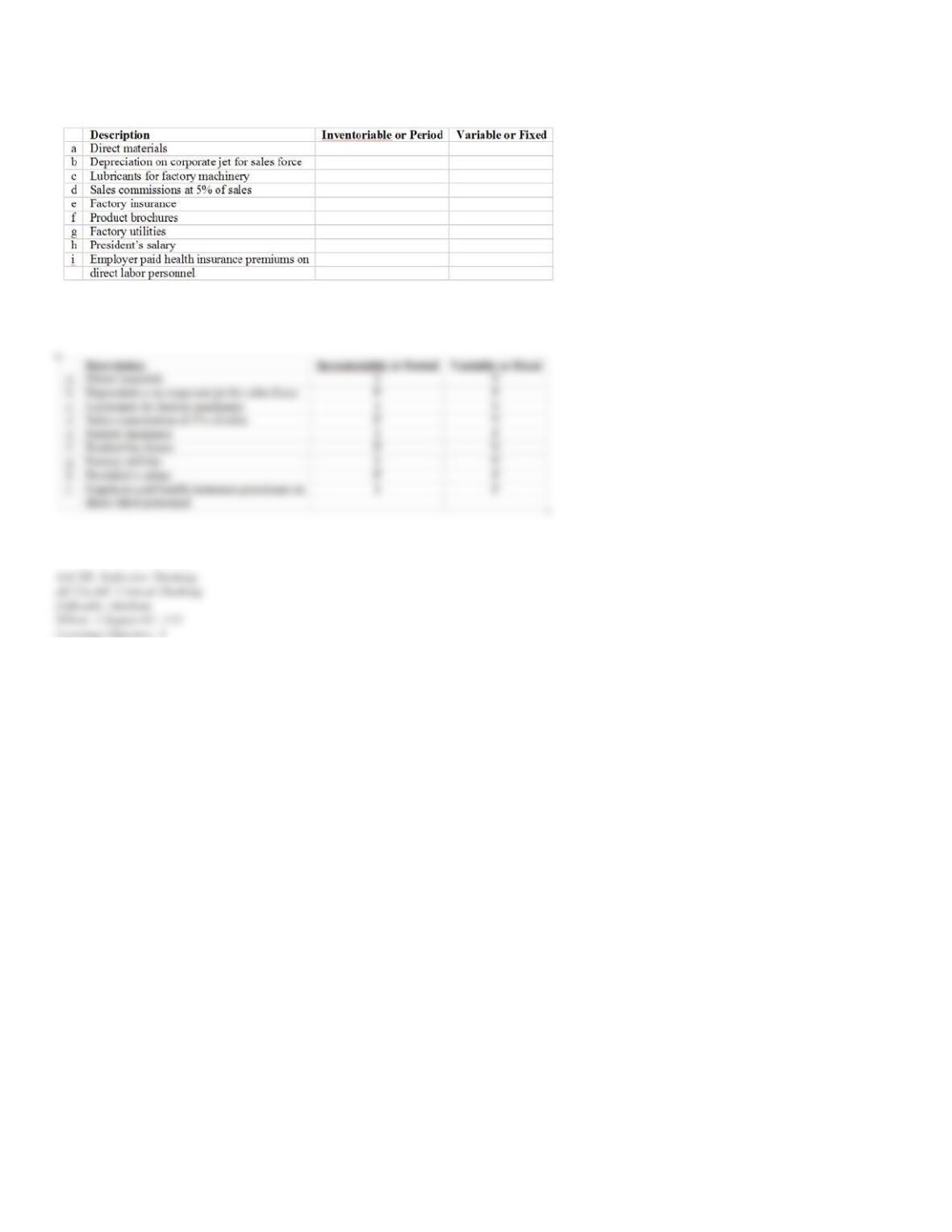
115. Classify each of the following costs as inventoriable (I) or period (P) and indicate whether the cost is a
variable cost (V) or a fixed cost (F).
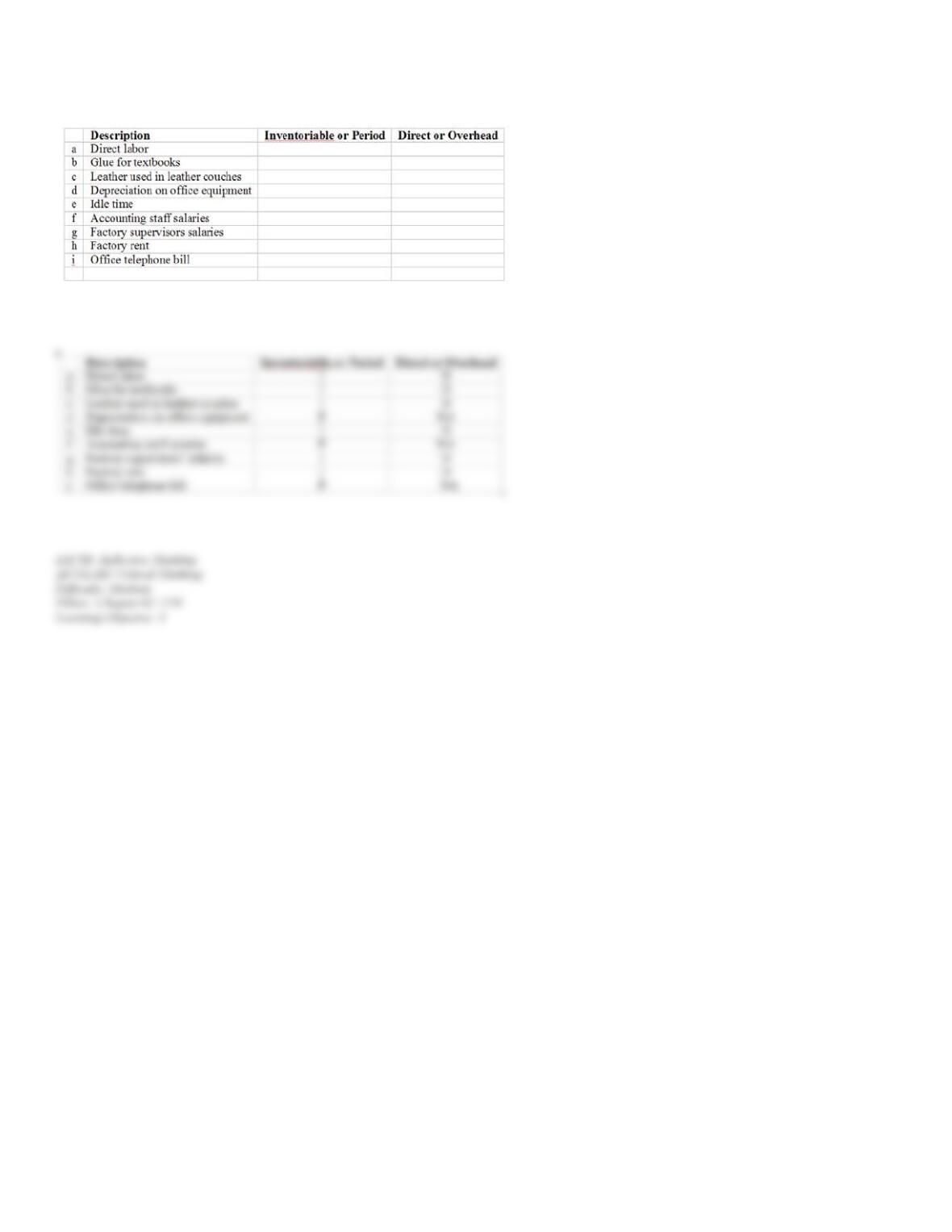
116. Classify each of the following costs as inventoriable (I) or period (P). If the cost is inventoriable, indicate
whether it would be considered a direct cost (D) or a factory overhead cost. (O)
117. Lyon Toys, Inc. (LTI) manufactures a variety of electronic toys for children aged 3 to 14 years. The
company started as a Ma & Pa basement operation, and grew steadily over the last nine years. It now employs
over 100 people and has sales revenue of over $250 million. Katie Burger, the CEO of LTI also recognizes that
competition has increased during this period; therefore future growth will not be easy.
Burger recognizes that one of the areas of weakness is the accounting and costing system. Burger‘s maternal
uncle, Martin, had maintained the accounts for the company. He meticulously kept track of all the invoices that
were received, payments made, and painstakingly prepared crude annual reports. With Martin passing away at
the age of 85, Burger decided to hire a professional cost management expert to keep track of the company‘s
costs. She hired Molly Wright, who had just completed her CMA.
After acquainting Wright with the company and its people, Burger decided to get down to business. She called
Wright to her office to have a serious conversation about accounting and costing, in particular.
Burger: Molly, I would like you to pay particular attention to developing an official costing system. Currently,
we don’t have one. I believe this should be your first priority because competition is rising and if we do not
understand our costs, we might start losing to our rivals.
Wright: I understand your point very well, Ms. Burger.
Burger: Call me Katie.
Wright: Very well, Katie. I have a few ideas that I picked up from my CMA courses that I think are worth
implementing. However, it looks like we need to start with the basics.
Required
Assume the role of Molly Wright. Write a brief report outlining the basics of a cost management information
system. Include in your report the following:
Ⴠ Resources and costs
Ⴠ Supply of resources vs. the use of resources
Ⴠ Classification of costs (three dimensions of resources)
Ⴠ Alternative costing systems
118. Explain how producing more units than can be sold can increase operating income. Would this be an issue
in a service company or is it only an issue in a manufacturing environment? Could a company employ this
strategy indefinitely to show continuous increases in profits?
119. The following description appeared in the 2005 annual report of McCormick & Company:
McCormick is a global leader in the manufacture, marketing and distribution of spices, herbs, seasonings and
other flavors to the entire food industry. Customers range from retail outlets and food service providers to food
manufacturers. Founded in 1889 and built on a culture of Multiple Management, McCormick has approximately
8,000 employees.” (McCormick & Company- 2005 Annual report)
Required: For each of the cost terms listed below, define the term and give an example of a cost that might fit
into that category at McCormick & Company.
(a) Unit- level costs
(b) Product costs
(c) Direct costs
(d) Manufacturing overhead costs
(e) Period costs
(f) Batch–level costs
120. Briefly compare and contrast throughput costing, variable costing and absorption costing.
What are the theoretical arguments for and against each method?
121. Case
Sabrina Wood has recently inherited a medium-sized machine shop. Upon taking over, she finds that the
business is not doing as well as her Dad had made it out to be. The list of dissatisfied customers has been
steadily growing; she has had to do a lot of explaining to customers and promised to improve the situation. She
called her Dad’s loyal production manager, James Hurley, to her office in order to have a chat with him.
Wood: Good morning Mr. Hurley. How are you?
Hurley: Good morning. I’m doing fine. What can I do for you?
Wood: I’ll be honest with you. I need your help and advice. You always were my Dad‘s most trusted employee.
Hurley: Any time, Ms. Wood. What seems to be the problem?
Wood: I have recently received calls from some long-time customers who are frustrated with our cost, quality
and on-time delivery performance. They said they would soon take their business elsewhere if we do not
improve. These people were good friends of my Dad and gave him their business only because of this
friendship.
Hurley: To be honest, our production processes need improvement. The whole shop floor has become a bit
chaotic during the last five years when more orders started coming in. We are just unable to cope. It is not that
we do not have the capacity or the capabilities. Our problem is more because of the lack of discipline. I could
not do a whole lot because your Dad was determined to continue in this manner.
Wood: My father was stubborn. I do not want to be like him. Please tell me if there are other problems that we
need to deal with.
Hurley: The other problem is the lack of a cost management system. Your Dad ran the show by just recording
all the costs and computing an average. We have no idea which products are making money and which are not.
Do you mind if I call Lindsay Sawin, our new accountant, and ask her to join us? She can explain you what is
going on, and can also make some suggestions to improve.
Wood: Please do. (She waits for Sawin to join the meeting.) Good morning, Lindsay. Mr. Hurley tells me that
our costing system is in disarray.
Sawin: Yes. Currently, there is no order in the way that we measure costs. In fact, in the last three months since
I joined this company, I have just been trying to understand the processes, the types of resources that are used,
where they are used in the company’s value-chain, and their traceability to decisions.
Wood: Thank you for doing this. What can we do? In fact, is there any hope for us? It is important that we
understand costs and are able to compute the cost and profitability information for each of our products or at
least product lines. Do you have any ideas?
Sawin: Yes, we can certainly do that. However, I must inform you that there are three alternative costing
methods and each of these has its merits and limitations.
Wood: I did not realize that we have to make decisions about the type of the costing system we would like to
use. We need to know a little more about each system. Can you show us what would happen under each costing
system? In particular, I would like you to present a scenario where you use cost data to show us the product
costs and operating incomes from using the three different costing methods. This might open the eyes of many
of us around here. Together, we can work hard to keep my Dad‘s company alive.
Sawin: Please give me a month‘s time. I will put together something to present to you and several others. It
would be nice if we can spend an entire afternoon on this so that I can get into some detail.
Required:
Assume the role of Lindsay Sawin. Identify all the issues raised and address them. For the computational
requirement, consider the following information.
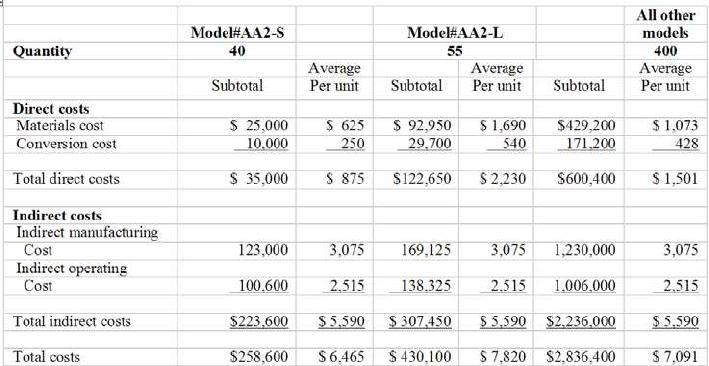
Additional information:
Ⴠ Sales prices:
$8,900 per unit of Model # AA2-S
16,700 per unit of Model AA2-L
10,000 per unit of all other models
Ⴠ The only spending increase was for material cost because this increased production. All other spending as
shown above was unchanged.
Ⴠ Sales were as follows:
32 units of part Model # AA2-S
55 units of Model # AA2-L
350 units of all other models