132)
Suppose you have four choicesgo to a movie, read a book, watch television, or go to a concert.
You choose to go to a movie. The opportunity cost of the movie is
132)
A)
the value of the book not read.
B)
the value of the concert that you didn’t attend.
C)
the value of the television program not watched.
D)
the value of the activity that you would have selected if you hadn’t gone to the movie.
133)
Fred and Ann both decide to see the same movie when they are given free movie tickets. We know
that
133)
A)
both bear the same opportunity cost since they are doing the same thing.
B)
both bear an opportunity cost since they could have done other things instead of see the
movie.
C)
the cost of going to the movie is greater for the one who had more choices to do other things.
D)
neither bears an opportunity cost because the tickets were free.
134)
If the quantity desired of something exceeds the amount available at zero price, that item is called
134)
A)
capital.
B)
a bad.
C)
an intangible good.
D)
an economic good.
135)
A point inside a production possibilities curve indicates
135)
A)
opportunity costs are constant.
B)
resources are being used very efficiently.
C)
resources are not being used efficiently.
D)
an output combination that is unobtainable with the current resource and technology levels

136)
Specialization occurs because
136)
A)
society produces made the production possibilities curve.
B)
people have different skills.
C)
society trades current consumption for future consumption.
D)
the production possibilities curve tends to be linear.
137)
The only way that a society can produce outside the production possibilities curve is
137)
A)
to use the concept of opportunity cost.
B)
by producing efficiently.
C)
through economic growth.
D)
by obeying the Law of Increasing Additional Cost.
138)
When productive activities are organized according to the principle of the division of labor
138)
A)
we do not devote enough resources for capital investment.
B)
total output increases due to the advantages of specialization.
C)
an inefficient outcome results.
D)
scarcity is eliminated.
139)
The ability to produce a good at a lower opportunity cost than others is known as
139)
A)
comparative advantage.
B)
marginal cost production.
C)
absolute advantage.
D)
specialization.

140)
Which of the following statements about economic scarcity is FALSE?
140)
A)
Scarcity only occurs if there are shortages and people wait in line to buy things.
B)
Scarcity results from not having enough resources to produce all the things we want.
C)
Scarcity occurs among the poor and the rich.
D)
Scarcity results in the necessity to make choices.
141)
The difference between scarcity and a shortage is that
141)
A)
scarcity is caused by poverty and shortages are caused by natural disasters.
B)
scarcity always is a part of human life while shortages usually are temporary.
C)
shortages are a type of scarcity caused by natural disasters while scarcity is caused by human
errors.
D)
shortages are always part of human life while scarcity is usually temporary.
142)
When a country or a region of a country specializes in producing the product that has the lower
opportunity cost compared to another country or region, it is practicing
142)
A)
comparative advantage.
B)
absolute advantage.
C)
cost disadvantage.
D)
regional advantage.
143)
The production possibilities curve represents
143)
A)
society’s needs.
B)
all possible combinations of total output that can be produced.
C)
the total amount of stocks and bonds that exist in the economy.
D)
the trade–off between human capital and physical capital that exists.
144)
A waitress brings a free glass of wine when you sit down in a restaurant. This glass of wine is
144)
A)
a service because the waitress carried it instead of making it.
B)
a good, but not an economic good because there is no price charged for the wine.
C)
an economic good because wine is produced with scarce resources, even if it is free to you.
D)
a nongood because there is no price charged for the wine.
145)
Which of the following would cause an economy to produce at a point inside its production
possibilities curve?
145)
A)
capital accumulation
B)
unemployment and an inefficient use of available resources
C)
population growth
D)
the efficient allocation of all factors of production
B
Explanation:
146)
A production point that lies outside the Production Possibilities Curve (PPC)
146)
A)
denotes inefficiency.
B)
is currently not attainable.
C)
indicates unemployment.
D)
can never be reached, even in future periods.
B
Explanation:
147)
A bowed outward production possibilities curve occurs when
147)
A)
there are shortages in the goods being produced.
B)
additional units of output of one good necessitate greater reductions in the other good.
C)
opportunity costs are constant.
D)
resources are not scarce.
B
Explanation:
C
Explanation:

148)
The reason that most of the coffee that is consumed in the United States comes from Colombia is
that
148)
A)
Colombia has an absolute advantage in producing coffee relative to the United States.
B)
coffee cannot be grown in the United States.
C)
Colombia has a comparative advantage in producing coffee relative to the United States.
D)
government trade disincentives regarding Colombian coffee make such trade possible.
149)
Wants
149)
A)
are used by economists and refer to the same thing as needs when used by psychologists.
B)
refer to services while needs refer to goods.
C)
is another term for needs.
D)
is the term used by economists instead of needs because needs are not objectively definable.
D
Explanation:
150)
Education increases the stock of which factor of production?
150)
A)
land
B)
entrepreneurship
C)
physical capital
D)
human capital
D
Explanation:
151)
Which of the following is a TRUE statement?
151)
A)
Opportunity cost is an objective measure since the cost of an activity is the same for everyone.
B)
Cost is always measured in the nation’s currency.
C)
Opportunity cost is always a foregone opportunity.
D)
The less alternatives there are the greater the cost.
C
Explanation:
C
Explanation:
152)
The idea of comparative advantage is related to
152)
A)
engineering efficiency.
B)
using the worker with the most diverse sets of skills.
C)
the idea of absolute advantage.
D)
the idea of opportunity cost.
153)
From the economist’s point of view
153)
A)
wants and needs are exactly the same.
B)
we all have wants but only very poor people have needs.
C)
a want is a lifesaving necessity.
D)
needs are objectively undefinable.
Explanation:
154)
The value of the best alternative sacrificed to obtain something you want is referred to as
154)
A)
sunk cost.
B)
opportunity cost.
C)
explicit cost.
D)
marginal cost.
Explanation:
155)
Efficiency can correctly be defined as
155)
A)
producing the maximum output with given technology and resources.
B)
producing outside the production possibilities boundary.
C)
providing for the immediate needs of the greatest proportion of the population.
D)
minimizing opportunity cost.
Explanation:
Explanation:
156)
In economics, the term physical capital
156)
A)
refers to the process of raising funds through the stock market.
B)
refers to funds used by businesses to acquire goods and services.
C)
defines the stock of merchandise already produced.
D)
refers to all manufactured resources used for production.
157)
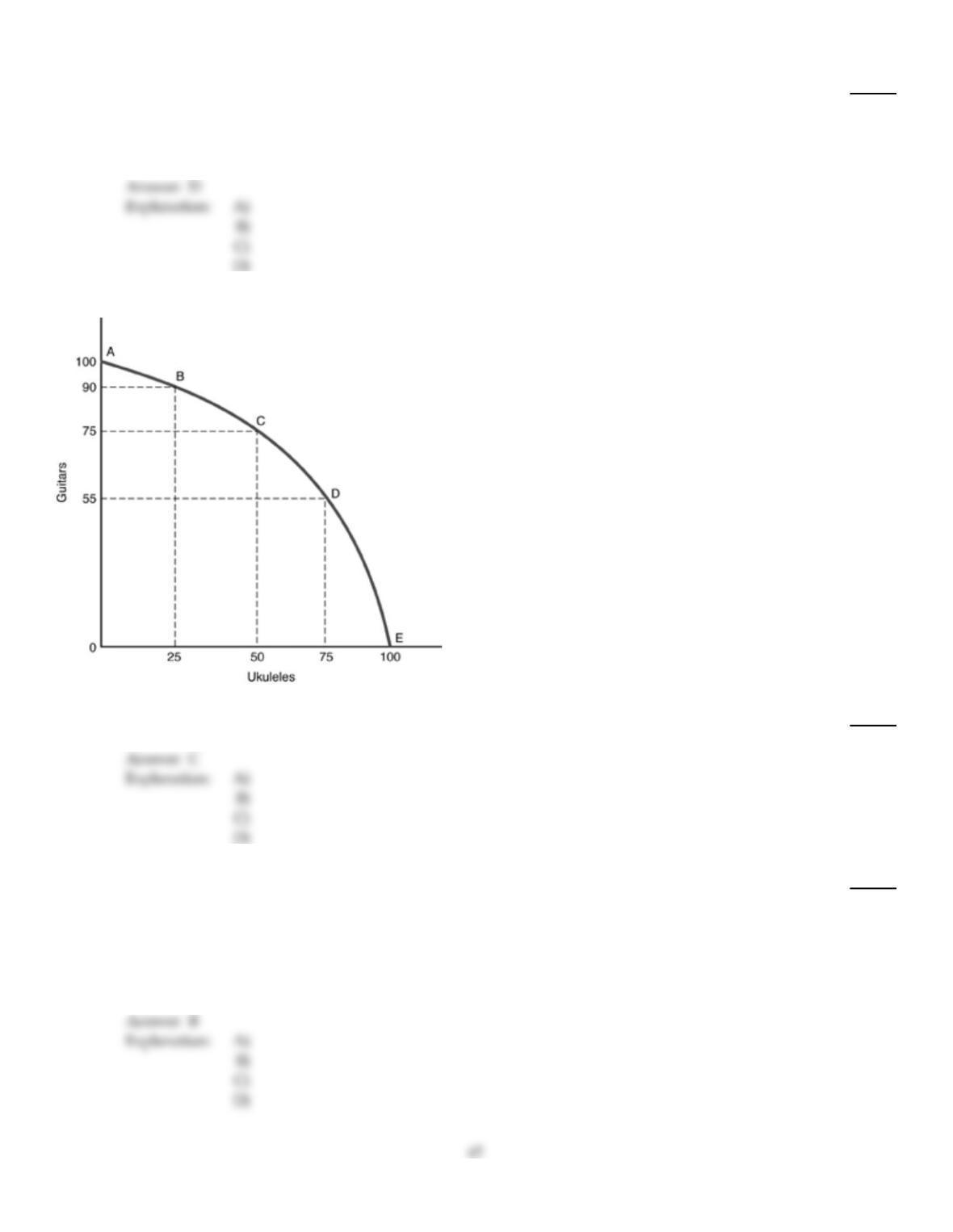
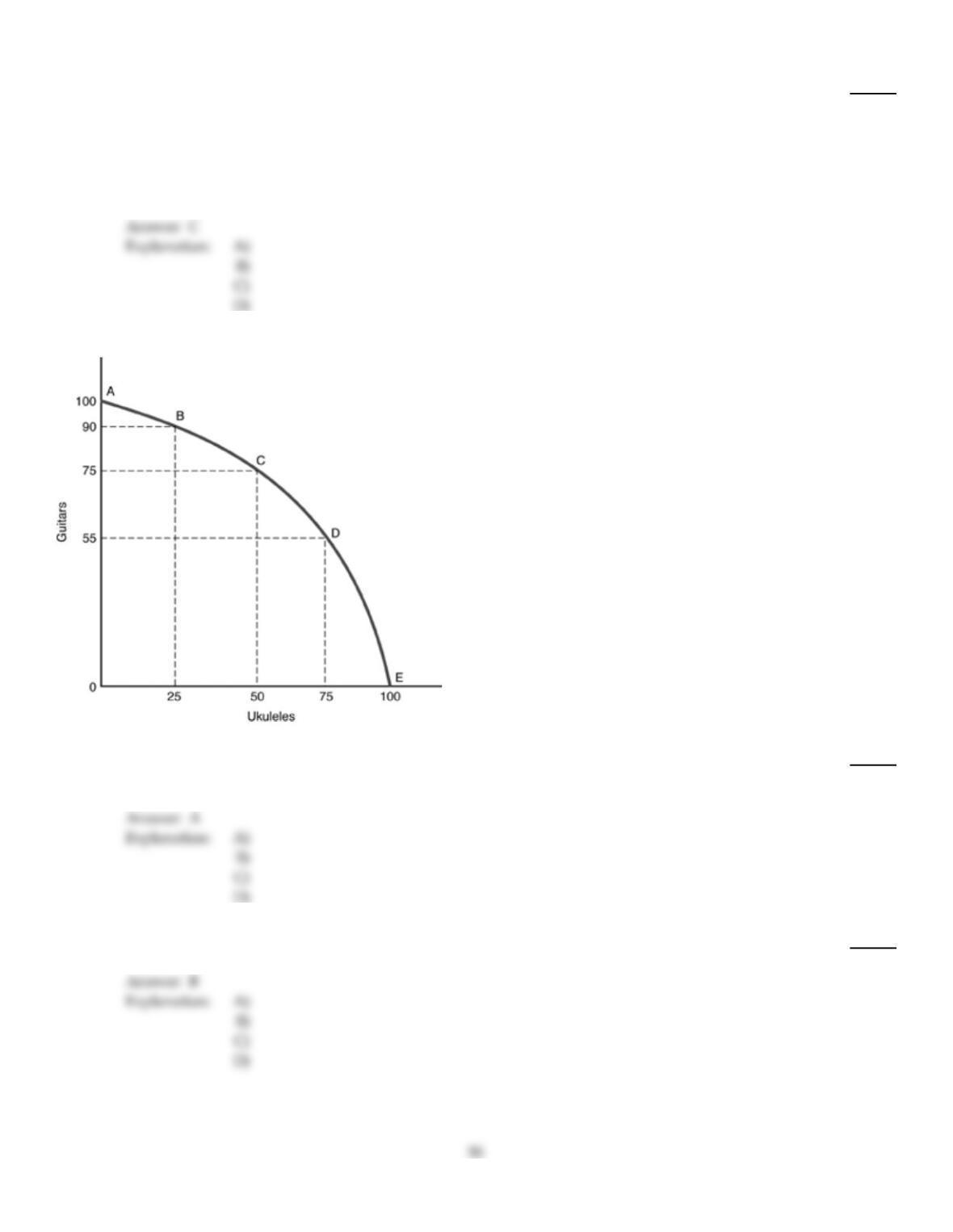
In the above figure, as more ukuleles are produced, the opportunity cost in terms of guitars is
157)
A)
constant.
B)
zero.
C)
increasing.
D)
decreasing.
C
158)
On an afternoon that a class meets, you could alternatively study for an exam that will take place in
another class the next morning, go to a movie with a friend, or, most desirable to you at present,
take a nap. The opportunity cost of attending the afternoon class is
158)
A)
giving up the time to study for the next morning’s exam.
B)
forgoing the nap.
C)
missing seeing the movie with your friend.
D)
being unable to engage in all three of the above activities.
B
D
159)
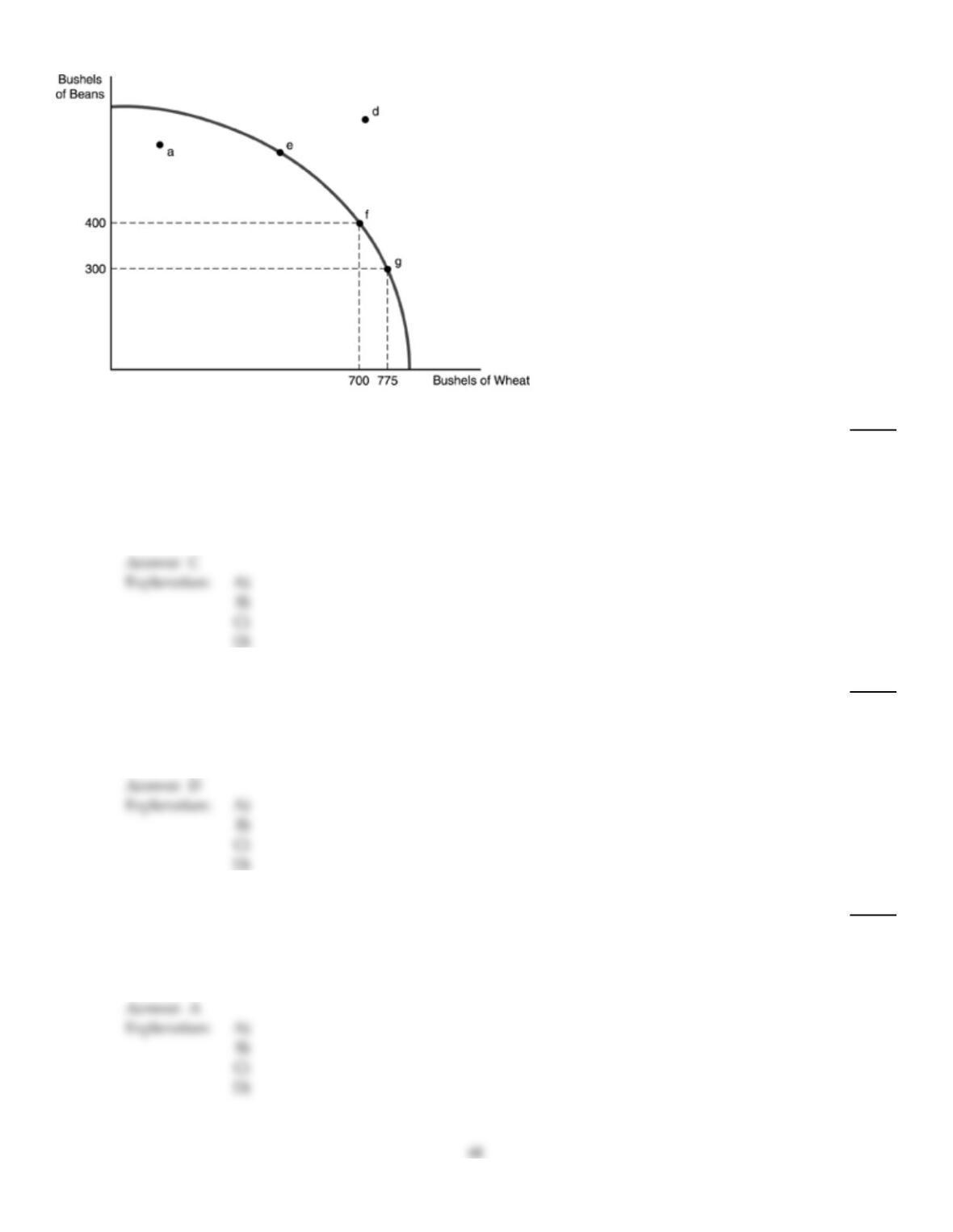
Refer to the above figure. The shape of the production possibility curve indicates that production of
159)
A)
both goods are characterized by decreasing costs.
B)
wheat is characterized by decreasing costs while the production of beans is characterized by
increasing costs.
C)
both goods are characterized by increasing costs.
D)
wheat is characterized by increasing costs while the production of beans is characterized by
decreasing costs.
160)
The principle of comparative advantage implies that
160)
A)
most people are harmed by trade.
B)
we should limit the extent to which people specialize.
C)
only wealthy countries ultimately can benefit from international trade.
D)
every country can benefit from international trade.
161)
The opportunity cost of more consumption of goods today is
161)
A)
lower consumption of goods in the future.
B)
more capital goods today.
C)
fewer capital goods in the future.
D)
more unemployment both today and in the future.
162)
If a person can make $70,000 as an accountant, $60,000 as a chef, $20,000 as a mechanic, and
nothing as an opera singer, he or she has a comparative advantage in
162)
A)
being a chef.
B)
being a mechanic.
C)
accounting.
D)
opera singing.
163)
Oil found in Alaska is an example of
163)
A)
physical capital.
B)
human capital.
C)
land or natural resource.
D)
labor.
164)
Scarcity exists because
164)
A)
there is a shortage of qualified workers throughout the world.
B)
there are not enough resources available to produce all the goods that people want.
C)
there is a shortage of goods caused by war.
D)
there is a disruption in the distribution of goods caused by bad weather.
165)
Which of the following is NOT a service?
165)
A)
a diamond used in an engagement ring
B)
tasks performed by someone else
C)
things purchased by a consumer that do not have physical characteristics
D)
physical labor purchased by a producer
166)
Whenever the economy is producing the maximum amount of goods given the level of technology
and the amount of resources
166)
A)
the concept of opportunity costs does not exist.
B)
more goods will be available than customers want to buy.
C)
the economy is producing efficiently.
D)
the number of resources used should be decreased since society must protect its scarce
resources.
167)
In the above figure, the production of 75 ukuleles and 75 guitars is
167)
A)
impossible production.
B)
inefficient production.
C)
efficient production.
D)
full employment production.
168)
In the above figure, the opportunity cost of moving from point D to point E is
168)
A)
75 guitars.
B)
55 guitars.
C)
100 guitars.
D)
100 ukuleles.
169)
The law of increasing opportunity cost implies that
169)
A)
the production possibilities curve will be a straight line.
B)
producing additional units of one good results in proportionately smaller reductions in
output of the other good.
C)
producing additional units of one good results in increasing amounts of lost output of the
other good.
D)
the society will be producing on its production possibilities curve.
170)
Economists argue that unhindered international trade leads to an efficient outcome. What is meant
by “an efficient outcome” in this context?
170)
A)
an outcome in which the standard of living is roughly equal around the world
B)
an outcome in which resources are devoted to their most efficient use
C)
an outcome in which an individual can choose to specialize in a certain line of work and be
certain that he or she can make a living at that until retirement
D)
an outcome in which wages are roughly equal around the world
171)
If a country wants to promote future growth, it should
171)
A)
produce more capital goods today.
B)
produce only economic goods.
C)
produce only needed goods.
D)
produce more consumer goods today.
172)
The law of increasing additional costs is due to
172)
A)
scarcity.
B)
taxes.
C)
the fact that it is more difficult to use resources efficiently the more society produces.
D)
the fact that resources are not perfectly adaptable for alternative uses.
173)
A graphical representation which shows the trade–off that occurs when more of one output is
obtained at the sacrifice of another is called
173)
A)
a bell curve.
B)
a Laffer Curve.
C)
a production possibilities curve.
D)
a supply curve.
174)
In order for a production possibilities curve to shift to the right, which of the following must occur?
174)
A)
reductions in the supply of resources
B)
increasing consumer wants
C)
economic growth
D)
government involvement
Explanation:
175)
Comparative advantage is
175)
A)
when a country can produce all goods more quickly than any other country.
B)
when the production possibilities curve shifts outward to the right.
C)
only for individuals and not countries.
D)
when a country can produce a good at a lower opportunity cost compared to other countries.
Explanation:
176)
Assuming Vice President Smith has to sacrifice more than his assistant in order to engage in
full–time typing, we would say that his assistant has a(n) ________ advantage in typing versus Mr.
Smith.
176)
A)
overwhelming
B)
pecuniary
C)
absolute
D)
comparative
Explanation:
177)
An outward bowed production possibilities curve illustrates
177)
A)
the law of increasing additional cost.
B)
zero opportunity cost of moving from inefficient production to currently unobtainable
production.
C)
a lack of scarcity.
D)
inefficient production.
Explanation:
Explanation:

178)
Production refers to
178)
A)
any activity that results in the conversion of resources into goods and services that can be
consumed.
B)
any activity carried on by a firm, whether a corporation, partnership, or sole proprietorship.
C)
physically producing material goods only.
D)
any activity that causes a material conversion of manufactured goods.
179)
Which of the following statements is TRUE about scarcity?
179)
A)
Scarcity exists only when supply is insufficient to meet demand.
B)
Scarcity can be eliminated when a country becomes richer.
C)
Scarcity exists only when a shortage exists.
D)
Both rich and poor people face the problem of scarcity.
180)
Which of the following statements indicates the idea of trade–offs?
180)
A)
“I chose the road less traveled.“
B)
“The devil made me do it.”
C)
“Always give it the best that you can.”
D)
“You’ve got me under your spell.”
181)
The most basic concept in economics is
181)
A)
wealth.
B)
income.
C)
spending.
D)
scarcity.
182)
A point outside a society’s production possibilities curve is one that is
182)
A)
desirable since it satisfies the desires of the population.
B)
unattainable given the resources of the society.
C)
technologically inefficient.
D)
undesirable given the implied underemployment of resources.
183)
If an economy produces only steel and wheat, a new fertilizer will
183)
A)
not affect the production of either wheat or steel.
B)
cause the production of both wheat and steel to increase at every point along the production
possibilities curve, that is the curve moves outward on both the wheat axis and the steel axis.
C)
cause the production of wheat to increase at every point on a production possibilities curve
but not affect the production of steel, that is the curve moves outward on the wheat axis only.
D)
cause the production of steel to increase at every point along the production possibilities
curve but not affect the production of wheat, that is the curve moves outward on the steel axis
only.
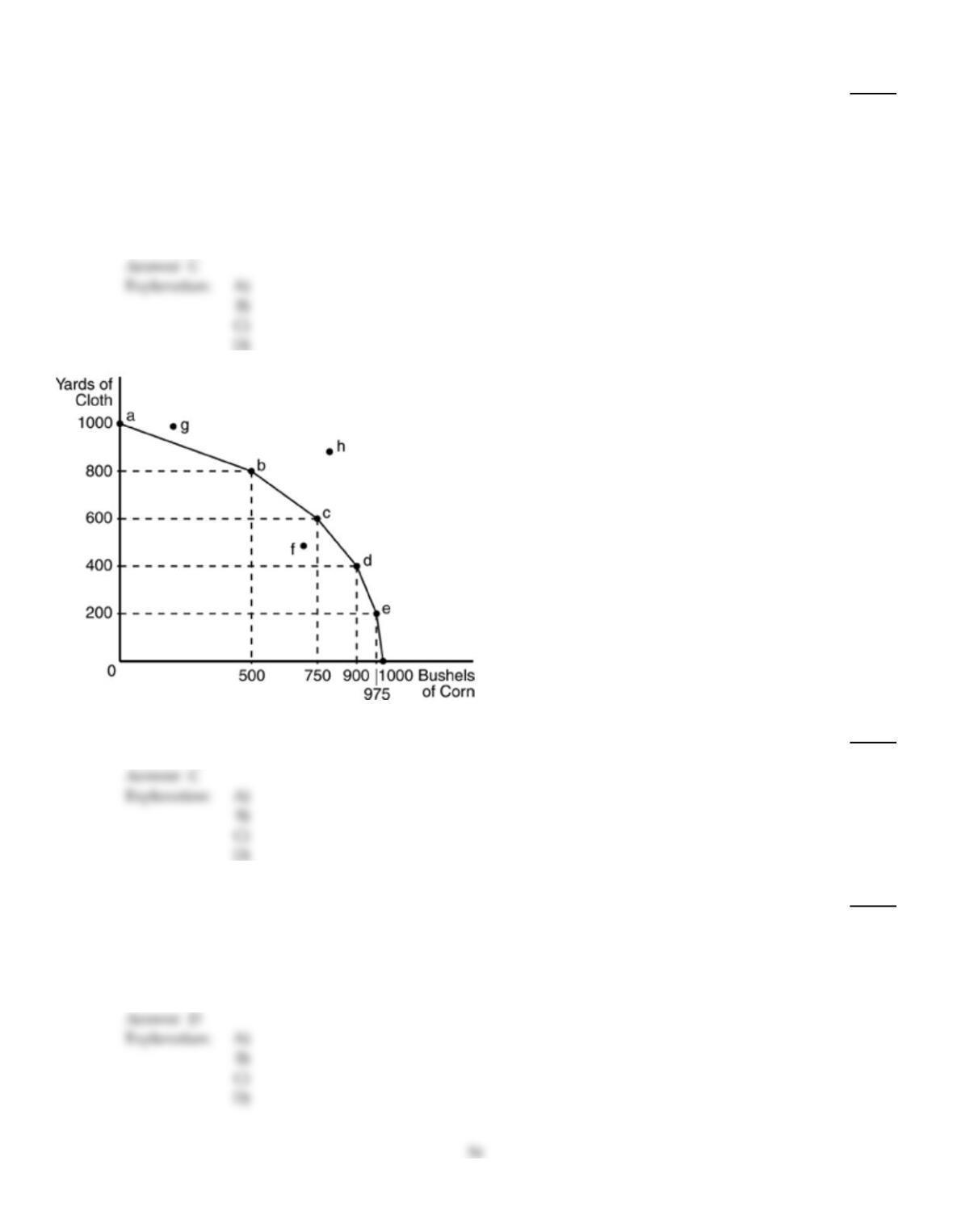
184)
In the above figure, which of the following points indicates the efficient use of resources?
184)
A)
h
B)
g
C)
a
D)
f
C
185)
Which of the following statements is NOT an assumption underlying the production possibilities
curve?
185)
A)
Production occurs over some specified time period.
B)
Technology is fixed.
C)
Resources are fully and efficiently employed.
D)
The amount of resources available for production can be changed quickly.
D
C

186)
Which type of resource will improve through more education and training by workers?
186)
A)
human capital
B)
physical capital
C)
natural resources
D)
money
187)
Which of the following will most likely happen when better technology is used in production?
187)
A)
an outward shift of the production possibilities curve
B)
a downward movement along the production possibilities curve
C)
an upward movement along the production possibilities curve
D)
an inward shift of the production possibilities curve
A
Explanation:
188)
It is correct to state that a society which is on its production possibilities curve is
188)
A)
underutilizing is resources.
B)
fully utilizing its productive resources.
C)
consuming too much output.
D)
technologically inefficient.
B
Explanation:
189)
Other things being equal, you can make $20,000 a year teaching, $25,000 a year typing, $30,000 a
year driving a cab, and $40,000 a year as a chef. You have a comparative advantage in
189)
A)
being a chef.
B)
driving a cab.
C)
teaching.
D)
one of them but we need more information to know which.
A
Explanation:
190)
A movement along the production possibilities curve would imply that
190)
A)
productivity has declined because workers are demanding more leisure.
B)
the labor force has grown.
C)
productivity has increased.
D)
society has chosen a different set of outputs.
D
Explanation:
A
Explanation:
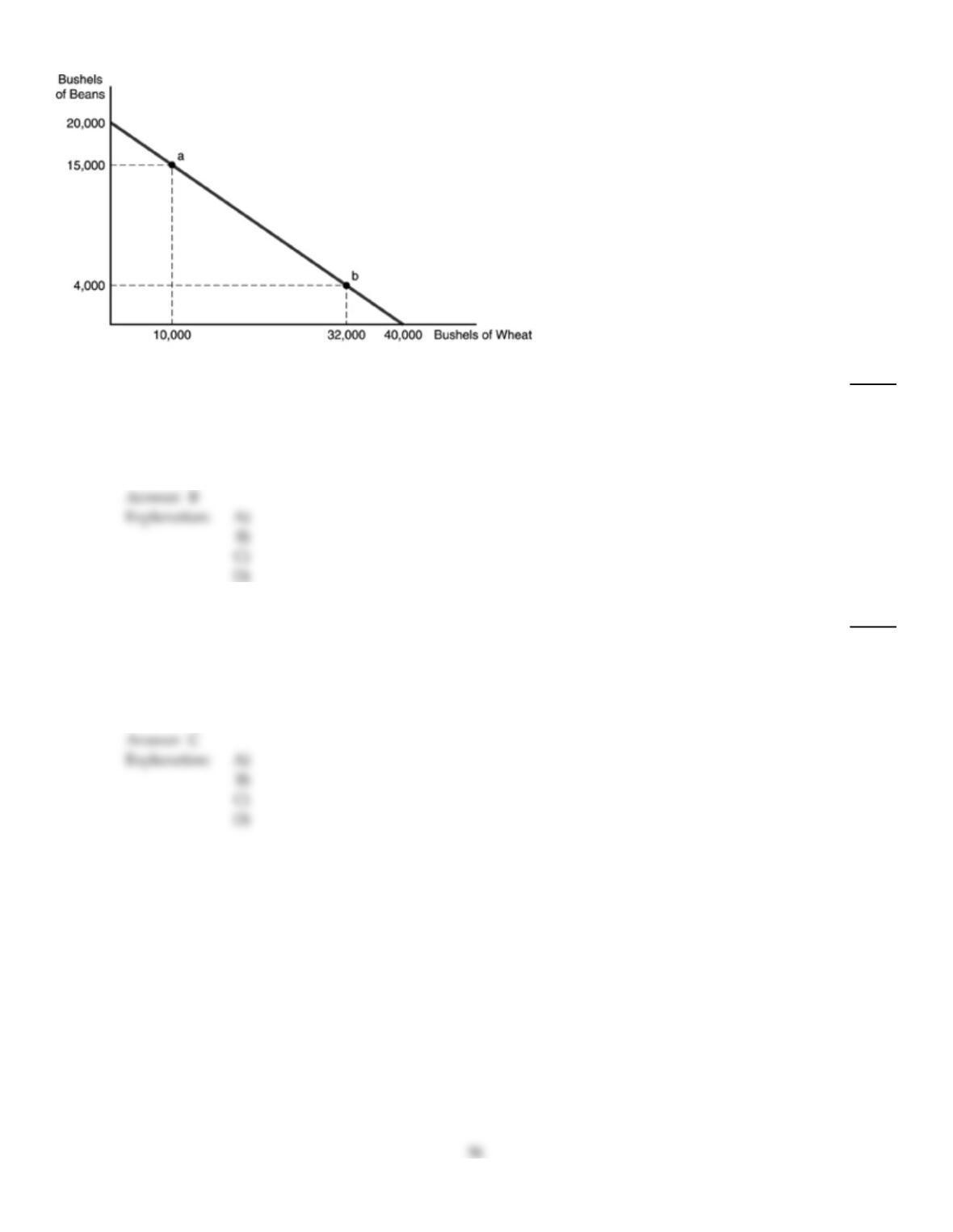
191)
Refer to the above figure. If the farmer is producing 4,000 bushels of beans and 38,000 bushels of
wheat, then we know the farmer
191)
A)
is inefficient because point a is the most efficient point on the curve.
B)
must be using more resources than were assumed available in constructing the graph.
C)
is using resources efficiently.
D)
is producing too much wheat.
192)
Refer to the above figure. If the farmer is growing 8,000 bushels of beans and 8,000 bushels of
wheat, then we know that
192)
A)
the farmer should increase the amount of wheat grown and reduce the amount of beans.
B)
the farmer is using more land for wheat than for beans.
C)
the farmer is not using resources efficiently.
D)
the farmer cannot be using the amount of land that was used to construct the curve.
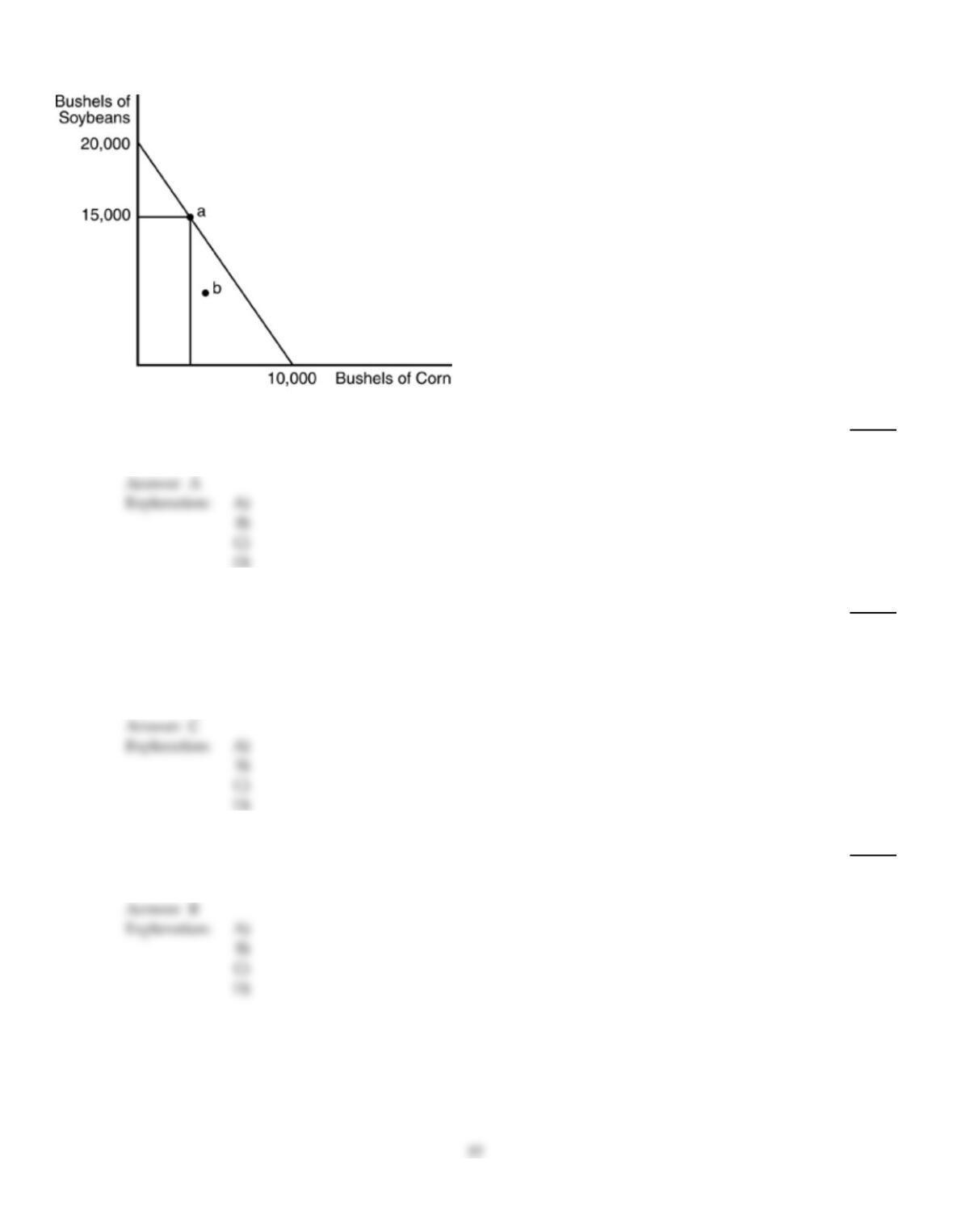
193)
In the above figure, what is the opportunity cost of one bushel of corn?
193)
A)
2 bushels of soybeans
B)
0.5 bushel of soybeans
C)
1 bushel of soybeans
D)
unable to determine
194)
One of the assumptions underlying the production possibilities curve is that
194)
A)
some of the factors of production are not being used.
B)
there is at least one factor of production that is employed inefficiently.
C)
the quantity of the resources available for the production of economic goods is fixed over a
given time period.
D)
at least one of the factors of production is a free good.
195)
Education and training of workers would best be categorized as
195)
A)
land.
B)
human capital.
C)
labor.
D)
physical capital.

A B C D E
Televisions 100 90 75 55 0
Computers 025 50 75 100
The above table shows the daily production possibilities for a nation.
196)
Given the production possibilities schedule in the above table, a combination of 60 televisions and
40 personal computers
196)
A)
is not attainable because it is not listed in the schedule.
B)
would be attainable only if a new technology of producing televisions or computers were
introduced.
C)
is attainable but involves an inefficient use of society’s resources.
D)
is not attainable because society does not have enough resources to produce this combination.
197)
The opportunity cost of going to college for a student receiving a scholarship
197)
A)
is the income that she would have earned if she did not go to college.
B)
is zero because she does not have to pay tuition.
C)
is the food and living expenses that she has to purchase while in college.
D)
is the risk of dropping out.
A B C D E
Pizza (Pies) 030 60 90 120
Bread (Loaves) 300 240 180 120 60
The above table shows the daily production possibilities for a bakery.
Currently the bakery bakes 60 pizzas and 180 loaves of bread, that is at alternative C.
198)
Using the above table, what is the opportunity cost of moving from alternative C to alternative B?
198)
A)
60 pizza pies
B)
30 pizza pies
C)
90 pizza pies
D)
1/2 a pizza pie
199)
If all resources were perfectly adaptable for alternative uses, the production possibilities curve
would
199)
A)
not exist.
B)
be bowed in.
C)
be bowed out.
D)
be a straight line.
200)
Inefficient use of resources is shown on the production possibilities curve
200)
A)
by a point inside the curve.
B)
by an inward shifting of the curve.
C)
by a point outside the curve.
D)
by a point near the top of the curve.
Explanation:
201)
Scarcity refers to
201)
A)
the ability of society to consume all that it produces.
B)
a shortage in a good or service.
C)
the inability of society to satisfy all human wants because of limited resources.
D)
the inability of an individual to purchase a good or service due to her limited income.
Explanation:
202)
Tiger Woods, a professional golfer, pays a garage mechanic to change the motor oil of his car even
though he can do the work himself. Which of the following best explains why Tiger Woods does
not change the oil himself?
202)
A)
Tiger Woods has an absolute advantage in changing oil.
B)
The opportunity cost of changing oil is higher for Tiger Woods than for the garage mechanic.
C)
There is no opportunity cost for the garage mechanic to change oil.
D)
Tiger Woods has a comparative advantage in changing oil.
Explanation:
Explanation:
203)
A friend says, “I really, really need a new car.” As an economist, you’re thinking
203)
A)
Right! Everyone needs a new car.
B)
This is an example of how objectively undefinable needs are. Many would argue that this
friend could get along just fine with a reliable used car.
C)
that a new car can only be considered a need if at least 51% of the public agrees.
D)
If this friend says she needs a new car, then we must all agree that a new car is a need and not
just a want.
204)
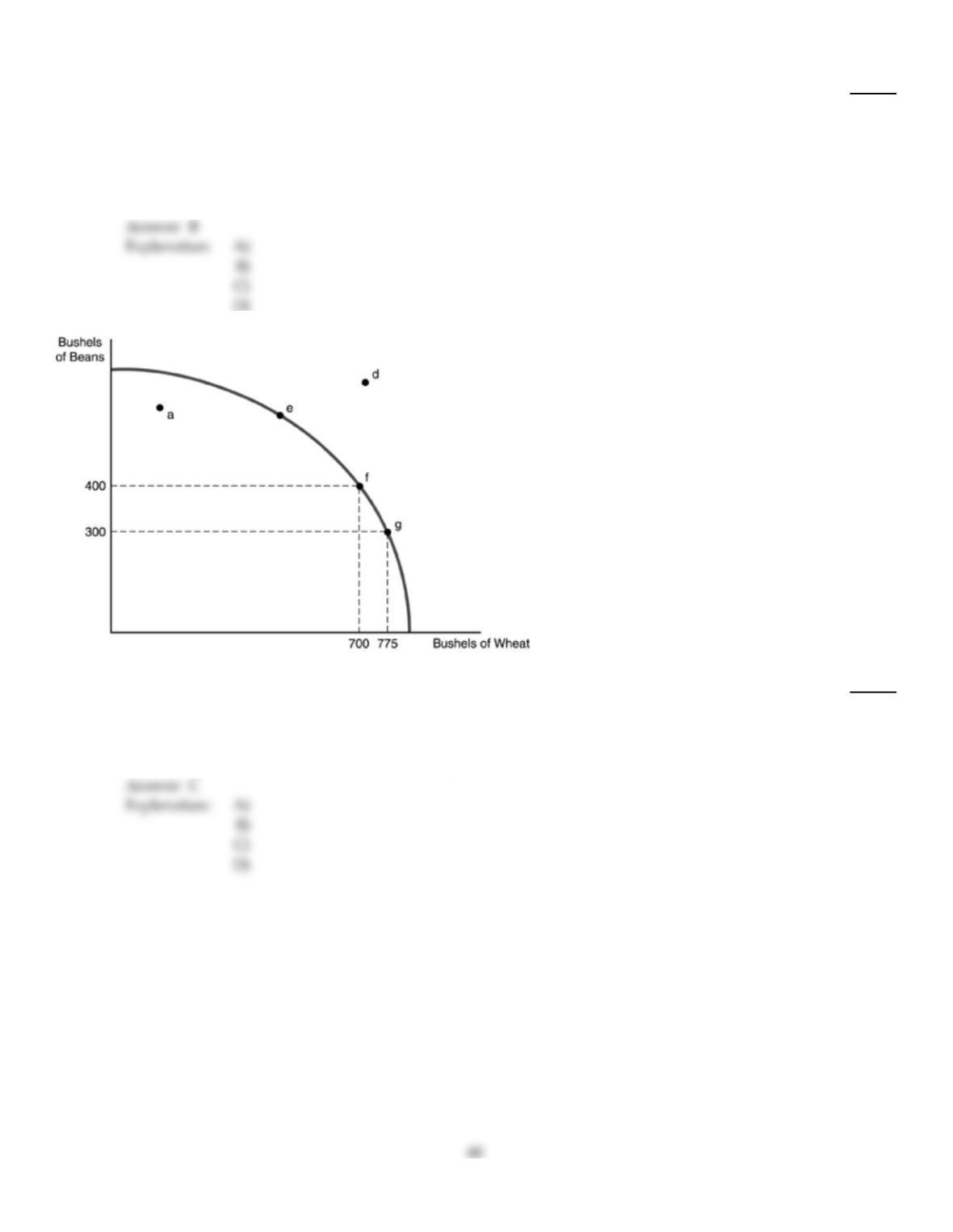
Refer to the above figure. Which of the following points indicates an efficient use of resources?
204)
A)
a
B)
d
C)
e
D)
More information is needed to answer the question.
C
B