Test Bank General Chemistry, 10th edition 32
C)
Al2F.
D)
AlF4.
E)
AlF2.
116. The formula for potassium carbonate is
A)
P2C.
B)
K2CO3.
C)
Po2CO3.
D)
P2CO3.
E)
K2C.
117. The formula for magnesium nitride is
A)
Mg2N3.
B)
Mg3N2.
C)
MgNO2.
D)
Mg(NO2)2.
E)
MgN.
118. What is the subscript of potassium in the formula for potassium sulfate?
A)
2
B)
5
C)
3
D)
4
E)
1
119. What is the formula for sodium peroxide?
A)
Na3O2
B)
NaO
C)
Na2O
Test Bank General Chemistry, 10th edition 33
D)
NaO2
E)
Na2O2
120. What is the formula for the chlorate of gadolinium(III)?
A)
Gd(ClO4)2
B)
GdCl2
C)
Gd2(ClO3)3
D)
GdCl3
E)
Gd(ClO3)3
121. What is the formula for the nitride of samarium(III)?
A)
SmN
B)
Sm2N3
C)
Sm(NO3)2
D)
Sm(NO3)3
E)
Sm(NO2)3
122. The correct name for LiCl is
A)
monolithium chloride.
B)
lithium chloride.
C)
lithium(I) chloride.
D)
monolithium monochloride.
E)
lithium monochloride.
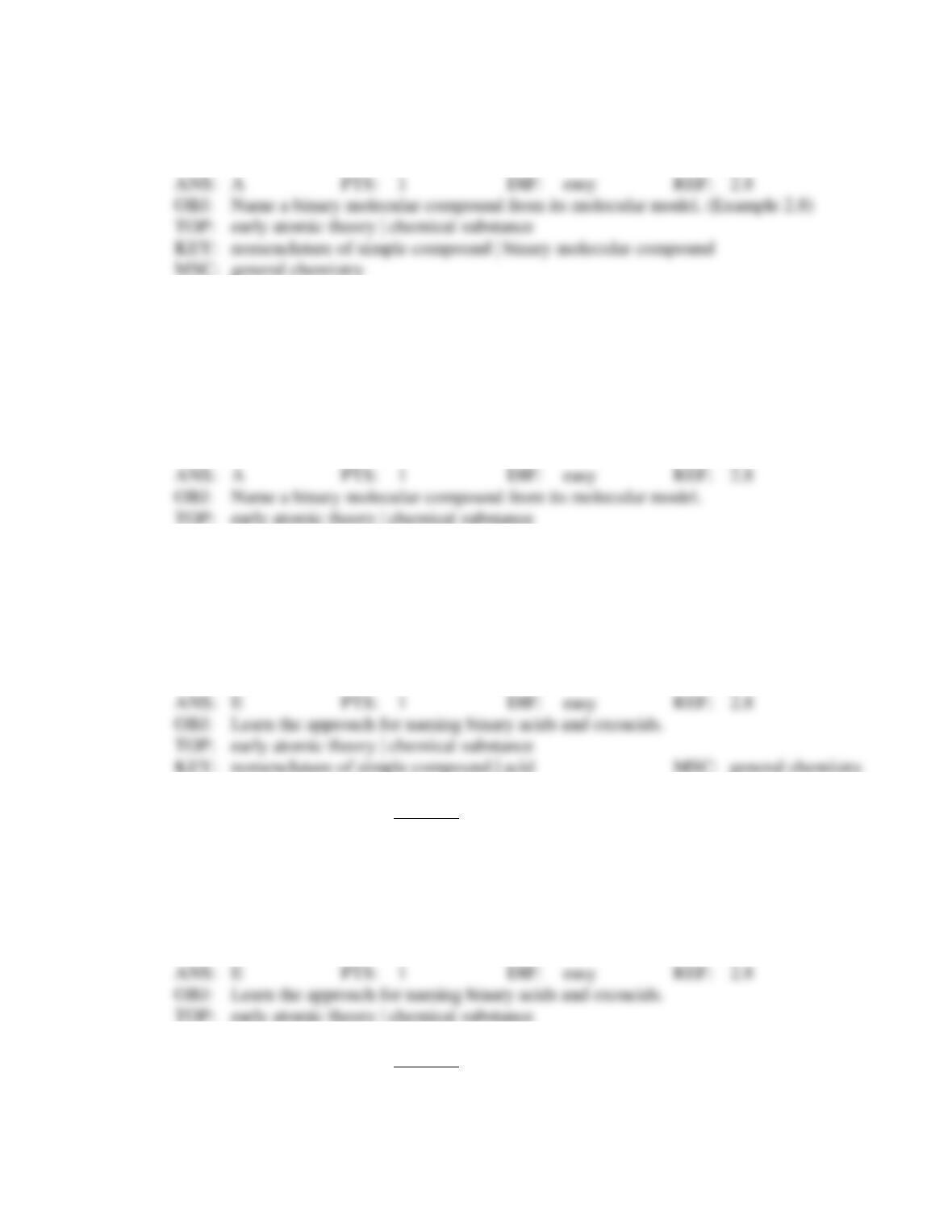
123. The chemical name for the model is
A)
dinitrogen tetroxide.
B)
nitrogen tetroxide.
Test Bank General Chemistry, 10th edition 34
C)
nitrogen oxide.
D)
nitric oxide.
E)
nitrogen trioxide
124. The chemical name for the binary, non-ionic molecule with the formula PBr5 is
A)
phosphorus pentabromide.
B)
monophosphorus bromide.
C)
phosphide pentabromide.
D)
phosphorus pentabromine.
E)
monophosphorus pentabromine.
125. The formula for chloric acid is
A)
HClO2.
B)
HClO.
C)
HCl.
D)
HClO4.
E)
HClO3.
126. Which name–formula pair is incorrect?
A)
HI, hydroiodic acid
B)
H2SO3, sulfurous acid
C)
H2SO4, sulfuric acid
D)
HClO4, perchloric acid
E)
HNO3, carbonic acid
127. Which name–formula pair is incorrect?
A)
hypochlorous acid, HClO2
B)
titanium(IV) carbide, TiC
C)
strontium nitride, Sr3N2
D)
magnesium sulfate heptahydrate, MgSO4·7H2O
E)
dinitrogen tetroxide, N2O4
128. The oxoanion that comes from nitrous acid is
A)
N2O3–.
B)
NO2–.
C)
HNO3–.
D)
NO–.
E)
NO3–.
129. For the following balanced chemical equation, which substance represents the catalyst?
2CO(g) + 2NO(g) 2CO2(g) + N2(g)
A)
NO(g)
B)
CO(g)
C)
CO2(g)
D)
N2(g)
E)
Rh(s)
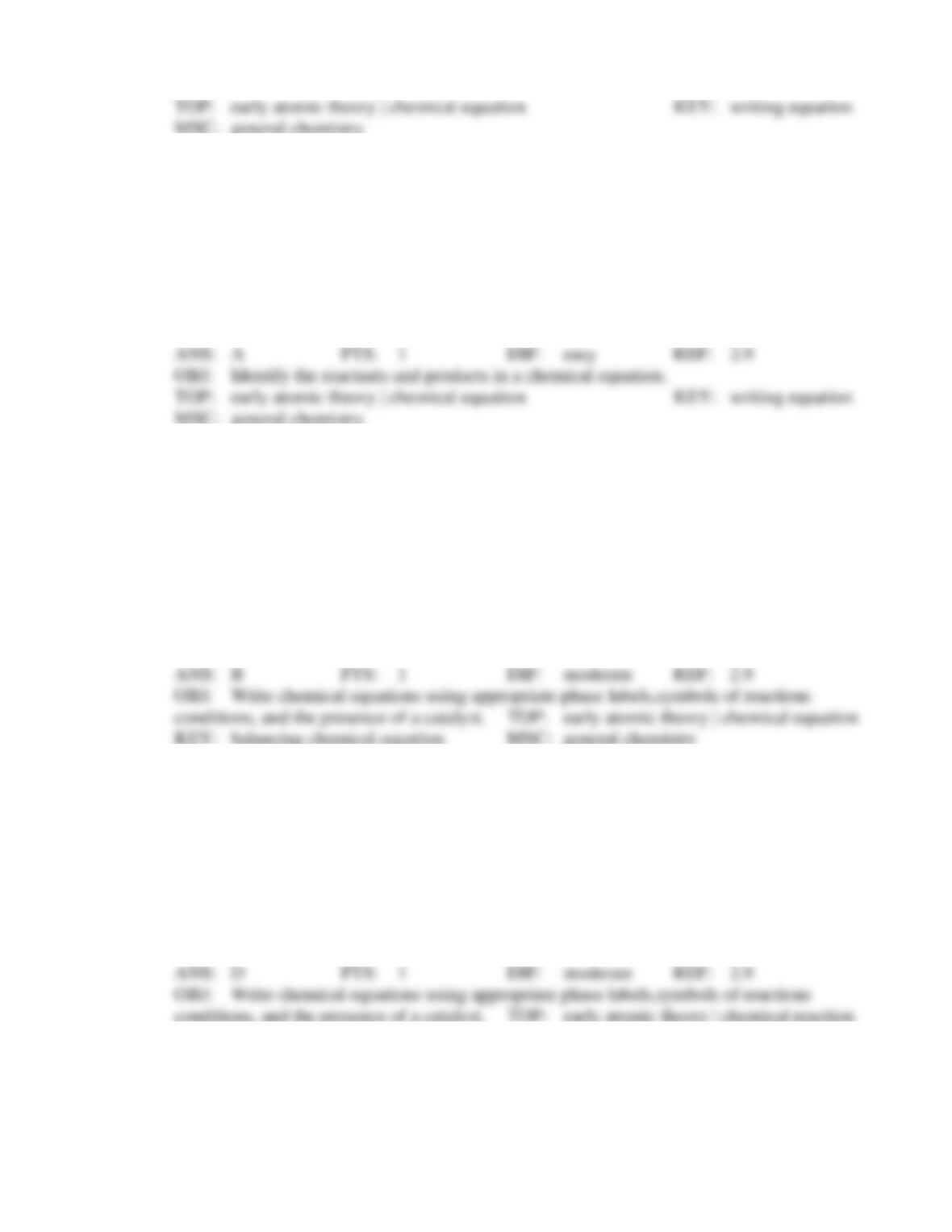
130. What is the balanced chemical equation that represents the following reaction?
A)
6H + 2N → 2NH3
B)
6H + 2N → 2HN3
C)
2N + 2H3 → 2H3N
D)
6H + 2N → 2N3H
E)
3H2 + N2 → 2NH3
Test Bank General Chemistry, 10th edition 36
131. In the following chemical equation, what is the reactant?
CuSO4·5H2O(s) → CuO(s) + SO3(g) + 5H2O(l)
A)
CuSO4·5H2O(s)
B)
H2O(l)
C)
CuO(s)
D)
SO3(g)
E)
CuSO4(s)
132. Which is a correct balanced chemical equation corresponding to the following description of
a chemical reaction?
Hydrochloric acid reacts with magnesium metal to produce aqueous magnesium chloride
and hydrogen gas.
A)
2HCl(aq) + Mg(s) → MgCl2(aq) + 2H(g)
B)
2HCl(aq) + Mg(s) → MgCl2(aq) + H2(g)
C)
2HCl(aq) + Mg(s) → MgCl(aq) + H2(g)
D)
2HCl(aq) + Mg(aq) → MgCl2(s) + H2(g)
E)
HCl(aq) + Mg(s) → MgCl(aq) + H(g)
133. Sulfuric acid reacts with aqueous sodium hydroxide to produce aqueous sodium sulfate and
liquid water. Which is the correct balanced chemical equation for this reaction description?
A)
H2SO4(aq) + 2NaOH(aq) → Na2S(aq) + 2H2O(l) + 2O2(g)
B)
H2S(aq) + 2NaOH(aq) → Na2S(aq) + 2H2O(l)
C)
H2SO4(aq) + NaOH(aq) → NaSO4(aq) + H2O(g)
D)
H2SO4(aq) + 2NaOH(aq) → Na2SO4(aq) + 2H2O(l)
E)
H2SO4(aq) + (NaOH)2(aq) → Na2SO4(aq) + 2H2O(l)
134. How many of the following statements are true concerning chemical equations?
I. Coefficients can be fractions.
II. Subscripts can be fractions.
Test Bank General Chemistry, 10th edition 37
III. Coefficients represent the relative masses of the reactants and/or products.
IV. Changing the subscripts to balance an equation can be done only once.
V. Atoms are conserved when balancing chemical equations.
A)
3
B)
4
C)
2
D)
5
E)
1
135. When the following equation is balanced with lowest whole-number coefficients, what is
the coefficient for NO(g)?
___NH3(g) + ___O2(g) → ___NO(g) + ___H2O(g)
A)
3
B)
2
C)
5
D)
4
E)
1
136. The complete combustion of propane, C3H8, yields carbon dioxide and water:
The smallest whole-number coefficient of oxygen in the balanced equation is
A)
6.
B)
3.
C)
7.
D)
4.
E)
5.
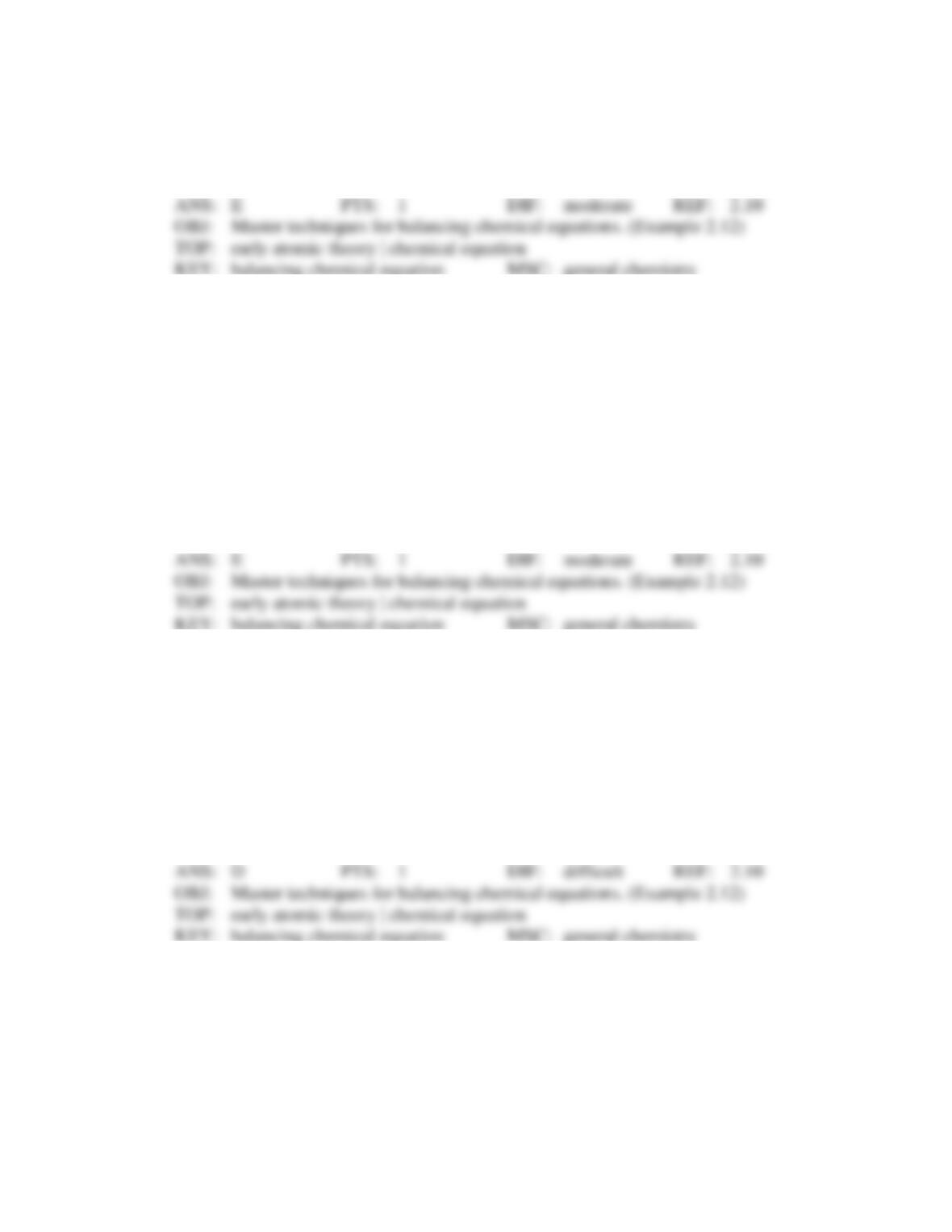
137. The complete combustion of butane, C4H10, yields carbon dioxide and water:
The smallest whole-number coefficient of oxygen in the balanced equation is
A)
12.
Test Bank General Chemistry, 10th edition 38
B)
14.
C)
10.
D)
11.
E)
13.
138. The products of the combustion of acetaldehyde with oxygen are shown in the following
equation:
__ CH3CHO + __ O2 → __ CO2 + __ H2O
When properly balanced, the equation indicates that ____ molecules of O2 are required to
burn 2 molecules of CH3CHO.
A)
2
B)
6
C)
4
D)
3
E)
5
139. Energy from the following reaction provided the lift for the moon lander:
__ (CH3)2N2H2 + __ N2O4 → __ N2 + __ H2O + __ CO2
When the equation is balanced, the smallest whole-number coefficient of nitrogen is
A)
5.
B)
4.
C)
1.
D)
3.
E)
2.
140. Treatment of sodium borohydride with sulfuric acid is a convenient method for the
preparation of diborane:
__ NaBH4 + __ H2SO4 → __ B2H6 + __ H2 + __Na2SO4
When the equation is balanced, the lowest whole number coefficient for hydrogen is
A)
5.
B)
2.
C)
4.
D)
1.
E)
3.
141. All the following may change during a chemical reaction except
A)
the total volume of the system.
B)
the density of the system.
C)
the temperature of the system.
D)
the total number of atoms in the system.
E)
the total number of molecules in the system.
142. The complete combustion of phenylhydrazine, C6H5NHNH2, with the oxidizer dinitrogen
tetraoxide is shown in the following equation:
__ C6H5NHNH2 + __ N2O4 → __ CO2 + __ H2O + __ N2
When this equation is balanced, the sum of all the coefficients (using smallest whole
numbers) is
A)
30.
B)
20.
C)
25.
D)
10.
E)
15.
143. The complete combustion of pentane yields carbon dioxide and water. When the equation
__ C5H12(l) + __ O2(g) → __ CO2(g) + __ H2O(l)
is balanced, the ratio of the coefficient of CO2 to the coefficient of O2 is
A)
8:5.
B)
8:6.
C)
6:5.
D)
5:6.
E)
5:8.
Test Bank General Chemistry, 10th edition 40
144. A reaction occurs between sodium carbonate and hydrochloric acid, producing sodium
chloride, carbon dioxide, and water. Which is the correct set of coefficients, respectively, for
the balanced reaction?
A)
3 6 6 3 4
B)
8 6 5 10 5
C)
5 10 10 5 5
D)
1 2 2 1 1
E)
none of these
145. When the equation
__ (CH3)2NNH2 + __ N2O4 → __ N2 + __ H2O + __ CO2
is balanced, the sum of all the coefficients (simplest whole number) is
A)
13.
B)
12.
C)
9.
D)
10.
E)
11.
146. When the equation
__ C5H6N2OS(s) + __ O2(g) → __ CO2(g) + __ H2O(l) + __ N2(g) + __ SO2(g)
is balanced, the sum of all the coefficients (simplest whole number) is
A)
19.
B)
20.
C)
24.
D)
18.
E)
21.
147. Ammonia can be made by reaction of water with magnesium nitride:
__ Mg3N2(s) + __ H2O(l) → __ Mg(OH)2(s) + __ NH3(g)
When the equation is properly balanced, the sum of the coefficients is
A)
6.
B)
14.
C)
12.
D)
9.
E)
8.
148. Which one of the following equations is properly balanced?
A)
Sn + 4HNO3 → SnO2 + 4NO2 + 2H2O
B)
2Na2SO4 + 3Bi(NO3)3 → Bi2(SO4)3 + 9NaNO3
C)
CH3CHO + 3O2 → 2CO2 + 2H2O
D)
NH4NO3 → 2H2O + N2
E)
Na2CO3 + 2H2SO4 → Na2SO4 + 2H2O + CO2
149. Which of the following chemical equations is not balanced?
A)
NH4NO3 → N2O + 2H2O
B)
C12H22O11 → 12C + 11H2O
C)
2NH4SCN + Ba(OH)2 • 8H2O → 2NH3 + 10H2O + Ba(SCN)2
D)
(NH4)2Cr2O7 → N2O + Cr2O3 + 4H2O
E)
2Mg + CO2 → 2MgO + C
150. Which of the following equations is not balanced?
A)
2Sb2OS2 + 10O2 → 2Sb2O5 + 4SO3
B)
(NH4)2Cr2O7 → N2 + 4H2O + Cr2O3
C)
C12H22O11 + 12O2 → 12CO2 + 11H2O
D)
2NaCl + Pb(NO3)2 → PbCl2 + 2NaNO3
E)
Fe3O4 + 3CO → 3Fe + 3CO2