Find and simplify the difference quotient f(x +
h) – f(x)
h, h
0 for the given function.
78)
f(x) =x2+8x – 9
78)
A)
2x2+ 2x + 2xh +h2+ h – 18
h
B)
1
C)
2x + h +8
D)
2x + h – 9
Write the standard form of the equation of the circle with the given center and radius.
79)
(0, 0); 9
79)
A)
x2+y2=81
B)
x2–y2=9
C)
x2+y2=9
D)
x2+y2=18
A
Given functions f and g, determine the domain of f +
g.
80)
f(x) =2x
x –6,g(x) =3
x +10
80)
A)
(–, )
B)
(–, –6) or (–6, 10) or (10, )
C)
(–, –3) or (–3, –2) or (–2, )
D)
(–, –10) or (–10, 6) or (6, )
D
Graph the linear function by plotting the x– and y–intercepts.
81)
–5x – 25y –25 = 0
81)
41
C
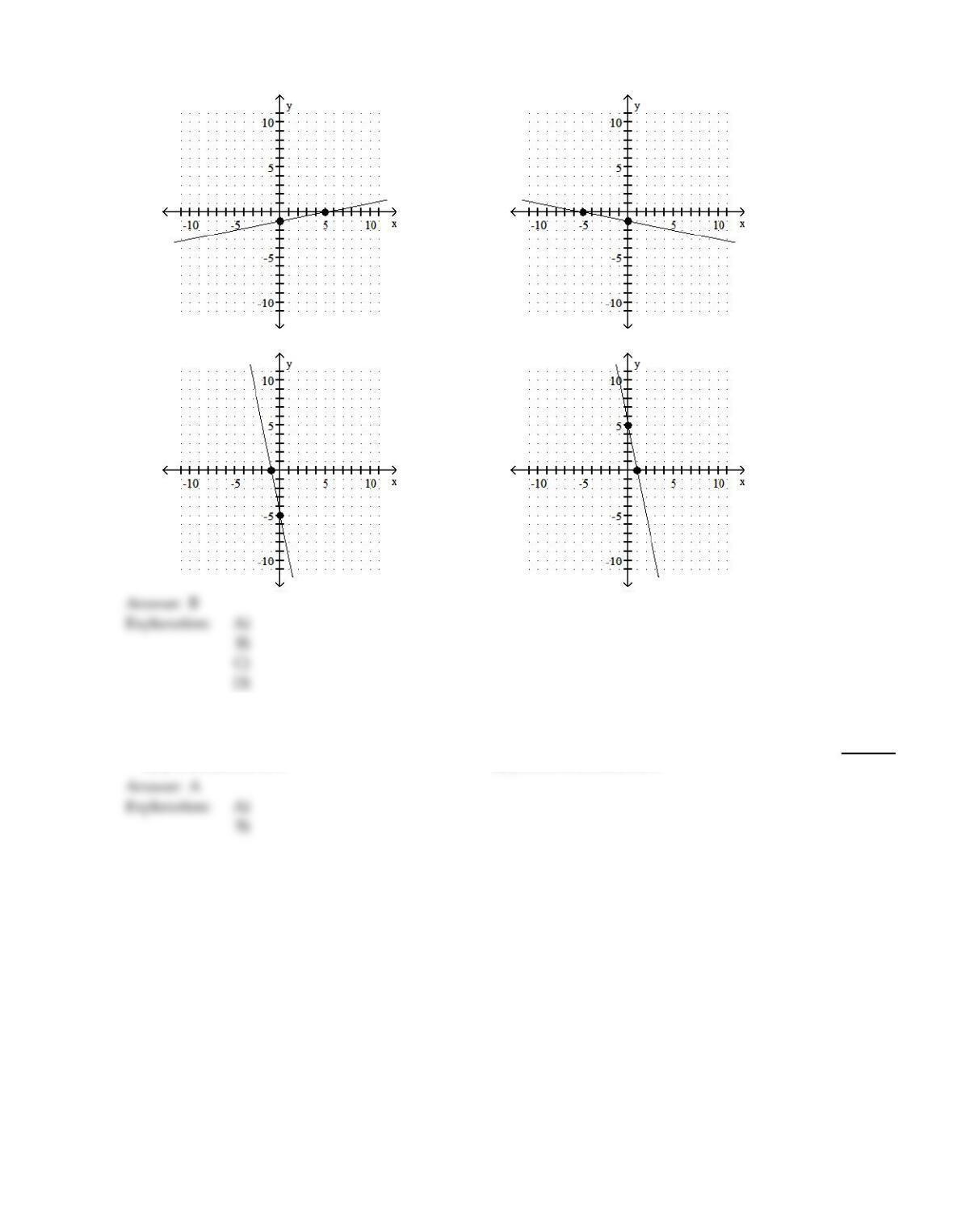
A)
intercepts: (0, –1), (5, 0)
B)
intercepts: (0, –1), (–5, 0)
C)
intercepts: (0, –5), (–1, 0)
D)
intercepts: (0, 5), (1, 0)
Determine whether the equation defines y as a function of x.
82)
2x + 3y =15
82)
A)
y is a function of x
B)
y is not a function of x
42
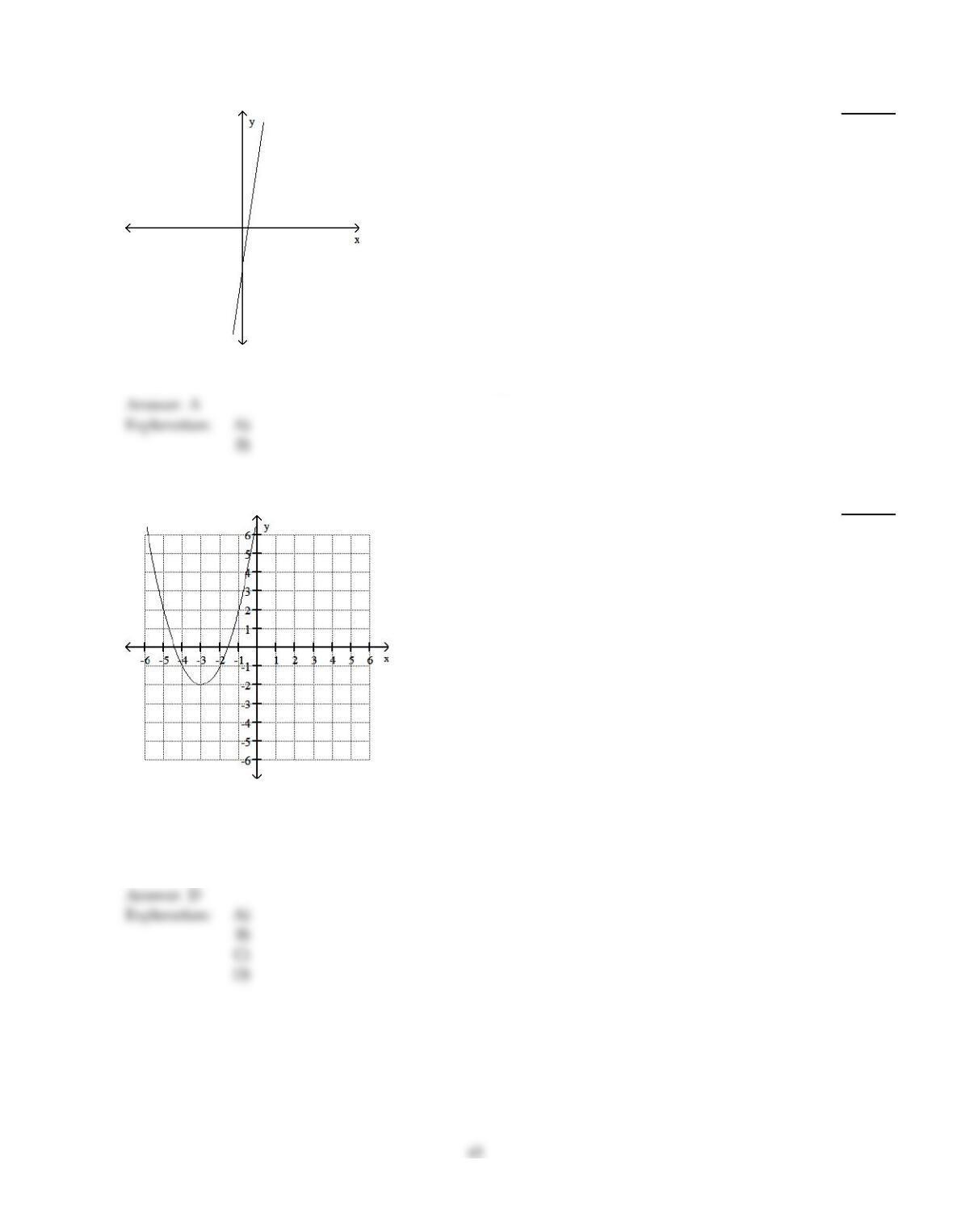
Does the graph represent a function that has an inverse function?
83)
83)
A)
Yes
B)
No
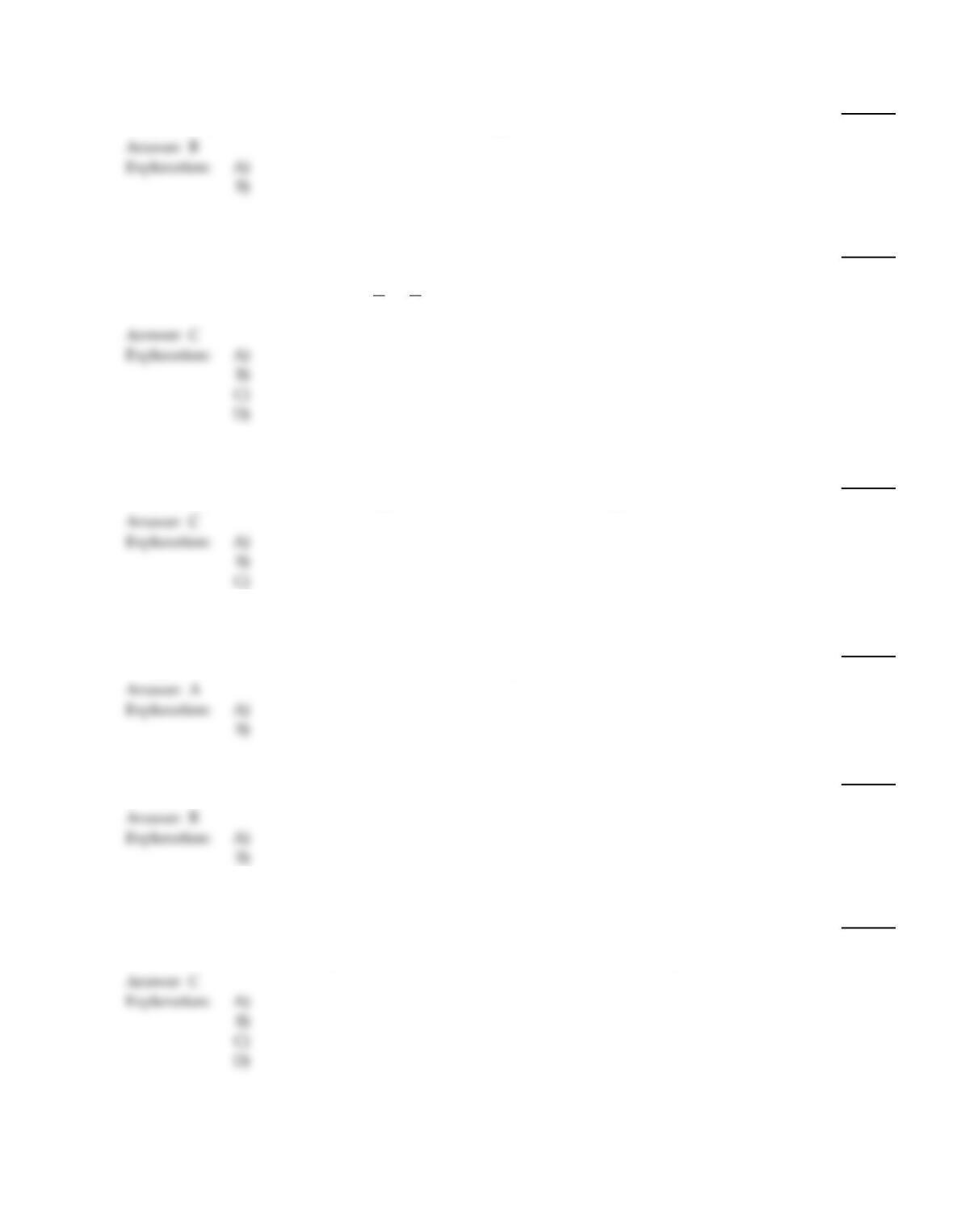
Use the graph to determine the function’s domain and range.
84)
84)
A)
domain: (–, )
range: (–, )
B)
domain: (–, –3) or (–3, )
range: (–, –2) or (–2, )
C)
domain: [–3, )
range: [–2, )
D)
domain: (–, )
range: [–2, )
Determine whether the relation is a function.
85)
{(–4, –4), (–2, 1), (–1, –7), (5, –9)}
85)
A)
Not a function
B)
Function
Use the given conditions to write an equation for the line in the indicated form.
86)
Passing through (4, 2) and parallel to the line whose equation is 4x + y –6= 0;
slope–intercept form
86)
A)
y =4x – 18
B)
y = – 1
4x –9
2
C)
y = – 4x + 18
D)
y = – 4x – 18
Determine whether the given function is even, odd, or neither.
87)
f(x) = – 5x5+ x3
87)
A)
Neither
B)
Even
C)
Odd
Determine whether the equation defines y as a function of x.
88)
x +y3=27
88)
A)
y is a function of x
B)
y is not a function of x
89)
x =y2
89)
A)
y is a function of x
B)
y is not a function of x
Given functions f and g, perform the indicated operations.
90)
f(x) =4– 5x, g(x) = – 8x + 5
Find f + g.
90)
A)
3x + 9
B)
–4x
C)
–13x + 9
D)
–8x + 4
44
Find the domain of the composite function f
g.
91)
f(x) =8
x + 8 ,g(x) =8
x
91)
A)
(–, )
B)
(–, –8) or (–8, 0) or (0, )
C)
(–, –8) or (–8, –1) or (–1, 0) or (0, )
D)
(–, –1) or (–1, 0) or (0, )
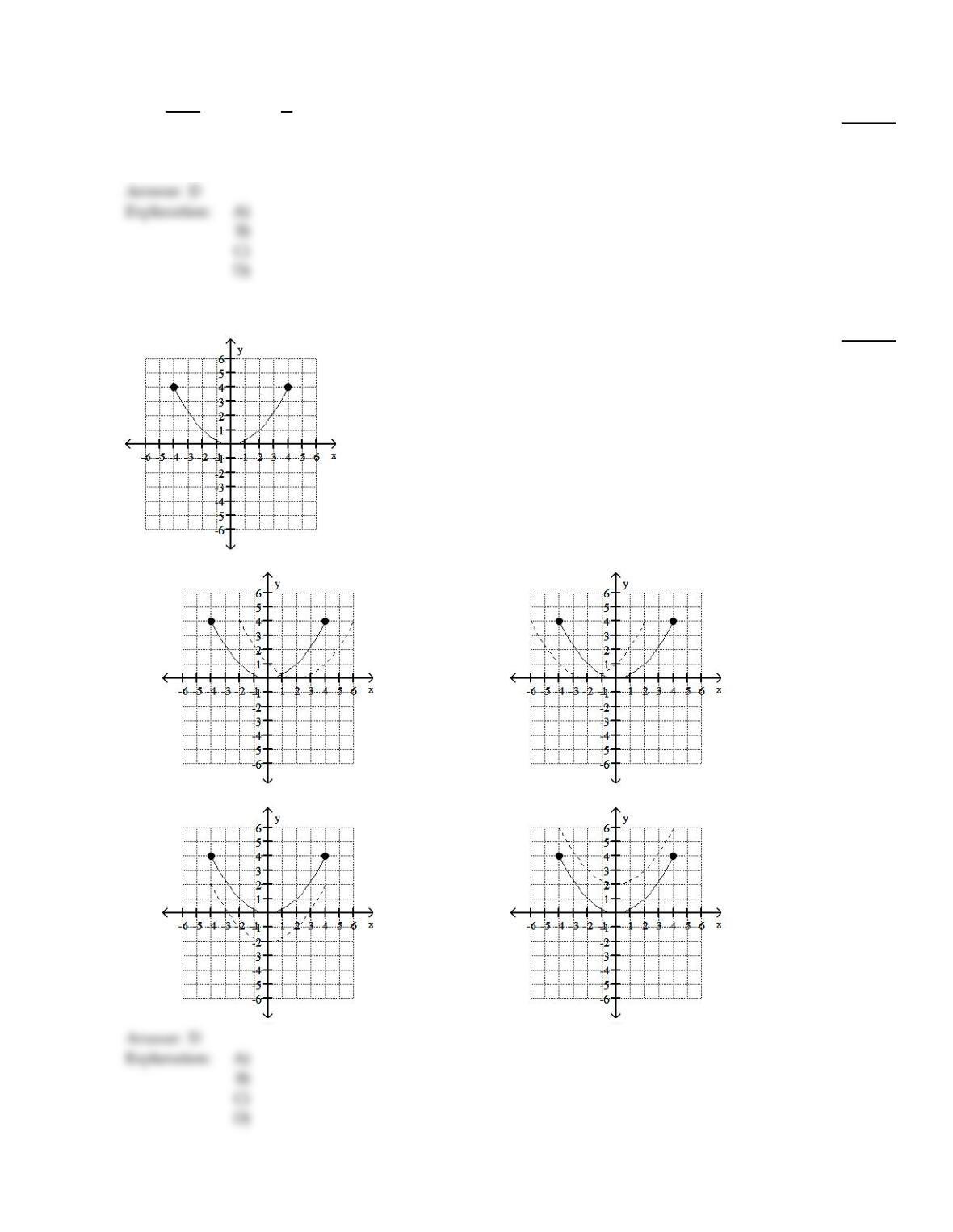
Use the graph of the function f, plotted with a solid line, to sketch the graph of the given function g.
92)
g(x) = f(x) + 2
y = f(x)
92)
A)
B)
C)
D)
D
45
D
Find the distance between the pair of points.
93)
(–6, –5) and (3, –2)
93)
A)
72 2
B)
72
C)
310
D)
6
Write the standard form of the equation of the circle with the given center and radius.
94)
(0, 2); 10
94)
A)
(x + 2)2+ y2=100
B)
(x – 2)2+ y2=100
C)
x2+ (y + 2)2=10
D)
x2+ (y – 2)2=10
D
Find the slope of the line that goes through the given points.
95)
(–8, –9), (–8, –3)
95)
A)
0
B)
3
4
C)
3
8
D)
Undefined
D
Use the vertical line test to determine whether or not the graph is a graph in which y is a function of x.
96)
96)
A)
not a function
B)
function
B
C
Use the graph of f to draw the graph of its inverse function.
97)
97)
A)
B)
Use the given conditions to write an equation for the line in slope–intercept form.
98)
Passing through (–8, –3) and (–4, –8)
98)
A)
y = mx – 13
B)
y = – 5
4x – 13
C)
y =5
4x – 13
D)
y + 3 = – 5
4(x + 8)
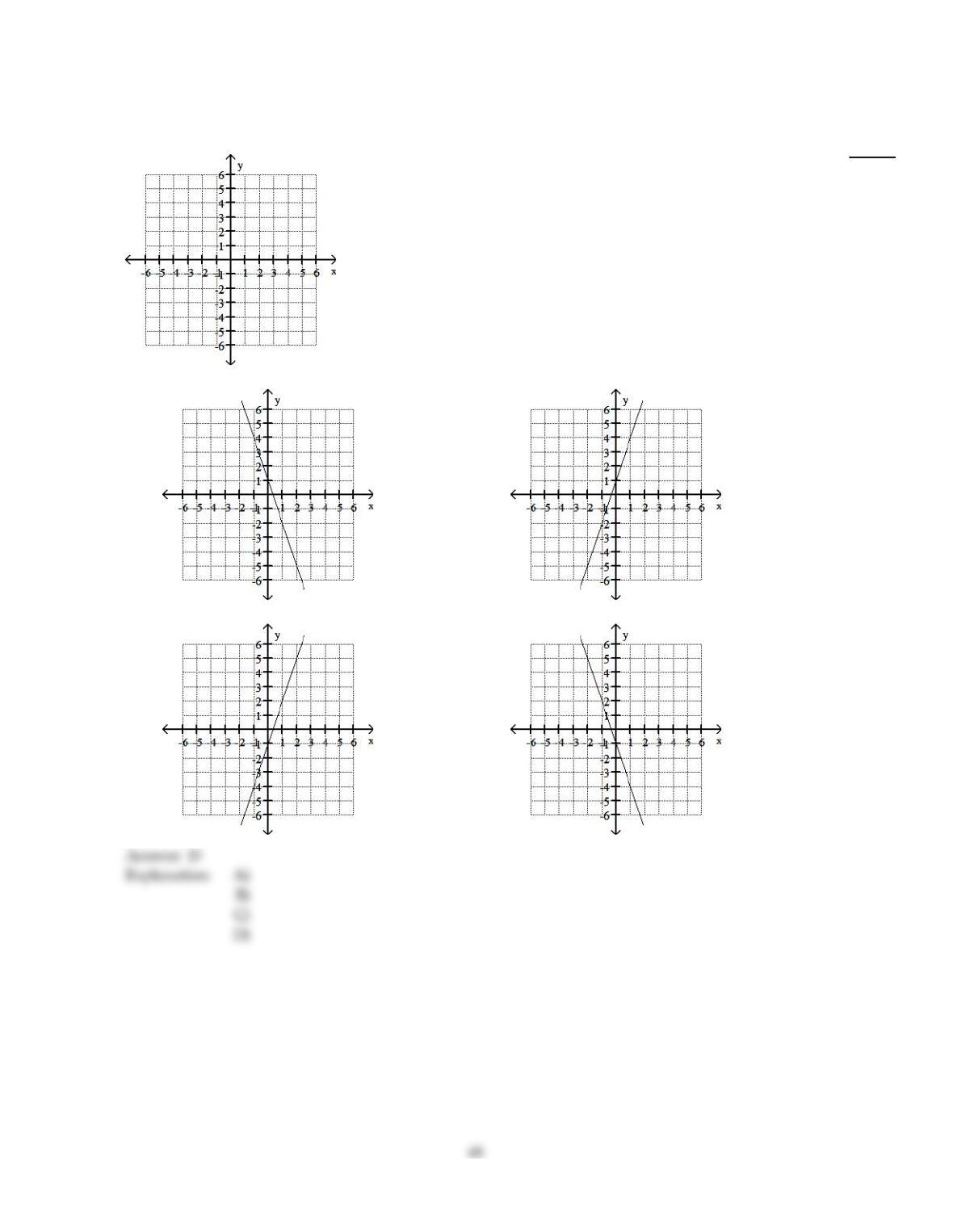
Graph f as a solid line and f–1 as a dashed line in the same rectangular coordinate space. Use interval notation to give the
domain and range of f and f–1.
47
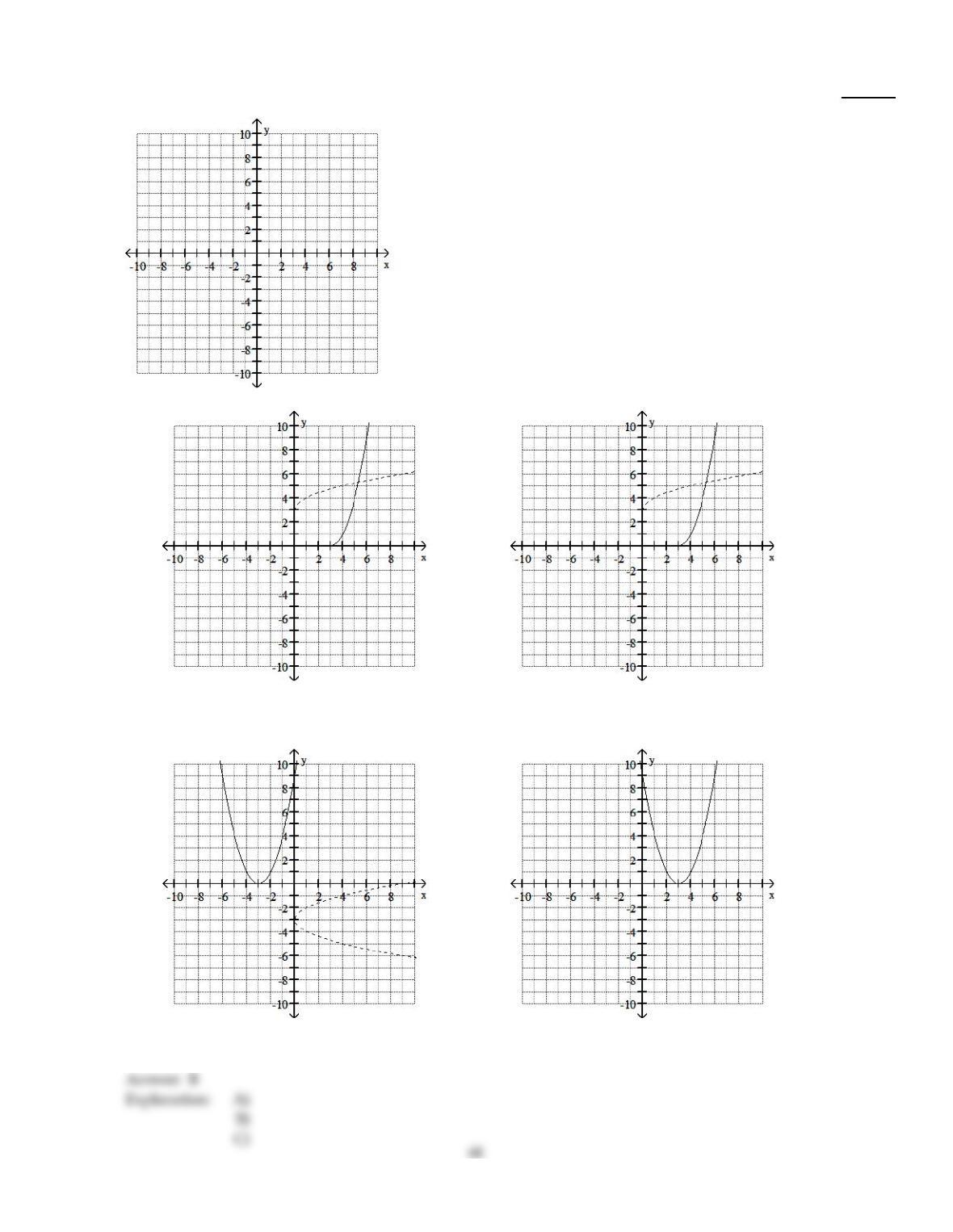
99)
f(x) =(x –3)2, x 3
99)
A)
f domain = (–, ); range = (0, )
f–1 domain =(0, ); range = (–, )
B)
f domain = (3, ); range = (0, )
f–1 domain =(0, ); range = (3, )
C)
f domain = (–, ); range = (0, )
f–1 domain =(0, ); range = (–, )
D)
Has no inverse
f domain = (–, ); range = (0, )
C)
D)
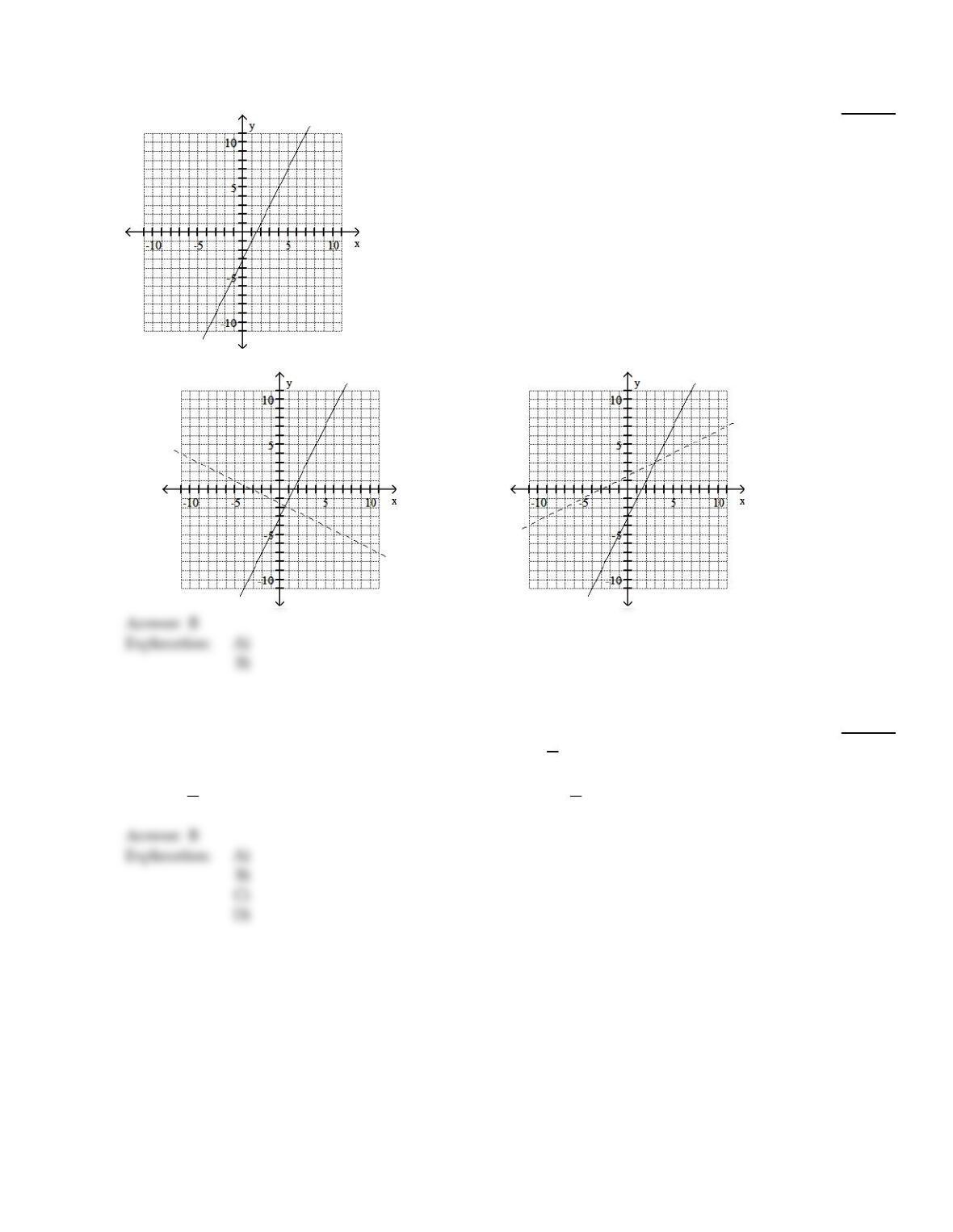
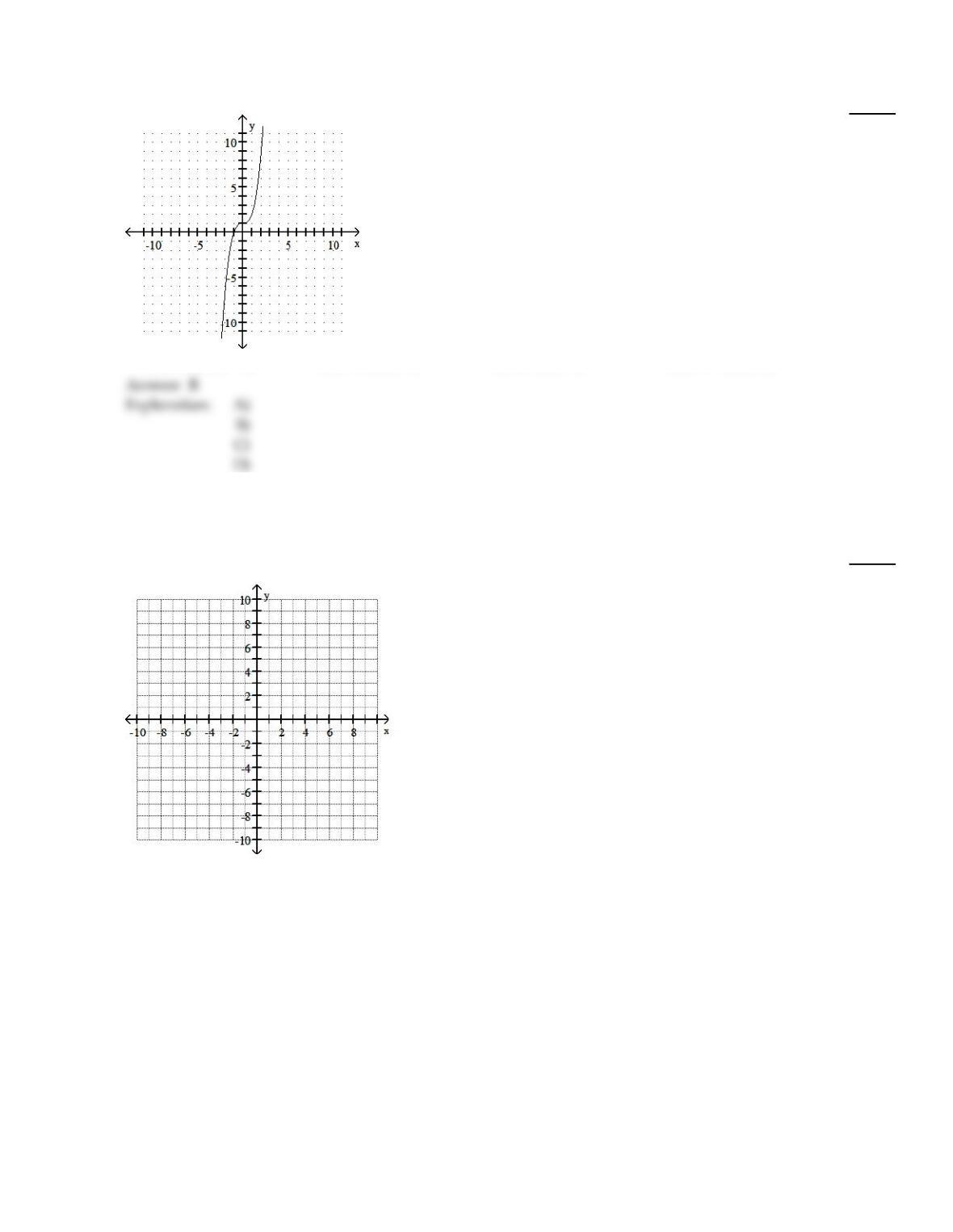
Graph the line whose equation is given.
100)
y = – 3x – 1
100)
A)
B)
C)
D)
C)
D)
Identify the intercepts.
101)
101)
A)
(–1, 0), (0, –1)
B)
(–1, 0), (0, 1)
C)
(1, 0), (0, 1)
D)
(–1, –1), (1, 1)
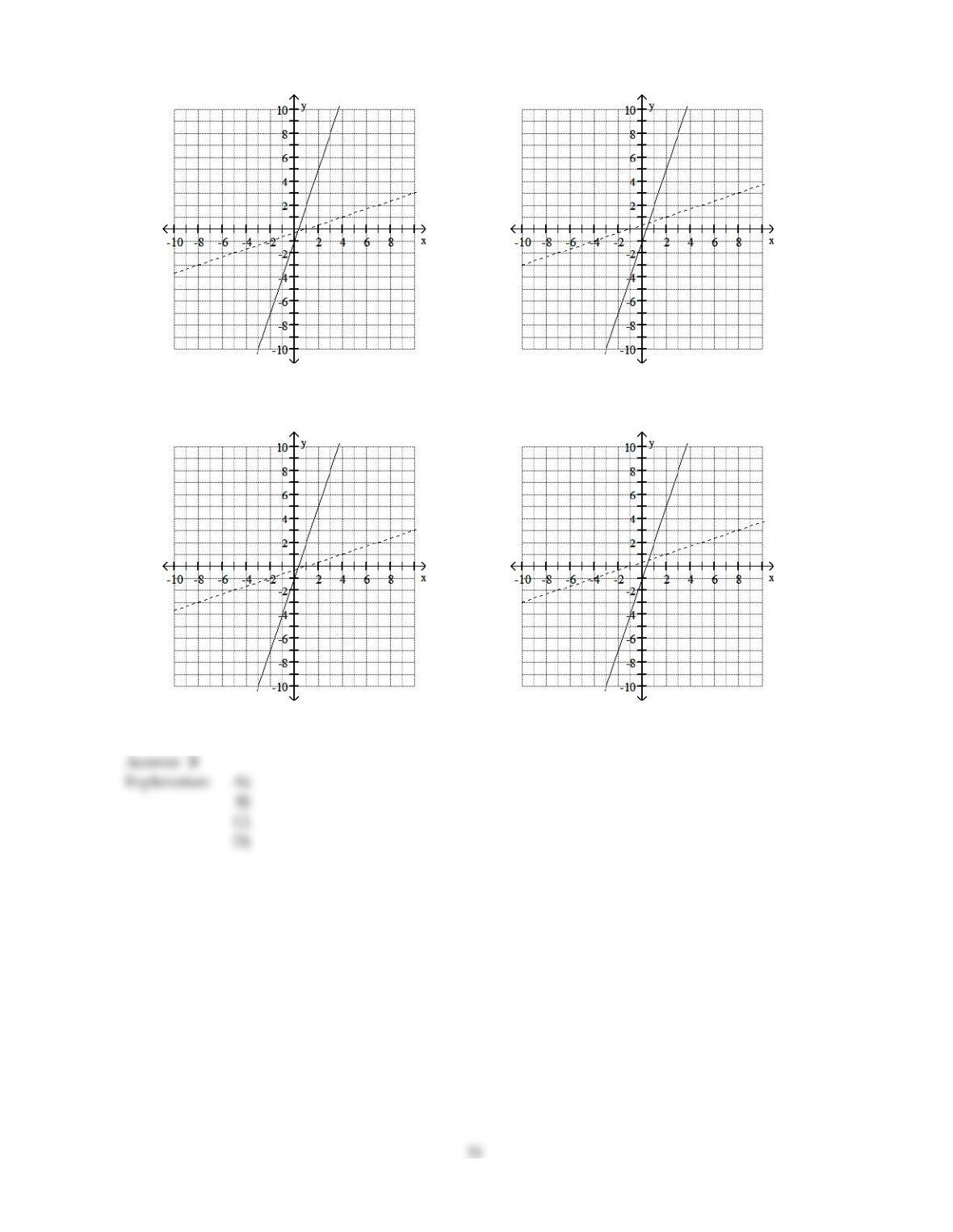
Graph f as a solid line and f–1 as a dashed line in the same rectangular coordinate space. Use interval notation to give the
domain and range of f and f–1.
102)
f(x) =3x –1
102)
50
A)
f domain = (–, ); range = (–, )
f–1 domain =(–, ); range = (–, )
B)
f domain = (–, ); range = (–, )
f–1 domain =(–, ); range = (–, )
C)
f domain = (–10, 10); range = (–10, 10)
f–1 domain =(–10, 10); range = (–10, 10)
D)
f domain = (–10, 10); range = (–10, 10)
f–1 domain =(–10, 10); range = (–10, 10)
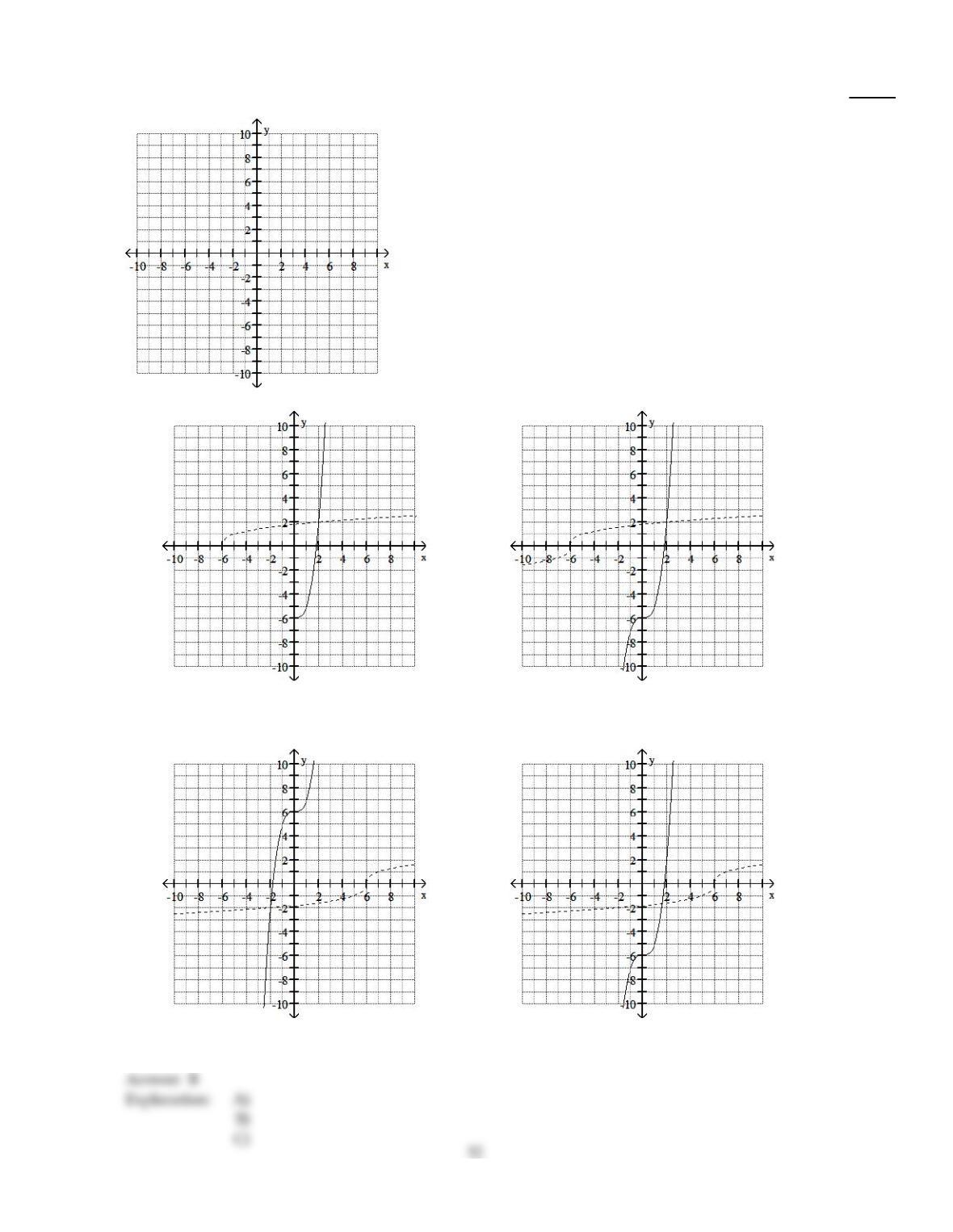
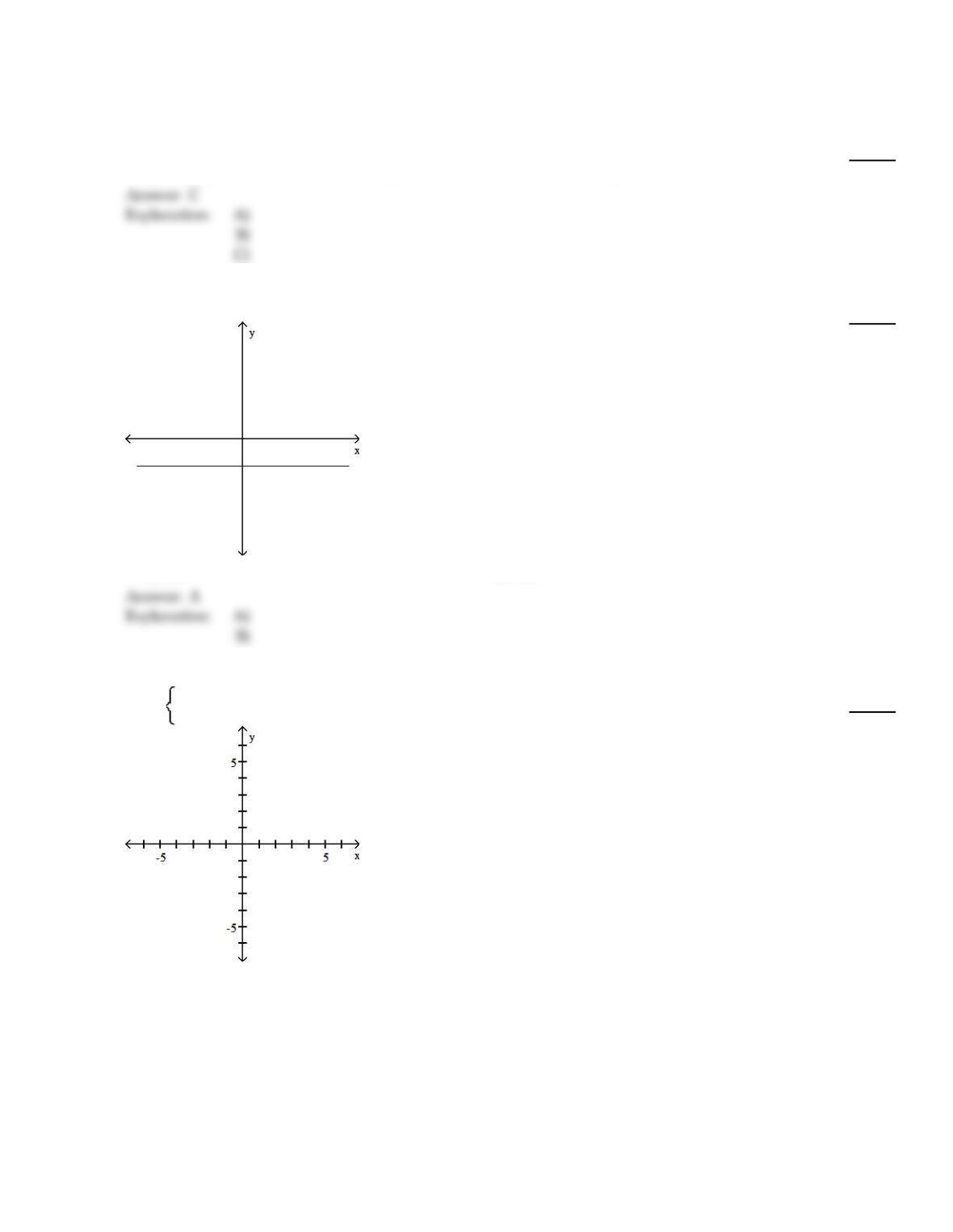
103)
f(x) =x3–6
103)
A)
f domain = (0, ); range = (–6, )
f–1 domain =(–6, ); range = (0, )
B)
f domain = (–, ); range = (–, )
f–1 domain =(–, ); range = (–, )
C)
f domain = (–, ); range = (–, )
f–1 domain =(–, ); range = (–, )
D)
f domain = (–, ); range = (–, )
f–1 domain =(–, ); range = (–, )
C)
D)
Determine whether the given function is even, odd, or neither.
104)
f(x) =2x2+ x4
104)
A)
Neither
B)
Odd
C)
Even
Does the graph represent a function that has an inverse function?
105)
105)
A)
No
B)
Yes
Graph the function.
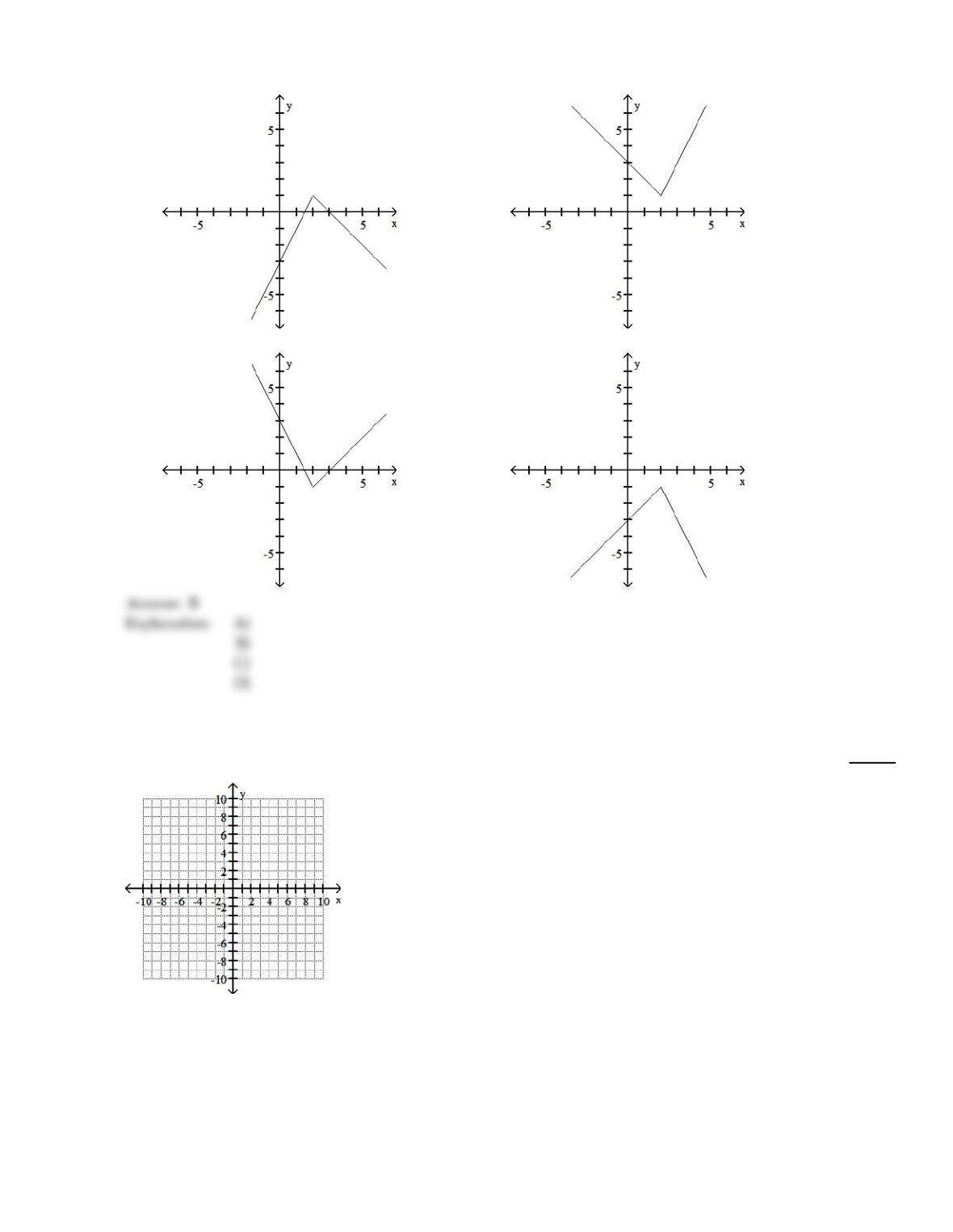
106)
f(x) =–x + 3 if x < 2
2x – 3 if x
2
106)
53
C)
A)
B)
C)
D)
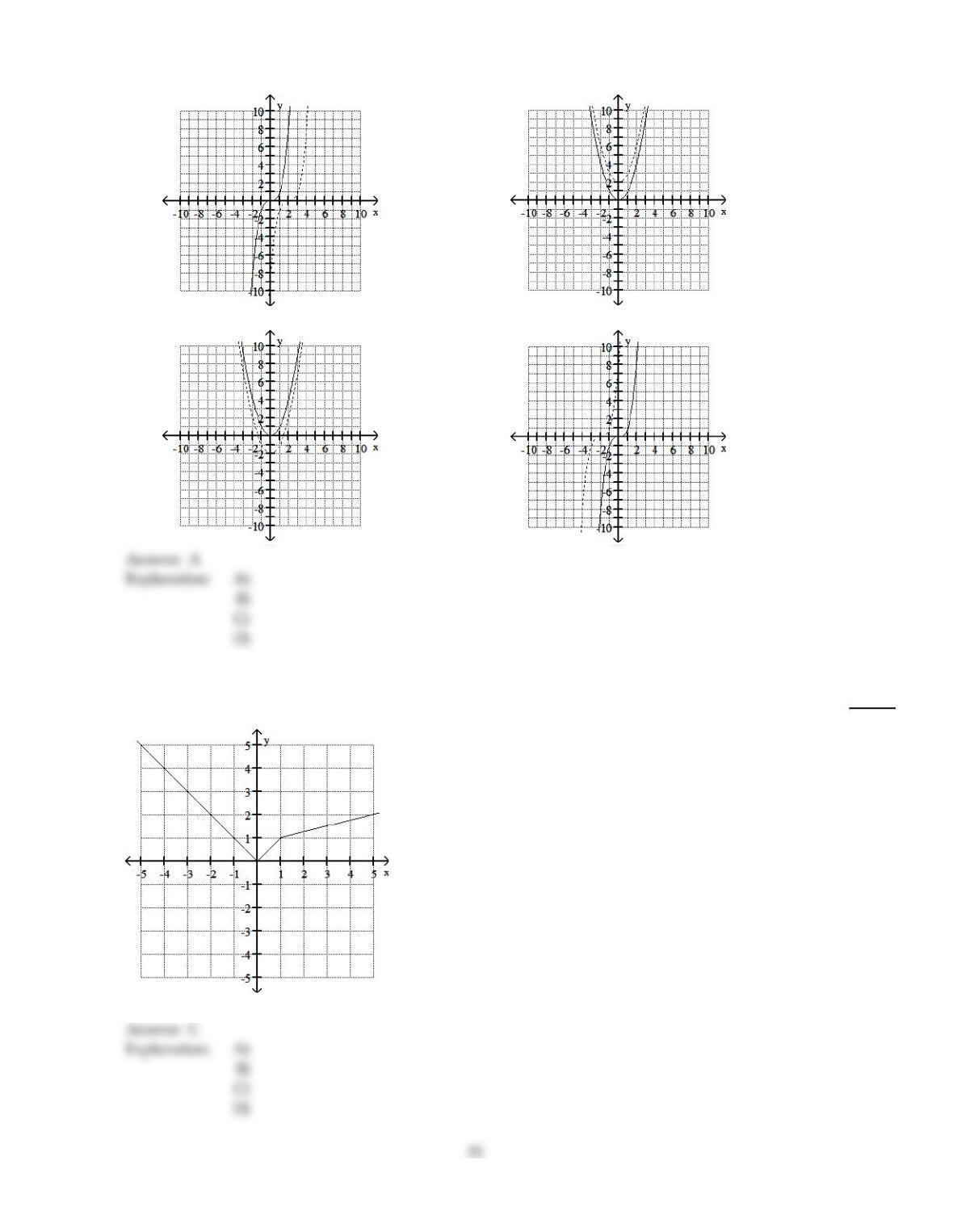
Begin by graphing the standard function f(x) =x3 Then use transformations of this graph to graph the given function.
107)
h(x) =(x – 2)3
107)
54
A)
B)
C)
D)
Use the graph to find the indicated function value.
108)
y = f(x). Find f(–5)
108)
A)
2
B)
–5
C)
5
D)
17
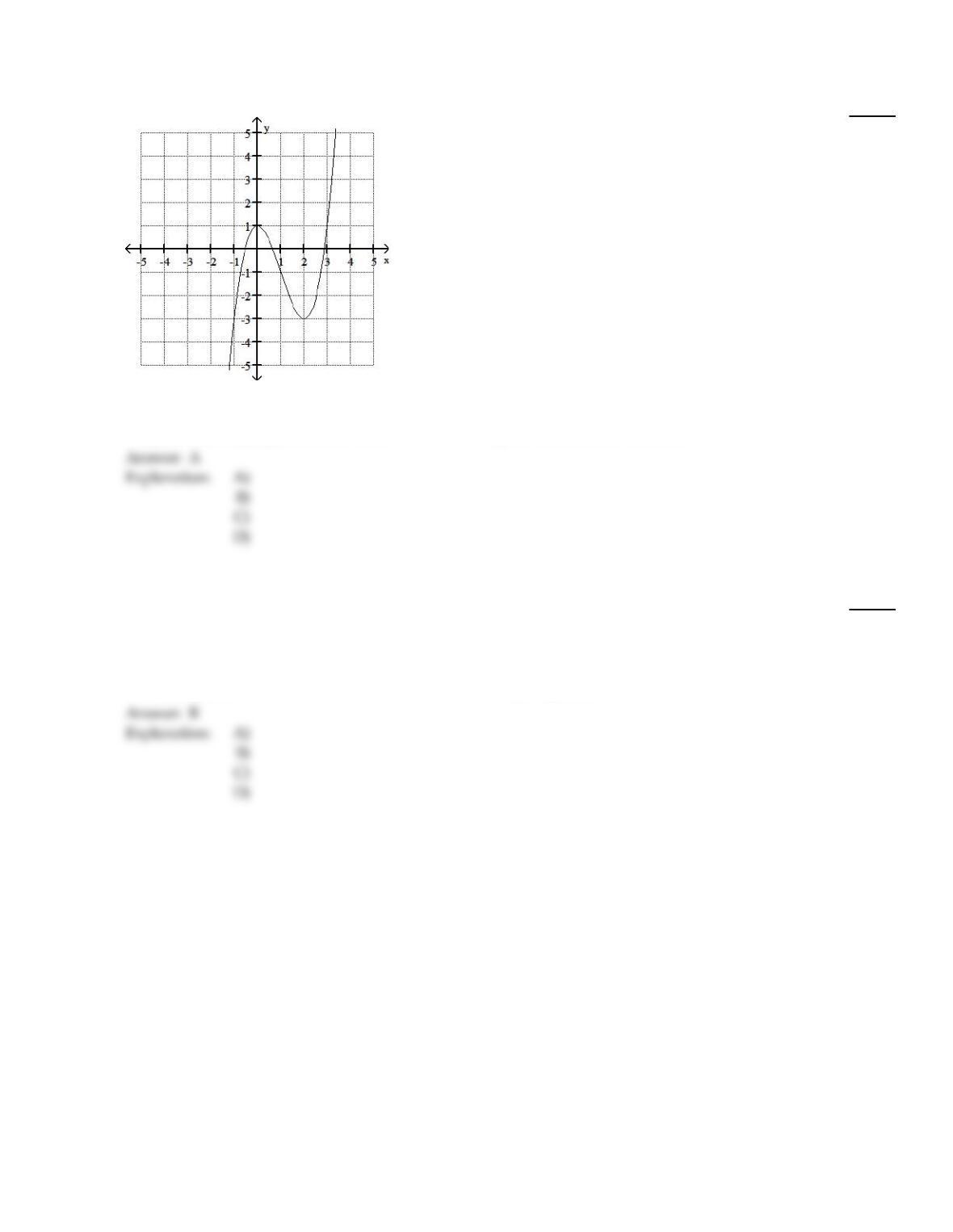
Use the graph of the given function to find any relative maxima and relative minima.
109)
f(x) = x3– 3x2+ 1
109)
A)
maximum: (0, 1); minimum: (2, –3)
B)
maximum: none; minimum: (2, –3)
C)
maximum: (0, 1); minimum: none
D)
no maximum or minimum
Complete the square and write the equation in standard form. Then give the center and radius of the circle.
110)
x2+ 14x + 49 + y2– 14y + 49 =49
110)
A)
(x – 7)2+(y + 7)2=49
(–7, 7), r =49
B)
(x + 7)2+(y – 7)2=49
(–7, 7), r =7
C)
(x – 7)2+(y + 7)2=49
(7, –7), r =7
D)
(x + 7)2+(y – 7)2=49
(7, –7), r =49
56
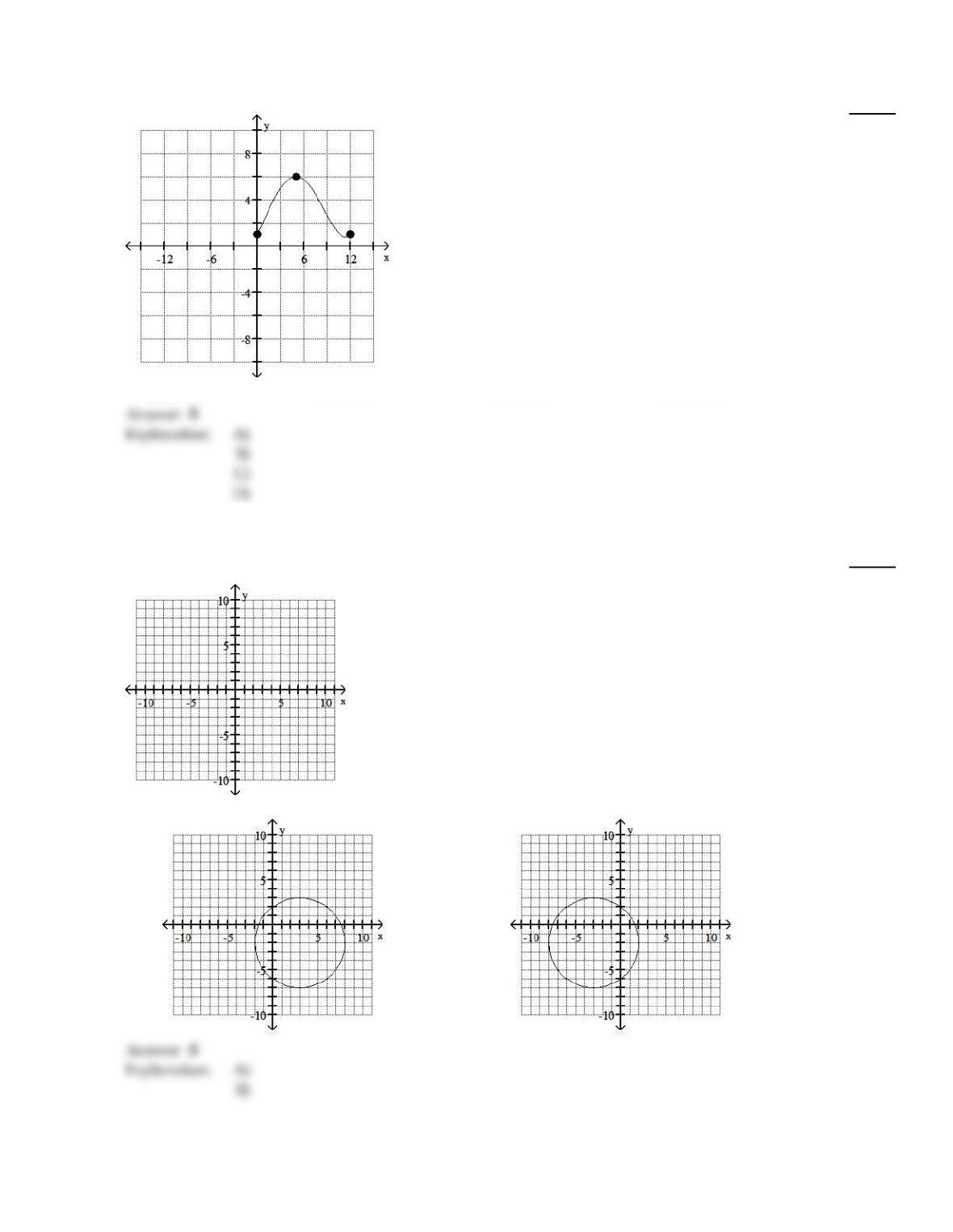
Identify the intervals where the function is changing as requested.
111)
Increasing
111)
A)
(0, 6)
B)
(0, 5)
C)
(1, 5)
D)
(1, 6)
Graph the equation.
112)
x2+ y2+ 6x + 4y – 12 = 0
112)
A)
B)
57
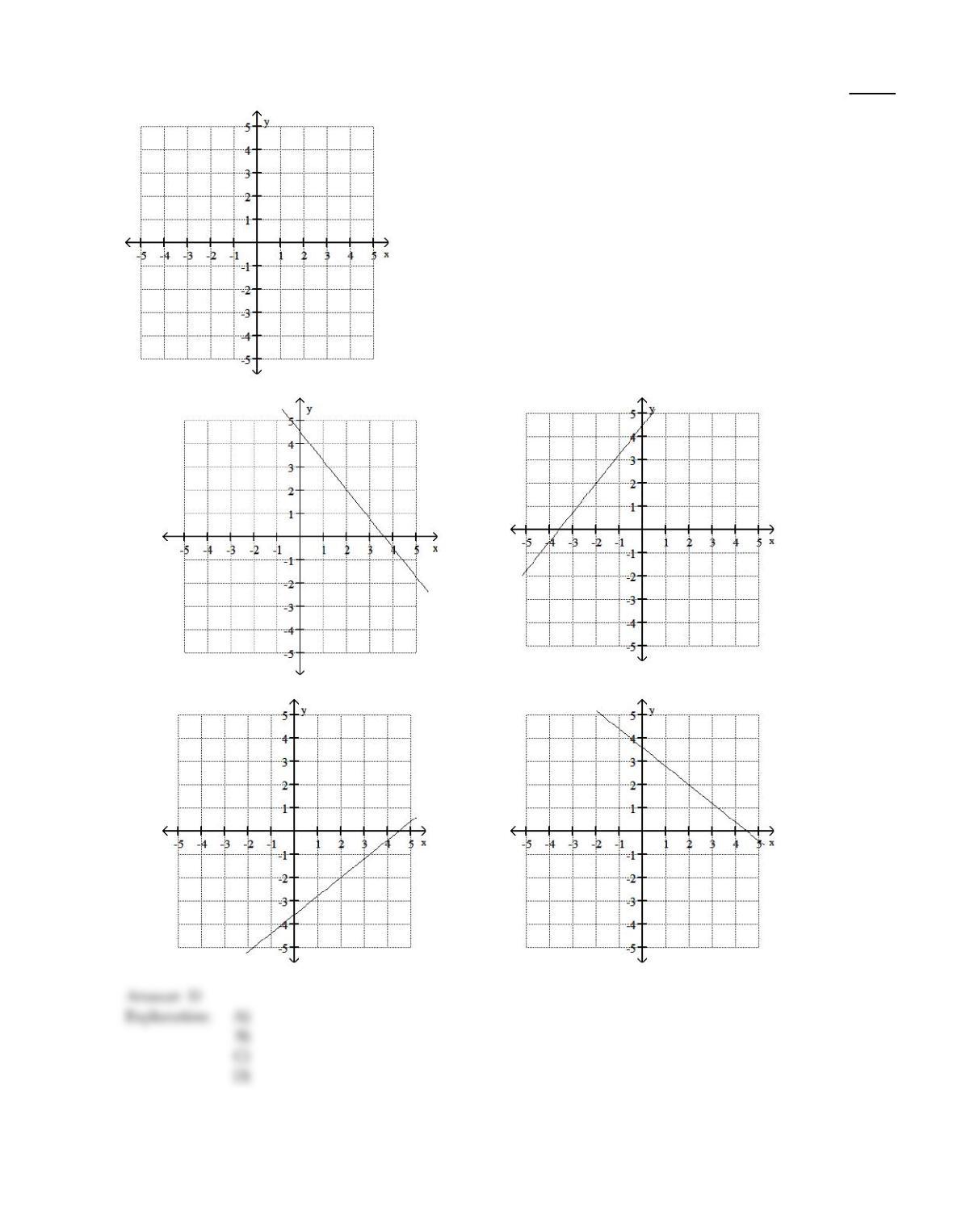
113)
4x + 5y – 18 = 0
113)
A)
B)
C)
D)
58
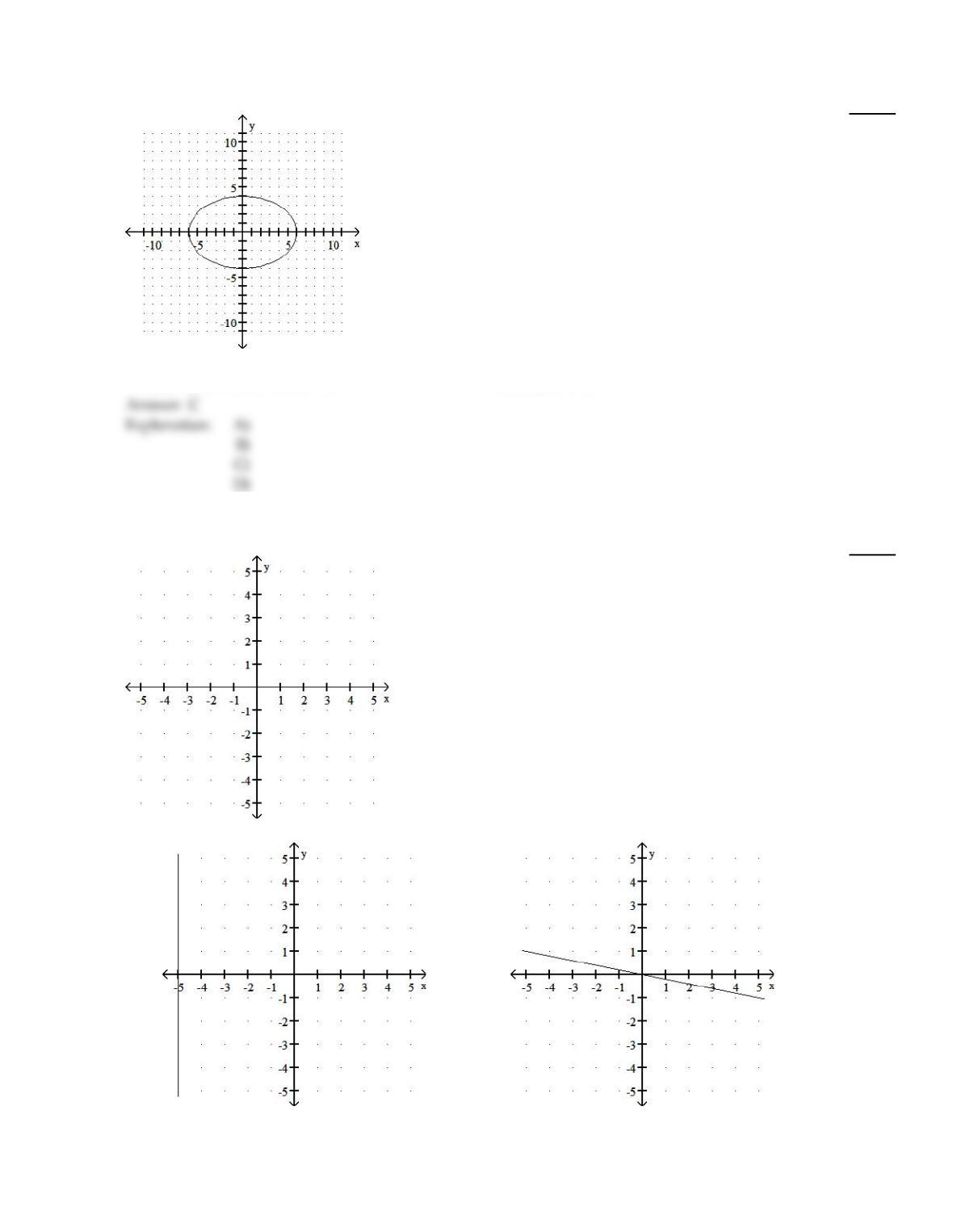
Identify the intercepts.
114)
114)
A)
(4, 0), (–4, 0), (0, 6), (0, –6)
B)
(0, 4), (0, –4)
C)
(6, 0), (–6, 0), (0, 4), (0, –4)
D)
(6, 0), (–6, 0)
Graph the equation in the rectangular coordinate system.
115)
y = – 5
115)
A)
B)
59
C
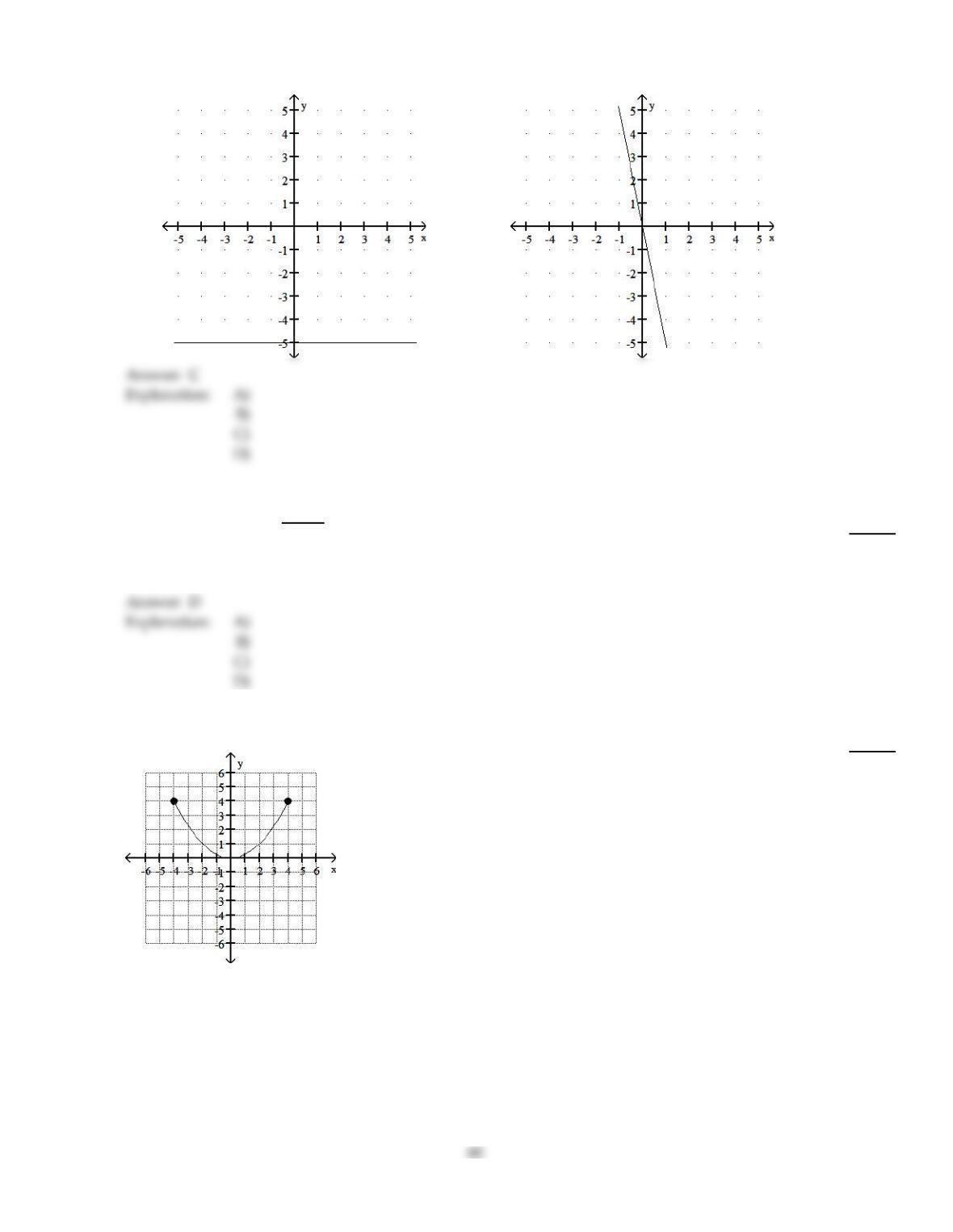
C)
D)
Given functions f and g, determine the domain of f +
g.
116)
f(x) =2x – 7,g(x) =3
x –10
116)
A)
(0, )
B)
(–, –3) or (–3, )
C)
(–, )
D)
(–, 10) or (10, )
D
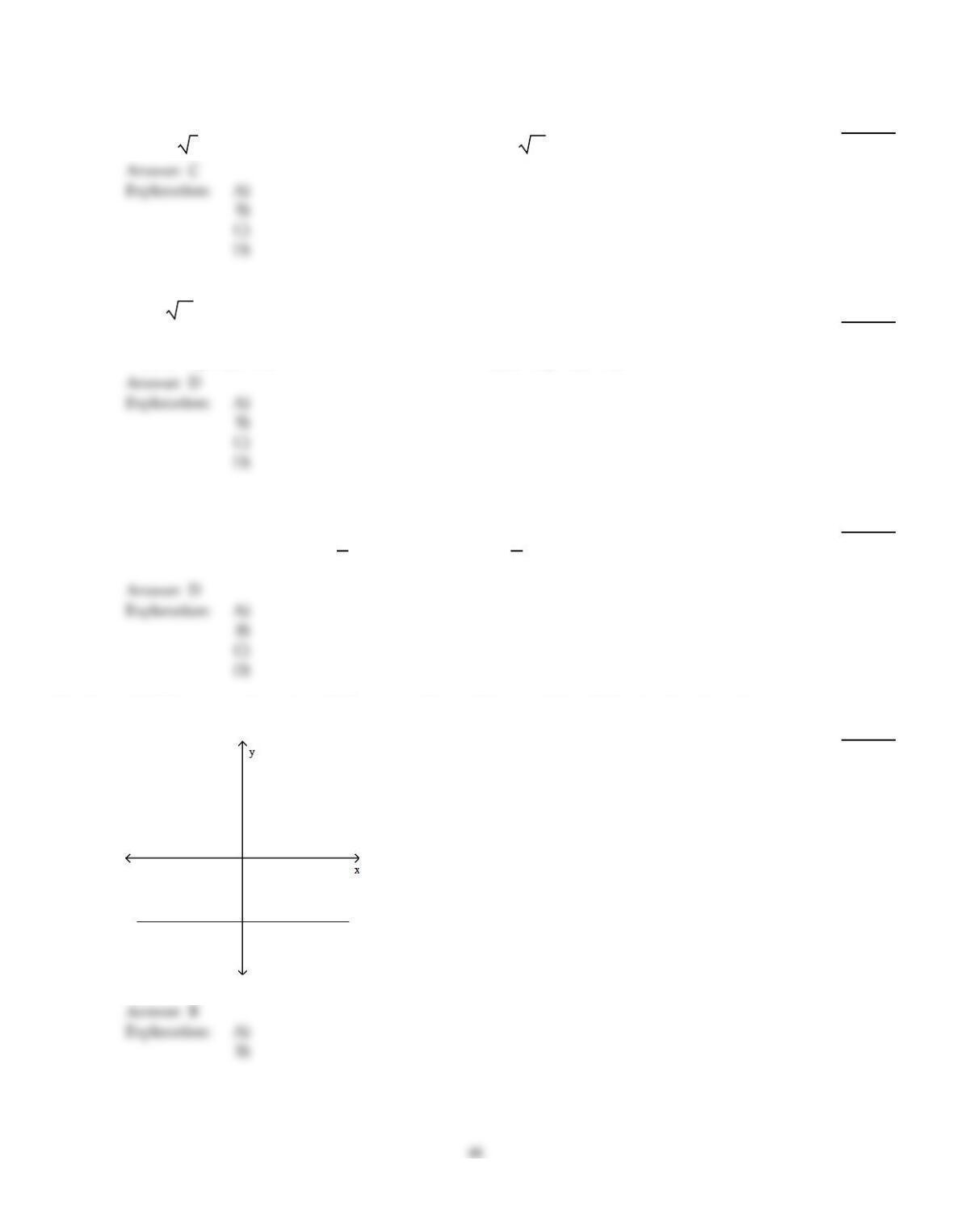
Use the graph of the function f, plotted with a solid line, to sketch the graph of the given function g.
117)
g(x) = f(x – 1)
y = f(x)
117)
C