112)
The first step in the marketing process is to set objectives for the marketing effort.
112)
113)
The key players in the marketing industry include the marketer, suppliers or vendors, distributors
and retailers, and agencies.
113)
114)
Institutional markets are wholesales, retailers, and distributors who buy finished products and
resell them for a profit.
114)
115)
The materials and ingredients used in producing the product are obtained from other companies
who are referred to as distributors.
115)
116)
Retailers’ main concern with respect to advertising is that it be directed at their customers as
opposed to the customers of the manufacturers.
116)
117)
The goal in marketing is to sell as many products as possible.
117)
118)
Brand equity is the reputation, meaning, and value that the brand name or symbol has acquired
over time and measures the financial value the brand contributes to the company.
118)
119)
Institutional markets consist of people who buy products and services for personal use.
119)
120)
A push strategy directs marketing efforts at the consumer in an attempt to stimulate consumer
demand.
120)
121)
It is considered inappropriate to use a product or company–focused approach in advertising.
121)
122)
Businesses spend most of their advertising dollars on business–to–business markets.
122)
123)
Only manufacturers advertise.
123)
124)
Marketing is the way a product is designed, tested, produced, branded, packaged, priced,
distributed, and promoted.
124)
125)
A company that operates with a marketing concept philosophy focuses on satisfying its customers’
needs and wants.
125)
126)
The supply chain refers to the various companies that are involved in moving a product from its
manufacturer into the hands of its buyer.
126)
127)
The marketing manager is the person in the marketer‘s organization responsible for all the strategic
decisions relating to the brand’s product design and manufacture as well as the brand’s pricing,
distribution, and marketing communications.
127)
128)
Co–branding means acknowledging a supplier’s brand as an important product feature.
128)
129)
The practice of inviting prospective customers to sign up or self–select themselves into a brand’s
target market in order to receive marketing communication is referred to as permission marketing.
129)
130)
The process of assessing whether there are identifiable groups within the market whose needs and
wants intersect with the product and its features is known as targeting.
130)
131)
A media planner is a type of planner who gathers all available intelligence on the market and
consumers and acts as the voice of the consumer.
131)
132)
The management supervisor is the key executive on a client’s business and the primary liaison
between the client and the agency.
132)
133)
Primary research identifies the brand’s strengths and weaknesses, as well as corporate and market
opportunities and threats.
133)
134)
Resellers may actually take ownership of the product and participate in the marketing, including
the advertising.
134)
135)
Creative boutiques are ad agencies, usually small, that concentrate entirely on preparing the
creative execution of client marketing communications.
135)
136)
Advertising can add value to a brand
136)
137)
Institutional markets are made up of nonprofit organizations only.
137)
138)
Positioning refers to how consumers view and compare competitive brands or types of products
how they see a brand relative to other brands in the category.
138)
139)
Integrated marketing (IM) is a recent trend that uses databases to drive communication with
customers and keep track of their interactions with a company.
139)
140)
When marketing strategists speak of markets, they generally refer to groups of people or
organizations.
140)
141)
Advertising is the process of creating a special meaning for a product, one that makes it distinctive
in the marketplace and in its product category.
141)
142)
The marketing process begins with the production of a product.
142)
143)
The traffic department in a full–service advertising agency acts as a liaison between the client and
the agency.
143)
144)
Gathering information from already existing and published sources is known as primary research.
144)
145)
The product is both the object of the advertising and the reason for marketing.
145)
ESSAY. Write your answer in the space provided or on a separate sheet of paper.
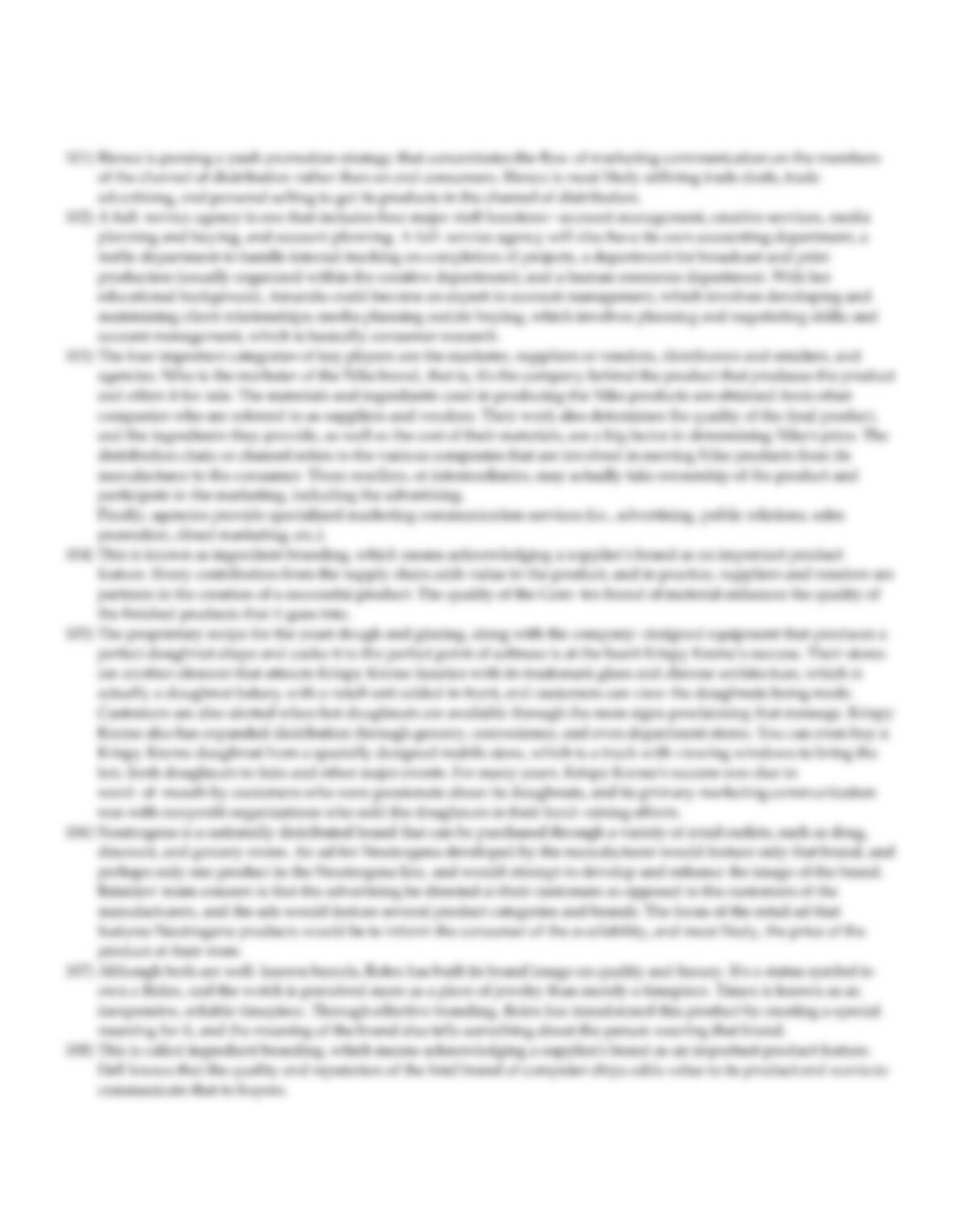
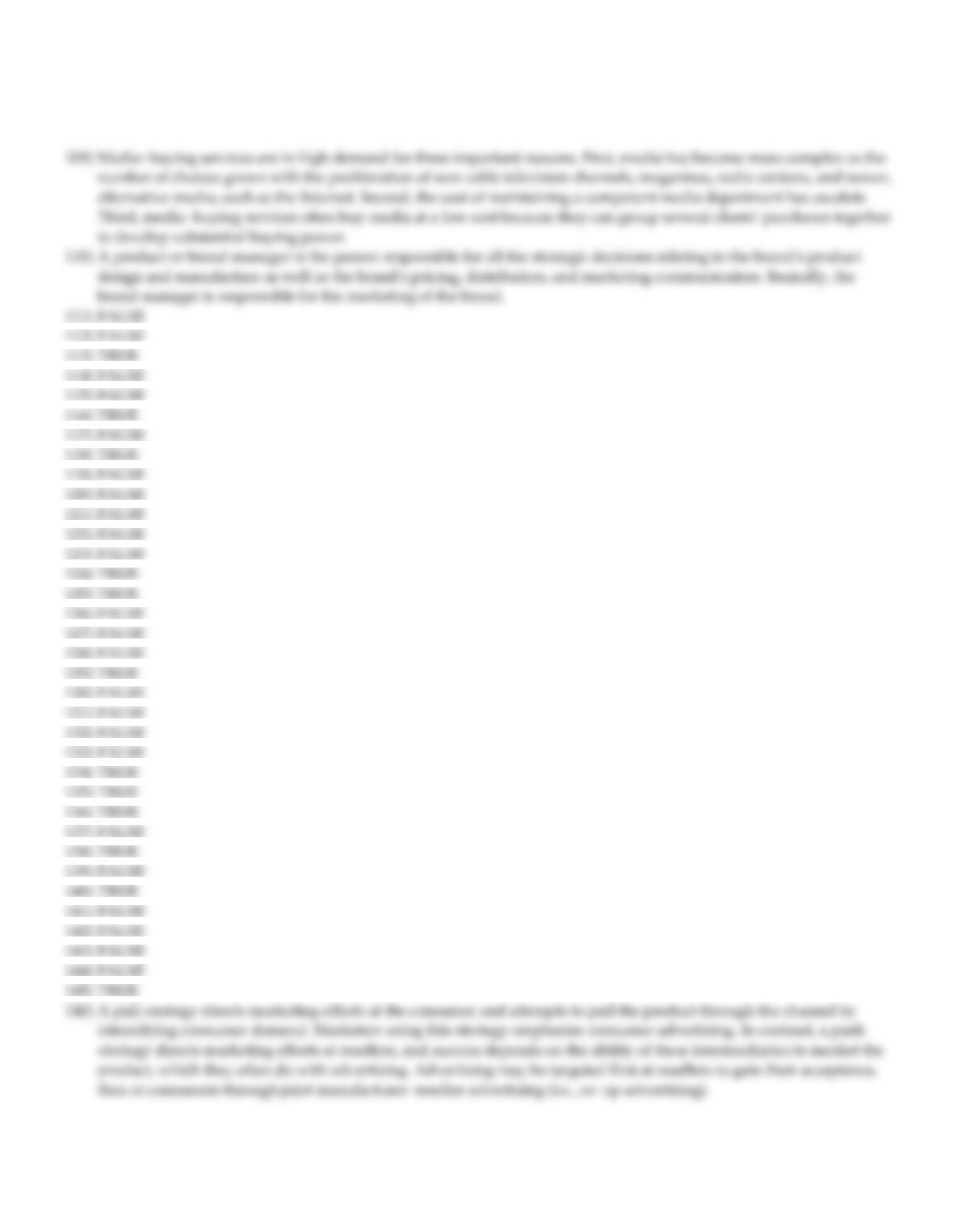
146)
Compare and contrast push and pull strategies and explain the role of advertising in each.
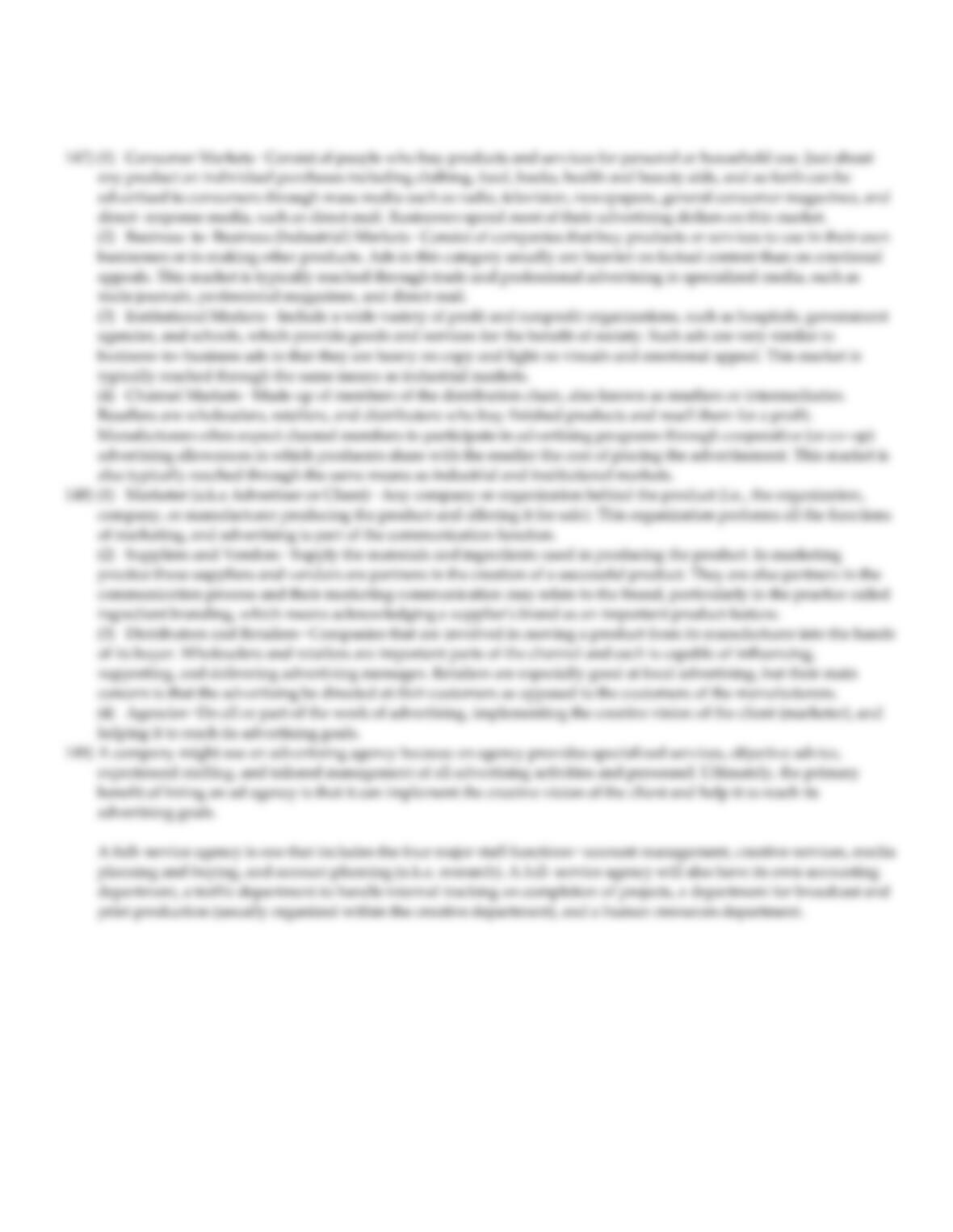
147)
Name and describe the four main types of markets, and discuss characteristics of advertising targeted toward
each market, respectively.
148)
Identify the four important categories of key players in marketing and how the organization of the industry
affects advertising.
149)
Explain why a company would use an advertising agency and describe the major functions performed by a
full–service agency.
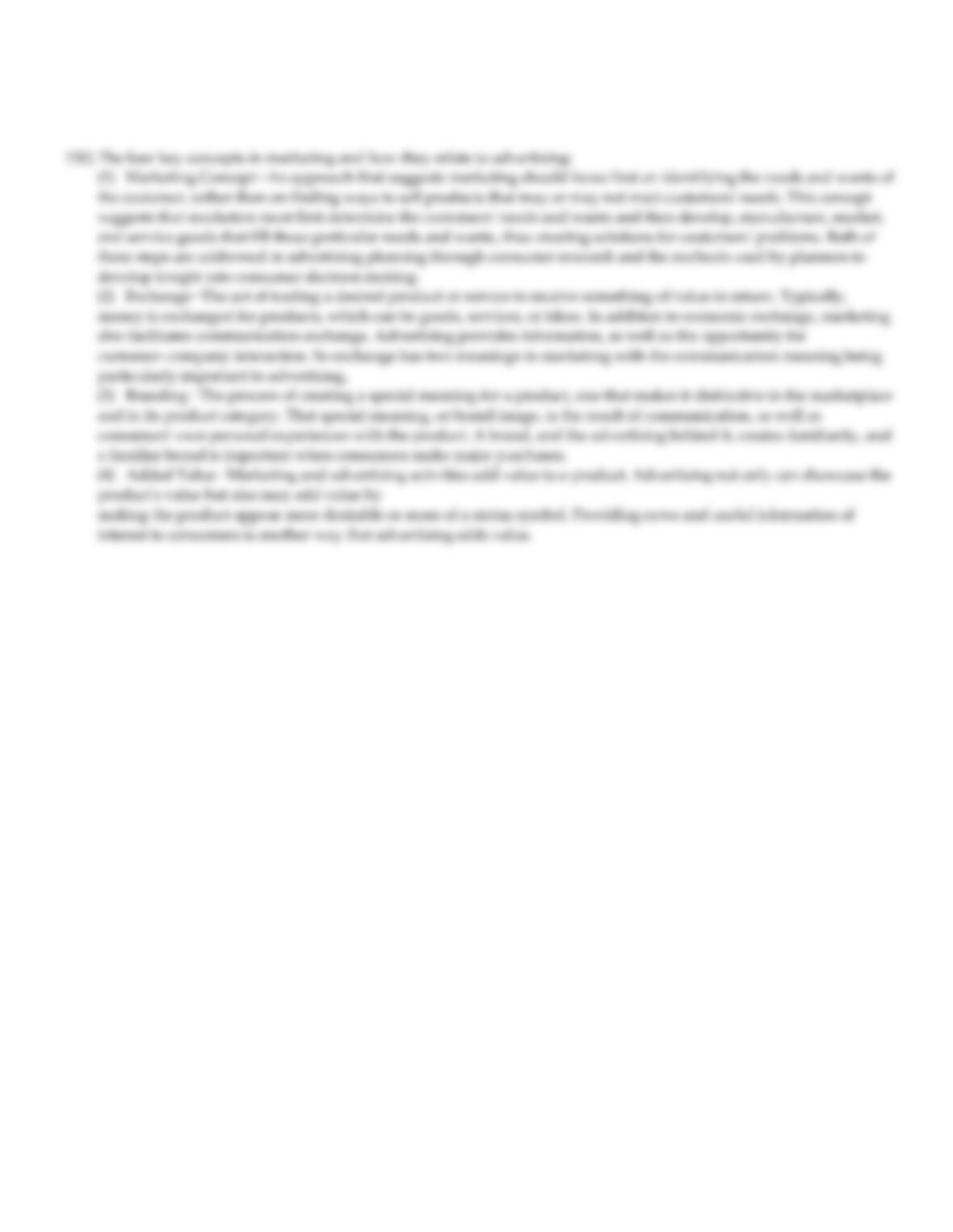
150)
Identify the four key concepts in marketing and explain how they relate to advertising.

Answer Key
Testname: C2
Answer Key
Testname: C2
Answer Key
Testname: C2
Answer Key
Testname: C2
44
Answer Key
Testname: C2
45
Answer Key
Testname: C2
46
Answer Key
Testname: C2
47