Write the expression using base e rather than base 10.
61)
10x3
61)
A)
e(ln 10)x3
B)
10ex3
C)
x3e10
D)
e10x3
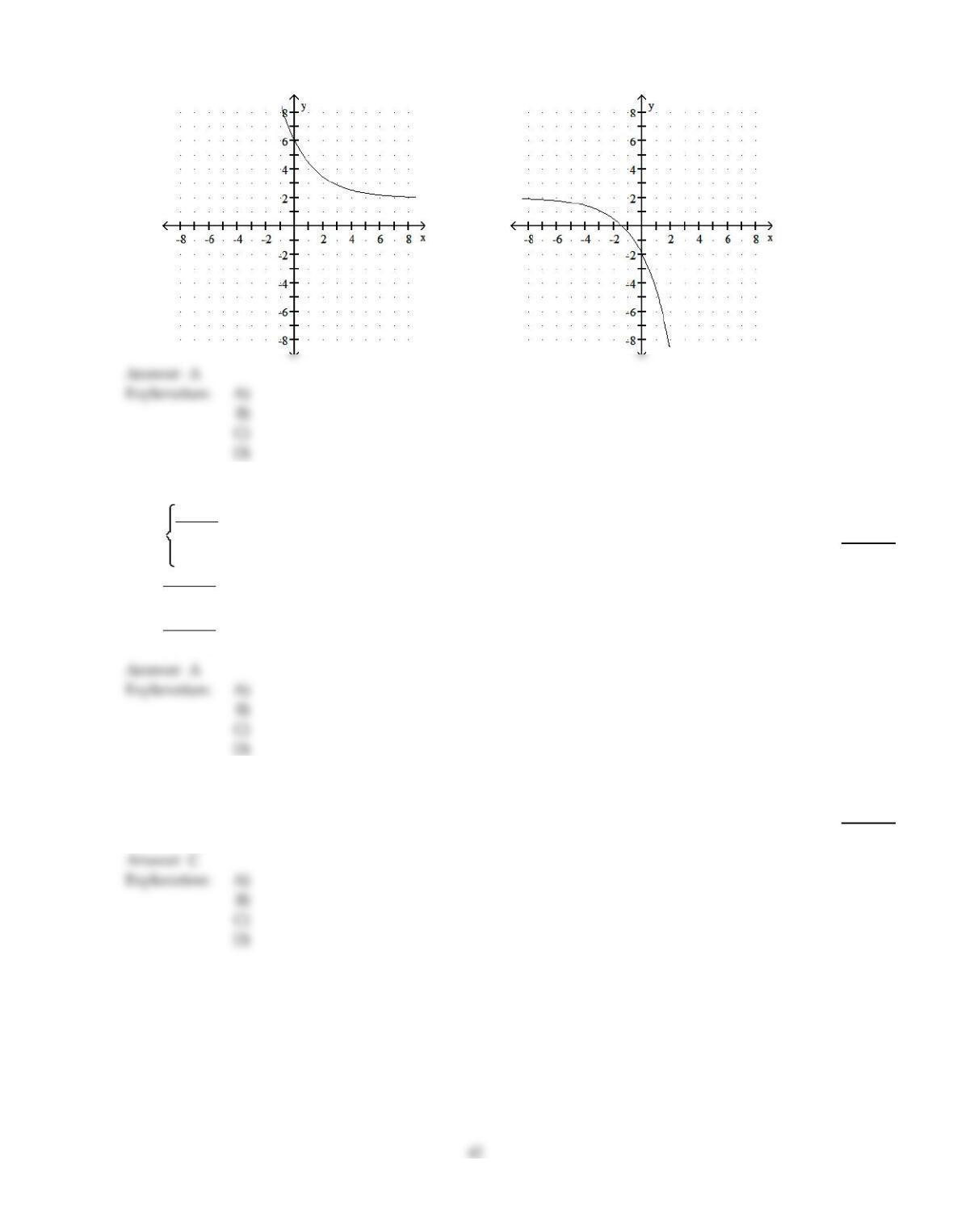
Graph the function.
62)
y = – 4e–x/2 +2
62)
A)
B)
41
C)
D)
Evaluate the function for the given value.
63)
f(x) =
2x +4
x –5if x 5
13 if x =5
; f(a)
63)
A)
(2a +4)
(a –5) if a 5, 13 if a =5
B)
0 if a 5, 13 if a =5
C)
(2a +4)
(a –4) if a =5, 13 if a 5
D)
2 if a 5, 13 if a =5
Write the exponential equation in logarithmic form.
64)
53=125
64)
A)
log53=125
B)
log125 5=3
C)
log5125 =3
D)
log3125 =5
Solve the equation. Round decimal answers to the nearest thousandth.
65)
3x=17
65)
A)
2.579
B)
1.735
C)
0.388
D)
5.667
Write the exponential equation in logarithmic form.
66)
42=16
66)
A)
log416 =2
B)
log42=16
C)
log16 4=2
D)
log216 =4
Solve the problem.
67)
The sales of a new model of notebook computer are approximated by: S(x) =4000 –12,000e–x/10,
where x represents the number of months the computer has been on the market and S represents
sales in thousands of dollars. In how many months will the sales reach $2,000,000? Round to the
nearest month.
67)
A)
28 months
B)
21 months
C)
25 months
D)
18 months
Find f(x +
h) – f(x)
h.
68)
f(x) =2
x
68)
A)
–2
x(x + h)
B)
–h
x(x + h)
C)
–2
(x + h)
D)
0
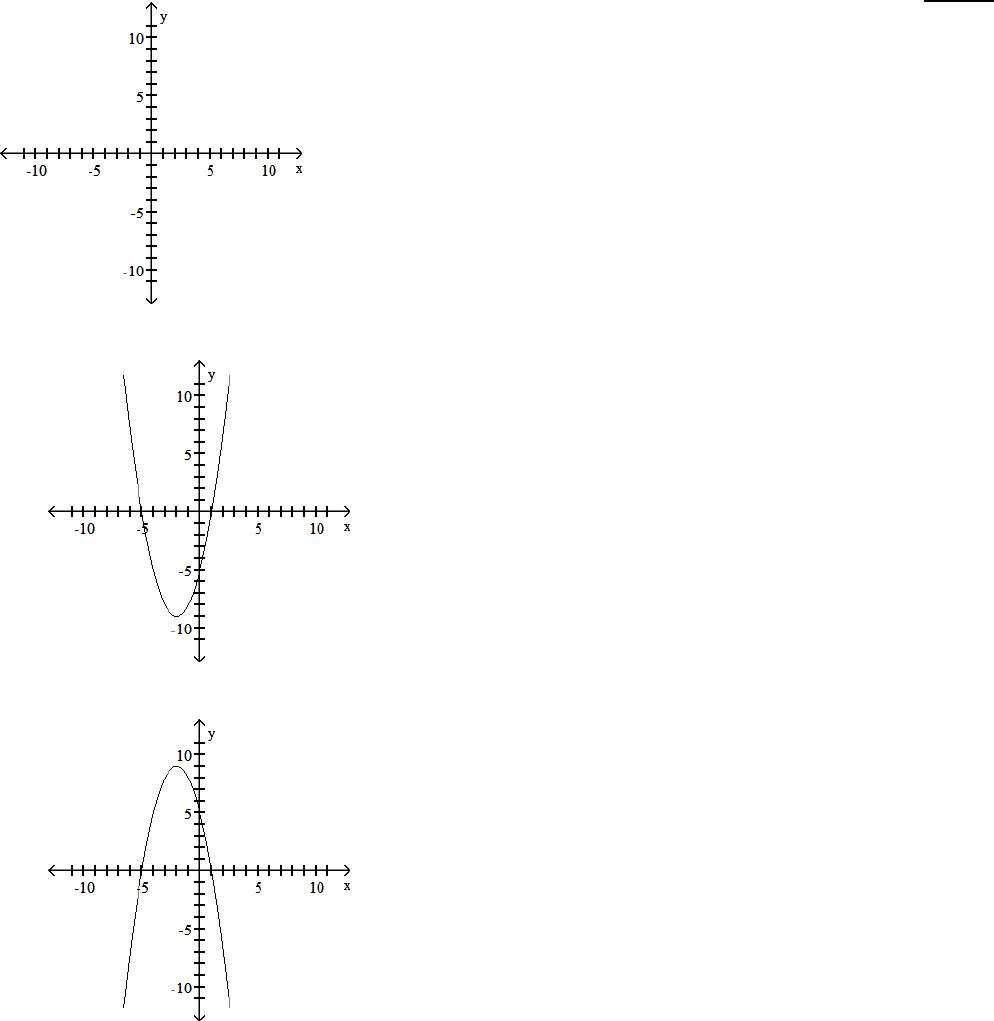
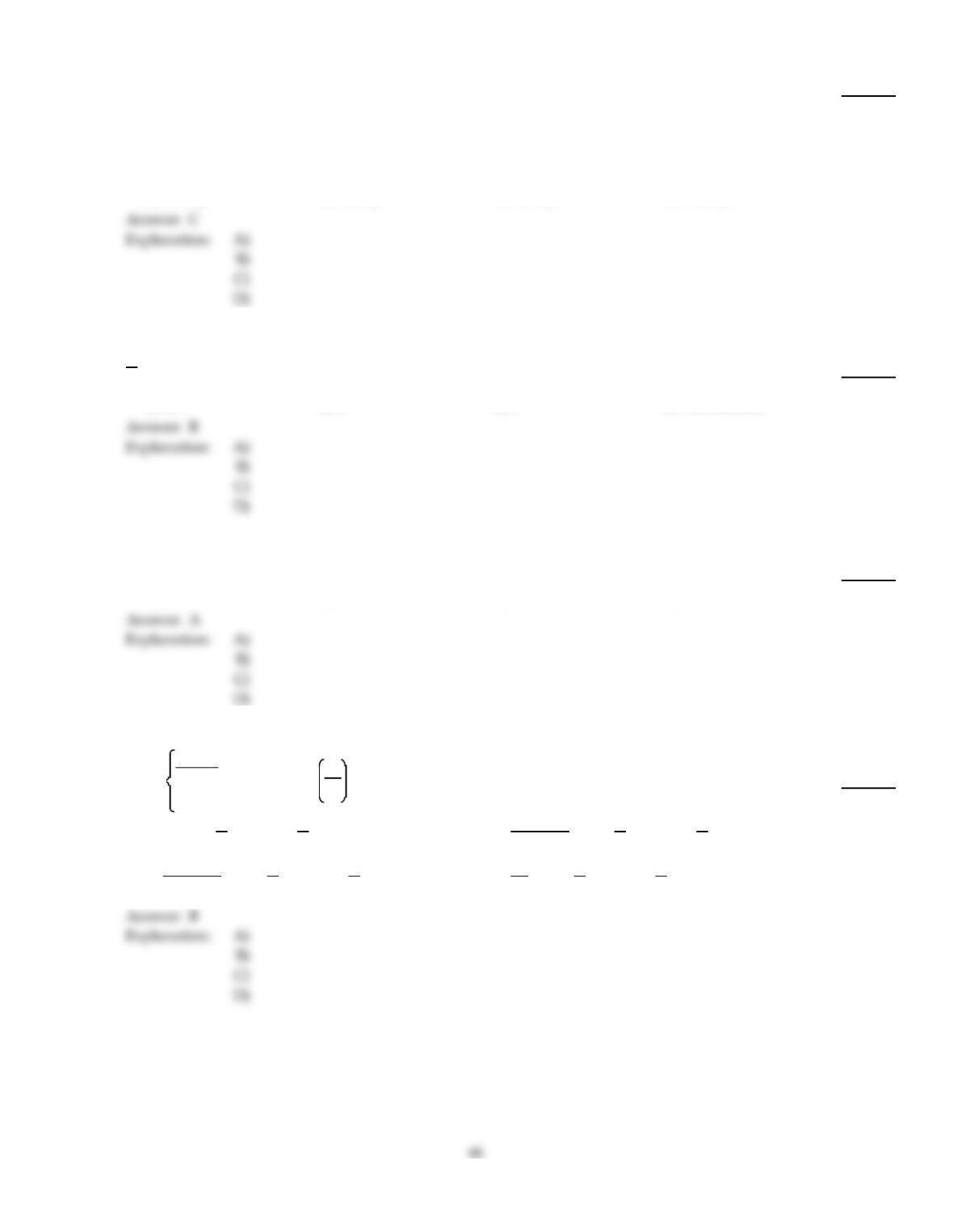
Graph the parabola and give its vertex, axis, x–intercepts, and y–intercepts.
43
69)
f(x) = – x2+ 4x + 5
69)
A)
vertex (–2, –9); axis is x = – 2;
x–intercepts are –5 and 1; y–intercept is –5
B)
vertex (–2, 9); axis is x = – 2;
x–intercepts are –5 and 1; y–intercept is 5
44
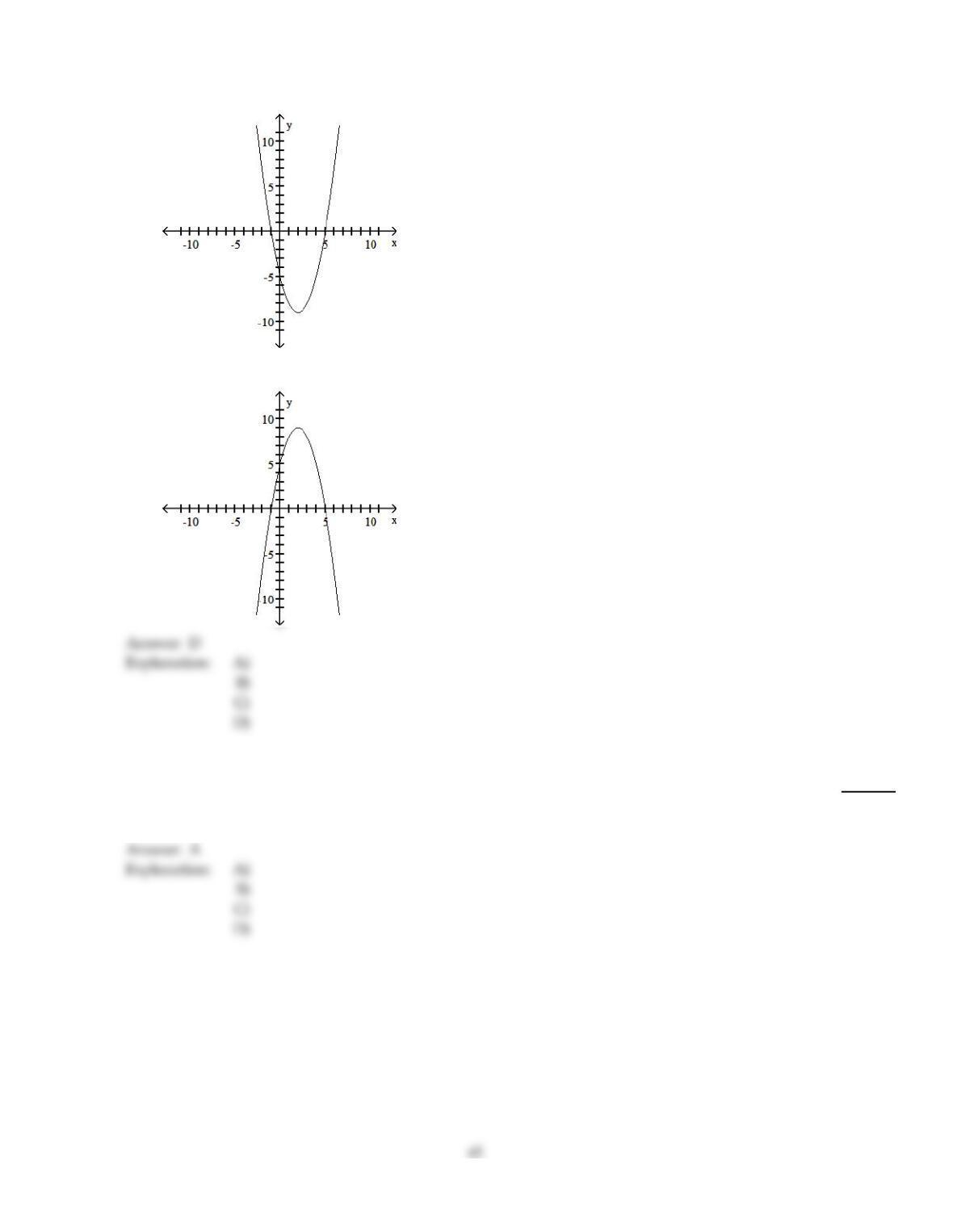
C)
vertex (2, –9); axis is x =2;
x–intercepts are 5 and – 1; y–intercept is –5
D)
vertex (2, 9); axis is x =2;
x–intercepts are 5 and – 1; y–intercept is 5
Solve the problem.
70)
John owns a hotdog stand. He has found that his profit is represented by the equation
P(x) = – x2+ 14x + 58, where x is the number of hotdogs. What is the most he can earn?
70)
A)
$107
B)
$29
C)
$14
D)
$58
71)
In the formula A(t) =A0ekt, A(t) is the amount of radioactive material remaining from an initial
amount A0 at a given time t and k is a negative constant determined by the nature of the material.
An artifact is discovered at a certain site. If it has 51% of the carbon–14 it originally contained, what
is the approximate age of the artifact, rounded to the nearest year? (carbon–14 decays at the rate of
0.0125% annually.)
71)
A)
2339 yr
B)
4080 yr
C)
5387 yr
D)
3920 yr
Solve the equation.
72)
1
2 log2 x2= log4 4x
72)
A)
4, 0
B)
4
C)
8
D)
No solution
Evaluate the function.
73)
f(x) =3x2+5x +11; Find f(a).
73)
A)
3a2+5a +11
B)
8a
C)
8a +11
D)
3a2+5a
Evaluate the function for the given value.
74)
f(x) =
2x +3
x –7if x 7
14 if x =7
; f 2
m
74)
A)
2 if m 2
7, 14 if m =2
7
B)
(4 +3m)
(2 –7m) if m 2
7, 14 if m =2
7
C)
(4m +3)
(2m–7) if m 2
7, 14 if m =2
7
D)
2
m if m 2
7, 14 if m =2
7
Find the asymptotes of the function.
75)
y =
–5
x – 8
75)
A)
Vertical asymptote at x = – 8; horizontal asymptote at y = – 5
B)
Vertical asymptote at x =8; horizontal asymptote at y = – 5
C)
Vertical asymptote at x =8; horizontal asymptote at y = 0
D)
Vertical asymptote at x = – 8; horizontal asymptote at y = 0
Approximate the expression in the form ax without using e. Round to the nearest thousandth when necessary.
76)
e6x
76)
A)
403.429x
B)
1.792x
C)
16.31x
D)
130.387x
Solve the problem.
77)
Barbara knows that she will need to buy a new car in 2 years. The car will cost $15,000 by then.
How much should she invest now at 6%, compounded quarterly, so that she will have enough to
buy a new car? Round to the nearest cent.
77)
A)
$14,150.94
B)
$12,594.29
C)
$14,138.94
D)
$13,315.67
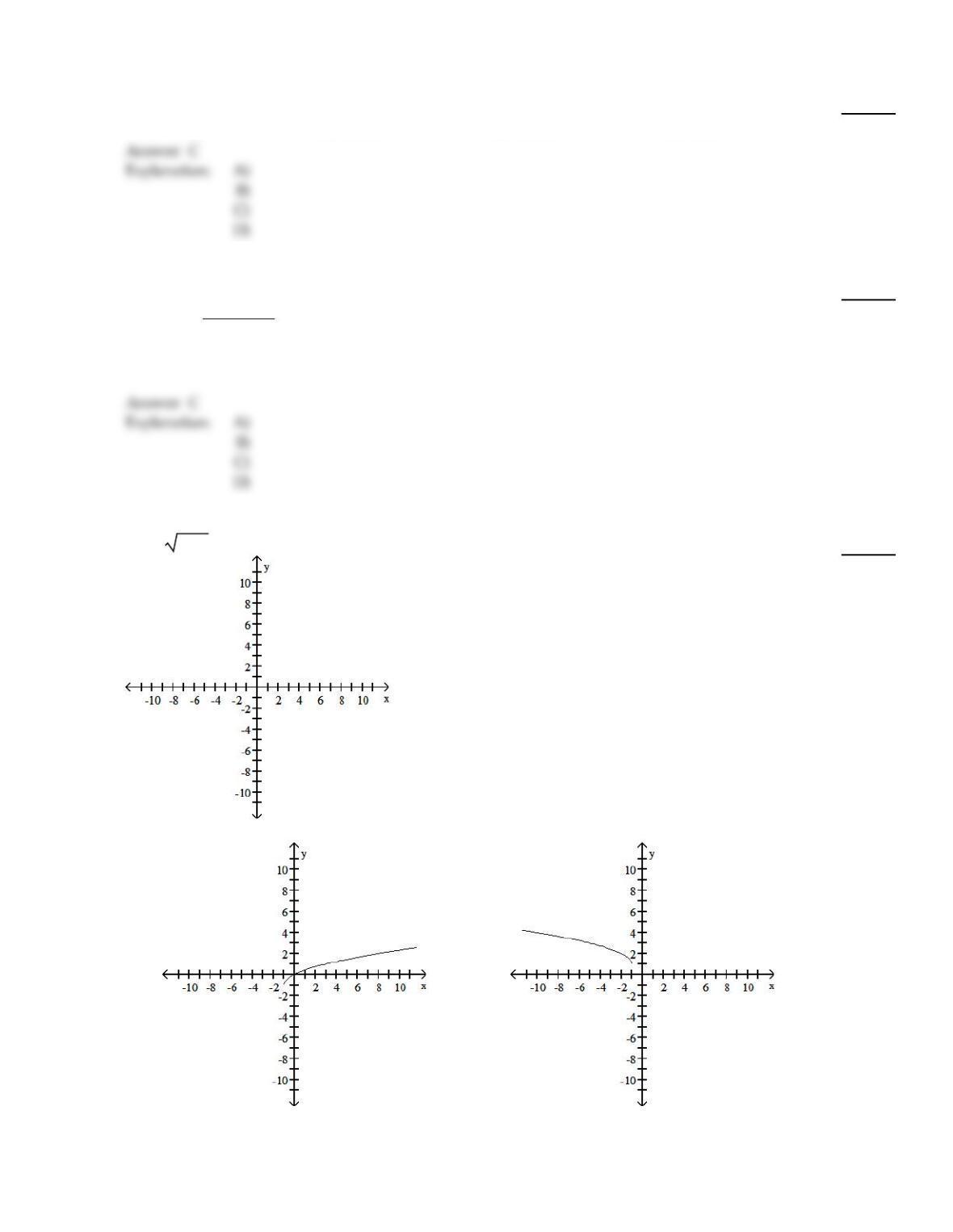
Graph the function.
78)
f(x) = – 5– x + 2
78)
47
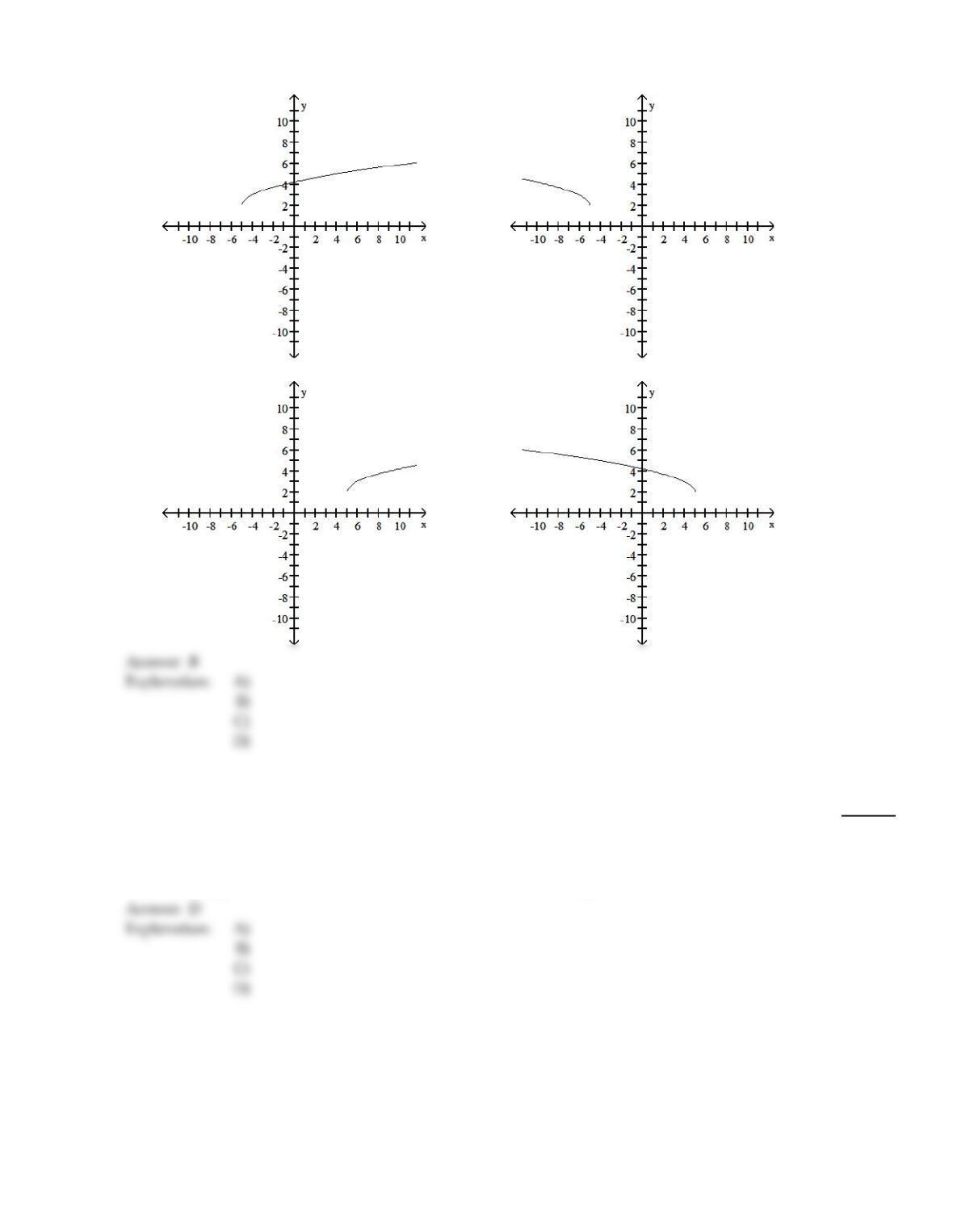
A)
B)
C)
D)
Solve the problem.
79)
The pH of a solution is defined as pH = – log[H+], where [H+] is the concentration of hydrogen ions
in the solution. The pH of pure water is 7, while the pH of orange juice is about 4. How much
greater is the concentration of hydrogen ions in orange juice than in pure water?
79)
A)
100 times greater
B)
10 times greater
C)
3 times greater
D)
1000 times greater
48
80)
At what interest rate must $4800 be compounded annually to equal $7217.43 after 7 years? Round
to the nearest percent.
80)
A)
7%
B)
5%
C)
8%
D)
6%
81)
Find the interest earned on $10,000 invested for 4 years at 8.4% interest compounded quarterly.
Round to the nearest cent.
81)
A)
$1808.80
B)
$13,944.79
C)
$1.39
D)
$3944.79
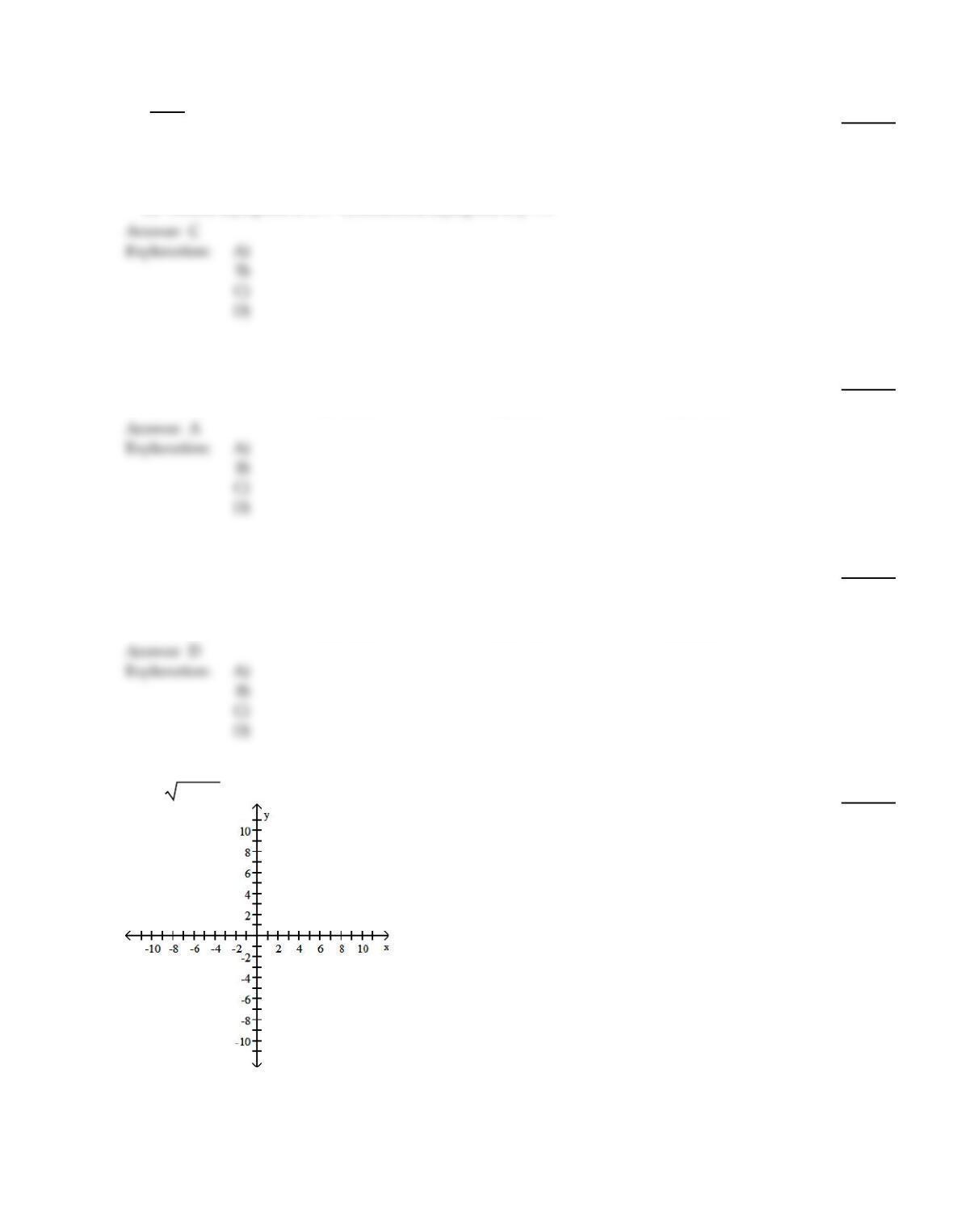
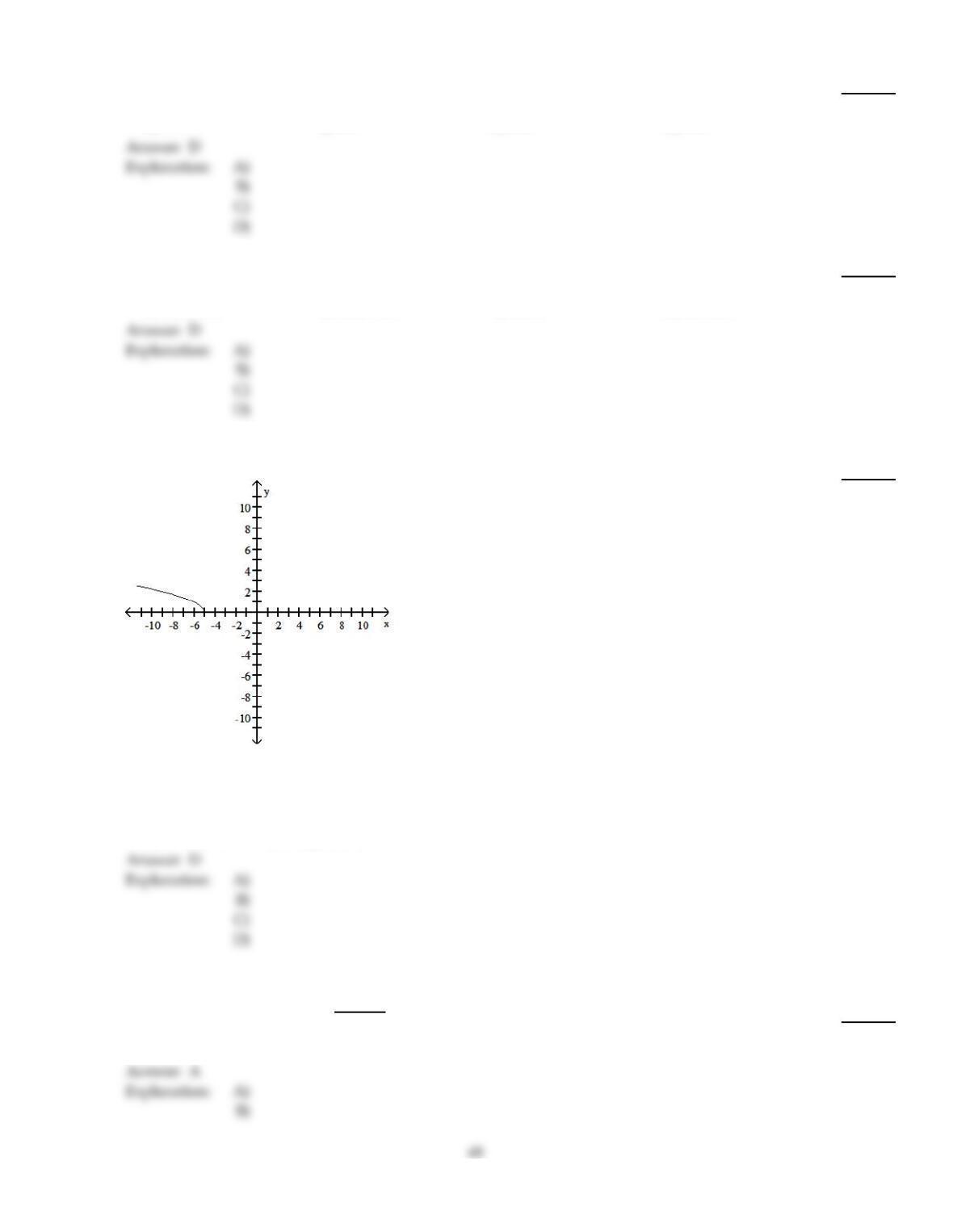
Give the domain and range of the function.
82)
82)
A)
Domain (–, ) ; Range [0, )
B)
Domain [0, ) ; Range (–, –5]
C)
Domain (–, –5) (–5, ) ; Range (–, 0) (0, )
D)
Domain (–, –5] ; Range [0, )
Provide an appropriate response.
83)
True or False. The function y =x2– 42
x – 4 is not continuous at x =4.
83)
A)
True
B)
False
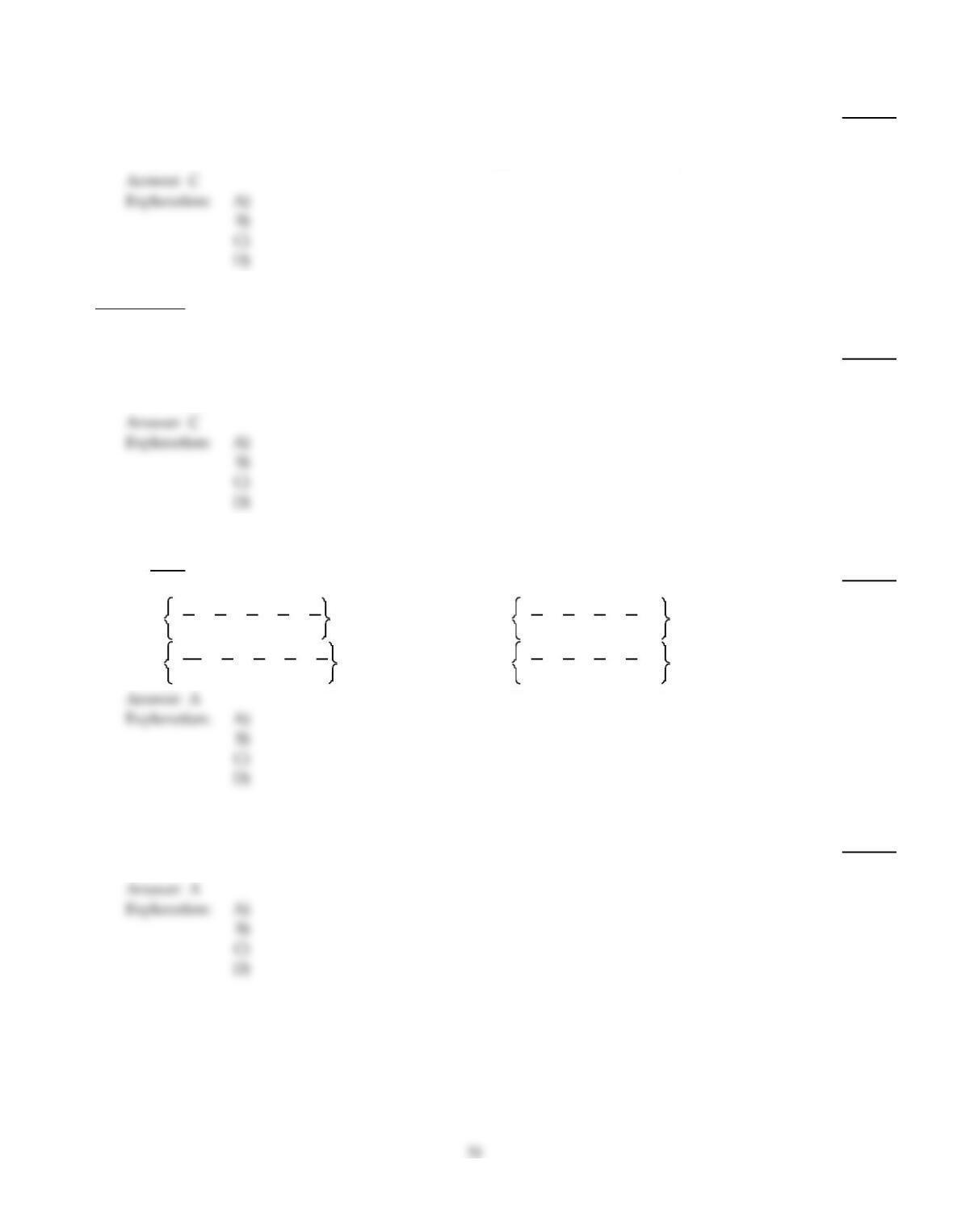
Determine whether the rule defines y as a function of x.
84)
X Y
318
848
13 78
18 108
84)
A)
Function
B)
Not a function
Solve the equation. Round decimal answers to the nearest thousandth.
85)
6e2x – 1 =36
85)
A)
18.500
B)
0.799
C)
0.396
D)
1.396
Give the range for the function if the domain is {–2, –1, 0, 1, 2}.
86)
y =x – 5
x + 5
86)
A)
–7
3, –3
2, –1, –2
3, –3
7
B)
–7
5, –3
4, –1, –2
3, –3
7
C)
–7
4, –3
2, 1, –2
5, –3
8
D)
–7
6, –3
4, 1, –2
5, –3
8
Evaluate the function.
87)
f(x) = – 3x2– 5x – 4; Find f(r + h).
87)
A)
–3r2– 3h2– 11r – 11h – 4
B)
–3r2– 3h2– 5r – 5h – 4
C)
–3r2– 6rh – 3h2– 5r – 5h – 4
D)
–3r2– 3rh – 3h2– 5r – 5h – 4
Find f(x +
h) – f(x)
h.
88)
f(x) =12 –9x3
88)
A)
–3x2
B)
–9(x2– xh –h2)
C)
–9(3x2+ 3xh +h2)
D)
–9(3x2– 3x – h)
Give the range for the function if the domain is {–2, –1, 0, 1, 2}.
89)
y =
–3
x + 7
89)
A)
–3
5, –1
2, –3
7, –3
8, –1
3
B)
–3
8, –1
4, –3
5, –3
5, –1
C)
–3
11 , –1
2, –3
7, –3
8, –1
3
D)
–3
7, –1
2, –3
8, –1
3, –1
Find the domain of the function.
90)
f(x) = log4 (25 – x2)
90)
A)
–5< x <5
B)
x < – 5 and x >5
C)
–5
x 5
D)
–25 < x <25
Use natural logarithms to evaluate the logarithm to the nearest thousandth.
91)
log50.671
91)
A)
–4.034
B)
–0.173
C)
–0.248
D)
7.452
Write the logarithmic equation in exponential form.
92)
log 10,000,000 =7
92)
A)
107=1
10,000,000
B)
107=7
C)
107=10,000,000
D)
107=100,000,000
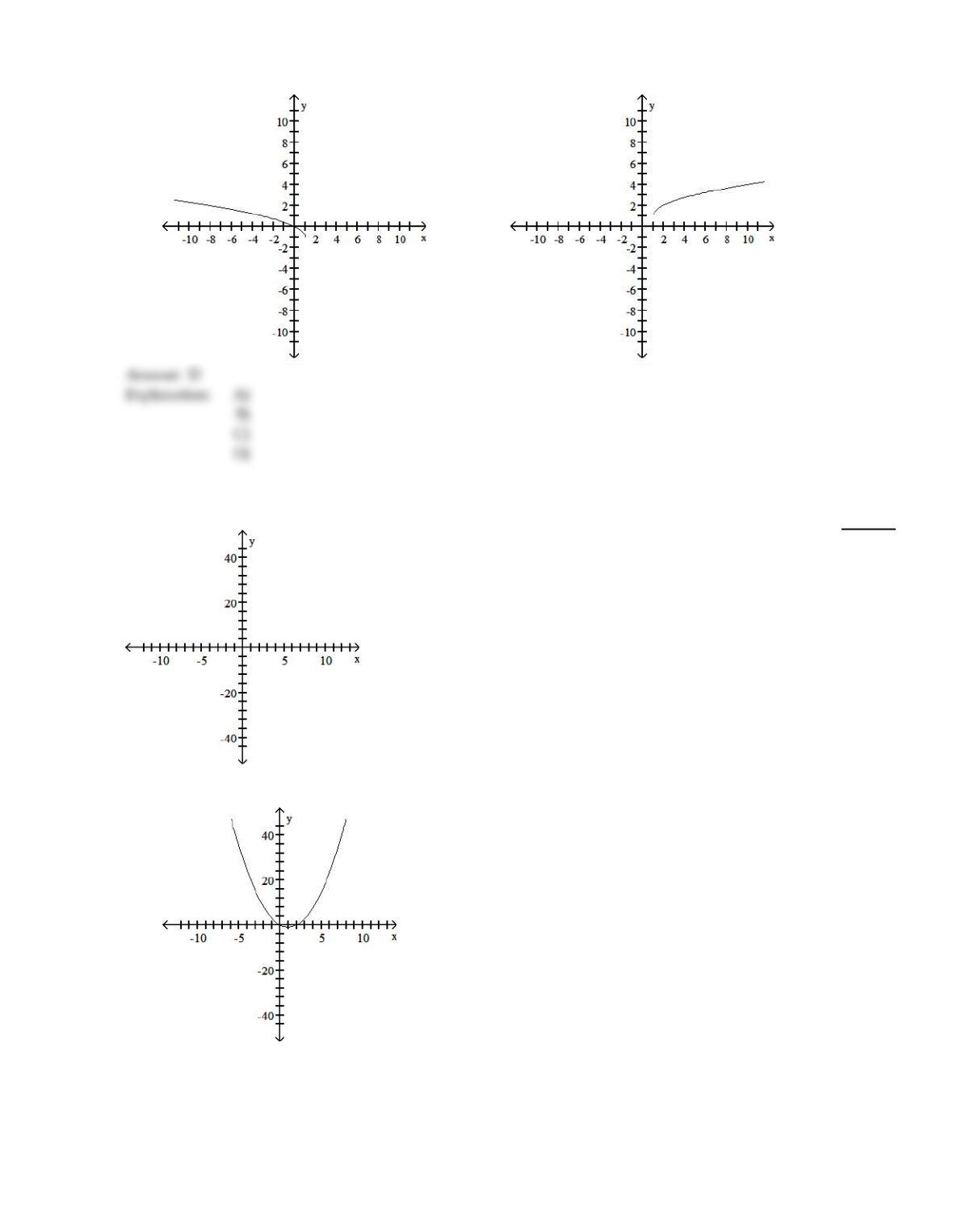
Graph the function.
93)
f(x) =x – 1 + 1
93)
A)
B)
52
C)
D)
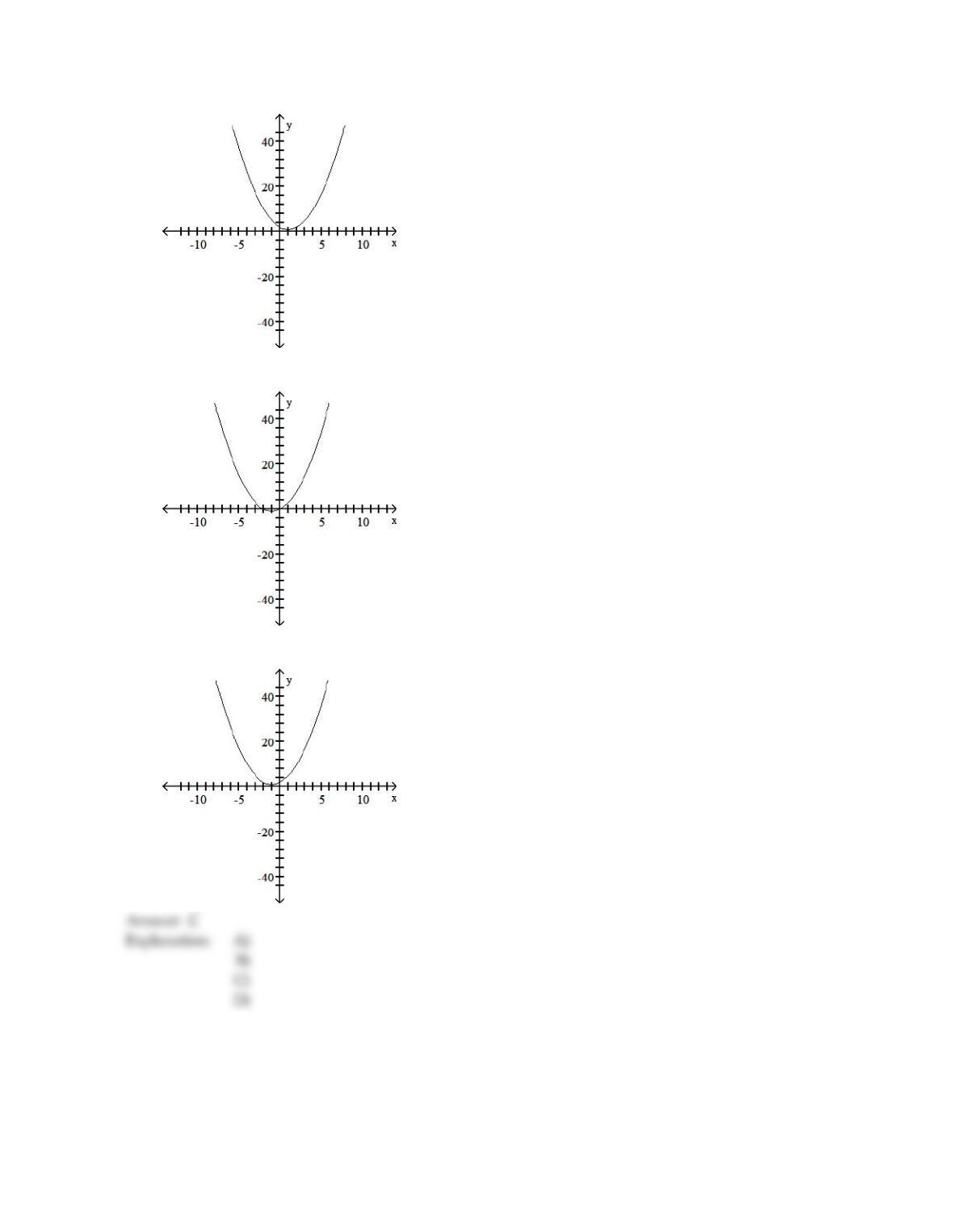
Graph the parabola and give its vertex, axis, x–intercepts, and y–intercepts.
94)
f(x) =x2+ 2x
94)
A)
vertex (1, –1); axis is x =1;
x–intercepts are 0 and 2; y–intercept is 0
53
B)
vertex (1, 1); axis is x =1;
no x–intercepts; y intercept is 2
C)
vertex (–1, –1); axis is x = – 1;
x–intercepts are 0 and – 2; y–intercept is 0
D)
vertex (–1, 1); axis is x = – 1;
no x–intercepts; y–intercept is 2
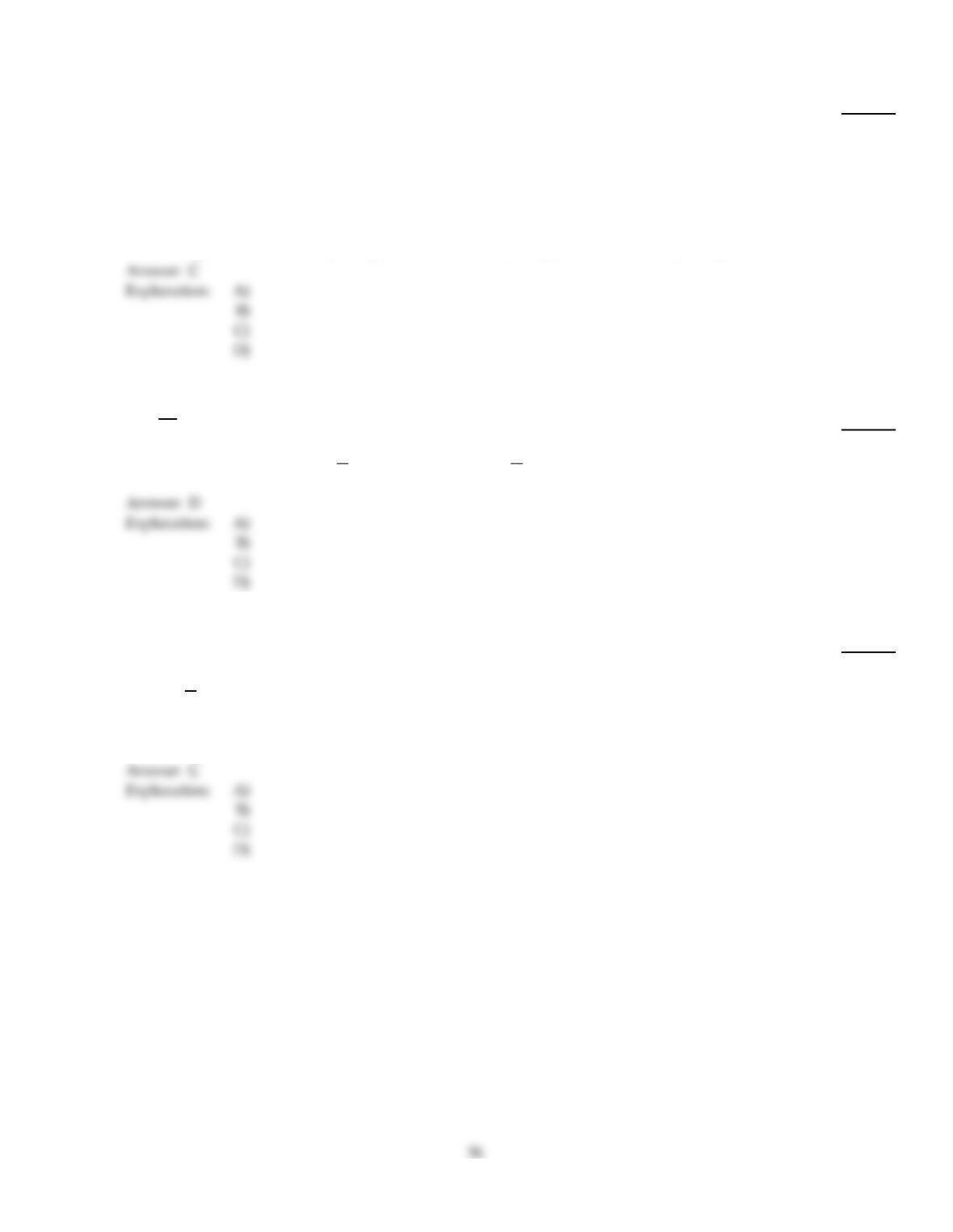
Graph the indicated new function, given the graph for y = f(x).
54
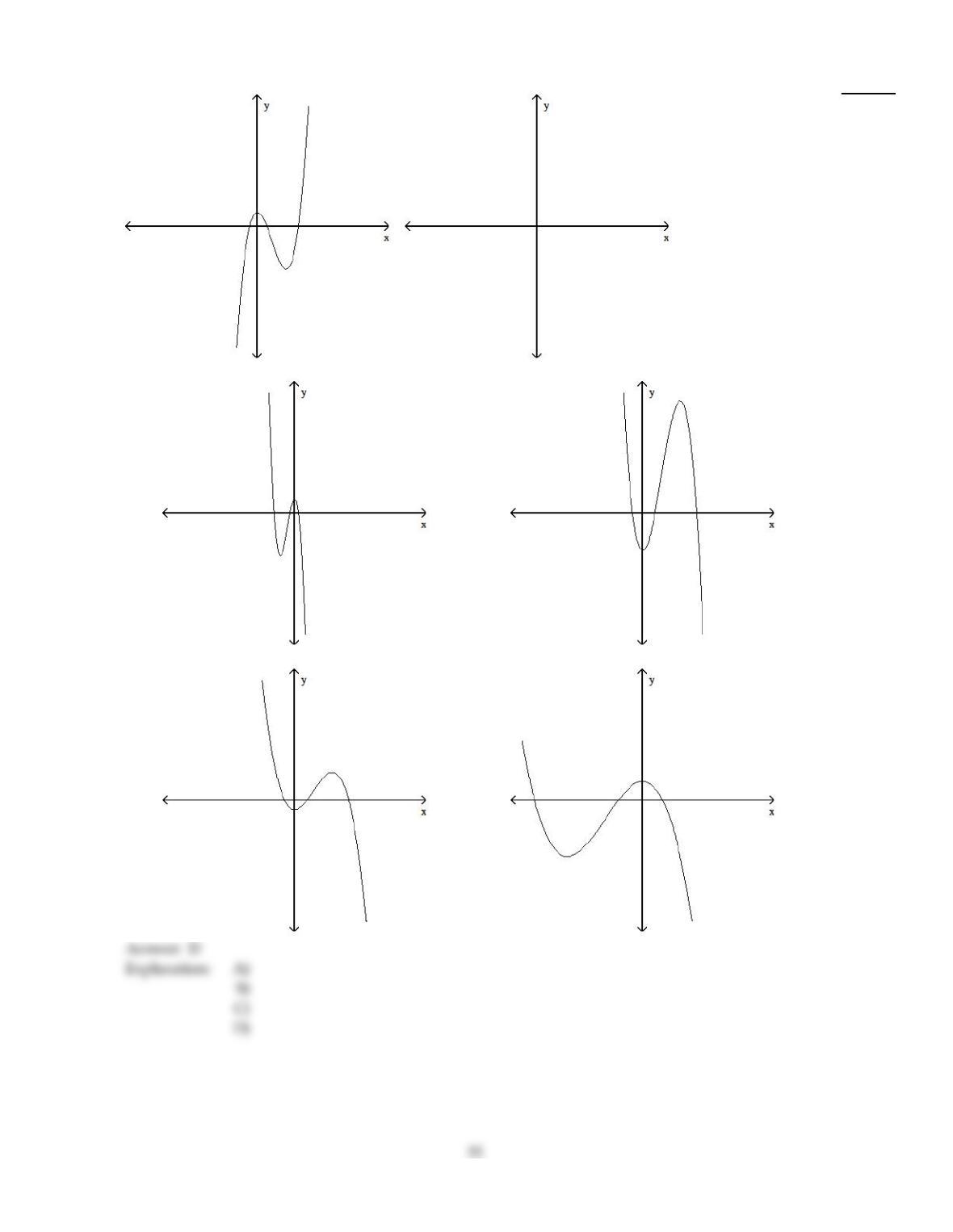
95)
y = f(ax), where a satisfies –1 < a < 0
95)
A)
B)
C)
D)
Solve the problem.
96)
When pouring water from one five gallon bucket to another, a person tends to pour at a faster rate
at first and then slow down in order not to spill. The amount of water left in the original bucket can
be approximated by
f(t) = 5 –0.75t0.63,
where f(t) is measured in gallons and t is the time spent pouring in seconds. Find the approximate
amount of water left in the original bucket after 6 seconds of pouring. Round to the nearest
hundredth.
96)
A)
4.37 gal
B)
4.25 gal
C)
2.68 gal
D)
2.32 gal
Solve the equation.
97)
5x=1
25
97)
A)
2
B)
1
2
C)
1
5
D)
–2
Solve the problem.
98)
An advertising agency has discovered that when the Holt Company spends x thousands of dollars
on advertising, it results in a profit increase in thousands of dollars given by the function
P(x) = – 1
5(x –8)2+60. How much should the Holt Company spend on advertising to maximize
the profit?
98)
A)
$6000
B)
$63,000
C)
$8000
D)
$60,000
Find the asymptotes of the function.
99)
y =
–1x +5
18 –6x
99)
A)
Vertical asymptote at x = – 1
6; horizontal asymptote at y =3
B)
Vertical asymptote at x =3; horizontal asymptote at y = – 1
6
C)
Vertical asymptote at x =3; horizontal asymptote at y =1
6
D)
Vertical asymptote at x =3; horizontal asymptote at y =1
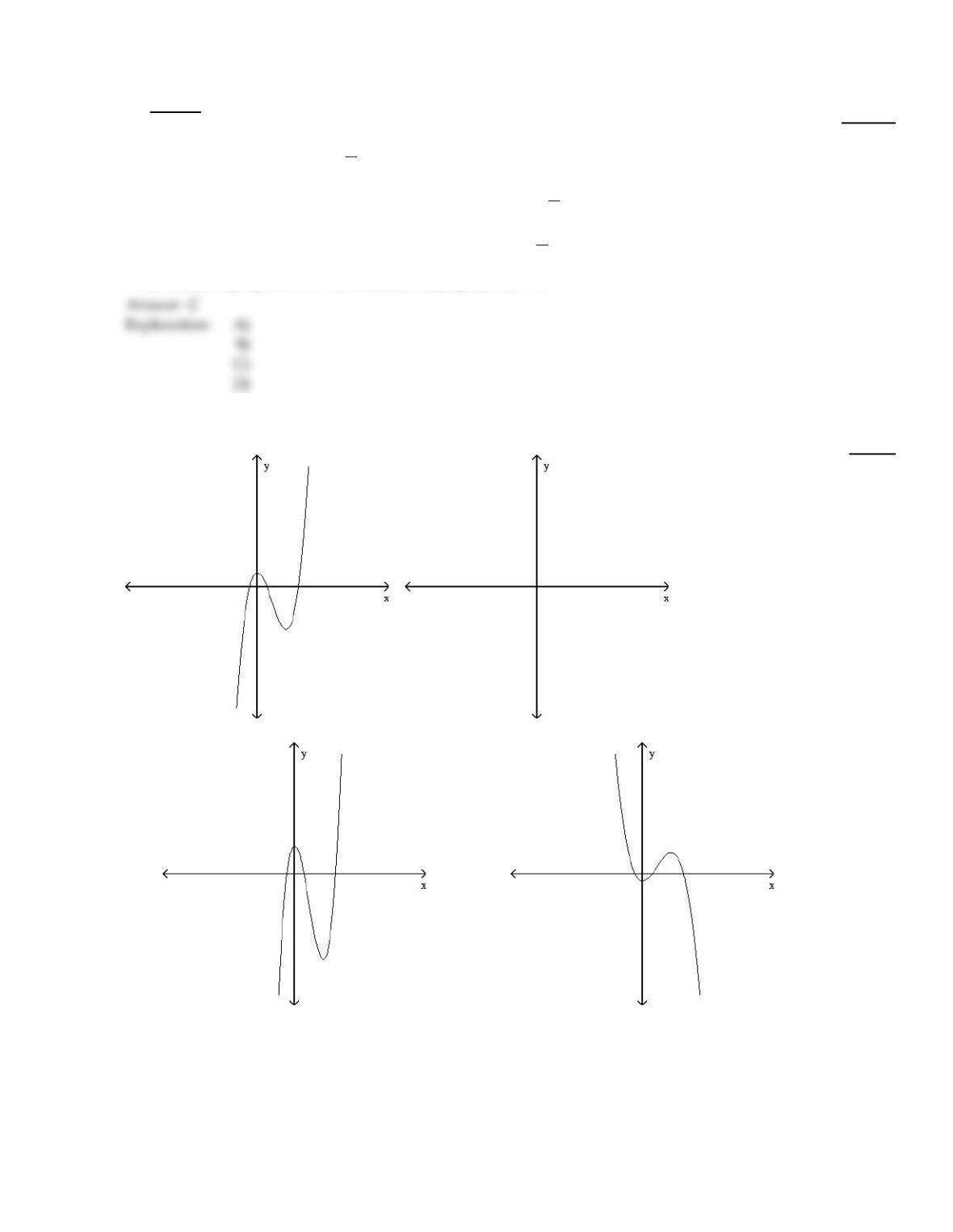
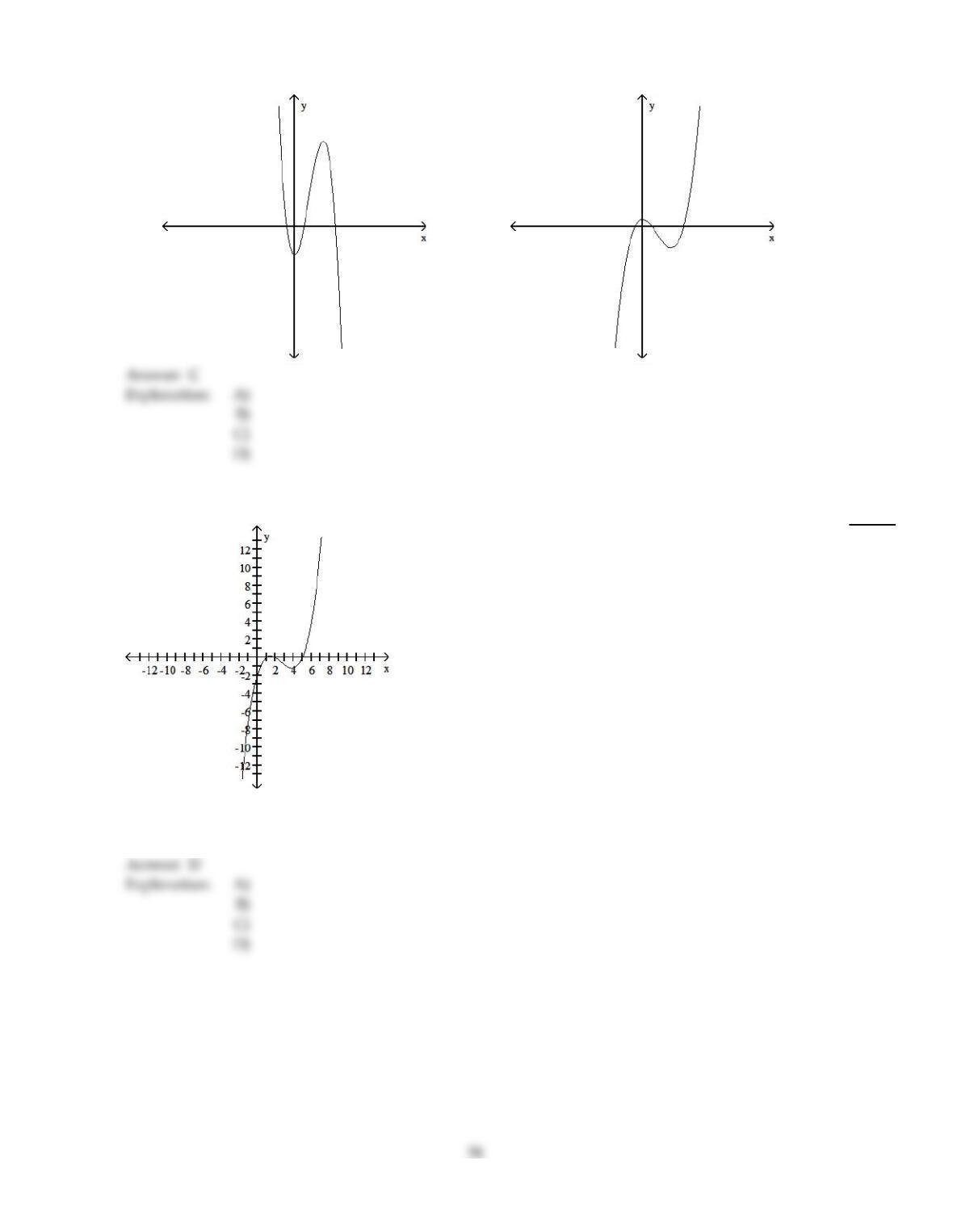
Graph the indicated new function, given the graph for y = f(x).
100)
y = af(x), where a satisfies a < – 1
100)
A)
B)
57
C)
D)
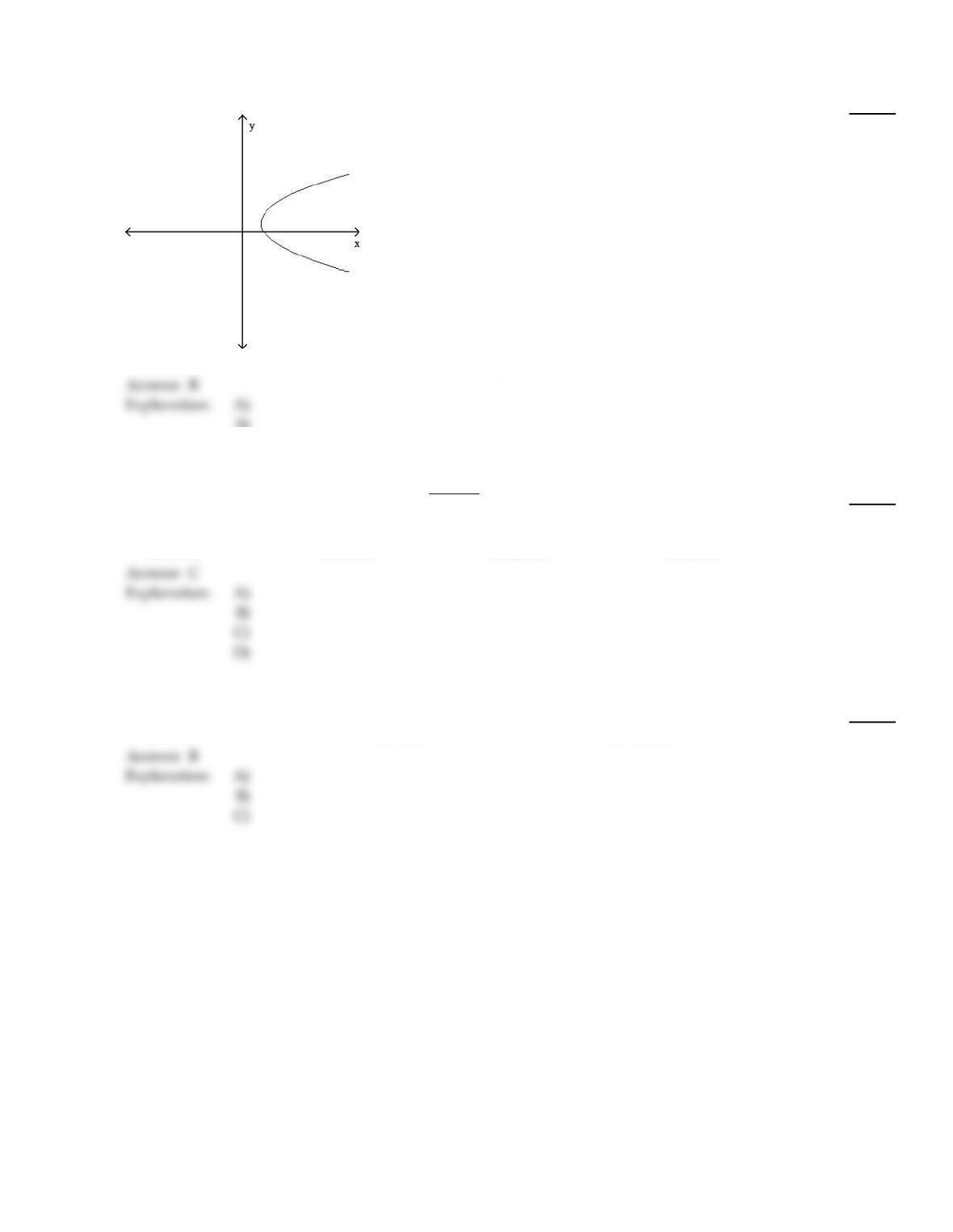
Give the domain and range of the function.
101)
101)
A)
Domain (–, ) ; Range {5, 2, 1}
B)
Domain (–, ) ; Range [–2, )
C)
Domain {5, 2, 1} ; Range (–, )
D)
Domain (–, ) ; Range (–, )
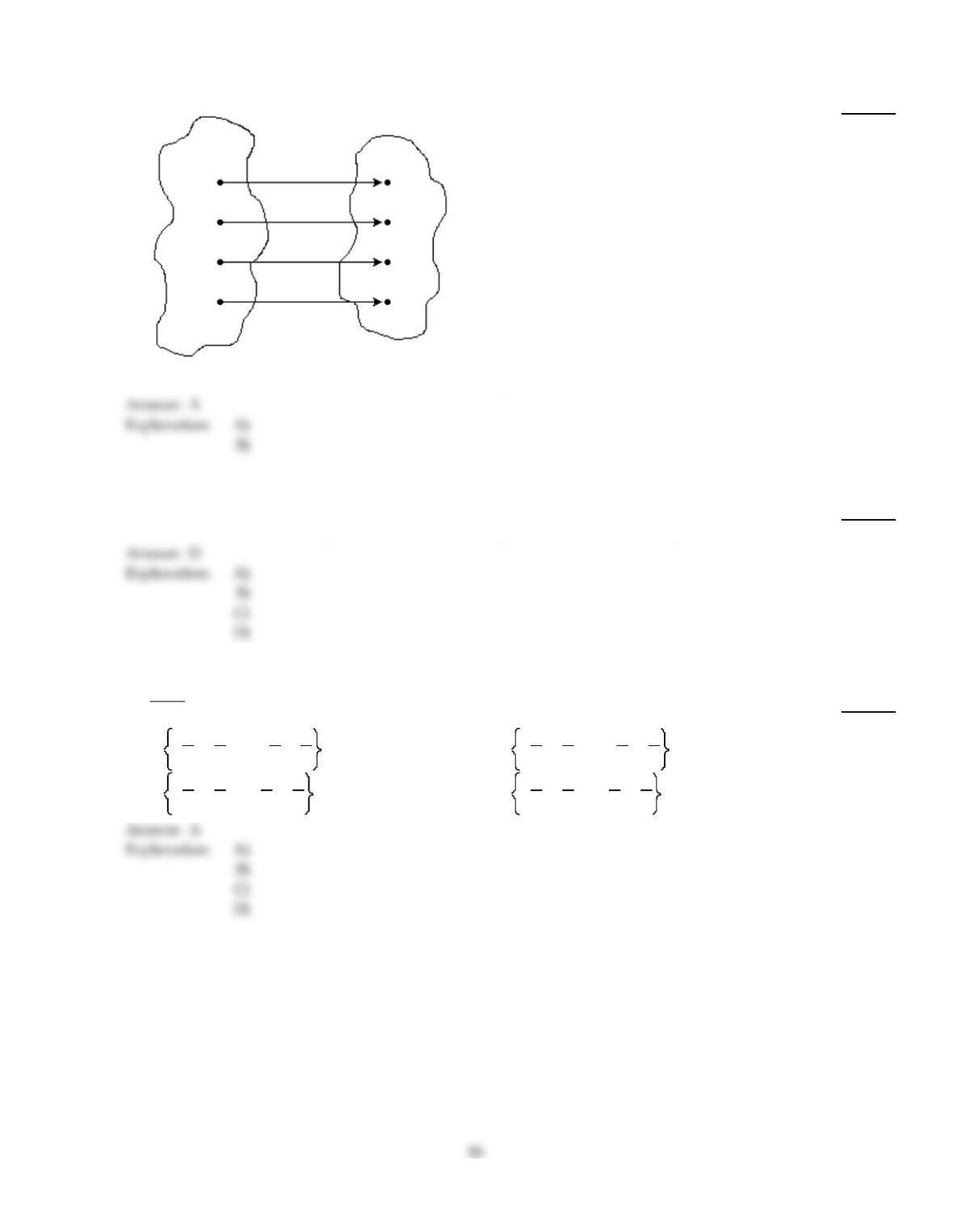
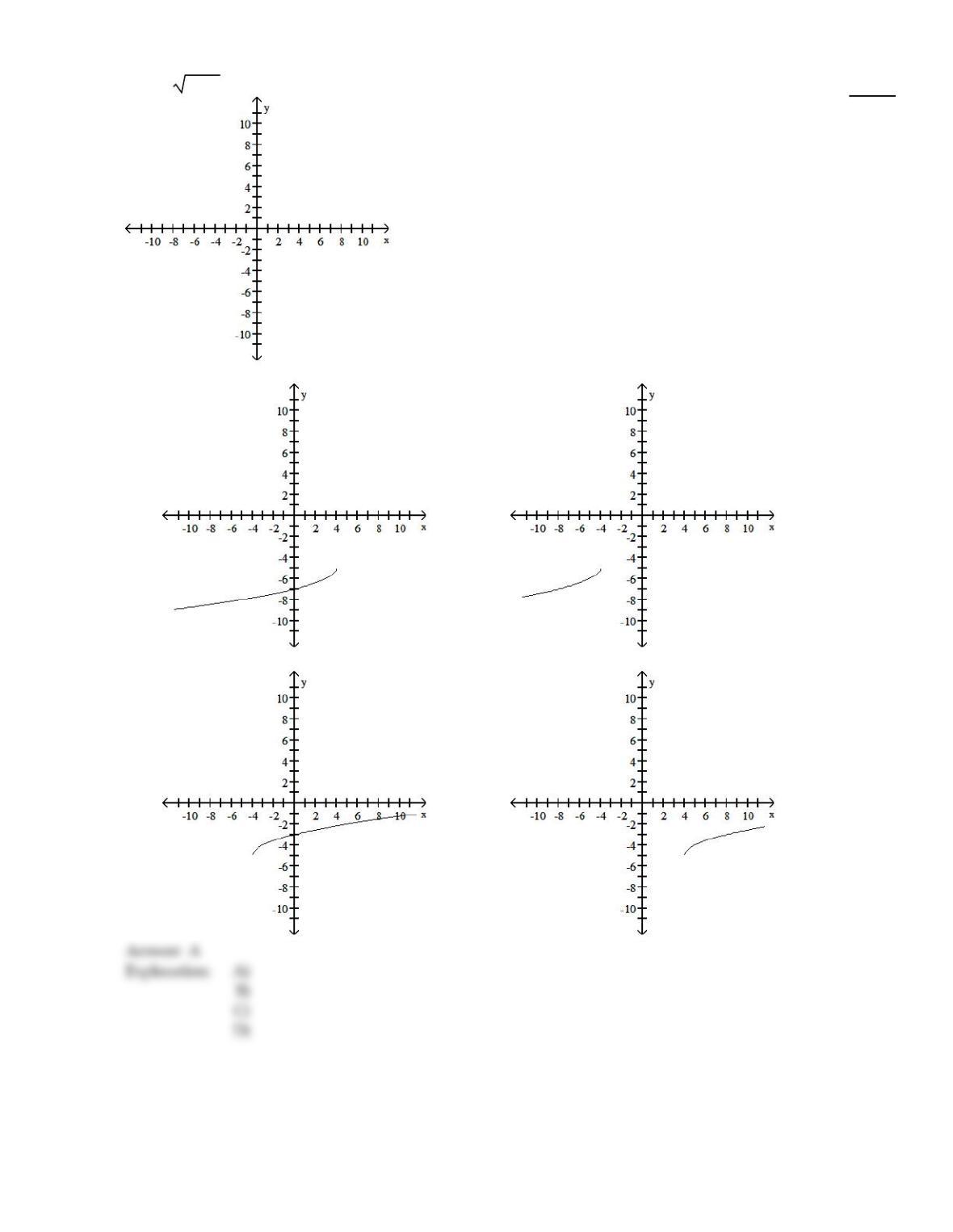
Decide whether the graph represents a function.
102)
102)
A)
Function
B)
Not a function
B)
Solve the problem.
103)
Suppose a cost–benefit model is given by y =2.1x
100 – x , where y is the cost in thousands of dollars for
removing x percent of a given pollutant. Find the cost of removing 80% to the nearest dollar.
103)
A)
$2100
B)
$1680
C)
$8400
D)
$4000
B)
Classify the function as even, odd, or neither.
104)
f(x) =8x
104)
A)
Even
B)
Odd
C)
Neither
B)
Graph the function.
59
105)
f(x) = – 4– x – 5
105)
A)
B)
C)
D)
60