Write an equation for a function that has a graph with the given transformations.
92)
The shape of y =x is shifted 5 units to the left. Then the graph is shifted 7 units upward.
92)
A)
f(x) =x + 5 + 7
B)
f(x) =x + 7 + 5
C)
f(x) = 7 x + 5
D)
f(x) =x – 5 + 7
Sketch the graph of the function.
93)
f(x) =x2
x2– x –20
93)
A)
B)
C)
D)
D)
Solve the problem.
94)
A professional basketball player has a vertical leap of 37 inches. A formula relating an athlete’s
vertical leap V, in inches, to hang time T, in seconds, is V=48T2. What is his hang time? Round to
the nearest tenth.
94)
A)
0.8 sec
B)
1 sec
C)
0.6 sec
D)
0.9 sec
The graph that follows is the graph of a polynomial function. (i) What is the minimum degree of a polynomial function
that could have the graph? (ii) Is the leading coefficient of the polynomial negative or positive?
95)
95)
A)
(i) 2
(ii) Positive
B)
(i) 1
(ii) Positive
C)
(i) 2
(ii) Negative
D)
(i) 1
(ii) Negative
D)
Solve the problem.
96)
Hi–Tech UnWater begins a cable TV advertising campaign in Miami to market a new water. The
percentage of the target market that buys water is estimated by the function w(t) = 100(1 –e–0.02t),
t represents the number of days of the campaign. After how long will 90% of the target market have
bought the water?
96)
A)
120 days
B)
3 days
C)
90 days
D)
115 days
D)
D)
Use a calculator to evaluate the expression. Round the result to five decimal places.
97)
ln 0.027
97)
A)
–3.61192
B)
0.56864
C)
–1.56864
D)
Undefined
Provide an appropriate response.
98)
How can the graph of f(x) = – (x –1 )2 6 be obtained from the graph of y =x2?
98)
A)
Shift it horizontally 1 units to the right. Reflect it across the y–axis. Shift it 6 units up.
B)
Shift it horizontally 1 units to the right. Reflect it across the x–axis. Shift it 6 units up.
C)
Shift it horizontally 1 units to the left. Reflect it across the x–axis. Shift it 6 units up.
D)
Shift it horizontally 1 units to the right. Reflect it across the y–axis. Shift it 6 units down.
D)
Use the properties of logarithms to solve.
99)
ln (3x – 4) = ln 20 – ln (x – 5)
99)
A)
–5, –19
3
B)
5, 5
3
C)
0, 19
3
D)
19
3
D)
Determine the domain of the function.
100)
f(x) = – 7x + 9
100)
A)
All real numbers except 9
7
B)
x 9
7
C)
All real numbers
D)
No solution
D)
43
D)
Find the function value.
101)
Find f(-8) when f(x) =7–3x2.
101)
A)
-185
B)
55
C)
199
D)
31
Solve graphically to two decimal places using a graphing calculator.
102)
1.3x2–2.1x –3.2 > 0
102)
A)
–2.57 < x <0.96
B)
x < – 0.96 or x >2.57
C)
x < – 2.57 or x >0.96
D)
–0.96 < x <2.57
Write an equation for a function that has a graph with the given transformations.
103)
The shape of y =x2 is vertically stretched by a factor of 10, and the resulting graph is reflected
across the x–axis.
103)
A)
f(x) = – 10x2
B)
f(x) = 10x2
C)
f(x) = 10(x – 10)2
D)
f(x) =(x – 10)2
Evaluate.
104)
log884
104)
A)
84
B)
8
C)
4
D)
32
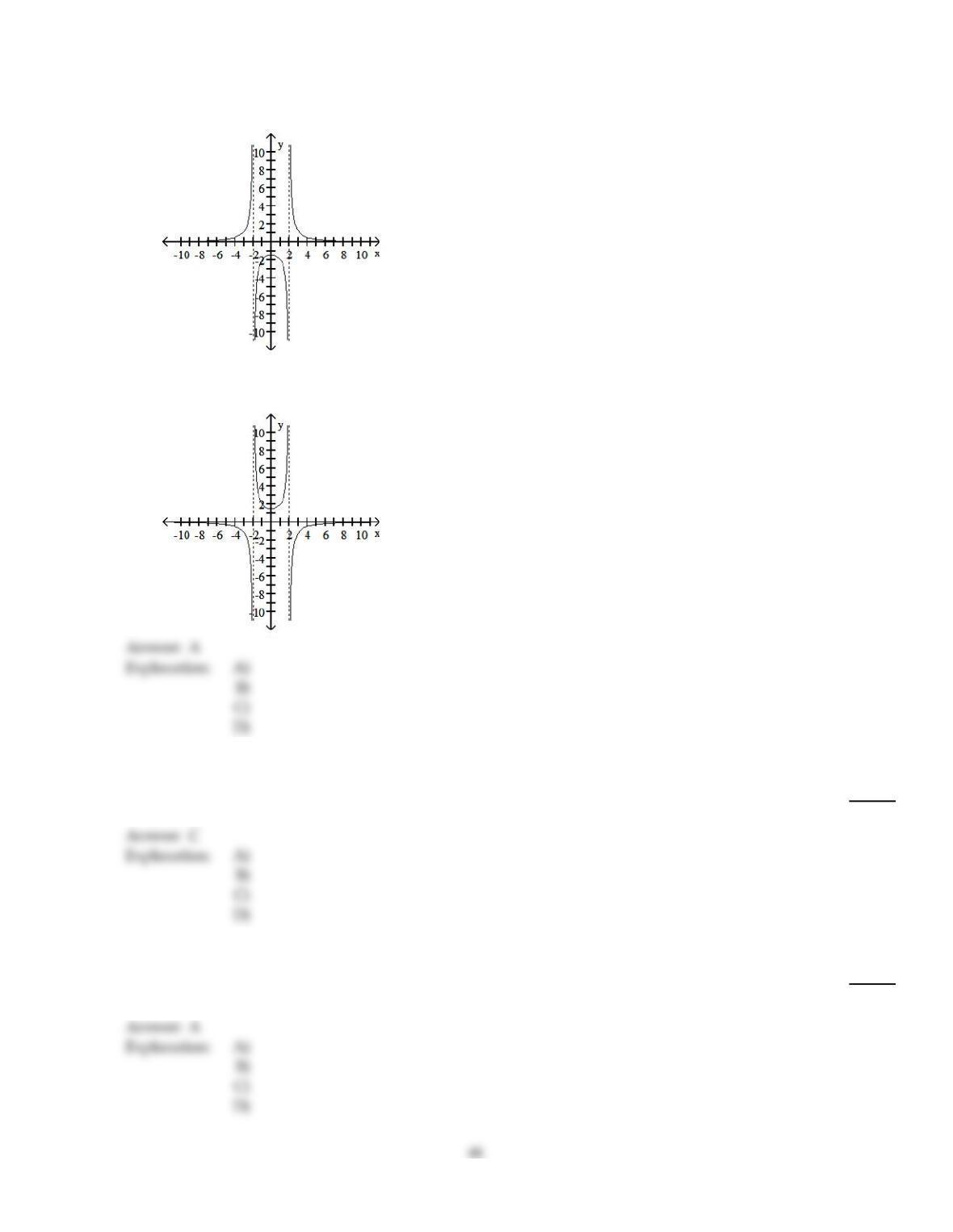
For the rational function below (i) Find any intercepts for the graph; (ii) Find any vertical and horizontal asymptotes for
the graph; (iii) Sketch any asymptotes as dashed lines. Then sketch a graph of f.
44
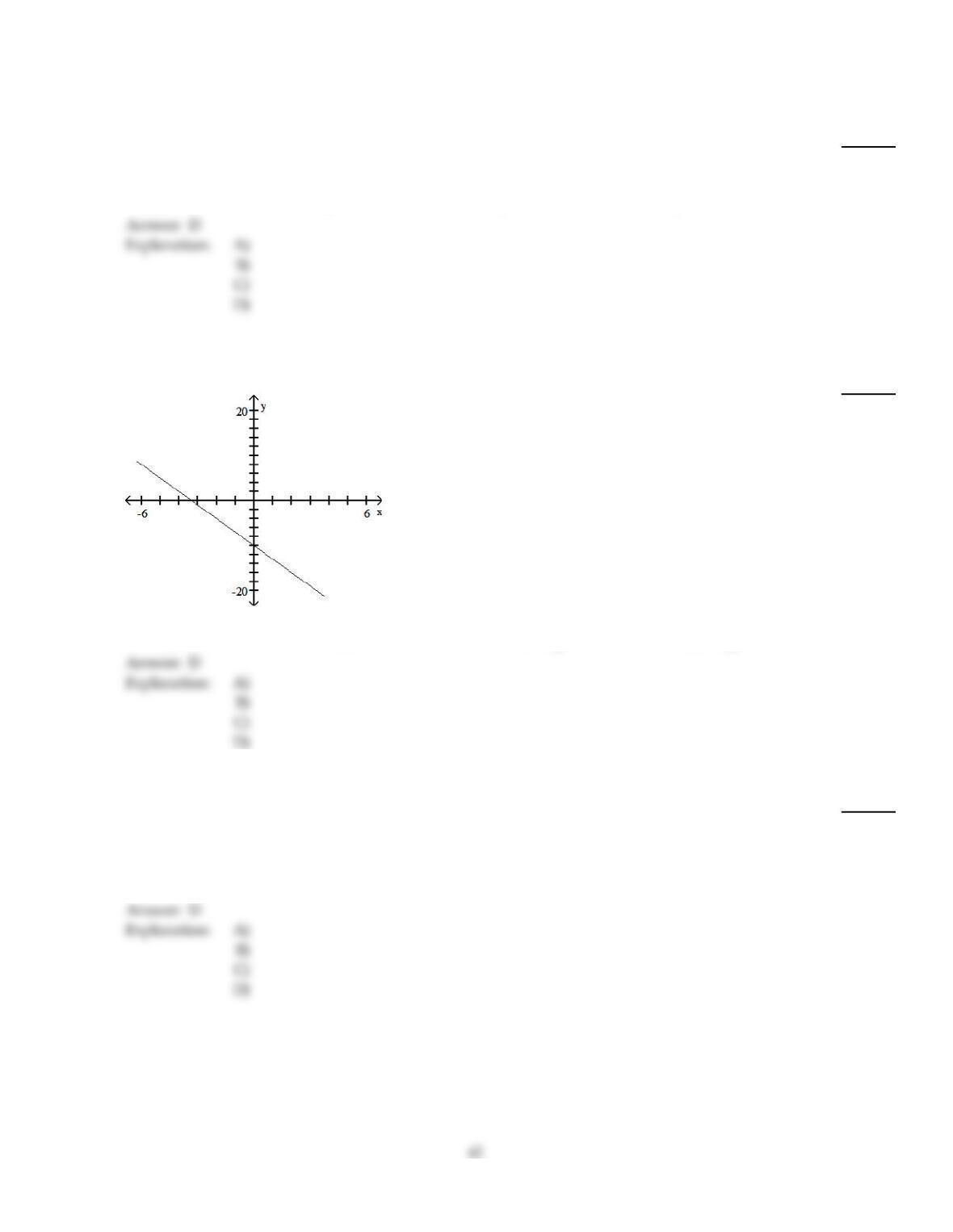
105)
y =6
x2–1
105)
A)
(i) y intercept: – 6
(ii) horizontal asymptote: y = 0; vertical asymptotes: x =1 and x = – 1
(iii)
B)
(i) y intercept: – 6
(ii) horizontal asymptote: y = 0
(iii)
45
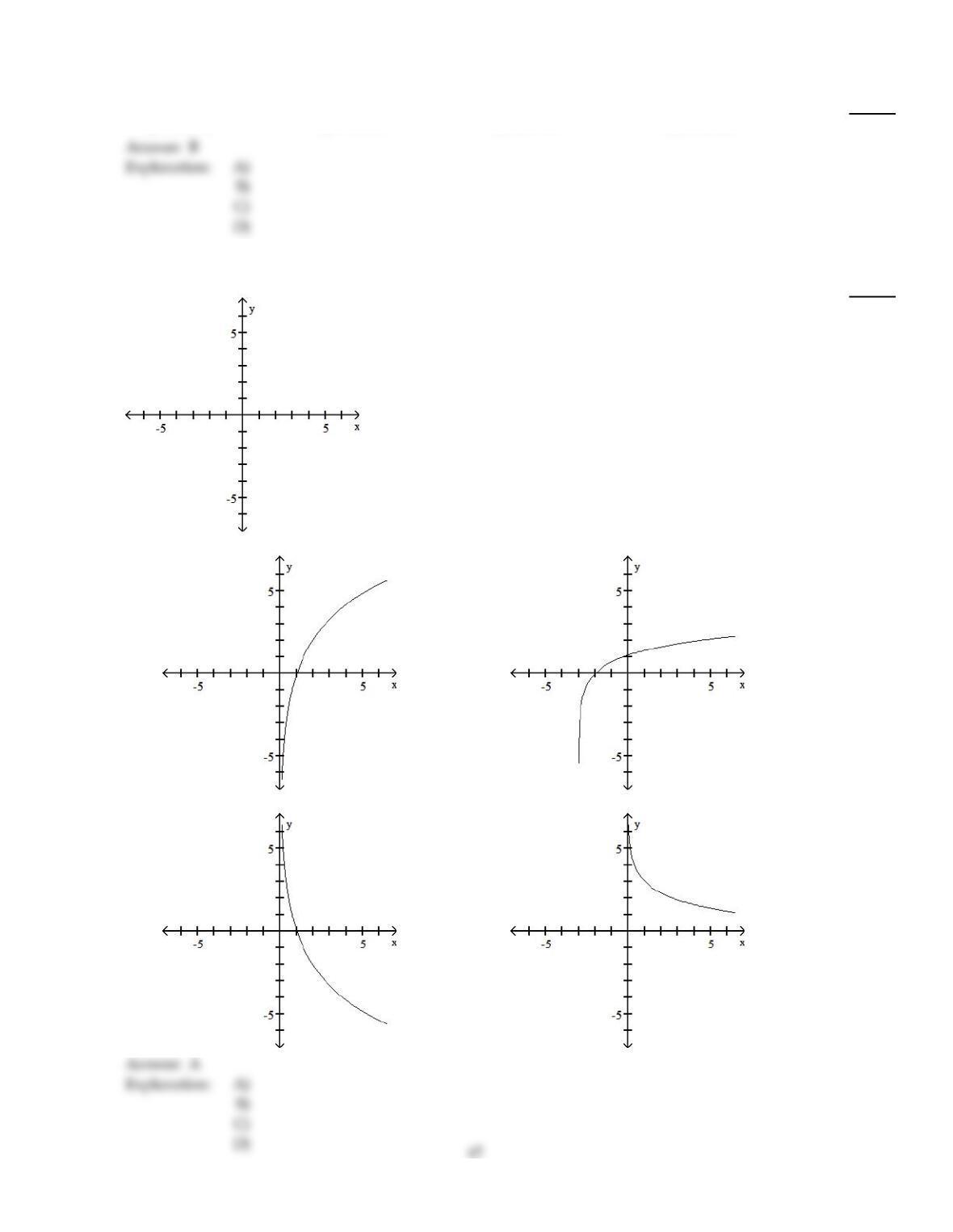
C)
(i) y intercept: –2
(ii) horizontal asymptote: y = 0; vertical asymptotes: x =2 and x = – 2
(iii)
D)
(i) y intercept: 2
(ii) horizontal asymptote: y = 0; vertical asymptotes: x =2 and x = – 2
(iii)
Solve the equation graphically to four decimal places.
106)
Let f(x) =-0.5x2+4x +2, find f(x) = – 5.
106)
A)
-1.4772
B)
9.4772
C)
-1.4772, 9.4772
D)
No solution
Use the properties of logarithms to solve.
107)
logb x –logb 5 =logb 2 –logb(x – 3)
107)
A)
5
B)
3
C)
2, 5
D)
2
Use a calculator to evaluate the expression. Round the result to five decimal places.
108)
ln 1097
108)
A)
9.30292
B)
7.00033
C)
4.69775
D)
3.04021
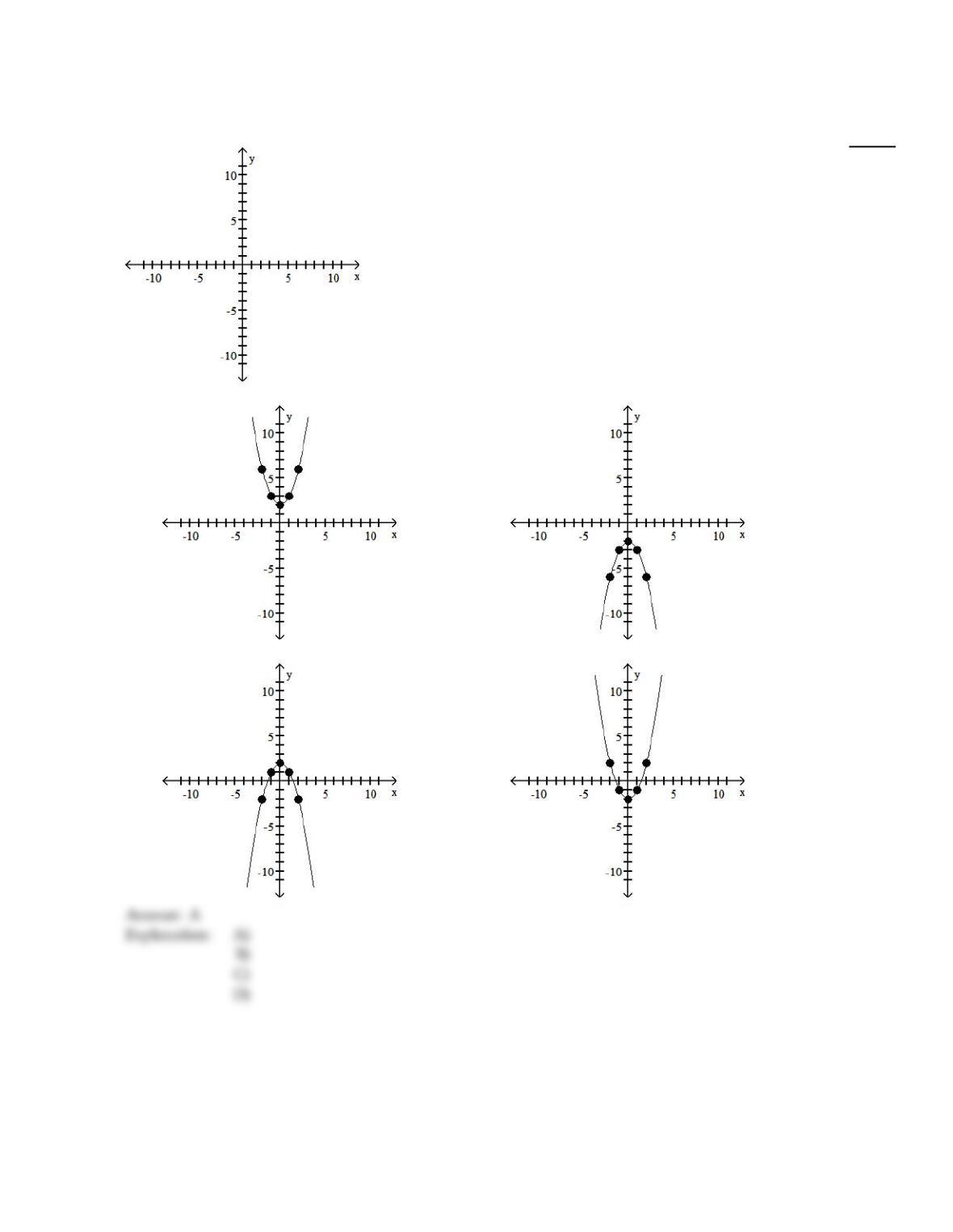
Graph the function using a calculator and point–by–point plotting. Indicate increasing and decreasing intervals.
109)
f(x) = 3 ln x
109)
A)
Increasing: (0, )
B)
Increasing: (–3, )
C)
Decreasing: (0, )
D)
Decreasing: (0, )
D)
Use point–by–point plotting to sketch the graph of the equation.
110)
y =x2+ 2
110)
A)
B)
C)
D)
48
D)
Determine whether the function is linear, constant, or neither
111)
y – 12 = 0
111)
A)
Linear
B)
Constant
C)
Neither
Write in terms of simpler forms.
112)
log2 XY
112)
A)
log2 X –log2 Y
B)
log1 X –log1 Y
C)
log1 X +log1 Y
D)
log2 X +log2 Y
Use the REGRESSION feature on a graphing calculator.
113)
The total cost of the Democratic and the Republican national conventions has increased 596% over
the 20–year period between 1980 and 2004. The following table lists the total cost, in millions of
dollars, for selected years.
Year, x Cost, y
1980, x = 0 $ 23.1
1984, x = 4 31.8
1988, x = 8 44.4
1992, x = 12 58.8
1996, x = 16 90.6
2000, x = 20 160.8
2004, x = 24 170.5
Find the exponential functions that best estimates this data. Round your answer to four decimal
places
113)
A)
y = 1.0929 · (22.2887)x
B)
y = 22.2887x· (1.0929)x
C)
y = 6.6643x + 2.8857
D)
y = 22.2887 · (1.0929)x
114)
Since 1984 funeral directors have been regulated by the Federal Trade Commission. The average
cost of a funeral for an adult in a Midwest city has increased, as shown in the following table.
YEAR
AVERAGE COST
OF FUNERAL
1980 $ 1926
1985 $ 2841
1991 $ 3842
1995 $ 4713
1996 $ 4830
1998 $ 5120
2001 $ 5340
Let x represent the number of years since 1980. Use a graphing calculator to fit a quartic function to
the data. Round your answer to five decimal places.
114)
A)
y = – 2.047489x2+ 212.82699x + 1879.85469
B)
y = – 0.04268x4
C)
y = 170.5971x + 1991.5213
D)
y = – 0.04268x4+ 1.53645x3– 16.76289x2+ 231.82723x + 1927.58518
Solve the problem.
115)
Assume that a savings account earns interest at the rate of 2% compounded monthly. If this
account contains $1000 now, how many months will it take for this amount to double if no
withdrawals are made?
115)
A)
408 months
B)
417 months
C)
12 months
D)
450 months
For the polynomial function find the following: (i) Degree of the polynomial; (ii) All x intercepts; (iii) The y intercept.
116)
y =x2–9
116)
A)
(i) 2
(ii) –3, 3
(iii) –9
B)
(i) 1
(ii) 4.5
(iii) –9
C)
(i) 2
(ii) –4, 4
(iii) –9
D)
(i) 1
(ii) 3
(iii) –9
Solve the equation.
117)
Solve for x: 24x =8x + 5
117)
A)
5
B)
–15
C)
–5
D)
15
Determine if the equation specifies a function with independent variable x. If so, find the domain. If not, find a value of x
to which there corresponds more than one value of y.
118)
y = x2+ 2
118)
A)
A function with domain
B)
Not a function; for example, when x =2, then y = ±1
Solve the problem.
119)
If the average cost per unit C(x) to produce x units of plywood is given by C(x) =1200
x + 40 , what is the
unit cost for 10 units?
119)
A)
$3.00
B)
$80.00
C)
$24.00
D)
$120.00
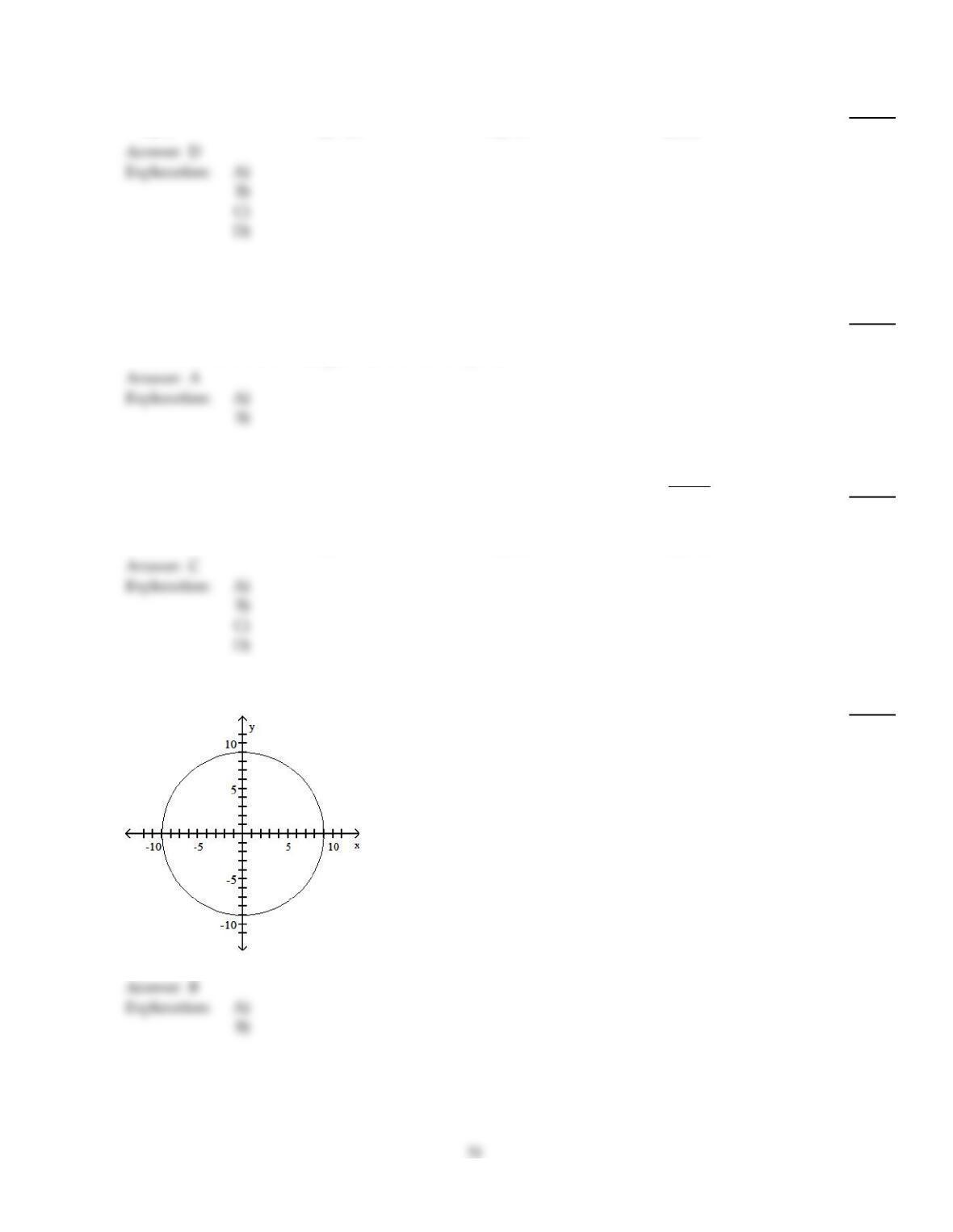
Determine whether the graph is the graph of a function.
120)
120)
A)
function
B)
not a function
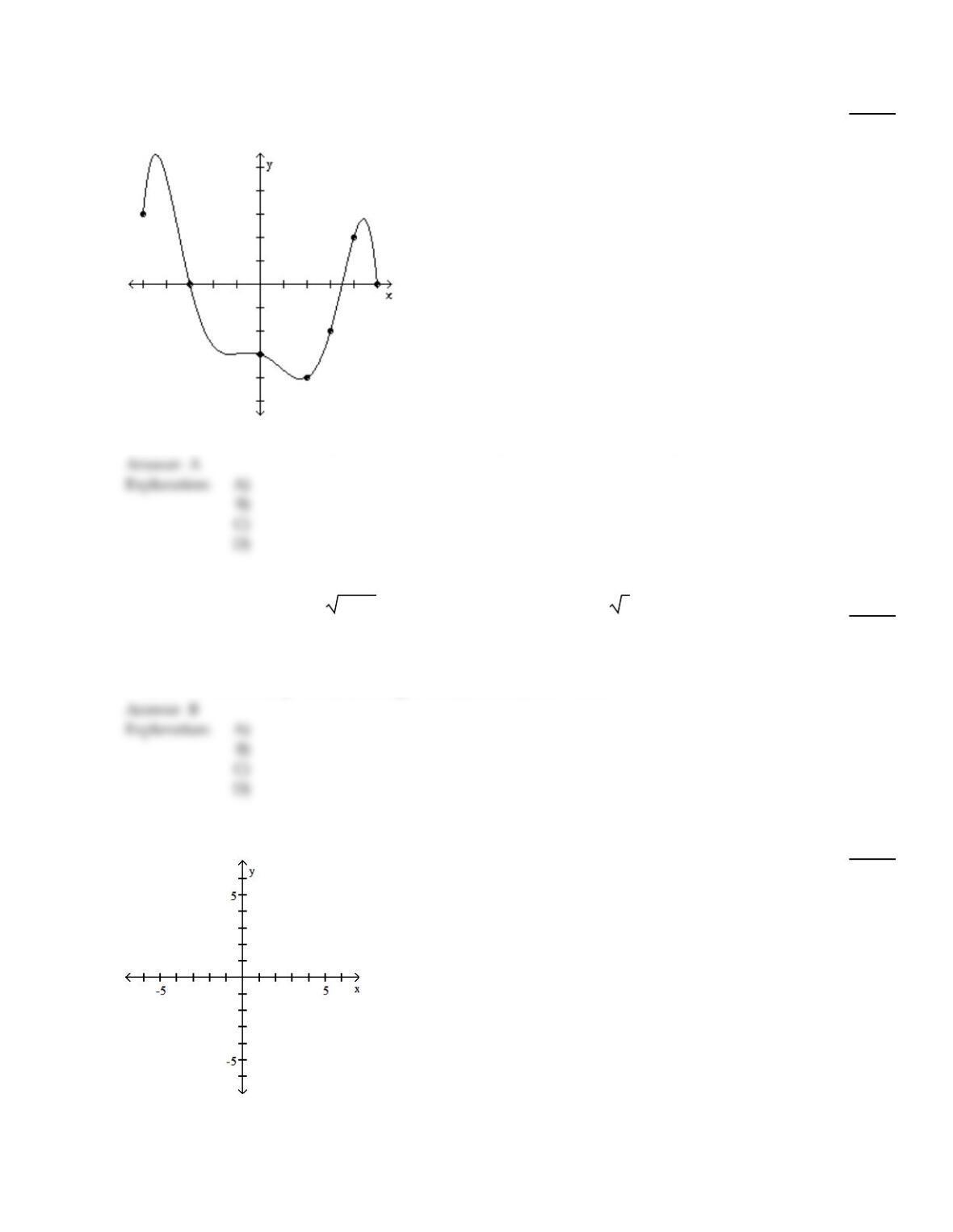
The graph of a function f is given. Use the graph to answer the question.
121)
Use the graph of f given below to find f(10).
25
-25 25
-25
121)
A)
–20
B)
0
C)
10
D)
15
Provide an appropriate response.
122)
How can the graph of f(x) = – x + 1 be obtained from the graph of y =x?
122)
A)
Shift it horizontally 1 units to the left. Reflect it across the y–axis.
B)
Shift it horizontally 1 units to the left. Reflect it across the x–axis.
C)
Shift it horizontally –1 units to the left. Reflect it across the x–axis.
D)
Shift it horizontally 1 units to the right. Reflect it across the x–axis.
Graph the function using a calculator and point–by–point plotting. Indicate increasing and decreasing intervals.
123)
f(x) =-3 – ln x
123)
52
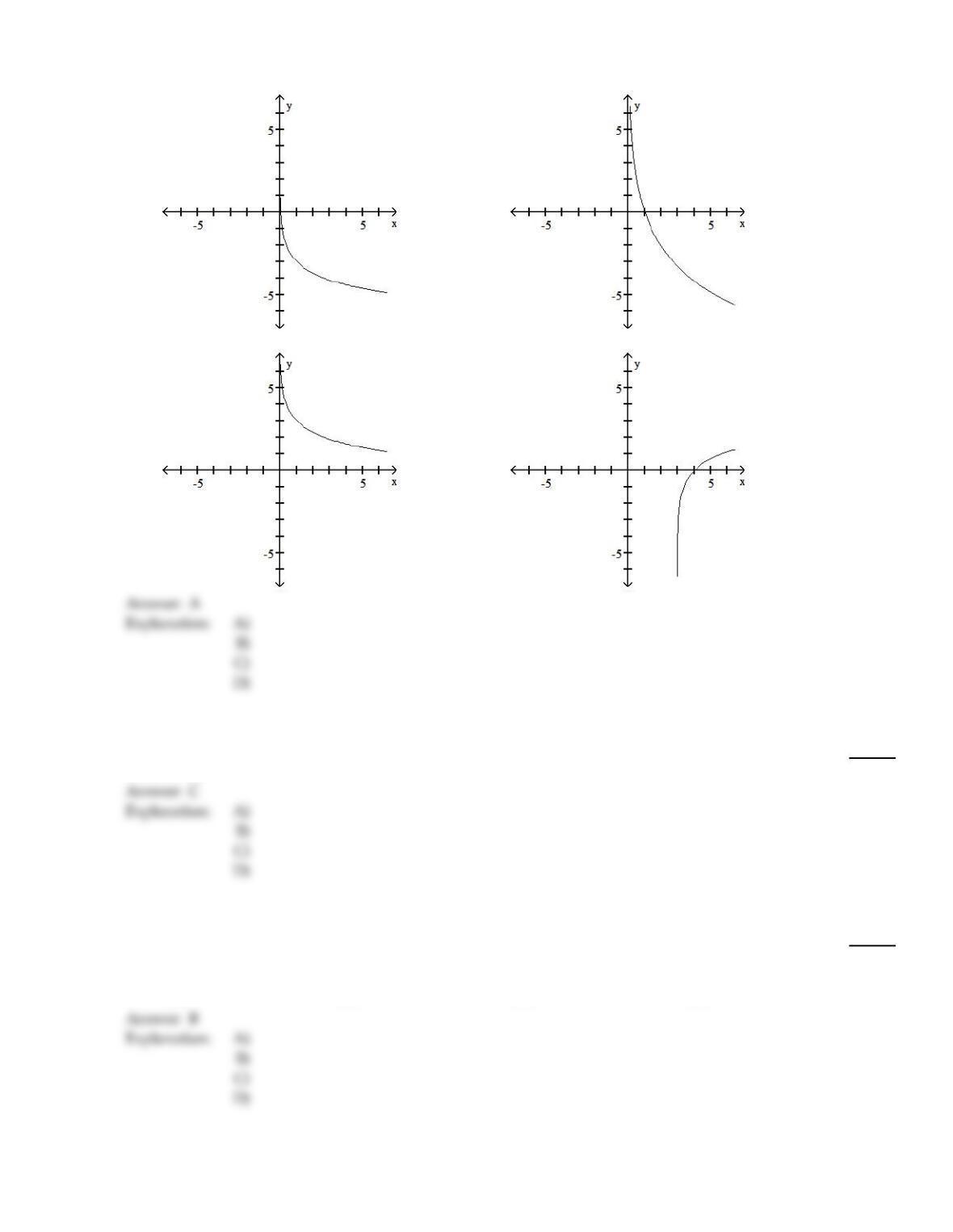
A)
Decreasing: (0, )
B)
Increasing (0, )
C)
Decreasing: (0, )
D)
Increasing (-3, )
Find the range of the given function. Express your answer in interval notation.
124)
f(x) = 4x2+ 16x + 19
124)
A)
(–, 2]
B)
(–, –3]
C)
[3, )
D)
[ – 2, )
For the polynomial function find the following: (i) Degree of the polynomial; (ii) All x intercepts; (iii) The y intercept.
125)
y =18 –x2+ 3x
125)
A)
(i) 2
(ii) -3, -6
(iii) –18
B)
(i) 2
(ii) 6, -3
(iii) 18
C)
(i) 2
(ii) 3, -6
(iii) –18
D)
(i) 2
(ii) 6, 3
(iii) 18
53
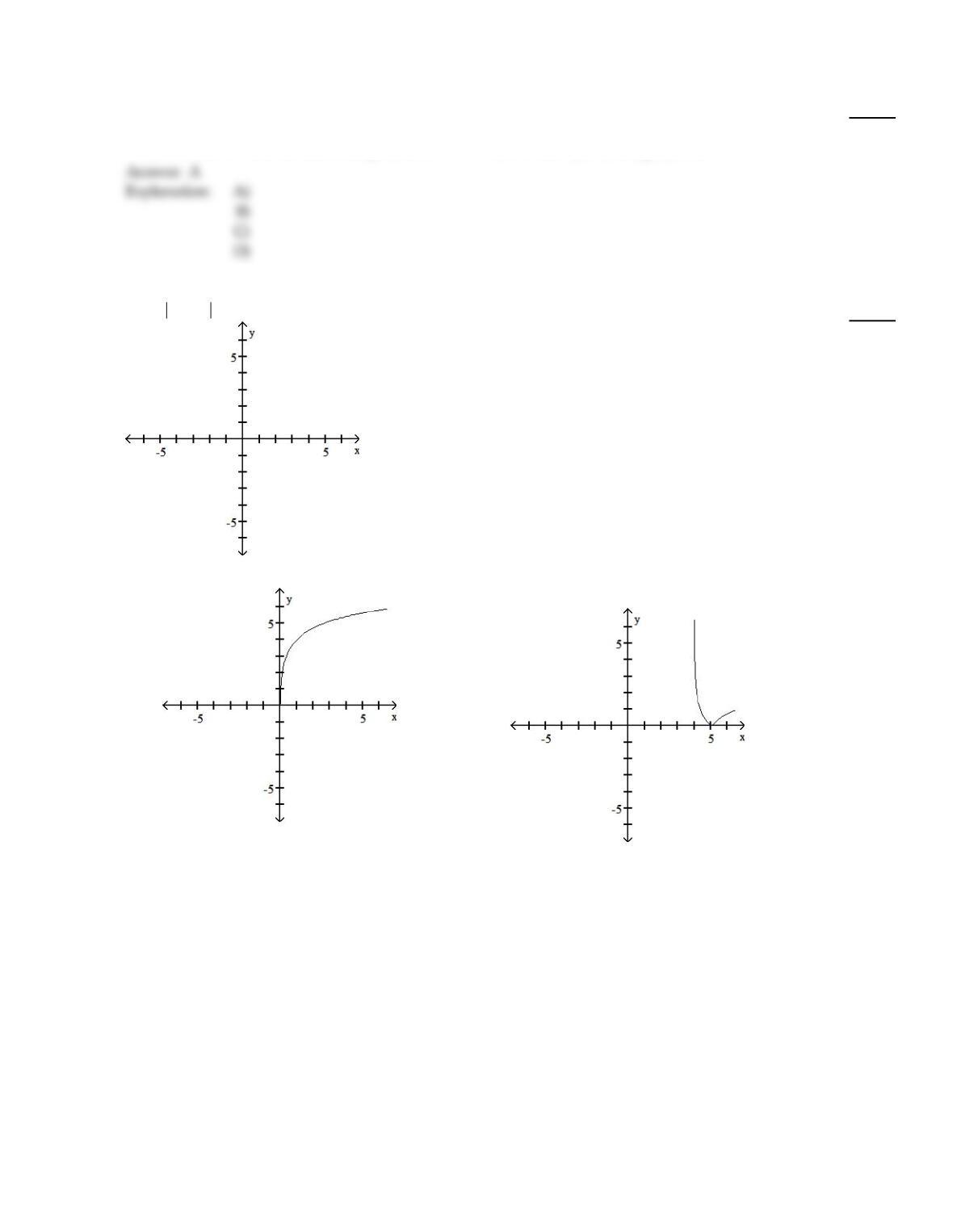
Give the domain and range of the function.
126)
f(x) =x2+6
126)
A)
Domain: all real numbers; Range: [6, )
B)
Domain: [6, ); Range: all real numbers
C)
Domain: all real numbers; Range: [-5, )
D)
Domain: [0, ); Range: [0, )
Graph the function using a calculator and point–by–point plotting. Indicate increasing and decreasing intervals.
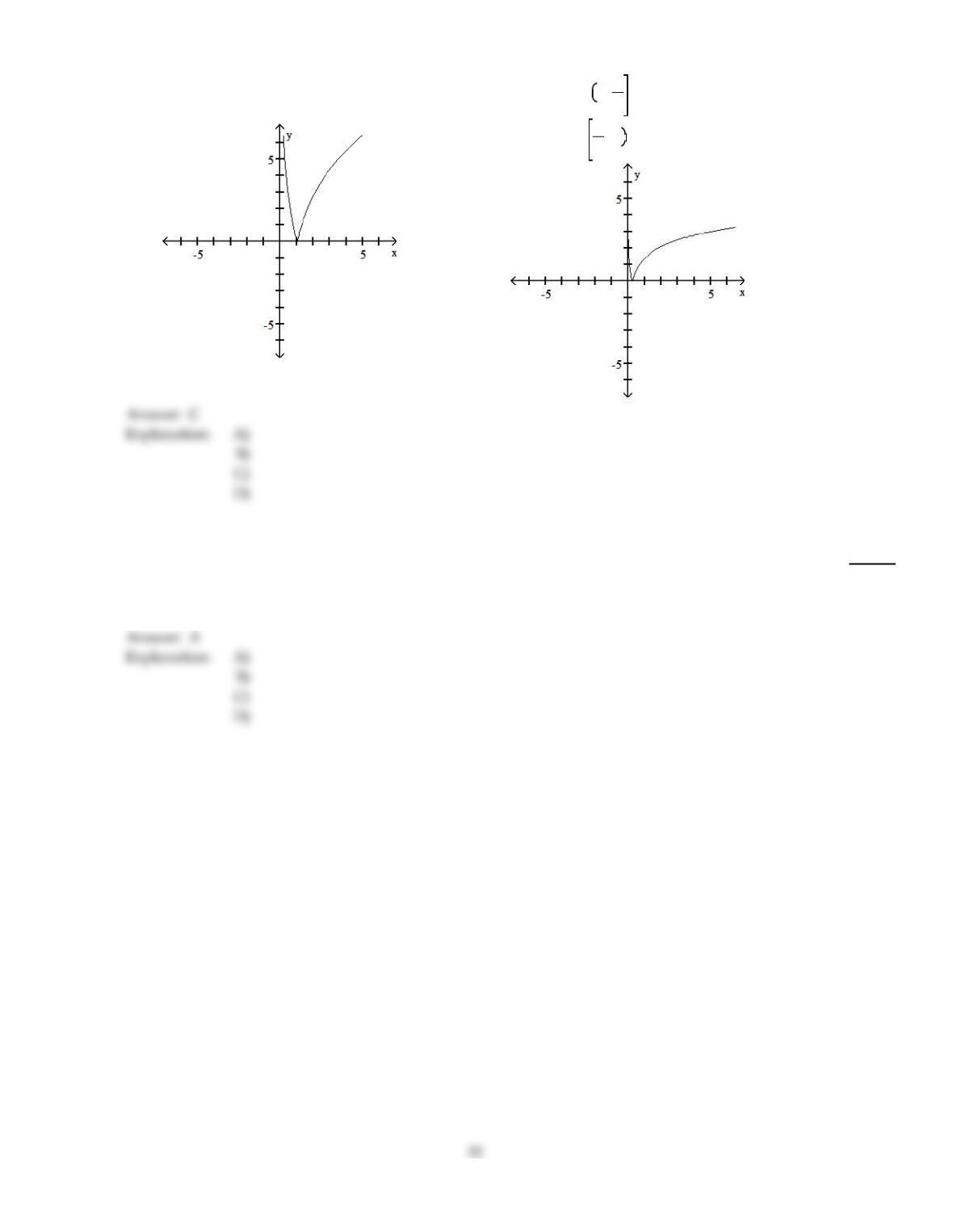
127)
f(x) =-4 ln x
127)
A)
Decreasing: (0, )
B)
Decreasing: (0, -4]
Increasing: [-4, )
54
C)
Decreasing: (0, 1]
Increasing: [1, )
D)
Decreasing: 0, 1
2
Increasing: 1
2,
Solve the problem.
128)
To estimate the ideal minimum weight of a woman in pounds multiply her height in inches by 4
and subtract 130. Let W = the ideal minimum weight and h = height. W is a linear function of h.
Find the ideal minimum weight of a woman whose height is 62 inches.
128)
A)
118 lb
B)
120 lb
C)
378 lb
D)
130 lb
For the given function, find each of the following:
(A) Intercepts
(B) Vertex
(C) Maximum or minimum
(D) Range
129)
n(x) = – (x – 1)2+ 9
129)
A)
(A) x–intercepts: -4, 2; y–intercept: 8
(B) Vertex (1, 9)
(C) Maximum: 9
(D) y 9
B)
(A) x–intercepts: – 2, 4; y–intercept: 8
(B) Vertex (1, 9)
(C) Maximum: 9
(D) y 9
C)
(A) x–intercepts: – 2, 4; y–intercept: 8
(B) Vertex (1, 9)
(C) Minimum: 9
(D) y 9
D)
(A) x–intercepts: – 2, 4; y–intercept: 8
(B) Vertex (-1, -9)
(C) Maximum: 9
(D) y 9
Solve for x to two decimal places (using a calculator).
130)
5.2 =1.00612x
130)
A)
2.32
B)
5.17
C)
22.97
D)
1.07
For the polynomial function find the following: (i) Degree of the polynomial; (ii) All x intercepts; (iii) The y intercept.
131)
f(x) = (x6+ 7)(x10 + 9)
131)
A)
(i) 60
(ii) none
(iii) –63
B)
(i) 16
(ii) 7, 9
(iii) 63
C)
(i) 16
(ii) none
(iii) 63
D)
(i) 60
(ii) 7, 9
(iii) –63
56
Find the vertex form for the quadratic function. Then find each of the following:
(A) Intercepts
(B) Vertex
(C) Maximum or minimum
(D) Range
132)
g(x) =x2– 2x – 3
132)
A)
Standard form: g(x) =(x – 1)2– 4
(A) x–intercepts: – 1, 3; y–intercept: -3
(B) Vertex (-1, -4)
(C) Minimum: -4
(D) y -4
B)
Standard form: g(x) =(x – 1)2– 4
(A) x–intercepts: – 1, 3; y–intercept: -3
(B) Vertex (1, -4)
(C) Minimum: -4
(D) y -4
C)
Standard form: g(x) =(x + 1)2– 4
(A) x–intercepts: – 1, 3; y–intercept: -3
(B) Vertex (1, -4)
(C) Maximum: -4
(D) y -4
D)
Standard form: g(x) =(x + 1)2– 4
(A) x–intercepts: -3, 1; y–intercept: -3
(B) Vertex (1, -4)
(C) Minimum: -4
(D) y -4
Determine the domain of the function.
133)
f(x) =8
x3
133)
A)
No solution
B)
x < 0
C)
All real numbers
D)
All real numbers except 0
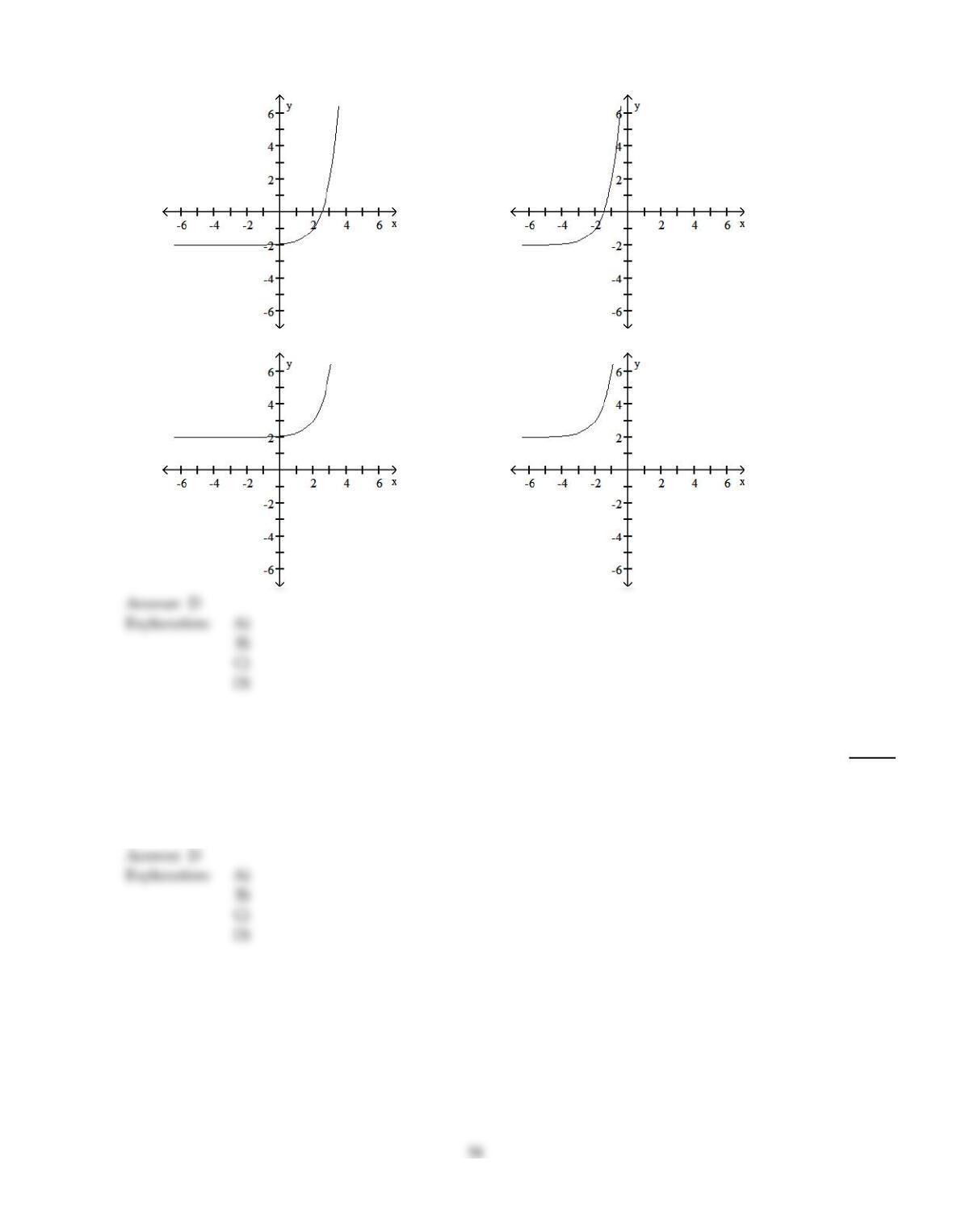
Graph the function.
134)
f(x) =4(x + 2)+ 2
134)
57
A)
B)
C)
D)
Solve the problem.
135)
The level of a sound in decibels (db) is determined by the formula N = 10 · log(I ×1012) db, where I
is the intensity of the sound in watts per square meter. A certain noise has an intensity of
8.49 ×10⁻⁴ watts per square meter. What is the sound level of this noise? (Round your answer to
the nearest decibel.)
135)
A)
9 db
B)
206 db
C)
79 db
D)
89 db
Solve the equation.
136)
Solve for x: 3(1 + 2x) = 27
136)
A)
1
B)
3
C)
9
D)
–1
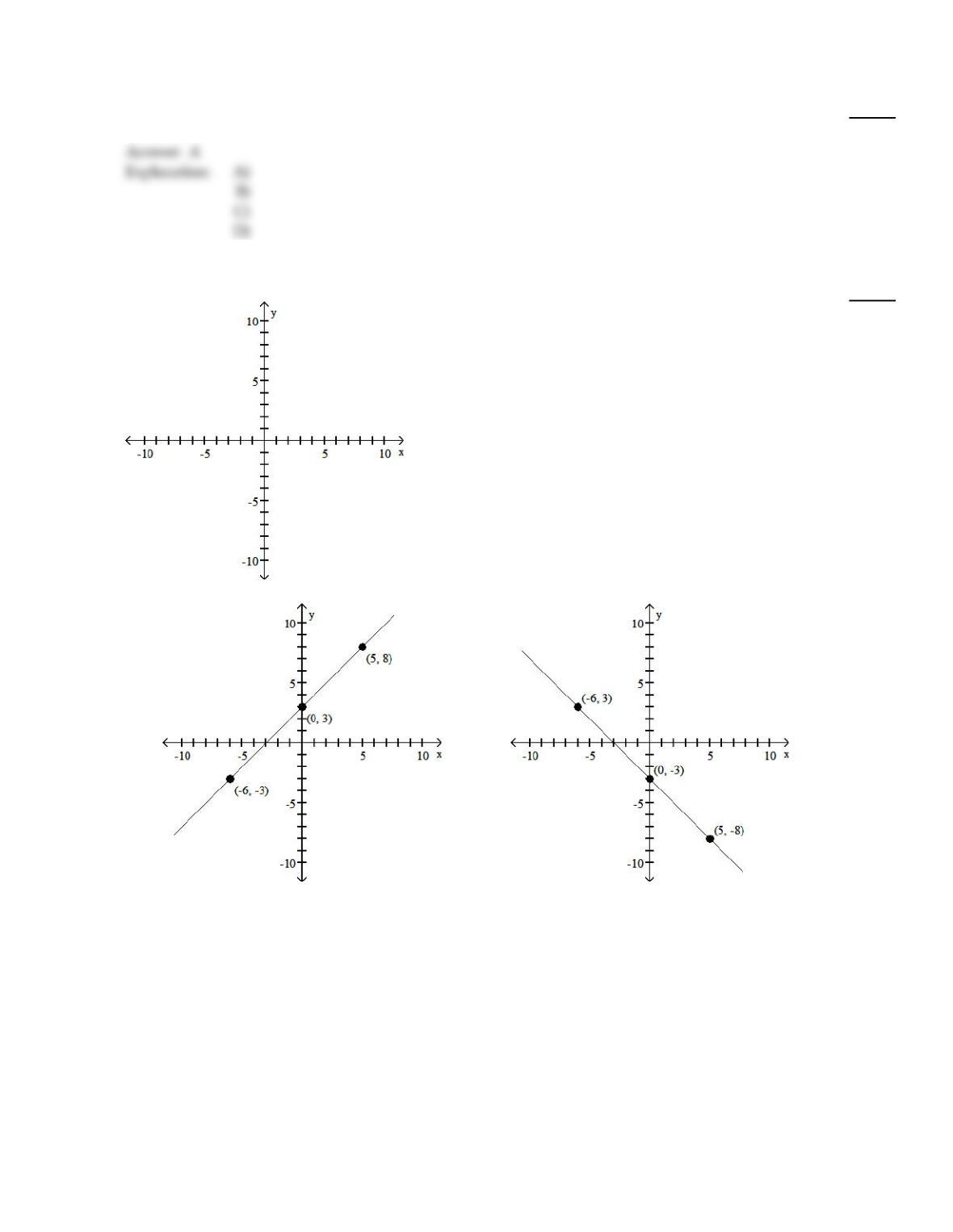
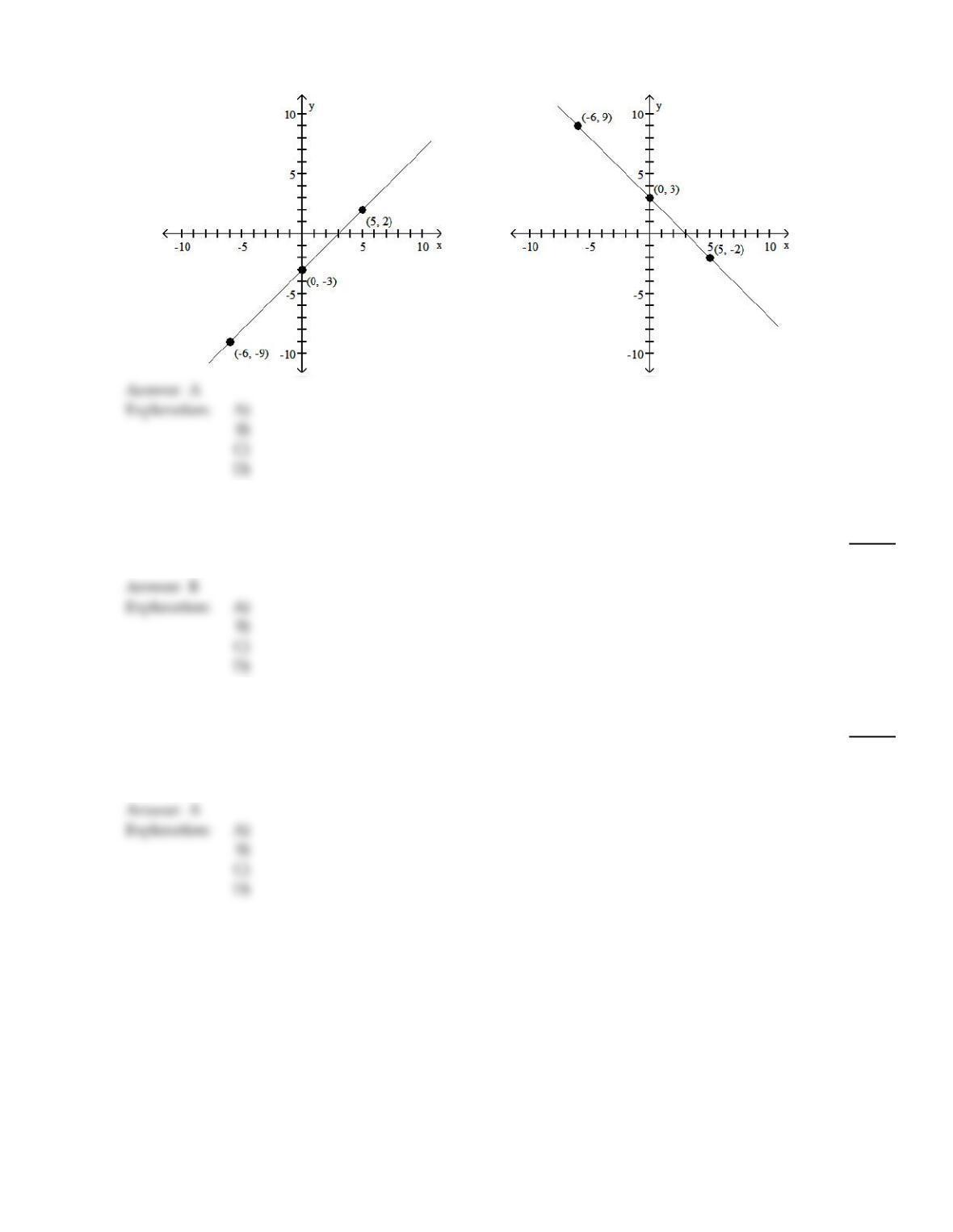
Use point–by–point plotting to sketch the graph of the equation.
137)
y = x + 3
137)
A)
B)
59
C)
D)
Write in terms of simpler forms.
138)
logbM9
138)
A)
M logb 9
B)
9 logb M
C)
9 +logb M
D)
M +logb 9
For the polynomial function find the following: (i) Degree of the polynomial; (ii) All x intercepts; (iii) The y intercept.
139)
y = (x + 7)(x + 7)(x + 2)
139)
A)
(i) 3
(ii) –7, –7, –2
(iii) 98
B)
(i) 3
(ii) –7, –7, –2
(iii) –14
C)
(i) 3
(ii) 7, 7, 2
(iii) 98
D)
(i) 3
(ii) 7, 7, 2
(iii) 14
60