151)
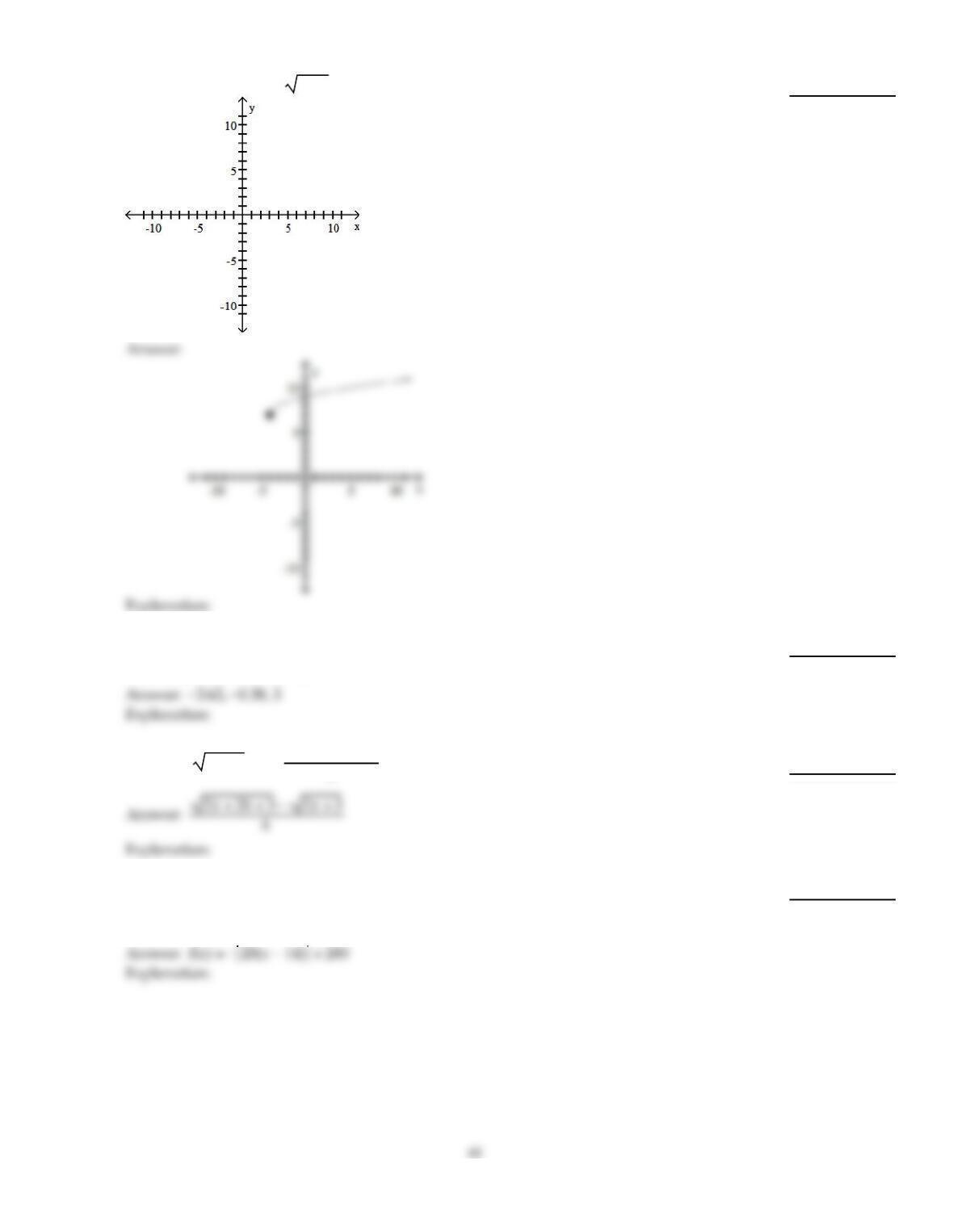
Sketch a graph of f(x) =x+ 4 + 7
151)
152)
Use a graphing calculator to find all real roots of the given function. Round answers to two
decimal places, if necessary: f(x) =x3– 8x – 3
152)
153)
Let g(x) =2x+ 3, find g(x+ h) –g(x)
h
153)
154)
In June Gail decided to save $20.00 a week. She saved for 14 weeks and then for 14 weeks
she spent $20.00 a week on gifts. Write an absolute–value function to represent the amount
of money Gail had in savings.
154)
155)
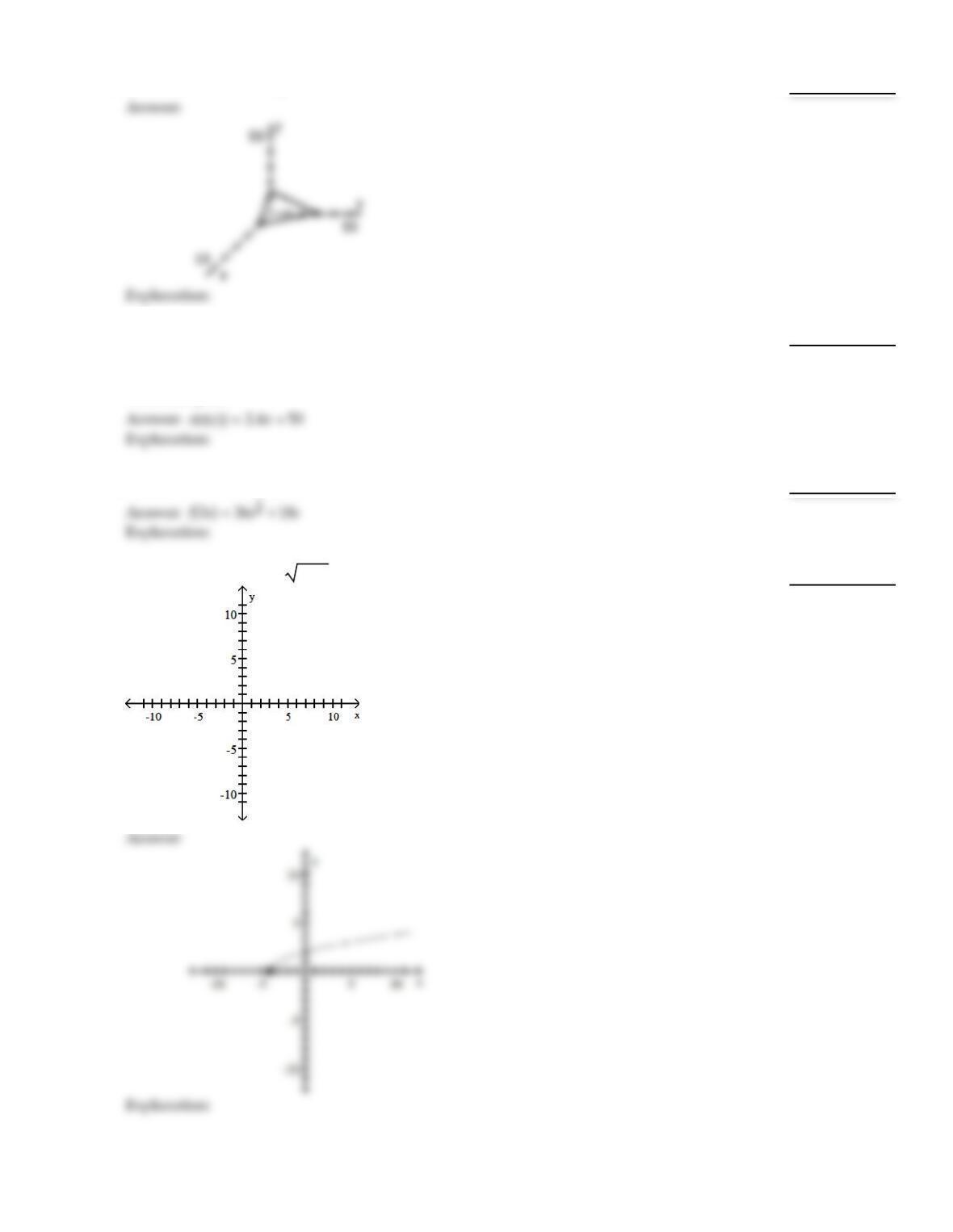
Sketch the surface 3x+y+ 2z= 6.
155)
156)
A coat costs x wholesale. The price the store pays is given by the function s(x) = 1.2x where
x is the wholesale price. The price the customer pays is c(x) = 2x+ 50 where x is the price
the store pays. Write a composite function to find the customer’s price as a function of the
wholesale price.
156)
157)
If f(x) = 4x2+ 6x, find f(3s).
157)
158)
Sketch a graph of f(x) =x+ 4
158)
42
159)
In November, Steve uses his credit cards to buy $30.00 of holiday gifts each week. After 8
weeks he begins saving $30.00 each week to pay his credit card bill. Write an
absolute–value function to represent the amount Steve has saved since he started buying
holiday gifts. (Hint: Let purchases on credit cards represent negative savings.)
159)
160)
Find the domain of the function: f(x) =x2+x+ 1
160)
161)
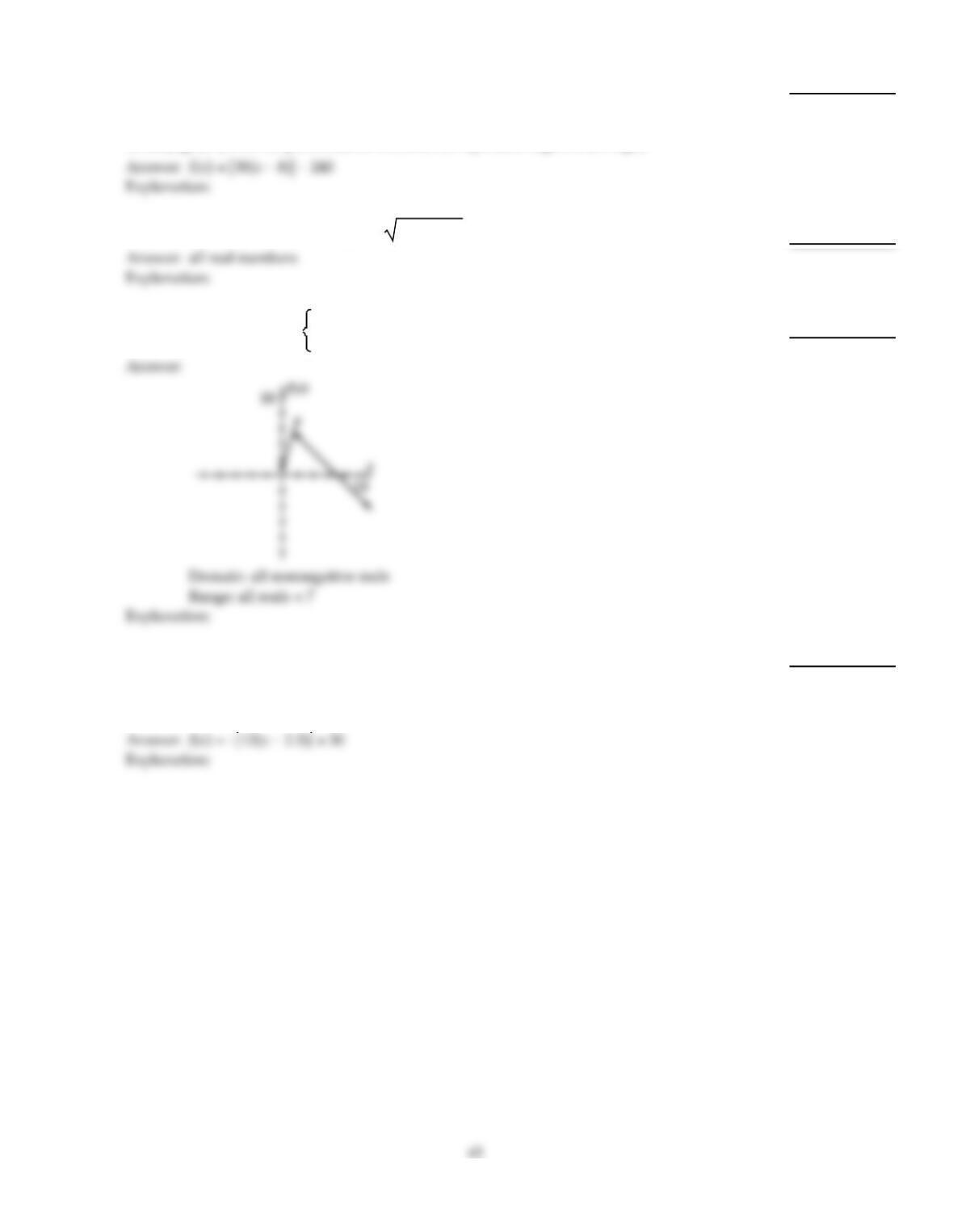
Sketch the graph of f(x) =3x + 1, if 0 x< 2
7 – x, if x 2 , and give the domain and range.
161)
162)
Brett rented a bike from a rental shop and rode at a constant rate of 12 mph for 2.5 hours
along a bike path, and then returned along the same path at the same rate. Write an
absolute–value function to represent Brett’s distance from the rental shop as a function of
time.
162)
163)
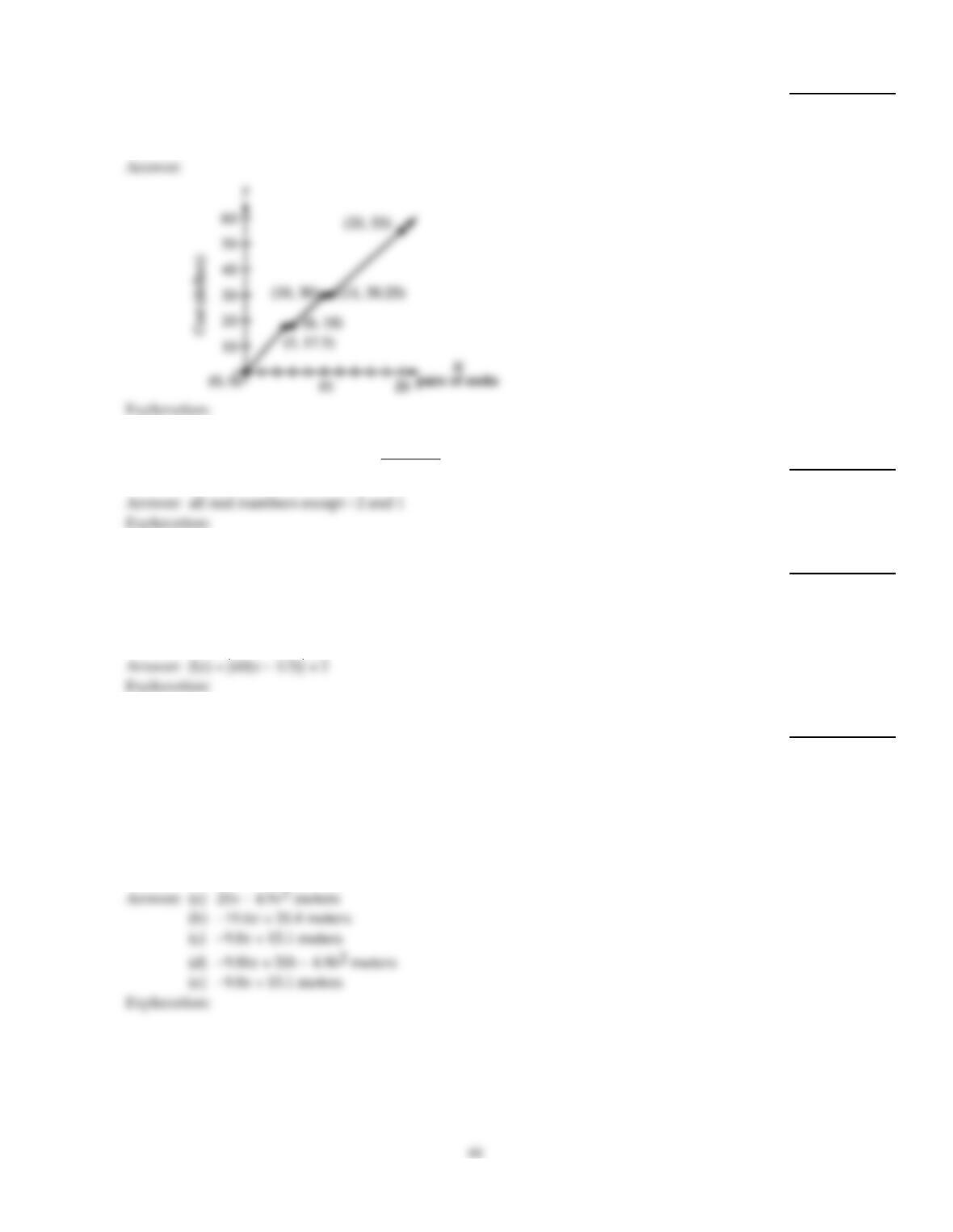
To reduce inventory, a department store charges three rates. If you buy 0–5 pairs of socks,
the price is $3.50 per pair of socks. If you buy 6–10 pairs of socks, the price is $3.00 per pair.
If you buy more than 10, the price is $2.75 per pair. Graph the compound function that
represents the cost of buying N pairs of socks.
163)
164)
Find the domain of the function: f(t) =t– 3
t2+t– 2
164)
165)
Julie lives 32 miles from the city. She drove home from the city at a constant rate of 60 mph
along the highway. At the exit 2 miles from her home, she realized she had left her purse at
the department store. She immediately returned to the department store at a rate of 60
mph. Write an absolute–value function to represent Julie’s distance from home as she
drove home from the city.
165)
166)
The height of an object thrown in the air depends on the time since it has been thrown. For
a particular situation the height in meters of an object after t seconds can be represented by
h(t) = 20t– 4.9t2.
(a) What is the height of the object if the time is x seconds?
(b) If the time is increased by 2 seconds, how much higher is the object?
(c) How much higher is the object per second increase?
(d) If the time is increased by h, how much higher is the object?
(e) How much higher is the object per unit increase?
166)
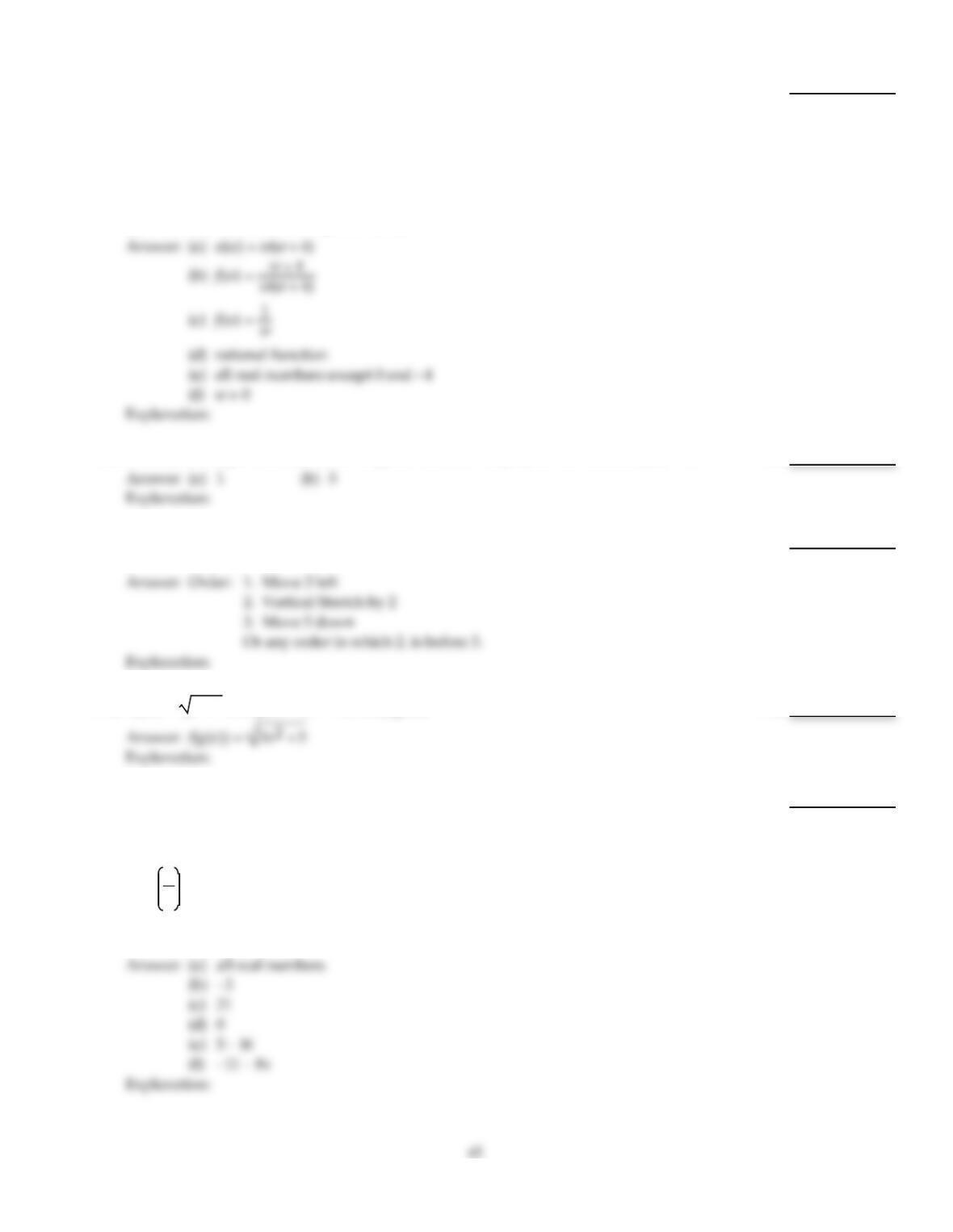
167)
A rectangular sheet of metal has a length that is 4 more than the width.
(a) Write the area of the rectangular sheet as a function of the width.
(b) Without simplifying, write the ratio of the length of the sheet to the area of the sheet as
a function of the width.
(c) Simplify the function you wrote in b.
(d) What kind of function is this?
(e) What is its domain out of context?
(f) What is its domain in the given context?
167)
168)
Find: (a) the degree and (b) the leading coefficient of the polynomial function f(x) = 5x+ 7.
168)
169)
List the graphical transformations, in the correct order, that must be done to y=f(x) to
produce the graph of y= 2f(x+ 3) – 5.
169)
170)
If f(x) =x + 1 and g(x) = 3x2 + 4, find f(g(x)).
170)
171)
If f(x) = 5 – 8x, find:
(a) the domain
(b) f(1)
(c) f(–2)
(d) f5
8
(e) f(t)
(f) f(x+ 2)
171)
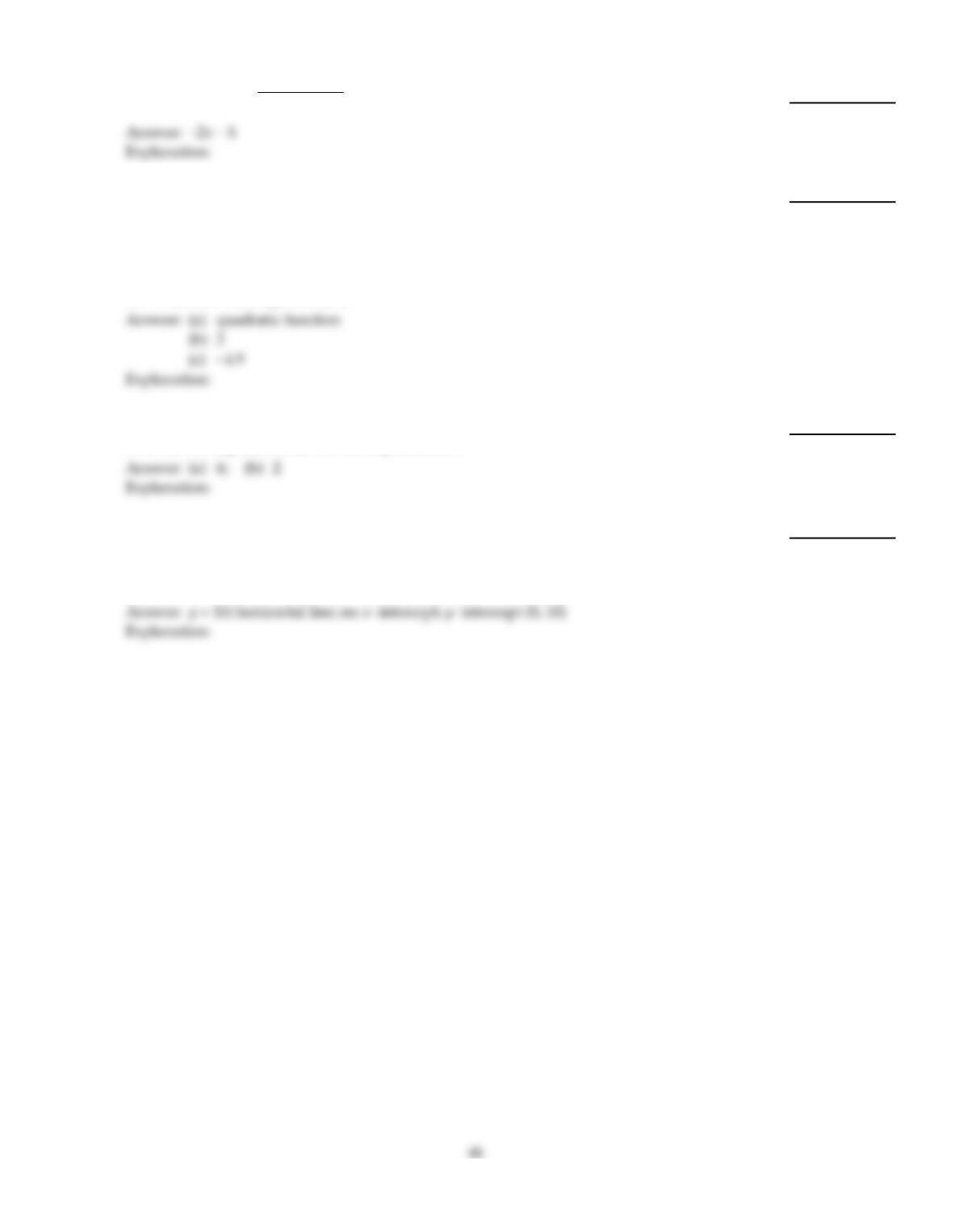
172)
If f(x) = 4 –x2, find f(x + h) – f(x)
h
172)
173)
The height of an object thrown in the air depends on the time since it has been thrown. For
a particular situation the height in meters of an object after t seconds can be represented by
h(t) = 32t– 4.9t2.
(a) What kind of function is this?
(b) What is its degree?
(c) What is its leading coefficient?
173)
174)
For the polynomial function f(x) =4x3+2x6,
Find: (a) the degree, and (b) the leading coefficient
174)
175)
Ellen’s health plan has a $10.00 copayment for complete pregnancy care. Let x represent the
number of prenatal visits and y represent her cost for the pregnancy. Write an equation
which represents the relationship between her cost for the pregnancy and her number of
prenatal visits; describe the graph of this equation, and identify the intercepts.
175)
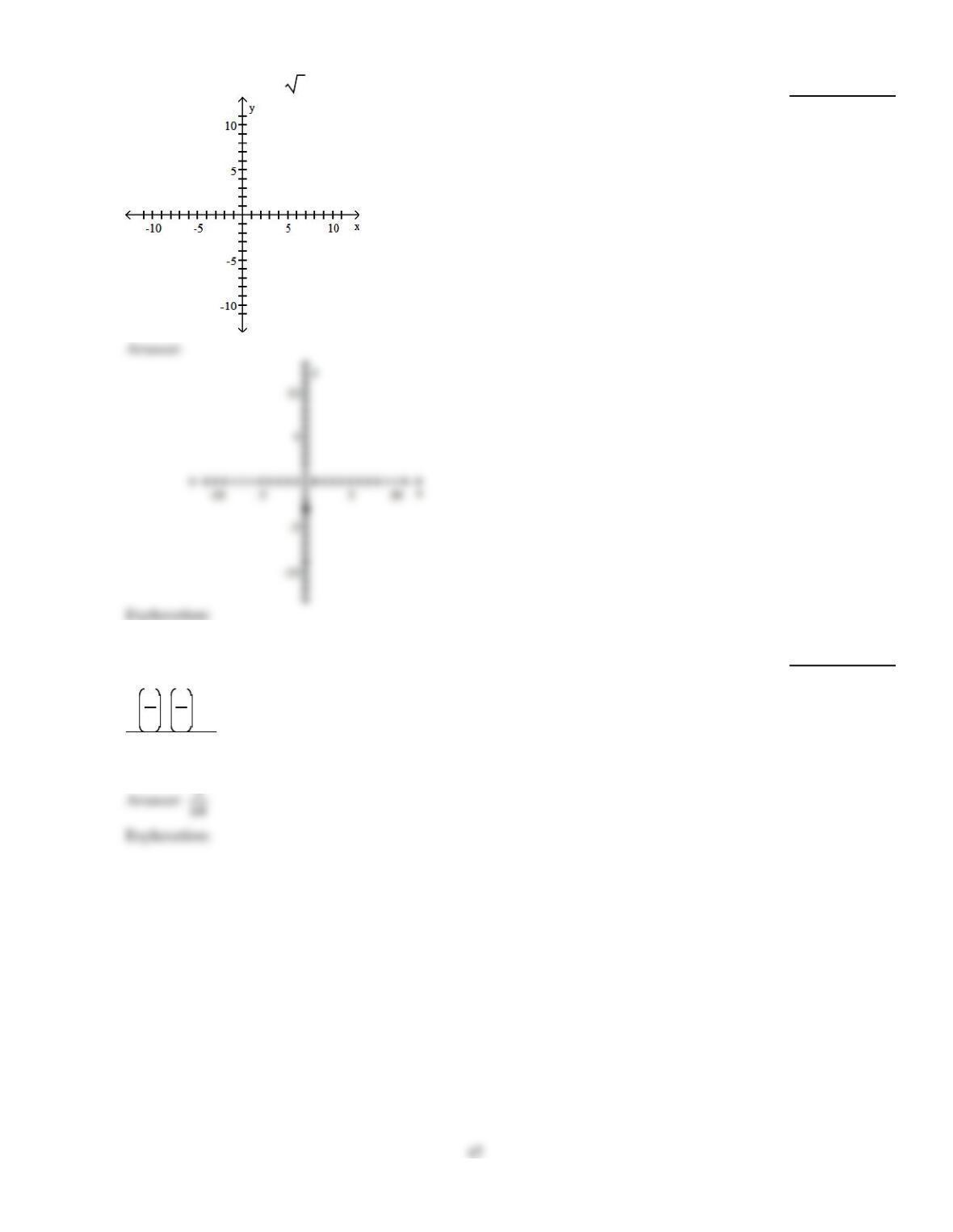
176)
Sketch a graph of f(x) =x– 3
176)
177)
Under certain conditions, if two brown–eyed parents have exactly four children, the
probability P that exactly r of them are blue–eyed is a function of r and is given by P(r) =
4! 1
4
r3
4
4–r
r!(4 –r)! .
Find the probability that exactly thee children will be blue–eyed.
177)
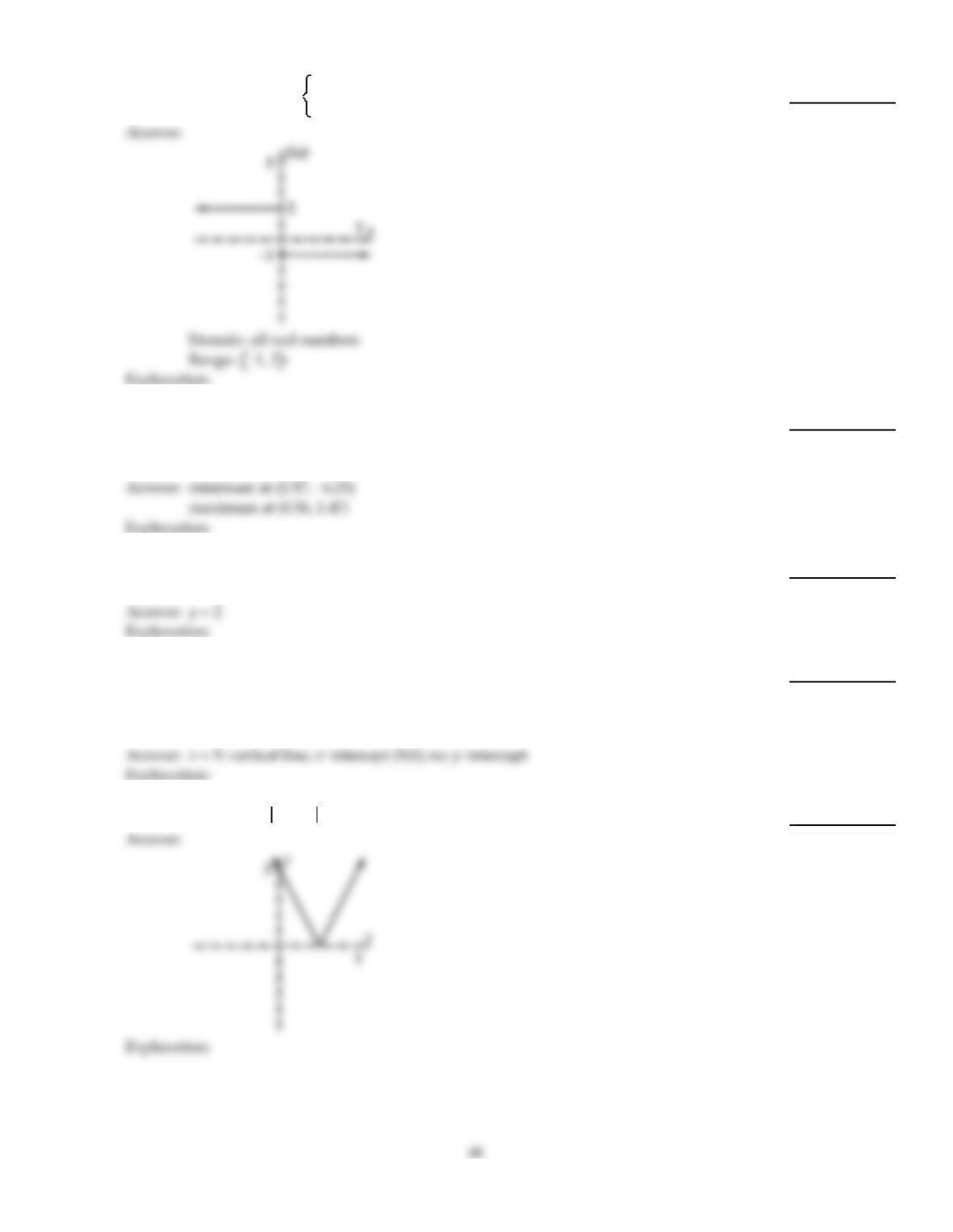
178)
Sketch the graph of f(x) =
–1, if x 0
2, if x< 0 , and give the domain and range.
178)
179)
Use a graphing calculator to find the maximum value of f(x) and the minimum value of
f(x) for the indicated values of x:
f(x) = 0.8x4– 3.1x3+ 1.2x2+ x + 1; 0
x
3
179)
180)
Find an equation of the plane that is parallel to the x, z–plane and that passes through the
point (–3, 2, 5).
180)
181)
The train holds 175 passengers. It departs daily at 9:00 A.M. Let x represent the time and y
represent the number of passengers. Write an equation which represents the relationship
between the number of passengers on the train and the train’s departure time. Describe the
graph of this equation, and identify the intercepts.
181)
182)
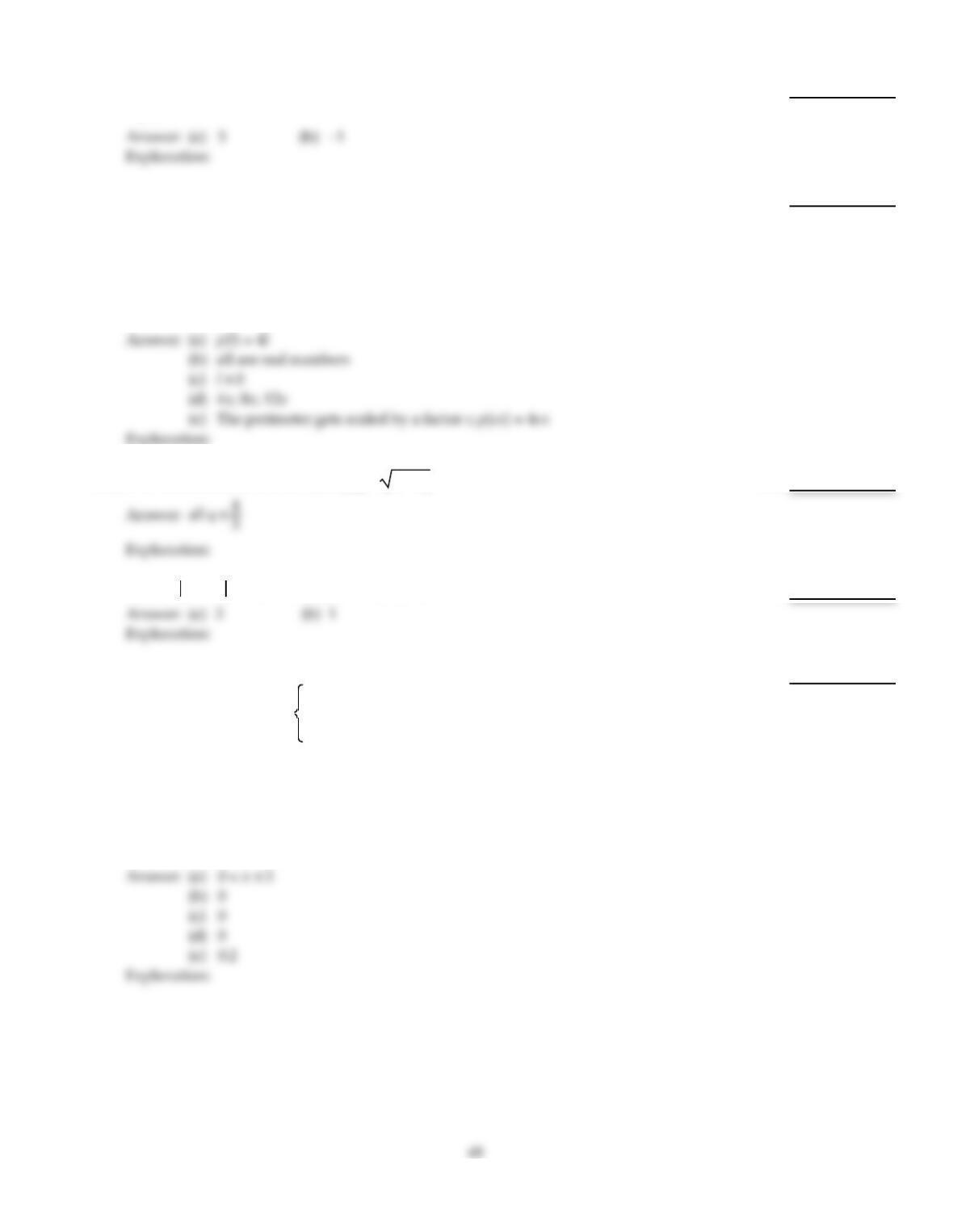
Sketch a graph of y=2x– 5
182)
183)
Find: (a) the degree and (b) the leading coefficient of the polynomial function f(x) = 7 +5x2
–x3.
183)
184)
The perimeter of a square depends on the length of its side.
(a) Write a function p(l) for the perimeter of a square when the length of its side is l.
(b) What is the domain of this function out of context?
(c) What is the domain of this function in the given context?
(d) Find p(x), p(2x) and p(3x).
(e) What happens to the perimeter of a square when the side is scaled by a factor s?
Describe using an equation.
184)
185)
Find the domain of the function: f(q) =4 – 3q
185)
186)
If f(x) =1 – 2x+ 2x, find: (a) f(1) and (b) f(–1).
186)
187)
Given the function f(x) =
2x, if 0 <x< 1
1 –x, if 1 x< 2,
0, if 2 x
3
find:
(a) the domain
(b) f(1)
(c) f(2)
(d) f(3)
(e) f(0.1)
187)
188)
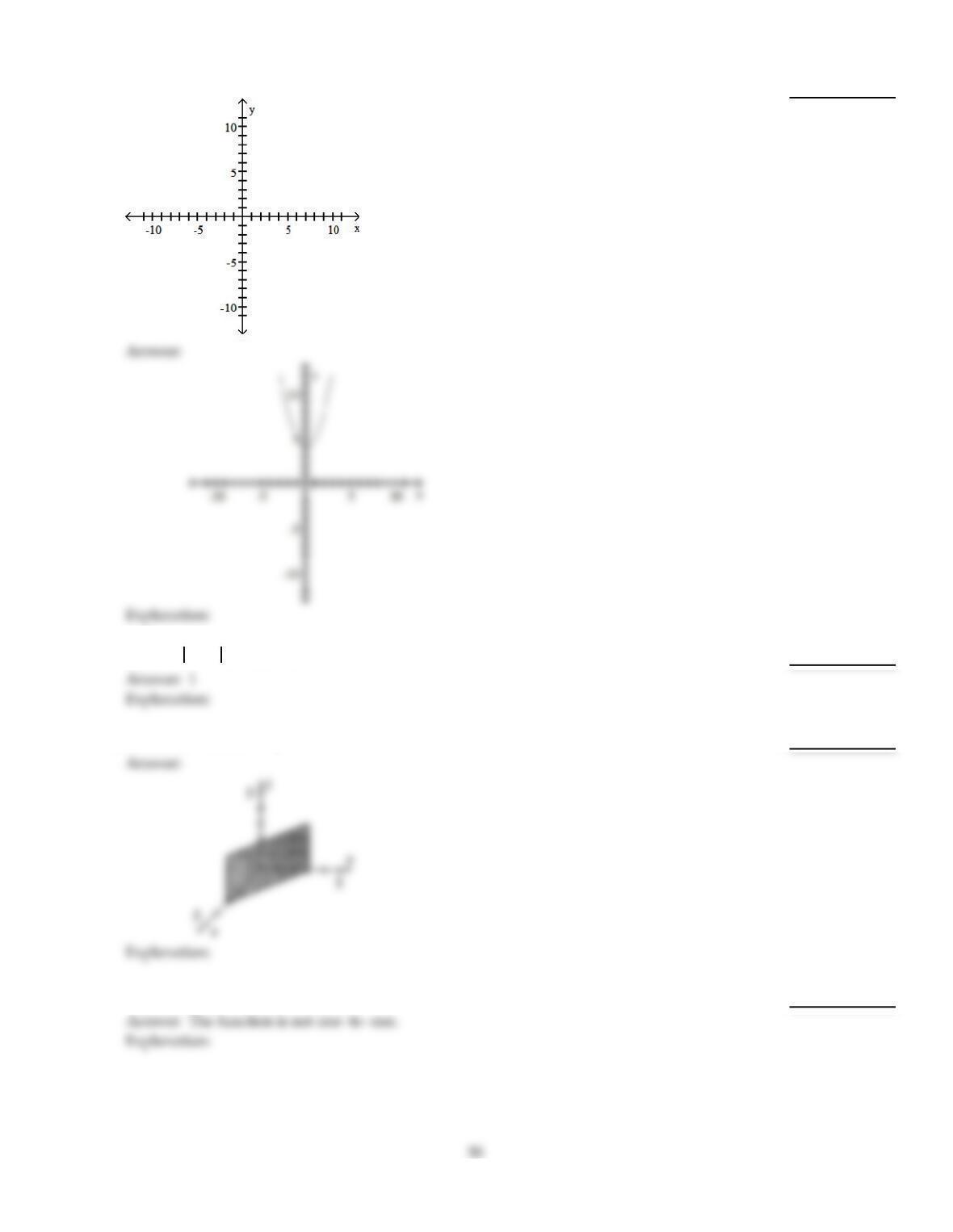
Sketch a graph of f(x) =x2+ 4
188)
189)
If g(x) =x+ 4 , find g(–5).
189)
190)
Sketch the surface x+y= 3.
190)
191)
Determine whether or not the function is one–to–one: f(x) =x2–3
191)
192)
The time it takes to go a given distance depends on the rate.
(a) Write a function t(r) for the time it takes if the distance is 400 miles and the rate is r
miles per hour.
(b) How much time is needed when the rate is x?
(c) If the speed is increased by 10 miles per hour, how much less time is needed?
(d) How much less time is needed per mile per hour increase?
(e) If the speed is increased by h, how much less time is needed?
(f) How much less time is needed per unit increase?
192)
193)
Given the function P(r, k) =
k!1
4
r3
4
k–r
r!(k–r)! , r= 0, 1, 2, …, k; find P(2, 4).
193)
51
194)
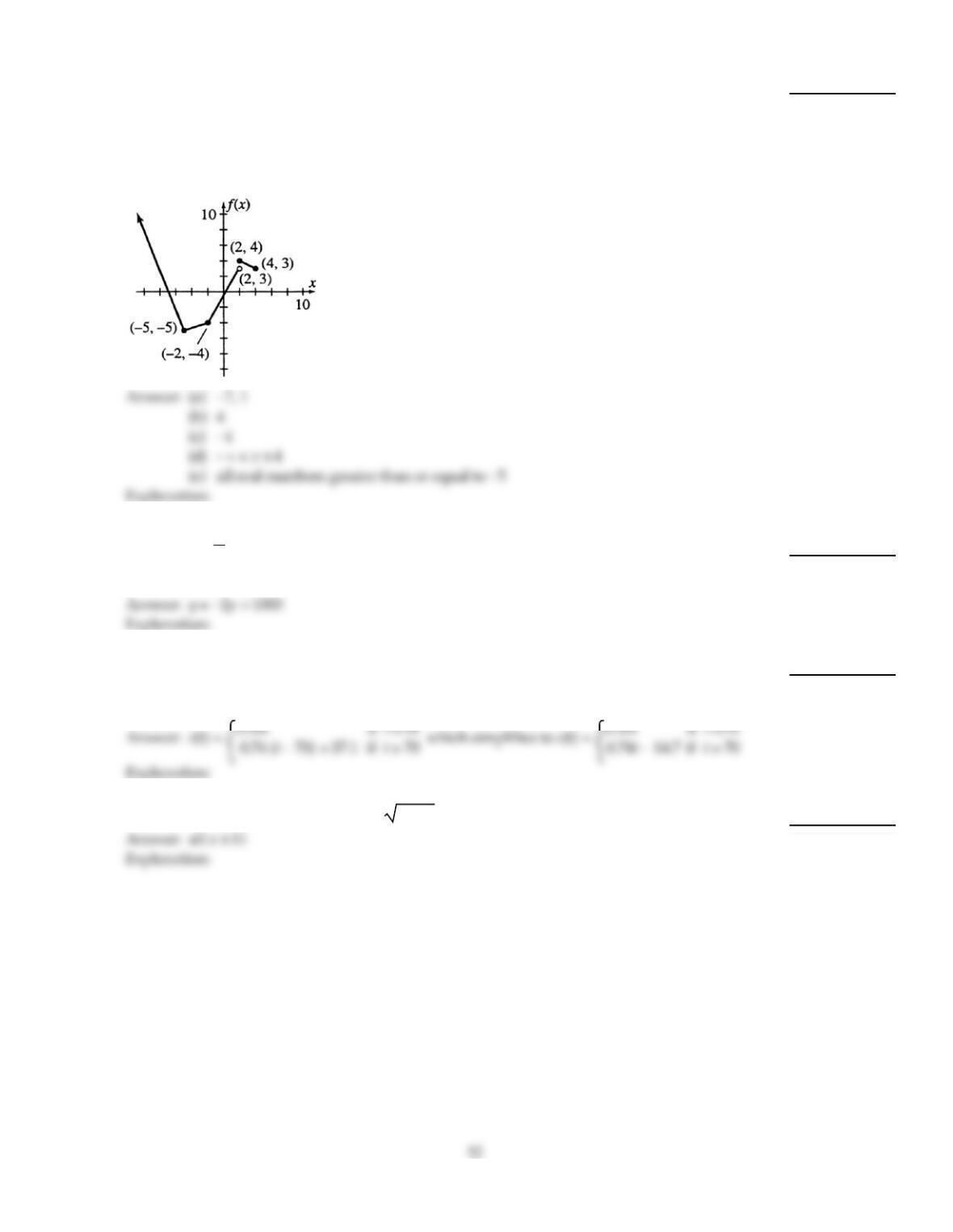
By looking a the graph below:
(a) list all values for which f(x) = 0
(b) f(2) =
(c) f(–2) =
(d) domain of f is?
(e) range of f is?
194)
195)
Let p= 500 –1
2q represent a demand equation for a product where p is unit price and q is
quantity with the restriction 0 q< 1000. Express the quantity q as a function of p.
195)
196)
To encourage conservation, a gas company charges two rates. You pay $0.53 per therm for
0–70 therms and $0.74 for each therm over 70. Write a compound fraction to represent the
monthly cost of t therms of water.
196)
197)
Find the domain of the function: f(x) =x– 11
197)
198)
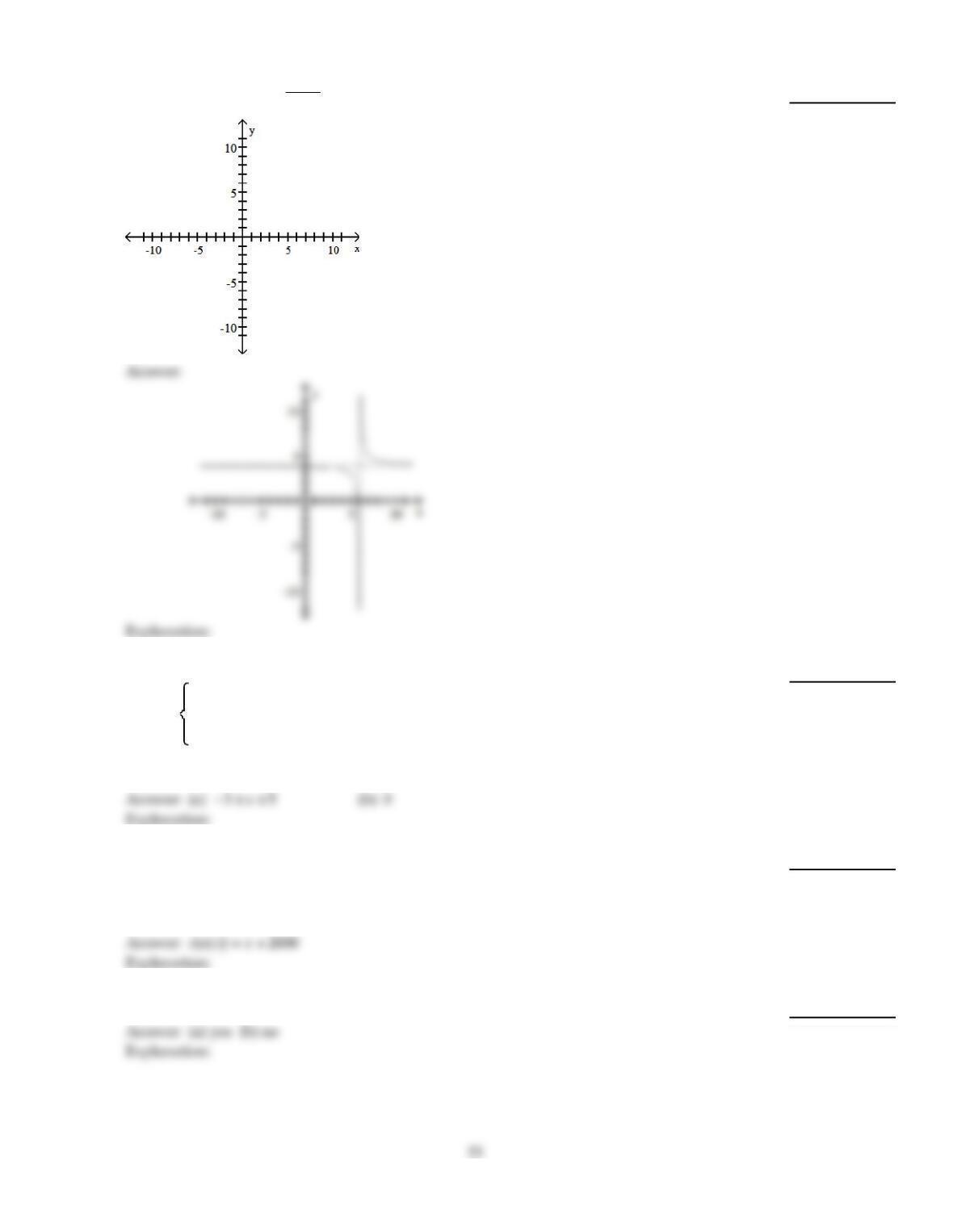
Sketch a graph of f(x) =1
x– 6 + 4
198)
199)
If f(x) =
3 –x, if 2 x 5
1 – 2x, if 0 x< 2
7 +x2,if –3 x< 0
,
(a) find the domain of f(x)
(b) find f(3)
199)
200)
A car costs x wholesale. The price the dealer pays is given by the function s(x) =
x+ 500, where x is the wholesale price. The price the customer pays is c(x) =
x+ 1500 where x is the price the dealer pays. Write a composite function to find the
customer’s price as a function of the wholesale price.
200)
201)
For the equation 4y=x2, (a) is y a function of x? (b) Is x a function of y?
201)
202)
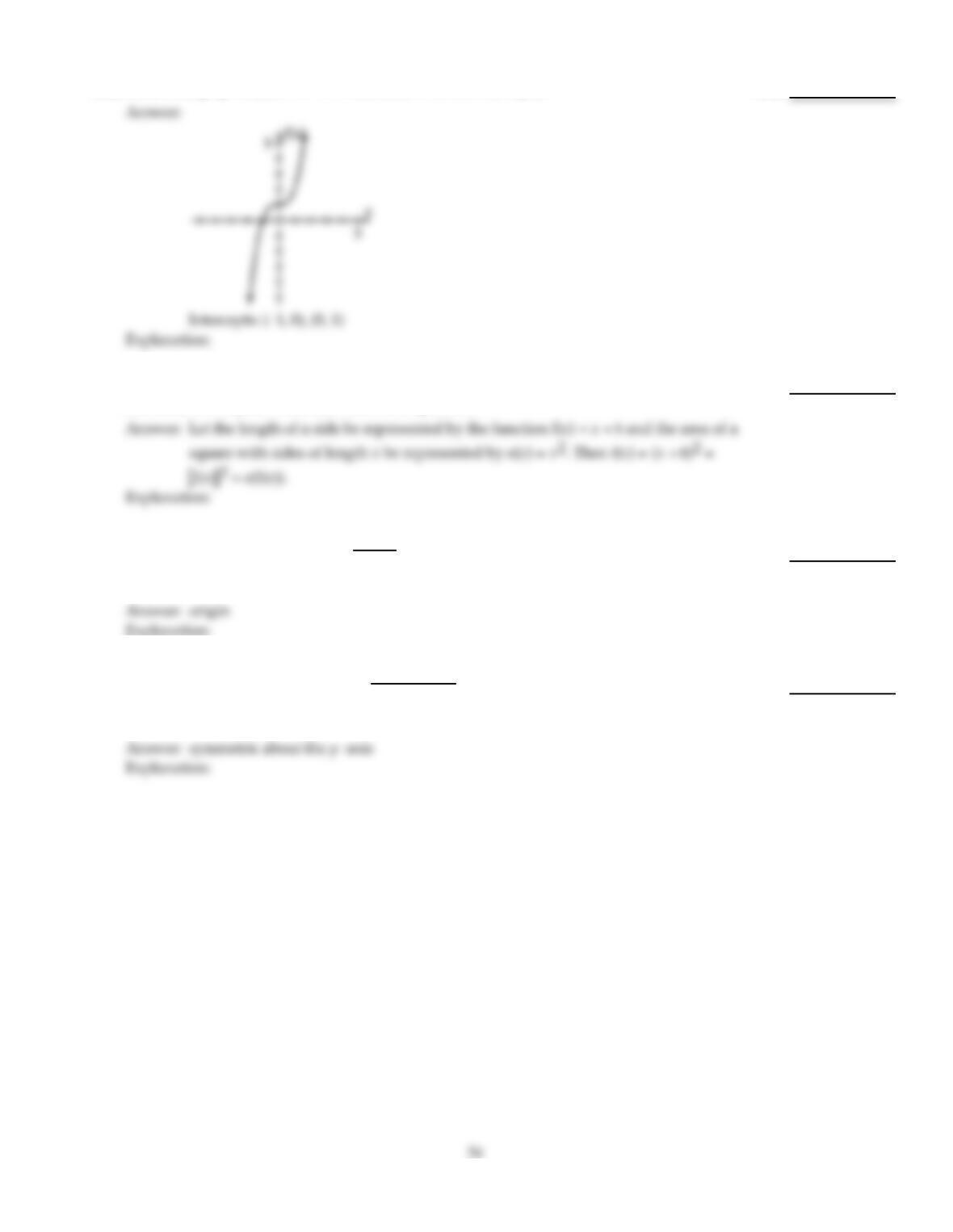
Sketch the graph of f(x) =x3+ 1. Also determine the intercepts.
202)
203)
Suppose the area of a square tablecloth is t(x) = (x+6)2. Express as a composition of two
functions and explain what each function represents.
203)
204)
Determine whether the graph y=x2– 1
x is symmetric about the x–axis, the y–axis, the
origin, or the line y=x.
204)
205)
Determine whether the graph of y =0.23 – 0.8x2
0.9 – 0.1x2 is symmetric about the x–axis, the
y–axis, the origin, or the line y=x.
205)
206)
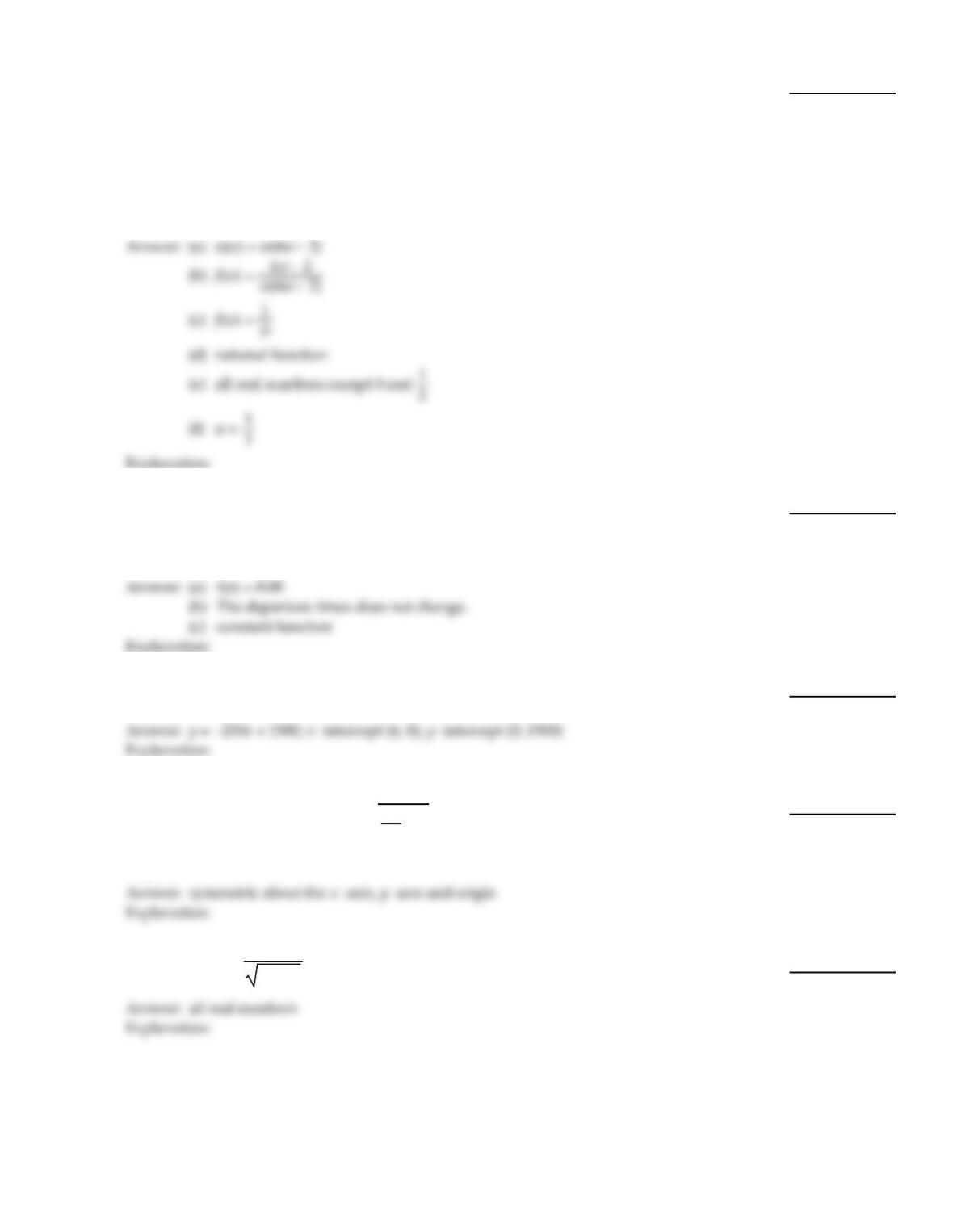
A rectangular sheet of metal has a length that is 2 less than 4 times the width.
(a) Write the area of the rectangular sheet as a function of the width.
(b) Without simplifying, write the ratio of the length of the sheet to the area of the
sheet as a function of the width.
(c) Simplify the function you wrote in b.
(d) What kind of function is this?
(e) What is its domain out of context?
(f) What is its domain in the given context?
206)
207)
A train holds 200 passengers and departs daily at 8:00 A.M.
(a) Write the daily departure time as a function of the number of people on the train.
(b) How does the departure time change as the number of people on the train increases?
(c) What kind of function is this?
207)
208)
Tom has saved $1500 for a vacation. He plans to spend $250 a week on his vacation. Write
an equation to represent the amount in savings and identify the intercepts.
208)
209)
Determine whether the graph of y2=7 – 9x2
1
x2– 1
is symmetric about the x–axis, the y–axis, the
origin, or the line y=x.
209)
210)
Find the domain: 3x+ 5
x2+ 5
210)
55
211)
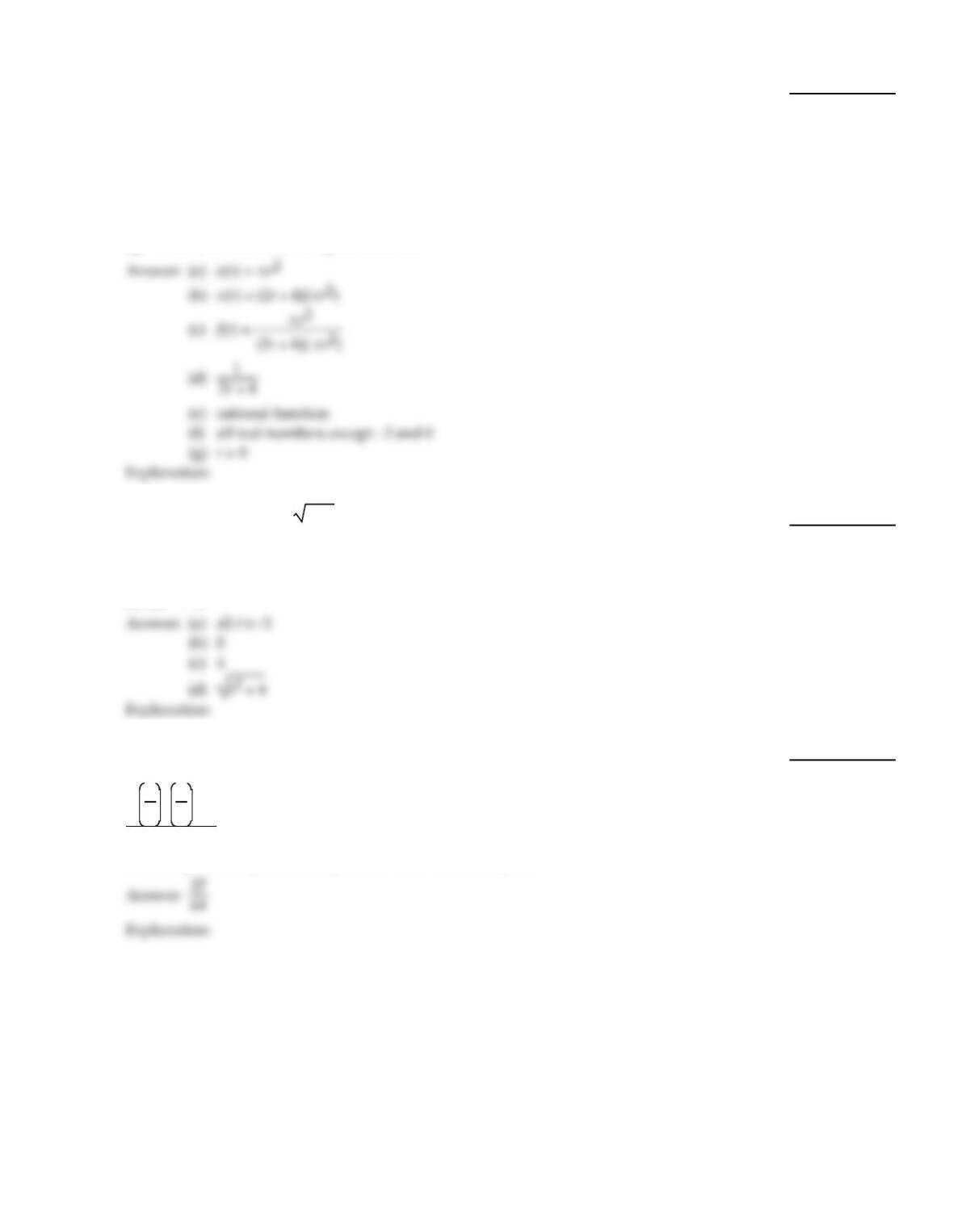
A cylinder has a height that is 4 more than the diameter of its base.
(a) Write the area of its circular base as a function of its radius.
(b) Write the volume of the cylinder as a function of its radius.
(c) Without simplifying, write the ratio of the area of the circular base and the
volume of the cylinder as a function of the radius.
(d) Simplify the function you wrote in c.
(e) What kind of function is this?
(f) What is its domain out of context?
(g) What is its domain in the given context?
211)
212)
Given the function F(t) =t + 3, find:
(a) the domain
(b) F(–3)
(c) F(13)
(d) f(t2+ 1)
212)
213)
Under certain conditions, if two brown–eyed parents have exactly four children, the
probability P that exactly r of them are blue–eyed is a function of r and is given by P(r) =
4! 1
4
r3
4
4–r
r!(4 –r)! .
Find the probability that exactly one child will be blue–eyed.
213)
56
214)
Sketch a graph of f(x) =(x– 5)3
214)
215)
The proceeds from an event depend on the number of people who attend.
(a) Write a function p(n) for the proceeds if each ticket costs $8.00 and the number of
tickets sold is n.
(b) What is the domain of this function out of context?
(c) What is the domain of this function in the given context?
(d) Find p(c), p(c+ 5), and p(c+ 25).
(e) What happens to the proceeds when the number who attend increases by a constant
m? Describe using an equation.
215)
216)
True or False: If x+y2– 5 = 0, then x is a function of y.
216)
57
217)
f(x) =.01x2– 3.12 if x 6.3
.39x– 1.2 if x< 6.3
Find: (a) f(6.3); (b) f(0)
217)
218)
Sketch a graph of f(x) =(x– 4)2
218)
219)
If f(x) = 7, find f(14).
219)
220)
A coffee shop earns $8.75 for every pound of coffee it sells.
(a) Write the profit as a function of the number of pounds of coffee sold.
(b) What kind of function is this?
(c) What is its degree?
(d) What is its leading coefficient?
220)
221)
If f(x) =x2 and g(x) = 2x+ 1, find:
(a) (f + g)(x)
(b) (f + g)(3)
(c) (f – g)(x)
(d) (fg)(x)
(e) (fg)–1
2
(f) f
g (t2)
(g) f(g(x))
(h) f(g(1))
(i) g(f(x))
221)
222)
The height of an object thrown in the air depends on the time since it’s been thrown. For a
particular situation the height in meters of an object after t seconds can be represented by
h(t) = 20t– 4.9t2.
(a) What is the domain of this function out of context?
(b) What is the domain of this function in the given context?
(c) Find h(s), h(s+ 2), and h(s+ 6).
(d) Use an equation to describe what happens to the height if the time increases by a
constant d.
222)
223)
You want to play a lottery that uses 50 numbers. How many combinations are possible if
you need to pick 5 numbers? Represent as a factorial and give the solution.
223)
224)
Let h(x) =7 –x. Find functions f and g such that h=f
g.
224)
225)
Let g(x) = 1 – 4x, h(x) =x2+ 3x. Find: (a) (g
h)(x); (b) (h
g)(x)
225)
226)
For the graph of y =f(x) =x2– 4,
(a) Determine the intercepts.
(b) Determine whether the graph is symmetric about the x–axis, y–axis, the origin, or the
line y=x.
(c) Sketch the graph. State (d) the domain and (e) the range of f.
226)