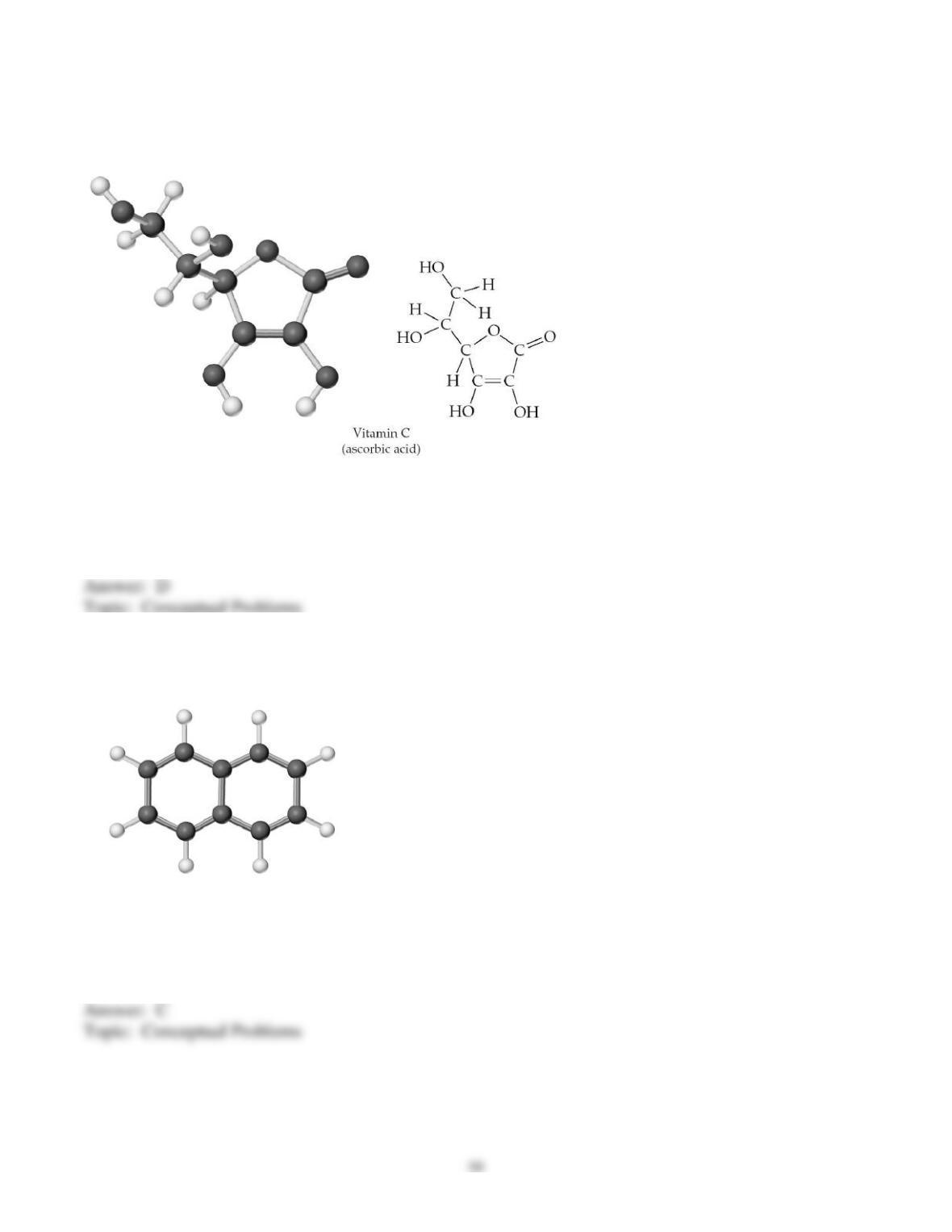
163) Give the molecular formula corresponding to the following ball-and-stick molecular representation
of vitamin C (ascorbic acid) (gray = C, unshaded = H, black = O). In writing the formula, list the atoms
in alphabetical order.
A) CHO
B) C3H4O3
C) C6H4O6
D) C6H8O6
164) Give the molecular formula corresponding to the following ball-and-stick molecular representation
of naphthalene (gray = C, unshaded = H). In writing the formula, list the atoms in alphabetical order.
A) CH
B) C5H4
C) C10H8
D) C10H10
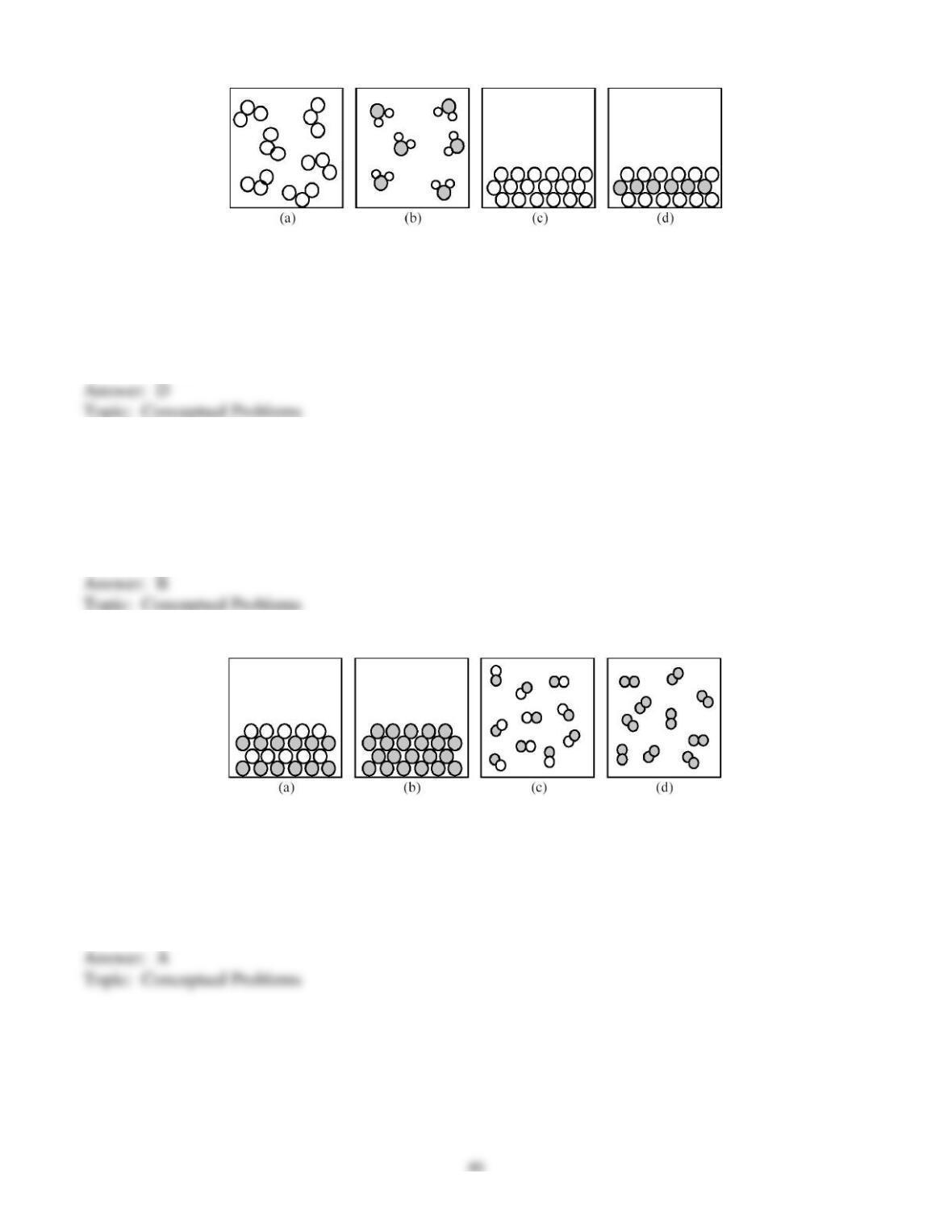
165) If shaded and unshaded spheres represent atoms of different elements, which of the above drawings
most likely represents an ionic compound at room temperature and a pressure of 1 atm?
A) drawing (a)
B) drawing (b)
C) drawing (c)
D) drawing (d)
166) If shaded and unshaded spheres represent atoms of different elements, which of the above drawings
most likely represents a molecular compound at room temperature and a pressure of 1 atm?
A) drawing (a)
B) drawing (b)
C) drawing (c)
D) drawing (d)
167) If shaded and unshaded spheres represent atoms of different elements, which of the above drawings
most likely represents an ionic compound at room temperature and a pressure of 1 atm?
A) drawing (a)
B) drawing (b)
C) drawing (c)
D) drawing (d)
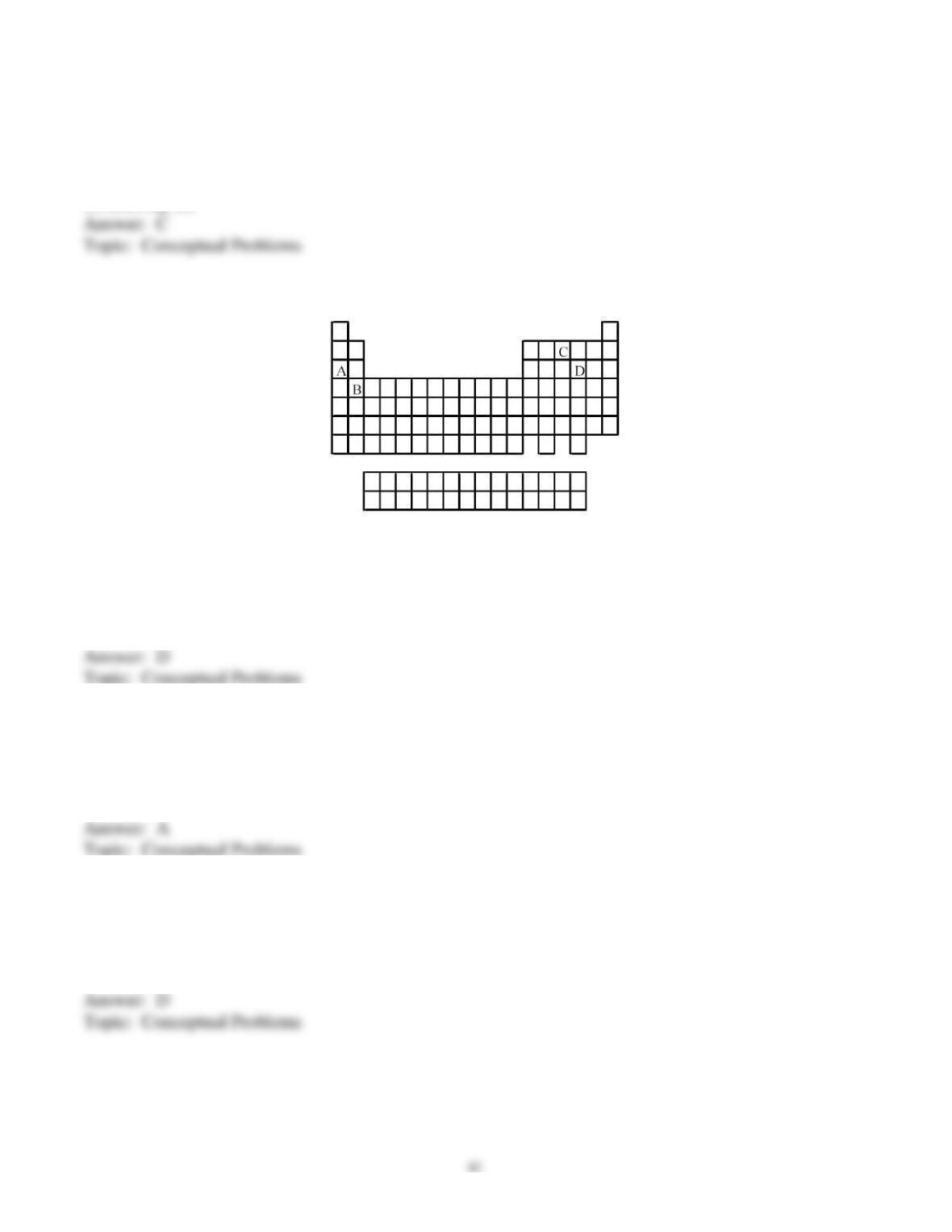
168) If shaded and unshaded spheres represent atoms of different elements, which of the above drawings
most likely represents a molecular compound at room temperature and a pressure of 1 atm?
A) drawing (a)
B) drawing (b)
C) drawing (c)
D) drawing (d)
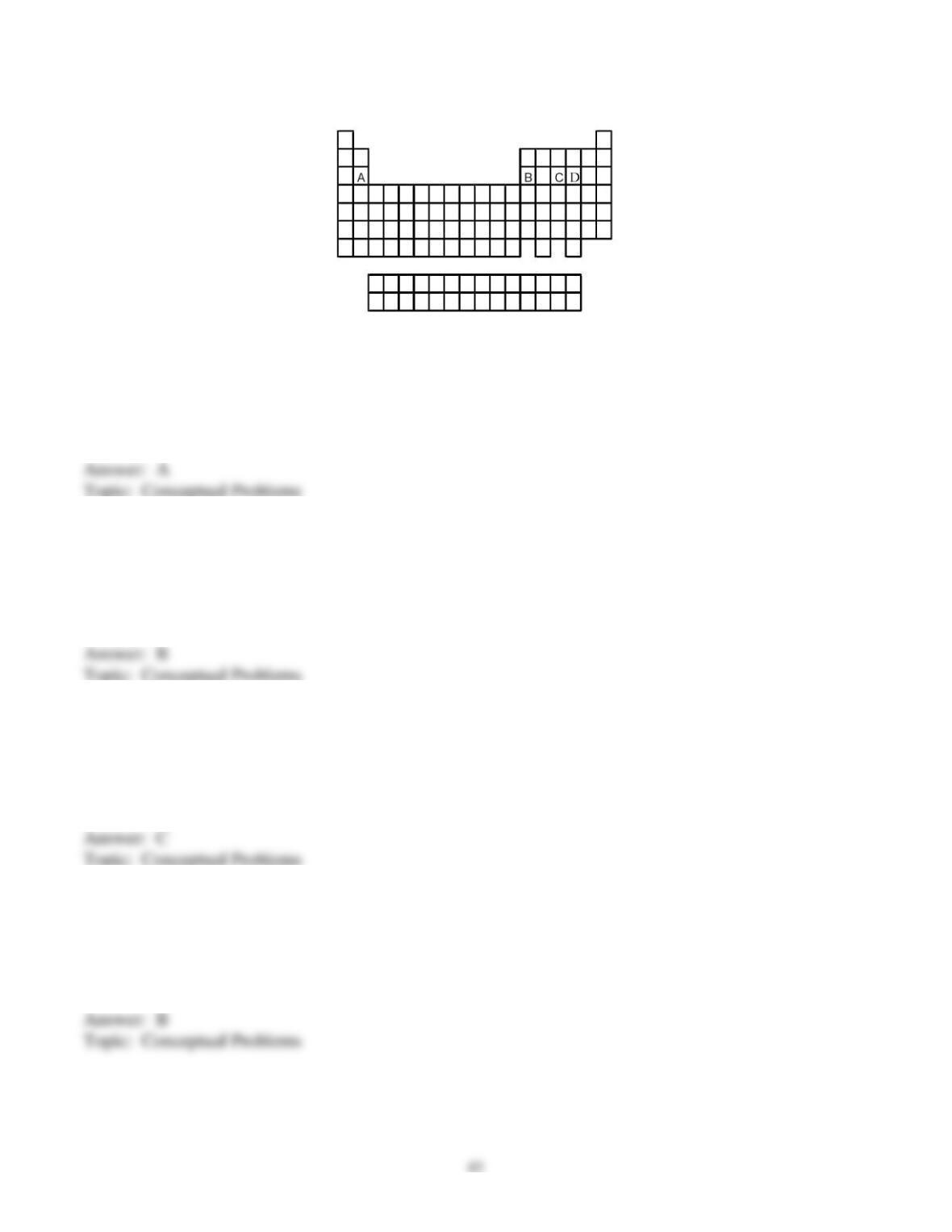
Use the periodic table below to answer the following questions.
169) Which elements commonly form anions?
A) A and B
B) A and C
C) B and D
D) C and D
170) Which elements commonly form cations?
A) A and B
B) A and C
C) B and D
D) C and D
171) Which elements commonly form covalent bonds?
A) A and B
B) A and C
C) B and D
D) C and D
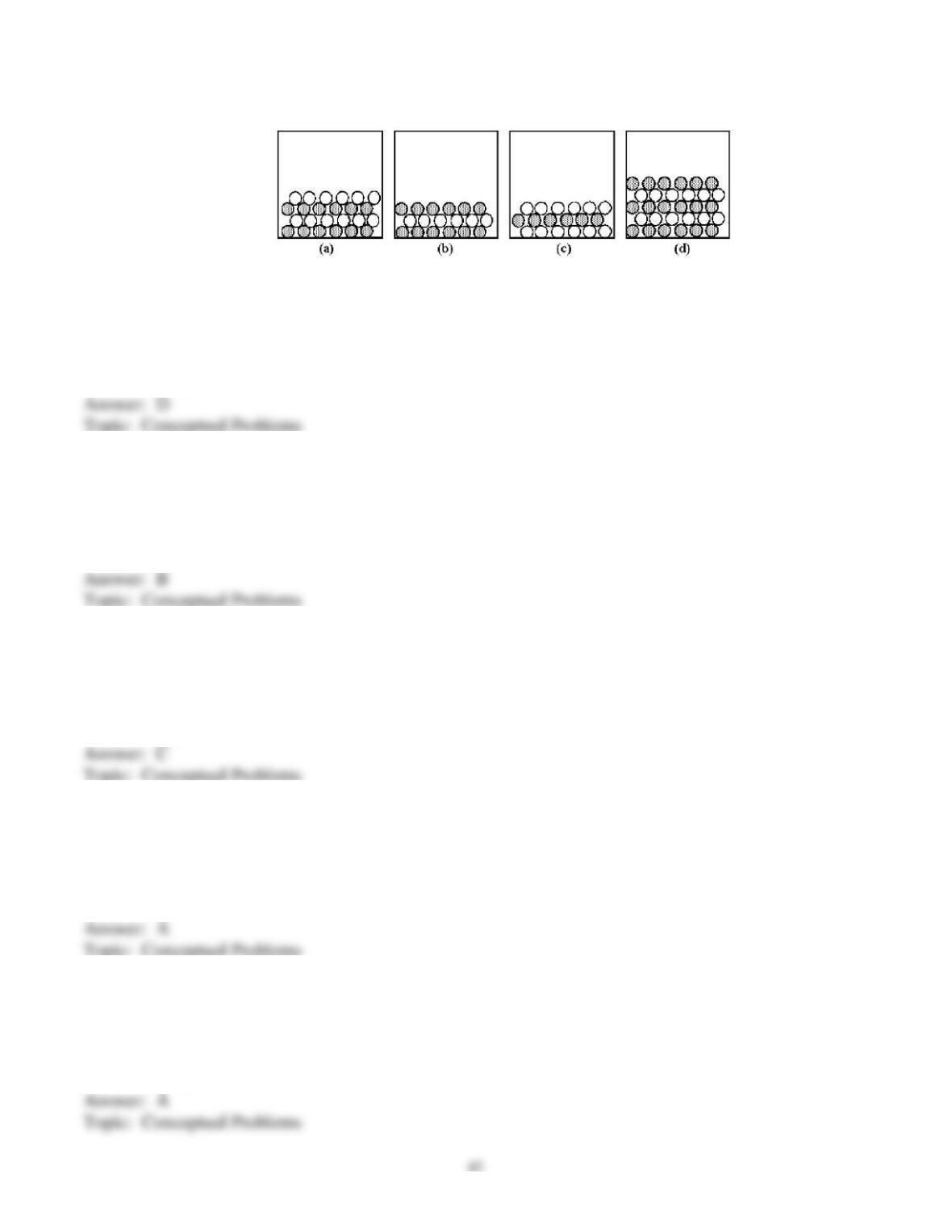
In the following drawings, shaded spheres represent cations and unshaded spheres represent anions.
172) Which drawing represents the ionic compound Mg3(PO4)2?
A) drawing (a)
B) drawing (b)
C) drawing (c)
D) drawing (d)
173) Which drawing represents the ionic compound Na2CO3?
A) drawing (a)
B) drawing (b)
C) drawing (c)
D) drawing (d)
174) Which drawing represents the ionic compound CaCl2?
A) drawing (a)
B) drawing (b)
C) drawing (c)
D) drawing (d)
175) Which drawing represents the ionic compound KNO3?
A) drawing (a)
B) drawing (b)
C) drawing (c)
D) drawing (d)
176) Which drawing represents the ionic compound NH4ClO4?
A) drawing (a)
B) drawing (b)
C) drawing (c)
D) drawing (d)
Use the periodic table below to answer the following questions.
177) Which is the correct formula of the binary fluoride of element A?
A) AF2
B) AF3
C) AF5
D) AF6
178) Which is the correct formula of the binary fluoride of element B?
A) BF2
B) BF3
C) BF5
D) BF6
179) In which pair are both formulas of binary fluorides of element C correct?
A) CF2 and CF3
B) CF2 and CF6
C) CF3 and CF5
D) CF5 and CF6
180) In which pair are both formulas of binary fluorides of element D correct?
A) DF2 and DF3
B) DF2 and DF6
C) DF3 and DF5
D) DF5 and DF6
181) Which is most likely to form a binary oxide with the formula MO (where M = element A, B, C, or
D)?
A) element A
B) element B
C) element C
D) element D
182) Which is most likely to form a binary oxide with the formula MO3 (where M = element A, B, C, or
D)?
A) element A
B) element B
C) element C
D) element D
183) Which is most likely to form a binary oxide with the formula M2O3 (where M = element A, B, C,
or D)?
A) element A
B) element B
C) element C
D) element D
184) Which is most likely to form a binary oxide with the formula M4O10 (where M = element A, B, C,
or D)?
A) element A
B) element B
C) element C
D) element D
2.2 Algorithmic Questions
1) Methane and oxygen react to form carbon dioxide and water. What mass of water is formed if 0.80 g
of methane reacts with 3.2 g of oxygen to produce 2.2 g of carbon dioxide?
A) 1.8 g
B) 2.2 g
C) 3.7 g
D) 4.0 g
2) Sodium metal and water react to form hydrogen and sodium hydroxide. If 5.98 g of sodium react
with water to form 0.26 g of hydrogen and 10.40 g of sodium hydroxide, what mass of water was
involved in the reaction?
A) 4.68 g
B) 5.98 g
C) 10.14 g
D) 10.66 g
3) A sample of pure lithium carbonate contains 18.8.4% lithium by mass. What is the % lithium by
mass in a sample of pure lithium carbonate that has twice the mass of the first sample?
A) 9.40%
B) 18.8%
C) 37.6%
D) 75.2%
4) A sample of pure calcium fluoride with a mass of 15.0 g contains 7.70 g of calcium. How much
calcium is contained in 40.0 g of calcium fluoride?
A) 2.27 g
B) 7.70 g
C) 15.0 g
D) 20.5 g
5) Elements A and Q form two compounds, AQ and A2Q3. The mass ratio (mass Q)/(mass A) for AQ is
0. 291. What is the mass ratio (mass Q)/(mass A) for A2Q3?
A) 0. 194
B) 0. 436
C) 2.29
D) 5.15
6) Which are isotopes? An atom that has an atomic number of 20 and a mass number of 42 is an
isotope of an atom that has
A) an atomic number of 21 and a mass number of 42.
B) an atomic number of 20 and a mass number of 40.
C) 22 neutrons and 20 protons.
D) 22 protons and 20 neutrons.
7) Which of the following represent isotopes?
A:
32
15
[ ] B:
32
16
[ ] C:
31
15
[ ] D:
34
17
[ ]
A) A and B
B) A and C
C) A and D
D) C and D
8) How many protons (p) and neutrons (n) are in an atom of
90Sr
38
?
A) 38 p, 52 n
B) 38 p, 90 n
C) 52 p, 38 n
D) 90 p, 38 n
9) How many protons (p) and neutrons (n) are in an atom of barium-130?
A) 56 p, 74 n
B) 56 p, 130 n
C) 74 p, 56 n
D) 130 p, 56 n
10) What is the element symbol for an atom that has 5 protons and 6 neutrons?
A) B
B) C
C) H
D) Na
11) How many electrons are in a neutral atom of bromine-81?
A) 1
B) 35
C) 36
D) 81
12) Identify the chemical symbol of element Q in
34
.
A) Br
B) Hg
C) Pd
D) Se
13) The number of nucleons in a
234Th
90
nucleus is
A) 90.
B) 144.
C) 234.
D) 324.
14) Beta decay of 32P produces a beta particle and
A) 28Al.
B) 31P.
C) 32Si.
D) 32S.
15) In addition to a beta particle, what is the other product of beta decay of
131I
53
?
A)
127Sb
51
B)
131Te
52
C)
131Xe
54
D)
135Cs
55
16) Which of the following elements would be expected to be particularly stable?
A)
16O
8
B)
14 N
7
C)
15C
6
D)
13B
5
17) Which of the following nuclides is most likely to undergo beta decay?
A)
190Hg
80
B)
195Hg
80
C)
200Hg
80
D)
205Hg
80
18) Which nuclide below is most likely to decay by electron capture?
A)
176W
74
B)
180W
74
C)
184W
74
D)
188W
74
19) Crude oil is an example of
A) a compound.
B) an element.
C) a heterogeneous mixture.
D) a homogeneous mixture.
20) Gasoline is an example of
A) a compound.
B) an element.
C) a heterogeneous mixture.
D) a homogeneous mixture.
21) Gold is an example of
A) a compound.
B) an element.
C) a heterogeneous mixture.
D) a homogeneous mixture.
22) Ammonia is an example of
A) a compound.
B) an element.
C) a heterogeneous mixture.
D) a homogeneous mixture.
23) In which set do all elements tend to form cations in binary ionic compounds?
A) K, Ga, O
B) Sr, Ni, Hg
C) N, P, Bi
D) O, Br, I
24) How many electrons are in the ion, Cu2+?
A) 27
B) 29
C) 31
25) How many electrons are in the ion, P3-?
A) 12
B) 18
C) 28
D) 34
26) In which of the following sets do all species have the same number of electrons?
A) F–, Ne, Mg2+
B) Ge, Se2-, Br–
C) K+, Rb+, Cs+
D) Br, Br–, Br+
27) In which of the following sets do all species have the same number of protons?
A) F–, Ne, Mg2+
B) Ge, Se2-, Br–
C) K+, Rb+, Cs+
D) Br, Br–, Br+
28) What is the identity of element Q if the ion Q2+ contains 10 electrons?
A) C
B) O
C) Ne
D) Mg
29) How many electrons are in the ion, PO43-?
A) 26
B) 44
C) 47
D) 50
30) In which set do all elements tend to form anions in binary ionic compounds?
A) C, S, Pb
B) K, Fe, Br
C) Li, Na, K
D) N, O, I
31) What type of bonding is found in the compound O F2?
A) covalent bonding
B) hydrogen bonding
C) ionic bonding
D) metallic bonding
32) Which one of the following compounds contains ionic bonds?
A) SrO
B) H Br
C) P Br3
D) SiO2
33) Which of the following is the correct chemical formula for a molecule of astatine?
A) At
B) At–
C) At+
D) At2
34) Which of the compounds, Li3N, NH3, C3H8, IF3 are ionic compounds?
A) only C3H8
B) only Li3N
C) Li3N and N H3
D) N H3, C3H8, and I F3
35) Which of the compounds CH4, SrCl2, Cr(NO3)3, XeF2 are expected to exist as molecules?
A) only CH4
B) CH4 and Xe F2
C) CH4, Cr(NO3)2, and Xe F2
D) SrCl2 and Cr(NO3)2
36) Which of the following elements has the least tendency to form an ion?
A) Ca
B) K
C) Kr
D) Se
37) The solid compound, Mg(NO3)2, contains
A) Mg2+, N5+, and O2- ions.
B) Mg2+ ions and (NO32- ions.
C) Mg 2+ and (NO32- ions.
D) Mg(NO3)2 molecules.
38) What is the chemical formula for iron( III) sulfate?
A) Fe3S
B) Fe3SO4
C) Fe2S3
D) Fe2( SO4)3
39) What is the charge on the Cr ions in Cr2O3?
A) 2-
B) 1+
C) 2+
D) 3+
40) Rb2S is named
A) rubidium disulfide.
B) rubidium sulfide.
C) rubidium(II) sulfide.
D) rubidium sulfur.
41) What is the chemical formula for calcium hydroxide?
A) CaH2
B) CaOH
C) CaOH2
D) Ca(OH)2
42) What is the chemical formula for magnesium hydride?
A) MgH2
B) MgOH
C) MgOH2
D) Mg(OH)2
43) An aqueous solution of H2S is named
A) hydrosulfuric acid.
B) hydrosulfurous acid.
C) sulfuric acid.
D) sulfurous acid.
44) The chemical formula for the sulfite ion is
A) S–.
B) S 2-.
C) SO32-.
D) SO42-.
45) The chemical formula for lithium peroxide is
A) LiOH.
B) LiO2.
C) Li2O.
D) Li2O2.
46) The compound, Cu( I O3 )2, is named
A) copper iodate(II).
B) copper(I) iodate.
C) copper(I) iodate(II).
D) copper(II) iodate.
47) The compound, SO3, is named
A) sulfate.
B) sulfite.
C) sulfur trioxide.
D) sulfur ( VI) oxide.
48) The ion, IO2–, is named
A) iodate ion.
B) iodite ion.
C) iodine dioxide ion.
D) iodine(II) oxide ion.
49) The chemical formula for nitrous acid is
A) H3N(aq).
B) H NO2(aq).
C) H NO3(aq).
D) H2N2O6(aq).
50) The chemical formula for calcium nitride is
A) Ca(NO3)2.
B) Ca(NO2)2.
C) Ca3N2.
D) CaN2.
2.3 Short Answer Questions
1) In the reaction HBr + NaOH → H2O + NaBr, If 81 g HBr react with 40 g of NaOH to produce 18 g
of H2O, the number of grams of NaBr produced is ________.
2) According to the law of multiple proportions, if 12 g of carbon combine with 16 g of oxygen to form
CO, the number of grams of carbon that combine with 16 g of oxygen in the formation of CO2 is
________.
3) The charge to mass ratio of an electron was determined from Rutherford’s cathode-ray tube
experiment to be 1.759 × 10⁸ C/g and the charge on a single electron was determined from the Millikan
oil drop experiment to be 1.602 × 10⁻¹⁹ C, so the mass of a single electron is ________.
4) The subatomic particles contained in the nucleus of an atom are ________ and ________.
5) Atoms of the same element always have the same number of ________ in their nuclei.
6) Isotopes have the same number of ________ but different numbers of ________ in their nuclei.
7) The symbol of the isotope having Z = 88 and A = 226 is ________.
8) The symbol for technetium-98 is ________.
55
9) The number of neutrons in a neutral atom of uranium-238 is ________.
10) A neutral atom with atomic number 5 and mass number 11 contains ________ electrons.
11) Chlorine has two common isotopes, chlorine-35 and chlorine-37, and an atomic mass of 35.45 amu.
The natural abundance of chlorine-35 is ________ (greater than, less than, the same as) the natural
abundance of chlorine-37.
12) The number of atoms in 23 g of Na is ________ (greater than, less than, the same as) the number of
atoms in 12 g of C.
13) To the nearest whole number, the number of grams of Ba in 3.25 mol of Ba is ________.
14) The number of moles of Li in 34.7 g Li is ________.
15) The number of protons, neutrons, and total nucleons in
106Ru
44
are ________, ________, and
________, respectively.
16) The missing reactant in the nuclear reaction ? →
14 N
7
+
0e
1−
is ________.
17) In a nuclear reaction, the symbol for a beta particle is ________.
18) In a nuclear reaction
4He
2
is the symbol for ________.
19)
238U
92
undergoes alpha decay producing one alpha particle and a single nuclide. To balance the
equation, ________ and ________ must be added to the right side of the equation below.
238U
92
→ ? + ?
20) In an electron capture reaction a proton is converted into a ________.
21) Nuclei that are in the band of stability have a neutron/proton ratio ________ (equal to, greater than,
less than) 1:1.
22) 10% saline solution (sodium chloride dissolved in water) is an example of a ________ mixture.
23) The number of electrons in the ion Ca2+ is ________.
24) The number of electrons in the ion C4– is ________.
25) The bonding in MgO is ________, whereas the bonding in CO is ________.
26) Phosphate ion has the formula ________.
27) The formula of iron(III) oxide contains ________ iron(III) and ________ oxide ions.