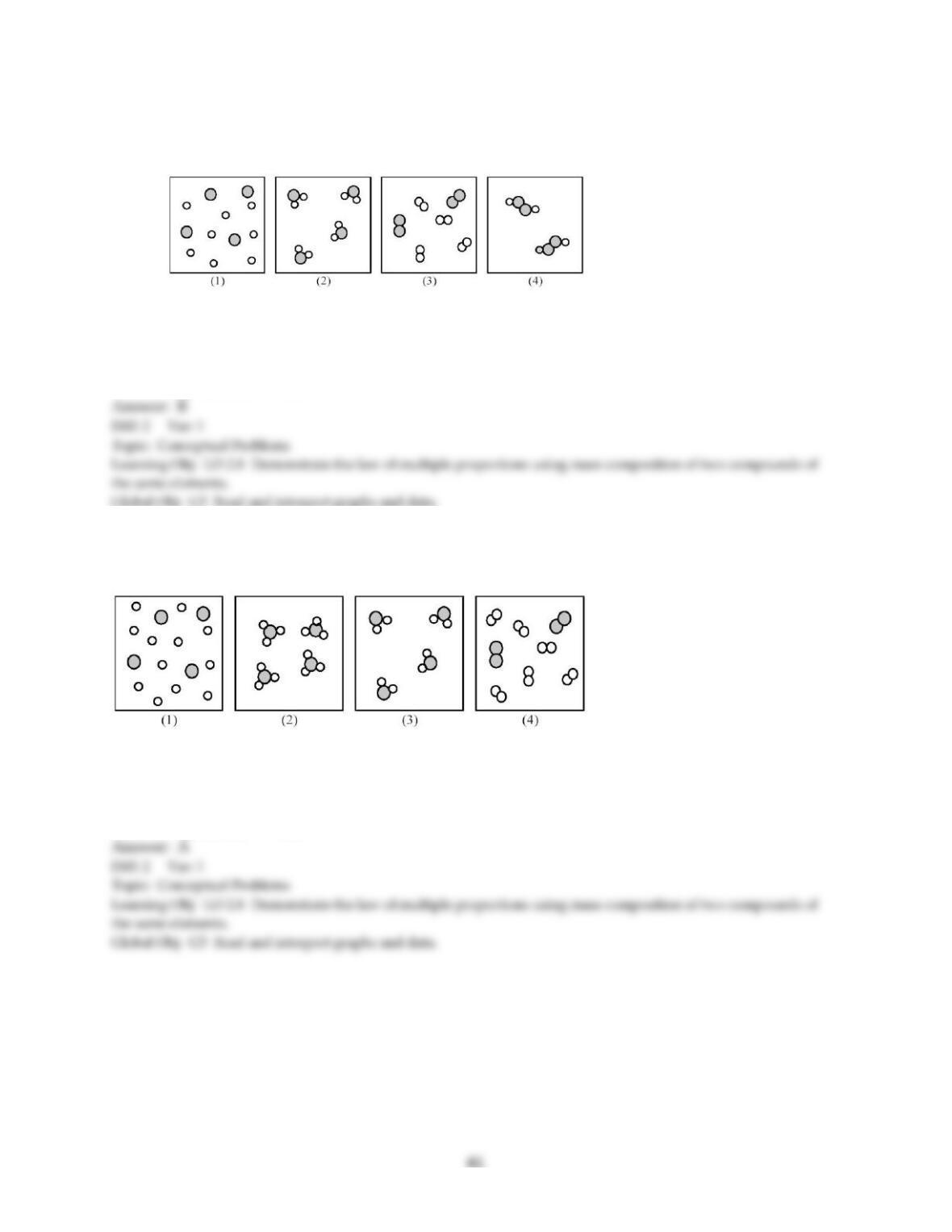
114) If shaded and unshaded spheres represent atoms of different elements, as shown in drawing (1),
which drawings (2)-(4) represent the law of multiple proportions?
A) only drawings (2) and (3)
B) only drawings (2) and (4)
C) only drawings (3) and (4)
D) drawings (2), (3), and (4)
115) If shaded and unshaded spheres represent atoms of different elements, as shown in drawing (1),
which drawings (2)-(4) represent the law of multiple proportions?
A) only drawings (2) and (3)
B) only drawings (2) and (4)
C) only drawings (3) and (4)
D) drawings (2), (3), and (4)
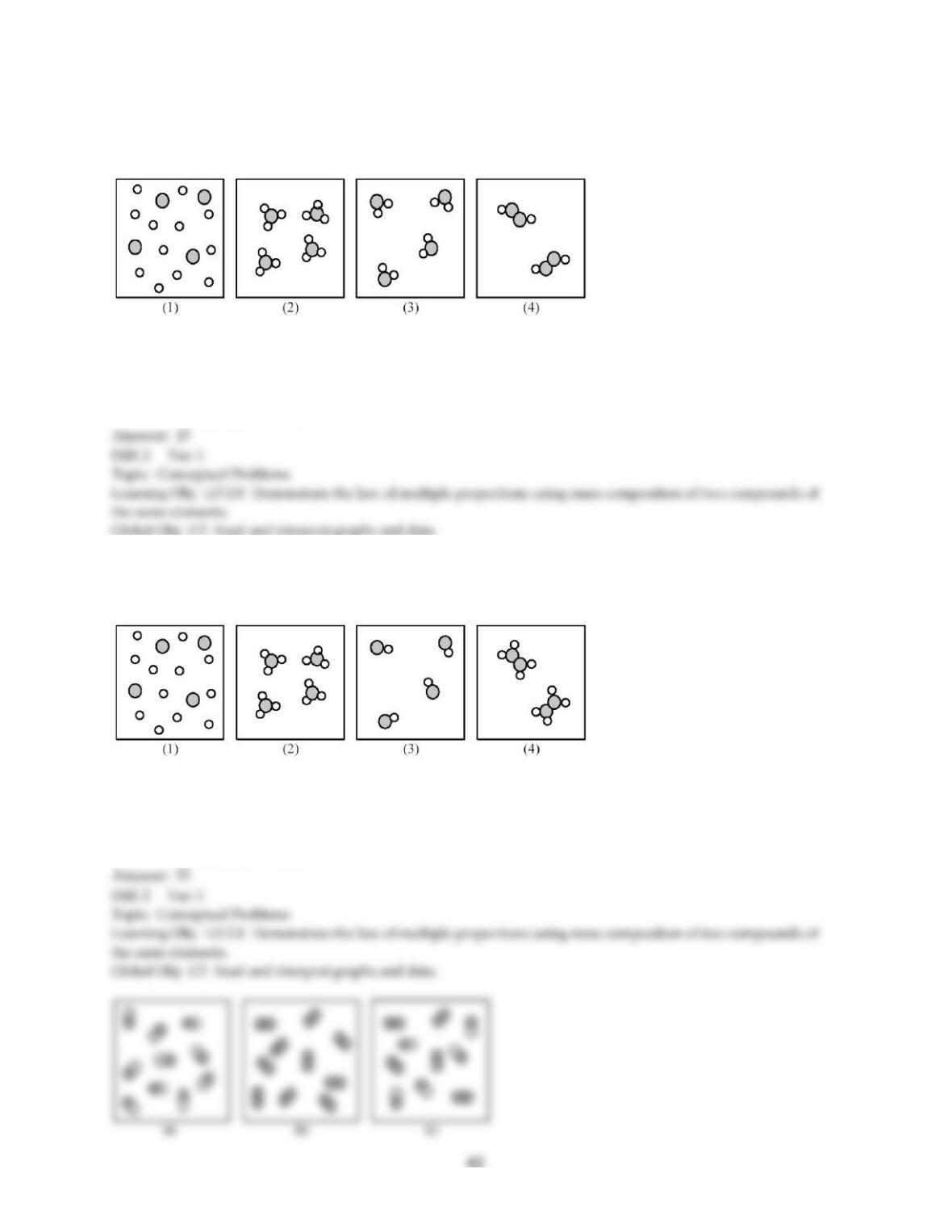
116) If shaded and unshaded spheres represent atoms of different elements, as shown in drawing (1),
which drawings (2)-(4) represent the law of multiple proportions?
A) only drawings (2) and (3)
B) only drawings (2) and (4)
C) only drawings (3) and (4)
D) drawings (2), (3), and (4)
117) If shaded and unshaded spheres represent atoms of different elements, as shown in drawing (1),
which combination of drawings (2)-(4) represent the law of multiple proportions?
A) only drawings (2) and (3)
B) only drawings (2) and (4)
C) only drawings (3) and (4)
D) drawings (2), (3), and (4)
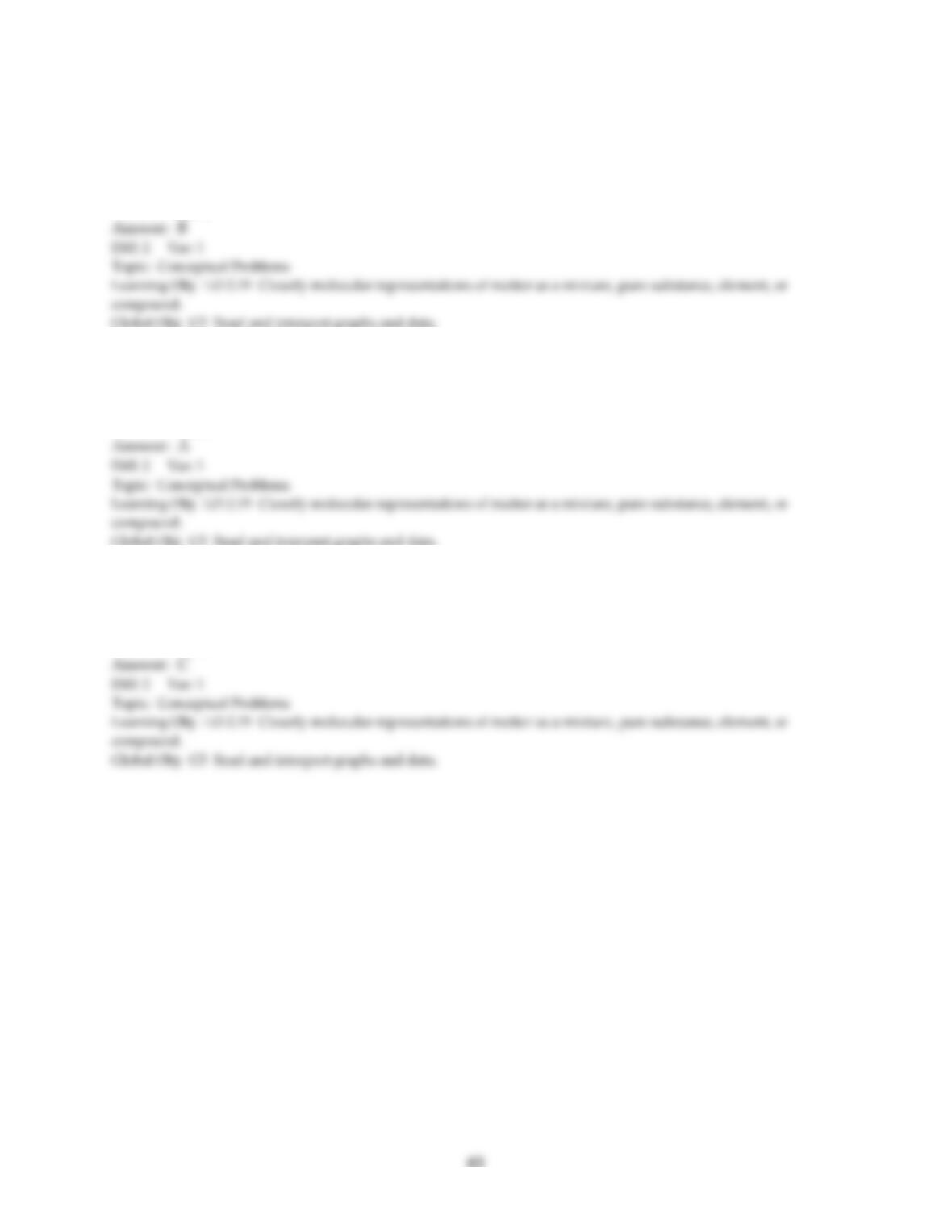
118) Which of the above drawings represents a pure element?
A) drawing (a)
B) drawing (b)
C) drawing (c)
119) Which of the above drawings represents a pure compound?
A) drawing (a)
B) drawing (b)
C) drawing (c)
120) Which of the above drawings represents a mixture?
A) drawing (a)
B) drawing (b)
C) drawing (c)
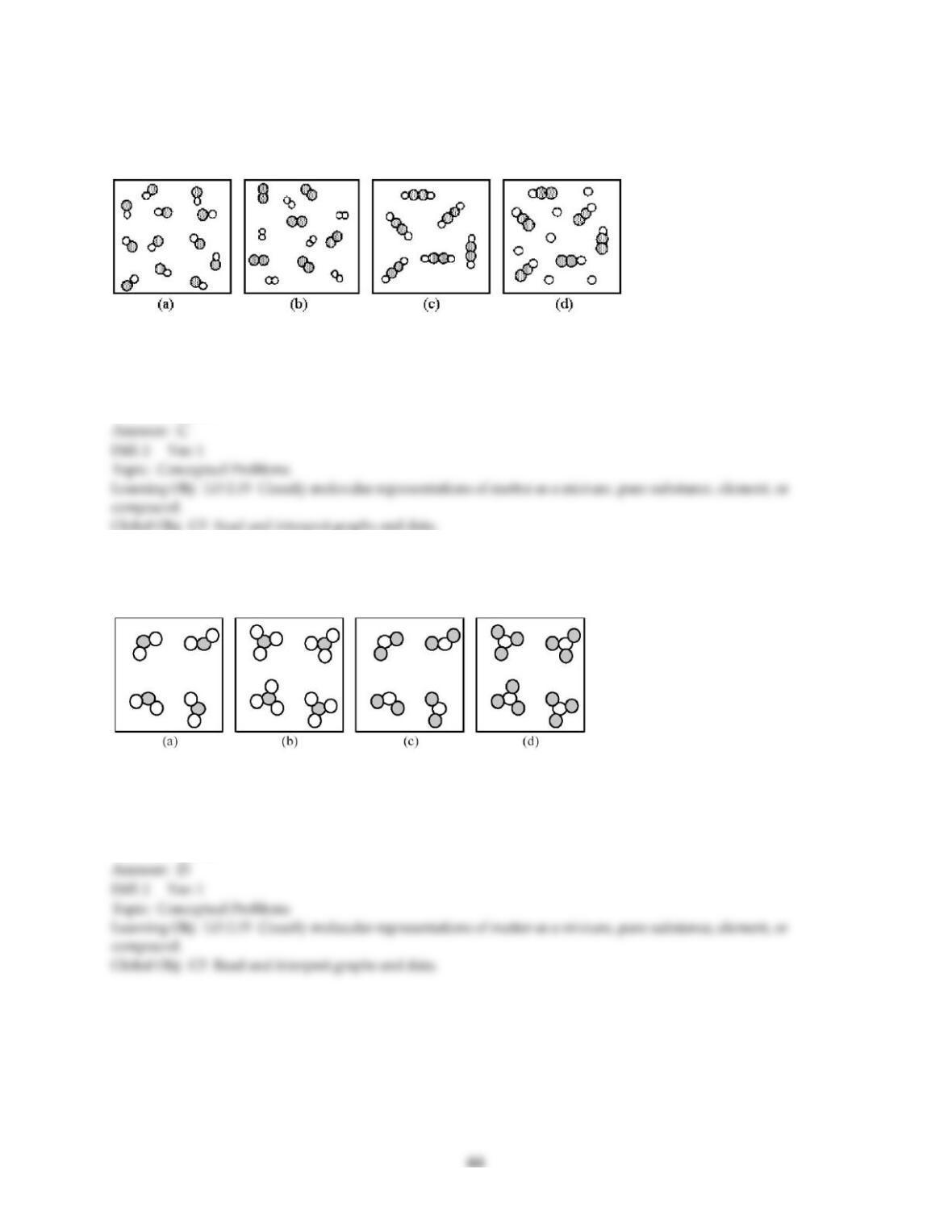
121) Which of the following drawings represents a collection of acetylene (C2H2) molecules? The shaded
spheres represent carbon atoms and the unshaded spheres represent hydrogen atoms.
A) drawing (a)
B) drawing (b)
C) drawing (c)
D) drawing (d)
122) If unshaded spheres represent sulfur atoms and shaded spheres represent oxygen atoms, which of
the following drawings depicts a collection of sulfur trioxide molecules?
A) drawing (a)
B) drawing (b)
C) drawing (c)
D) drawing (d)
45
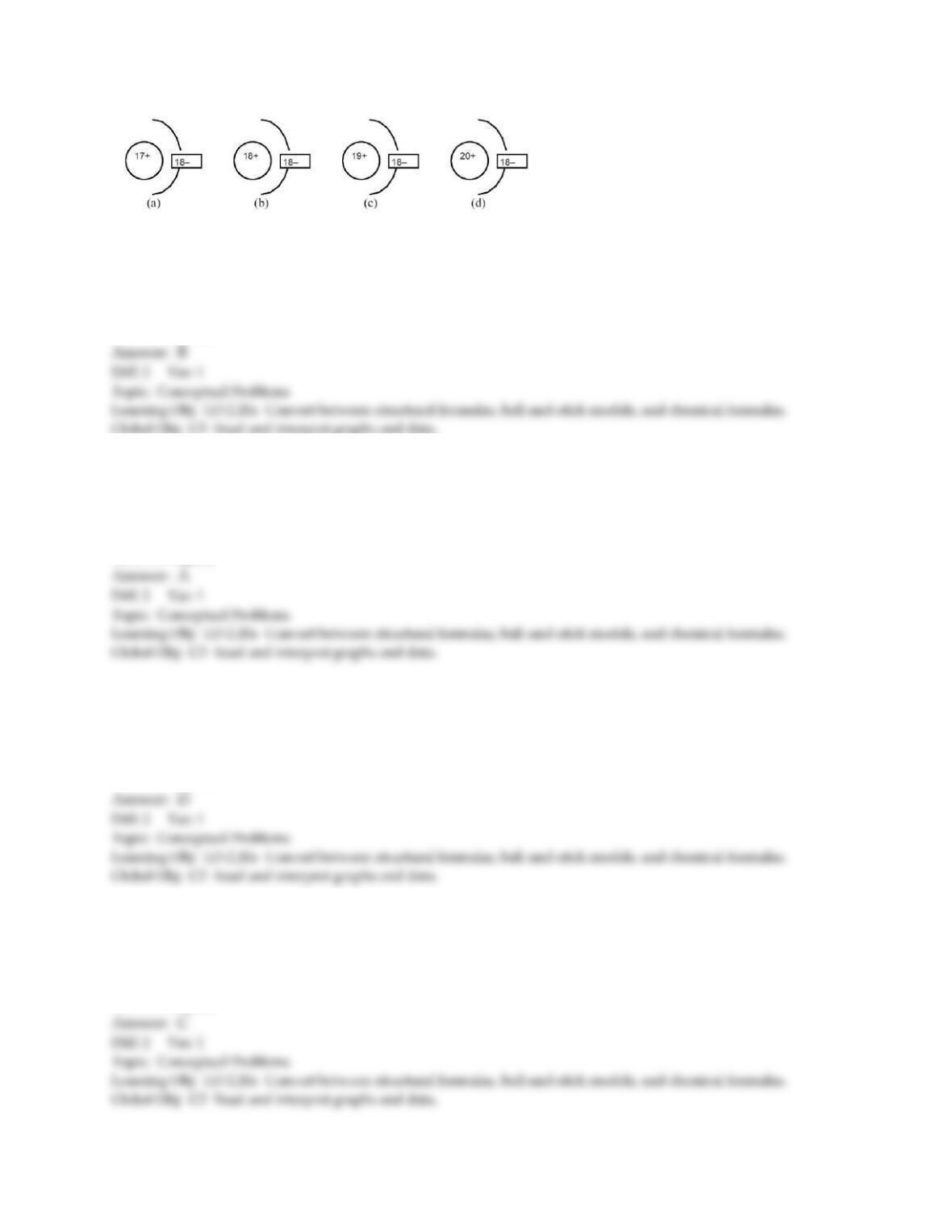
123) Which of the above drawings represents an Ar atom?
A) drawing (a)
B) drawing (b)
C) drawing (c)
D) drawing (d)
124) Which of the above drawings represents a Cl– ion?
A) drawing (a)
B) drawing (b)
C) drawing (c)
D) drawing (d)
125) Which of the above drawings represents a Ca2+ ion?
A) drawing (a)
B) drawing (b)
C) drawing (c)
D) drawing (d)
126) Which of the above drawings represents a K+ ion?
A) drawing (a)
B) drawing (b)
C) drawing (c)
D) drawing (d)
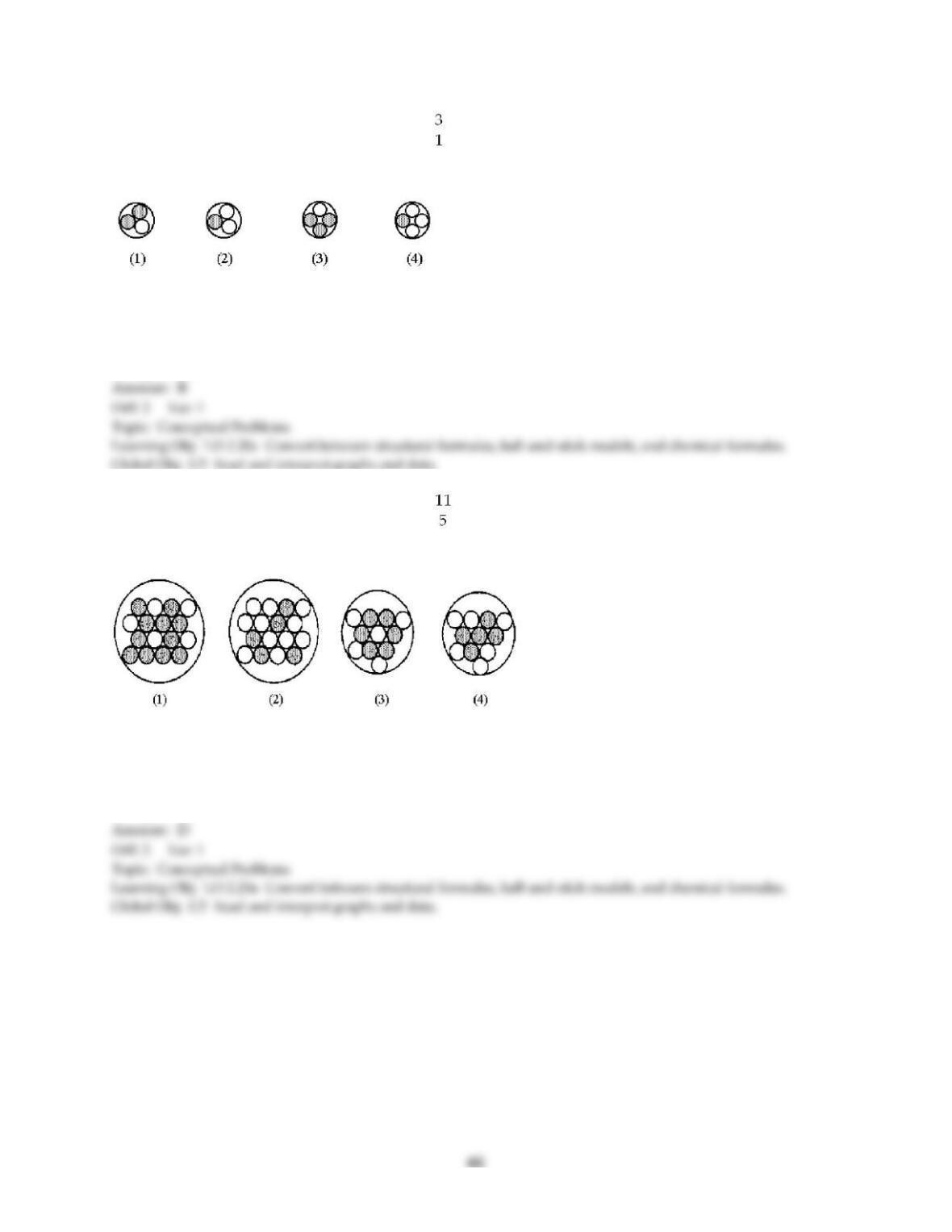
127) Which of the following figures represents H? Unshaded spheres represent neutrons and shaded
spheres represent protons.
A) figure (1)
B) figure (2)
C) figure (3)
D) figure (4)
128) Which of the following figures represents B? Unshaded spheres represent neutrons and shaded
spheres represent protons.
A) figure (1)
B) figure (2)
C) figure (3)
D) figure (4)
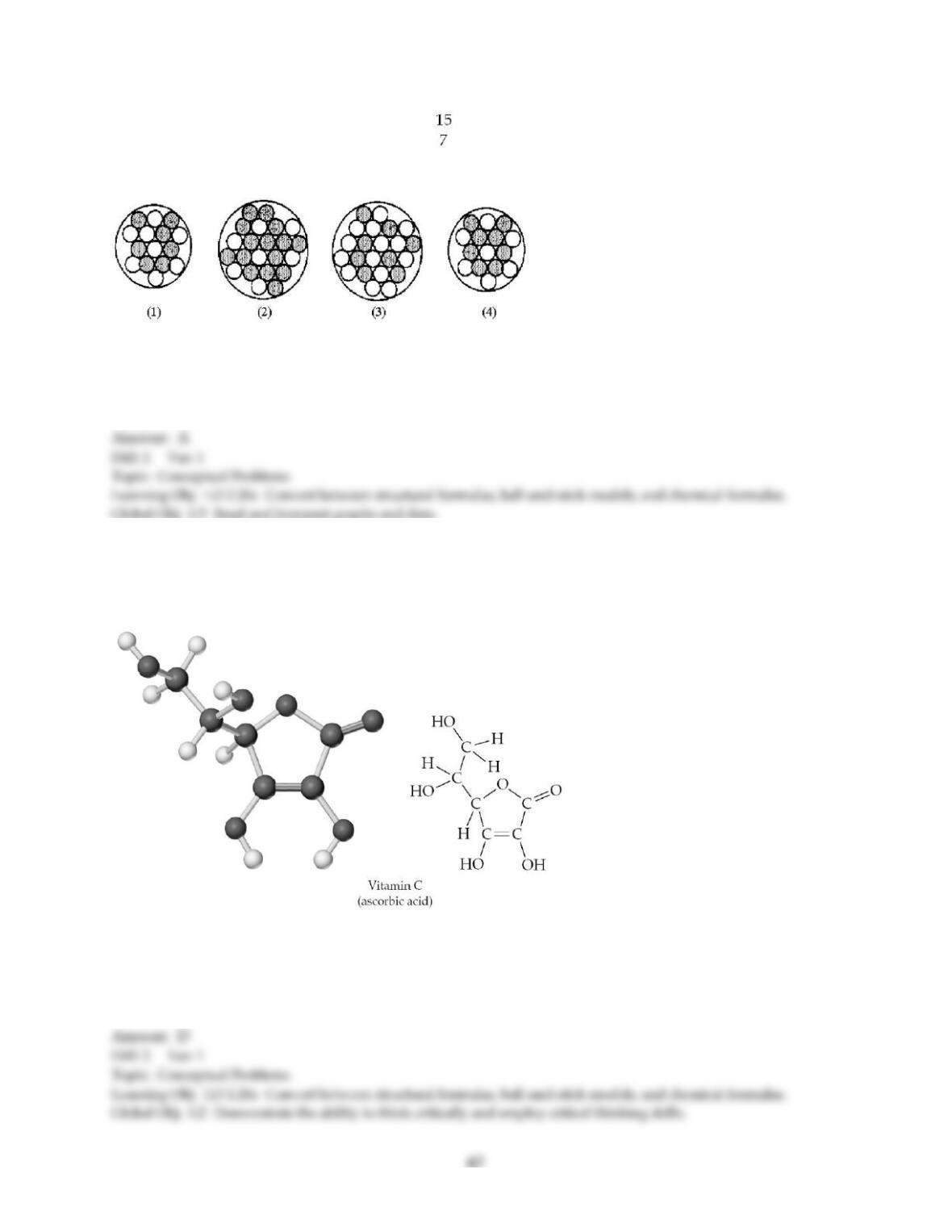
129) Which of the following figures represents N? Unshaded spheres represent neutrons and shaded
spheres represent protons.
A) figure (1)
B) figure (2)
C) figure (3)
D) figure (4)
130) Give the molecular formula corresponding to the following ball-and-stick molecular representation
of vitamin C (ascorbic acid) (gray = C, unshaded = H, black = O). In writing the formula, list the atoms in
alphabetical order.
A) CHO
B) C3H4O3
C) C6H4O6
D) C6H8O6
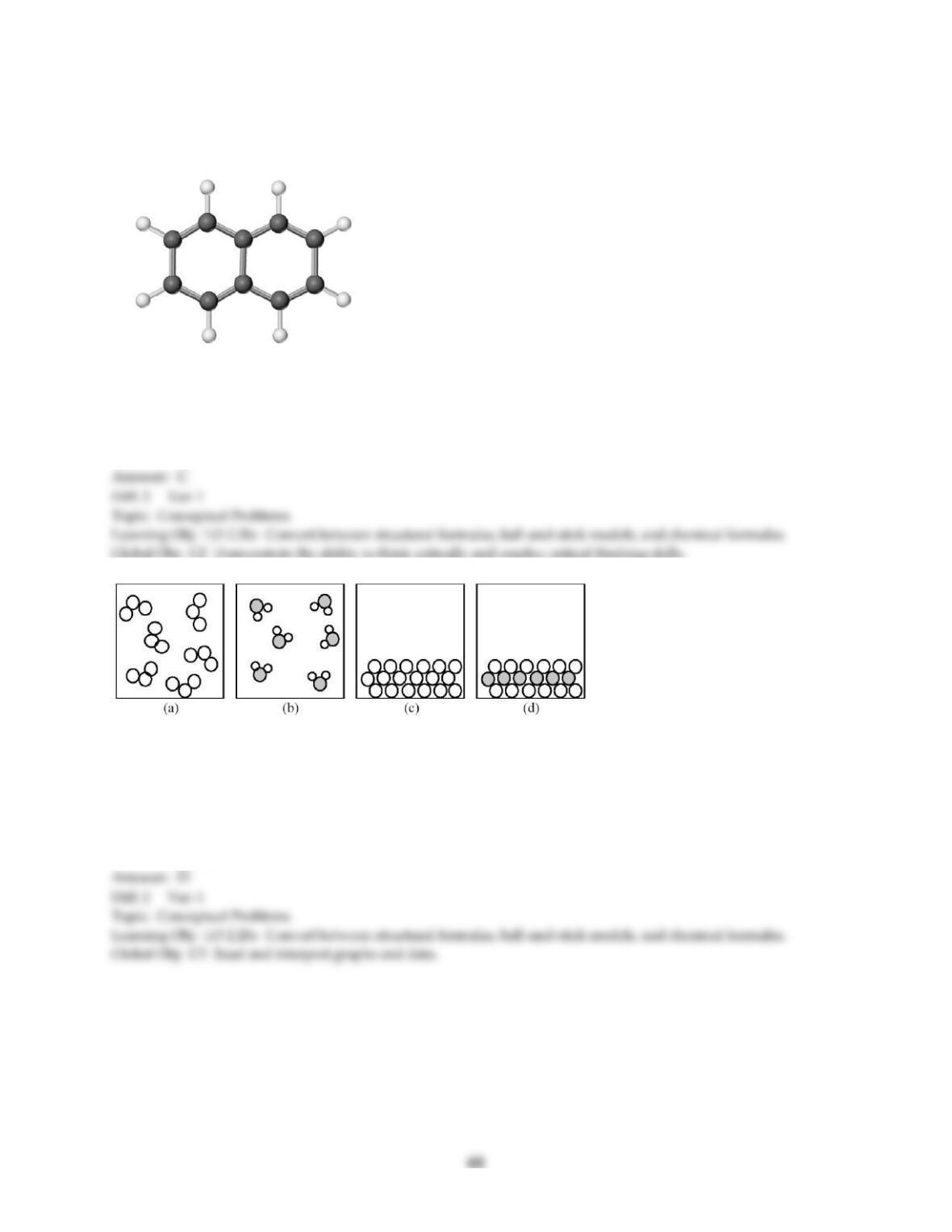
131) Give the molecular formula corresponding to the following ball-and-stick molecular representation
of naphthalene (gray = C, unshaded = H). In writing the formula, list the atoms in alphabetical order.
A) CH
B) C5H4
C) C10H8
D) C10H10
132) If shaded and unshaded spheres represent atoms of different elements, which of the above drawings
most likely represents an ionic compound at room temperature and a pressure of 1 atm?
A) drawing (a)
B) drawing (b)
C) drawing (c)
D) drawing (d)
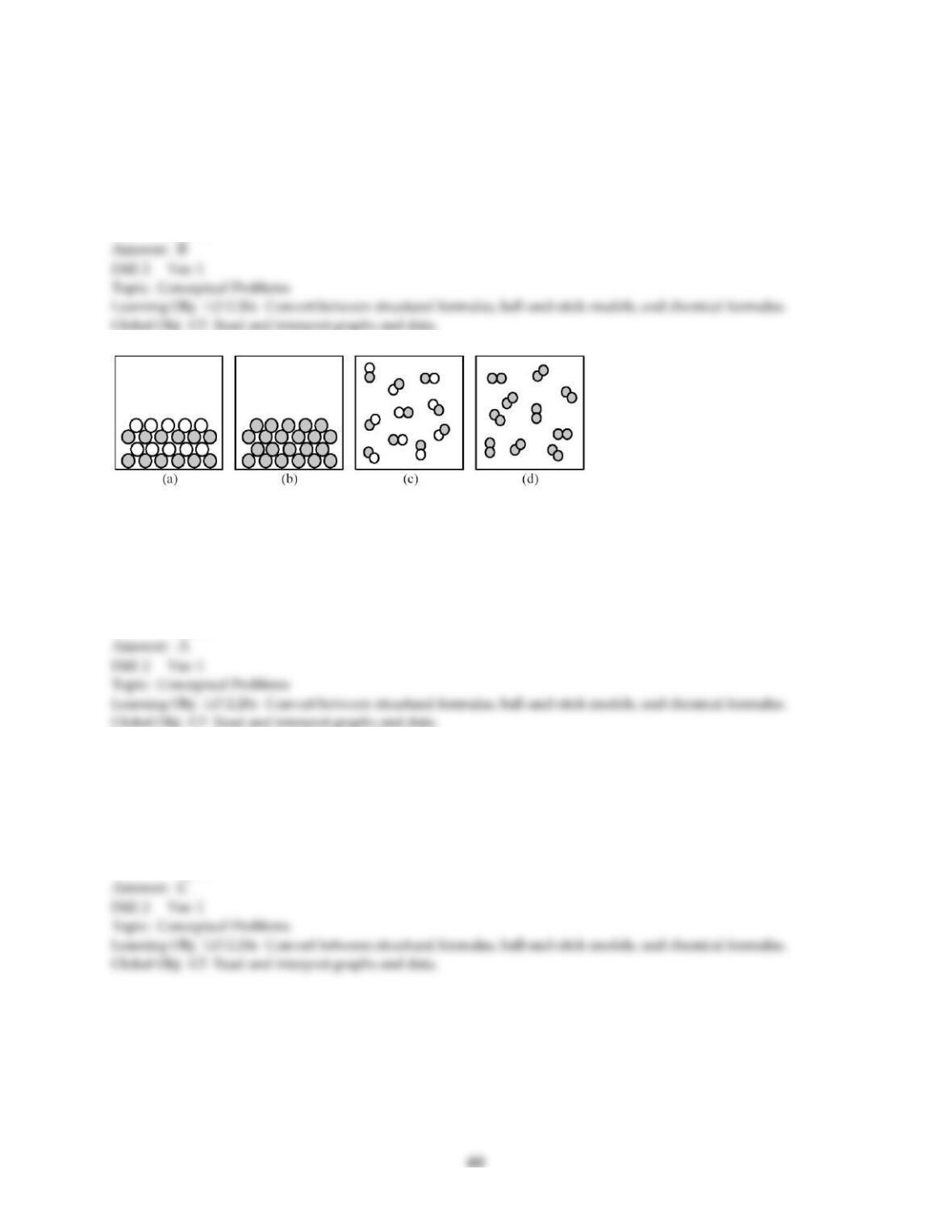
133) If shaded and unshaded spheres represent atoms of different elements, which of the above drawings
most likely represents a molecular compound at room temperature and a pressure of 1 atm?
A) drawing (a)
B) drawing (b)
C) drawing (c)
D) drawing (d)
134) If shaded and unshaded spheres represent atoms of different elements, which of the above drawings
most likely represents an ionic compound at room temperature and a pressure of 1 atm?
A) drawing (a)
B) drawing (b)
C) drawing (c)
D) drawing (d)
135) If shaded and unshaded spheres represent atoms of different elements, which of the above drawings
most likely represents a molecular compound at room temperature and a pressure of 1 atm?
A) drawing (a)
B) drawing (b)
C) drawing (c)
D) drawing (d)
2.2 Algorithmic Questions
1) What is the chemical symbol for thallium?
A) Ti
B) Tl
C) Tm
D) Th
2) What is the chemical symbol for arsenic?
A) Ac
B) Ar
C) As
D) At
3) What is the chemical symbol for niobium?
A) Au
B) Nb
C) Pb
D) Nn
4) What is the chemical symbol for platinum?
A) Pd
B) Pr
C) Pt
D) Au
5) Which element has the chemical symbol, Au?
A) antimony
B) americium
C) gold
D) lead
6) What is the chemical symbol for carbon?
A) Co
B) Cr
C) C
D) Ca
7) Which element has the chemical symbol, Pb?
A) tin
B) lead
C) mercury
D) potassium
8) Which element has the chemical symbol, N?
A) nickel
B) niobium
C) nitrogen
D) nobelium
9) Which of the following elements has chemical properties similar to oxygen?
A) neon
B) hydrogen
C) nitrogen
D) tellerium
10) ________ is used in lights and signs.
A) Neon
B) Helium
C) Iodine
D) Silicon
11) ________ does not combine with any other element.
A) Chlorine
B) Nitrogen
C) Helium
D) Krypton
12) Identify a chemical property.
A) tarnishing
B) boiling point
C) taste
D) solubility
13) ________ is a nonmetal that is a solid at room temperature.
A) Calcium
B) Selenium
C) Bromine
D) Copper
14) Rubidium belongs to the ________ group of the periodic table.
A) alkali metal
B) alkaline earth metal
C) halogen
D) noble gas
15) Chlorine belongs to the ________ group of the periodic table.
A) alkali metal
B) alkaline earth metal
C) halogen
D) noble gas
16) Radon belongs to the ________ group of the periodic table.
A) alkali metal
B) alkaline earth metal
C) halogen
D) noble gas
17) Calcium belongs to the ________ group of the periodic table.
A) alkali metal
B) alkaline earth metal
C) halogen
D) noble gas
18) Which of the following elements has chemical properties similar to oxygen?
A) fluorine
B) hydrogen
C) nitrogen
D) sulfur
19) Which of the following elements is a gas at room temperature?
A) bromine
B) iron
C) krypton
D) sodium
20) Which of the following elements is not a solid at room temperature?
A) Ag
B) Al
C) He
D) Fe
21) Which of the following elements is classified as a semimetal?
A) calcium
B) silicon
C) fluorine
D) uranium
22) Which of the following elements is a good conductor of heat and electricity?
A) carbon
B) chlorine
C) neon
D) zinc
23) Which one of the following elements is a poor conductor of heat and electricity?
A) copper
B) phosphorus
C) iron
D) lead
24) All of the following elements are nonmetals except
A) beryllium.
B) carbon.
C) hydrogen.
D) oxygen.
25) Which of the following underlined items is not an intensive property?
A) the amount of gold.
B) the color of copper hydroxide
C) the density of argon
D) the melting point of iron metal
26) Which of the following underlined items is not an extensive property?
A) the color of a cobalt compound
B) the diameter of a gold nugget
C) the mass of a diamond
D) the volume of a glucose solution
27) Which group 1A element is not a metal?
A) H
B) K
C) Cs
D) Be
28) Which of the following elements is a liquid at room temperature?
A) neon
B) helium
C) mercury
D) lithium
29) Which of the following elements is not a solid at room temperature?
A) Zn
B) Hg
C) N
D) C
30) Which of the following elements is classified as a semimetal?
A) gold
B) astatine
C) osmium
D) berkelium
31) Which of the following elements is a good conductor of heat and electricity?
A) silicon
B) iodine
C) radon
D) lead
32) Which one of the following elements is a poor conductor of heat and electricity?
A) nickel
B) sulfur
C) aluminum
D) lead
33) All of the following elements are nonmetals except
A) copper.
B) nitrogen.
C) krypton.
D) phosphorus.
34) Methane and oxygen react to form carbon dioxide and water. What mass of water is formed if 6.4 g of
methane reacts with 25.6 g of oxygen to produce 17.6 g of carbon dioxide?
A) 14.4 g
B) 17.6 g
C) 29.6 g
D) 32.0 g
35) Sodium metal and water react to form hydrogen and sodium hydroxide. If 11.96 g of sodium react
with water to form 0.52 g of hydrogen and 20.80 g of sodium hydroxide, what mass of water was
involved in the reaction?
A) 9.36 g
B) 11.96 g
C) 20.28 g
D) 21.32 g
36) A sample of pure lithium chloride contains 16% lithium by mass. What is the % lithium by mass in a
sample of pure lithium carbonate that has twice the mass of the first sample?
A) 8.20%
B) 16.4%
C) 32.8%
D) 65.6%
37) A sample of pure calcium fluoride with a mass of 15.0 g contains 7.70 g of calcium. How much
calcium is contained in 35.0 g of calcium fluoride?
A) 1.99 g
B) 7.70 g
C) 15.0 g
D) 18.0 g
38) Mg can react with HCl to produce the white solid MgCl2 and H2 gas. A student mixes 1.99 g of Mg
with 5.98 g of HCl. If the mass of the white solid is 7.79 g, then what is the mass of H2 produced?
A) 0.0 g
B) 0.18 g
C) 2.0 g
D) 15.76 g
39) Elements A and Q form two compounds, AQ and A2Q3. The mass ratio (mass Q)/(mass A) for AQ is
0.286. What is the mass ratio (mass Q)/(mass A) for A2Q3?
A) 0.191
B) 0.429
C) 2.33
D) 5.24
40) A proton is approximately
A) 600 times larger than an electron.
B) 2000 times larger than an electron.
C) 700 times smaller than an electron.
D) 3000 times smaller than an electron.
41) Which are isotopes? An atom that has an atomic number of 12 and a mass number of 26 is an isotope
of an atom that has
A) an atomic number of 13 and a mass number of 26.
B) an atomic number of 12 and a mass number of 24.
C) 12 neutrons and 14 protons.
D) 12 protons and 14 neutrons.
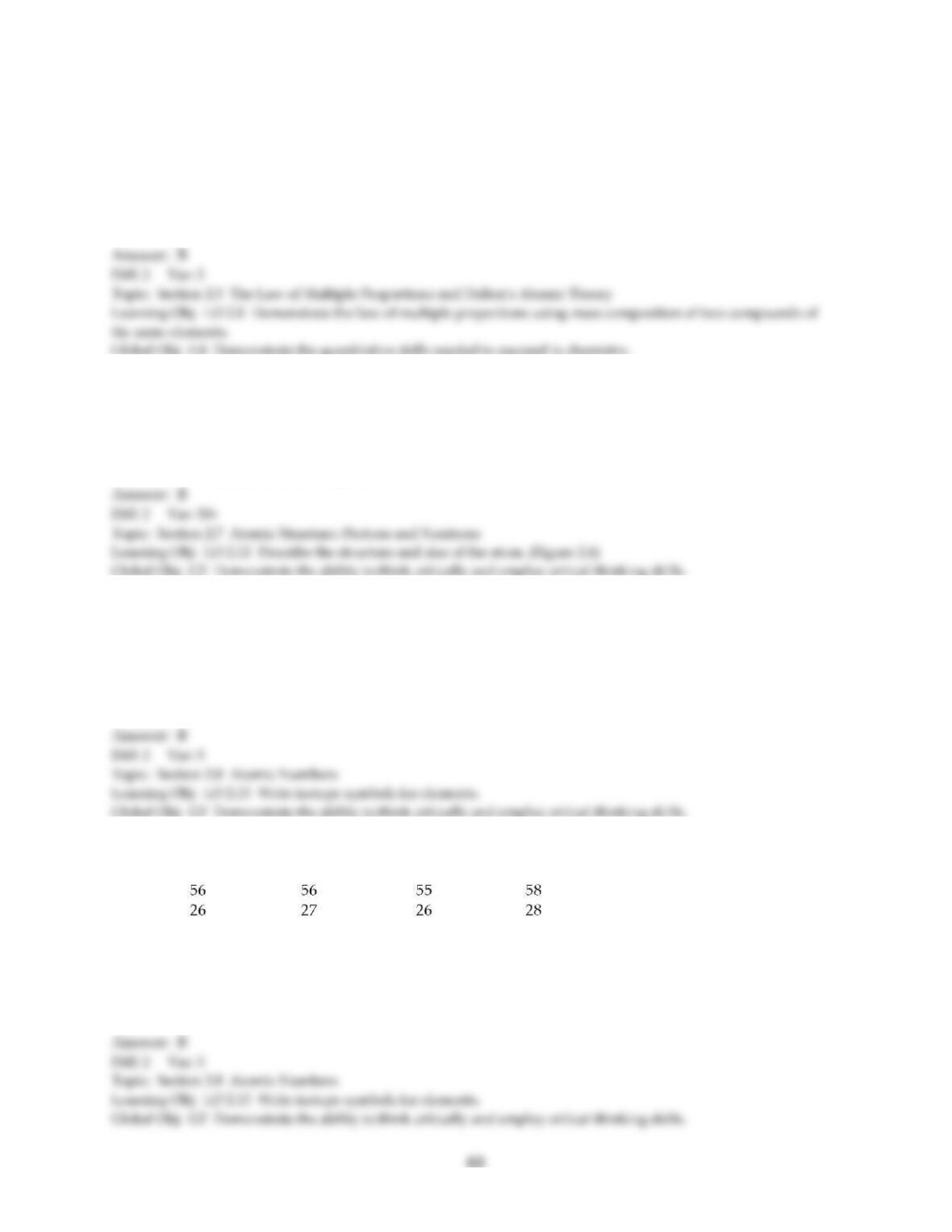
42) Which of the following represent isotopes?
A: [ ] B: [ ] C: [ ] D: [ ]
A) A and B
B) A and C
C) A and D
D) C and D