33) In a two-good, two country world, if one country has an absolute advantage in the production
of both goods, it cannot benefit by trading with the other country.
34) For a person to have a comparative advantage in producing a product, she must be able to
produce that product at a lower opportunity cost than her competitors.
35) It is possible to have a comparative advantage in producing a good or service without having
an absolute advantage.
36) What is comparative advantage? What is absolute advantage?
37) Is it possible for a firm to have an absolute advantage in producing something without having
a comparative advantage? Why or why not?
Table 2-5
Digital Camera
Wheat (bushels)
China
100 hours
5 hours
South Korea
90 hours
3 hours
38) Refer to Table 2-5. This table shows the number of labor hours required to produce a digital
cameras and a bushel of wheat in China and South Korea.
a. Which country has an absolute advantage in the production of digital cameras?
b. Which country has an absolute advantage in the production of wheat?
c. What is China’s opportunity cost of producing one digital camera?
d. What is South Korea’s opportunity cost of producing one digital camera?
e. What is China’s opportunity cost of producing one pound of wheat?
f. What is South Korea’s opportunity cost of producing one pound of what?
g. If each country specializes in the production of the product in which it has a comparative
advantage, who should produce digital cameras?
h. If each country specializes in the production of the product in which it has a comparative
advantage, who should produce wheat?

44
39) Refer to Table 2-5. This table shows the number of labor hours required to produce a digital
camera and a bushel of wheat in China and South Korea.
a. If each country has a total of 9,000 labor hours to devote to the production of the two
goods, draw the production possibilities frontier for each country. Put “Digital Camera” on the
horizontal axis and “Wheat” on the vertical axis. Be sure to identify the intercept values on your
graphs.
b. Suppose each country allocates 60% its labor hours to wheat production and 40% to the
production of digital cameras. Complete Table 2-6 below to show each country’s output of the
two products.
Table 2-6: Production and Consumption with no Trade
Digital Camera
Output
Wheat
Output
(bushels)
China
South Korea
Total
c. If the two countries do not trade and consume whatever they produce, identify the current
production and consumption point for each country on their respective production possibilities
frontiers. Label China’s consumption point “C” and South Korea’s consumption point, “K.”
d. Suppose the two countries specialize and trade. Who should produce digital cameras and
who should produce wheat? Explain your answer.
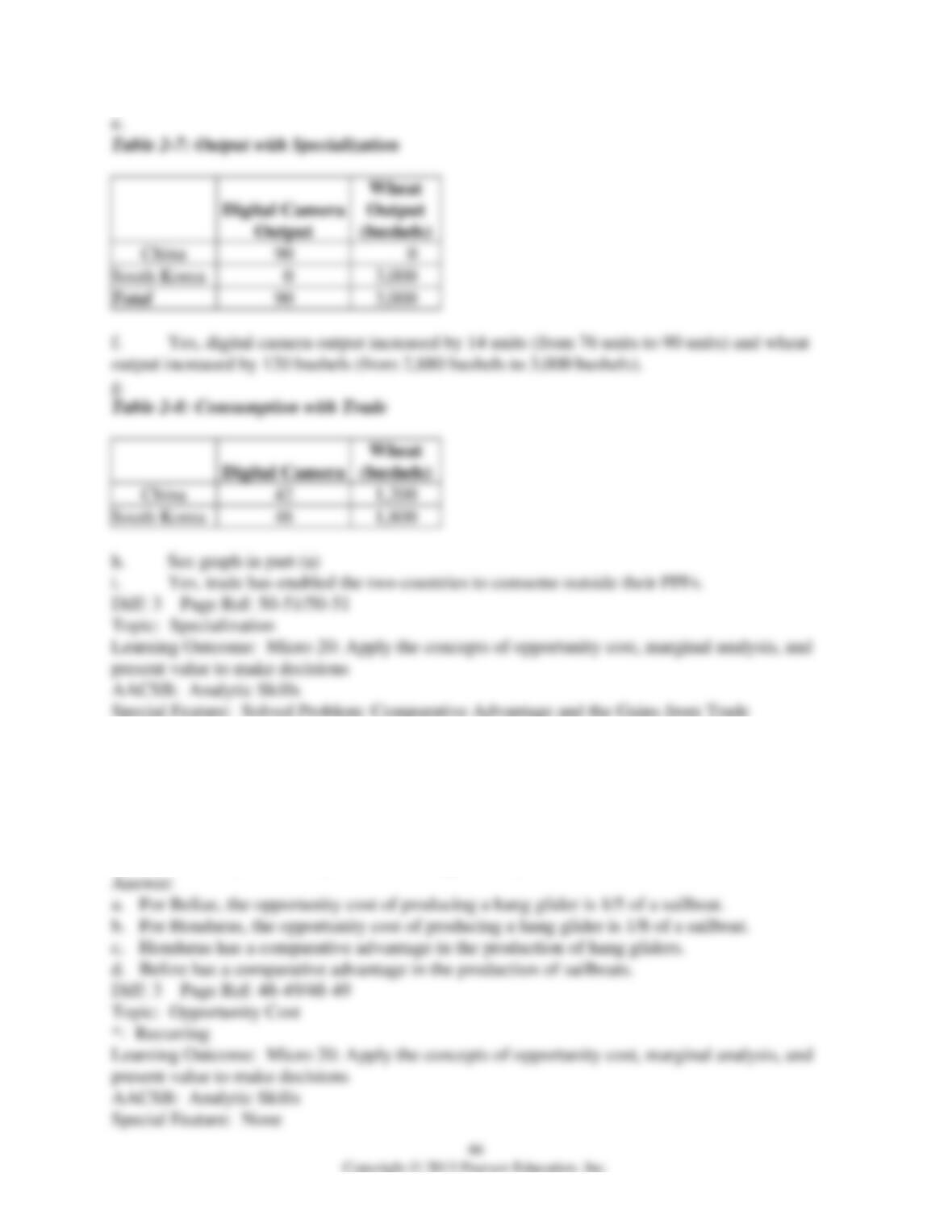
e. Complete Table 2-7 below to show each country’s output with specialization.
Table 2-7: Output with Specialization
Digital Camera
Output
Wheat
Output
(bushels)
China
South Korea
Total
f. Did specialization increase the combined output for the two countries without any
increase in resources? If so, by how much?
g. Suppose China and South Korea agree to trade so that in exchange for 1,200 bushels of
wheat, the exporter of wheat receives 48 digital cameras. Complete Table 2-8 below to show
each country’s consumption bundle after trade.
Table 2-8: Consumption with Trade
Digital Camera
Wheat
(bushels)
China
South Korea
h. Show the consumption points after trade on each country’s production possibilities frontier.
Label these points “B” for China and “J” for South Korea.
i. Has trade made the two countries better off? Explain your answer.
(bushels)
South Korea
40) Suppose in Belize, the opportunity cost of producing a sailboat is 5 hang gliders. In
Honduras, the opportunity cost of producing a sailboat is 8 hang gliders.
a. What is the opportunity cost of producing a hang glider for Belize?
b. What is the opportunity cost of producing a hang glider for Honduras?
c. Which country has a comparative advantage in the production of hang gliders?
d. Which country has a comparative advantage in the production of sailboats?
2.3 The Market System
1) Which of the following is not a factor of production?
A) an acre of farmland
B) a drill press in a machine shop
C) the manager of the local tire shop
D) $1,000 in cash
2) An example of a factor of production is
A) stock issued by Dell.
B) the computers exported by Dell.
C) a computer produced by an Dell.
D) a worker hired by Dell.
3) If a commercial dairy farm wants to raise funds to purchase feeding troughs, it does so in the
A) output market.
B) product market.
C) factor market.
D) dairy products market.
4) The natural resources used in production are made available in the
A) goods and services market.
B) product market.
C) government market.
D) factor market.
5) When you purchase a new pair of jeans you do so in the
A) factor market.
B) input market.
C) product market.
D) resource market.
6) The resource income earned by those who supply ________ is called wages.
A) labor
B) capital
C) natural resources
D) entrepreneurship
7) Which of the following statements about an entrepreneur is false?
A) organizes the other factors of production into a working unit
B) develops the vision for the firm and funds the producing unit
C) sells his entrepreneurial services in the output market
D) risks the personal funds provided
8) The ________ demonstrates the roles played by households and firms in the market system.
A) production possibilities frontier
B) circular flow model
C) theory of comparative advantage
D) business cycle
9) Households
A) have no influence on the circular flow in a market economy.
B) purchase resources in the factor market.
C) sell goods in the product market.
D) sell resources in the factor market.
10) Households ________ final goods and services in the ________ market.
A) purchase; factor
B) purchase; product
C) sell; factor
D) sell; product
11) In the circular flow model, producers
A) sell goods and services in the input market.
B) and households spend earnings from resource sales on goods and services in the factor
market.
C) hire resources sold by households in the factor market.
D) spend earnings from resource sales on goods and services in the product market.
12) Which of the following is a flow in the circular flow model?
A) the flow of goods and services from households to firms
B) the flow of profit and the flow of revenue
C) the flow of income earned by firms and the flow of expenditures earned by households
D) the flow of revenue received by firms and the flow of payments to resource owners
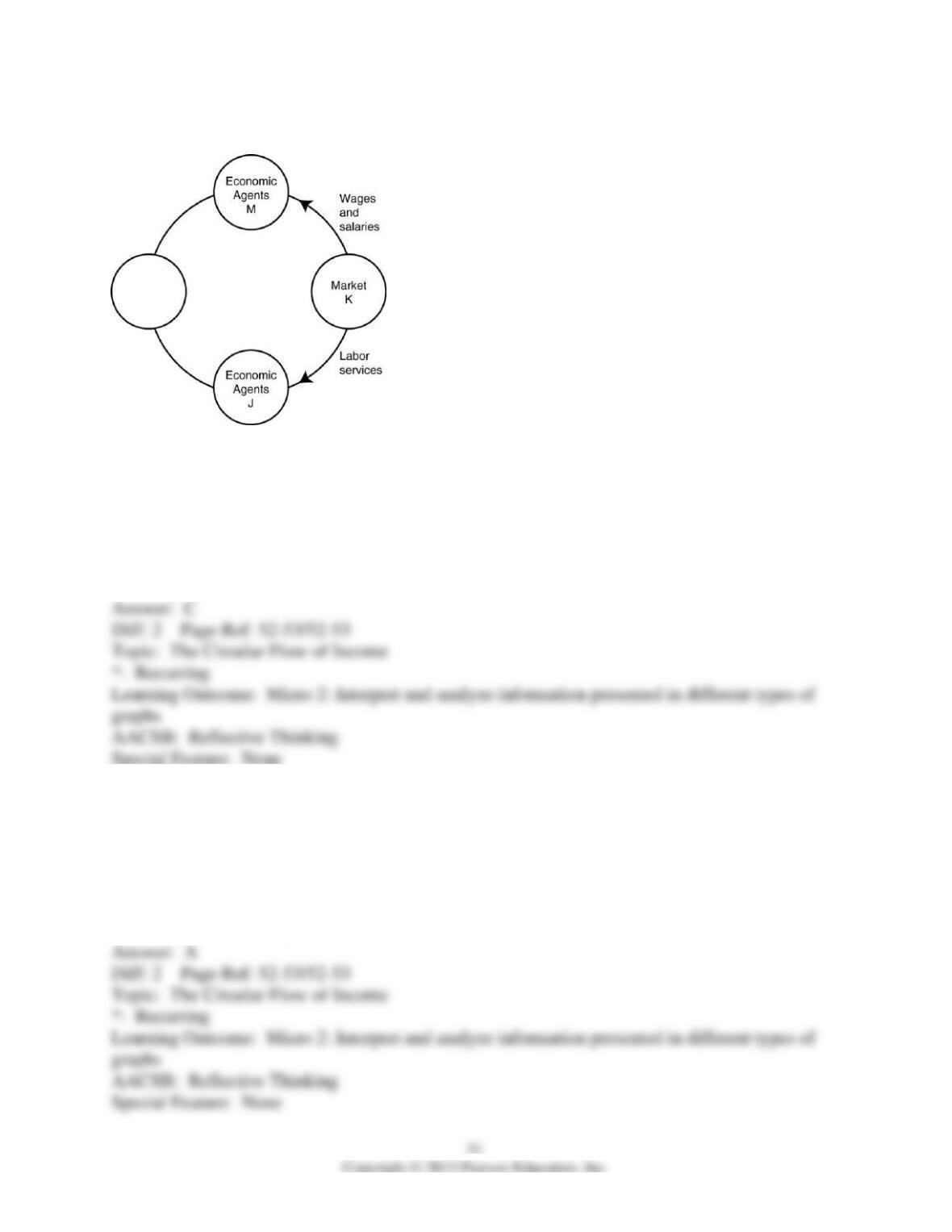
Figure 2-8
13) Refer to Figure 2-8. One segment of the circular flow diagram in the figure shows the flow
of labor services from market K to economic agents J. What is market K and who are economic
agents J?
A) K = factor markets; J = households
B) K = product markets; J = households
C) K = factor markets; J = firms
D) K = product markets; J = firms
14) Refer to Figure 2-8. One segment of the circular flow diagram in the figure shows the flow
of wages and salaries from market K to economic agents M. What is market K and who are
economic agents M?
A) K = factor markets; M = households
B) K = product markets; M = households
C) K = factor markets; M = firms
D) K = product markets; M = firms
15) Which of the following are separate flows in the circular flow model?
A) the flow of goods and the flow of services
B) the flow of costs and the flow of revenue
C) the flow of income earned from the sale of resources and the flow of expenditures on goods
and services.
D) the flow of income received by households and the flow of tax revenues paid by households
16) Which of the following statements about a simple circular flow model is false?
A) Producers are buyers in the factor market and sellers in the product market.
B) Households are neither buyers nor sellers in the input market.
C) Producers are buyers in the factor market.
D) Households are sellers in the product market.