15
11) Identify a cation.
A) An atom that has lost an electron.
B) An atom that has gained an electron.
C) An atom that has lost a proton and a neutron.
D) An atom that has gained a neutron.
12) Identify an anion.
A) An atom that has lost an electron.
B) An atom that has gained an electron.
C) An atom that has lost a neutron and a proton.
D) An atom that has gained a neutron.
13) How many electrons does the Al3+ ion possess?
A) 16
B) 10
C) 6
D) 0
E) 13
14) How many protons does the Br– ion possess?
A) 34
B) 36
C) 6
D) 8
E) 35
15) What is the chemical symbol for titanium?
A) Th
B) Ti
C) Tl
D) Tm
16) What is the chemical symbol for mercury?
A) Ag
B) Au
C) Hg
D) Pb
17) What is the chemical symbol for copper?
A) Co
B) Cr
C) Cu
D) C
18) Which element has the chemical symbol, Ru?
A) rubidium
B) ruthenium
C) rutherfordium
D) rhodium
19) Which element has the chemical symbol, S?
A) selenium
B) silicon
C) sulfur
D) scandium
20) Which are isotopes? An atom that has an atomic number of 20 and a mass number of 42 is an
isotope of an atom that has
A) an atomic number of 21 and a mass number of 42.
B) an atomic number of 20 and a mass number of 40.
C) 22 neutrons and 20 protons.
D) 22 protons and 20 neutrons.
21) Which of the following represent isotopes?
A: X B: X C: X D: X
A) A and B
B) A and C
C) A and D
D) C and D
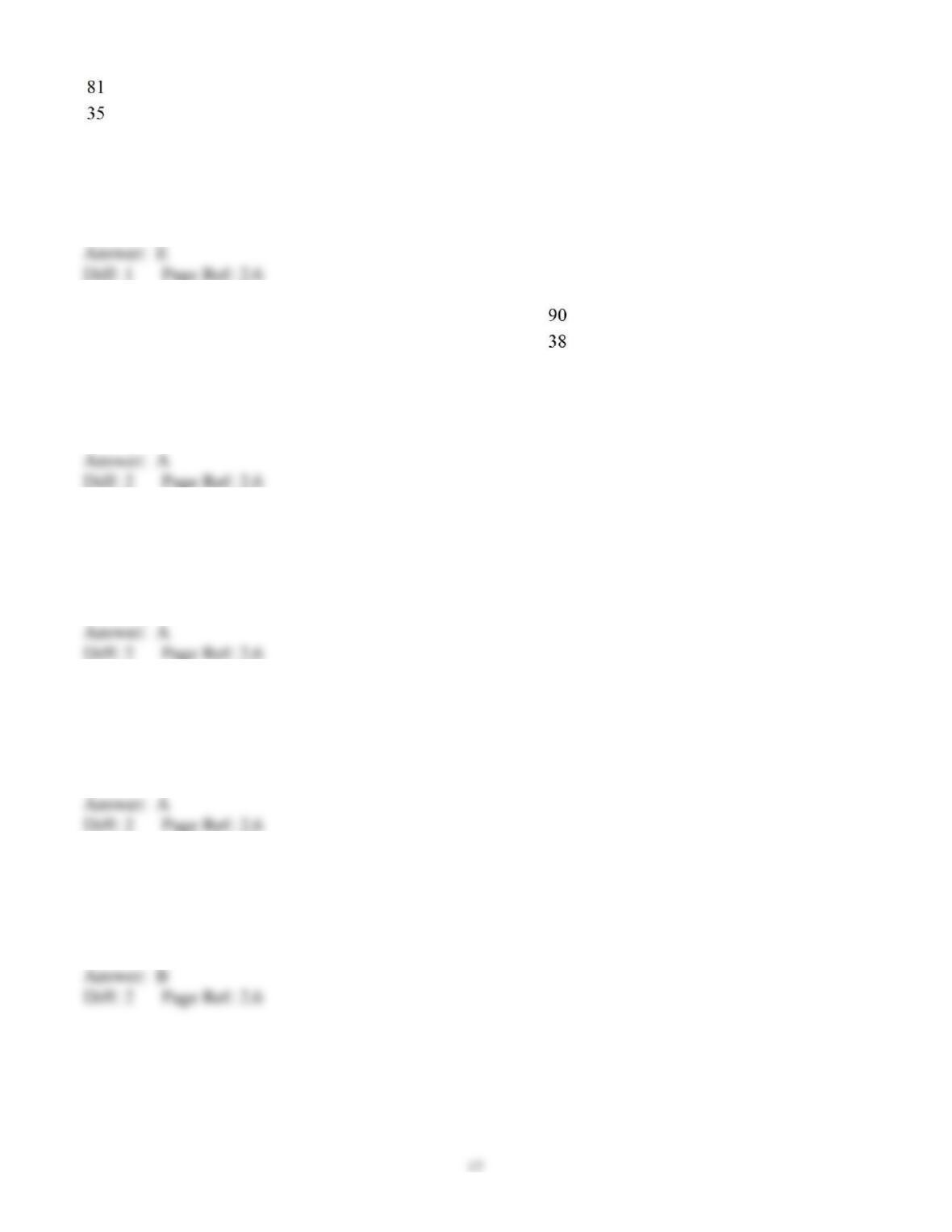
22) What does “X” represent in the following symbol?
X
A) nickel
B) krypton
C) mercury
D) thallium
E) bromine
23) How many protons (p) and neutrons (n) are in an atom of Sr?
A) 38 p, 52 n
B) 38 p, 90 n
C) 52 p, 38 n
D) 90 p, 38 n
24) How many protons (p) and neutrons (n) are in an atom of barium-130?
A) 56 p, 74 n
B) 56 p, 130 n
C) 74 p, 56 n
D) 130 p, 56 n
25) What is the element symbol for an atom that has 5 protons and 6 neutrons?
A) B
B) C
C) H
D) Na
26) How many electrons are in a neutral atom of bromine-81?
A) 1
B) 35
C) 36
D) 81
18
27) Identify the chemical symbol of element Q in Q.
A) Br
B) Hg
C) Pd
D) Se
28) An atom of 118Xe contains ________ neutrons.
A) 54
B) 172
C) 64
D) 110
E) 118
29) The mass number of an atom of 128Xe is ________.
A) 54
B) 182
C) 74
D) 128
E) 120
30) What is the identity of element Q if the ion Q2+ contains 10 electrons?
A) C
B) O
C) Ne
D) Mg
31) Give the number of neutrons in Al+3.
A) 10
B) 16
C) 17
D) 13
E) 14
32) Give the number of electrons in P-3.
A) 18
B) 12
C) 19
D) 15
E) 16
33) Give the number of protons in Na+1.
A) 10
B) 13
C) 9
D) 11
E) 12
34) How many electrons are in the ion, Cu2+?
A) 27
B) 29
C) 31
35) How many electrons are in the ion, P3-?
A) 12
B) 18
C) 28
D) 34
36) In which of the following sets do all species have the same number of electrons?
A) F–, Ne, Mg2+
B) Ge, Se2-, Br–
C) K+, Rb+, Cs+
D) Br, Br–, Br+
37) In which of the following sets do all species have the same number of protons?
A) F–, Ne, Mg2+
B) Ge, Se2-, Br–
C) K+, Rb+, Cs+
D) Br, Br–, Br+
38) Predict the charge that the ion formed from fluorine would have.
A) 1-
B) 2+
C) 1+
D) 4+
E) 2-
39) Predict the charge of the most stable ion of bromine.
A) 2+
B) 1+
C) 3+
D) 1-
E) 2-
40) Predict the charge of the most stable ion of potassium.
A) 3+
B) 1-
C) 2+
D) 2-
E) 1+
41) Which of the following elements is a metal?
A) As
B) S
C) Br
D) Fe
E) Kr
42) Which of the following elements is a metalloid?
A) As
B) S
C) Br
D) Fe
E) Kr
43) Which of the following elements is a noble gas?
A) As
B) S
C) Br
D) Fe
E) Kr
44) Which of the following elements is a halogen?
A) As
B) S
C) Br
D) Fe
E) Kr
45) Which of the following elements is a nonmetal?
A) Ce
B) N
C) Br
D) K
E) Be
46) Which of the following elements is a alkali metal?
A) Ce
B) N
C) Br
D) K
E) Be
22
47) Which of the following elements is an alkali earth metal?
A) Ce
B) N
C) Br
D) K
E) Be
48) Which of the following elements is a transition metal?
A) Ce
B) N
C) Br
D) K
E) Be
49) Cesium belongs to the ________ group of the periodic table.
A) alkali metal
B) alkaline earth metal
C) halogen
D) noble gas
50) Iodine belongs to the ________ group of the periodic table.
A) alkali metal
B) alkaline earth metal
C) halogen
D) noble gas
51) Argon belongs to the ________ group of the periodic table.
A) alkali metal
B) alkaline earth metal
C) halogen
D) noble gas
52) Barium belongs to the ________ group of the periodic table.
A) alkali metal
B) alkaline earth metal
C) halogen
D) noble gas
53) Which of the following elements has chemical properties similar to tellurium?
A) fluorine
B) hydrogen
C) nitrogen
D) sulfur
54) Which of the following elements is a gas at room temperature?
A) bromine
B) carbon
C) helium
D) sodium
55) Which of the following elements is not a solid at room temperature?
A) Ag
B) Al
C) Xe
D) Fe
56) Which of the following elements is classified as a semimetal?
A) calcium
B) germanium
C) fluorine
D) uranium
57) Which of the following elements is a good conductor of heat and electricity?
A) carbon
B) iodine
C) neon
D) aluminum
58) Which one of the following elements is a poor conductor of heat and electricity?
A) copper
B) fluorine
C) iron
D) lead
59) All of the following elements are nonmetals EXCEPT
A) arsenic.
B) nitrogen.
C) helium.
D) oxygen.
60) The atomic mass for potassium is ________.
A) 30.97
B) 15
C) 39.10
D) 19
61) The atomic number for potassium is ________.
A) 30.97
B) 15
C) 39.10
D) 19
62) Which of the following contains the MOST atoms? You shouldn’t need to do a calculation here.
A) 10.0 g Mg
B) 10.0 g Ne
C) 10.0 g Ca
D) 10.0 g Rb
E) 10.0 g Cs
63) Which of the following contains the FEWEST atoms? You shouldn’t need to do a calculation here.
A) 10.0 g Na
B) 10.0 g Li
C) 10.0 g Ar
D) 10.0 g Kr
E) 10.0 g Cs
64) How many Fe atoms are contained in 787 g of Fe?
A) 5.90 × 1025 Fe atoms
B) 7.09 × 10²¹ Fe atoms
C) 8.49 × 1024 Fe atoms
D) 4.27 × 10²² Fe atoms
E) 4.18 × 1024 Fe atoms
65) Calculate the mass (in g) of 2.1 x 1024 atoms of W.
A) 3.9 × 10² g
B) 2.4 × 10² g
C) 3.2 × 10² g
D) 1.5 × 10² g
E) 6.5 × 10² g
66) How many silver atoms are contained in 3.75 moles of silver?
A) 1.23 × 1024 silver atoms
B) 2.26 × 1024 silver atoms
C) 1.61 × 10²³ silver atoms
D) 2.44 × 1026 silver atoms
E) 6.50 × 1025 silver atoms
67) What mass (in g) does 3.99 moles of Kr have?
A) 334 g
B) 476 g
C) 211 g
D) 240 g
E) 144 g
68) How many moles of potassium are contained in 300 g of potassium?
A) 7.67 moles
B) 1.44 moles
C) 20.0 moles
D) 15.8 moles
E) 9.69 moles
69) How many moles are in 2.16 x 1024 atoms of silver?
A) 35.9 moles
B) 3.59 moles
C) 0.359 moles
D) 6.08 moles
E) 1.79 moles
70) How many atoms are in 2.50 moles of SO2?
A) 4.52 x 1024 atoms
B) 1.52 x 1024 atoms
C) 5.02 x 10²³ atoms
D) 3.01 x 1024 atoms
E) 7.53 x 10²³ atoms
71) How many molecules are in 2.50 moles of SO2?
A) 4.52 x 1024 atoms
B) 1.51 x 1024 atoms
C) 5.02 x 10²³ atoms
D) 3.01 x 1024 atoms
E) 7.53 x 10²³ atoms
72) How many atoms of nitrogen are in 2.50 moles of NO2?
A) 4.52 x 1024 atoms
B) 1.51 x 1024 atoms
C) 5.02 x 10²³ atoms
D) 3.01 x 1024 atoms
E) 7.53 x 10²³ atoms
73) How many atoms of oxygen are in 2.50 moles of CO2?
A) 4.52 x 1024 atoms
B) 1.51 x 1024 atoms
C) 5.02 x 10²³ atoms
D) 3.01 x 1024 atoms
E) 7.53 x 10²³ atoms
27
74) What mass (in kg) does 5.01 moles of iron have?
A) 0.352 kg
B) 0.122 kg
C) 0.820 kg
D) 0.280 kg
E) 0.632 kg
Matching Questions
Match the following.
A) C
B) Fe
C) Si
D) K
E) Mg
1) magnesium
Diff: 1 Page Ref: 2.6
2) carbon
Diff: 1 Page Ref: 2.6
3) potassium
Diff: 1 Page Ref: 2.6
4) iron
Diff: 1 Page Ref: 2.6
5) silicon
Diff: 1 Page Ref: 2.6
Short Answer Questions
1) Describe an atom and what it is made up of according to modern atomic theory.
2) The atomic number is equal to the number of ________.
3) Why do the isotopes of the same element have the same atomic size?
4) Why doesn’t a mass spectrum of silver have a peak at 107.9 amu?
5) Are anions typically larger or smaller than their corresponding atom? Why?
6) Give the name of the element whose symbol is Na.
7) Describe the difference between ions and isotopes.
8) Give an example of an halogen.
9) What group of elements in the periodic table are the most unreactive and why?
10) Why do elements in the same group tend to have similar chemical properties?
11) Give the name of the instrument that is used to measure masses of atoms and the percent abundance
of isotopes.
12) The number 6.022 x 10²³ is called ________.