66)
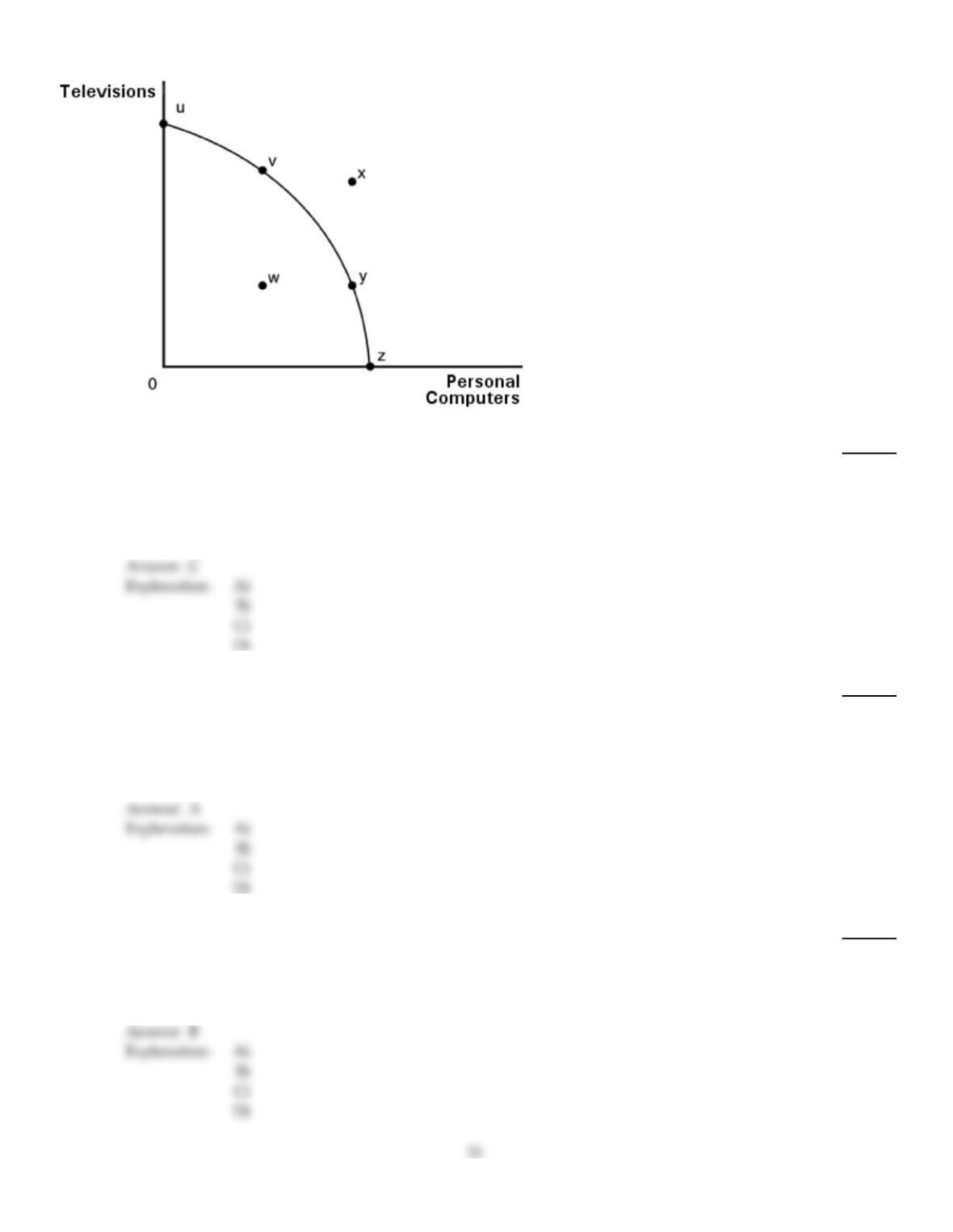
In the above figure, the combination of personal computers and televisions shown by point w
66)
A)
is an efficient use of society’s resources because it is below the production possibilities curve.
B)
is beyond the capacity of society to produce.
C)
is attainable but involves the inefficient use of some of society’s resources.
D)
is more desirable than point x because producing at point w does not put a strain on society’s
resources.
67)
A point on a production possibilities curve indicates
67)
A)
resources are being used efficiently.
B)
an output combination that can be attained only if society gets more resources or there is
technological change.
C)
resources are not being used efficiently.
D)
opportunity costs are constant.
Explanation:
68)
Opportunity cost can best be defined as
68)
A)
the value of all of the alternatives sacrificed.
B)
the value of the next–highest–ranked alternative.
C)
the interest cost of financing a business loan at the bank.
D)
There is no real definition for opportunity cost.
Explanation:
Explanation:
69)
Opportunity cost is
69)
A)
the intrinsic value of an economic good.
B)
the value of the opportunity selected when a need is satisfied.
C)
the value of the next highest ranked alternative that must be sacrificed to obtain a want.
D)
the total value of all the alternatives given up when a choice is made.
70)
The use of goods and services for personal satisfaction is known as
70)
A)
comparative advantage.
B)
consumption.
C)
specialization.
D)
the law of increasing relative cost.
B
Explanation:
71)
Technology
71)
A)
is the recipe for combining land, labor, physical capital, and entrepreneurship to produce a
good.
B)
does not have an effect on the amount of a good a society can produce with its given
resources.
C)
only changes if resources change.
D)
is constantly changing at every point along a production possibilities curve.
A
Explanation:
72)
A bowed–outward production possibilities curve demonstrates the concept of
72)
A)
decreasing opportunity costs as production shifts from the production of one good to the
production of the other good.
B)
increasing opportunity costs as production shifts from the production of one good to the
production of the other good.
C)
increasing opportunity costs at first but the opportunity costs steadily decrease as you move
down along the curve.
D)
constant opportunity costs as production shifts from the production of one good to the
production of the other good.
B
Explanation:
C
Explanation:
73)
The production possibilities curve can shift inward when
73)
A)
employment increases.
B)
a country experiences a natural disaster.
C)
the stock of productive capital rises.
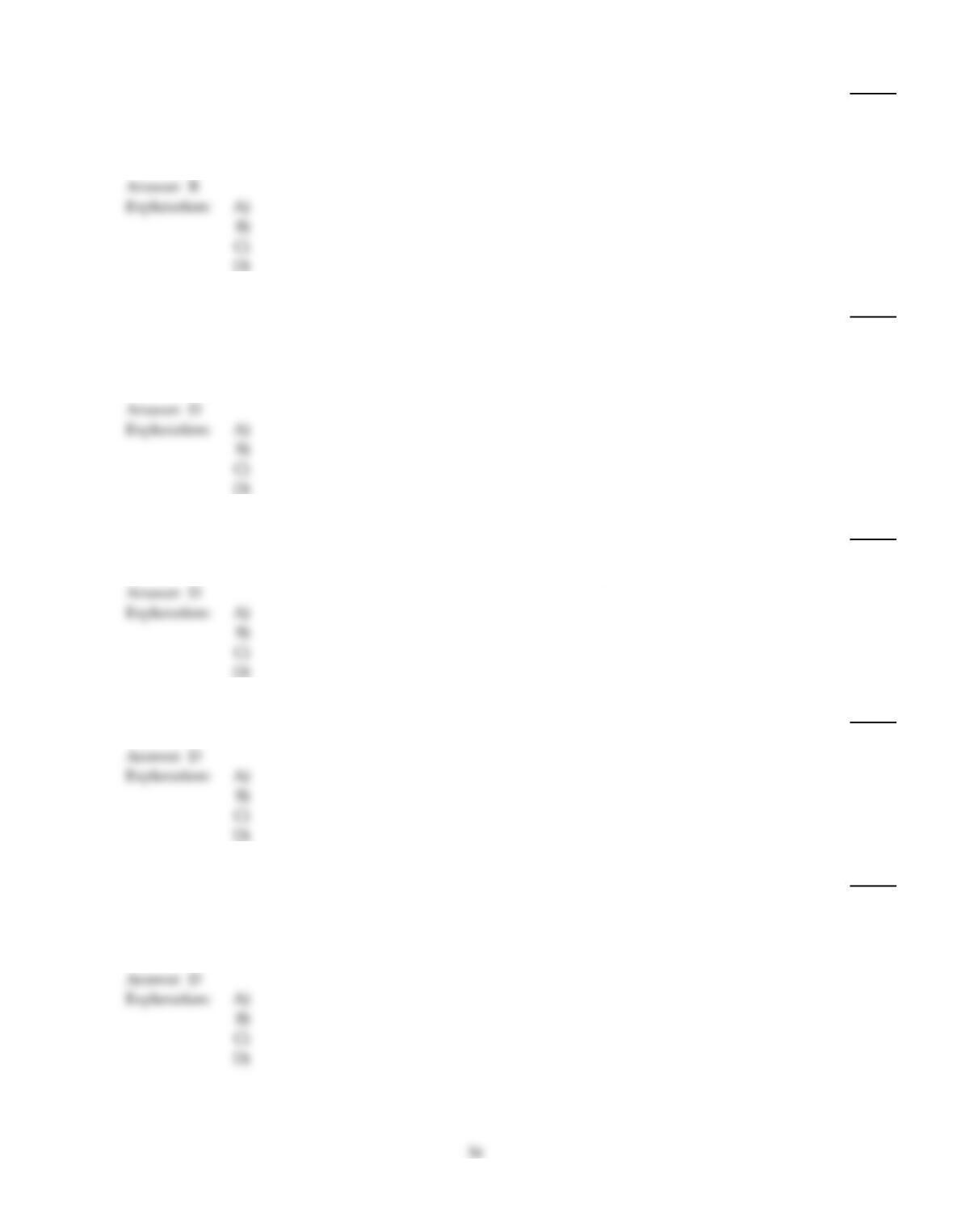
D)
production increases.
74)
A country operates inside its production possibilities curve; this may be caused by
74)
A)
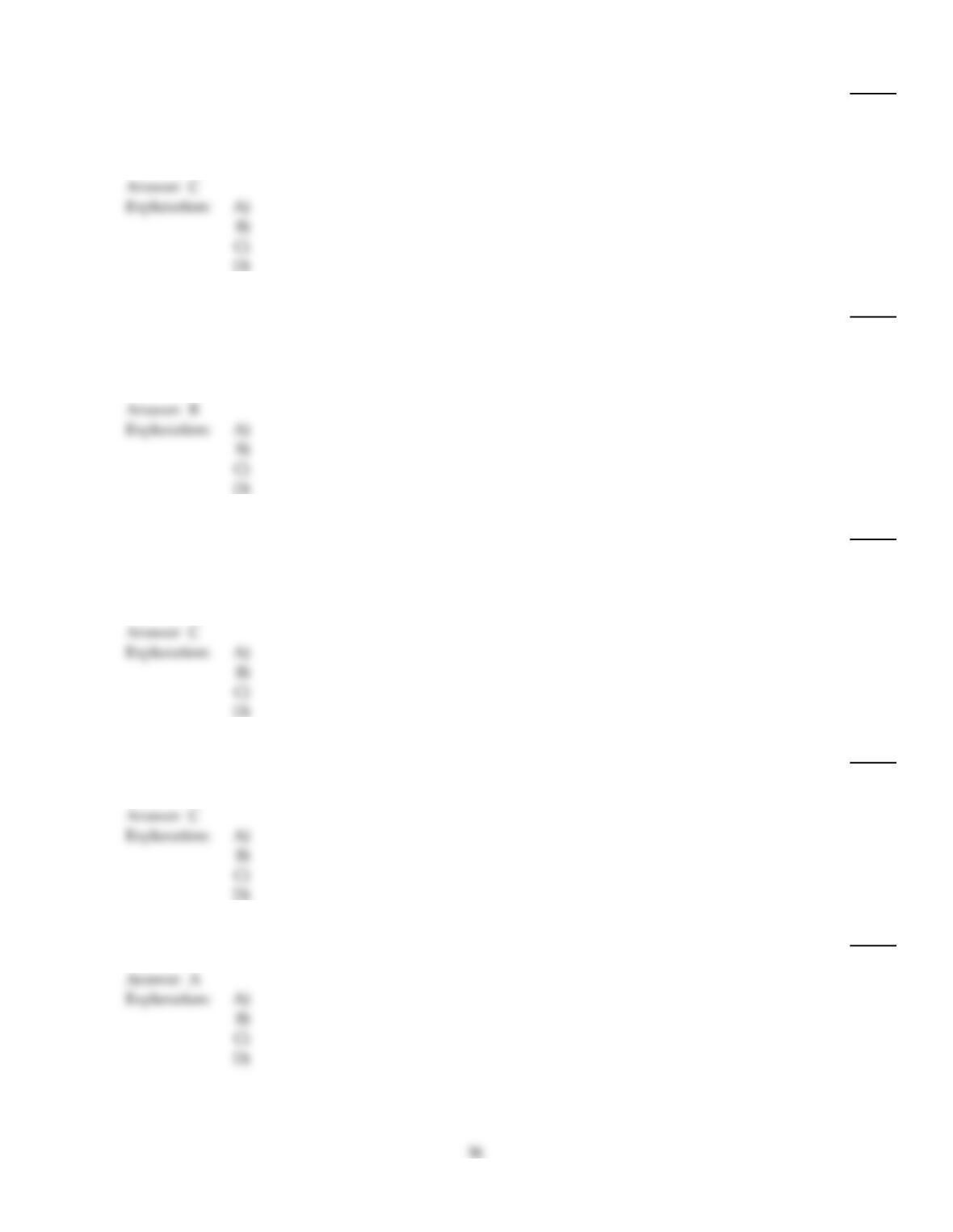
unemployed resources.
B)
a lack of modern products being produced.
C)
a new resource being discovered.
D)
total efficiency in industry.
A
75)
Which of the following activities are production?
75)
A)
taking ice cubes from a tray to put in a drink
B)
moving coal from southern Illinois to an electrical power plant in northern Illinois
C)
combining flour, milk, and eggs to make cookies
D)
All of the above are production.
D
76)
During periods of unemployment
76)
A)
the economy operates at a point inside the production possibilities curve.
B)
the economy operates at a point outside the production possibilities curve.
C)
the production possibilities curve shifts outward.
D)
the production possibilities curve shifts inward.
A
B
77)
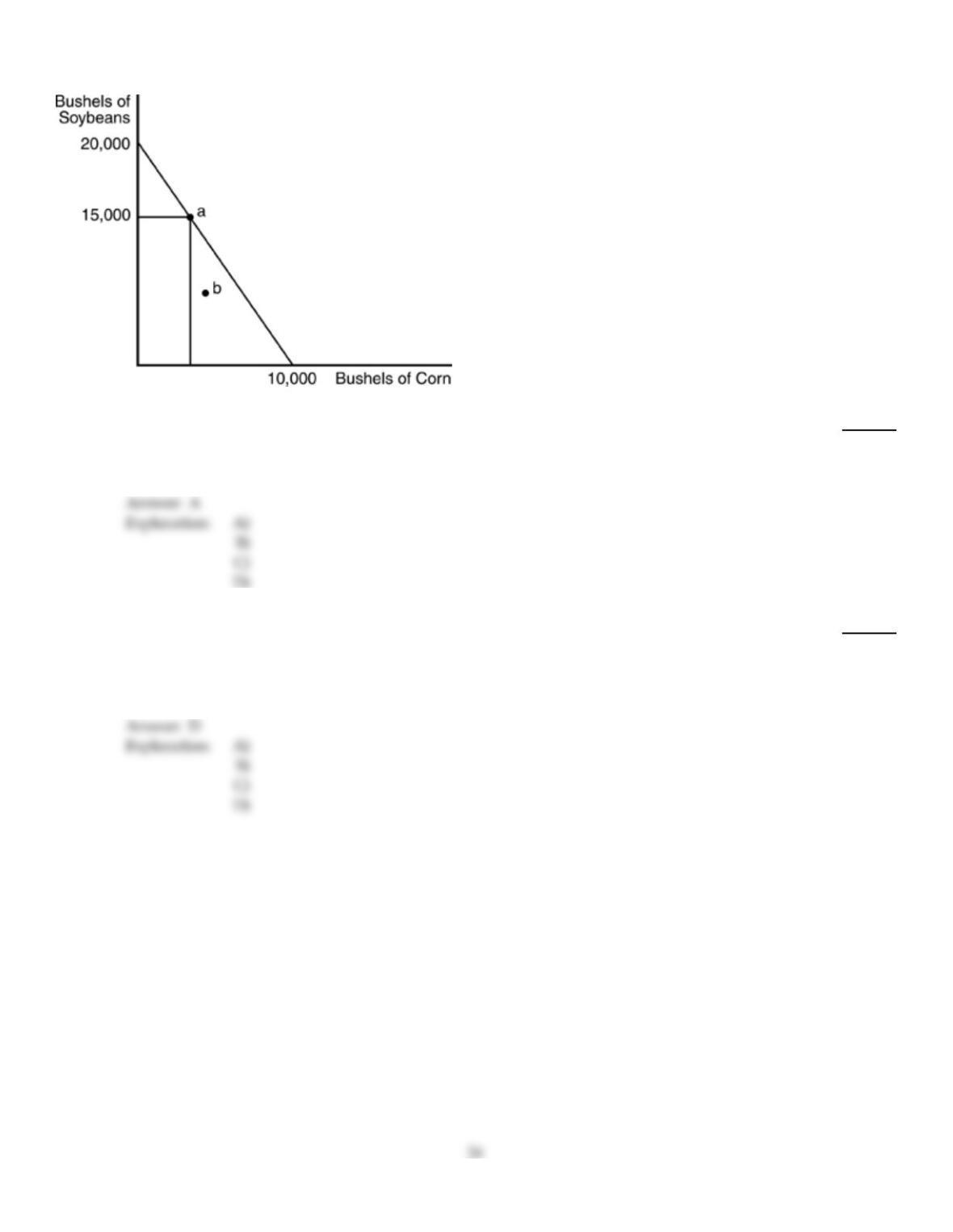
A farmer has 100 acres of land on which he can grow soybeans or corn. An acre of land yields 200
bushels of soybeans or 100 bushels of corn. The above figure refers to the farmer’s
77)
A)
production possibilities curve.
B)
opportunity cost curve.
C)
substitution options curve.
D)
demand curve.
78)
One of the benefits of specialization is
78)
A)
people enjoy doing one repetitive task over and over.
B)
training costs are higher.
C)
specialists cost less to hire.
D)
greater output.
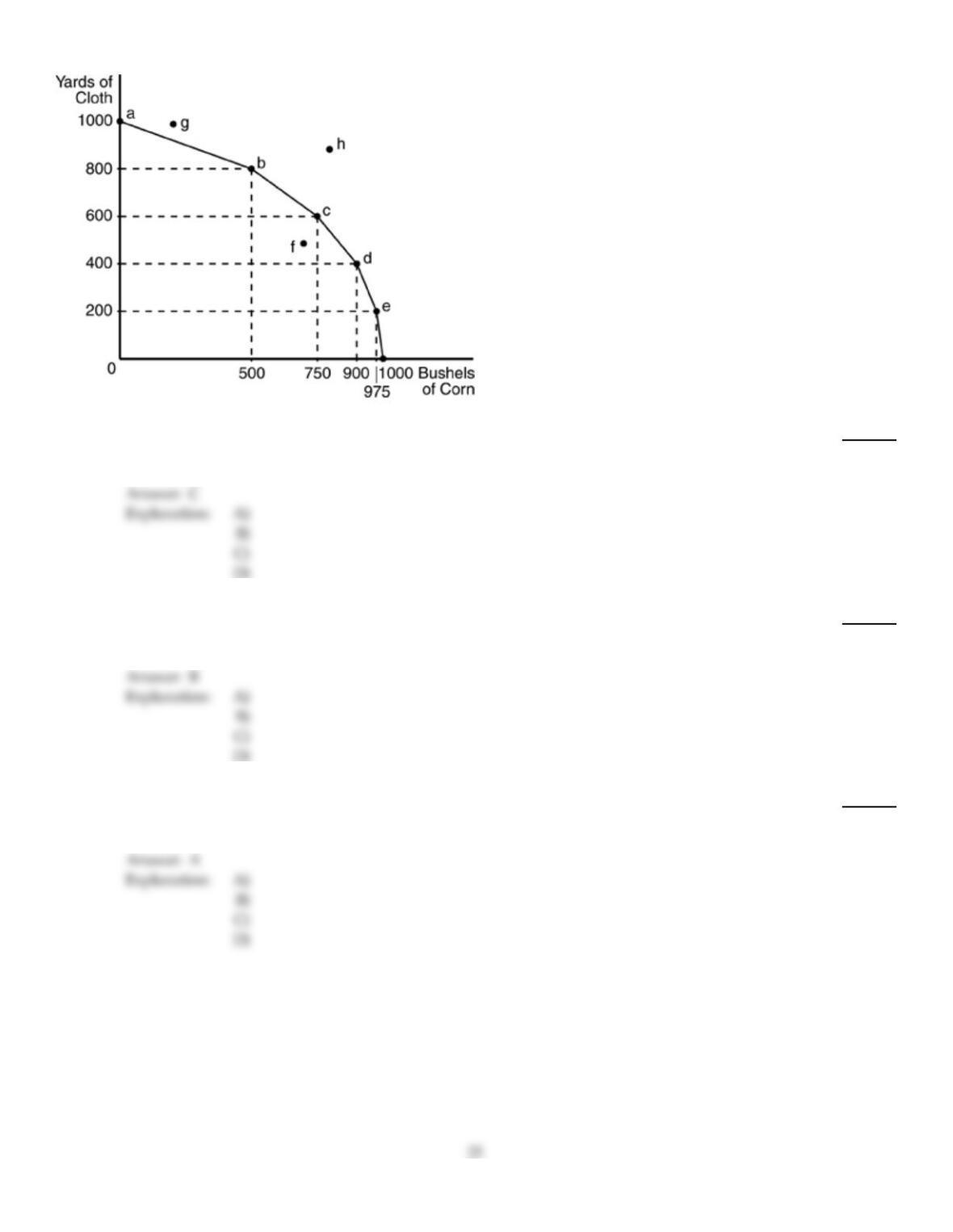
79)
Which of the following would NOT allow society to move to point “h” in the above figure?
79)
A)
an improvement in technology
B)
an increase in quantity of labor
C)
more efficient use of current resources
D)
an increase in quantity of capital
80)
Which of the following would be categorized as “land”?
80)
A)
human capital
B)
timber
C)
entrepreneurship
D)
buildings
81)
Which of the following sets of terms describes the problem of scarcity in economics?
81)
A)
choices, opportunity costs, and trade–offs
B)
goods, land, and needs
C)
labor, needs, and opportunity costs
D)
production, consumption, and wants
82)
Stephanie has decided to eat lunch between classes. She has ranked her choices, from highest to
lowest as, (1) turkey sandwich, (2) tuna sandwich, (3) slice of cheese pizza, (4) cheeseburger. The
opportunity cost of the eating turkey sandwich is
82)
A)
zero since she has satisfied a want.
B)
the combined value of the tuna sandwich, slice of cheese pizza and cheeseburger.
C)
the value of tuna sandwich, the next best choice.
D)
the value of the cheeseburger.
83)
Which of the following is a TRUE statement?
83)
A)
All economic goods are goods, but not all goods are economic goods.
B)
All goods are economic goods.
C)
Economic goods do not include services while goods do include services.
D)
Economic goods and goods mean the same thing.
84)
If Irene can make either four chairs or one table in an hour and Greg can make either three chairs or
two tables in an hour then
84)
A)
Greg has the comparative advantage in the production of chairs.
B)
Greg has the absolute advantage in the production of chairs.
C)
Irene has the comparative advantage in the production of tables.
D)
Irene has the absolute advantage in the production of chairs.
85)
The trade–off between current consumption and the production of capital goods is also a trade–off
between
85)
A)
satisfying the needs of the poor and the wants of the wealthy.
B)
the future cost for capital goods and future cost of consumption goods.
C)
having fewer needs and more wants in the future.
D)
current consumption and future consumption.
86)
In economic terminology, the accumulated training and education that workers receive to increase
their productivity is referred to as
86)
A)
labor.
B)
human capital.
C)
physical capital.
D)
entrepreneurship.
87)
John and Mary work at a bakery. John can decorate either 10 ice–cream cakes or 4 wedding cakes;
Mary can decorate either 8 ice–cream cakes or 2 wedding cakes. According to this scenario
87)
A)
the opportunity cost of decorating a wedding cake for Mary is 4 ice–cream cakes.
B)
the opportunity cost of decorating a wedding cake for Mary is 2 1/2 ice–cream cakes.
C)
the opportunity cost of decorating a wedding cake for Mary is 1/4 ice–cream cake.
D)
the opportunity cost of decorating a wedding cake for Mary is 2/5 ice–cream cake.
A
88)
Why is it that all of our wants cannot be satisfied?
88)
A)
because of shortages
B)
because limited resources mean all the goods we want cannot be obtained
C)
because other people try to change your mind about what you want
D)
because we cannot seem to decide what we really want
B
89)
The production possibilities curve for two products is bowed out because
89)
A)
as the production of a good increases, opportunity cost is unchanged.
B)
as the production of a good increases, opportunity cost increases.
C)
the qualities of the resources are not identical.
D)
there are unemployed resources.
B
B
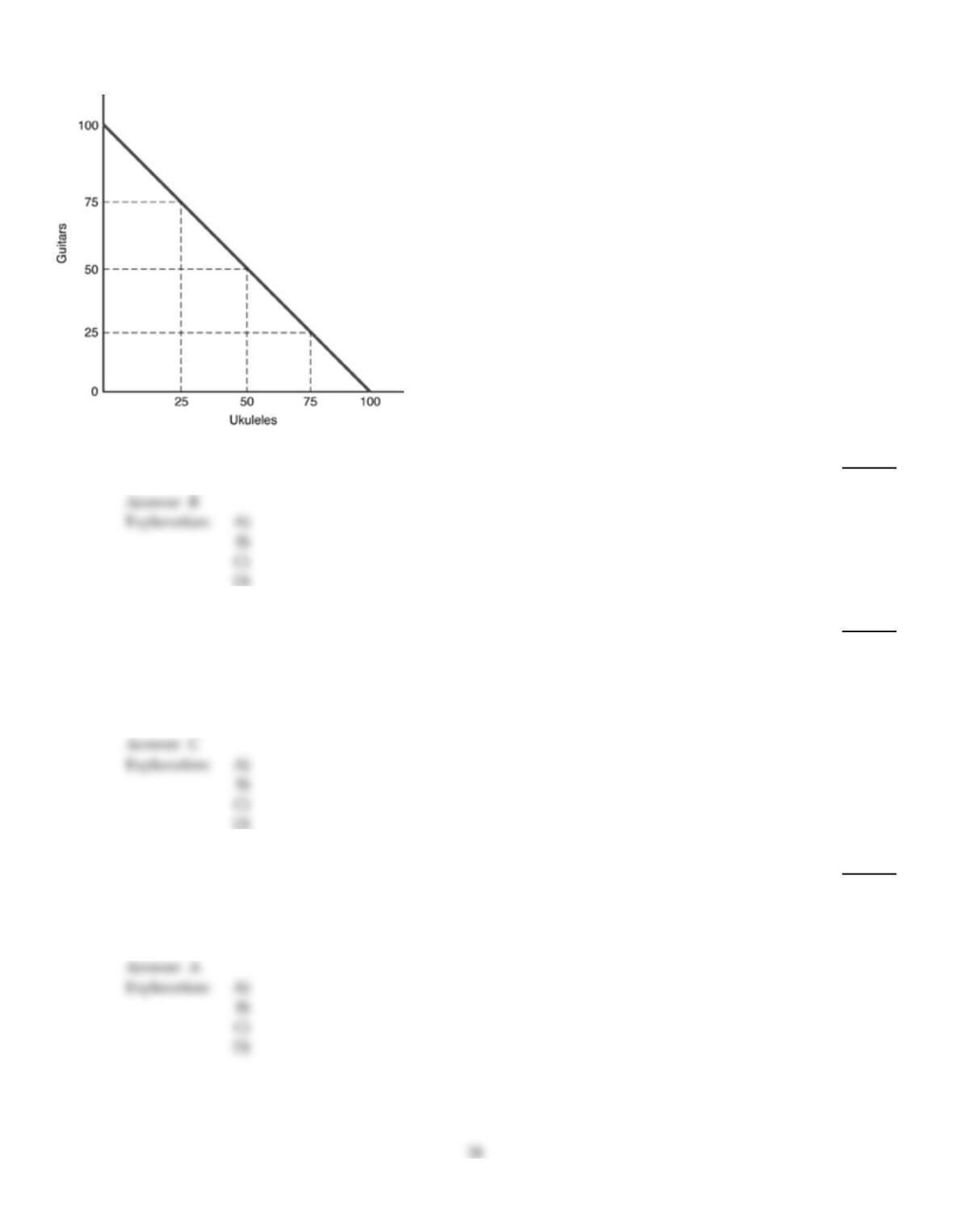
90)
In the above figure, as more ukuleles are produced, the opportunity cost in terms of guitars is
90)
A)
decreasing.
B)
constant.
C)
increasing.
D)
zero.
91)
Which of the following statements is FALSE about opportunity cost?
91)
A)
Cost is always foregone opportunity.
B)
John wants a burger and fries. The concept of opportunity cost applies even though he has
enough funds to buy both.
C)
Opportunity cost exists only for goods with monetary values.
D)
Opportunity cost is the next best alternative.
92)
How is economic growth shown by the production possibilities curve?
92)
A)
by shifting the curve to the right
B)
by changing the shape of the curve from a straight line to one that is bowed
C)
by moving the curve to the left
D)
by moving up the existing curve
93)
Which is the best example of an intangible good?
93)
A)
the car you dream of owning but cannot afford
B)
the suit you hope will make a good impression when you go on job interviews
C)
the advice and expertise provided by the music store clerk who sold you that CD
D)
the textbook study guide you hope will prepare you to perform well on examinations
94)
Bonnie volunteers to help make floral arrangements at a flower shop. She is an example of
94)
A)
physical capital.
B)
human capital.
C)
entrepreneurial ability.
D)
labor.
95)
Some resources are better suited to produce certain goods than other resources. This fact leads to
95)
A)
inefficiency in the economy.
B)
a linear production possibilities curve.
C)
the law of increasing additional cost.
D)
increases in technology.
96)
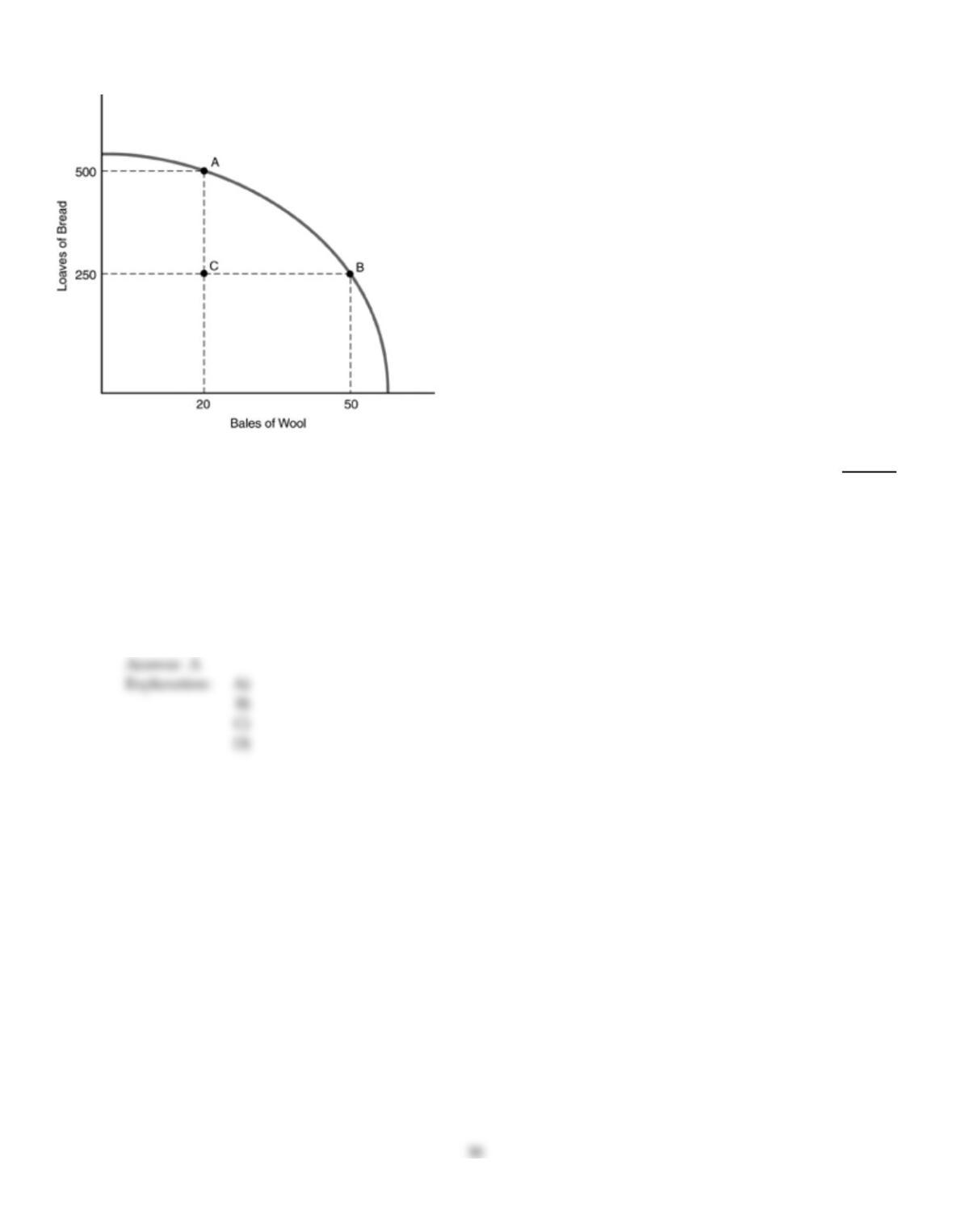
Refer to the above figure. Which one of the following statements is TRUE with regard to the
economy depicted in the graph?
96)
A)
The total amount of resources it takes to produce 20 bales of wool and 500 loaves of bread is
the same as the amount of resources needed to produce 50 bales of wool and 250 loaves of
bread.
B)
Point C cannot be produced.
C)
The best production point is 500 loaves of bread and 50 bales of wool.
D)
The total amount of resources it takes to produce 20 bales of wool and 500 loaves of bread is
more than the amount of resources needed to produce 50 bales of wool and 250 loaves of
bread.
97)
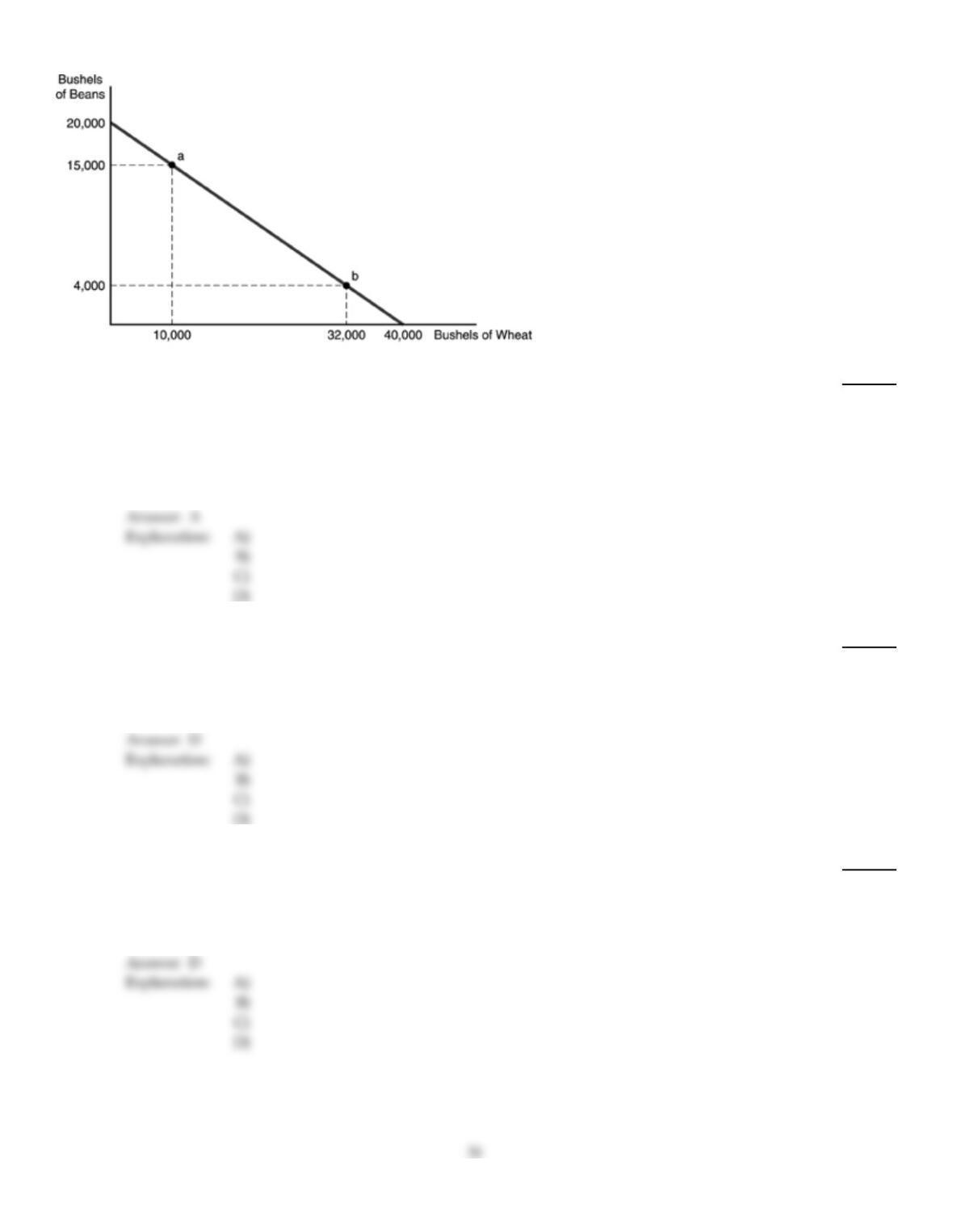
Refer to the above figure. A farmer has 50 acres of land on which to grow wheat or beans. An acre
of land yields 400 bushels of beans or 800 bushels of wheat. Which of the following is a possible
combination of beans and wheat that can be grown, assuming the land is farmed efficiently?
97)
A)
15,000 bushels of beans and 10,000 bushels of wheat
B)
30,000 bushels of each
C)
25,000 bushels of beans and 25,000 bushels of wheat
D)
20,000 bushels of beans and 40,000 bushels of wheat
98)
The opportunity cost of a decision is the
98)
A)
value of all the alternatives not chosen.
B)
cost of making the wrong choice.
C)
cost incurred by others who are unhappy with your decision.
D)
value of the best alternative not chosen.
99)
A person has a comparative advantage in an activity whenever she
99)
A)
has an absolute advantage in the activity.
B)
can do everything better than anyone else.
C)
can do the activity in less time than anyone else.
D)
can perform the activity at a lower opportunity cost than another person can.
100)
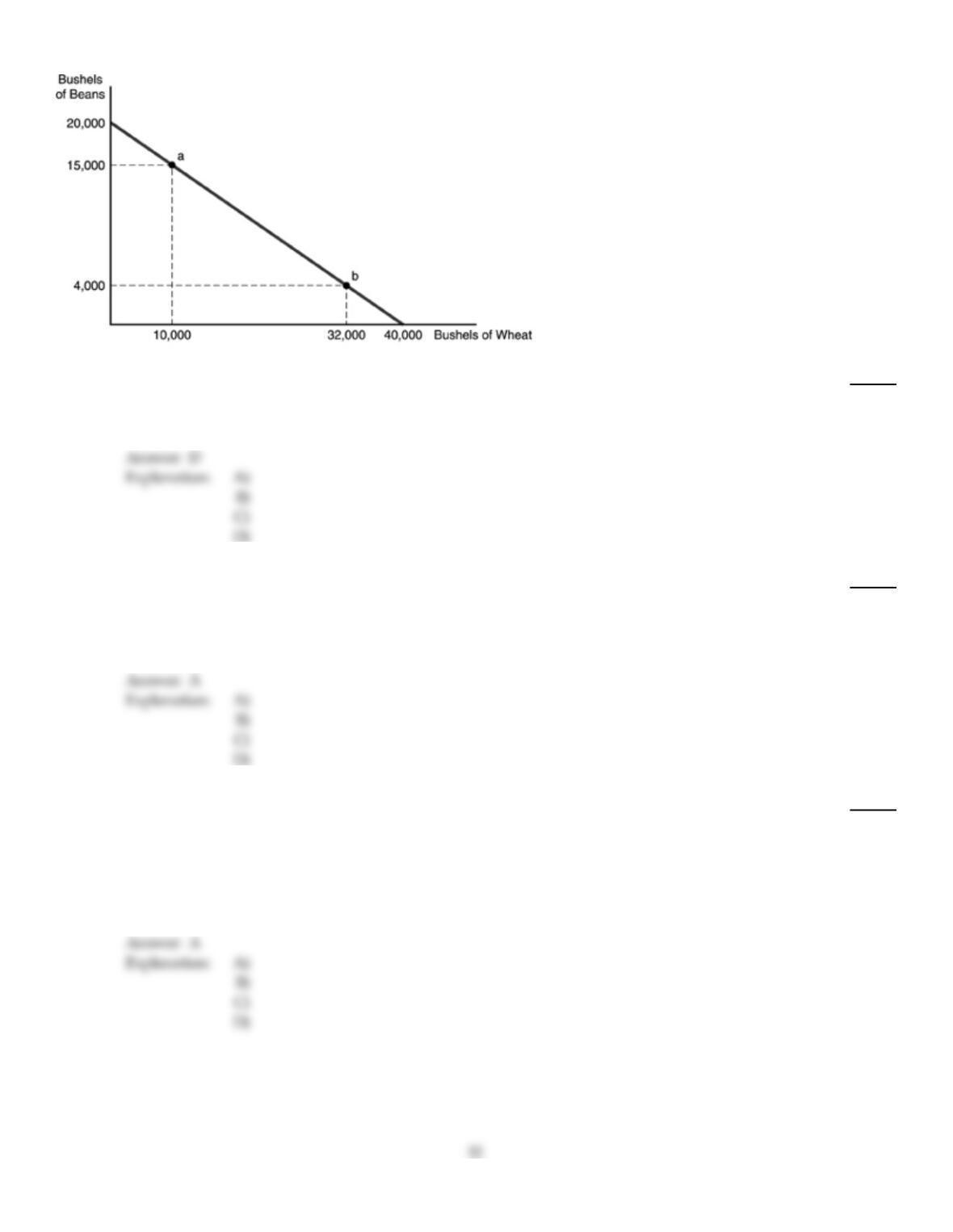
Refer to the above figure. If the farmer has 50 acres of land, the farmer is producing at point a, and
an acre of land yields 400 bushels of beans or 800 bushels of wheat, how much land is devoted to
the production of wheat?
100)
A)
10 acres
B)
8.5 acres
C)
15 acres
D)
12.5 acres
101)
Economic goods are defined as
101)
A)
anything from which an individual derives satisfaction.
B)
any item which is available in sufficient quantity at zero price.
C)
services only.
D)
tangible items only.
102)
If individual X has comparative advantage in painting and individual Y has comparative
advantage in carpentry, then
102)
A)
there is a lower opportunity cost (expressed in units of carpentry) for individual X to paint
than for individual Y to paint.
B)
individual X must use fewer hours to paint a fence than individual Y.
C)
specialization will not occur, since each does not have a clear absolute advantage.
D)
individual Y will specialize in painting.
103)
You should specialize in the production of a good if you have
103)
A)
an absolute advantage.
B)
more capital resources than your trading partner.
C)
a comparative advantage.
D)
more human resources than your trading partner.
104)
Comparative advantage is always a(n) ________ concept.
104)
A)
absolute
B)
monetary
C)
relative
D)
efficiency
105)
In the above figure, the opportunity cost of moving from producing 75 guitars and 25 ukuleles to
producing 25 guitars and 75 ukuleles is
105)
A)
50 guitars.
B)
75 ukuleles.
C)
25 guitars.
D)
25 ukuleles.
106)
Absolute advantage is
106)
A)
producing a good only when demand is high.
B)
producing a good using the fewest inputs.
C)
producing at a lower opportunity cost.
D)
producing a good that requires imported components.
107)
Specialization can occur because
107)
A)
absolute advantage creates specialization among laborers.
B)
governments pass laws that require it.
C)
managers and laborers share job tasks.
D)
varying skills differentiate workers.
108)
If Vice President Smith is a better typist than his assistant, he is said to have a(n) ________
advantage in typing over his assistant.
108)
A)
unusual
B)
relative
C)
overwhelming
D)
absolute
109)
Opportunity costs arise from
109)
A)
taxes.
B)
regrets.
C)
mistakes.
D)
choices.
110)
A typical economic good has which one of the following characteristics?
110)
A)
The quantity available exceeds the desired quantity at a zero price.
B)
It is never scarce.
C)
It uses no resources to produce.
D)
The desired quantity exceeds the quantity available at a zero price.
111)
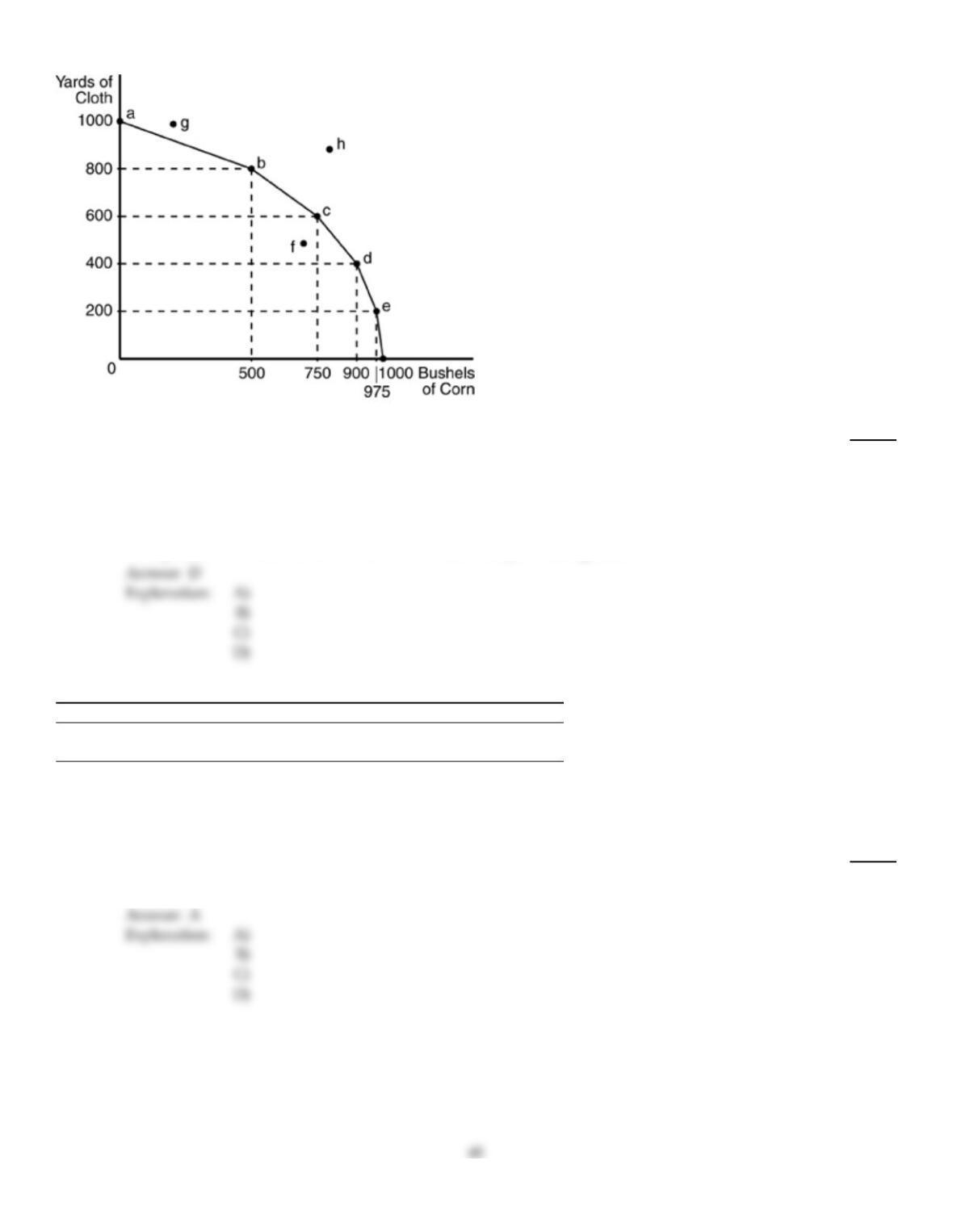
Between points “b” and “c” in the above figure, the opportunity cost of 250 more bushels of corn is
111)
A)
600 yards of cloth.
B)
800 yards of cloth.
C)
250 yards of cloth.
D)
200 yards of cloth.
112)
People always face trade–offs because
112)
A)
they always have more than one use for their time and money.
B)
they can make themselves better off through trade.
C)
they buy goods with money.
D)
trading takes place in a market economy.
A
113)
Suppose an acre of land yields 100 bushels of corn and that one bushel of corn provides enough
seed for one–quarter of an acre of land. The opportunity cost of consuming another 100 bushels of
corn today is
113)
A)
100 bushels of corn next year.
B)
10 bushels of corn next year.
C)
2.5 bushels of corn next year.
D)
25 bushels of corn next year.
D
D
114)
Division of labor increases the output of society by
114)
A)
ensuring that people are happier in performing their work.
B)
reducing the choices people have to make to a more manageable number.
C)
allowing resources to specialize in the tasks for which they have a comparative advantage.
D)
eliminating scarcity.
115)
The production possibilities curve shifts outward when
115)
A)
we produce more consumption goods over productive investment in equipment.
B)
there is an increase in resources or technology.
C)
the economy is producing efficiently.
D)
the law of increasing additional cost takes hold.
116)
Typically, the greater the specialization of resources
116)
A)
the less production that takes place.
B)
the poorer the country becomes.
C)
the greater the bow of the production possibilities curve.
D)
the greater the unemployment in the country.
117)
A tractor used to prepare land for planting is called
117)
A)
labor.
B)
land.
C)
physical capital.
D)
human capital.
118)
Opportunity cost exists because of
118)
A)
scarcity.
B)
self–interest.
C)
poverty.
D)
greed.
119)
A point outside a production possibilities curve indicates
119)
A)
an output combination that society cannot attain given its current level of resources and
technology.
B)
that resources are being used very efficiently.
C)
that both goods are characterized by increasing costs.
D)
that resources are not being used efficiently.
120)
Naturally occurring diamonds are an example of
120)
A)
human capital.
B)
physical capital.
C)
labor.
D)
land.
121)
Which of the following statements is FALSE?
121)
A)
Wants are unlimited and include all material and nonmaterial desires.
B)
Services are intangible goods such as dry cleaning, hospital care, and restaurant meal
preparation.
C)
A good is anything that gives satisfaction or happiness to individuals.
D)
Economic goods are available in desired quantities at a zero price.
122)
Scarcity implies that
122)
A)
firms should be more efficient when producing goods.
B)
people should limit their wants, since shortages exist.
C)
people must make choices.
D)
nonrenewable resources should never be used.
123)
Physical capital is distinguished from human capital because
123)
A)
human capital refers only to day laborers.
B)
physical capital refers to equipment and machinery, whereas human capital refers to trained
people.
C)
physical capital refers to trained people.
D)
physical capital refers to trained people, whereas human capital refers to equipment and
machinery.
124)
At a point on a production possibilities curve, opportunity cost of more capital goods today is
124)
A)
fewer capital goods in the future.
B)
fewer consumer goods today.
C)
more unemployed resources in the future.
D)
fewer consumer goods in the future.
B
125)
If opportunity costs are constant, then
125)
A)
the production possibilities curve bows outward.
B)
factors of production must not be fully employed.
C)
the production possibilities curve is a negatively sloped straight line.
D)
the production possibilities curve does not exist.
C
126)
Jane is a top–level executive earning a high salary. Jane has just ordered a luxury car only to be told
that she will have to wait three weeks for it to be delivered. Which of the following statements is
TRUE?
126)
A)
The car is an intangible good.
B)
The car is human capital.
C)
The car is not a scarce good.
D)
The car is an economic good.
D
B
127)
When the economy moves from point A to B in the above table, the opportunity cost of a computer
in terms of televisions is
127)
A)
10.
B)
2.5.
C)
0.5.
D)
2.
128)
In economics, physical capital includes
128)
A)
money.
B)
shares of stock.
C)
machinery.
D)
bank accounts.
129)
Scarcity exists because
129)
A)
not enough new technology is being used to eliminate scarcity.
B)
the majority of people in the world are poor.
C)
people are too greedy and refuse to share what they have with others.
D)
human wants exceed what can be produced with the limited resources available.
130)
The shape of the production possibilities curve in the above figure indicates that
130)
A)
production of corn is characterized by increasing costs while the production of cloth is
characterized by decreasing costs.
B)
production of both corn and cloth is characterized by constant costs.
C)
production of corn is characterized by constant costs and the production of cloth is
characterized by increasing costs.
D)
production of both corn and cloth is characterized by increasing costs.
A B C D E
Pizza (Pies) 030 60 90 120
Bread (Loaves) 300 240 180 120 60
The above table shows the daily production possibilities for a bakery.
Currently the bakery bakes 60 pizzas and 180 loaves of bread, that is at alternative C.
131)
Using the above table, what is the opportunity cost of moving from alternative C to alternative D?
131)
A)
60 loaves of bread
B)
30 loaves of bread
C)
1/2 loaf of bread
D)
2 loaves of bread
A
D