47)
The function F described by F(x) = 2.75x + 71.48 can be used to estimate the height, in centimeters,
of a woman whose humerus (the bone from the elbow to the shoulder) is x cm long. Estimate the
height of a woman whose humerus is 30.93 cm long. Round your answer to the nearest four
decimal places.
47)
A)
43.3000 cm
B)
13.5775 cm
C)
156.5375 cm
D)
105.1600 cm
Convert to an exponential equation.
48)
log9 27 =3
2
48)
A)
27 =93/2
B)
9 =273/2
C)
27 =3
2
9
D)
3
2=927
Solve the equation graphically to four decimal places.
49)
Let f(x) =-0.6x2+3x +1, find f(x) =5.
49)
A)
2.5000, 4.7500
B)
No solution
C)
2.5000
D)
4.7500
21
Use the REGRESSION feature on a graphing calculator.
50)
As the number of farms has decreased in South Carolina, the average size of the remaining farms
has grown larger, as shown below.
YEAR
AVERAGE ACREAGE
PER FARM
1900 (x = 0)
1910 (x = 10)
127
119
1920
1930
135
137
1940 155
1950 196
1960 283
1970 353
1980 406
1990 440
2000 (x = 100) 420
Let x represent the number of years since 1900. Use a graphing calculator to fit a quadratic function
to the data. Round your answer to five decimal places.
50)
A)
y = – .00114x3+ 0.19605x2– 5.29775 + 143.55245
B)
y = 0.02536x3+ 1.21114 x + 102.58741
C)
y = 0.02536x3+ 1.21114 + 102.58741
D)
y = 0.02536x2+ 1.21114 x + 102.58741
Use the properties of logarithms to solve.
51)
log 6 (4x – 5) = 1
51)
A)
11
6
B)
11
4
C)
log 5
4
D)
7
Graph the function.
22
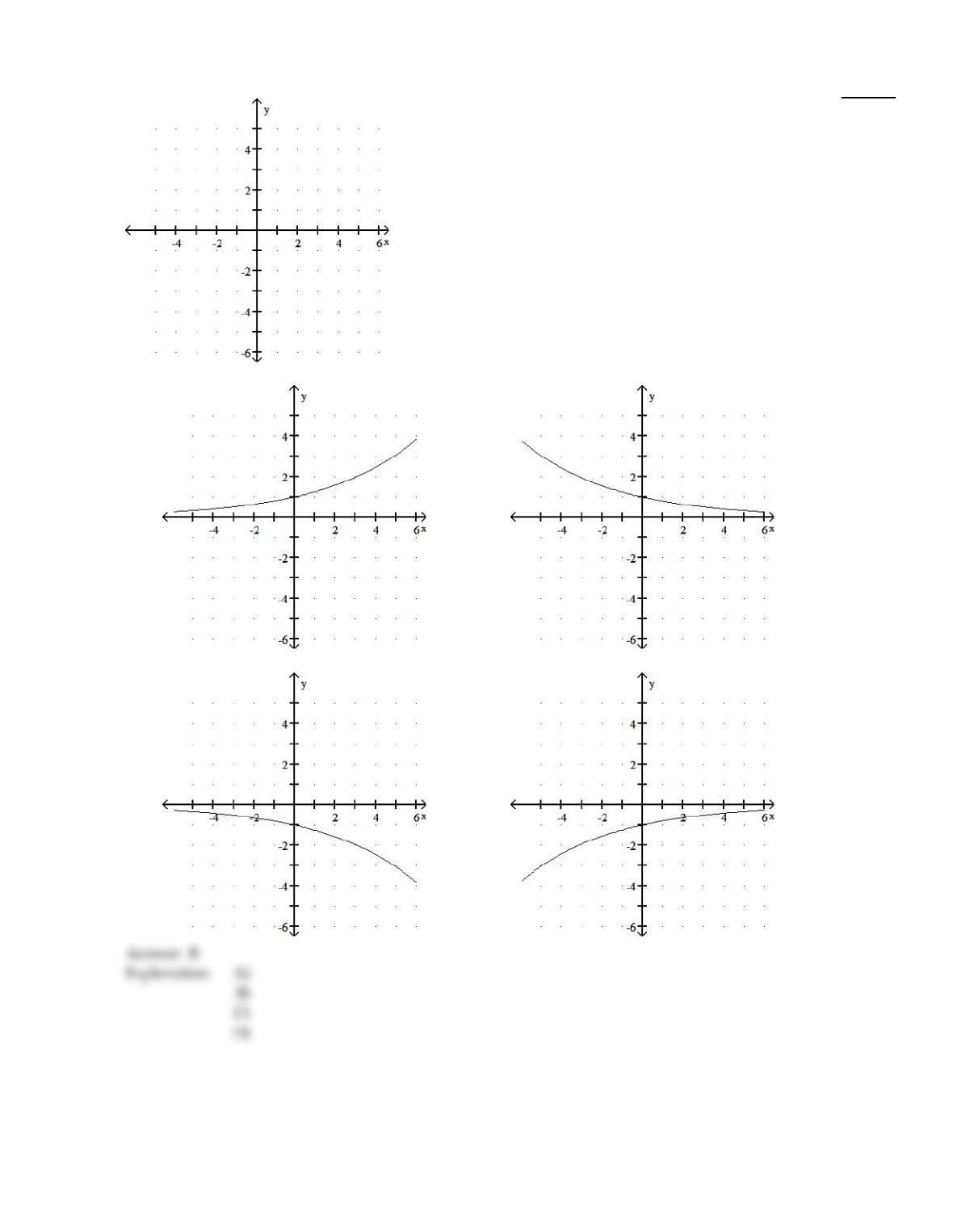
52)
f(x) =0.8x
52)
A)
B)
C)
D)
23
Find the equations of any vertical asymptotes.
53)
f(x) =x2– 100
(x – 3)(x + 5)
53)
A)
y =3, y =-5
B)
x =3, x =-5
C)
x = 10, x = – 10
D)
x =-3
Solve the problem.
54)
U. S. Census Bureau data shows that the number of families in the United States (in millions) in
year x is given by h(x) = 51.42 + 15.473 · log x , where x = 0 is 1980. How many families were there
in 2002?
54)
A)
48 million
B)
21 million
C)
72 million
D)
90 million
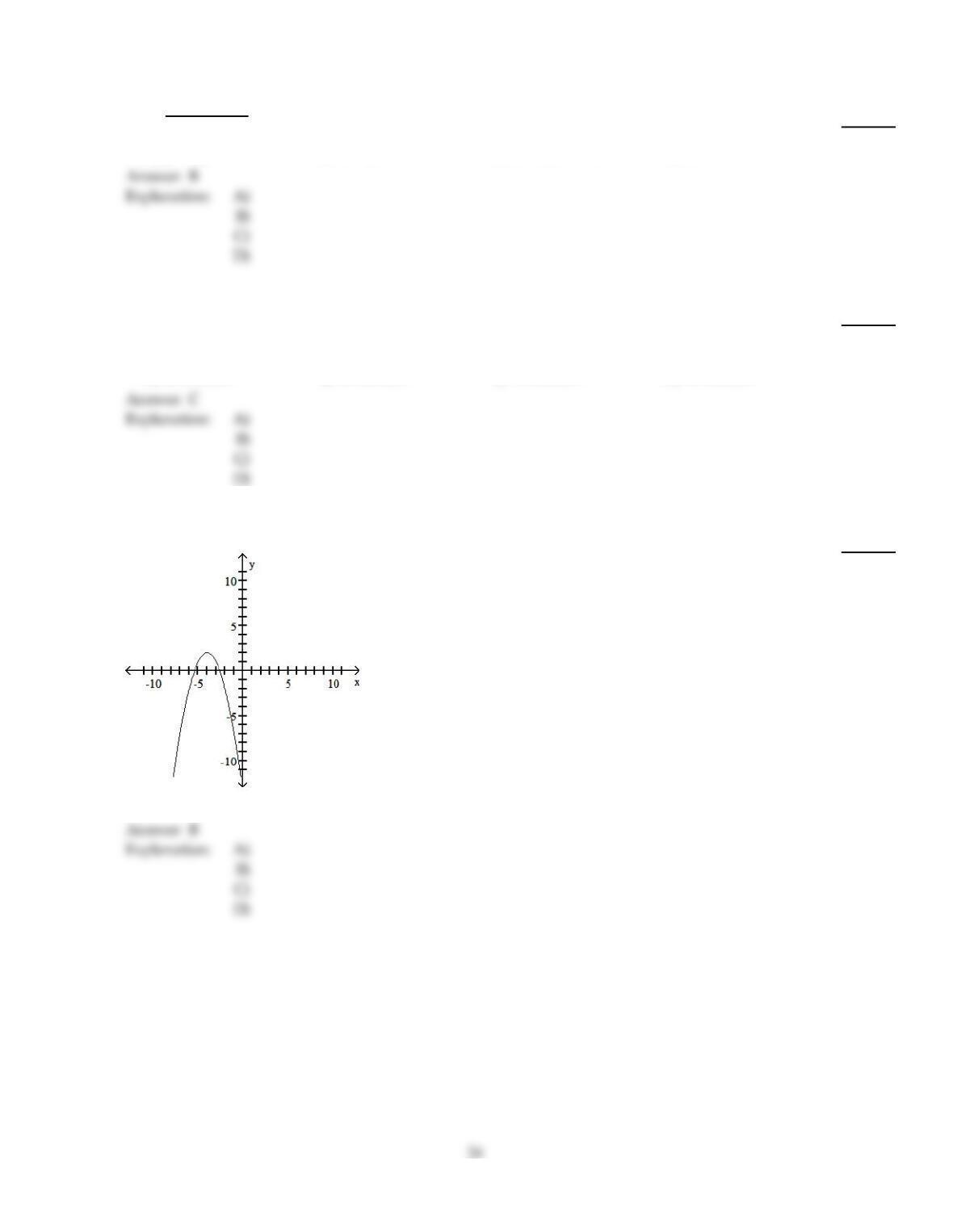
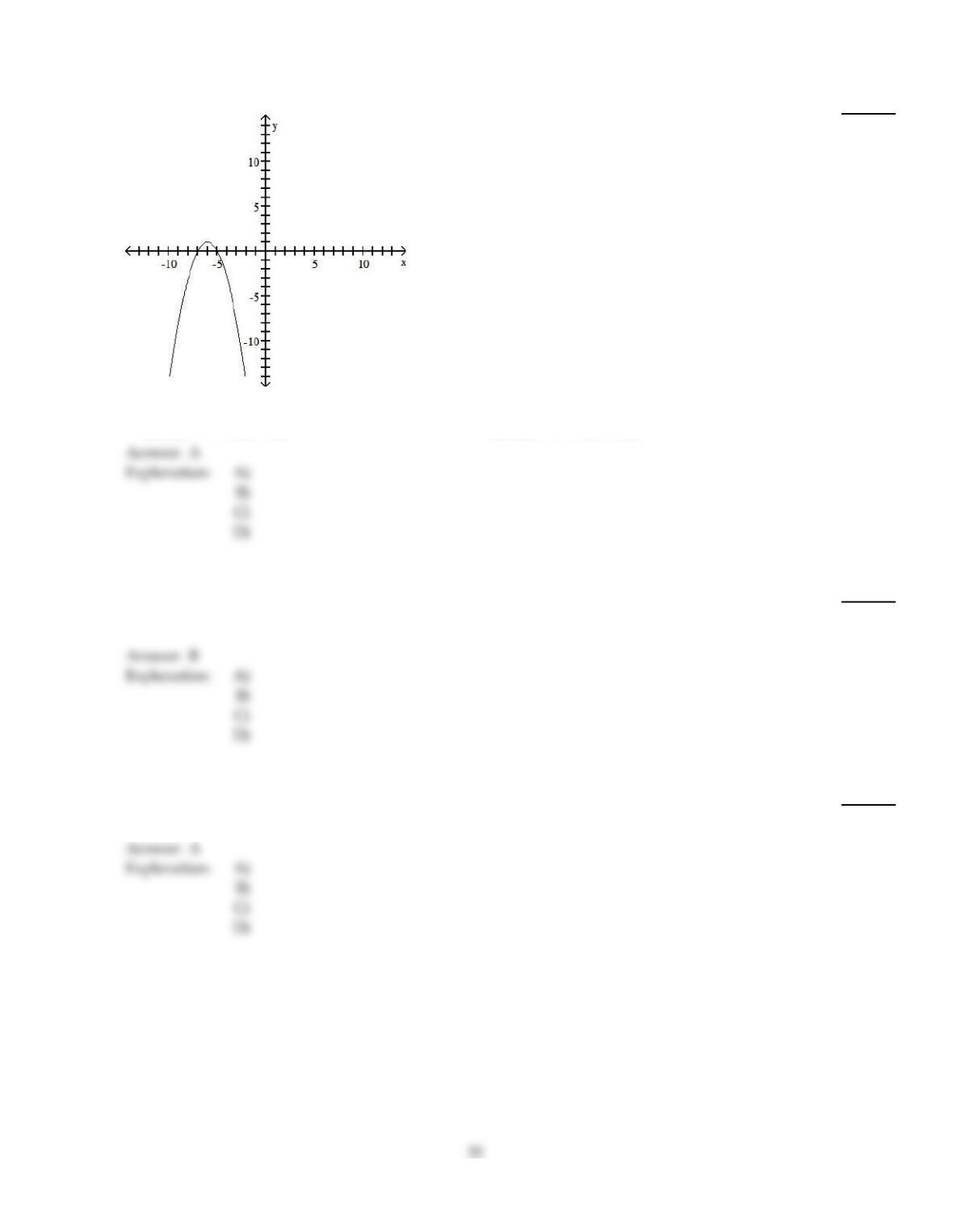
Write an equation for the graph in the form y = a(x – h)2+
k, where a is either 1 or –1 and h and k are integers.
55)
55)
A)
y =(x + 4)2–4
B)
y = – (x + 4)2+ 2
C)
y =(x + 4)2+ 2
D)
y = – (x – 4)2– 2
Solve the problem.
56)
The number of reports of a certain virus has increased exponentially since 1960. The current
number of cases can be approximated using the function r(t) = 207 e0.005t, where t is the number of
years since 1960. Estimate the of cases in the year 2010.
56)
A)
207
B)
240
C)
266
D)
190
Determine whether the function is linear, constant, or neither
57)
y =x3–x2+ 8
57)
A)
Linear
B)
Constant
C)
Neither
Solve for x to two decimal places (using a calculator).
58)
700 = 500(1.04)x
58)
A)
8.58
B)
520
C)
1.40
D)
1.35
Solve the problem.
59)
The number of books in a community college library increases according to the function
B = 7200e0.03t, where t is measured in years. How many books will the library have after 8 year(s)?
59)
A)
7200
B)
9153
C)
4462
D)
10,275
Use a calculator to evaluate the expression. Round the result to five decimal places.
60)
log 0.234
60)
A)
–1.45243
B)
–0.63074
C)
1.26364
D)
0.234
Determine if the equation specifies a function with independent variable x. If so, find the domain. If not, find a value of x
to which there corresponds more than one value of y.
61)
x2–y2= 9
61)
A)
A function with domain all real numbers except x = 5
B)
Not a function; for example, when x = 5, y = ±4
Solve the problem.
62)
If $4,000 is invested at 7% compounded annually, how long will it take for it to grow to $6,000,
assuming no withdrawals are made? Compute answer to the next higher year if not exact.
[A =P(1 + r)t]
62)
A)
2 years
B)
6 years
C)
5 years
D)
8 years
63)
A country has a population growth rate of 2.4% compounded continuously. At this rate, how long
will it take for the population of the country to double? Round your answer to the nearest tenth.
63)
A)
2.9 years
B)
30 years
C)
.29 years
D)
28.9 years
Write in terms of simpler forms.
64)
logb
y
x
64)
A)
logby+logbx
B)
log2b
y
x
C)
logby–logbx
D)
logby– x
Determine if the equation specifies a function with independent variable x. If so, find the domain. If not, find a value of x
to which there corresponds more than one value of y.
65)
x2+ y2=9
65)
A)
A function with domain
B)
Not a function; for example, when x = 0, y = ±3
26
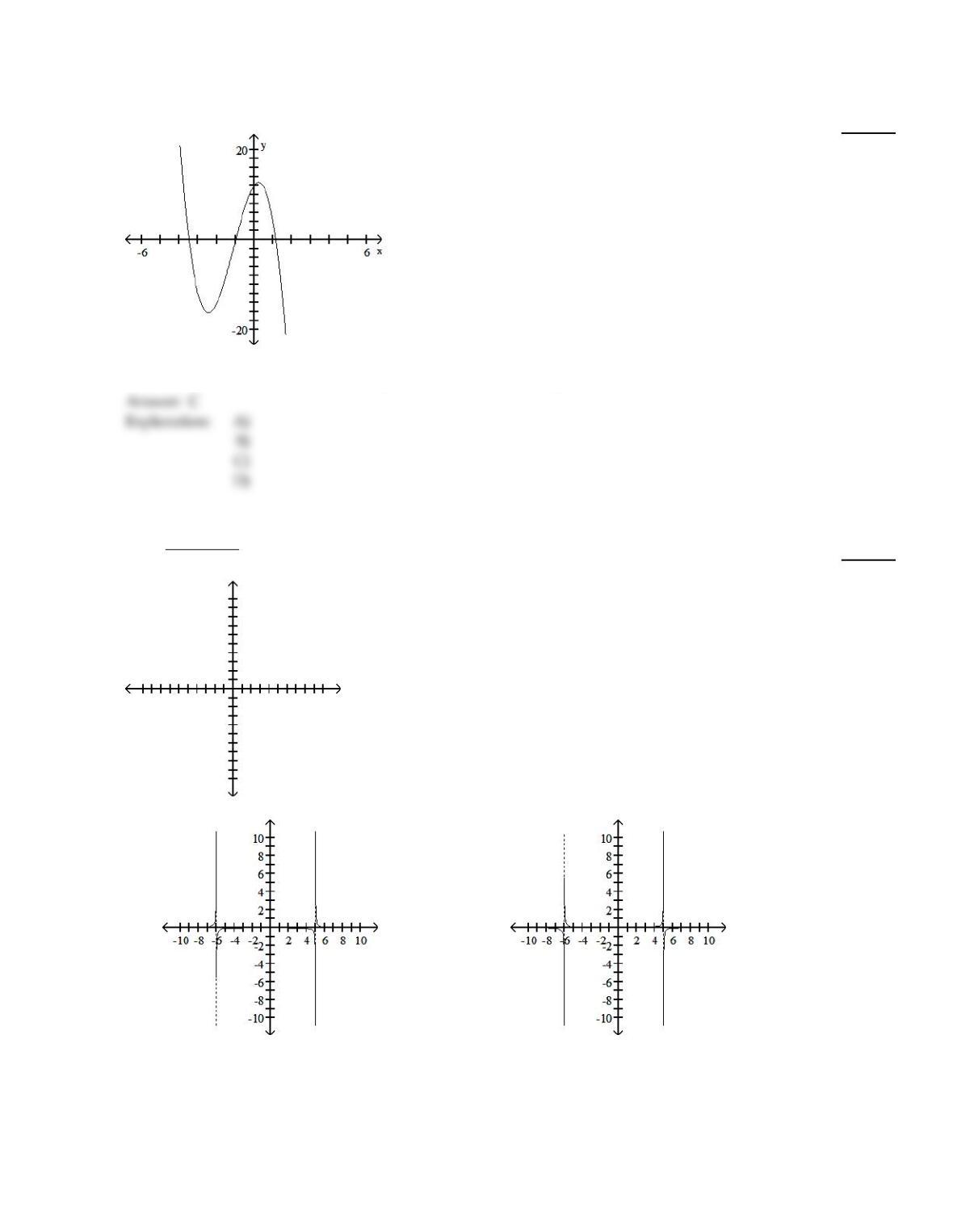
The graph that follows is the graph of a polynomial function. (i) What is the minimum degree of a polynomial function
that could have the graph? (ii) Is the leading coefficient of the polynomial negative or positive?
66)
66)
A)
(i) 4
(ii) Positive
B)
(i) 4
(ii) Negative
C)
(i) 3
(ii) Negative
D)
(i) 3
(ii) Positive
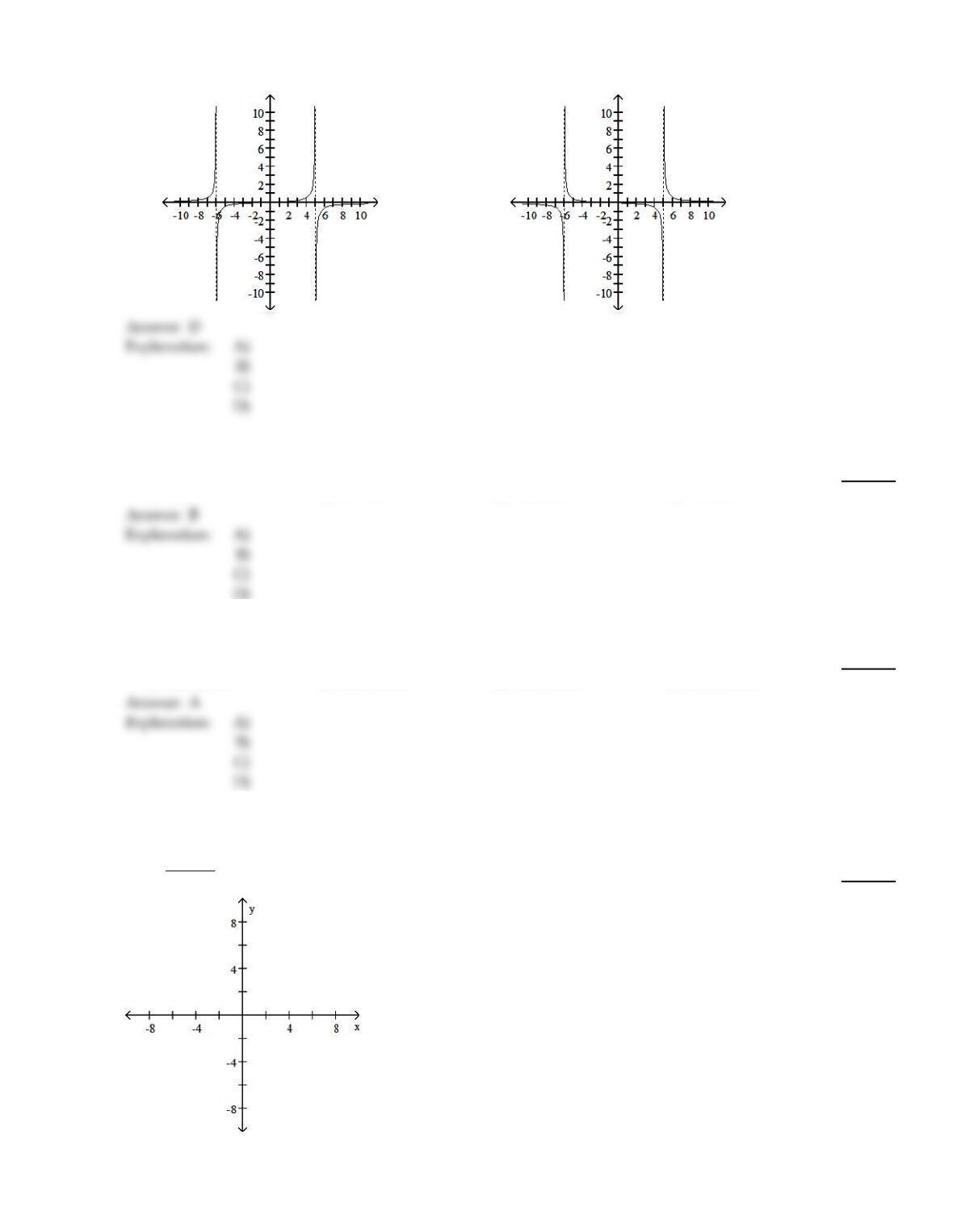
Sketch the graph of the function.
67)
f(x) =x + 1
x2+ x –30
67)
A)
B)
27
C)
D)
Solve the equation.
68)
Solve for t: e–0.07t = 0.05 Round your answer to four decimal places.
68)
A)
44.321
B)
42.7962
C)
–66.4815
D)
–70.1312
Determine whether there is a maximum or minimum value for the given function, and find that value.
69)
f(x) = – x2– 18x – 90
69)
A)
Maximum: – 9
B)
Minimum: –9
C)
Minimum: 9
D)
Minimum: 0
For the rational function below (i) Find the intercepts for the graph; (ii) Determine the domain; (iii) Find any vertical or
horizontal asymptotes for the graph; (iv) Sketch any asymptotes as dashed lines. Then sketch the graph of y = f(x).
70)
f(x) =–2x – 3
x + 2
70)
28
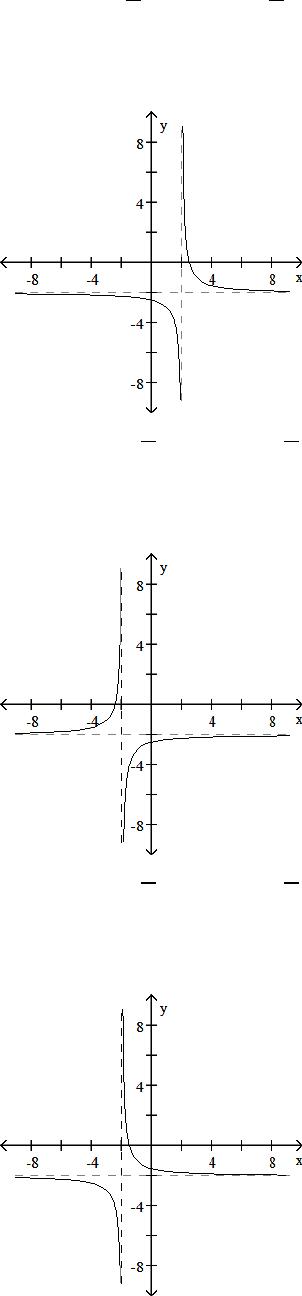
A)
(i) x intercept: 3
2; y intercept: –3
2
(ii) Domain: all real numbers except 2
(iii) Vertical asymptote: x = 2; horizontal asymptote: y = – 2
(iv)
B)
(i) x intercept: –3
2; y intercept: –3
2
(ii) Domain: all real numbers except –2
(iii) Vertical asymptote: x = – 2; horizontal asymptote: y = – 2
(iv)
C)
(i) x intercept: –3
2; y intercept: –3
2
(ii) Domain: all real numbers except –2
(iii) Vertical asymptote: x = – 2; horizontal asymptote: y = – 2
(iv)
29
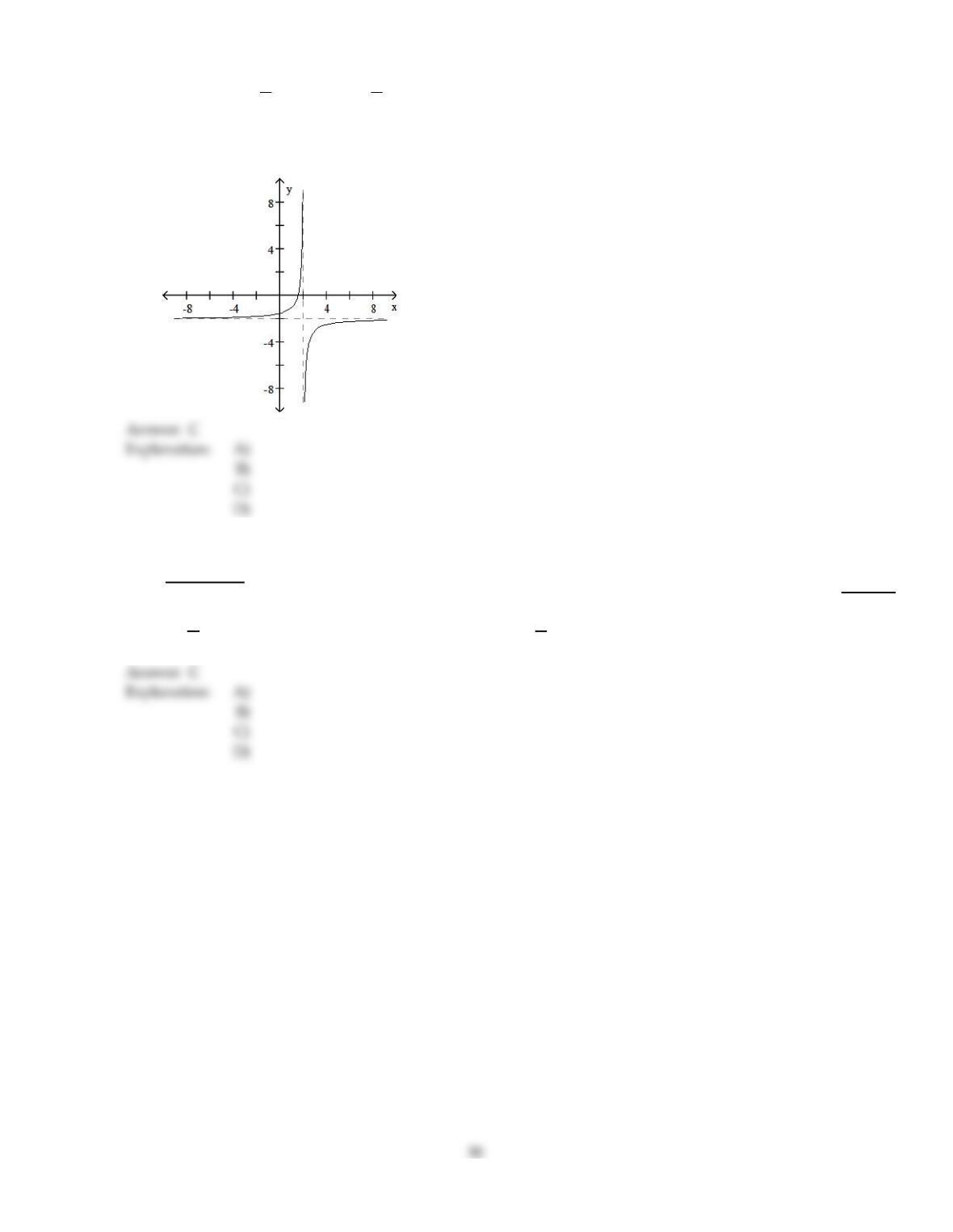
D)
(i) x intercept: 3
2; y intercept: –3
2
(ii) Domain: all real numbers except 2
(iii) Vertical asymptote: x = 2; horizontal asymptote: y = – 2
(iv)
Find the equation of any horizontal asymptote.
71)
f(x) =7x2– 2x – 9
5x2– 9x + 9
71)
A)
y =
2
9
B)
y = 0
C)
y =
7
5
D)
None
Find the vertex form for the quadratic function. Then find each of the following:
(A) Intercepts
(B) Vertex
(C) Maximum or minimum
(D) Range
72)
f(x) =x2+ 2x – 3
72)
A)
Standard form: f(x) =(x – 1)2– 4
(A) x–intercepts: – 3, 1; y–intercept: -3
(B) Vertex (-1, -4)
(C) Maximum: -4
(D) y -4
B)
Standard form: f(x) =(x + 1)2– 4
(A) x–intercepts: – 3, 1; y–intercept: -3
(B) Vertex (1, -4)
(C) Minimum: -4
(D) y -4
C)
Standard form: f(x) =(x + 1)2– 4
(A) x–intercepts: – 3, 1; y–intercept: -3
(B) Vertex (-1, -4)
(C) Minimum: -4
(D) y -4
D)
Standard form: f(x) =(x – 1)2– 4
(A) x–intercepts: -1, 3; y–intercept: -3
(B) Vertex (-1, -4)
(C) Minimum: -4
(D) y -4
Find the equation of any horizontal asymptote.
73)
f(x) =4x2+ 2
4x2– 2
73)
A)
y =-2
B)
y =2
C)
y = 1
D)
None
31
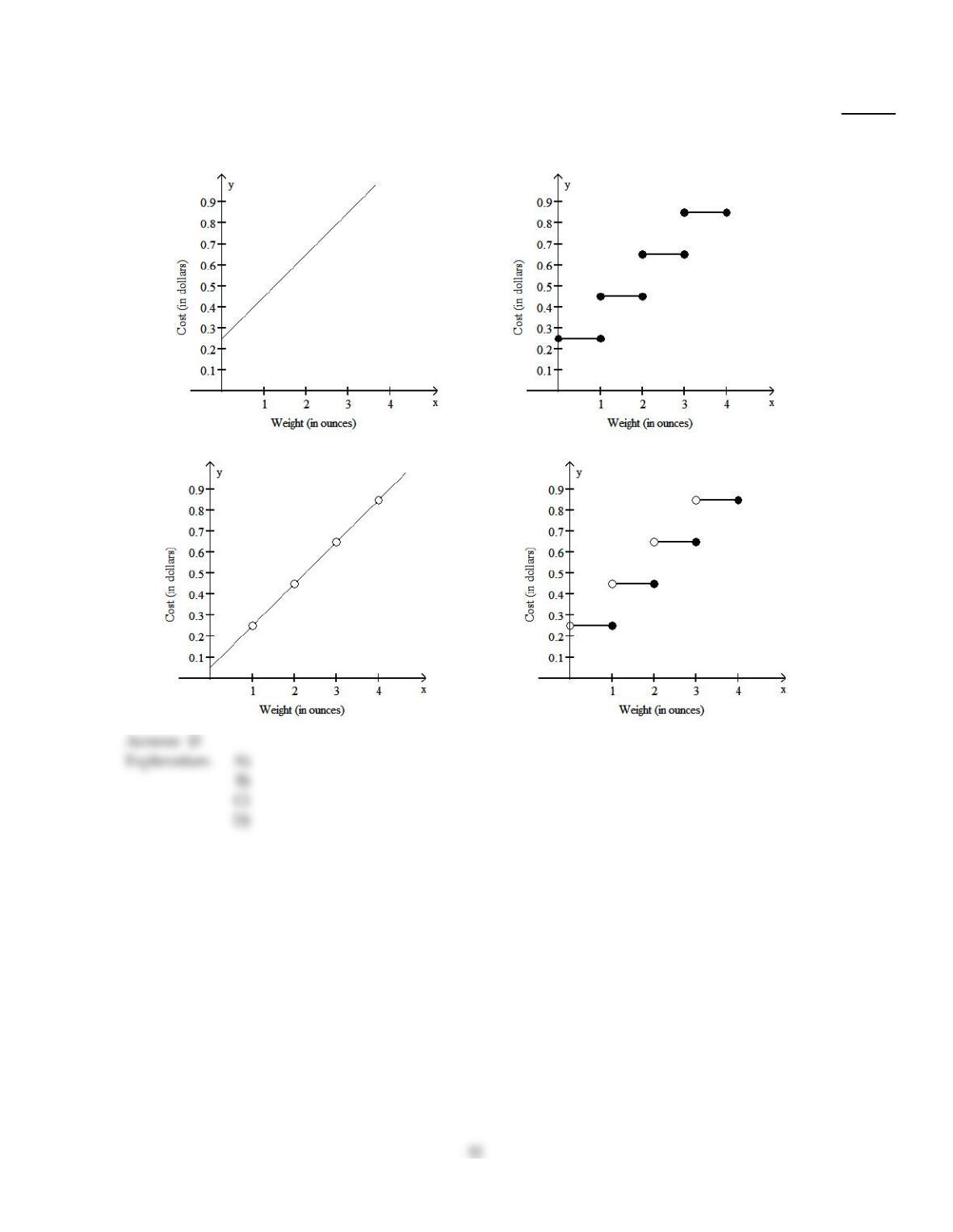
Graph the function.
74)
Assume it costs 25 cents to mail a letter weighing one ounce or less, and then 20 cents for each
additional ounce or fraction of an ounce. Let L(x) be the cost of mailing a letter weighing x ounces.
Graph y = L(x). Use the interval (0, 4].
74)
A)
B)
C)
D)
Write an equation for the lowest–degree polynomial function with the graph and intercepts shown in the figure.
75)
75)
A)
f(x) = – x2– 12x –35
B)
f(x) =x2+ 12x + 35
C)
f(x) =x2+ 35x – 12
D)
f(x) =x2+ 35x + 12
Use a calculator to evaluate the expression. Round the result to five decimal places.
76)
log 0.17
76)
A)
–1.76955
B)
–0.76955
C)
–4.07454
D)
–1.77196
Convert to an exponential equation.
77)
log 8 512 = t
77)
A)
8t= 512
B)
5128= t
C)
t8= 512
D)
8512 = t
Use the properties of logarithms to solve.
78)
log7 x +log7(x – 2) =log7 24
78)
A)
24
B)
2
C)
6
D)
7
79)
log (x + 10) – log (x + 4) = log x
79)
A)
2
B)
6
C)
2, – 5
D)
–5
A
Solve the problem.
80)
A carbon–14 dating test is performed on a fossil bone, and analysis finds that 15.5% of the original
amount of carbon–14 is still present in the bone. Estimate the age of the fossil bone. (Recall that
carbon–14 decays according to the equation A =A0e–0.000124t).
80)
A)
1,500 years
B)
15,035 years
C)
15, 000 years
D)
150 years
B
81)
The function M described by M(x) = 2.89x + 70.64 can be used to estimate the height, in centimeters,
of a male whose humerus (the bone from the elbow to the shoulder) is x cm long. Estimate the
height of a male whose humerus is 30.93 cm long. Round your answer to the nearest four decimal
places.
81)
A)
160.0277 cm
B)
157.3400 m
C)
30.9300 cm
D)
156.5375 cm
A
Solve graphically to two decimal places using a graphing calculator.
82)
1.3x2–2.1x –3.2 0
82)
A)
x < – 0.96 or x >2.57
B)
–2.57 < x <0.96
C)
–0.96 < x <2.57
D)
x < – 2.57 or x >0.96
C
C
Determine whether the relation represents a function. If it is a function, state the domain and range.
83)
{(-2, 5), (-1, 2), (0, 1), (1, 2), (3, 10)}
83)
A)
function
domain: {5, 2, 1, 10}
range: {-2, -1, 0, 1, 3}
B)
function
domain: {-2, -1, 0, 1, 3}
range: {5, 2, 1, 10}
C)
not a function
Solve the problem.
84)
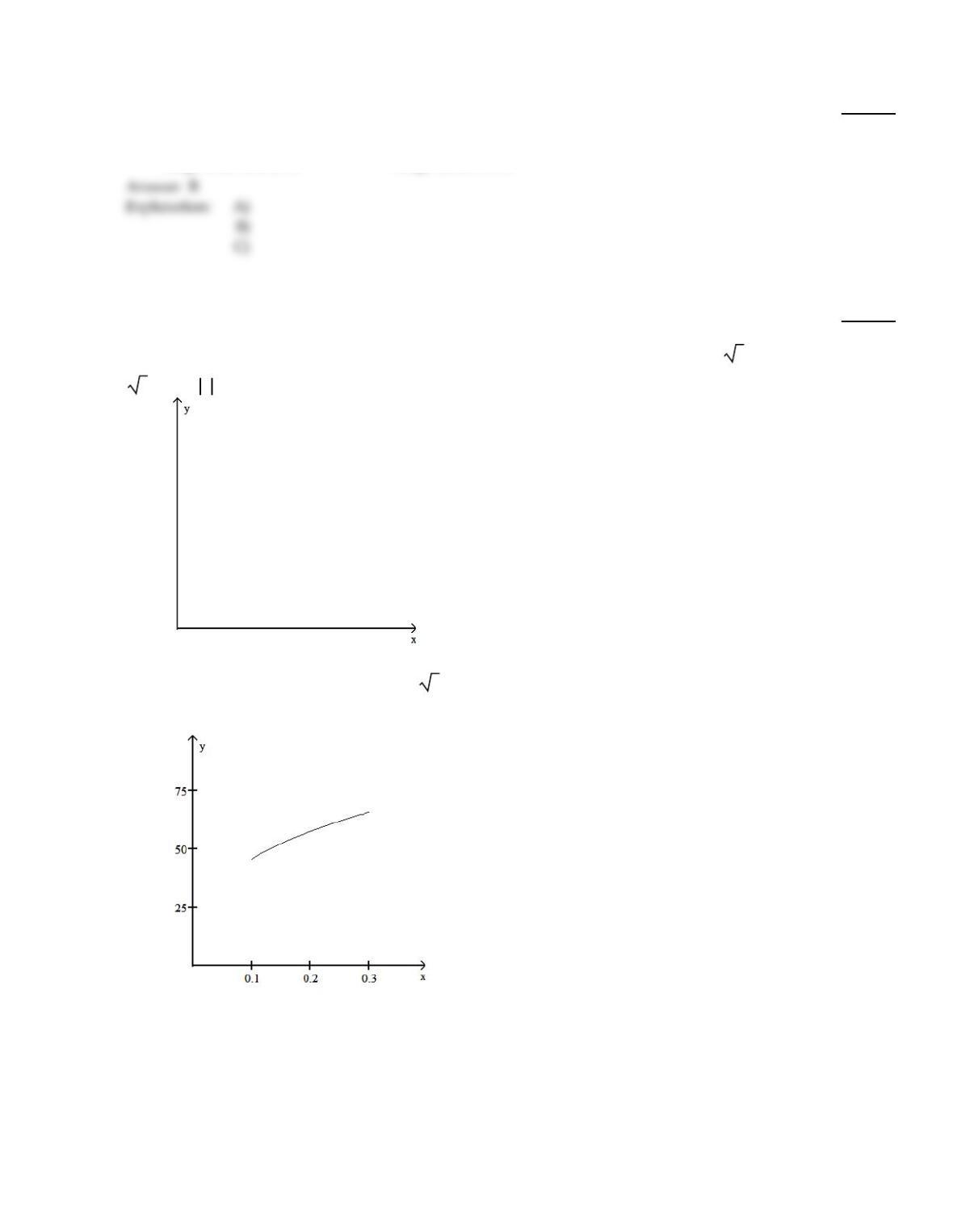
The average weight of a particular species of frog is given by w(x) = 98x3, 0.1 x 0.3, where x is
length (with legs stretched out) in meters and w(x) is weight in grams. (i) Describe how the graph
of function w can be obtained from one of the six basic functions: y = x, y =x2, y =x3, y =x, y =
3x, or y =x. (ii) Sketch a graph of function w using part (i) as an aid.
84)
A)
(i) The graph of the basic function y =3x is
vertically expanded by a factor of 98.
(ii)
35
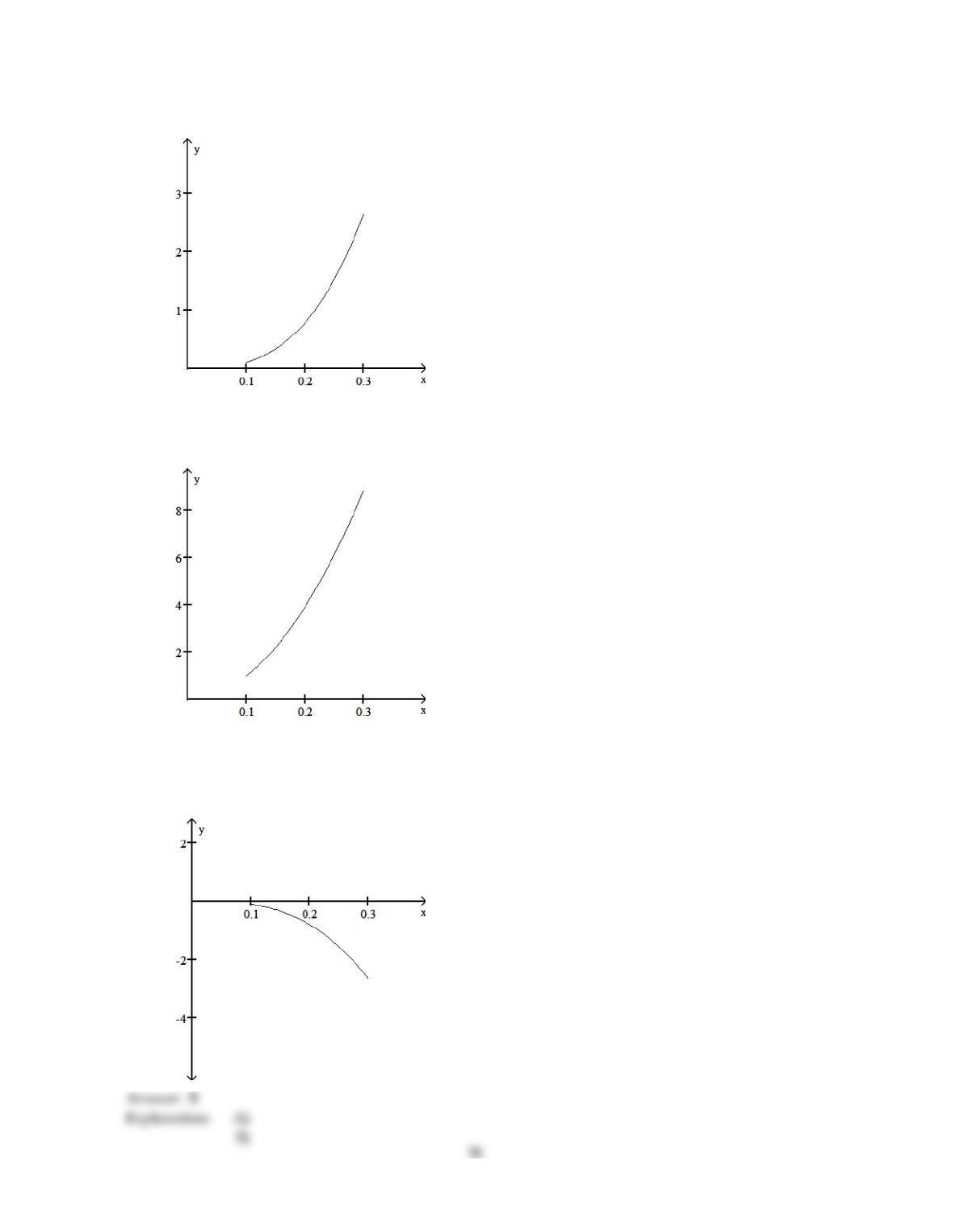
B)
(i) The graph of the basic function y =x3 is
vertically expanded by a factor of 98.
(ii)
C)
(i) The graph of the basic function y =x2 is
vertically expanded by a factor of 98.
(ii)
D)
(i) The graph of the basic function y =x3 is
reflected on the x–axis and is vertically
expanded by a factor of 98.
(ii)
Find the vertex form for the quadratic function. Then find each of the following:
(A) Intercepts
(B) Vertex
(C) Maximum or minimum
(D) Range
85)
m(x) = – x2– 6x – 8
85)
A)
Standard form: m(x) = – (x – 3)2+ 1
(A) x–intercepts: – 4, -2; y–intercept: -8
(B) Vertex (-3, 1)
(C) Minimum: 1
(D) y 1
B)
Standard form: m(x) = – (x + 3)2+ 1
(A) x–intercepts: – 4, -2; y–intercept: -8
(B) Vertex (3, -1)
(C) Maximum: 1
(D) y 1
C)
Standard form: m(x) = – (x + 3)2+ 1
(A) x–intercepts: – 4, -2; y–intercept: -8
(B) Vertex (-3, 1)
(C) Maximum: 1
(D) y 1
D)
Standard form: m(x) = – (x – 3)2+ 1
(A) x–intercepts: 2, 4; y–intercept: -8
(B) Vertex (-3, 1)
(C) Maximum: 1
(D) y 1
Solve the problem.
86)
In economics, functions that involve revenue, cost and profit are used. Suppose R(x) and C(x)
denote the total revenue and the total cost, respectively, of producing a new high–tech widget. The
difference P(x) = R(x) – C(x) represents the total profit for producing x widgets. Given R(x) = 60x –
0.4 x2 and C(x) = 3x + 13, find P(100).
86)
A)
55687
B)
313
C)
1687
D)
2000
For the rational function below (i) Find the intercepts for the graph; (ii) Determine the domain; (iii) Find any vertical or
horizontal asymptotes for the graph; (iv) Sketch any asymptotes as dashed lines. Then sketch the graph of y = f(x).
37
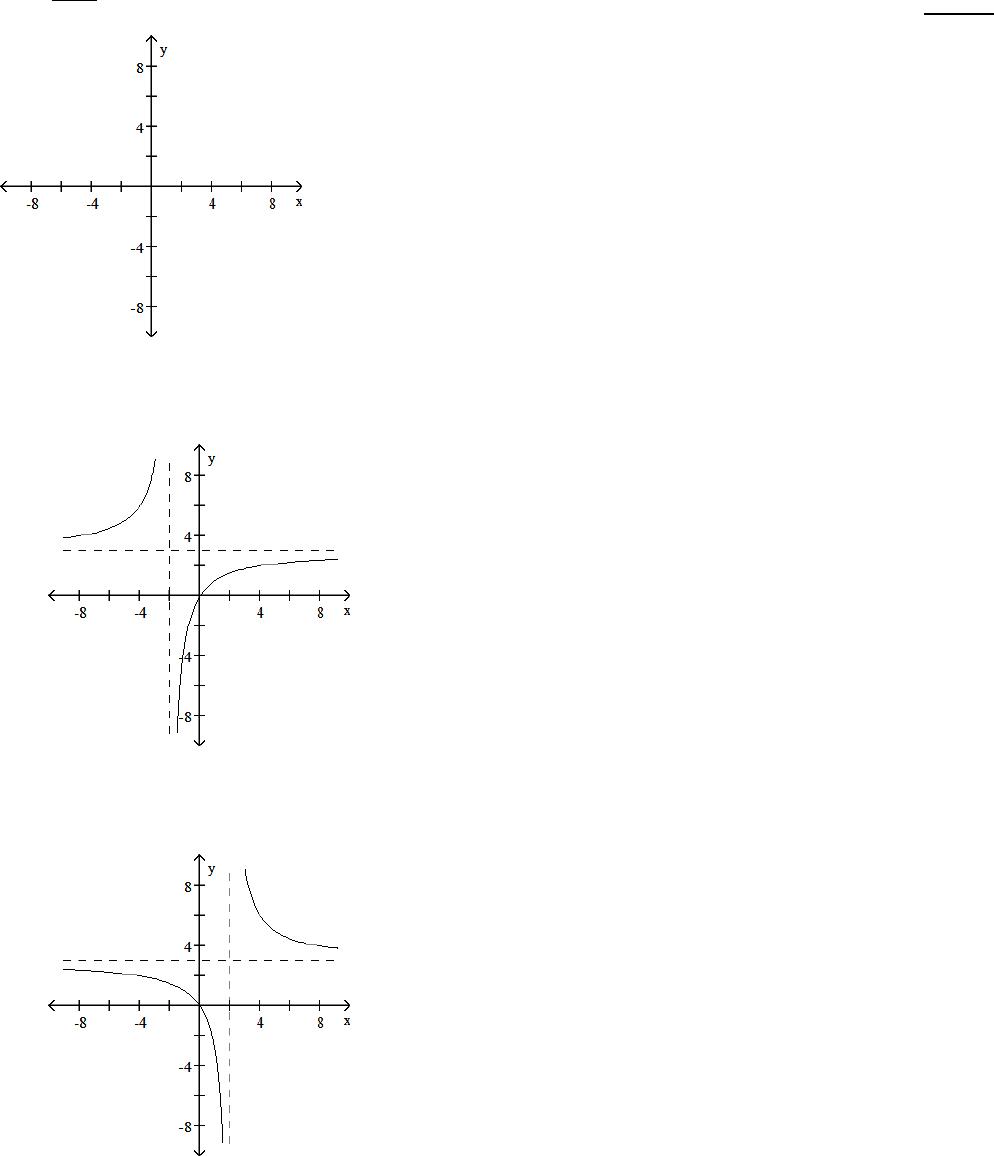
87)
f(x) =3x
x – 2
87)
A)
(i) x intercept: 0; y intercept: 0
(ii) Domain: all real numbers except –2
(iii) Vertical asymptote: x = – 2; horizontal asymptote: y = 3
(iv)
B)
(i) x intercept: 0; y intercept: 0
(ii) Domain: all real numbers except 2
(iii) Vertical asymptote: x = 2; horizontal asymptote: y = 3
(iv)
38
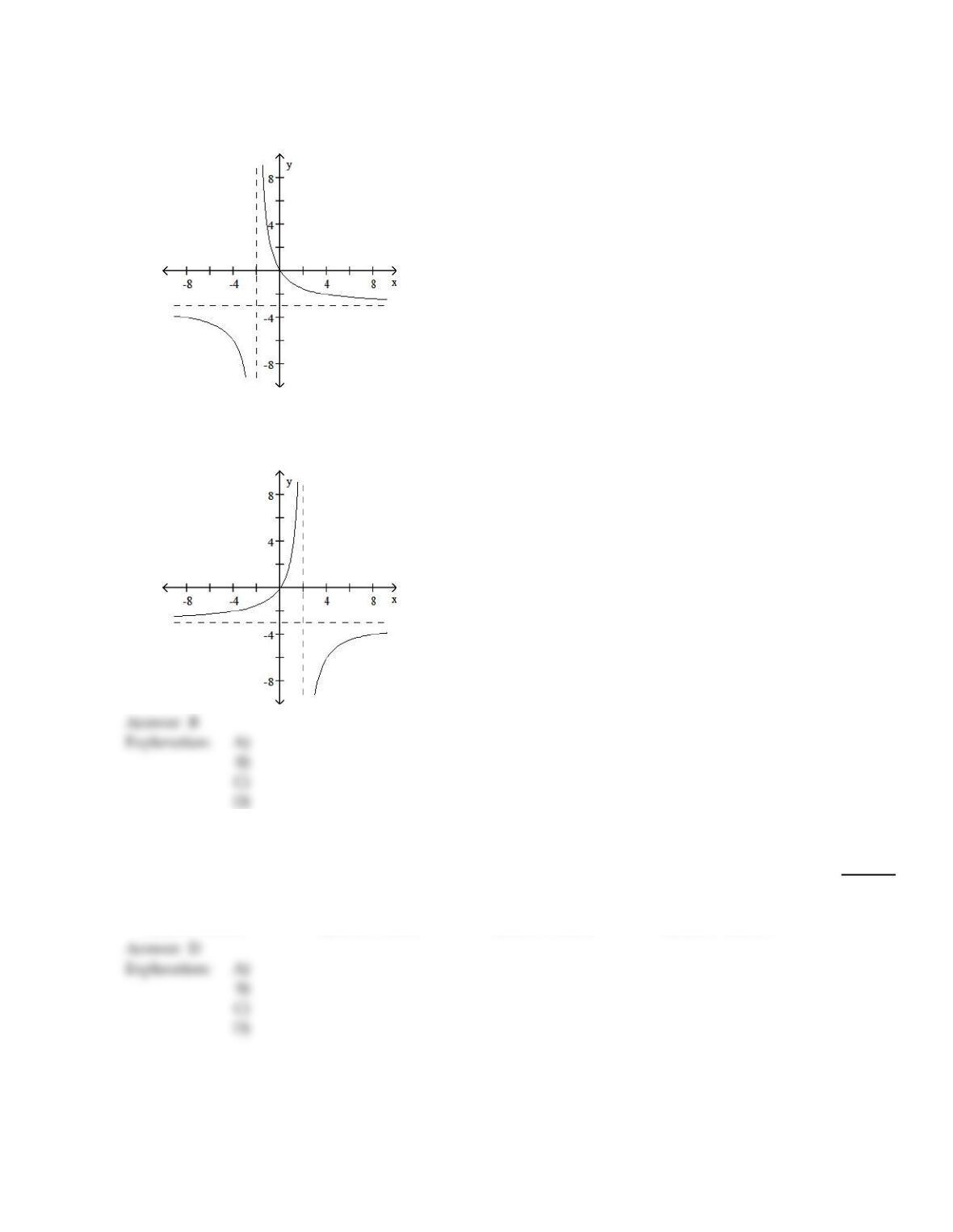
C)
(i) x intercept: 0; y intercept: 0
(ii) Domain: all real numbers except –2
(iii) Vertical asymptote: x = – 2; horizontal asymptote: y = – 3
(iv)
D)
(i) x intercept: 0; y intercept: 0
(ii) Domain: all real numbers except 2
(iii) Vertical asymptote: x = 2; horizontal asymptote: y = – 3
(iv)
Solve the problem.
88)
The polynomial 0.0053x3+ 0.003x2+ 0.108x + 1.54 gives the approximate total earnings of a
company, in millions of dollars, where x represents the number of years since 1996. This model is
valid for the years from 1996 to 2000. Determine the earnings for 2000. Round to 2 decimal places.
88)
A)
$2.26 million
B)
$2.82 million
C)
$2.03 million
D)
$2.36 million
39
For the polynomial function find the following: (i) Degree of the polynomial; (ii) All x intercepts; (iii) The y intercept.
89)
y =x2+ 4x – 12
89)
A)
(i) 2
(ii) –6, 2
(iii) -12
B)
(i) 2
(ii) 6, 2
(iii) -12
C)
(i) 2
(ii) 6, -2
(iii) -12
D)
(i) 2
(ii) –6, 1
(iii) -12
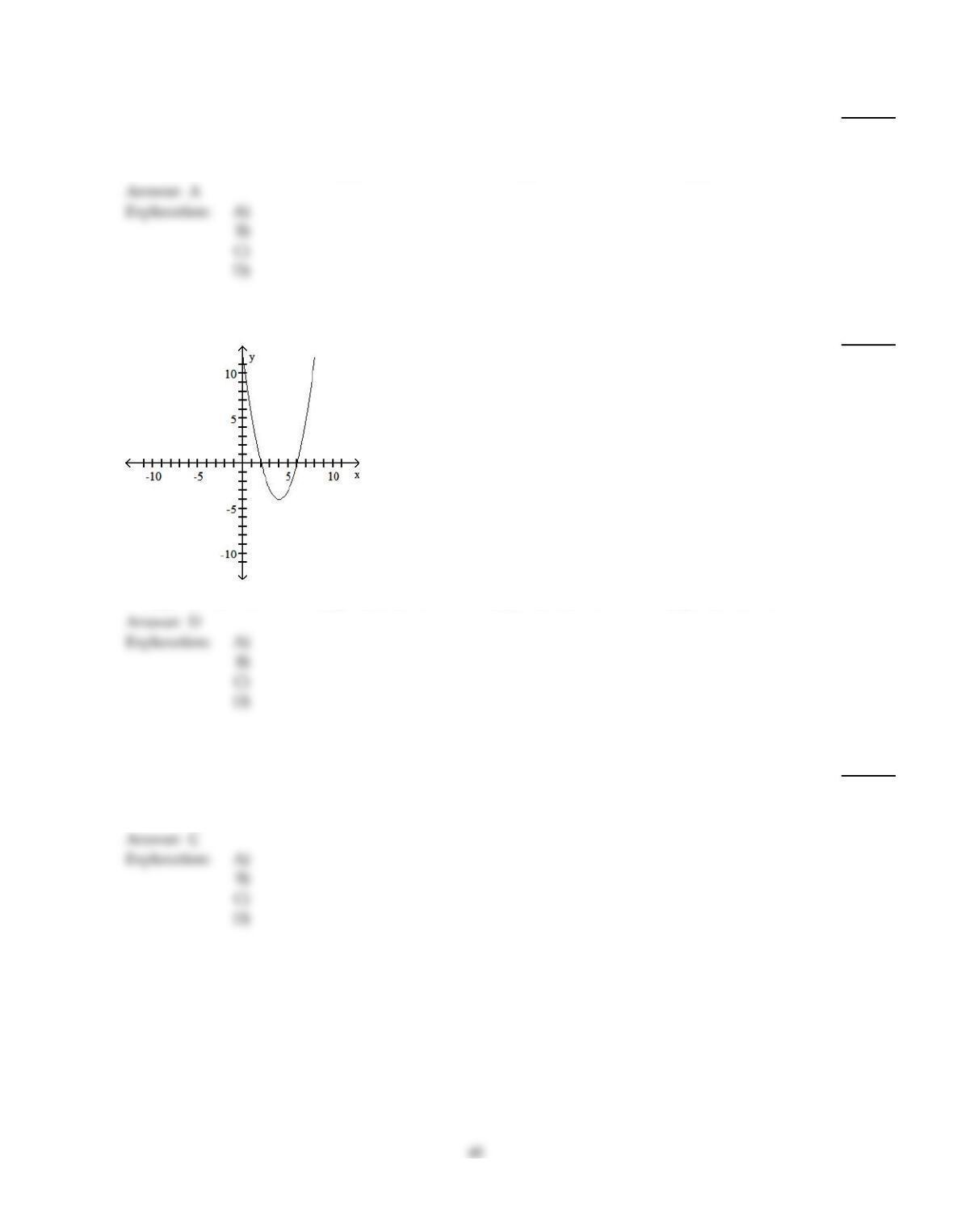
Write an equation for the graph in the form y = a(x – h)2+
k, where a is either 1 or –1 and h and k are integers.
90)
90)
A)
y =(x – 4)2–5
B)
y =(x + 4)2+5
C)
y =(x – 5)2– 4
D)
y =(x – 4)2– 4
Convert to a logarithmic equation.
91)
100.4771 = 3
91)
A)
0.4771 =log 9 10
B)
3 = log 0.4771
C)
0.4771 = log 3
D)
0.4771 = log 10