63)
The saying that “You cannot have your cake and eat it too” illustrates the economic concept of
63)
A)
physical capital.
B)
a normative statement.
C)
opportunity cost.
D)
a positive statement.
64)
Opportunity costs arise from
64)
A)
mistakes.
B)
regrets.
C)
choices.
D)
taxes.
65)
If all resources were perfectly adaptable for alternative uses, the production possibilities curve
would
65)
A)
be bowed out.
B)
be a straight line.
C)
be bowed in.
D)
not exist.
66)
Entrepreneurs are important to market economies because
66)
A)
they take few risks and thereby, suffer fewer bankruptcies.
B)
they engage in risk taking and innovation.
C)
they represent the bulk of employment at large corporations.
D)
they make up a large portion of low–skilled labor.
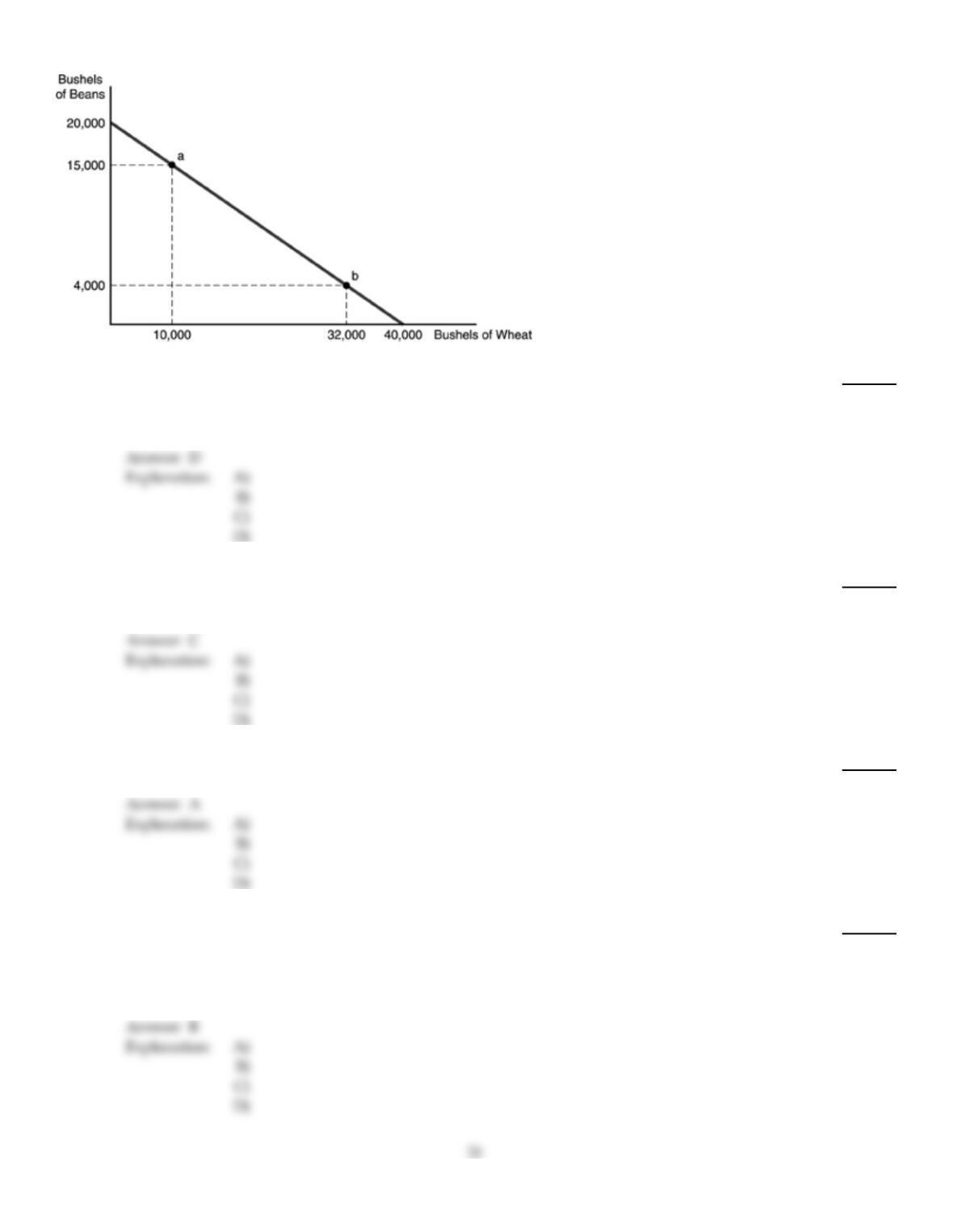
67)
Refer to the above figure. If the farmer has 50 acres of land, the farmer is producing at point a, and
an acre of land yields 400 bushels of beans or 800 bushels of wheat, how much land is devoted to
the production of wheat?
67)
A)
8.5 acres
B)
15 acres
C)
10 acres
D)
12.5 acres
68)
If Vice President Smith is a better typist than his assistant, he is said to have a(n) ________
advantage in typing over his assistant.
68)
A)
relative
B)
overwhelming
C)
absolute
D)
unusual
69)
Opportunity cost exists because of
69)
A)
scarcity.
B)
poverty.
C)
self–interest.
D)
greed.
70)
Economic growth is shown by
70)
A)
a point near the top of the production possibilities curve.
B)
an outward shift of the production possibilities curve.
C)
a point outside the production possibilities curve.
D)
an inward shift of the production possibilities curve.
71)
The production possibilities curve bows out because
71)
A)
resources are not being fully utilized.
B)
production is inefficient.
C)
production is efficient.
D)
of the law of increasing additional cost.
72)
The trade–off between the present and future consumption is measured by
72)
A)
the money cost of both the present and future consumption.
B)
the difference between the money price of present goods and the money cost of producing
them.
C)
the difference between the money price of future goods and the money cost of producing
them.
D)
the foregone present consumption.
73)
From the economist’s point of view,
73)
A)
needs are objectively undefinable.
B)
wants and needs are exactly the same.
C)
we all have wants but only very poor people have needs.
D)
a want is a lifesaving necessity.
74)
“Wants” as an economic concept includes
74)
A)
only those goods that can be purchased with one‘s paycheck.
B)
only the desire for luxury goods.
C)
both material and nonmaterial desires.
D)
only the purchase of necessary basic goods.
75)
A production point that lies outside the Production Possibilities Curve (PPC)
75)
A)
is currently not attainable.
B)
can never be reached, even in future periods.
C)
denotes inefficiency.
D)
indicates unemployment.
76)
People always face trade–offs because
76)
A)
they buy goods with money.
B)
they always have more than one use for their time and money.
C)
they can make themselves better off through trade.
D)
trading takes place in a market economy.
B
77)
The difference between scarcity and a shortage is that
77)
A)
scarcity always is a part of human life while shortages usually are temporary.
B)
shortages are always part of human life while scarcity is usually temporary.
C)
shortages are a type of scarcity caused by natural disasters while scarcity is caused by human
errors.
D)
scarcity is caused by poverty and shortages are caused by natural disasters.
A
78)
A student has a job that pays a wage rate of $10 per hour. The night before an economics exam, the
student has set aside four hours to study for the exam, estimating that for each hour spent studying,
her grade will rise by 5 points. That night, she gets a call from her employer to come to work for a
wage rate of $15 per hour for that night. She decides to work for three hours and earn an extra
$45.00. The next day she takes the test and gets a grade of 75. The opportunity cost for her work is
78)
A)
the entire four hours she set aside for studying.
B)
the 15 extra points she estimates that she could have earned on the exam if she had studied
the extra three hours.
C)
the three hours she did not study.
D)
the $45.00 she earned.
B
A
79)
Economic goods are
79)
A)
goods that are scarce, for which the quantity demanded exceeds the quantity supplied at any
price.
B)
goods that are scarce, for which the quantity demanded exceeds the quantity supplied at a
zero price.
C)
all imaginable items from which individuals derive satisfaction or happiness.
D)
abundant goods, about which we must constantly make decisions about their best use.
80)
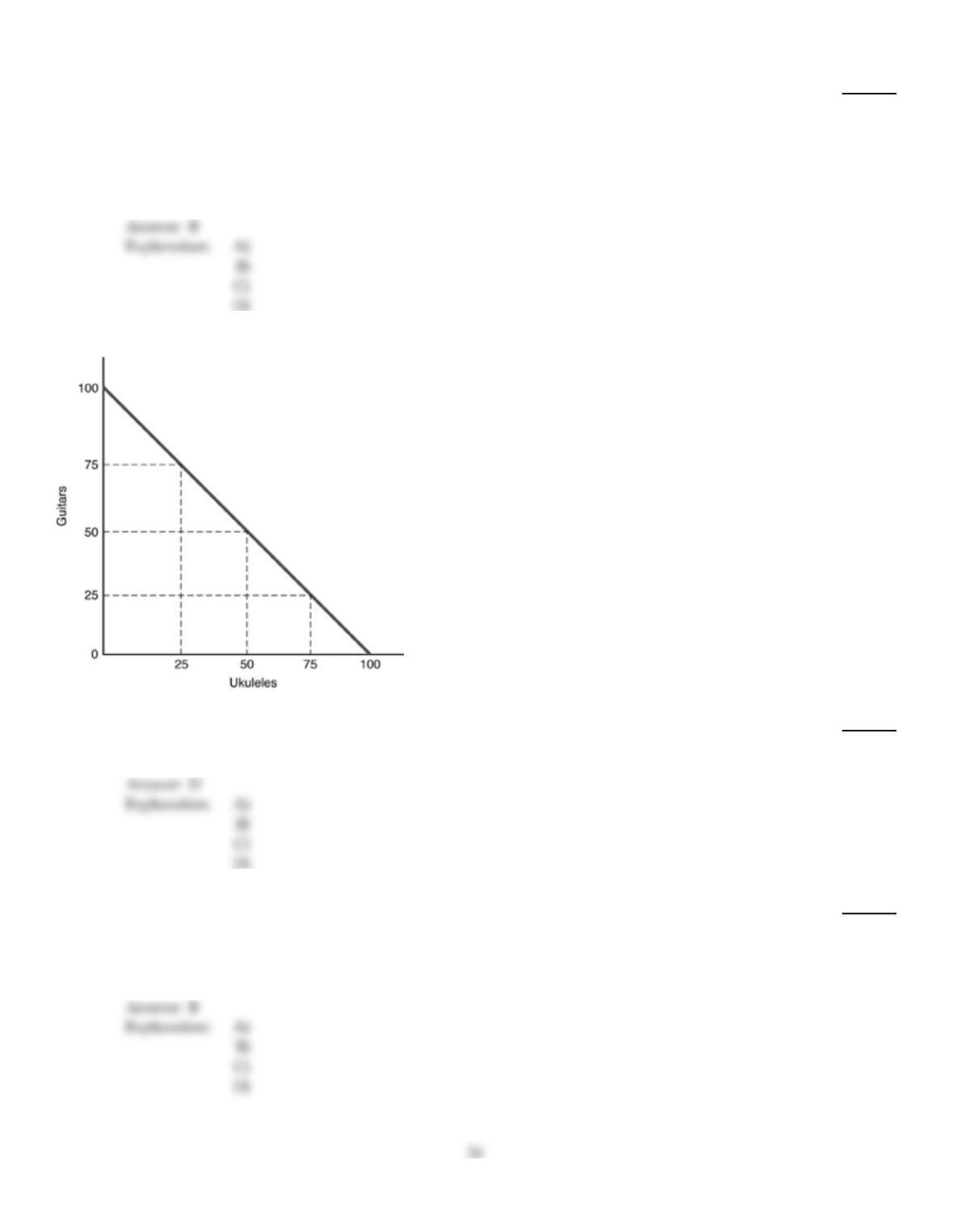
In the above figure, the opportunity cost of moving from producing 75 guitars and 25 ukuleles to
producing 50 guitars and 50 ukuleles is
80)
A)
25 ukuleles.
B)
100 guitars.
C)
50 guitars.
D)
25 guitars.
81)
If the production possibilities curve is a downward sloping straight line, then
81)
A)
resources are highly specialized, making it difficult to use them for alternative uses.
B)
all resources must be perfectly adaptable for alternative uses.
C)
technological change has increased.
D)
production is efficient only when producing at the mid–point.
82)
In economics, the term physical capital
82)
A)
refers to the process of raising funds through the stock market.
B)
refers to funds used by businesses to acquire goods and services.
C)
refers to all manufactured resources used for production.
D)
defines the stock of merchandise already produced.
83)
John has decided to view the solar eclipse tomorrow. The eclipse is an example of
83)
A)
a good.
B)
entrepreneurship.
C)
an economic good.
D)
a service.
84)
The concept of opportunity cost exists because
84)
A)
of shortages.
B)
goods have different prices.
C)
the value of services is hard to determine.
D)
of scarcity.
85)
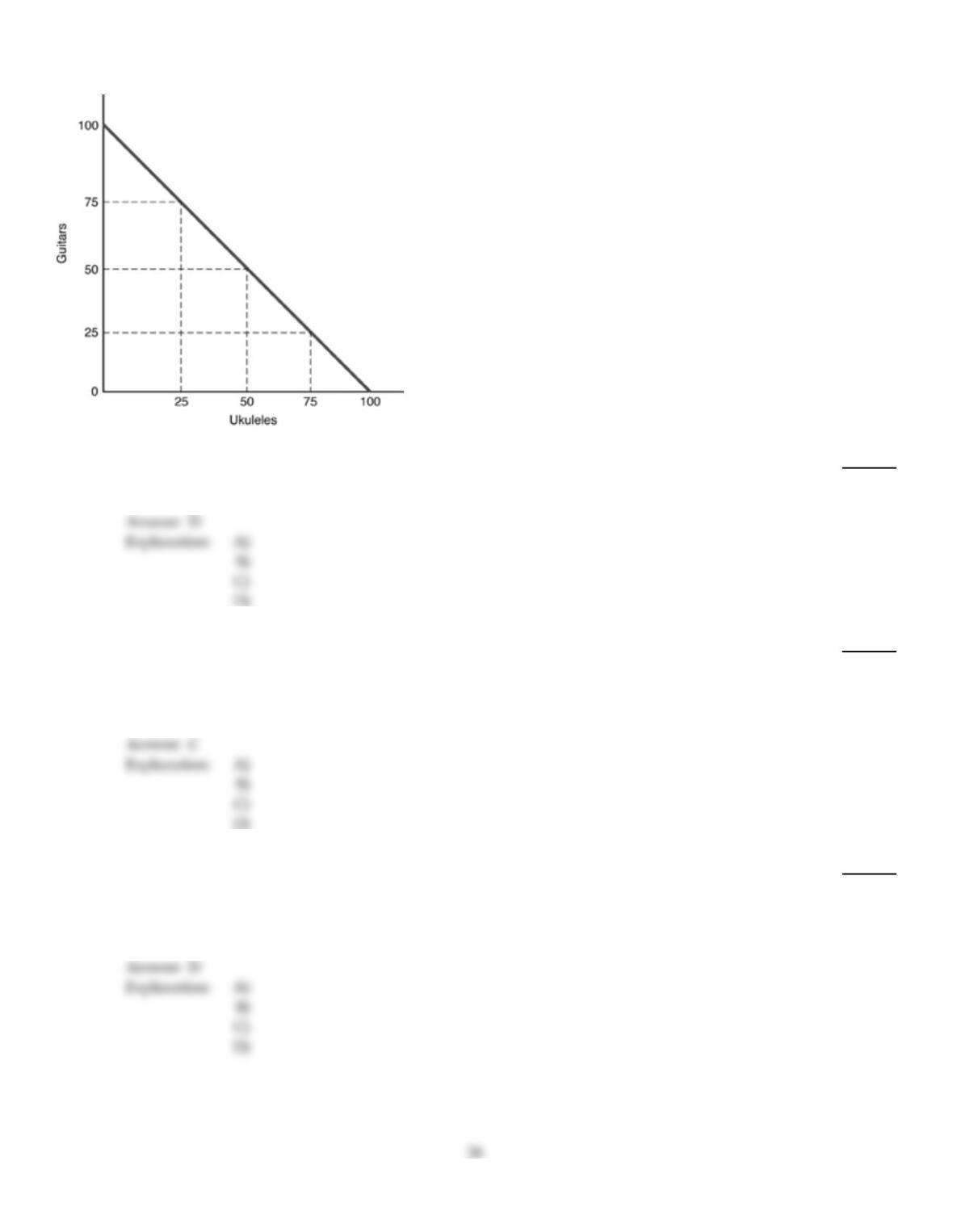
In the above figure, moving from producing 50 guitars and 50 ukuleles to producing 25 guitars and
75 ukuleles, the opportunity cost of one ukulele is
85)
A)
75 ukuleles.
B)
25 guitars.
C)
25 ukuleles.
D)
1 guitar.
86)
A point inside a production possibilities curve indicates
86)
A)
resources are being used very efficiently.
B)
an output combination that is unobtainable with the current resource and technology levels
C)
resources are not being used efficiently.
D)
opportunity costs are constant.
87)
Comparative advantage is
87)
A)
only for individuals and not countries.
B)
when a country can produce all goods more quickly than any other country.
C)
when the production possibilities curve shifts outward to the right.
D)
when a country can produce a good at a lower opportunity cost compared to other countries.
88)
A country operates inside its production possibilities curve; this may be caused by
88)
A)
a lack of modern products being produced.
B)
total efficiency in industry.
C)
a new resource being discovered.
D)
unemployed resources.
89)
To have more consumer goods in the future, we must
89)
A)
produce more capital goods today.
B)
get government involved in the production process.
C)
lower current income.
D)
stop producing all goods today.
90)
Fred and Ann both decide to see the same movie when they are given free movie tickets. We know
that
90)
A)
the cost of going to the movie is greater for the one who had more choices to do other things.
B)
both bear the same opportunity cost since they are doing the same thing.
C)
neither bears an opportunity cost because the tickets were free.
D)
both bear an opportunity cost since they could have done other things instead of see the
movie.
91)
Human capital is
91)
A)
the human resources that perform the function of raising capital.
B)
the accumulation of skills, training and education of workers.
C)
what people get from physical capital.
D)
the value obtained from selling stocks and bonds.
92)
Which of the following is NOT considered to be an economic resource?
92)
A)
your economics professor
B)
the local gas station
C)
the telephone company repair truck
D)
a view of the stars on a clear night
93)
Production is efficient when
93)
A)
the maximum amounts of the most important good are produced.
B)
it generates a point beyond the production possibility curve.
C)
the maximum output possible is being produced given current levels of resources and
technology.
D)
technological change occurs.
94)
Which of the following is NOT an economic good?
94)
A)
a haircut
B)
a sunset
C)
broccoli
D)
education
95)
Which of the following activities are production?
95)
A)
Moving coal from southern Illinois to an electrical power plant in northern Illinois.
B)
Combining flour, milk, and eggs to make cookies.
C)
Taking ice cubes from a tray to put in a drink.
D)
All of the above are production.
96)
Extremely cold winter weather has destroyed oranges in Florida. The freeze has caused
96)
A)
scarcity because people have to switch to other types of citrus fruits.
B)
a shortage because people cannot obtain as many oranges as they wish to buy at the
pre–freeze price.
C)
scarcity because there are less oranges now than people want.
D)
a shortage because the orange growers will have less income.
97)
Steve and Karen decide to attend the same concert when they are each given free tickets to it. We
know that
97)
A)
neither bears an opportunity cost since the tickets were given free to them.
B)
both bear an opportunity cost that depends on what each person is giving up to attend the
concert.
C)
both bear the same opportunity cost because they are seeing the same thing.
D)
both bear the same opportunity cost because the tickets have the same face value.
98)
A straight–line production possibilities curve has
98)
A)
no opportunity cost between the two goods.
B)
a constant opportunity cost between the two goods.
C)
a decreasing opportunity cost between the two goods.
D)
an increasing opportunity cost between the two goods.
99)
An improvement in technology will shift the production possibilities curve
99)
A)
inward.
B)
to the left.
C)
along the curve.
D)
to the right.
100)
The production possibilities curve bows outward because
100)
A)
resources are of uniform quality.
B)
opportunity costs are fixed as the production of a good increases.
C)
opportunity costs are increasing as the production of a good increases.
D)
opportunity costs are decreasing as the production of a good increases.
SHORT ANSWER. Write the word or phrase that best completes each statement or answers the question.
101)
How are scarcity, choice, and opportunity cost related?
101)
102)
Distinguish between scarcity and shortages.
102)
103)
It is not uncommon for people to say something like, “If we can put someone on the moon
we should be able to . . . ,” followed by the person’s favorite project. What response can an
economist make to this person?
103)
104)
Why do most people specialize in their work?
104)
105)
“Economics is the study of how people eliminate scarcity.” Do you agree or disagree?
Why?
105)
106)
Briefly explain the factors of production and give an example of each.
106)
107)
Are all goods economic goods? Are all economic goods also goods? Explain.
107)
108)
Explain why even the most affluent people, businesses and counties never solve the
problem of scarcity.
108)
109)
Why does the trade–off between consumption goods and capital goods represent a
trade–off between the present and the future?
109)
110)
Explain: “The law of increasing additional cost is an inevitable phenomenon in economics.”
110)
111)
Briefly explain the concept of opportunity cost. What is the opportunity cost of attending
college?
111)
112)
Explain what is meant by economic efficiency. Does efficiency imply that the fastest
production processes or the most powerful equipment must always be used? Explain.
112)
113)
What is the difference between comparative advantage and absolute advantage?
113)
114)
Briefly explain how specialization and trade can benefit nations.
114)
115)
Explain briefly what will likely happen to society if it chooses to produce more capital
goods and fewer consumption goods.
115)
116)
Why is a point below the production possibilities curve less efficient than a point on that
curve?
116)
117)
What causes the production possibility curve to be bowed out?
117)
118)
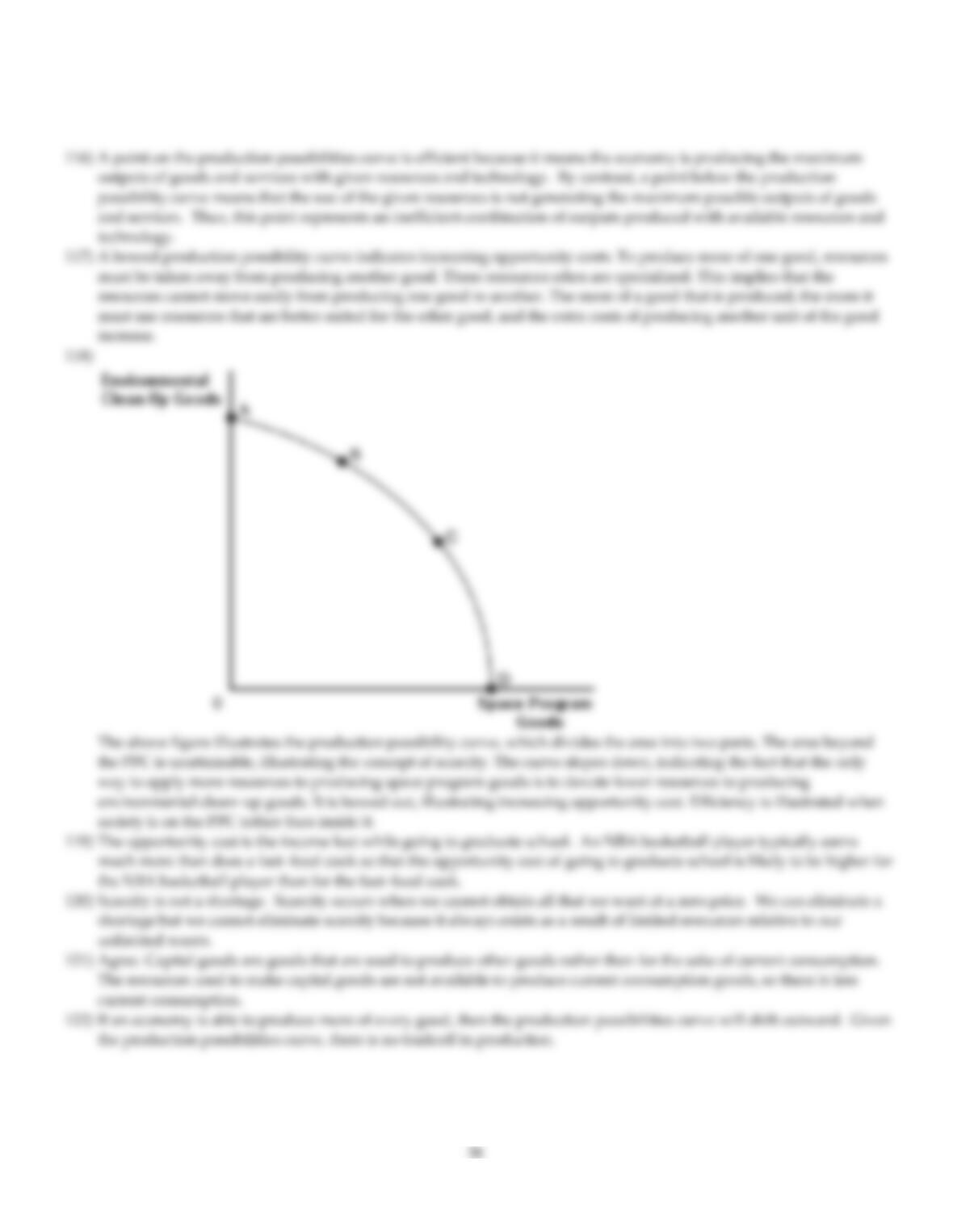
For a country that produces two goods: Environmental clean–up goods and space program
goods. What economic information is contained in its production possibility curve?
118)
119)
Both an NBA basketball player and a fast–food cook are going to graduate school. Who
has a higher opportunity cost? Explain.
119)
120)
Briefly explain the difference between the concepts of scarcity and shortage.
120)
121)
“Because resources are scarce, the production of more capital goods means that fewer
resources are available to produce consumption goods, so there is less current
consumption.” Do you agree or disagree? Explain.
121)
122)
What happens to the production possibilities curve if technology enables an economy to
produce more of every good? Is there any tradeoff involved in this change?
122)

Answer Key
Testname: C2
Answer Key
Testname: C2
Answer Key
Testname: C2
Answer Key
Testname: C2