2-20 Test Bank – Chapter 2 – The Financial Statements
5. For each financial statement item listed in 1 through 5 below, identify in which balance
sheet category (listed in a through h) it should be reported. You may use each letter
more than once or not at all.
Financial Statement Categories
a. Current assets
b. Long-term investments
c. Property, plant, and equipment
d. Intangible assets
e. Current liabilities
f. Long-term liabilities
g. Shareholders’ equity
h. Not disclosed on the balance sheet
1.
Contributed capital
2.
Prepaid insurance
3.
Accounts payable
4.
Sales revenue
5.
Delivery truck
6. For each statement listed in 1 through 5 below, state whether it is correct or not by
writing ‘Yes’ or ‘No’ in the space provided.
1. Financing activities involve the sale of goods and services of a
business.
2. The income statement is often referred to as a statement of financial
condition.
3. The most liquid of all assets is cash.
4. The asset sections found on a classified balance sheet include current
assets, current liabilities, and owners’ equity.
5. Dividends payable, Inventories, Contributed capital, and Accumulated
Depreciation all appear on a company’s balance sheet.
Test Bank – Chapter 2 – The Financial Statements 2-21
7. For each financial statement item listed in 1 through 7 below, identify in which balance
sheet category (listed in a through h) it should be reported. You may use each letter
more than once or not at all.
Financial Statement Categories
a. Current assets
b. Long-term investments
c. Property, plant, and equipment
d. Intangible assets
e. Current liabilities
f. Long-term liabilities
g. Shareholders’ equity
h. Not disclosed on the balance sheet
1.
Accumulated depreciation
2.
Accounts receivable
3.
Trademarks
4.
Investment in bonds
5.
Retained earnings
6.
Short-term investments
7.
Prepaid insurance
2-22 Test Bank – Chapter 2 – The Financial Statements
SHORT PROBLEMS
1. Given below are several accounts from Kramer Company’s accounting records.
Cash $12,500
Accumulated depreciation 8,000
Retained earnings, beginning of year 17,000
Contributed capital 14,000
Patents 3,000
Dividends 3,000
Net income for the year was $30,000. How much is total shareholders’ equity at the end
of the year?
2. Below are several amounts from Netcom Company’s accounting records. Answer the
questions that follow.
Total assets, end of year $190,000
Total liabilities, end of year 88,000
Contributed capital, end of year 20,000
Retained earnings, beginning of year 65,000
Dividends for the period 15,000
Net income 32,000
A. Calculate the amount of retained earnings at the end of the year.
B. If revenue amounts to $200,000, how much is ‘total expenses’?
C. How do you know the company has been profitable since it began operations?
Test Bank – Chapter 2 – The Financial Statements 2-23
3. Following are several items from Arbor Company’s financial statements. Use this
information to calculate the amounts for the questions that follow.
Cost of goods sold $2,400
Sales revenue 8,600
Operating expenses 500
Income taxes 600
Dividends 400
Accounts receivable 800
A. Calculate the dollar amount of net income.
B. How much is inventory expense?
C. Was the company profitable during the current year? How do you know?
4. At the beginning of 2018, Kristol Company sold stock and began operations. Information
from Kristol’s accounting records for the year ending December 31, 2018, follows:
Sales $490,000
Selling expenses 220,000
Cost of goods sold 190,000
Dividends 100,000
General and administrative expenses 50,000
Contributed capital 60,000
A. Circle the names of any accounts above that would not be reported on the income
statement.
B. Determine the amount of net income.
2-24 Test Bank – Chapter 2 – The Financial Statements
5. The following are account balances of Phineas Company on 12/31/18.
Accounts payable
$ 2,000
Accounts receivable
7,000
Buildings and equipment
54,000
Contributed capital
20,000
Bonds payable
15,300
Cash
8,800
Retained earnings
17,000
Accumulated depreciation
(24,000)
Inventory
5,500
Patents
3,000
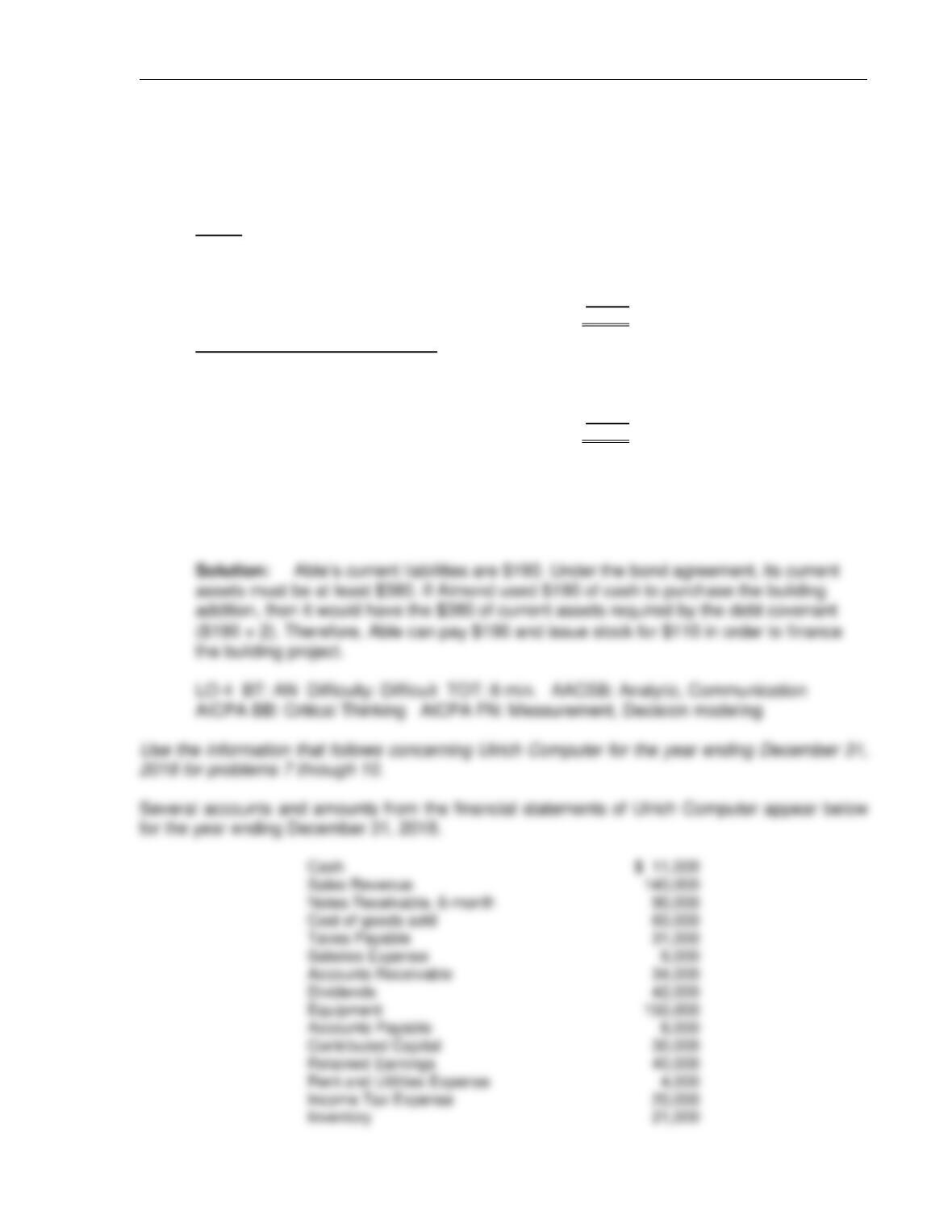
Prepare a classified balance sheet for Phineas Company on December 31, 2018.
Test Bank – Chapter 2 – The Financial Statements 2-25
6. The following is the balance sheet of Able Corporation immediately prior to deciding how
to finance the purchase of a $300 addition to its building.
Able Corporation
Balance Sheet
December 31, 2018
Assets
Cash $ 310
Accounts receivable 260
Building 380
Land 370
Total assets $1,320
Liabilities and Shareholders’ Equity
Accounts payable $ 190
Long-term bonds payable 620
Contributed capital 340
Retained earnings 170
Total liabilities & shareholders’ equity $1,320
The bonds payable contract agreement requires current assets to be twice as much as
current liabilities. Assume the $300 addition to the building is to be paid in cash and
financed by issuing more stock. Calculate and explain the maximum cash that Able can
pay and still honor its debt agreement.

2-26 Test Bank – Chapter 2 – The Financial Statements
Test Bank – Chapter 2 – The Financial Statements 2-27
7. What is the total amount owed to Ulrich by its customers at the end of 2018?
8. Calculate total expenses for Ulrich.
Solution:
9. Calculate Ulrich’s total current assets.
Solution:
10. How much must Ulrich pay out during its next accounting period for amounts owed?
11. Below is all of the account information from Chamber Company’s balance sheet, with the
exception of Retained Earnings.
Cash $13,000
Inventory 16,000
Equipment 51,000
Accounts Payable 17,000
Long-term Payable 10,000
Contributed capital 30,000
Using this information, please calculate the following:
A. The total amount of retained earnings for Chamber Company.
B. The total amount of shareholders’ equity for the company at the end in the
year.
2-28 Test Bank – Chapter 2 – The Financial Statements
12. The following information is shown on Morris Company’s balance sheet. Answer the
questions that follow.
Cash $12,000
Inventory 15,000
Equipment 80,000
Accounts Payable 15,000
Bonds Payable 45,000
Contributed capital 30,000
A. How much did debt investors provide to Morris Company?
B. What is the amount of money provided by equity investors to Morris Company?
C. How much would be classified as property, plant, and equipment?
13. Autry Company determined its total sales were $400,000, salaries expense was
$110,000, dividends paid were $8,000, rent expense was $14,000, other operating
expenses were $20,000, and customers still owed $2,000 at the end of the year. How
much is net income for the year?
14. If cash inflows from operating activities were $2,000, cash outflows for financing
activities were $2,500, and the net increase in cash was $4,000, how much are cash
flows from investing activities?
Test Bank – Chapter 2 – The Financial Statements 2-29
15. The following is the balance sheet of Columbus Corporation immediately prior to
deciding how to finance the purchase of an additional $210,000 parcel of land. Answer
the question that follows.
Columbus Corporation
Balance Sheet
December 31, 2018
Assets
Cash $ 180,000
Accounts receivable 60,000
Land 270,000
Total assets $510,000
Liabilities and Shareholders’ Equity
Accounts payable $ 90,000
Contributed capital 250,000
Retained earnings 170,000
Total liabilities & shareholders’ equity $510,000
REQUIRED: Columbus will finance the $210,000 investment in land by issuing either
$210,000 of common stock or using $210,000 of additional accounts payable that will be
due in 90 days. Indicate which method of financing is preferable for Columbus. Consider
the effects on short-term solvency positions.
2-30 Test Bank – Chapter 2 – The Financial Statements
SHORT ESSAY QUESTIONS
1. Describe operating activities.
2. Which business activity occurs first for a business? Why does this business activity
occur first?
3. What business aspect does the income statement measure?
4. Which asset is more liquid, inventory or accounts receivable? Why?
5. What business aspect does the statement of shareholders’ equity measure?

2-32 Test Bank – Chapter 2 – The Financial Statements
Use the information provided from Haloid Company’s accounting records to answer questions 6
and 7.
For the Years Ended December 31, 2018, and 2017
Assets 2018 2017
Cash $ 80 $60
Accounts receivable 40 40
Short-term investment in property 40 60
Property, plant, and equipment 350 310
Total assets $510 $470
Liabilities and Shareholders’ Equity
Accounts payable $ 85 $90
Contributed capital 310 300
Retained earnings 115 80
Total liabilities & shareholders’ equity $510 $470
Income Statement:
Sales revenue $850
Expenses 800
Net Income $ 50
6. How is it possible that Haloid reports “property” in two different places on its balance
sheet?
7. Comment on the following statement: “On December 31, 2018, Haloid’s accounts
payable exceeds its cash by $5. If Haloid needs additional money to pay its accounts
payable, it can use the $115 stashed in its retained earnings”.
9. Explain the concept of liquidity.

2-34 Test Bank – Chapter 2 – The Financial Statements
10. Give an example of a prepaid expense. Why would a company use this account?
11. What type of assets are included in short-term investments?
12. What is unique about the way plant and equipment appear on the balance sheet?
13. Explain the difference between net income and cash flow from operations.
14. Why would a company use a notes receivable account?
Test Bank – Chapter 2 – The Financial Statements 2-35
15. What is the account, Accounts Payable, used for?
16. Describe how the amount of net income relates to the balance sheet.
17. Where in a company’s financial statements would you locate the ‘book value’ of the
company?
18. Which group of financial statement users would be most concerned with the amount of a
company’s total current assets and current liabilities?
2-36 Test Bank – Chapter 2 – The Financial Statements
19. Which assets on a company’s balance sheet have no physical substance? Explain.
20. A company sold 10 widgets. How will the amounts the company reports as ‘Sales’ differ
from amounts reported as ‘Cost of Goods Sold’?
21. What concerns might you have if you examined a company’s balance sheet and found a
negative amount in retained earnings?
22. Distinguish between the amounts reported on the income statement compared to the
amounts reported on the statement of cash flows.
Test Bank – Chapter 2 – The Financial Statements 2-37
23. Describe how the equity sections of balance sheets differ for each of the three types of
business entities.

2-38 Test Bank – Chapter 2 – The Financial Statements