12) Krystal runs a nail salon and needs to decide how many hours to stay open. Table 2.2
illustrates her marginal costs of staying open for each additional hour. Suppose that we observe
Krystal staying open 4 hours per day. If she is following the marginal principle, what must her
marginal benefit be?
A) $12
B) $18
C) $24
D) $30
13) Krystal runs a nail salon and needs to decide how many hours to stay open. Table 2.2
illustrates her marginal costs of staying open for each additional hour. Suppose that we observe
Krystal staying open 2 hours per day. If she is following the marginal principle, what must her
marginal benefit be?
A) $6
B) $12
C) $15
D) $18
14) Krystal runs a nail salon and needs to decide how many hours to stay open. Table 2.2
illustrates her marginal costs of staying open for each additional hour. Suppose that we observe
Krystal staying open 5 hours and her marginal benefit of staying open per hour is $18. If she is
following the marginal principle, Krystal should
A) stay open 2 more hours.
B) stay open 3 more hours.
C) stay open 2 fewer hours.
D) stay open 3 fewer hours.
15) Krystal runs a nail salon and needs to decide how many hours to stay open. Table 2.2
illustrates her marginal costs of staying open for each additional hour. Suppose that we observe
Krystal staying open 5 hours and her marginal benefit of staying open per hour is $36. If she is
following the marginal principle, Krystal should
A) stay open 1 more hour.
B) stay open 2 more hours.
C) stay open 1 fewer hour.
D) stay open 2 fewer hours.
16) Considering how a change in one variable affects the value of another variable is called
A) the Peter Principle.
B) the marginal principle.
C) the principle of supply and demand.
D) functional decision making.
17) When referring to “marginal” changes, the economic focus is on
A) changes which affect only a few people or products.
B) large changes on the low end.
C) graduated changes on the high end.
D) small or incremental changes.
18) When deciding whether to engage in an activity or how much to do, people should follow
A) the principle of microeconomics.
B) the principle of macroeconomics.
C) the marginal principle.
D) the law of supply and demand.
19) Recall the application. Weighing the benefits and costs of the different speeds at which to
sail an ocean cargo ship addresses the economic concept known as
A) the principle of opportunity cost.
B) the marginal principle.
C) the principle of voluntary exchange.
D) the principle of diminishing returns.
20) Recall the application. Sailing an ocean cargo ship slower to save on the expense of fuel as
opposed to sailing it faster to save time and therefore allow it to make more deliveries makes
sense if the ________ of sailing slower is less than the ________ of sailing slower.
A) marginal benefit; marginal cost
B) marginal cost; marginal benefit
C) marginal benefit; opportunity cost
D) marginal cost; opportunity cost
21) The use of seat belts and other automobile safety features making bicycling more hazardous
can be explained by the economic concept known as
A) the real-nominal principle.
B) the marginal principle.
C) the principle of voluntary exchange.
D) the principle of diminishing returns.
22) Saving time by driving faster is an example of a ________ of driving faster. Increasing the
severity of injuries from a potential accident due to driving faster is a(n) ________ of driving
faster.
A) nominal cost; real cost
B) marginal cost; nominal cost
C) marginal benefit; marginal cost
D) normative benefit; opportunity cost
23) When applying the marginal principle, you should pick the level at which the activity’s
marginal benefit equals its marginal cost.
24) When applying the marginal principle, you should pick the level at which the activity’s
marginal benefit is less than its marginal cost.
25) Basically, the marginal principle helps us to evaluate the factors involved in taking an action
or if doing something is worth the effort.
26) When Lonnie produces 1 pair of cowboy boots his costs total $300. When he produces 2
pairs of cowboy boots his total costs are $500. This means that Lonnie’s marginal cost of
producing the second pair of cowboy boots is $200.
27) Economists argue that individuals should continue to consume until total benefit equals total
cost.
28) If a company’s total costs per day increase from $200 to $400 by adding another worker, but
its additional benefits are $300, it is sensible to add that additional worker.
29) What is a marginal cost?
30) What is a marginal benefit?
31) When a firm hired its tenth worker, its factory output increased by four units per month.
Would you expect the firm’s output to increase by eight more units per month if the firm hired
two more workers?
32) Consider a firm that is trying to determine how many hours to remain open in a day. How
would the firm make this decision?
33) Different people eat different amounts of food when they go to buffet restaurants, even
though they all pay the same price. Explain how this relates to the marginal principle.
34) Use the marginal principle to explain why government mandated safety features in
automobiles during the 1960s and 1970s resulted in an increase in collisions between
automobiles and bicycles.
2.3 The Principle of Voluntary Exchange
1) People acting in their own self interest is the basis of the
A) principle of supply and demand.
B) principle of voluntary exchange.
C) real-nominal principle.
D) principle of scarcity.
2) The principle of voluntary exchange is based on the idea of
A) making assumptions.
B) isolating variables.
C) thinking at the margin.
D) rational self-interest.
Recall the Application about Jasper Johns and house painting to answer the following
question(s). In this Application, it is assumed that Johns can earn $5,000 per day by
painting works of art, and therefore should hire a house painter who charges $150 per day,
and takes 10 days, to paint his house.
3) This Application addresses the economic concept of
A) the marginal principle.
B) diminishing returns.
C) specialization and exchange.
D) real versus nominal costs.
4) Recall the application. At what point should Jasper Johns consider painting his own house?
A) if the house painter charges $500 per day and takes 20 days to paint the house
B) if the house painter charged $2,500 per day, since that is excessive for painting a house
C) if his earnings dropped to $1,000 per day
D) if the house painter charged more for 10 days worth of work than Johns could earn each day
5) Based on the Application, Jasper Johns’ daily earnings are 33.33 times more than the house
painter’s daily earnings. If Jasper Johns’ earnings per day were only twice as much as the house
painter’s earnings, what should he do?
A) He should still hire the house painter to paint his house.
B) He should paint his house himself.
C) He should hire a less productive house painter.
D) He should remain indifferent as to who paints the house, for the difference in daily earnings
would now be much less significant.
6) When you have a job and your employer compensates you for your time with money,
resulting in both of you being better off, it is an example of a voluntary exchange.
7) The principle of voluntary exchange is the concept that a voluntary exchange between two
people makes both people better off.
8) A “market” is an arrangement that allows people to exchange things.
2.4 The Principle of Diminishing Returns
1) The principle of diminishing returns implies that as one input increases while the other inputs
are held fixed, output
A) increases at an increasing rate.
B) increases at a decreasing rate.
C) decreases at a decreasing rate.
D) decreases at an increasing rate.
2) The principle that “as one input increases while the other inputs are held fixed, output
increases at a decreasing rate” is known as the
A) marginal principle.
B) principle of opportunity cost.
C) principle of diminishing returns.
D) spillover principle.
3) According to the principle of diminishing returns, if all factors of production but one are held
constant and if that one factor is doubled, then eventually output will most likely
A) double too.
B) less than double.
C) more than double.
D) remain unchanged.
4) A firm produces its product using both capital and labor. When it does not change its capital
usage, but doubles its labor input, its output increases by less than 50%. Which of the following
is the most likely explanation of this finding?
A) the principle of opportunity cost
B) the principle of diminishing returns
C) the marginal principle
D) the spillover principle
5) According to the principle of diminishing returns, if the number of workers is increased
beyond the point of diminishing returns, then the additional worker
A) increases total output by the same amount as previous workers.
B) increases total output by more than the amount of previous workers.
C) increases total output by less than the amount of previous workers.
D) decreases total output.
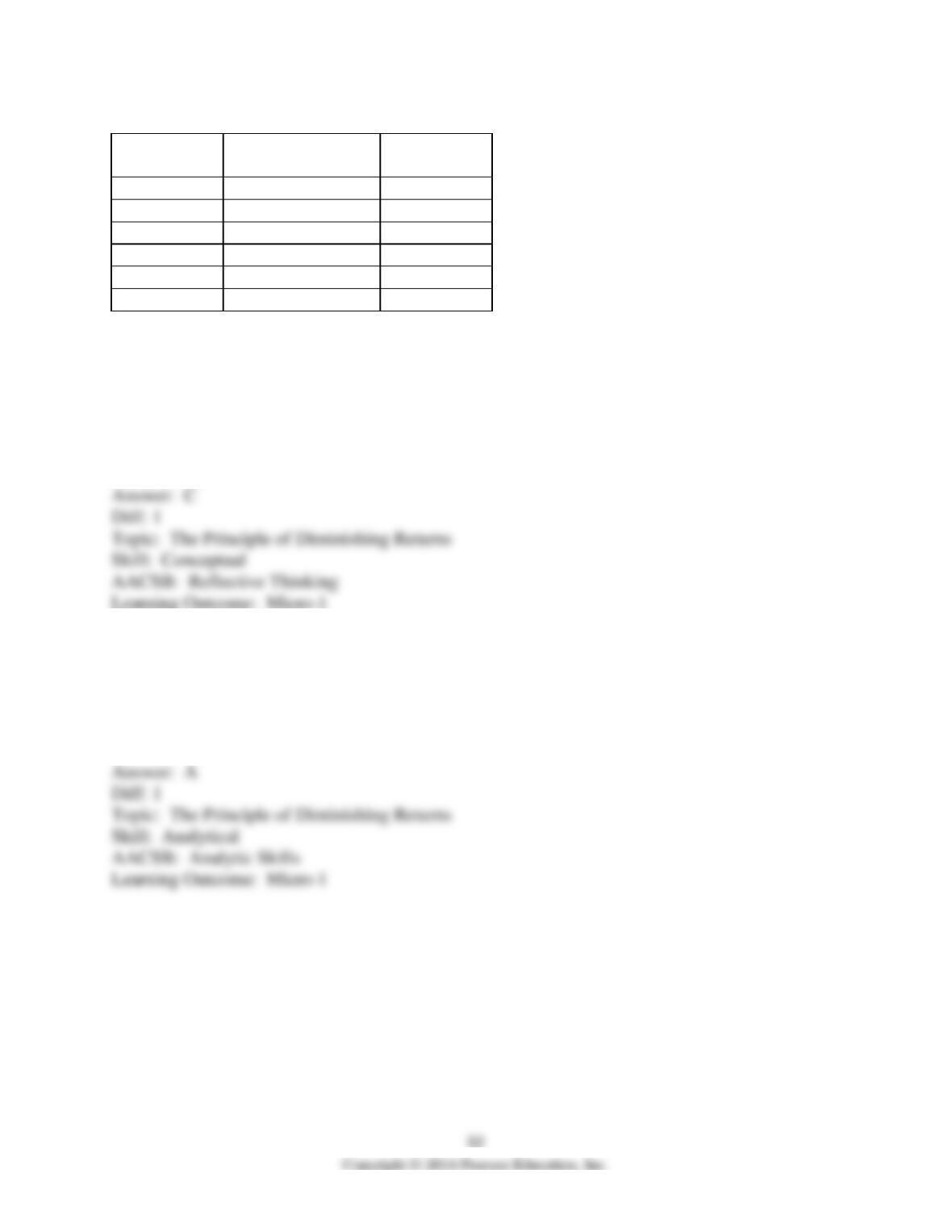
Units of
Capital
Number of Workers
Output/Day
5
0
0
5
1
40
5
2
90
5
3
150
5
4
200
5
5
235
Table 2.3
6) Refer to Table 2.3. What can be observed about the given resources?
A) Capital and labor are both fixed.
B) Capital is variable.
C) Capital is fixed.
D) Labor is fixed.
7) Refer to Table 2.3. Increasing the number of workers from 2 to 3 will increase output per day
by
A) 60 units.
B) 90 units.
C) 150 units.
D) 240 units.
8) Refer to Table 2.3. The principle of diminishing returns first occurs when how many workers
are hired?
A) 2
B) 3
C) 4
D) 5
Acres of Land
Tanks of Fertilizer
Truckloads of
Potatoes
20
0
28
20
1
70
20
2
105
20
3
135
20
4
152
20
5
141
Table 2.4
9) Refer to Table 2.4. What can be observed about the given resources?
A) Land is variable but fertilizer is fixed.
B) Land and fertilizer are both fixed.
C) Land and fertilizer are both variable.
D) Land is fixed but fertilizer is variable.