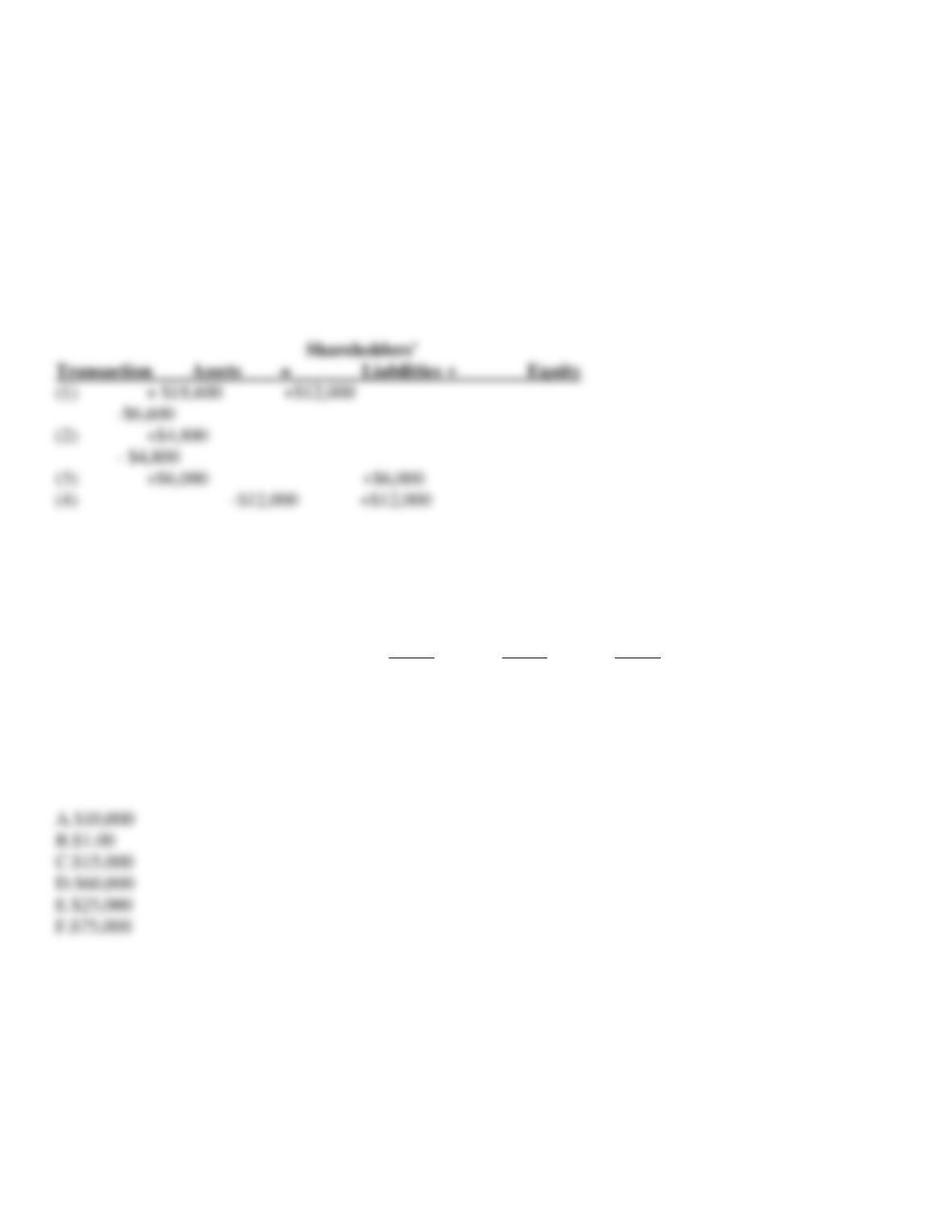
89. Supplies and More, a firm specializing in building materials, engaged in the following four transactions
during 2014:
(1) purchased and received inventory costing $18,600 million, of which $12,000 million was on account with
the rest paid in cash;
(2) purchased a machine for $4,800 million with cash;
(3) issued 2,000 shares of common stock for $6,000 million in cash;
(4) issued shares of common stock to its suppliers for the remaining amount due on purchases of inventory.
REQUIRED:
Indicate the effects of each of these four transactions on the balance sheet equation. Supplies and More applies
U.S. GAAP financial reporting standards and reports its results in millions of U.S. dollars ($).
90. Complete the shareholders’ equity section for each of the following independent situations.
CASE A
CASE B
CASE C
Common stock, 10,000 shares
A
C
E
Additional paid-in capital
25,000
D
30,000
Retained earnings
45,000
25,000
20,000
Total shareholders’ equity
80,000
100,000
F
Par value per share
B
1.50
2.50
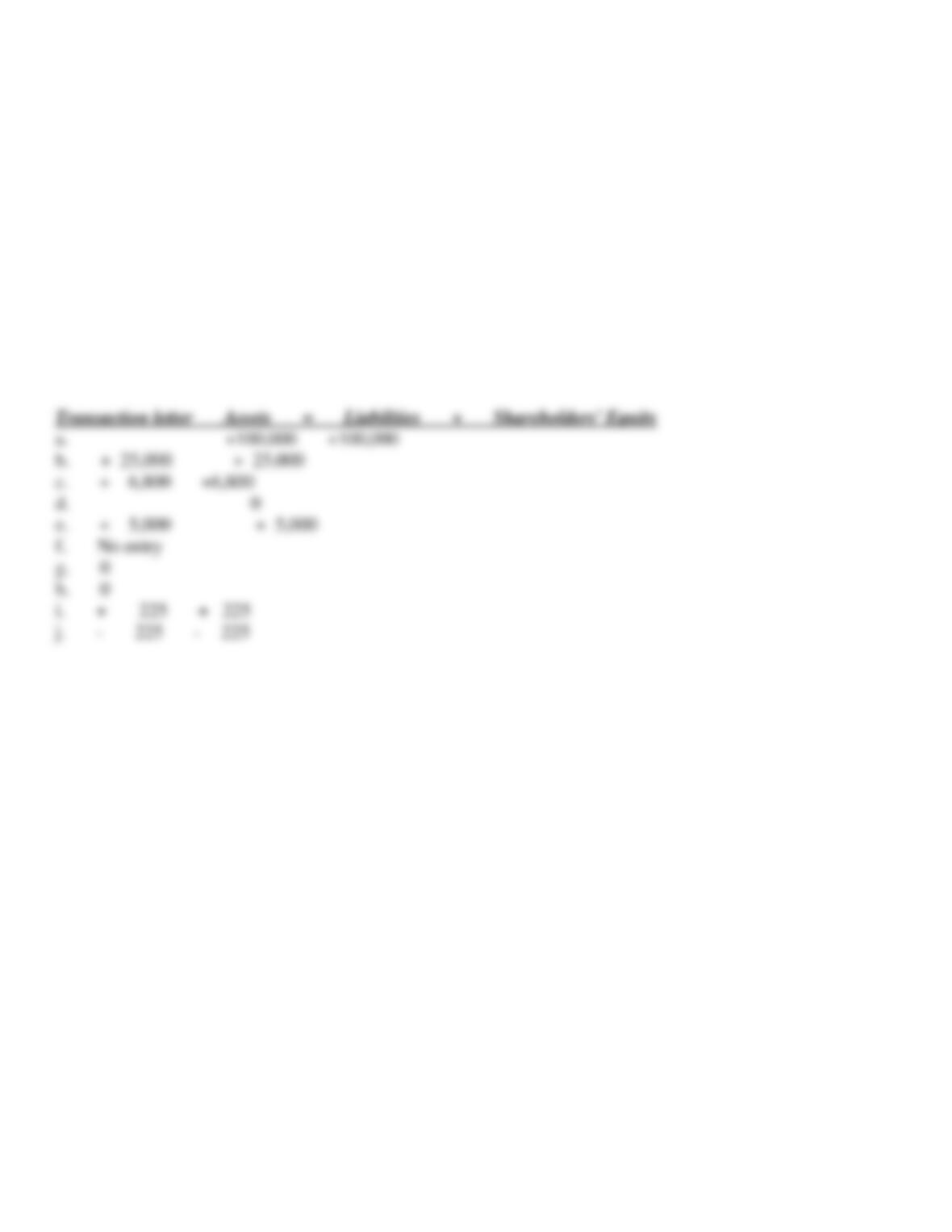
91. Indicate the effects of the following transactions on the balance sheet equation, using the format:
Transaction letter
Assets
=
Liabilities
+
Shareholders’ equity
a.
Issued 20,000 shares of $0.10 par value common stock for $100,000.
b.
Issued 5,000 shares of $0.10 par value common stock in full payment for land worth $25,000 to be used as a future building site.
c.
Acquired equipment costing $7,500 for a cash payment of $700 with the balance payable over the next five years.
d.
Paid $1,000 for rent for the next two months.
e.
Completed a consulting job and invoiced the client for $5,000, payable in 30 days.
f.
Ordered office supplies for the office, totaling $225.
g.
Purchased a three-year fire insurance policy and pays in advance $3,000.
h.
Received payment from the client for services rendered in (e) above.
i.
Received the office supplies. The invoice indicates payment is due within 10 days.
j.
Issued a check for the office supplies purchased in (i) above.
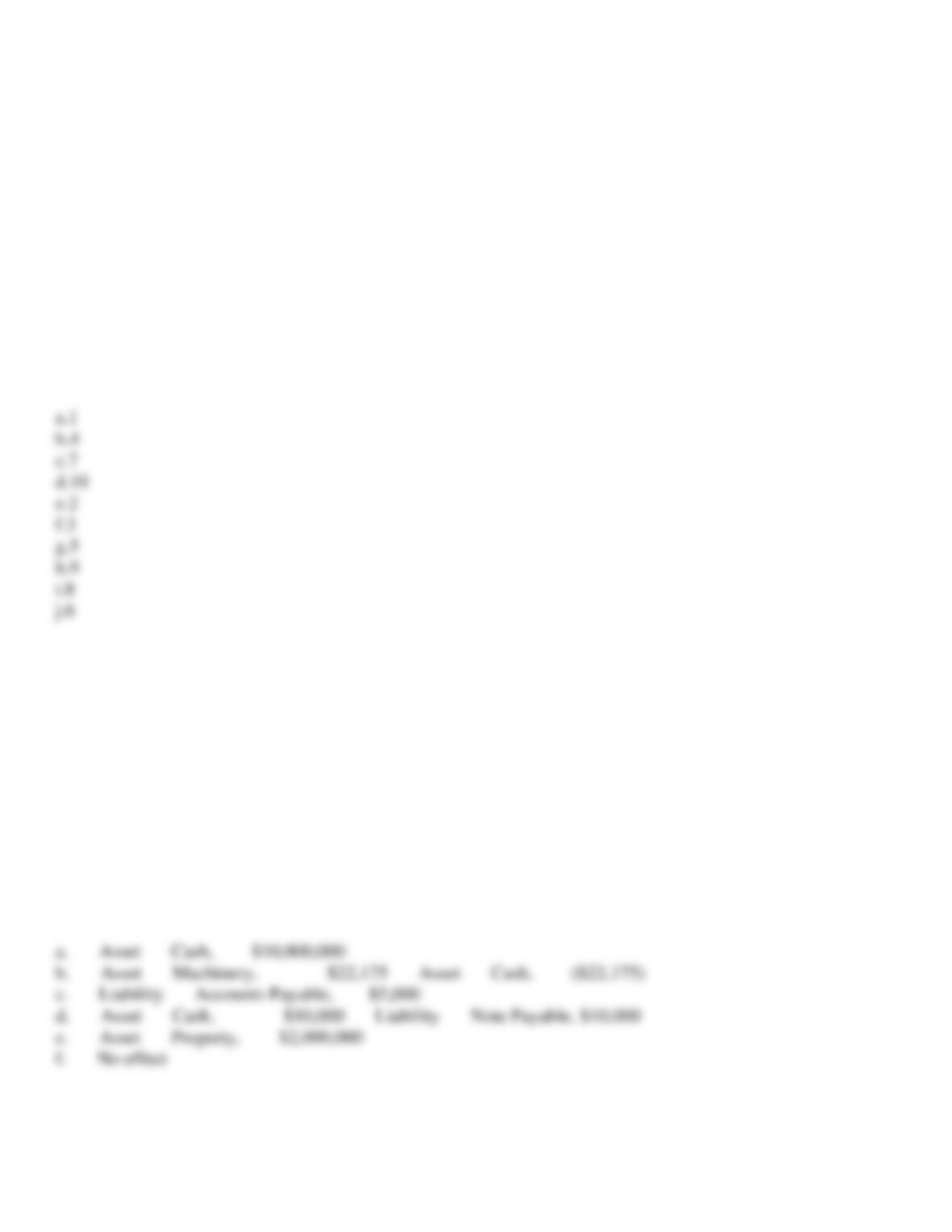
92. In European countries, terminology on financial statements sometimes differs from terminology commonly
used in the United States. Match the European terms to commonly used United States counterparts.
Common European Term
Common U.S. Term
a.
Tangible Fixed Asset
1.
Property, Plant, and Equipment
b.
Financial Assets
2.
Common Stock
c.
Trade Receivables
3.
Additional Paid-in Capital
d.
Liquid Funds
4.
Investment in Securities
e.
Subscribed Capital
5.
Retained Earnings
f.
Capital Reserve
6.
Accounts Payable
g.
Profit Reserves, Net Income
7.
Accounts Receivable
Available for Distributions
8.
Notes Payable to Banks
h.
Bonds
9.
Bonds Payable
i.
Due to Banks
10.
Cash
j.
Trade Payables
93. The transactions listed below relate to the JB Corporation. Indicate whether or not each transaction
immediately gives rise to an asset or liability of JB Corporation under generally accepted accounting principles.
If accounting recognizes an asset or a liability, give the account title and amount.
a.
JB Corporation issues $1 par value common stock for $10,000,000, its market value.
b.
JB Corporation purchases a machine for $20,000, freight of $675, and installation costs of $1,500.
c.
JB Corporation owes $5,000 for utilities at the end of the year. The firm has 10 days before payment is due without paying a late fee.
d.
JB Corporation receives a 30-day, 10% loan of $10,000 from a local bank.
e.
JB Corporation acquires property with an appraised value of $2,000,000 for its stock.
f.
JB Corporation receives an order for merchandise totaling $5,000 from a customer. The merchandise will be shipped next week.
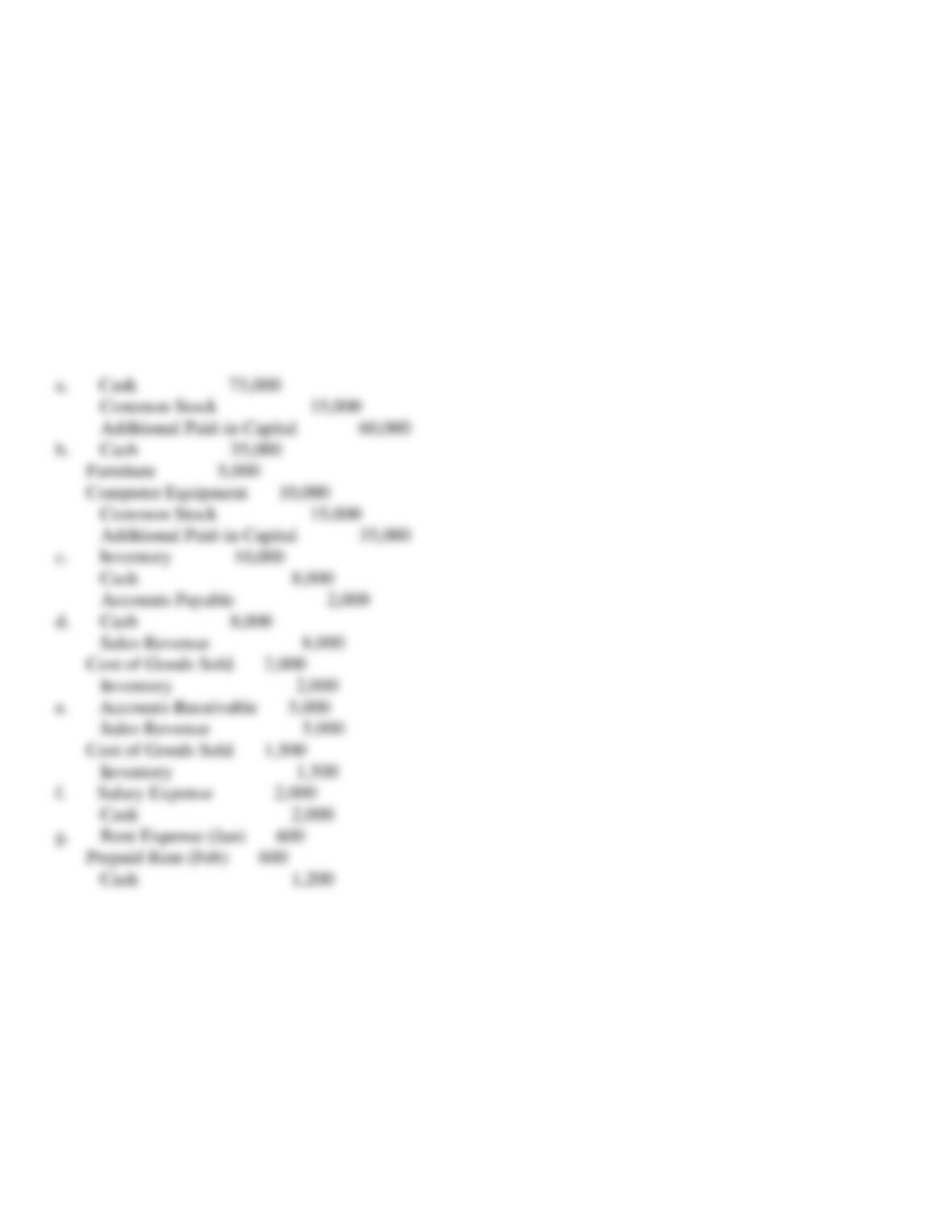
94. Collette and Cohen incorporate as CC Designs, Inc. on January 1, Year 1. CC Designs creates custom wall
finishes and sells painting products. The following transactions occur during January.
a.
Cohen contributes cash of $75,000 and receives 15,000 shares of $1 par value stock.
b.
Collette contributes $35,000 cash, office furniture with a value of $5,000, and computer equipment with a value of $10,000 and receives
15,000 shares of $1 par value stock. The furniture and equipment is expected to last 5 years and has no salvage value.
c.
On January 2, $10,000 of painting products are purchased. CC paid $8,000 cash with the remaining amount on account.
d.
During January, painting products are sold for $8,000 cash. The cost of the products is $2,000.
e.
Additional painting products with a value of $5,000 are sold, with a cost of $1,500, but the cash is not collected as of January 31st. It is
expected that the $5,000 will be collected in full by February 15th.
f.
Cohen is paid a salary of $2,000.
g.
CC paid $1,200 for January and February rent.
Required:
Prepare appropriate accrual basis journal entries.
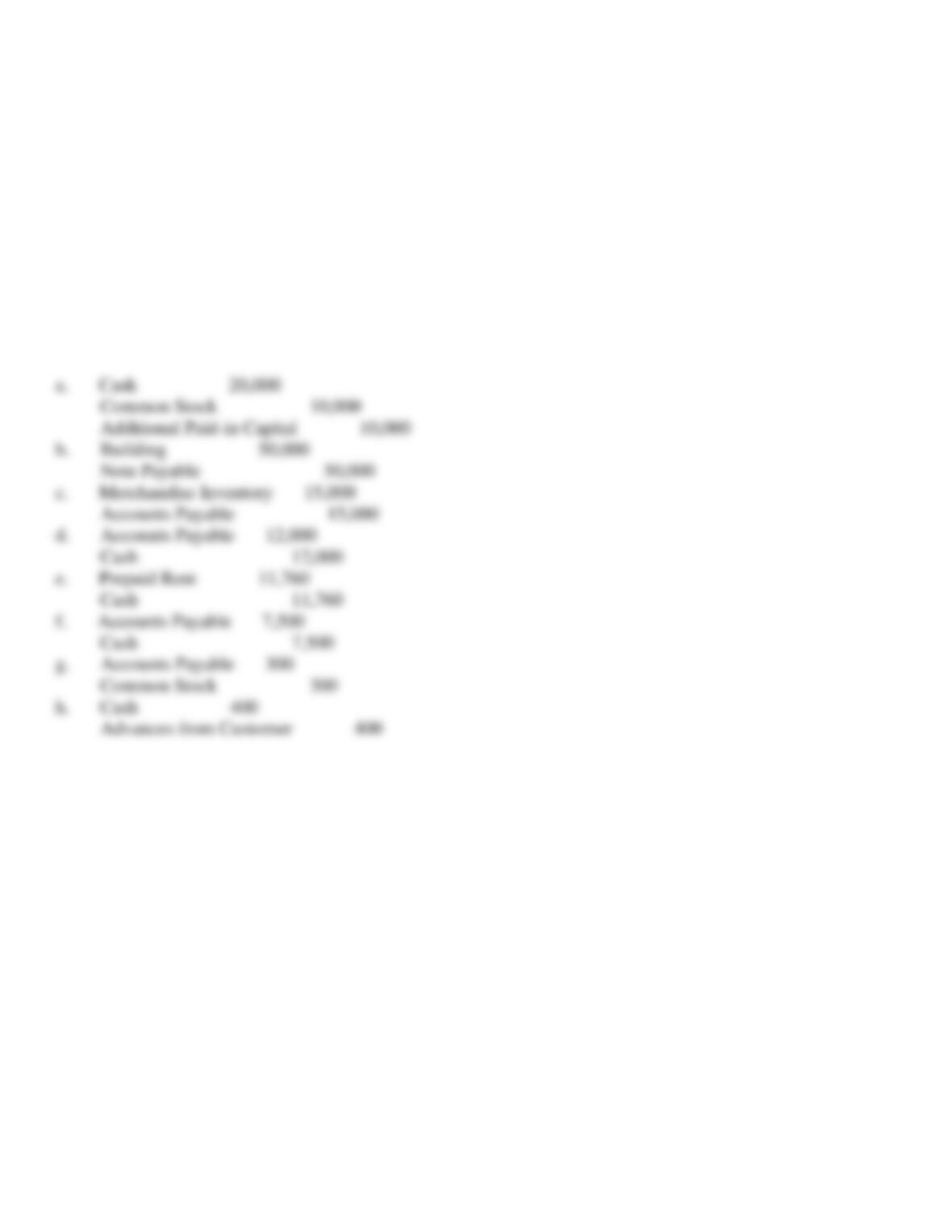
95. Monmath Corp. started operations in March of Year 3. The following transactions occur during March.
a.
On March 1, Year 3, Monty contributes $20,000 for 10,000 shares of $1 par value stock.
b.
On March 1, Year 3, Monmath borrows $50,000 on a note from the bank to finance the purchase of a building.
c.
Monmath buys $15,000 of inventory on account (this is the gross price before any possible discounts).
d.
Monmath pays a $12,000 account payable with cash.
e.
Monmath paid the annual rent of $11,760.
f.
Monmath pays for one half of the inventory purchased in (c) above. There are no discounts given.
g.
Issued 300 shares of $1 par value stock in settlement of $300 accounts payable.
h.
Received $400 from a customer for merchandise to be delivered on April 15, Year 3.
Required:
Prepare the journal entries for transactions a through h, assuming Monmath uses the accrual basis of accounting.
96. Assets are usually classified in one of following ways:
CA
-current assets
PPE
-property, plant, and equipment
IA
-intangible asset
Using the abbreviations above, indicate the appropriate classification of each of the following items.
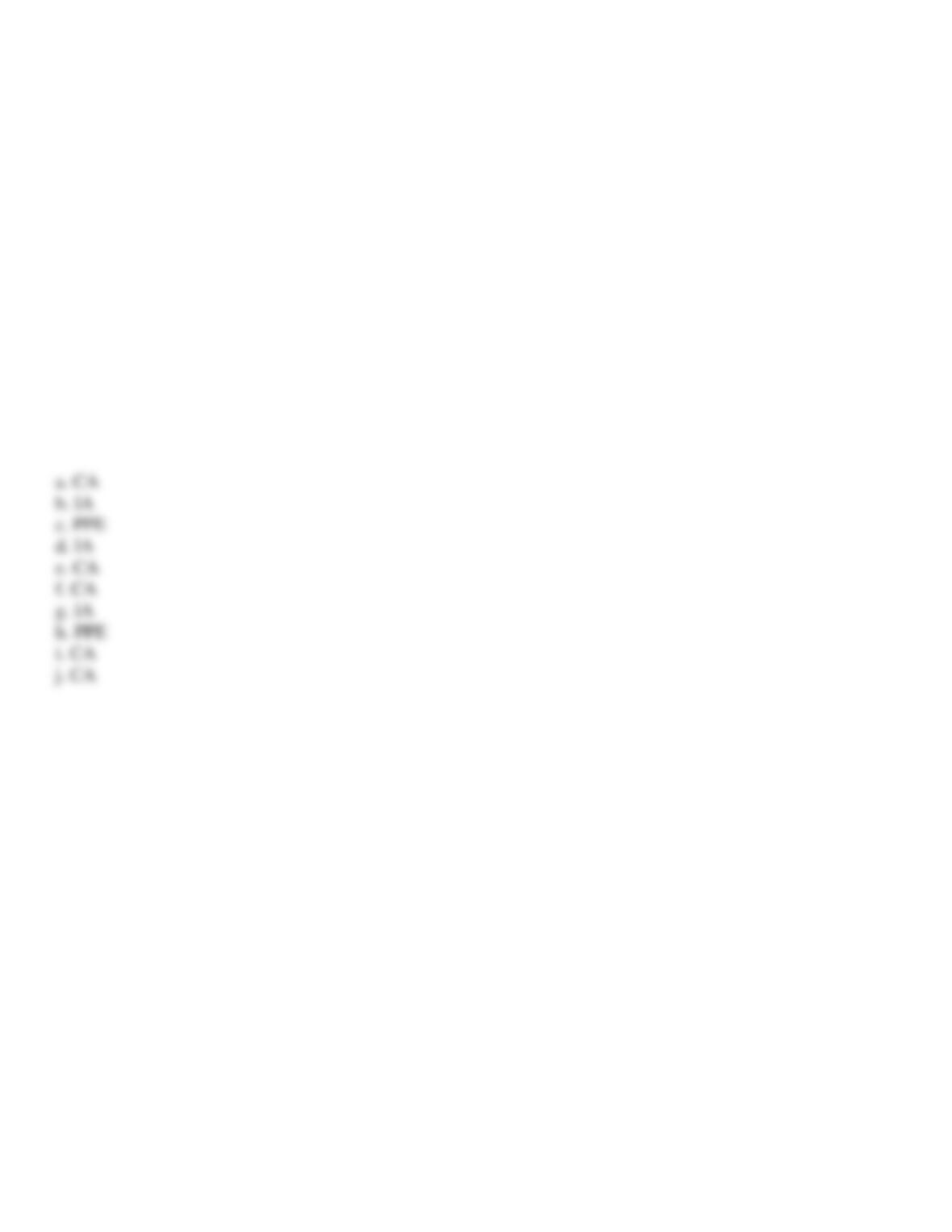
a.
__________ merchandise inventory
b.
__________ goodwill
c.
__________ land
d.
__________ patent
e.
__________ work-in-process inventory
f.
__________ marketable equity securities
g.
__________ trademark
h.
__________ furniture and fixtures
i.
__________ cash
j.
__________ prepaid insurance
97. A friend of yours has prepared the following balance sheet for his bicycle shop but it has a problem. He
thought his total assets did not reflect the assets available to the firm. He has asked you to take a look at this
balance sheet and help him out.
Eric’s Bike Shop, Inc.
Balance Sheet
As of December 31, Year 1
Assets
Current Assets:
Cash
$15,000
Merchandise Inventory
30,000
Merchandise Sold, at cost
37,500
Prepaid Insurance
1,000
Advance from Customer
(1,000)
Total Current Assets
$82,500
Property, Plant, and Equipment:
Equipment
8,000
Less Note Payable
(5,000)
Total Assets
$85,500
Liabilities and Shareholders’ Equity
Current Liabilities:
Bike Sales
$55,000
Accounts Payable
2,000
Accumulated Depreciation
700
Rent Payable
1,000
Total Current Liabilities
$58,700
Shareholders’ Equity:
Common Stock 1,000 shares at $10 par value
$10,000
Additional Paid-in Capital
7,500
Retained Earnings
9,300
Total Shareholders’ Equity
$26,800
Total Liabilities and Shareholders’ Equity
$85,500
Required:
a.
Prepare a corrected balance sheet for Eric’s Bike Shop, Inc.
b.
Draft a memo to Eric explaining the errors you corrected. Include your reasons.
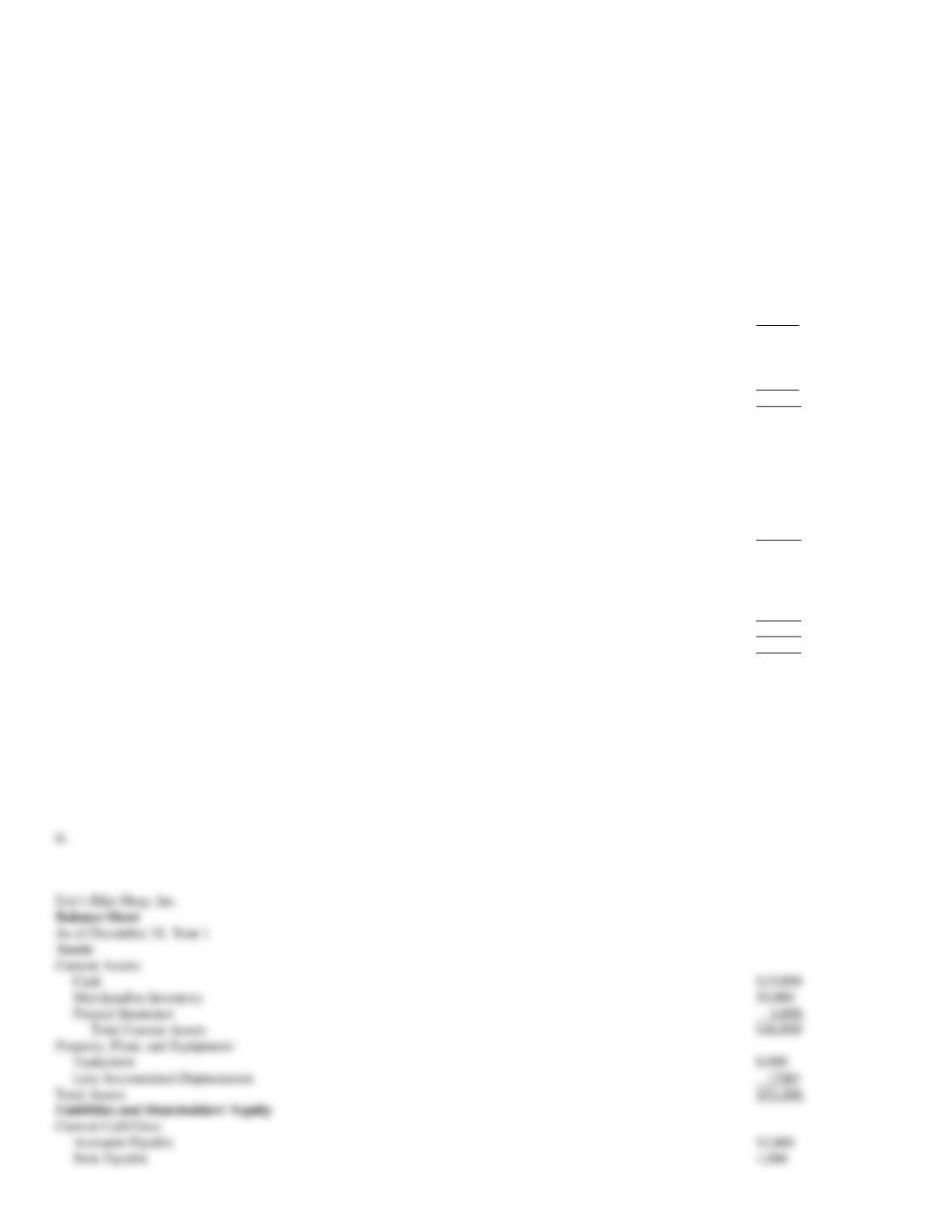
Assets
Current Assets:
Cash
$15,000
Merchandise Inventory
30,000
Prepaid Insurance
1,000
Total Current Assets
$46,000
Property, Plant, and Equipment:
Equipment
8,000
Liabilities and Shareholders’ Equity
Current Liabilities:
98. Prepare journal entries for each of the following unrelated transactions. You may omit explanations for the
journal entries.
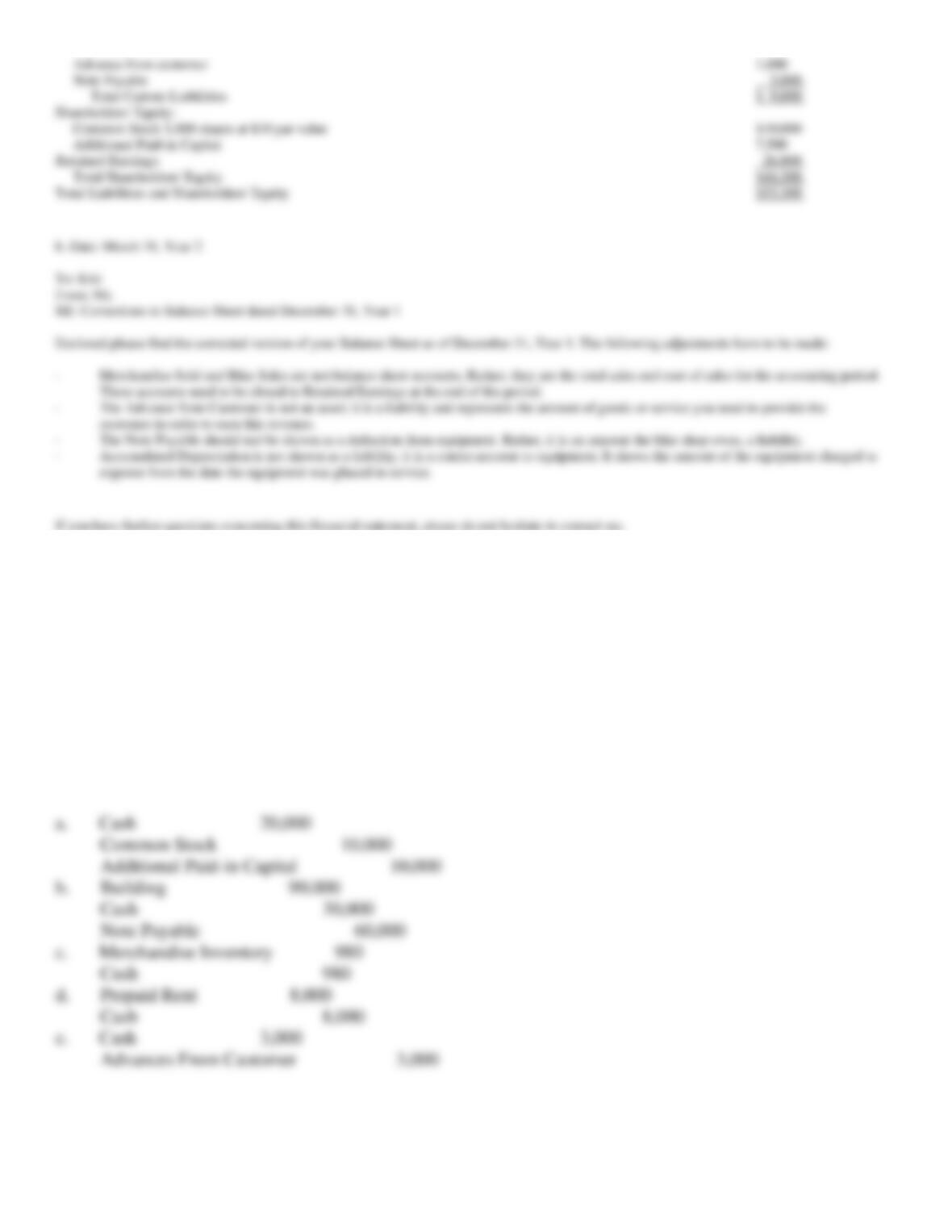
a.
A firm issues 5,000 shares of $2 par value common stock in exchange for $20,000 cash.
b.
A firm acquires a building with $30,000 cash and signs a 15-year note for $60,000.
c.
A firm buys inventory for $980 cash.
d.
A firm pays $8,000 to its landlord for annual rent.
e.
A publisher sells $3,000 in magazine subscriptions that will be filled over the next 12 months.
Advance from customer
1,000
Note Payable
5,000
Total Current Liabilities
$ 9,000
Shareholders’ Equity:
Common Stock 1,000 shares at $10 par value
$10,000
Additional Paid-in Capital
7,500
Retained Earnings
26,800
Total Shareholders’ Equity
$44,300
Total Liabilities and Shareholders’ Equity
$53,300
·
The Note Payable should not be shown as a deduction from equipment. Rather, it is an amount the bike shop owes, a liability.
99. You’ve been asked to review the following balance sheet which has been prepared by a new staff member.
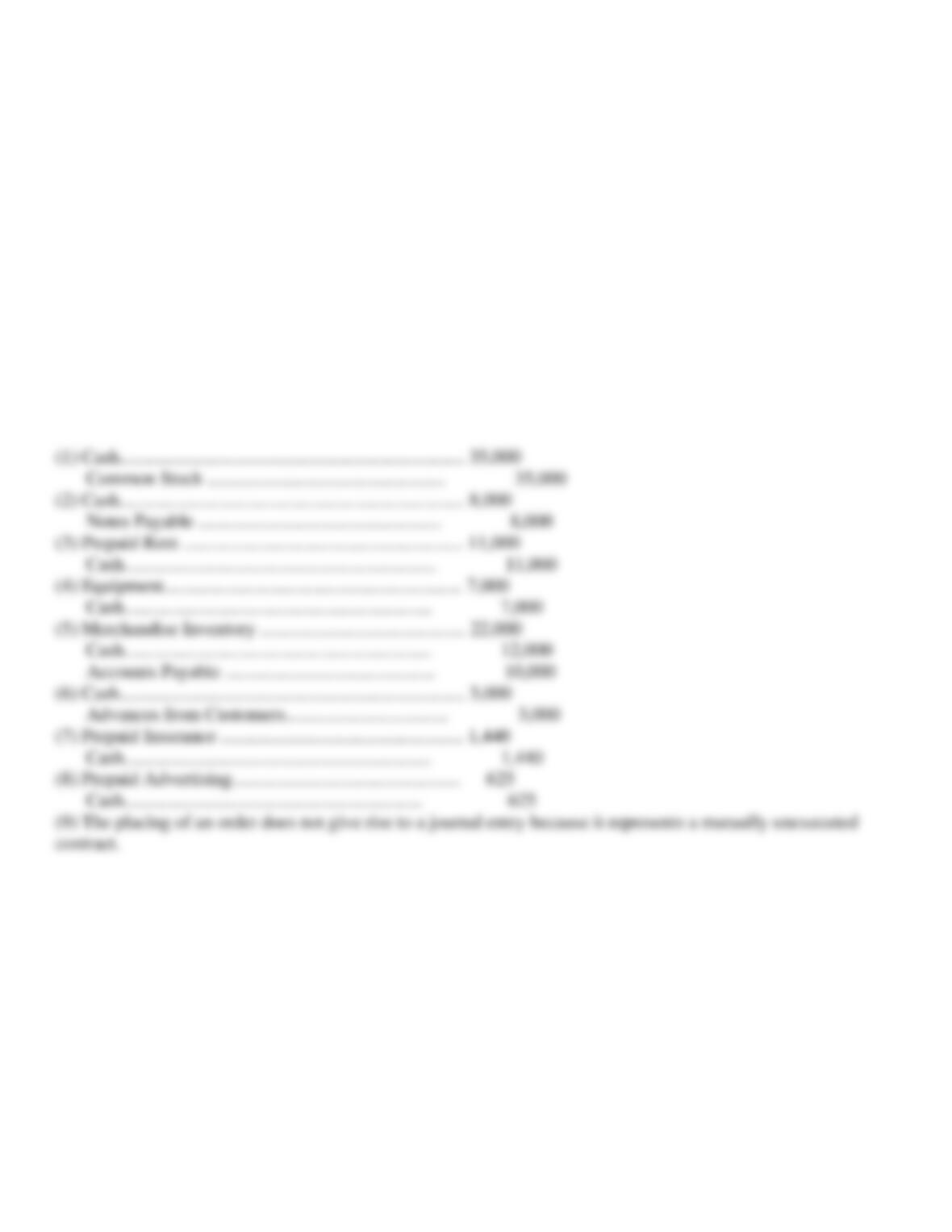
Calvin Springs Outfitters
Balance Sheet
As of December 31, Year 1
Assets
Current Assets:
Cash
$ 7,500
Accounts Receivable
14,000
Merchandise Inventory
25,000
Land
9,000
Total Current Assets
$ 46,500
Property, Plant, and Equipment:
Building
$125,000
Total Assets
$180,500
Liabilities and Shareholders’ Equity
Current Liabilities:
Advance from Customer
$ 500
Accounts Payable
21,000
Rent Payable
3,600
Utilities Payable
1,200
Salaries Payable
1,800
Total Current Liabilities
$ 28,100
Shareholders’ Equity:
Common Stock 2,000 shares at $2.50 par value
$ 5,000
Additional Paid-in Capital
85,000
Retained Earnings
62,400
Total Shareholders’ Equity
$152,400
Total Liabilities and Shareholders’ Equity
$180,500
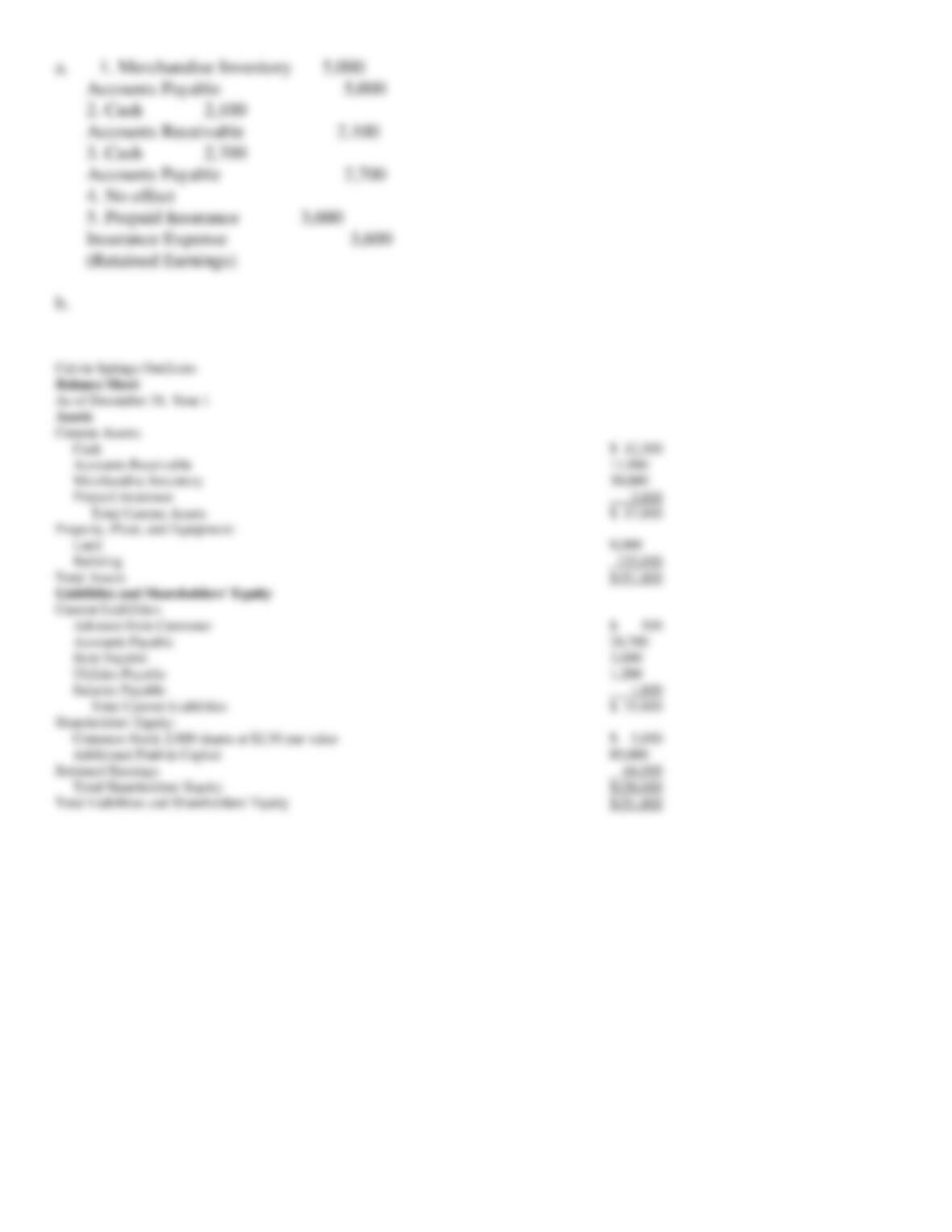
Merchandise purchased on account and costing $5,000 was received but not recorded.
Payments by clients for previously billed invoices were found in the receptionist’s desk drawer. The checks totaled $2,100.
It was discovered that the company president had hired a new secretary for an annual salary of $18,250.
100. Express the following transactions of Forman’s Store, Inc., in journal entry form. If an entry is not
required, indicate the reason. You may omit explanations for the journal entries.
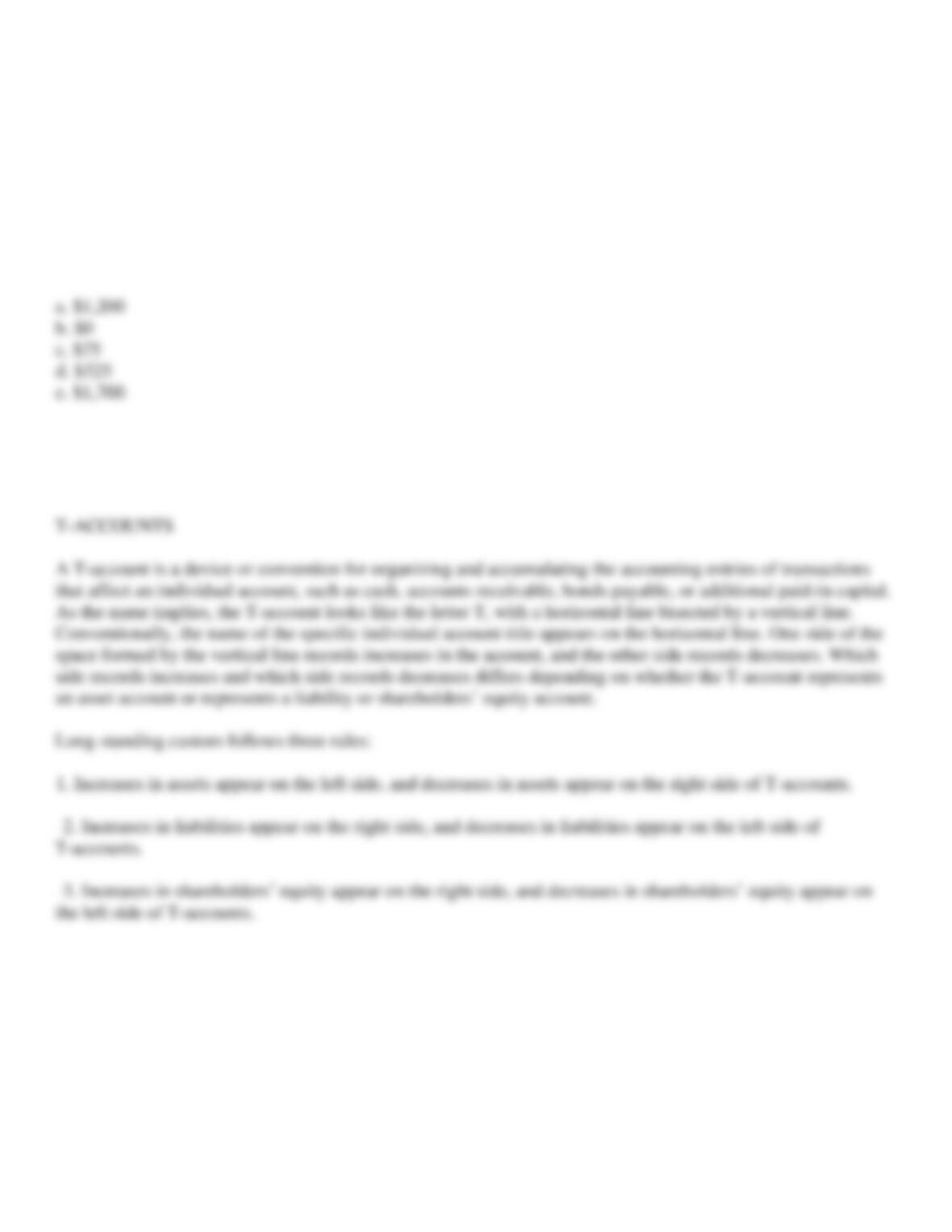
The store:
(1) Receives $35,000 from John Forman in return for 1,000 shares of the firm’s $35 par
value common stock.
(2) Gives a 60-day, 8% note to a bank and receives $8,000 cash from the bank.
(3) Rents a building and pays the annual rental of $11,000 in advance.
(4) Acquires display equipment costing $7,000 and issues a check in full payment.
(5) Acquires merchandise inventory costing $22,000. The firm issues a check for $12,000,
with the remainder payable in 30 days.
(6) Signs a contract with a nearby restaurant under which the restaurant agrees to purchase
$1,500 of groceries each week. The firm receives a check for the first two weeks’
orders in advance.
(7) Obtains a fire insurance policy providing $50,000 coverage beginning next month. It
pays the one-year premium of $1,440.
(8) Pays $625 for advertisements that will appear in newspapers next month.
(9) Places an order with suppliers for $43,500 of merchandise to be delivered next month.
101. Assume that a firm uses the accrual basis of accounting. Indicate the amount of expense the firm
recognizes during the month of November for each independent transaction.
a. Rent of $3,600 is paid on November 1 for the months November through January.
b. Inventory costing $2,500 is ordered on account. The invoice is received on November 25 and the goods are
received on December 5.
c. Insurance premium of $900 is paid for a full year of coverage starting November 1.
d. On December 3, an invoice for November utilities of $325 is received.
e. On November 1, supplies costing $2,200 are purchased. At November 30, $500 of supplies remained on
hand.
102. Describe T-accounts and how they are used.
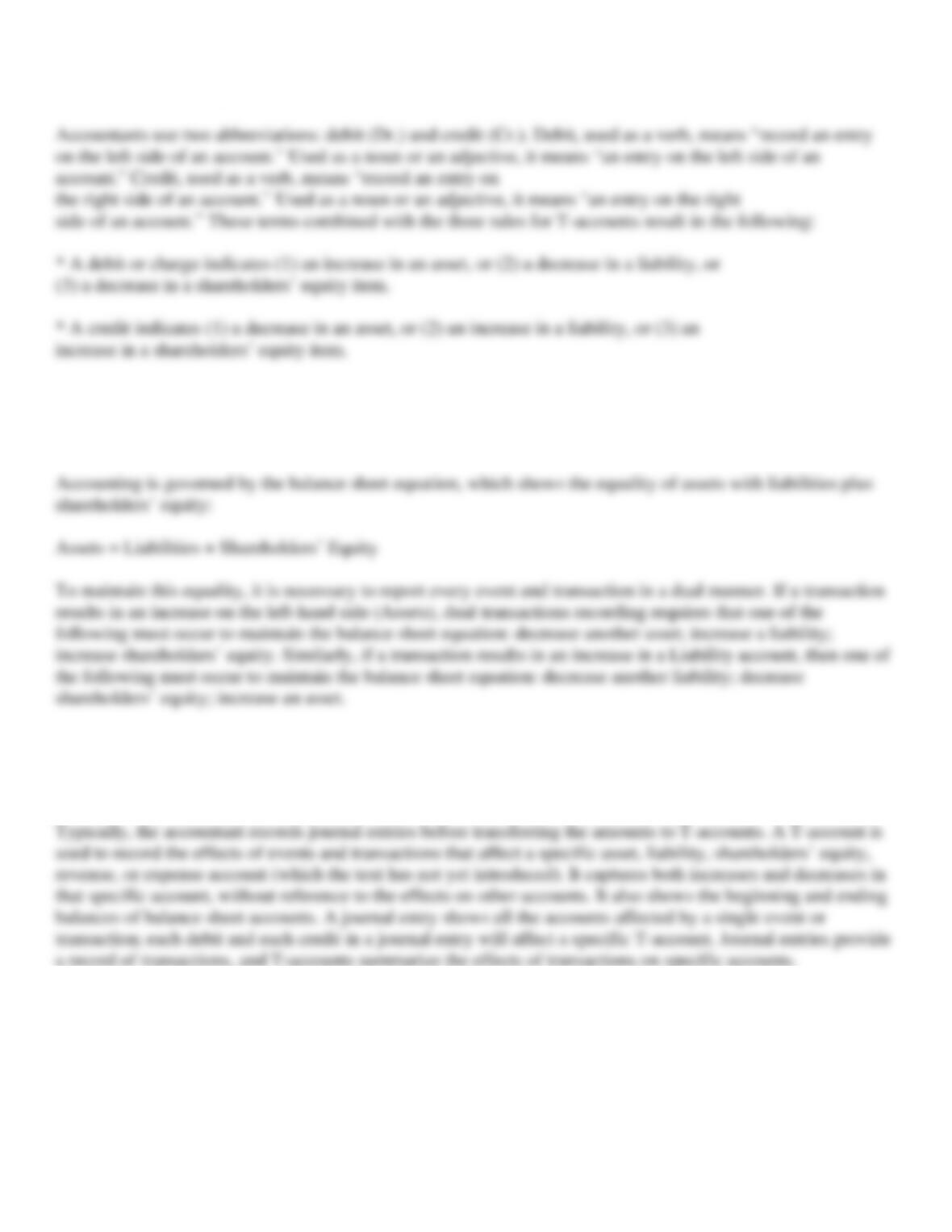
103. Explain the terms debit and credit. In your discussion, also present the debit and credit rules that are
critical for maintaining T-accounts, as well as the equality of the balance sheet.
104. Why does every accounting transaction have two effects?
105. What is the relationship between a T-account and a journal entry?
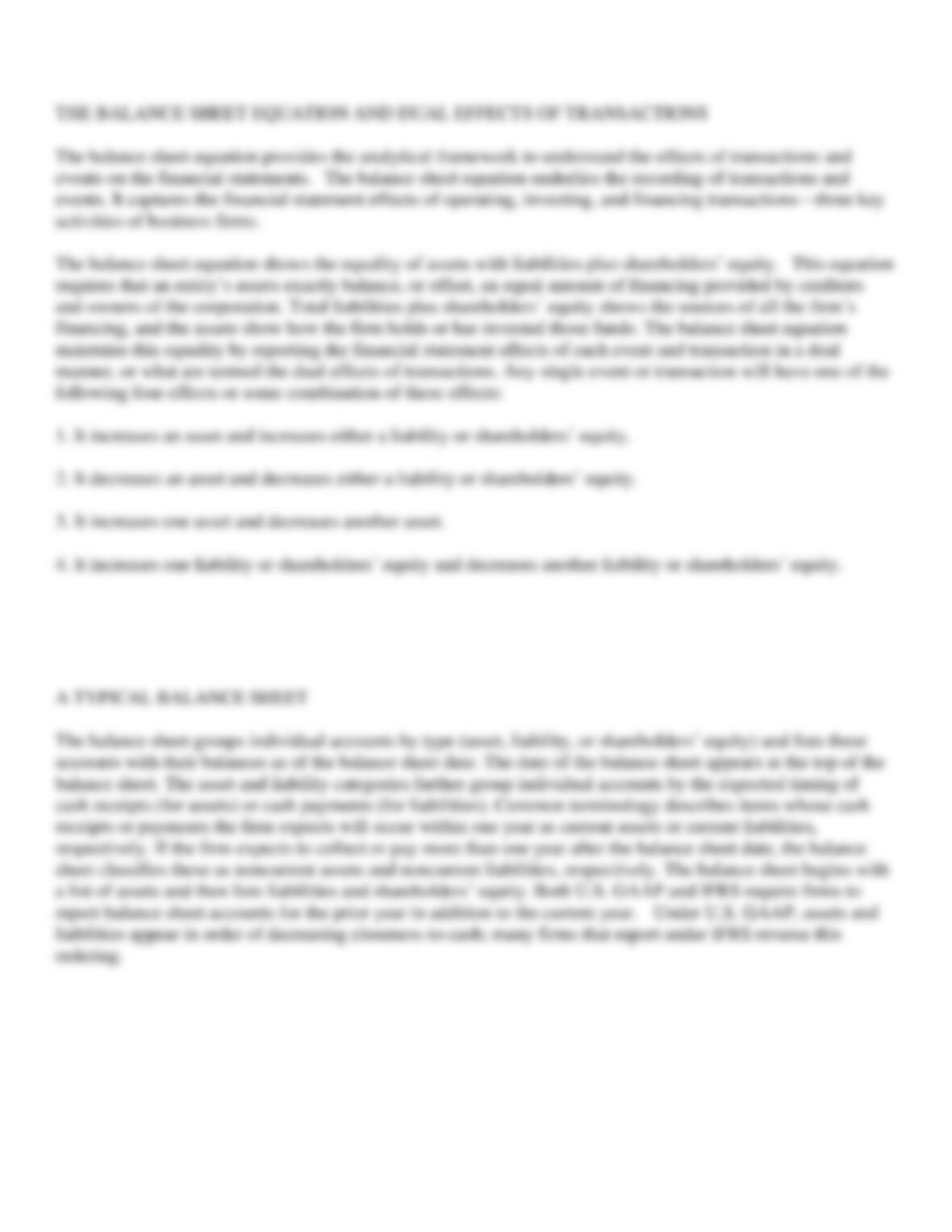
106. Describe the balance sheet equation and the dual effects of transactions.
107. Describe a typical balance sheet.
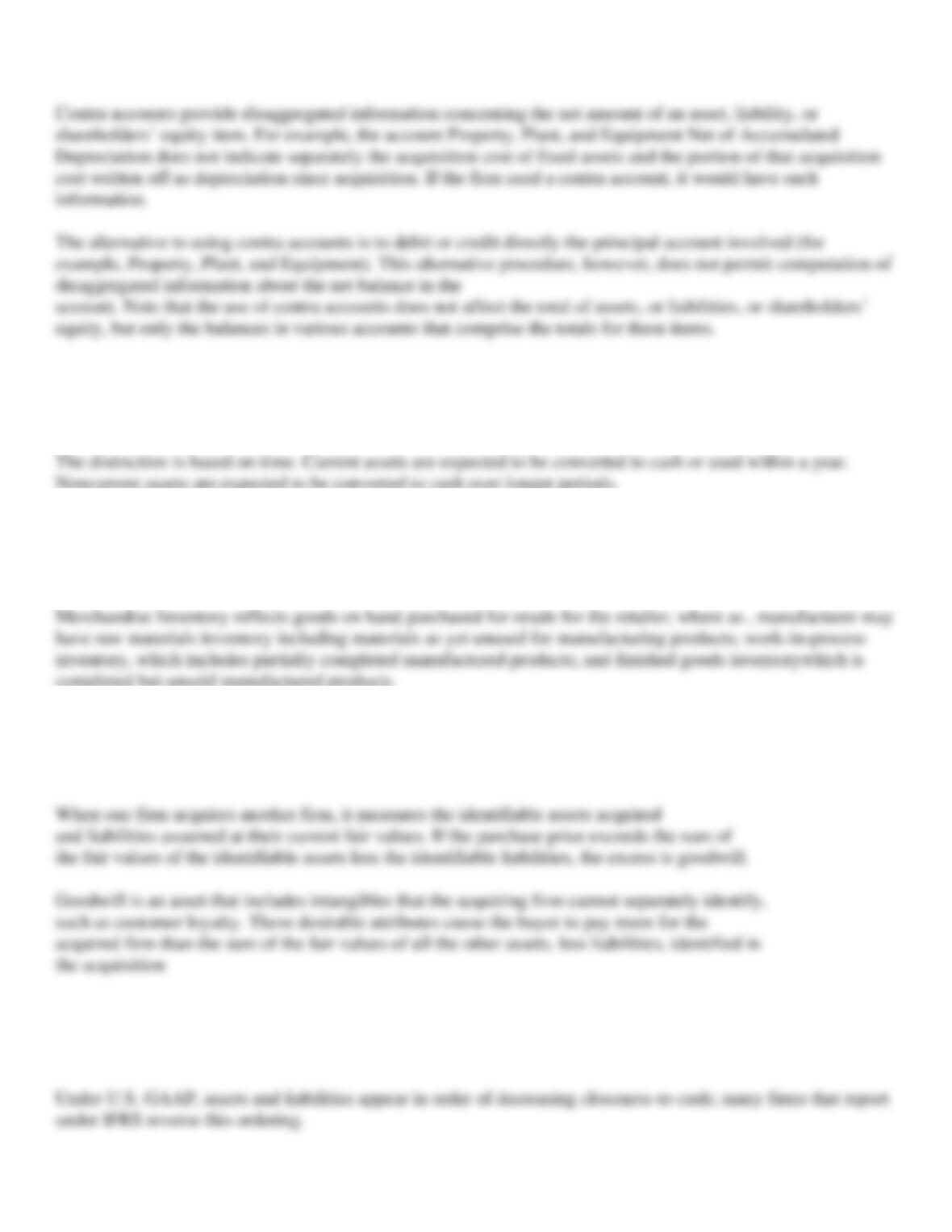
108. What is the purpose of using contra accounts? What is the alternative to using them?
109. What distinguishes noncurrent assets from current assets?
110. Explain the difference between inventories for a retailer versus a manufacturer.
111. What is goodwill and how is it classified in terms of the accounting equation?
112. Explain the order of assets and liabilities in the balance sheet under U.S. GAAP and IFRS.
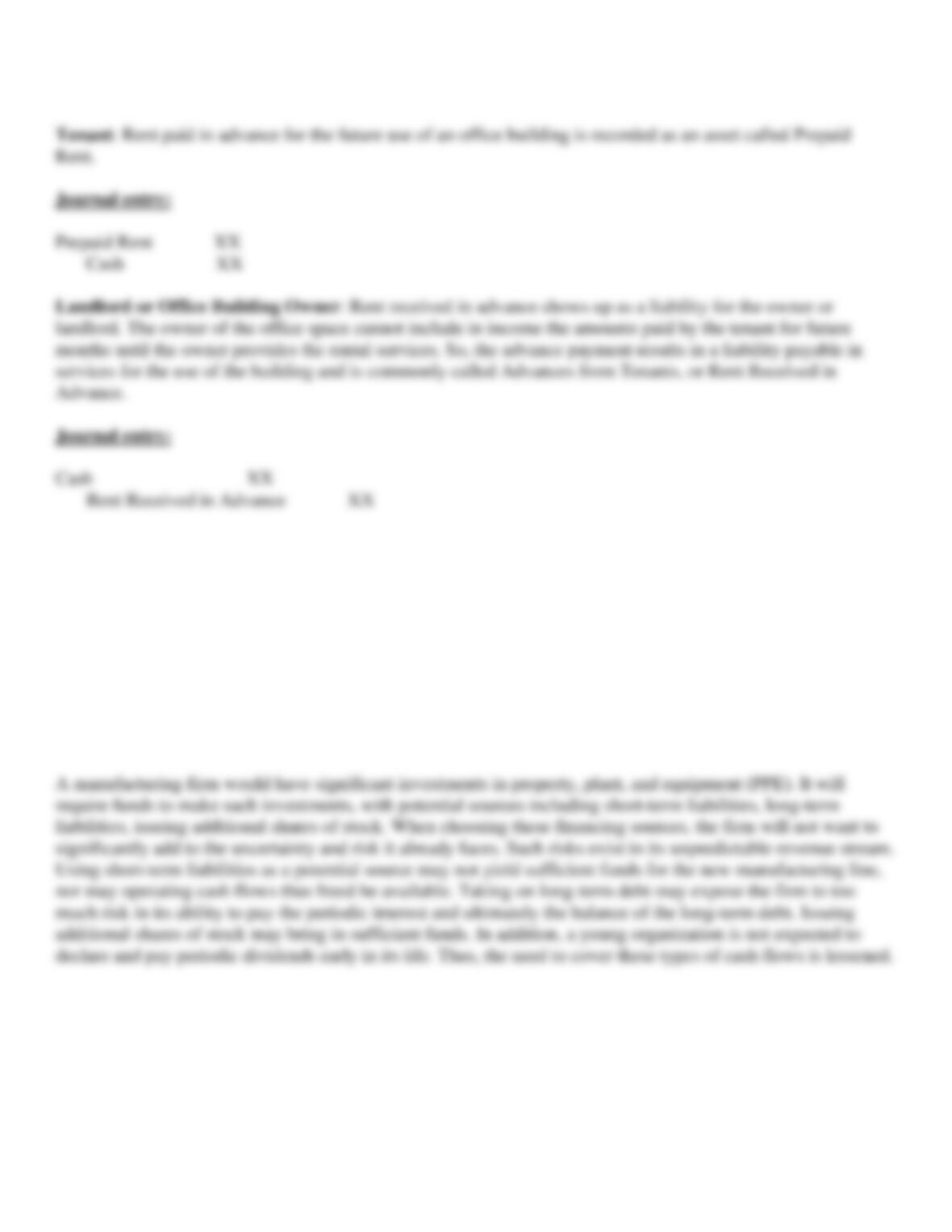
113. Explain how tenants record rent paid in advance for an office building and how a landlord or owner of the
property rented records the receipt of the advance payment. Show journal entries as part of your answer.
114. Many firms, especially in their first years of operation and growth, face a variety of challenges obtaining
funds to finance their growth.
Required:
Discuss how a small, young manufacturing firm that has a relatively unpredictable revenue stream might
approach financing a new manufacturing line.
115. Several actions that an organization may take are not recognized or entered in the accounting records.
While not entered into the formal accounting system, several such actions are exceedingly important to the
organization.
Required:
Comment on the current and future implications that the hiring of a new president may have on the
organization’s accounting records.