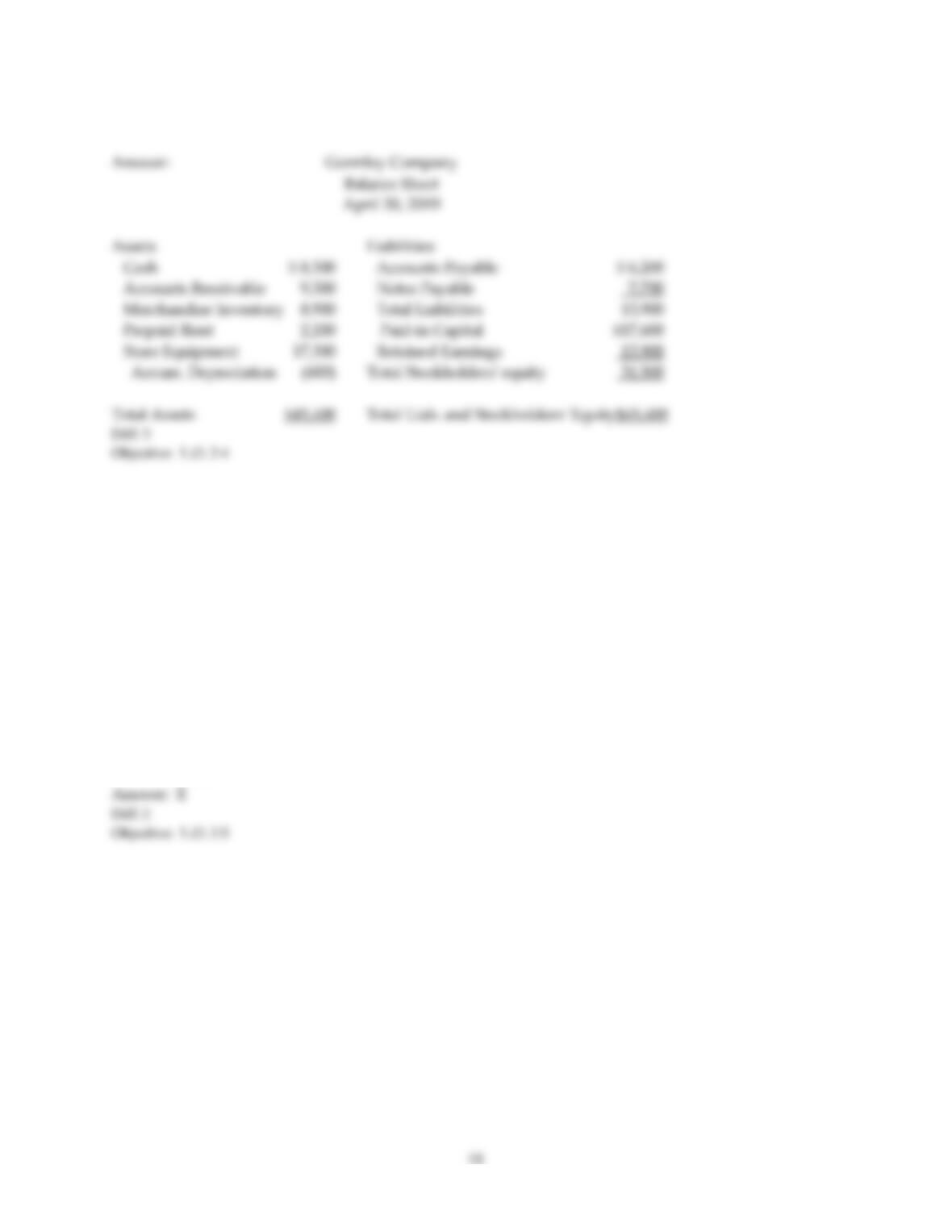
Prepare a balance sheet dated April 30, 20X9.
Learning Objective 2.5 Questions
2.5-1) On July 21, 20X9, the Hallock Company declared a $5,000 cash dividend payable on August 2,
20X9. The effect of the July 21 transaction on the Hallock Company would be to
A) decrease the balance in the cash account and decrease the balance in the retained earnings account by
$5,000.
B) increase the balance in the dividend expense account and increase the balance in the dividend payable
account by $5,000.
C) increase the balance in the dividend expense account and increase the balance in the retained earnings
account by $5,000.
D) increase the balance in the dividend payable account and increase the balance in the prepaid dividend
account by $5,000.
E) increase the balance in the dividend payable account and decrease the balance in the retained earnings
account by $5,000.
2.5-2) On February 23, 20X9, the Herriman Company declared a $9,000 cash dividend payable on March
3, 20X9. The effect of the March 3, 20X9, transaction on the Herriman Company would be to
A) increase the balance in the cash account and decrease the balance in the prepaid dividend account by
$3,000.
B) decrease the balance in the cash account and decrease the balance in the dividend payable account by
$3,000.
C) decrease the balance in the cash account and increase the balance in the dividend expense account by
$3,000.
D) decrease the balance in the cash account and increase the balance in the prepaid dividend account by
$3,000.
E) decrease the balance in the cash account and decrease the balance in the retained earnings account by
$3,000.
2.5-3) Cash dividends
A) are distributions of cash to trade creditors.
B) are expenses like rent and depreciation.
C) should not be deducted from revenues because they are not directly linked to the generation of
revenues or the costs of operating activities.
D) must be paid annually, regardless of the amount of cash in the bank.
E) cannot be paid if a net loss is incurred.
2.5-4) The Jacobs Company had the following balances in its stockholders’ equity accounts as of
December 31, 20X9:
Paid–in Capital $53,000
Retained Earnings $31,000
During the year ended December 31, 20X9, the Jacobs Company generated $36,000 in net income, and
declared and paid $16,000 in dividends. The ending balance in the retained earnings account at December
31, 20X8, was
A) $11,000.
B) $26,000.
C) $13,000.
D) $67,000.
E) $40,000.
2.5-5) The Kearney Company’s balance sheet on June 30, 20X9, has total assets of $75,000, total liabilities
of $30,000, paid–in–capital of $25,000, and retained earnings of $20,000. During the month of July, the
Kearney Company recognized revenues of $38,000, cost of goods sold of $27,000, depreciation expense of
$3,000, the payment of August and September’s rent totaling $1,000, and salary expense of $4,000. The
retained earnings balance at July 31, 20X9, will be
A) $24,000.
B) $29,000.
C) $23,000.
D) $21,000.
E) $25,000.
2.5-6) Kosman’s Catering balance sheet on August 31, 20X9, has total assets of $73,000, total liabilities of
$20,000, paid–in capital of $30,000, and retained earnings of $23,000. During the month of September,
Kosman’s Catering recognized revenues of $73,000, cost of goods sold of $47,000, depreciation expense of
$12,000, the payment of October and November’s rent totaling $2,500, and salary expense of $8,000. The
retained earnings balance at September 30, 20X9, will be
A) $29,000.
B) $27,750.
C) $31,000.
D) $41,000.
E) $26,500.
2.5-7) Cash dividends are an expense, and therefore they appear on the income statement.
2.5-8) The date the board of directors declares a dividend is known as the record date or the payment
date.
2.5-9) Frequently, the statement of retained earnings is added to the bottom of the balance sheet.
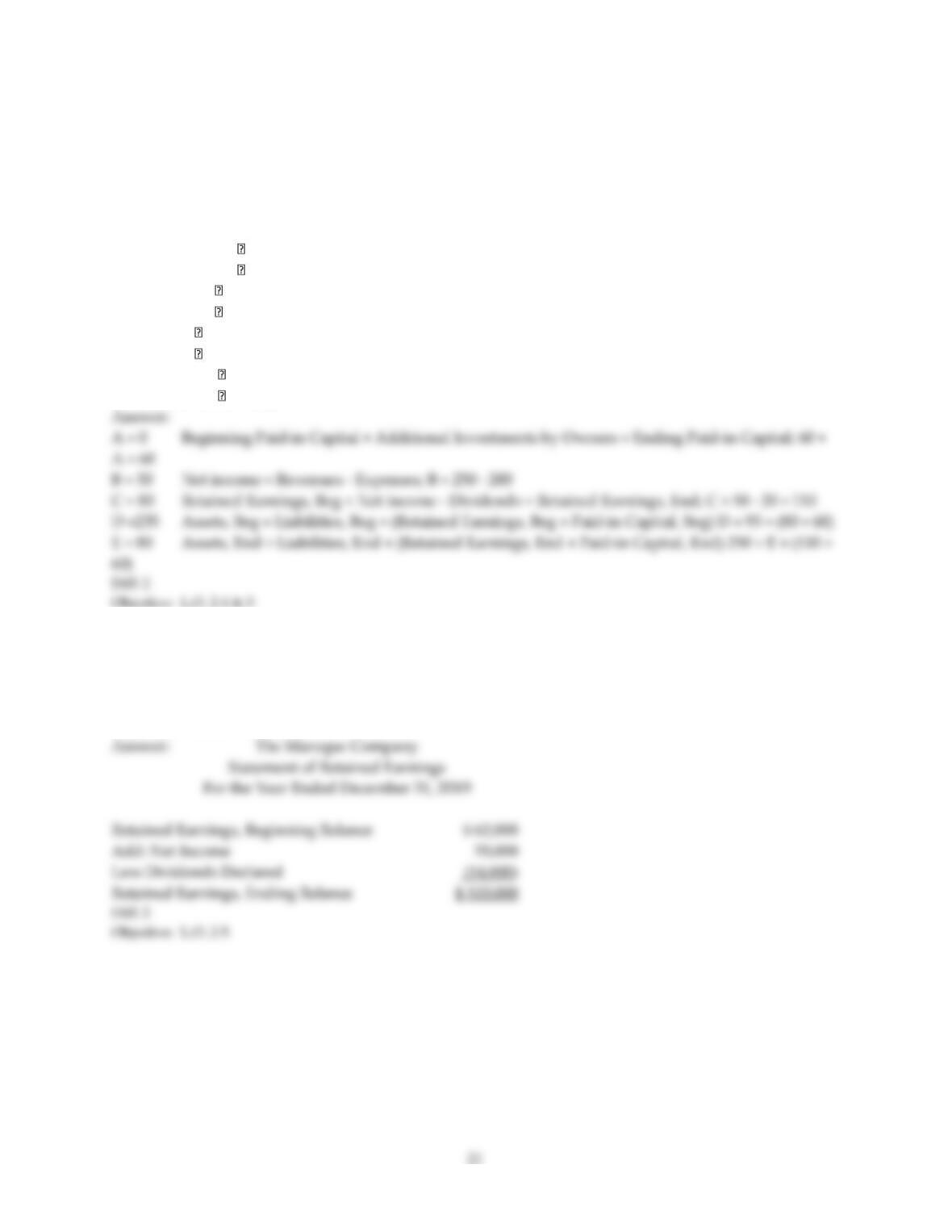
2.5-10) Determine the missing values.
Revenues $250
Expenses 200
Dividends Declared 20
Additional investments by owners A
Net income B
Retained Earnings Beginning C
Retained Earnings Ending 110
Paid–in Capital Beginning 60
Paid–in Capital Ending 60
Total Assets Beginning D
Total Assets Ending 250
Total Liabilities Beginning 95
Total Liabilities Ending E
2.5-11) The Marcque Company had net income during 20X9 of $55,000. During the year, dividends of
$14,000 were declared, of which $21,000 had been paid as of year end. As of the beginning of 20X9, the
Paid–in Capital account had a balance of $38,000 and the Retained Earnings account had a balance of
$62,000. Prepare a Statement of Retained Earnings for the Marcque Company for the year ended
December 31, 20X9.
Learning Objective 2.6 Questions
2.6-1) ________ is a quality of information meaning free of error or bias; dependable.
A) Relevance
B) Reliable
C) Verifiable
D) Validity
E) Neutrality
2.6-2) What is the concept that differentiates a corporation from its management?
A) Entity
B) Going concern
C) Reliability
D) Cost–benefit criterion
E) Materiality
2.6-3) The cost–benefit concept is of most concern to
A) banks.
B) accounting regulators.
C) owners.
D) creditors.
E) workers.
2.6-4) The reason that companies use historical costs is the
A) entity concept.
B) materiality concept.
C) going concern concept.
D) period cost principle.
E) neutrality principle.
2.6-5) Reliability is defined as
A) a correspondence between the accounting numbers and the resources or events those numbers
purport to represent.
B) the capability of information to make a difference to the decision maker.
C) the quality of information that allows decision makers to depend on it to represent the conditions or
events that it purports to represent.
D) choosing accounting policies without attempting to achieve purposes other than measuring economic
impact.
E) a quality of information such that there would be a high extent of consensus among independent
measurers of an item.
2.6-6) Reliability is the assumption that, ordinarily, an entity persists indefinitely.
2.6-7) The cost–benefit criterion asserts that an item should be included in a financial statement if its
omission or misstatement would tend to mislead the reader.
2.6-8) The stable monetary unit concept is based on a principle of low inflation.
2.6-9) Reliability refers to whether the information makes a difference to the decision maker.
2.6-10) The assumption that in all ordinary situations an entity persists indefinitely is known as the
reliability assumption.

24
2.6-11) Name which of the following concepts is applicable to each situation.
Entity
Reliability
Going Concern
Materiality
Cost–benefit
Stable monetary unit
Confirmatory value
Predictive value
1. Morgan Enterprises acquired equipment with a fair market value of $12,000 and a trade–in value of
$9,000, yet paid $10,000 for the equipment. Morgan Enterprises recorded the equipment at $10,000.
2. Swanson Industries has divisions in several countries. Before publishing financial statements, Swanson
Industries translates its divisional financial information to U.S. dollars.
3. Novotny, Inc., is experiencing financial difficulties due to poor economic conditions. The organization
has been in existence for 50 years and has experienced these conditions in the past with little financial
impact to the organization. Although Novotny, Inc., may be impacted, there is no reason to believe that it
will go bankrupt.
4. Poloha Manufacturing is owned by Lynn Roberts and Dale Shiley, after each deposited $50,000 into the
business’s bank account. Both Lynn and Dale have access to the bank account and periodically transfer
money from their personal accounts to the business account, but they never access the business account
for personal use.
5. Pittman Bar and Grill prepares monthly financial statements. Each month after they are Prepared, the
owner, Bill Scodd, reviews them in an effort to forecast future revenues and expenses.
6. Searle Company is inquiring about new machinery for the plant. The current machinery is paid in full;
however, new machinery would need to be financed, thus incurring monthly payments that include
interest. If Searle Company decides to purchase the new machinery, the decision makers must believe
that the advantages exceed the expenditures.
2.6-12) Why is the concept of going concern necessary for financial statements to be useful?
Learning Objective 2.7 Questions
2.7-1) Which financial ratio is required to be reported on the face of the income statement of publicly–held
corporations?
A) Earnings per share
B) Price–earnings ratio
C) Dividend–yield ratio
D) Dividend payout ratio
E) Inventory turnover ratio
2.7-2) Which financial ratio measures how much the investing public is willing to pay for a company’s
prospects for earnings?
A) Earnings per share
B) Price–earnings ratio
C) Dividend–yield ratio
D) Dividend payout ratio
E) Profit margin ratio
Table 2–2
McGinty, Inc., had 20X9 earnings of $600,000. Cash dividends per share were $1.25. The company had an
average of 225,000 shares of common stock outstanding. The market price of the stock at the end of the
year was $25 per share.
2.7-3) Referring to Table 2–2, the earnings per share for 20X9 is
A) $ 1.50.
B) $24.00.
C) $ 1.25.
D) $ 2.67.
E) This cannot be determined from the information given.
2.7-4) Referring to Table 2–2, what was the price–earnings ratio for Cleary Systems?
A) 0.10
B) 18.4
C) 9.36
D) 24.0
E) Cannot be determined from the information provided
2.7-5) Referring to Table 2–2, what was the dividend–yield for Cleary Systems?
A) 5%
B) 12%
C) 47%
D) 15%
E) Cannot be determined from the information provided
Table 2–3
Megyes Corporation had 20X9 earnings of $1,500,000. Cash dividends per share were $0.50. The company
had an average of 1,225,000 shares of common stock outstanding. The market price of the stock at the end
of the year was $6.00 per share.
2.7-6) Referring to Table 2–3, what was the earnings per share for 20X9?
A) $0.60
B) $0.75
C) $1.22
D) $1.25
E) $5.50
2.7-7) Referring to Table 2–3, what was the price–earnings ratio for Megyes Corporation?
A) 6.5
B) 4.91
C) 3.00
D) 12
E) 5.20
2.7-8) Referring to Table 2–3, what was the dividend–yield for Megyes Corporation?
A) 12.00%
B) 10.00%
C) 20.33%
D) 8.33%
E) Cannot be determined from the information provided
2.7-9) Which financial ratio measures the return on an investment in common stock by dividing the cash
dividends per share by the market price per share?
A) Earnings per share
B) Price–earnings ratio
C) Dividend–yield ratio
D) Dividend payout ratio
E) Accounts receivable turnover ratio
2.7-10) The dividend–yield ratio must appear on the face of the balance sheet.
2.7-11) A low P–E ratio indicates that investors think a stock is underpriced.
2.7-12) The price–earnings ratio is earnings per share of common stock divided by the market price per
share of common stock.
2.7-13) The dividend–yield ratio is computed as the current market price of the stock divided by the
current dividend per share.
2.7-14) Companies with exceptional growth (growth stocks) tend to pay a higher percentage of their
earnings in dividends.
28
2.7-15) The dividend–payout ratio is computed as common dividends per share divided by earnings per
share.
2.7-16) Following is a list of selected financial data for a series of companies:
| Per–share Data | Ratios and Percentages
Company | Price Earnings Dividends | P–E Dividend–yield Dividend–payout
Alpha | $50 $1.75 A | B C 30%
Beta | $35 D $2.25 | E F 40%
Charlie | G $5.25 $1.75 | 12.0 I J
1. Compute the missing figures and identify the company with
a. the highest dividend–yield.
b. the highest dividend–payout percentage.
c. the lowest market price relative to earnings.
2. Assume that you know nothing about any of these companies other than the data given and the
computations you have made from the data. If you were interested in receiving dividend income, which
company would you choose as
a. the most attractive investment? Why?
b. the least attractive investment? Why?
Learning Objective 2.8 Questions
2.8-1) R&D costs are expensed in the period that they occur,
A) which is a violation of the matching principle.
B) because FASB determined that the benefits of R&D are often harder to pinpoint than the costs.
C) because is was the only way FASB could get verifiability.
D) because IASB lobbied FASB to do so.
E) because the U.S. Congress passed a law on it.
2.8-2) The primary driver for FASB rule–making is
A) consistency.
B) representational faithfulness.
C) validity.
D) the cost–benefit criterion.
E) the matching concept.
2.8-3) Accounting regulation is difficult because of
A) the congressional oversight.
B) company lobbying.
C) the trade–off between relevance and reliability.
D) IRS rules conflicting with financial rules.
E) period costs that are difficult to identify.
2.8-4) Financial accounting standards
A) are products of airtight logic.
B) are issued by the FASB without the input of parties such as corporate accountants or analysts.
C) are often the result of compromises among the interested parties.
D) have never been overturned by the SEC.
E) None of the above statements is true.
2.8-5) The FASB’s main criterion in making decisions about reporting requirements is the
A) usefulness of the information provided.
B) benefit of implementing a particular standard.
C) cost versus the benefit of implementing a particular standard.
D) cost of implementing a particular standard.
E) None of the above statements is correct.
2.8-6) ________ is the capability of information to make a difference to the decision maker.
A) Verifiability
B) Reliability
C) Relevance
D) Validity
E) Neutrality
2.8-7) Relevance is defined as
A) choosing accounting policies without attempting to achieve purposes other than measuring economic
impact.
B) the capability of information to make a difference to the decision maker.
C) the quality of information that allows users to depend on it to represent the conditions or events that it
purports to represent.
D) a correspondence between the accounting numbers and the resources or events those numbers
purport to represent.
E) a quality of information such that there would be a high extent of consensus among independent
measurers of an item
2.8-8) ________ is a quality of information producing a high extent of consensus among independent
measurers of an item.
A) Validity
B) Relevance
C) Verifiability
D) Reliability
E) Neutrality

2.8-9) Verifiability is defined as
A) the quality of information that allows users to depend on it to represent the conditions or events that it
purports to represent.
B) the capability of information to make a difference to the decision maker.
C) choosing accounting policies without attempting to achieve purposes other than measuring economic
impact.
D) a correspondence between the accounting numbers and the resources or events those numbers
purport to represent.
E) a quality of information such that it can be checked to ensure it is correct.
2.8-10) Neutrality is defined as
A) information which is free from bias and not slanted to influence the behavior of decision makers.
B) the capability of information to make a difference to the decision maker.
C) the quality of information that allows users to depend on it to represent the conditions or events that it
purports to represent.
D) a correspondence between the accounting numbers and the resources or events those numbers
purport to represent.
E) a quality of information such that there would be a high extent of consensus among independent
measures of an item.
2.8-11) Charging all research and development costs to expense as incurred is an example of
A) materiality.
B) conservatism.
C) reliability.
D) accrual accounting.
E) relevance.
2.8-12) Which of the following statements is incorrect?
A) Verifiability means there would be a high extent of consensus among independent measurers of an
item.
B) Validity means a correspondence between the account number and the resources and events those
numbers purport to represent.
C) Neutrality means choosing accounting policies without attempting to achieve purposes other than
measuring economic impact.
D) Relevance is the capability of information to make a difference to a decision–maker.
E) Materiality means that the cost/benefit trade–off in the determination of instituting new accounting
policies and procedures has been applied with due diligence.
2.8-13) Devising an accelerated method of depreciation for financial statement purposes that would
promote a national goal of increased investment in capital equipment would be an example of a lack of
A) neutrality.
B) consistency.
C) matching.
D) conservatism.
E) recognition.
2.8-14) Using LIFO to value inventory one year and using FIFO the next is a violation of which
accounting principle?
A) Conservatism
B) Recognition
C) Neutrality
D) Matching
E) Consistency
2.8-15) Relevance means that the information can be counted on to represent faithfully the condition of
the company, given the rules in use.
2.8-16) There is often a conflict between applying the concept of relevance and the concept of reliability.
2.8-17) Verifiability is a correspondence between numbers and the effects portrayed.
2.8-18) The cost–benefit criterion states that an accounting system should be changed when the expected
additional benefits of the change exceed its expected additional costs.
2.8-19) U.S. financial reporting follows the IASB framework for decision usefulness
2.8-20) Relevance and validity are the two main qualities that make accounting information useful for
decision making.
2.8-21) One of the major relevance characteristics is neutrality.
2.8-22) Describe the trade–off between relevance and reliability in a paragraph or two.
2.8-23) Define three of the following:
a. Neutrality
b. Relevance
c. Reliability
d. Consistency
e. Verifiability
2.8-24) For each example, write the qualitative characteristic(s) or accounting term that best corresponds.
a. The use of a different inventory method every year is not an example of this
b. An error of $100 of revenue for Sherry’s Dairy King versus $100 of revenue for McDonald’s
c. Record revenue when it is earned and record expenses when incurred regardless of when cash changes
hands
d. A parent corporation, a subsidiary, and a retail store are examples of this concept
e. Applying lower–of–cost–or–market methods to asset valuation
f. Three auditors count the same amount of cash