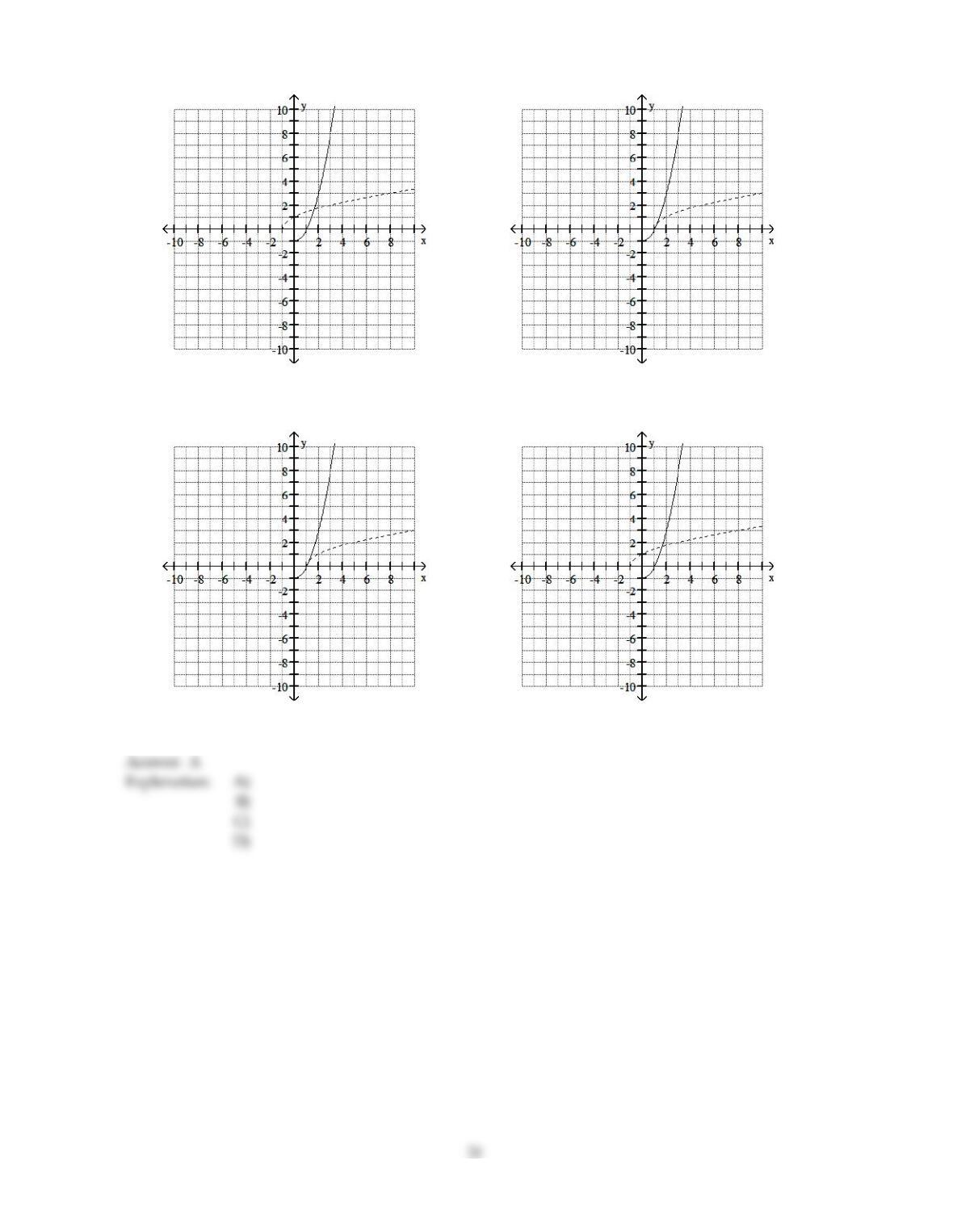
A)
f domain = (0, ); range = (–1, )
f–1 domain =(0, ); range = (–1, )
B)
f domain = (–, ); range = (–1, )
f–1 domain =(–, ); range = (1, )
C)
f domain = (0, ); range = (–1, )
f–1 domain =(0, ); range = (1, )
D)
f domain = (–, ); range = (–1, )
f–1 domain =(–, ); range = (–1, )
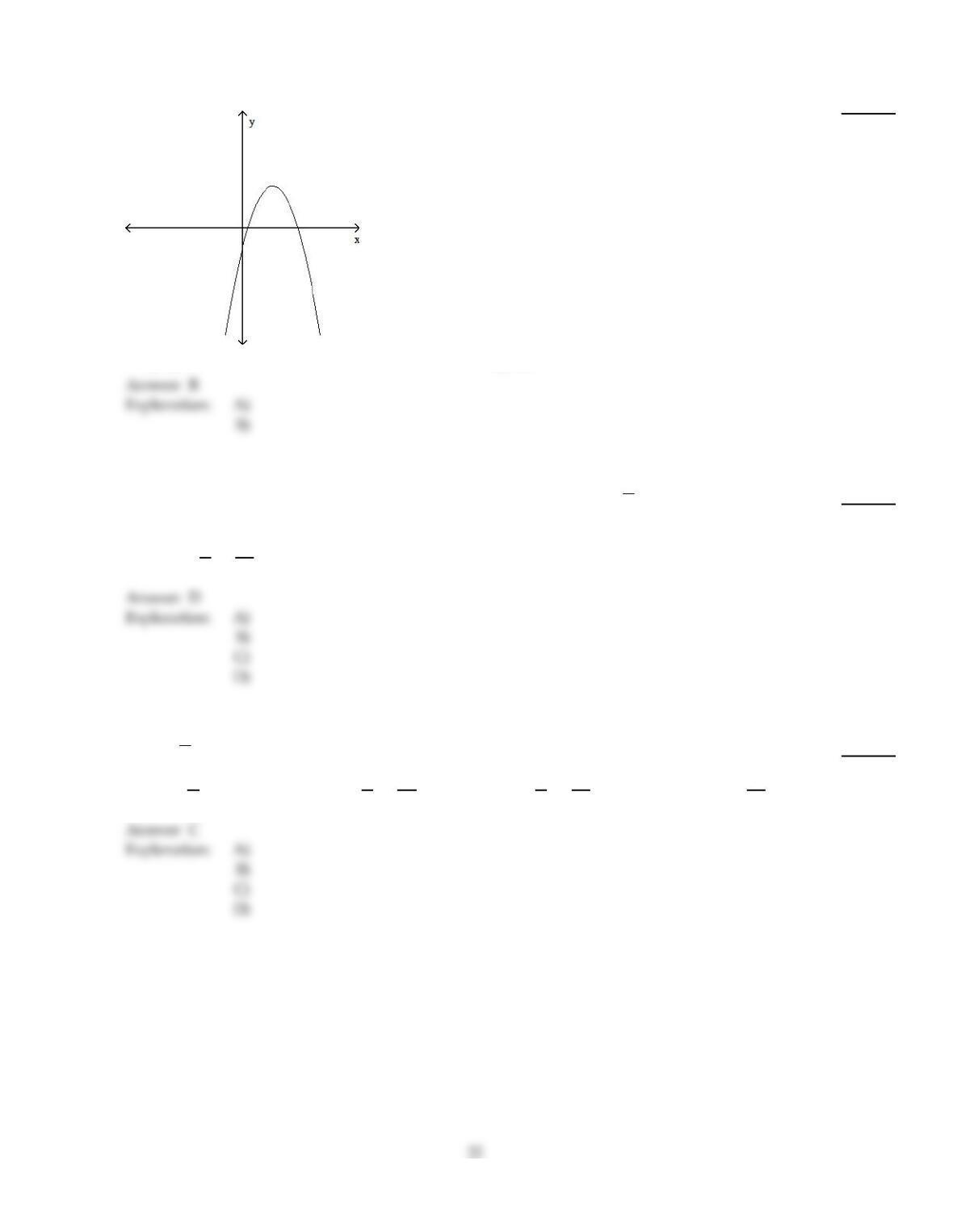
Does the graph represent a function that has an inverse function?
39)
39)
A)
Yes
B)
No
Use the given conditions to write an equation for the line in the indicated form.
40)
Passing through (5, 3) and perpendicular to the line whose equation is y =1
7x +5;
slope–intercept form
40)
A)
y = – 1
7x –38
7
B)
y =7x – 38
C)
y = – 7x – 38
D)
y = – 7x + 38
Use the given conditions to write an equation for the line in slope–intercept form.
41)
Slope =4
5, passing through (2, 7)
41)
A)
y =4
5x + 2
B)
y =4
5x –27
5
C)
y =4
5x +27
5
D)
y = mx +27
5
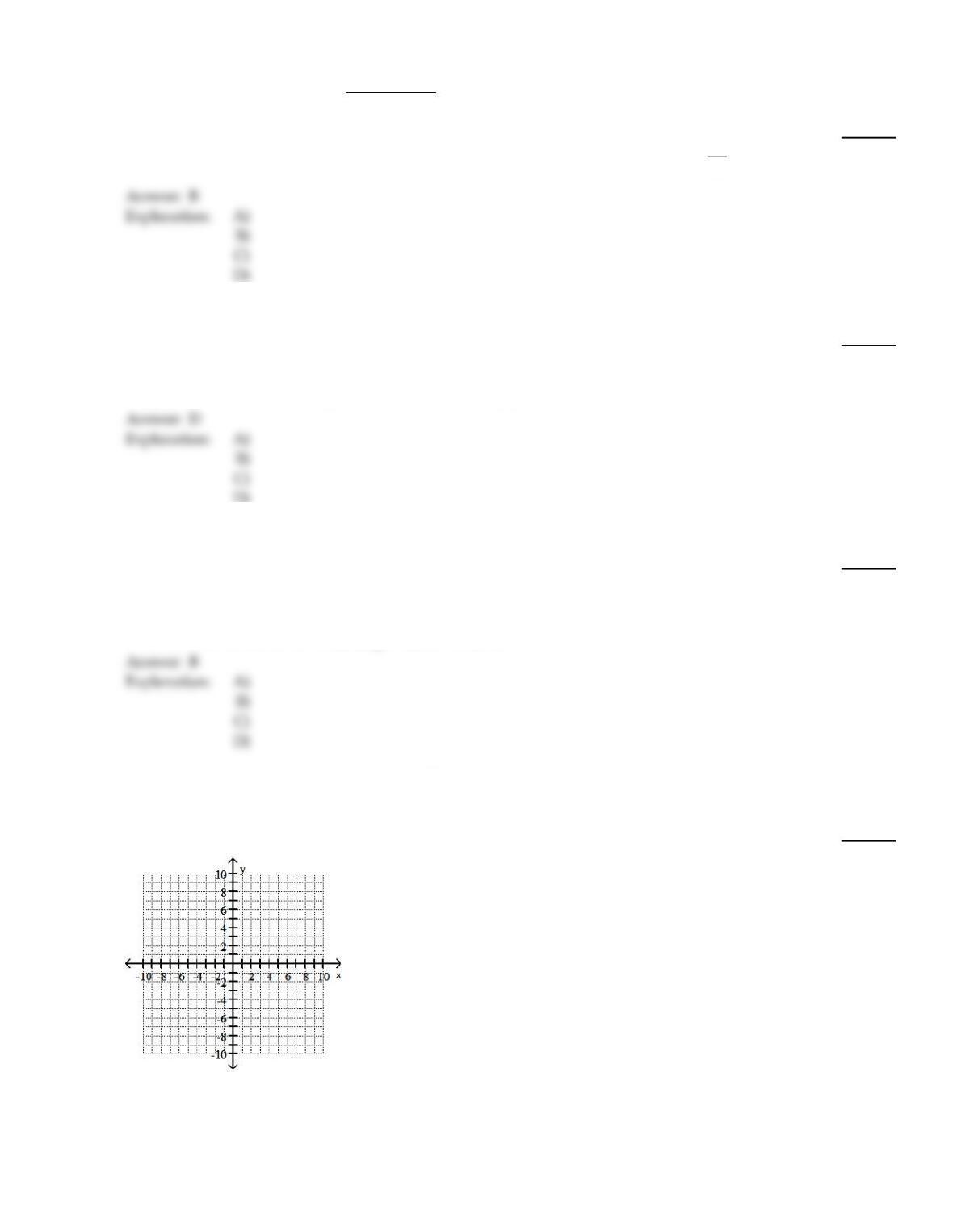
Find and simplify the difference quotient f(x +
h) – f(x)
h, h
0 for the given function.
42)
f(x) =9
42)
A)
9
B)
0
C)
1
D)
1 +18
h
Solve the problem.
43)
Suppose a life insurance policy costs $16 for the first unit of coverage and then $4 for each
additional unit of coverage. Let C(x) be the cost for insurance of x units of coverage. What will 10
units of coverage cost?
43)
A)
$56
B)
$40
C)
$24
D)
$52
D)
Give the domain and range of the relation.
44)
{(–6, 5), (–6, –7), (5, –6), (6, –1), (–4, –5)}
44)
A)
domain = {5, 13, –4, 6, –6}; range = {–6, –5, –1, –7, 5}
B)
domain = {5, –4, 6, –6}; range = {–6, –5, –1, –7, 5}
C)
domain = {5, –3, –4, 6, –6}; range = {–6, –5, –1, –7, 5}
D)
domain = {–6, –5, –1, –7, 5}; range = {5, 5, –4, 6, –6}
D)
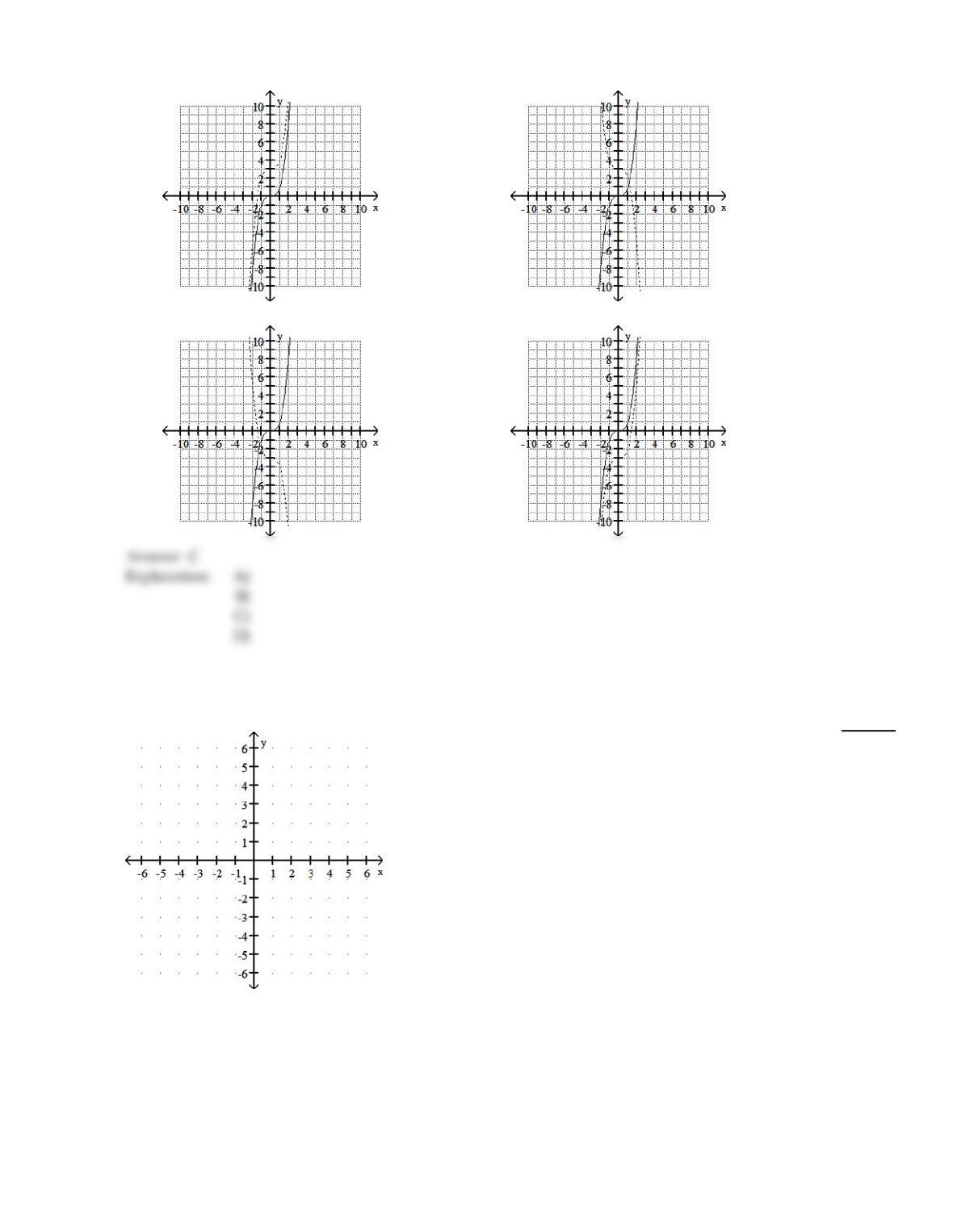
Begin by graphing the standard cubic function f(x) =x3. Then use transformations of this graph to graph the given
function.
45)
g(x) = – x3– 3
45)
23
D)
A)
B)
C)
D)
Graph the given functions on the same rectangular coordinate system. Describe how the graph of g is related to the graph
of f.
46)
f(x) =x3, g(x) =x3+ 2
46)
24
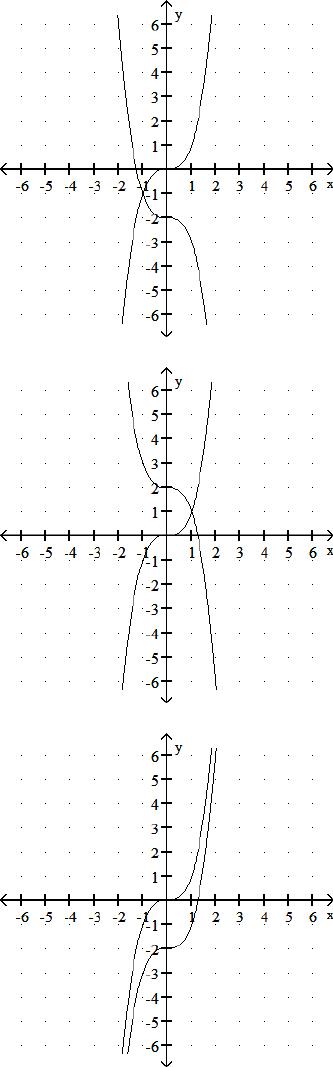
A)
g shifts the graph of f vertically down 2 units
B)
g shifts the graph of f vertically up 2 units
C)
g shifts the graph of f vertically down 2 units
25
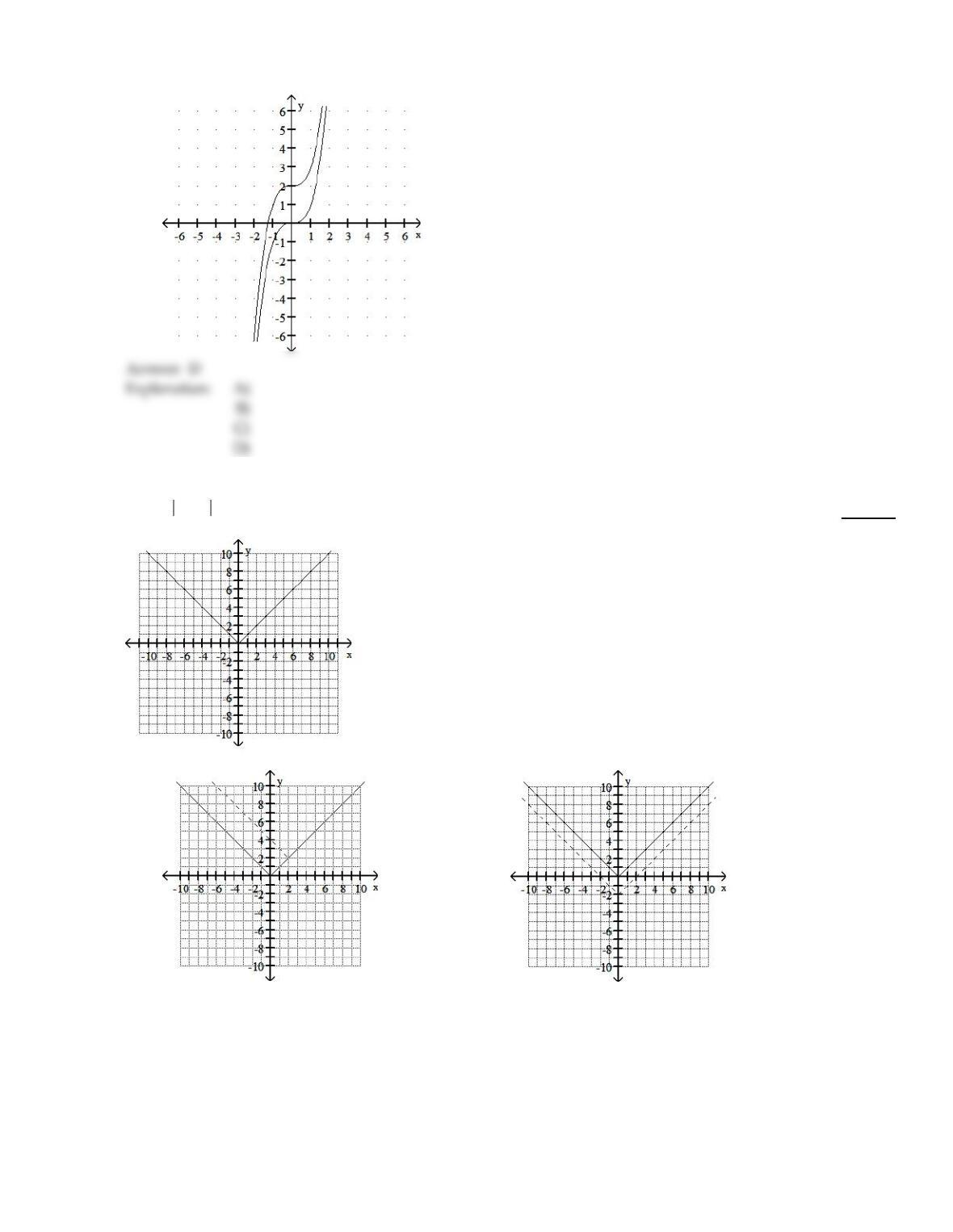
D)
g shifts the graph of f vertically up 2 units
Use the graph of the function f, plotted with a solid line, to sketch the graph of the given function g.
47)
g(x) =x – 2
47)
A)
B)
26
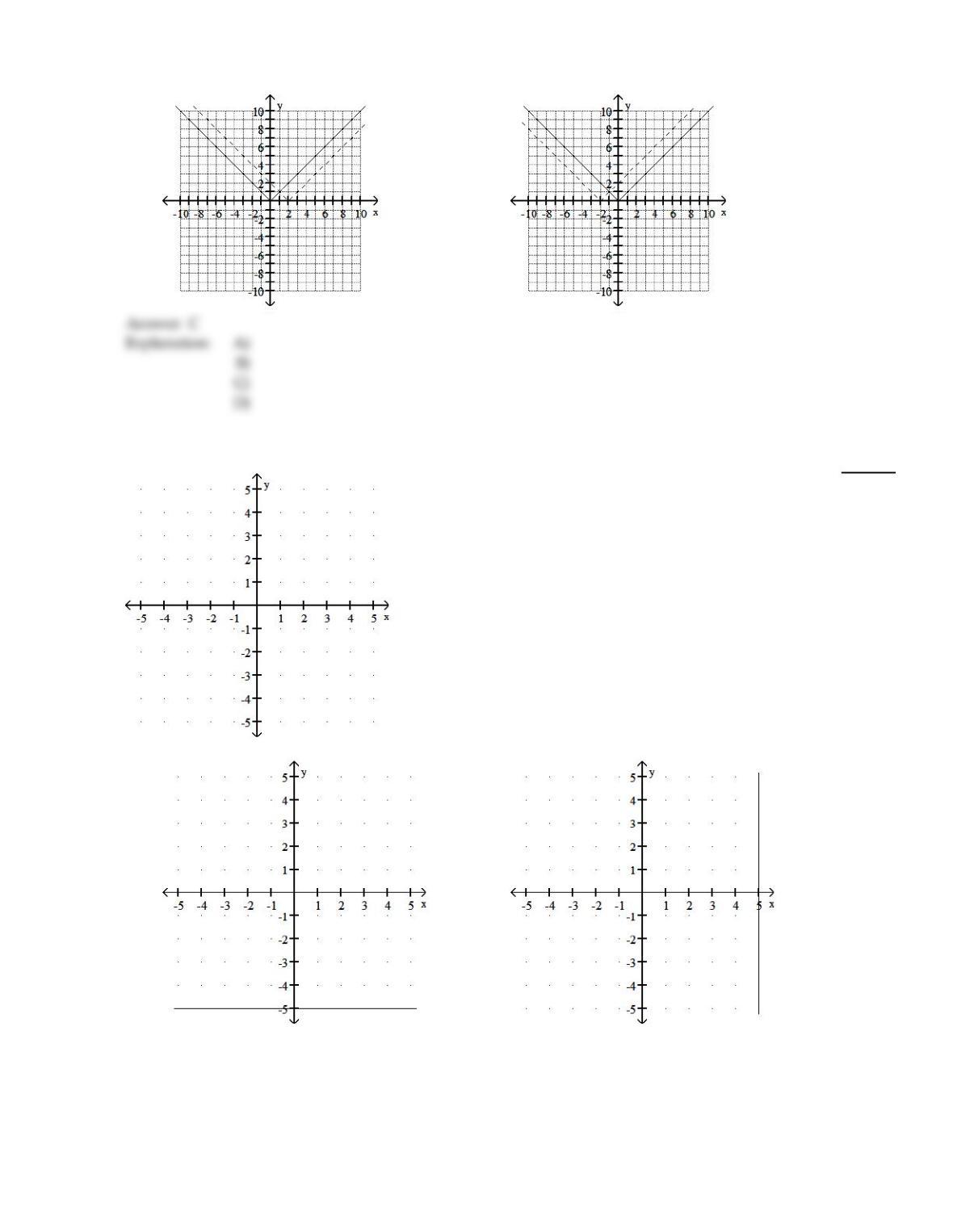
C)
D)
Graph the equation in the rectangular coordinate system.
48)
5y =25
48)
A)
B)
27
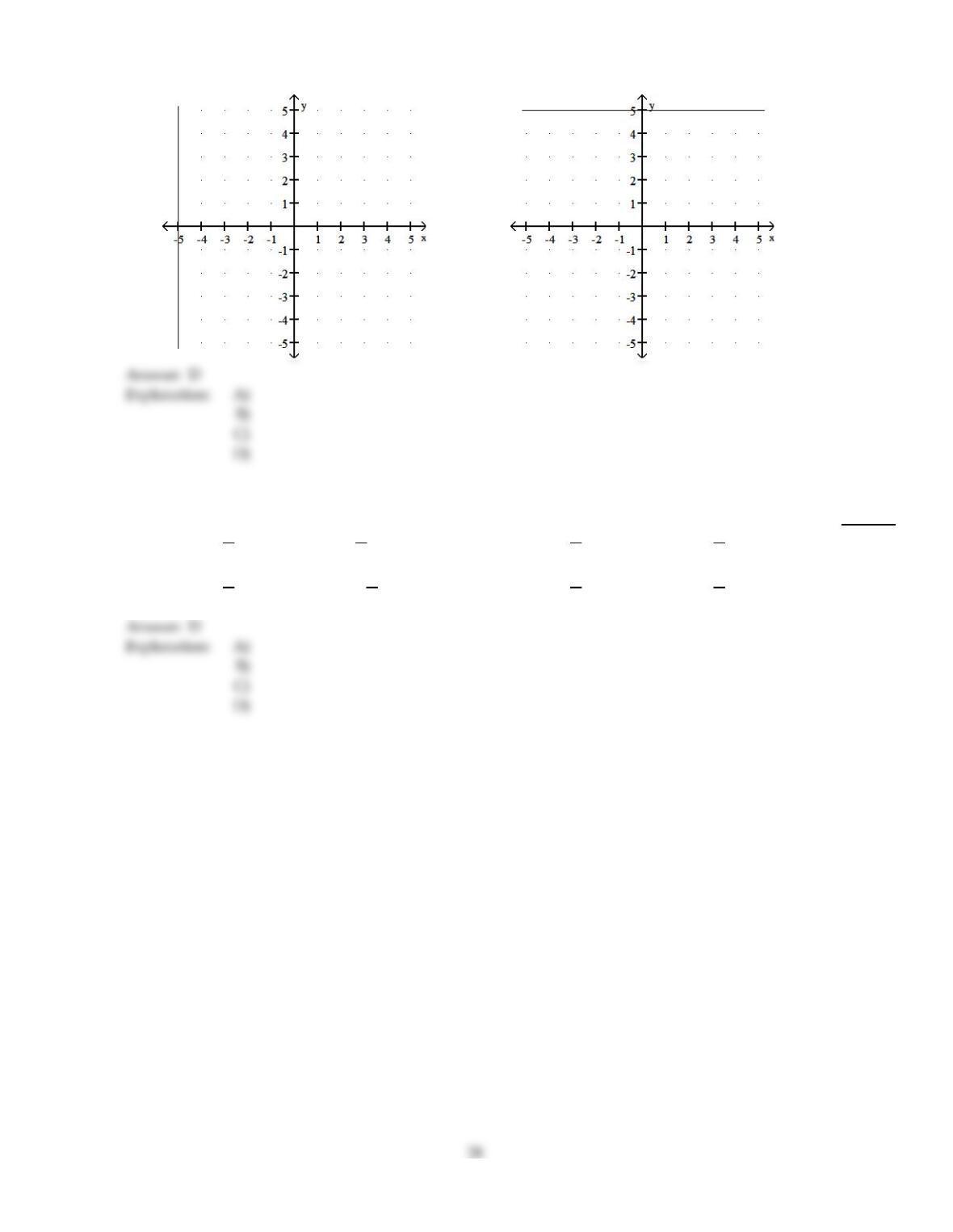
C)
D)
Use the given conditions to write an equation for the line in point–slope form.
49)
Passing through (–4, –4) and (–2, –7)
49)
A)
y + 4 = – 3
2x – 4 or y + 7 = – 3
2x + 4
B)
y + 4 = – 3
2(x + 2) or y + 7 = – 3
2(x + 4)
C)
y – 4 = – 3
2(x – 4) or y – 7 = – 3
2(x – 2)
D)
y + 4 = – 3
2(x + 4) or y + 7 = – 3
2(x + 2)
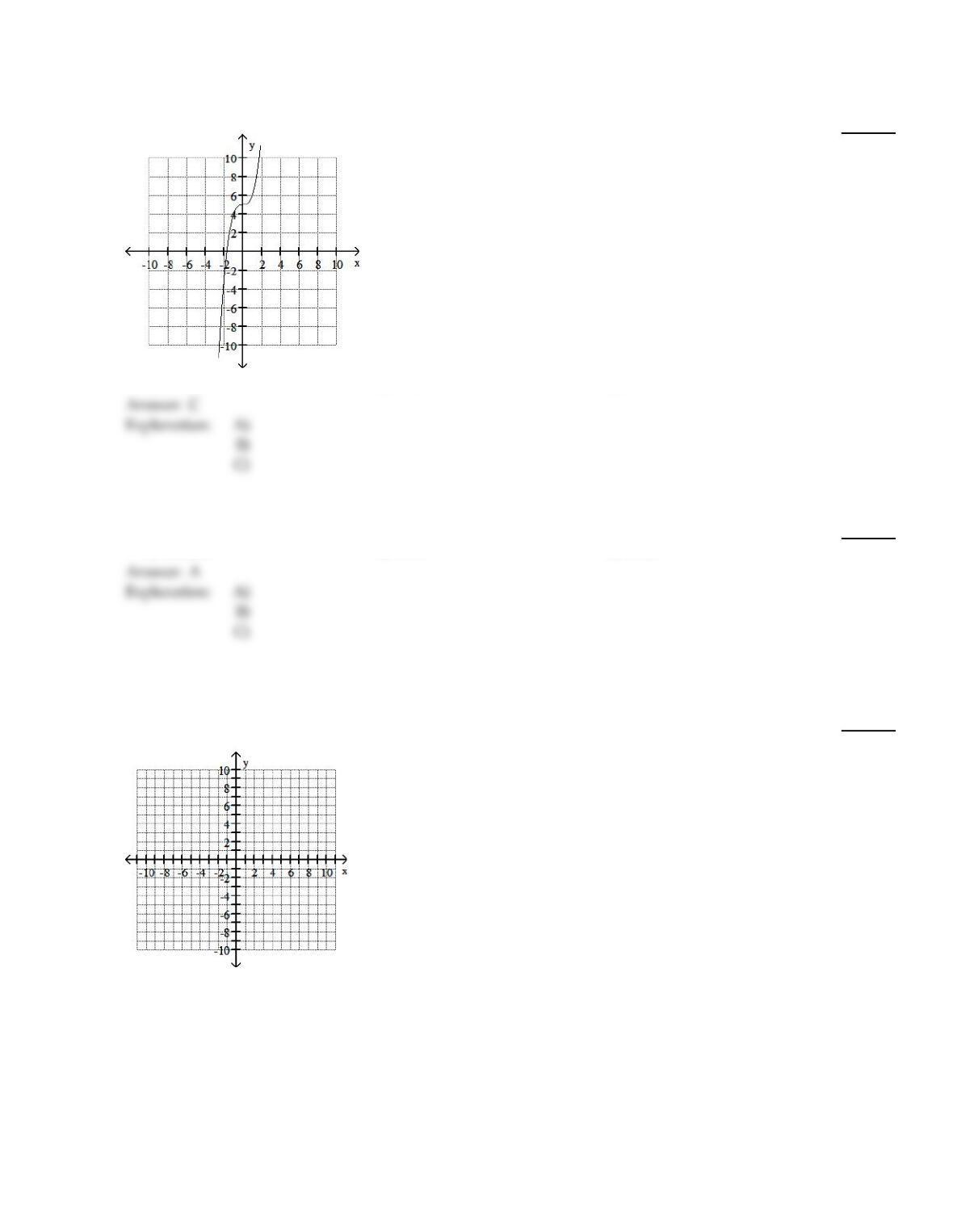
Use possible symmetry to determine whether the graph is the graph of an even function, an odd function, or a function
that is neither even nor odd.
50)
50)
A)
Even
B)
Odd
C)
Neither
Determine whether the given function is even, odd, or neither.
51)
f(x) = x3+ x2+ 3
51)
A)
Neither
B)
Odd
C)
Even
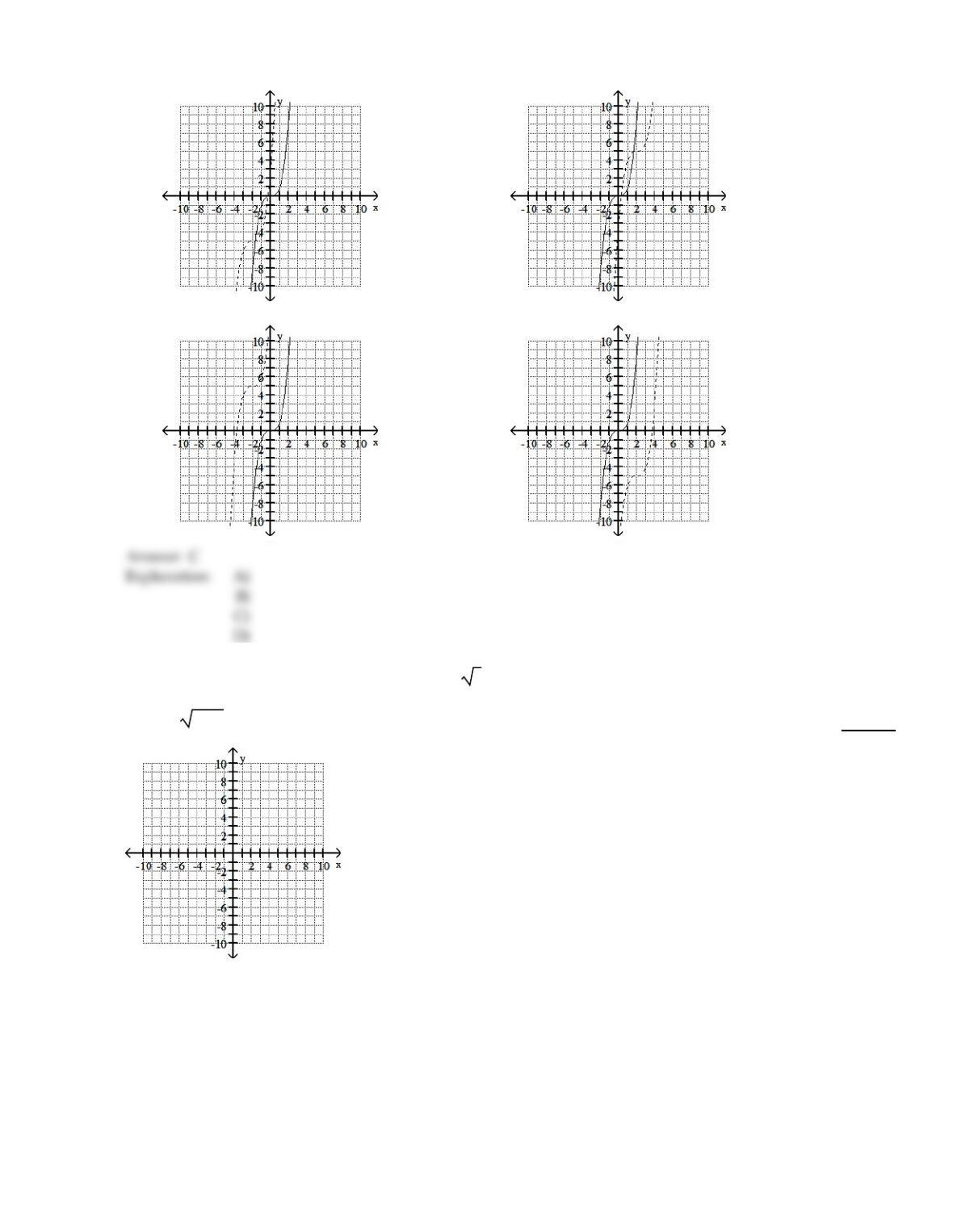
Begin by graphing the standard cubic function f(x) =x3. Then use transformations of this graph to graph the given
function.
52)
h(x) =(x + 2)3+ 5
52)
29
A)
B)
C)
D)
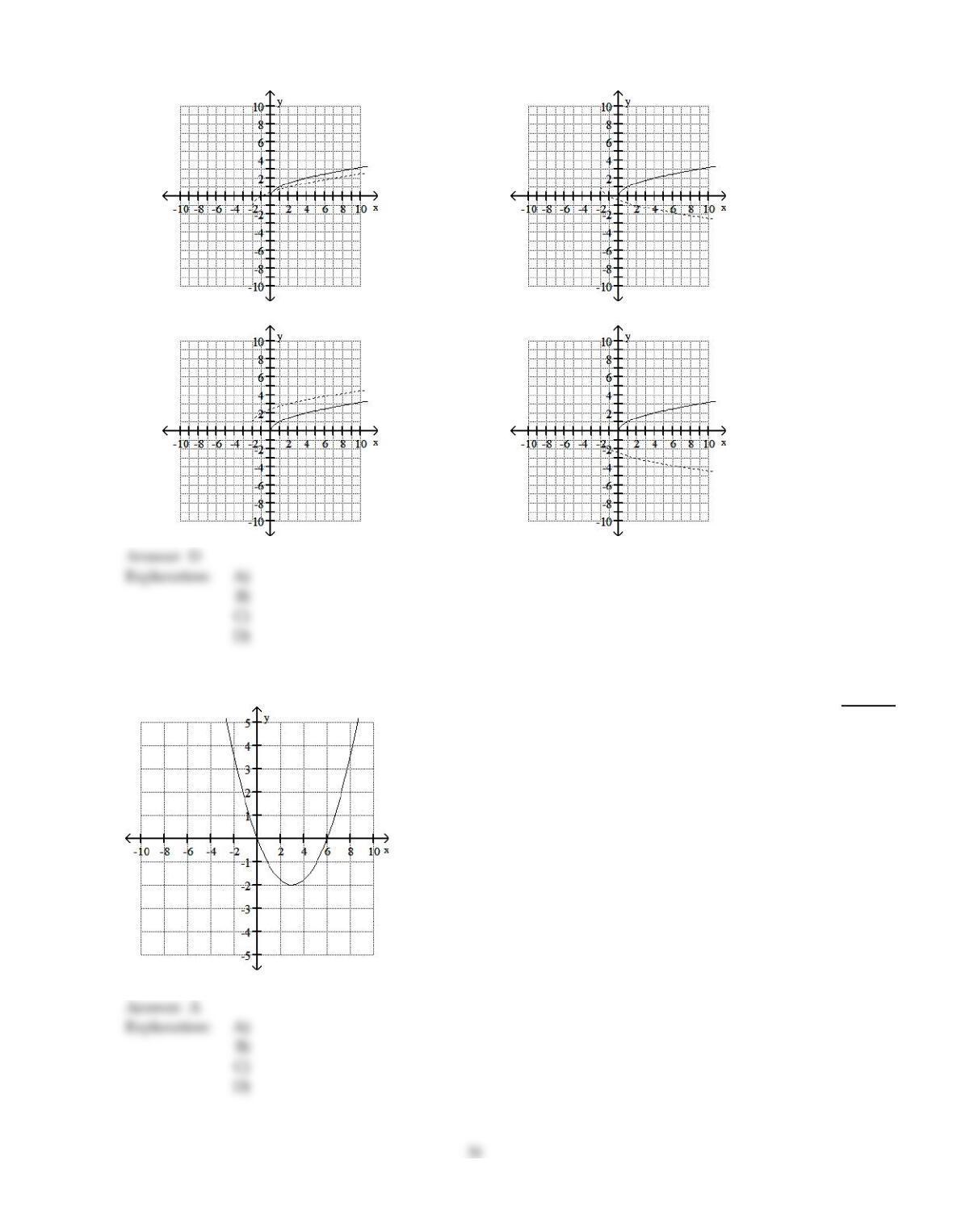
Begin by graphing the standard square root function f(x) =x . Then use transformations of this graph to graph the given
function.
53)
g(x) = – x +2– 1
53)
30
A)
B)
C)
D)
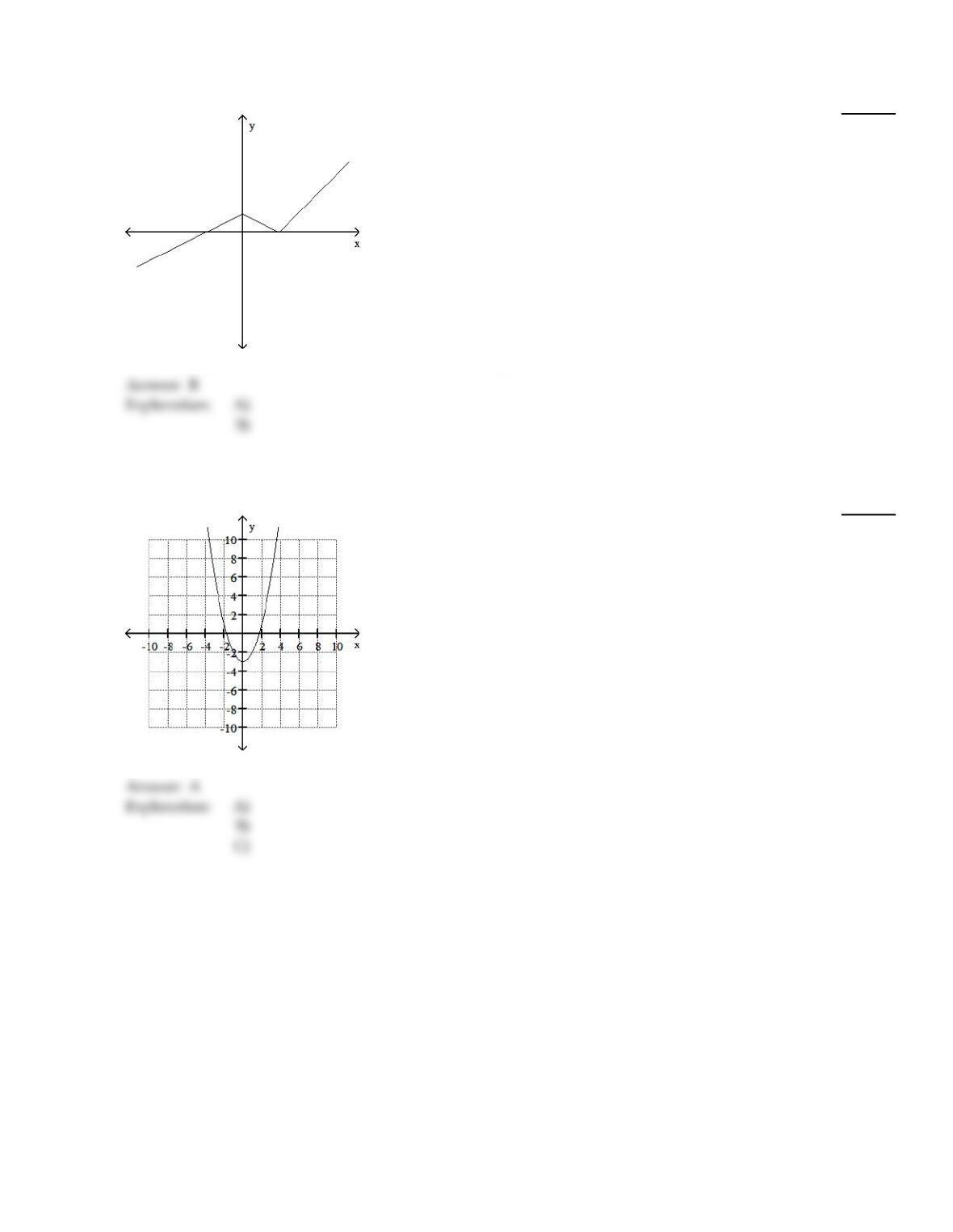
Identify the intervals where the function is changing as requested.
54)
Increasing
54)
A)
(3, )
B)
(–2, )
C)
(3, 6)
D)
(–2, 0)
Use the vertical line test to determine whether or not the graph is a graph in which y is a function of x.
55)
55)
A)
not a function
B)
function
Use possible symmetry to determine whether the graph is the graph of an even function, an odd function, or a function
that is neither even nor odd.
56)
56)
A)
Even
B)
Neither
C)
Odd
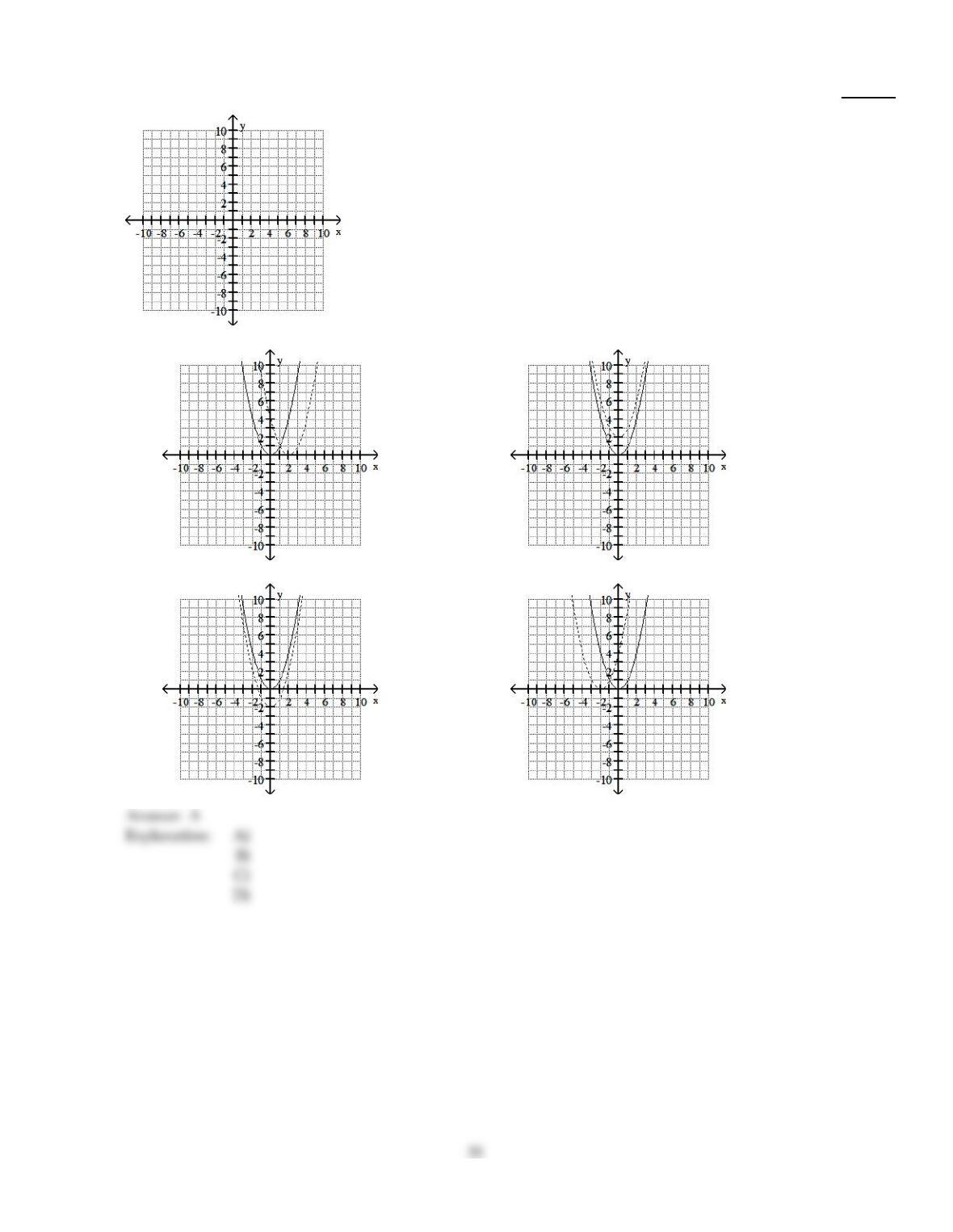
Begin by graphing the standard quadratic function f(x) =x2 . Then use transformations of this graph to graph the given
function.
32
57)
h(x) =(x – 2)2
57)
A)
B)
C)
D)
Evaluate the piecewise function at the given value of the independent variable.
58)
g(x) =
x2+ 5
x + 8 if x –8
x – 1 if x = – 8
; g(5)
58)
A)
30
13
B)
4
C)
5
D)
10
13
Write the standard form of the equation of the circle with the given center and radius.
59)
(0, 10); 4
59)
A)
(x + 10)2+ y2=16
B)
(x – 10)2+ y2=16
C)
x2+ (y + 10)2=4
D)
x2+ (y – 10)2=16
Solve the problem.
60)
From April through December 2000, the stock price of QRS Company had a roller coaster ride. The
chart below indicates the price of the stock at the beginning of each month during that period. Find
the monthly average rate of change in price between June and September.
Month Price
April (x = 1) 115
May 109
June 88
July 100
August 96
September 111
October 92
November 86
December 64
60)
A)
$11.50 per month
B)
$7.67 per month
C)
–$7.67 per month
D)
–$11.50 per month
Give the domain and range of the relation.
61)
{(10, –3), (12, 3), (–8, –7), (6, –1)}
61)
A)
domain = {6, 10, –8, 12}; range = {–1, –3, –7, 3}
B)
domain = {–1, –3, –7, 3}; range = {6, 10, –8, 12}
C)
domain = {6, 10, –8, 12}; range = {–1, –1, –3, –7, 3}
D)
domain = {6, 10, –8, 12}; range = {–1, 3, –3, –7, 3}
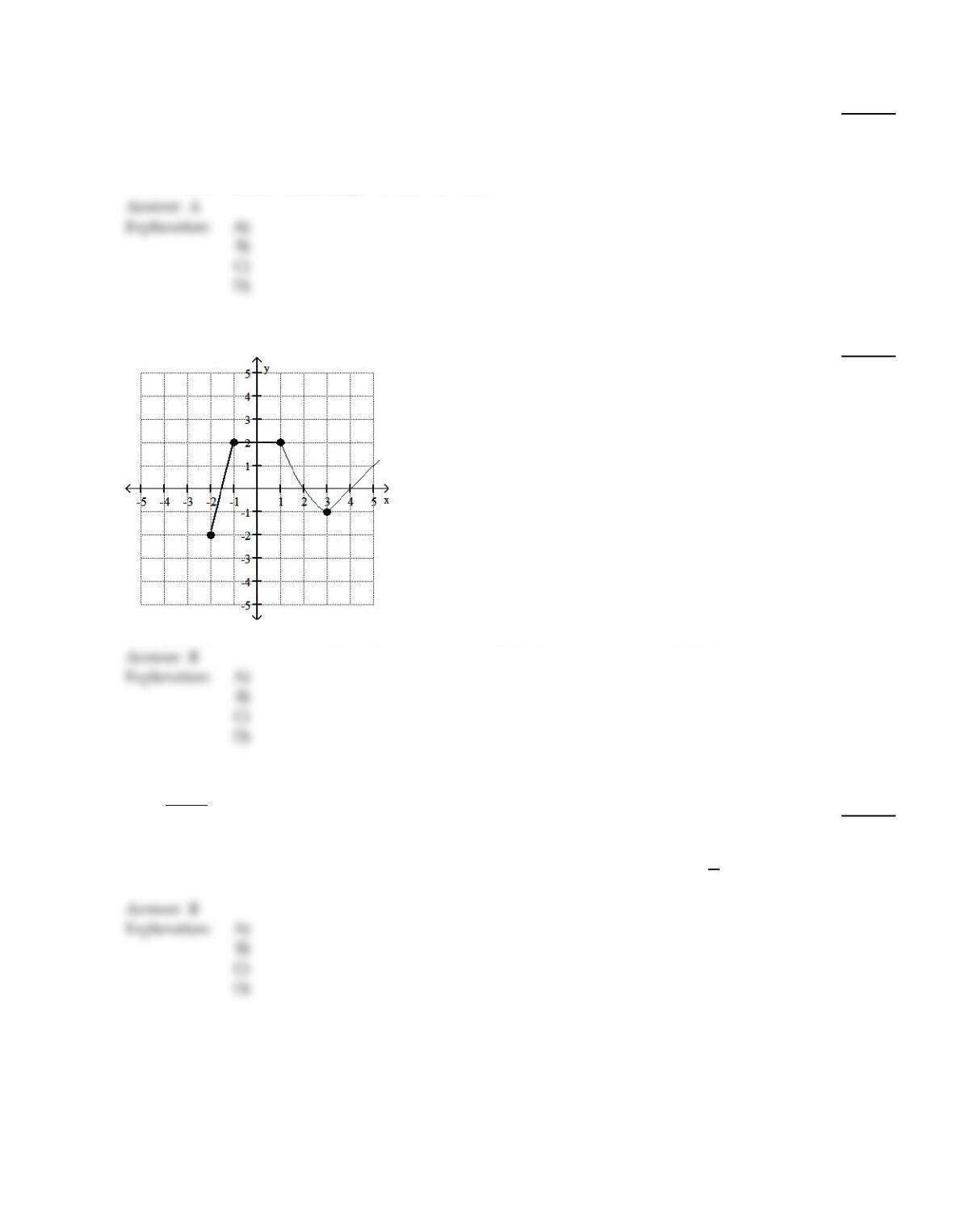
Identify the intervals where the function is changing as requested.
62)
Constant
62)
A)
(–2, –1)
B)
(–1, 1)
C)
(1, 2)
D)
(2, )
For the given functions f and g , find the indicated composition.
63)
f(x) =x – 10
4,g(x) =4x + 10
(g
f)(x)
63)
A)
x + 20
B)
x
C)
4x + 30
D)
x –5
2
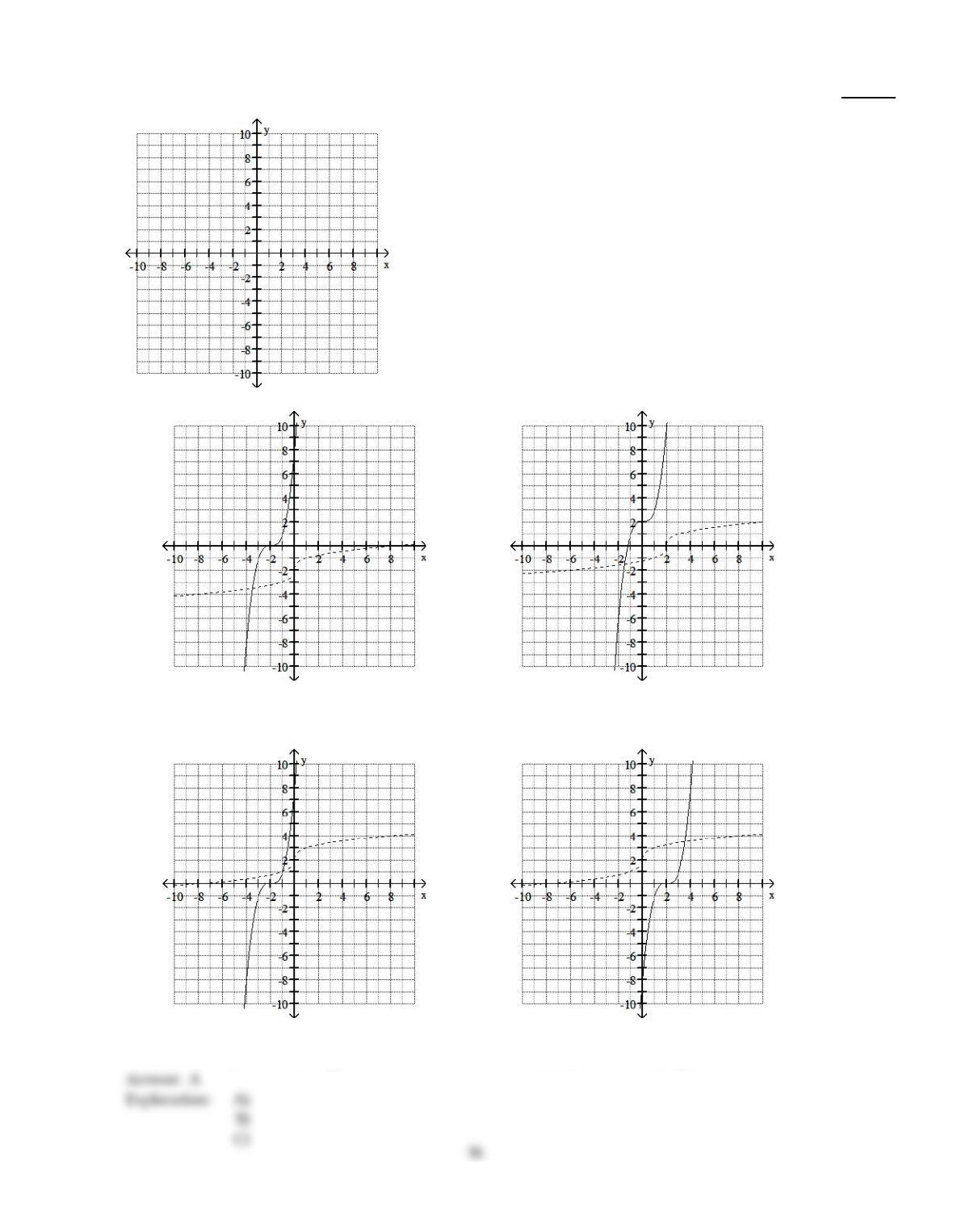
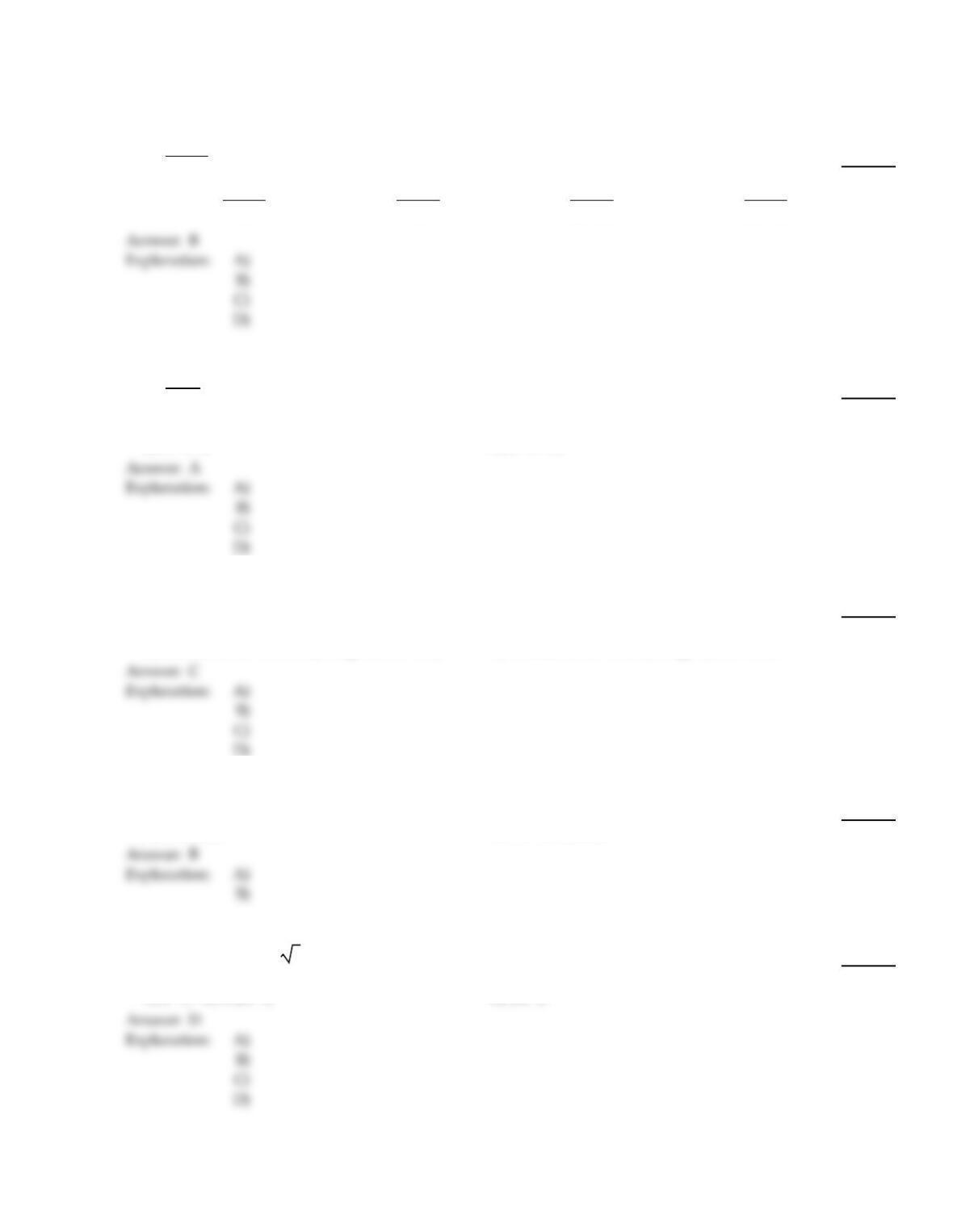
Graph f as a solid line and f–1 as a dashed line in the same rectangular coordinate space. Use interval notation to give the
domain and range of f and f–1.
35
64)
f(x) =(x +2)3
64)
A)
f domain = (–, ); range = (–, )
f–1 domain =(–, ); range = (–, )
B)
f domain = (–, ); range = (–, )
f–1 domain =(–, ); range = (–, )
C)
f domain = (–, ); range = (–, )
f–1 domain =(–, ); range = (–, )
D)
f domain = (–, ); range = (–, )
f–1 domain =(–, ); range = (–, )
C)
D)
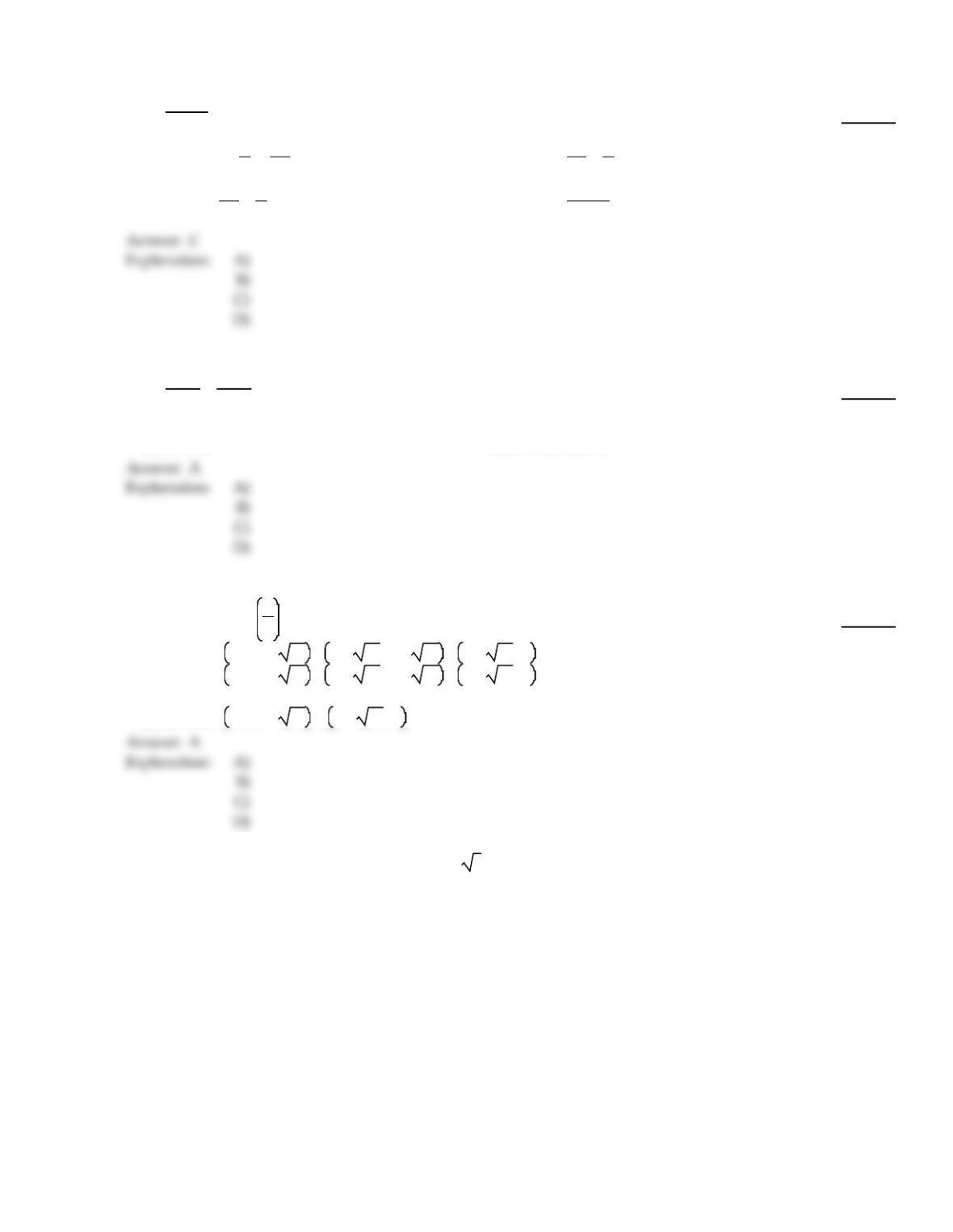
Find the inverse of the one–to–one function.
65)
f(x) =8x + 5
3
65)
A)
f–1(x) =3x + 5
8
B)
f–1(x) =3x – 5
8
C)
f–1(x) =3
8x + 5
D)
f–1(x) =3
8x – 5
Find the domain of the function.
66)
f(x) =
–4x
x + 8
66)
A)
(–, –8)
(–8, )
B)
(–, 0)
(0, )
C)
(–, )
D)
(–, –8)
A
C)
D)
Give the domain and range of the relation.
67)
{(–2, 3), (–1, 0), (0, –1), (1, 0), (3, 8)}
67)
A)
domain: {3, 0, –1, 8}; range: {–2, –1, 1, 3}
B)
domain: {3, 0, –1, 8}; range: {–2, –1, 0, 1, 3}
C)
domain: {–2, –1, 0, 1, 3}; range: {3, 0, –1, 8}
D)
domain: {–2, –1, 1, 3}; range: {3, 0, –1, 8}
C
C)
D)
Determine whether the relation is a function.
68)
{(–6, –5), (–3, –7), (4, 6), (4, 8)}
68)
A)
Function
B)
Not a function
B
Find the domain of the composite function f
g.
69)
f(x) =3x +12;g(x) =x
69)
A)
[–4, )
B)
(–, )
C)
(–, –4] or [0, )
D)
[0, )
D
C)
37
B
C)
D)
Determine whether the equation defines y as a function of x.
70)
x2+ y =16
70)
A)
y is a function of x
B)
y is not a function of x
Solve.
71)
When making a telephone call using a calling card, a call lasting 6 minutes cost $1.65. A call lasting
15 minutes cost $3.45. Let y be the cost of making a call lasting x minutes using a calling card.
Write a linear equation that models the cost of making a call lasting x minutes.
71)
A)
y = – 0.2x +2.85
B)
y =0.2x – 11.55
C)
y =0.2x +0.45
D)
y =5x –567
20
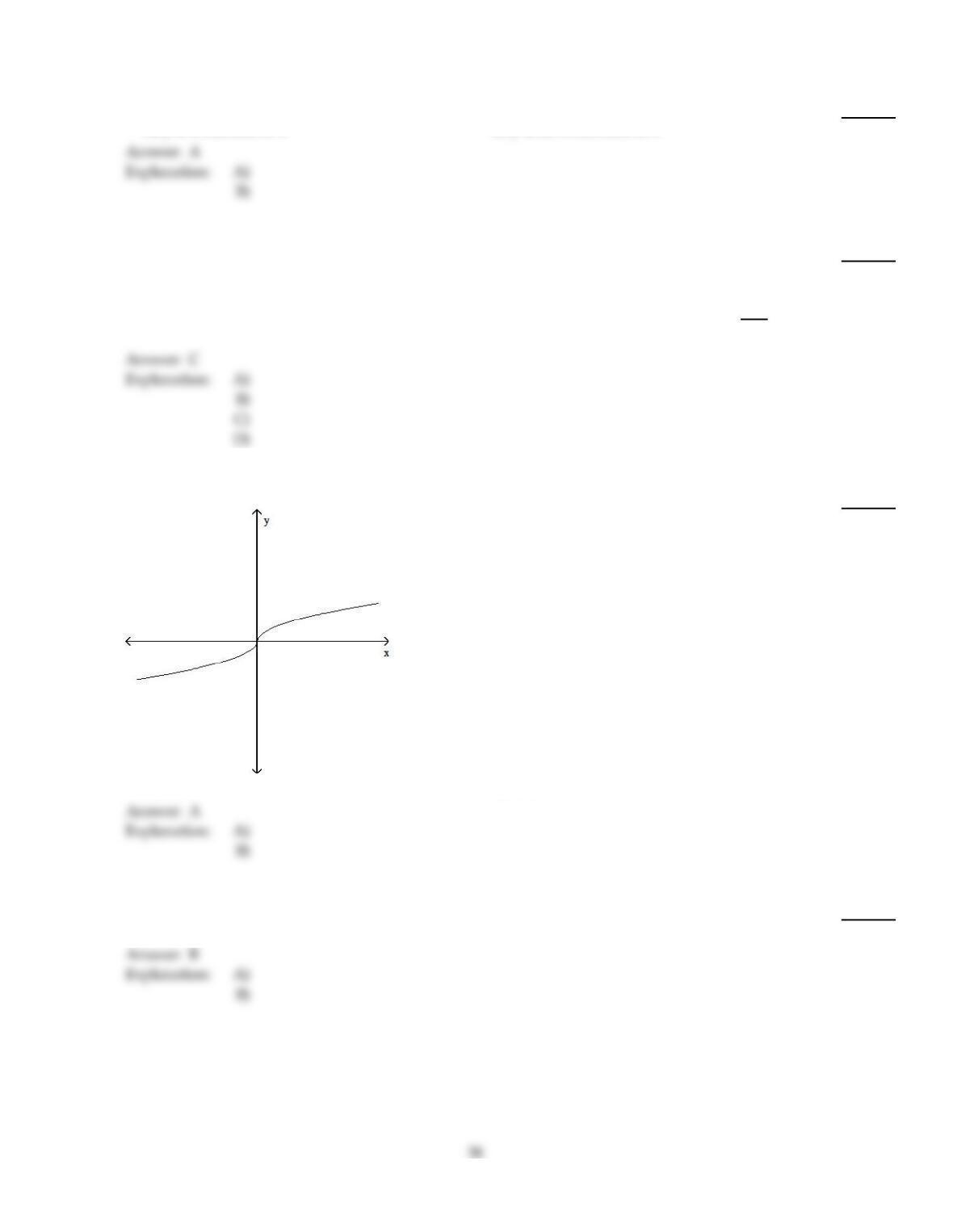
Does the graph represent a function that has an inverse function?
72)
72)
A)
Yes
B)
No
Determine whether the relation is a function.
73)
{(–7, 2), (–3, –3), (1, 8), (2, 3)}
73)
A)
Not a function
B)
Function
Find the inverse of the one–to–one function.
74)
f(x) =7
3x – 1
74)
A)
f–1(x) = – 1
3–7
3x
B)
f–1(x) =7
3y +1
3
C)
f–1(x) =7
3x +1
3
D)
f–1(x) =3x – 1
7
Find the domain of the function.
75)
f(x) =1
x –2+4
x – 4
75)
A)
(–, 4)
(4, 2) (2, )
B)
(–, 2)
(2, )
C)
(–, )
D)
(–, 4)
(4, )
A
Find the domain of the indicated combined function.
76)
Find the domain of f
g(x) when f(x) =7x2–9x and g(x) =x2–4x –7.
76)
A)
Domain: –, 2–11 2–11, 2+11 2+11,
B)
Domain: –, 2–11 2–11, 2+11 2–11,
C)
Domain: (–,)
D)
Domain: –, 2–11 2–11,
A
Begin by graphing the standard square root function f(x) =x . Then use transformations of this graph to graph the given
function.
39
C
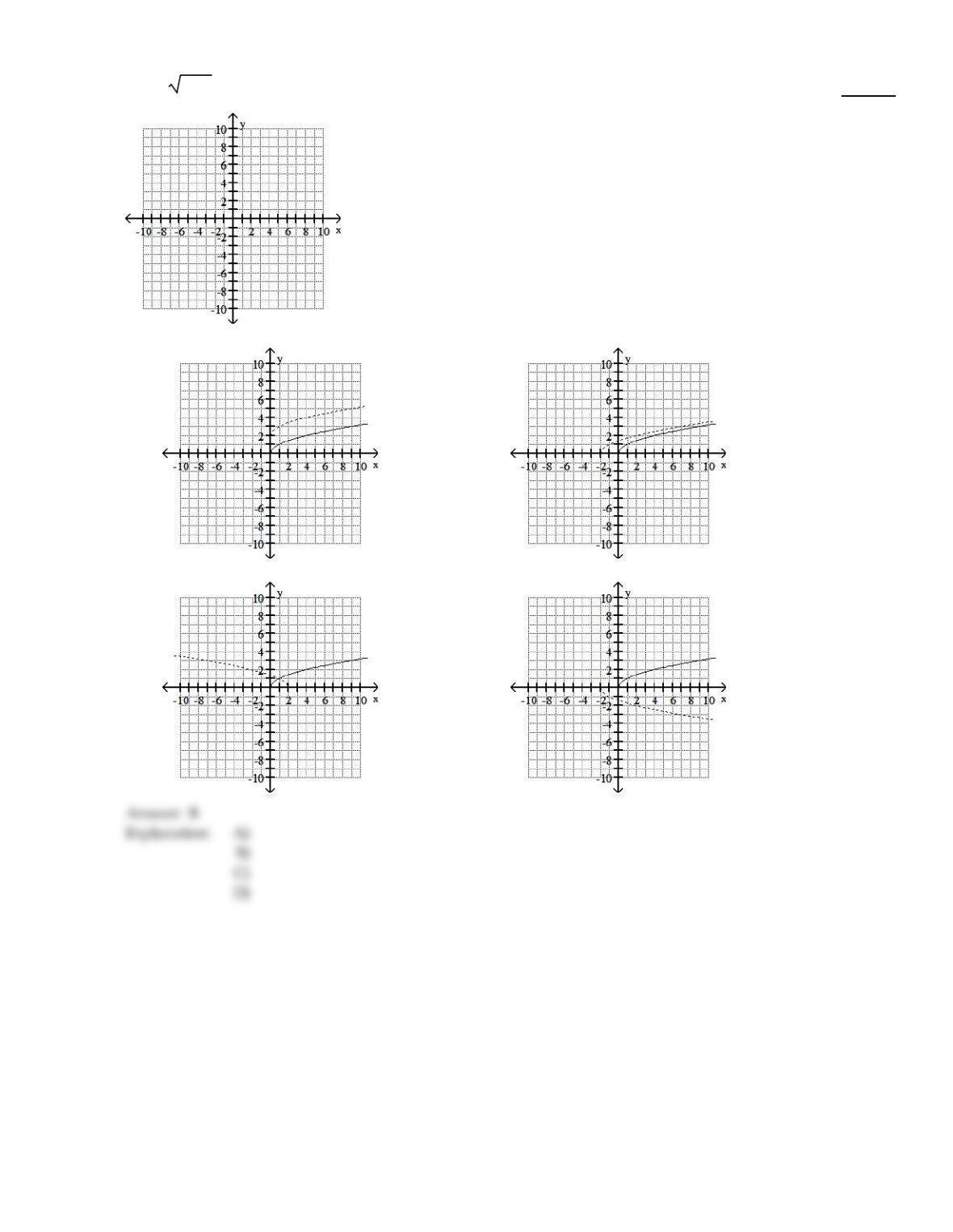
77)
h(x) =x + 2
77)
A)
B)
C)
D)
40