Basic Accounting Concepts ♦ 73
3. What are the three built in controls that transactions have been analyzed, reported and summarized
correctly?
4. Explain how the four financial statements are linked.
5. How can a company earn a large net income and have a small balance in retained earnings?
6. Suppose that your business had $100,000 of current liabilities that must be paid within the next
few months and your current assets only totaled $70,000 and sales are slow. Identify two ways to
finance the extra amount needed to pay your current liabilities.
74 ♦ Chapter 2
7. If you cold pick a single source of cash for your business ( from the statement of cash flows), what
would it be and why?
8. Describe how vertical analysis can be used to analyze and evaluate a company’s performance.
PROBLEM
1. Determine the missing amount for each of the following:
ASSETS
=
LIABILITIES
+
STOCKHOLDERS’ EQUITY
X
$45,000
$158,000
$294,000
X
$172,000
$96,000
$35,000
X
X= $203,000
$45,000
$158,000
$294,000
X= $122,000
$172,000
$96,000
$35,000
X = $61,000
Basic Accounting Concepts ♦ 75
2. Determine the missing amounts on the following summaries of the balance sheet and income
statement data for Barron, Inc.
Barron, Inc.
December 31, 2006:
Assets
$ 556, 602
Liabilities
(a)
Stockholders’ equity
(b)
Increase (decrease) in assets, liabilities, and stockholders’ equity during 2007:
Assets
$42,116
Liabilities
$26,633
Stockholders’ equity
$15,483
December 31, 2007:
Assets
(c)
Liabilities
$441,856
Stockholders’ equity
(d)
76 ♦ Chapter 2
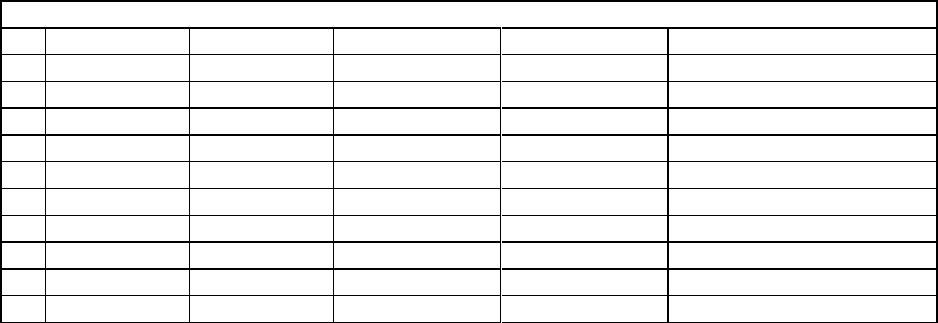
3. Part A
Indicate the effect of each transaction during the month of October 2006 and the balances for the
accounting equation after all transactions have been recorded. An accounting equation has been
provided.
a.
Opened a business bank account for Ole, Inc., with an initial deposit of $40,000 in exchange for
capital stock.
b.
Paid rent on the office building for the month of $2,000
c.
Received cash for fees earned of $5,000
d.
Purchased equipment $7,000
e.
Borrowed $20,000 by issuing a note payable
f.
Paid salaries for the month $1,000
g.
Received cash for fees earned of $8,000
h.
Paid dividends, $3,000
i.
Paid interest on the note, $100
Assets = Liabilities + Stockholders’ Equity
Cash
Equipment
Notes Payable
Capital Stock
Retained Earnings
a.
b.
c.
d.
e.
f.
g.
h.
i.
Bal.
Basic Accounting Concepts ♦ 77
Part B
Using the information from Part A, prepare (1) an income statement, (2) a statement of retained
earnings, (3) a balance sheet, and (4) a statement of cash flows for the month of October.
Ole, Inc.
Income Statement
Ole, Inc.
Statement of Retained Earnings
78 ♦ Chapter 2
Ole, Inc.
Balance Sheet
Basic Accounting Concepts ♦ 79
Ole, Inc.
Statement of Cash Flows
Bal.
80 ♦ Chapter 2
Basic Accounting Concepts ♦ 81
4. The financial statements of Weems, Inc. are shown below. By analyzing the interrelationships
between the financial statements, fill in the amounts left blank for (a) through (n).
Weems, Inc.
Income Statement
For the Month Ended October 31, 2006
Revenues:
Fees Earned
(a)
Expenses:
Rent Expense
$2,000
Salaries Expense
(b)
Utility Expense
500
Interest Expense
250
Miscellaneous Expense
250
Total Expenses
5,000
Net Income
(c)
Weems, Inc.
Statement of Retained Earnings
For the Month Ended October 31, 2006
Retained Earnings, October 1, 2006
0
Add: Net Income
$19,000
Less Dividends
(d)
Retained Earnings, October 31, 2006
$17,000
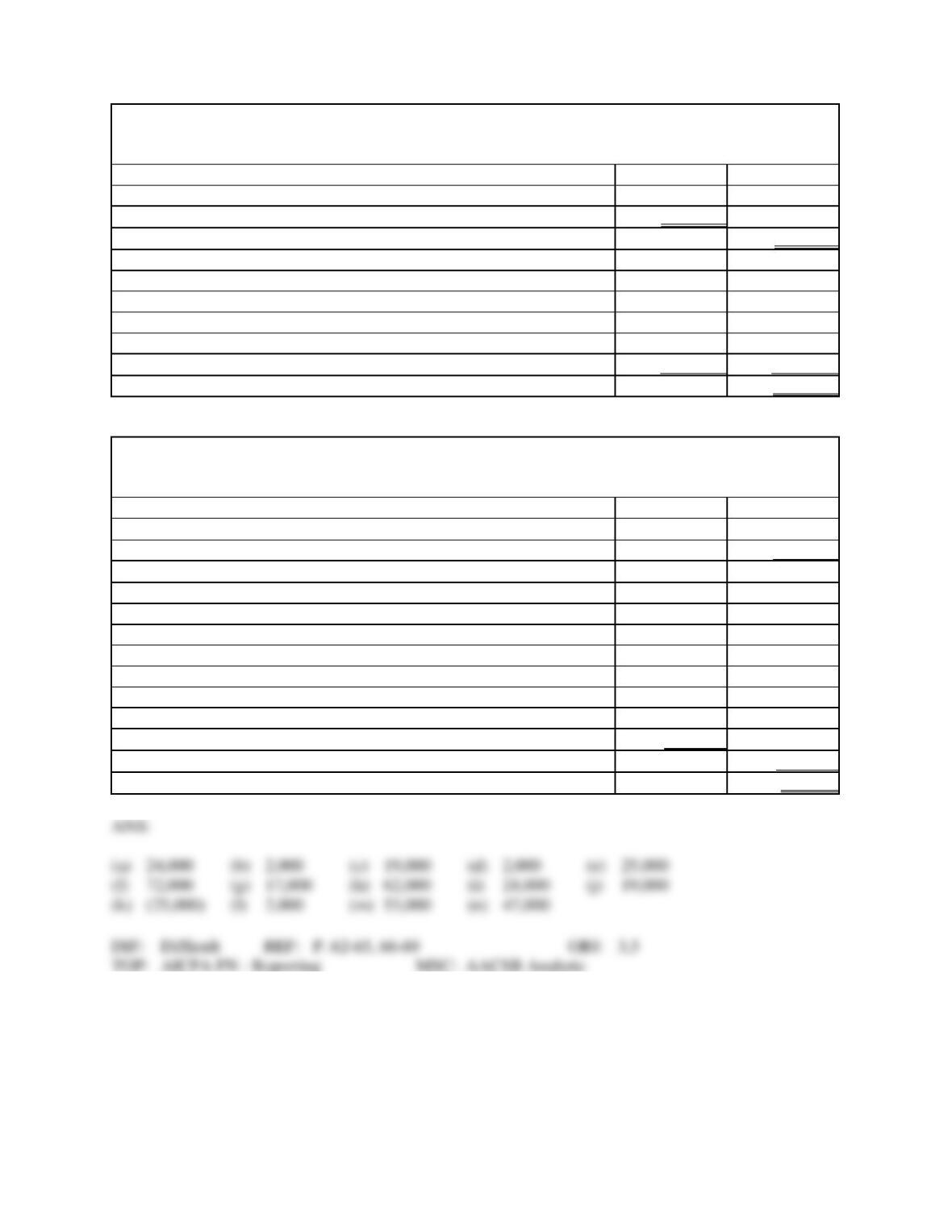
Cash flows from operating activities:
Cash receipts from operating activities
Cash payments for operating activities
Net cash flows from operating activities
Cash flows from investing activities:
Cash payments for equipment
(7,000)
Cash flows from financing activities:
Cash receipts from issuing capital stock
Cash payments for dividends
Net cash flows from financing activities
Cash as of October 31, 2006
82 ♦ Chapter 2
Weems, Inc.
Balance Sheet
October 31, 2006
Assets
Cash
$47,000
Equipment
(e)
Total Assets
(f)
Liabilities
Liabilities
Notes Payable
$10,000
Stockholders’ Equity
Capital Stock
$45,000
Retained Earnings
(g)
(h)
Total liabilities and Stockholders’ Equity
$72,000
Weems, Inc.
Statement of Cash Flows
For the Month Ended October 31, 2006
Cash flows from operating activities:
Cash receipts from operating activities
$ (i)
Cash payments for operating activities
5,000
Net cash flows from operating activities
$ (j)
Cash flows from investing activities:
Cash payments for equipment
(k)
Cash flows from financing activities:
Cash receipts from issuing capital stock
Cash receipts from note payable
Cash payments for dividends
(l)
Net cash flows from financing activities
(m)
Cash as of October 31, 2006
$ (n)
(a)
24,000
(b)
2,000
(c)
19,000
(d)
2,000
(e)
25,000
72,000
(g)
17,000
(h)
62,000
24,000
19,000
Basic Accounting Concepts ♦ 83
5. The following amounts (in alphabetical order) were taken from the accounting records of Wolfe
Consulting, Inc., as of December 31, 2006. Wolfe began operations on January 1, 2006.
Capital stock
$12,500
Cash
49,375
Dividends
31,250
Fees earned
422,875
Interest expense
6,000
Land
156,125
Miscellaneous expense
9,375
Notes payable
50,000
Rent expense
45,000
Retained earnings (on 1/1/2006)
0
Salaries expense
100,000
Taxes expense
37,500
Utilities expense
50,000
Prepare (1) an income statement, (2) a statement of retained earnings, (3) a balance sheet, and (4) a
statement of cash flows for the year ending December 31, 2006.
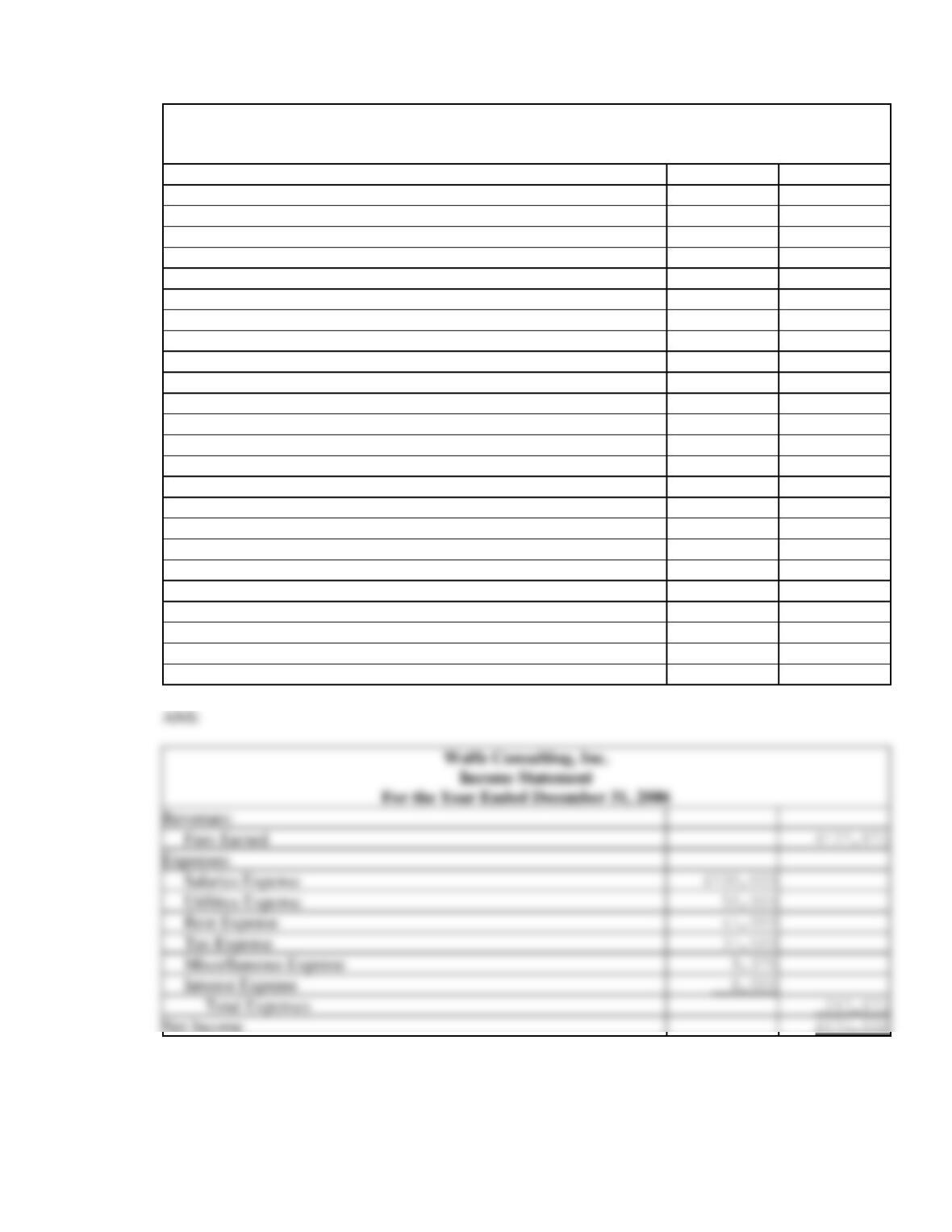
Wolfe Consulting, Inc.
Income Statement
84 ♦ Chapter 2
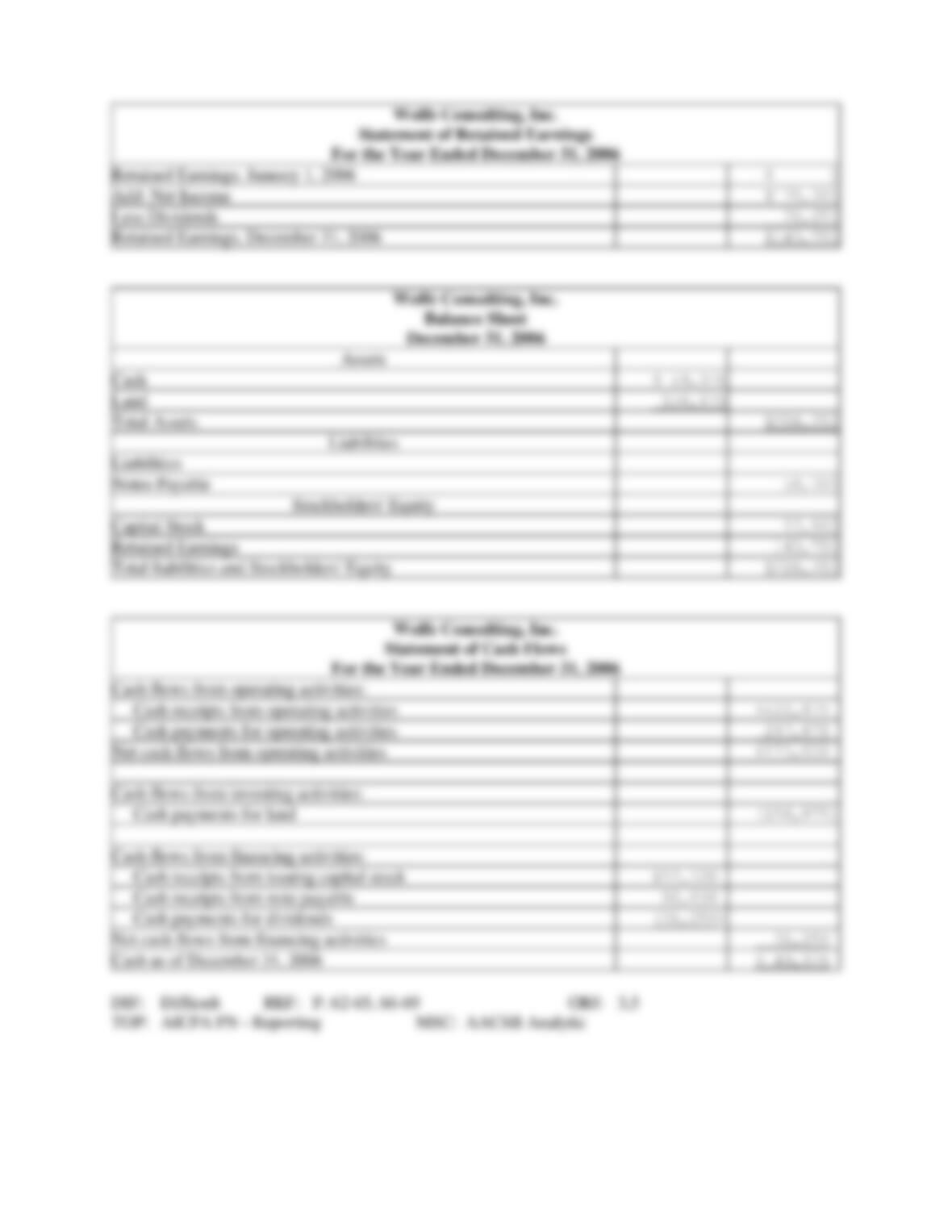
Wolfe Consulting, Inc.
Statement of Retained Earnings
Wolfe Consulting, Inc.
Balance Sheet
Basic Accounting Concepts ♦ 85
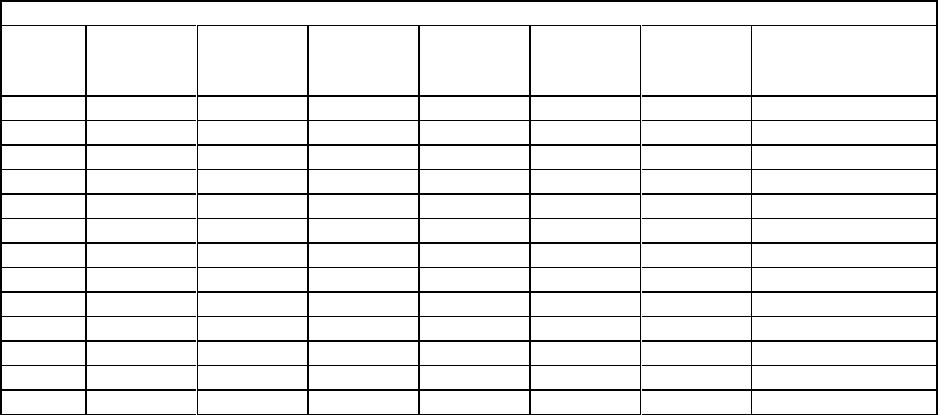
Wolfe Consulting, Inc.
Statement of Cash Flows
Revenues:
Expenses:
Utilities Expense
Net Income
86 ♦ Chapter 2
Basic Accounting Concepts ♦ 87
6. Lou’s Laundry and Dry Cleaning incorporated and started business on January 1, 2006. Although
excellent with laundry and dry cleaning, the owner knows nothing about accounting. The owner
has hired you to perform the accounting and record-keeping for his business.
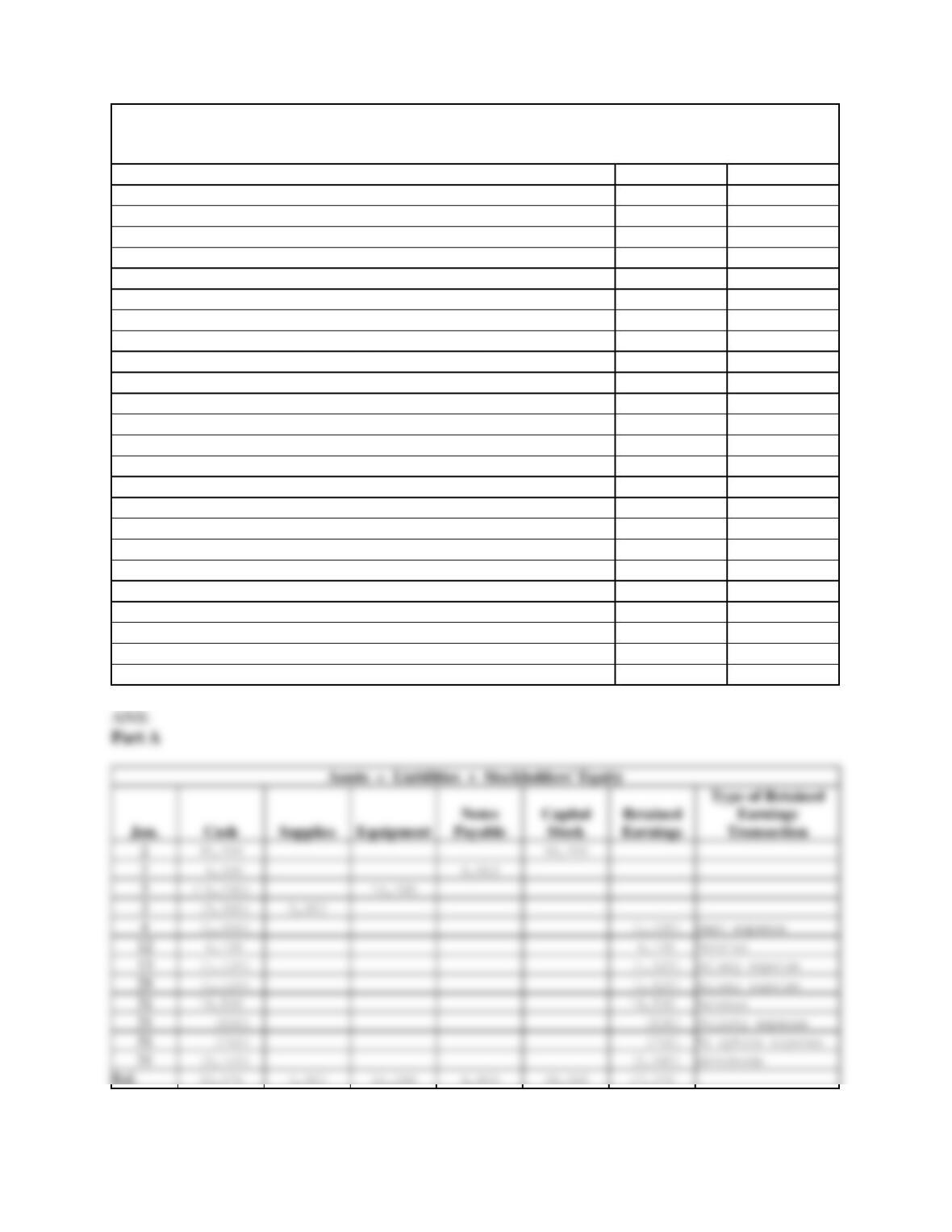
Part A
Enter the following transactions into the following accounting equation provided.
Jan.
2
Lou’s Laundry and Dry Cleaning began business by depositing $30,000 in a checking account
in the name of Lou’s Laundry and Dry Cleaning, Inc. Capital stock is issued.
2
Borrowed $6,000 from City Bank for 5 years and signed a promissory note with an annual
interest rate of 9%.
3
Purchased equipment from Washers Wholesale, $16,200.
3
Purchased supplies costing $3,000 from Suds ‘n Stuff with cash.
4
Paid one month’s rent for business space in Pine Plaza, $1,000.
12
Services provided to customers during the first half of January totaled $6,700. All services
were paid for in cash.
13
Paid employees for the first two weeks in January, $1,120.
28
Paid wages for January 15 – 28, $1,120.
31
Services provided the second half of January totaled $16,500.
All services were paid for in cash.
31
Received and paid the utility bill, $500.
31
Received and paid the telephone bill, $250.
31
Declared and paid dividends to the stockholders, $2,140.
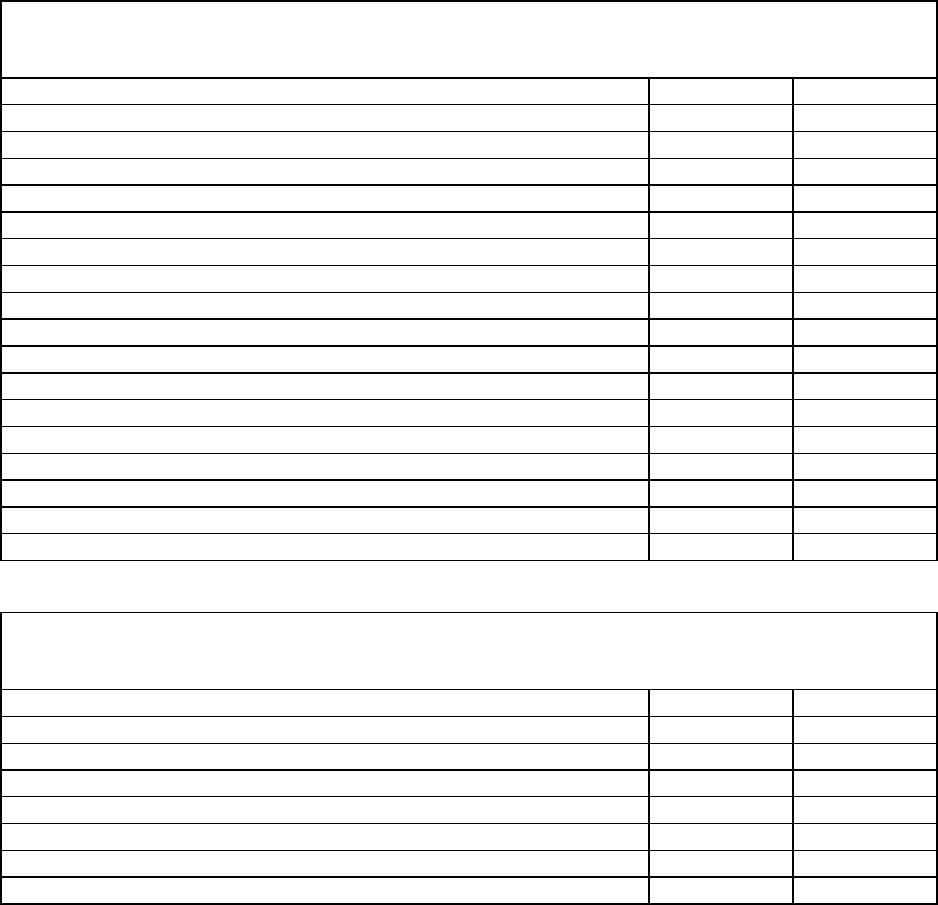
Assets = Liabilities + Stockholders’ Equity
Cash
Supplies
Equipment
Notes
Payable
Capital
Stock
Retained
Earnings
Type of Retained
Earnings
Transaction
88 ♦ Chapter 2
Part B
Using the information from Part A, prepare (1) an income statement, (2) a statement of retained
earnings, (3) a balance sheet, and (4) a statement of cash flows.
Lou’s Laundry and Dry Cleaning, Inc.
Income Statement
Lou’s Laundry and Dry Cleaning, Inc.
Statement of Retained Earnings
Basic Accounting Concepts ♦ 89
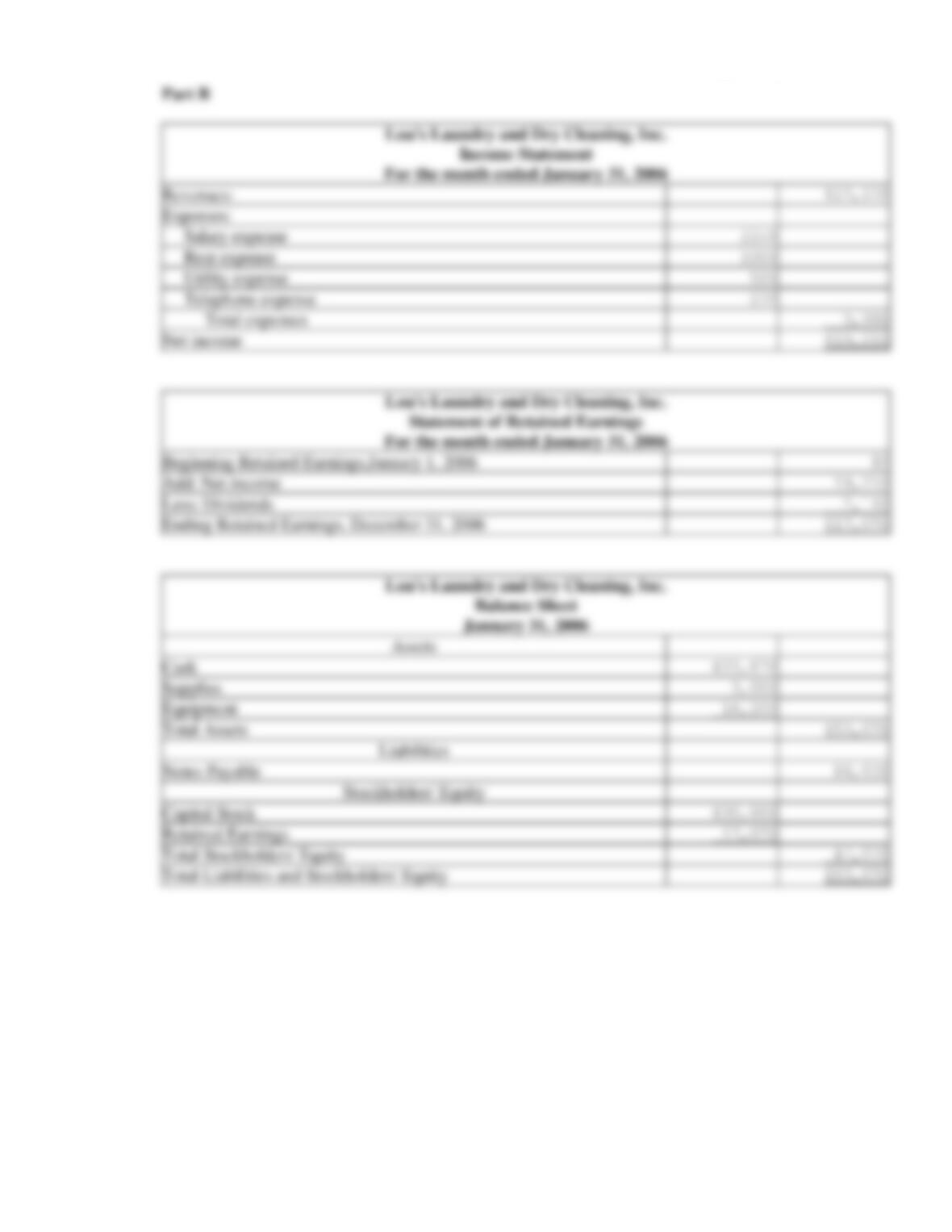
Lou’s Laundry and Dry Cleaning, Inc.
Balance Sheet
90 ♦ Chapter 2
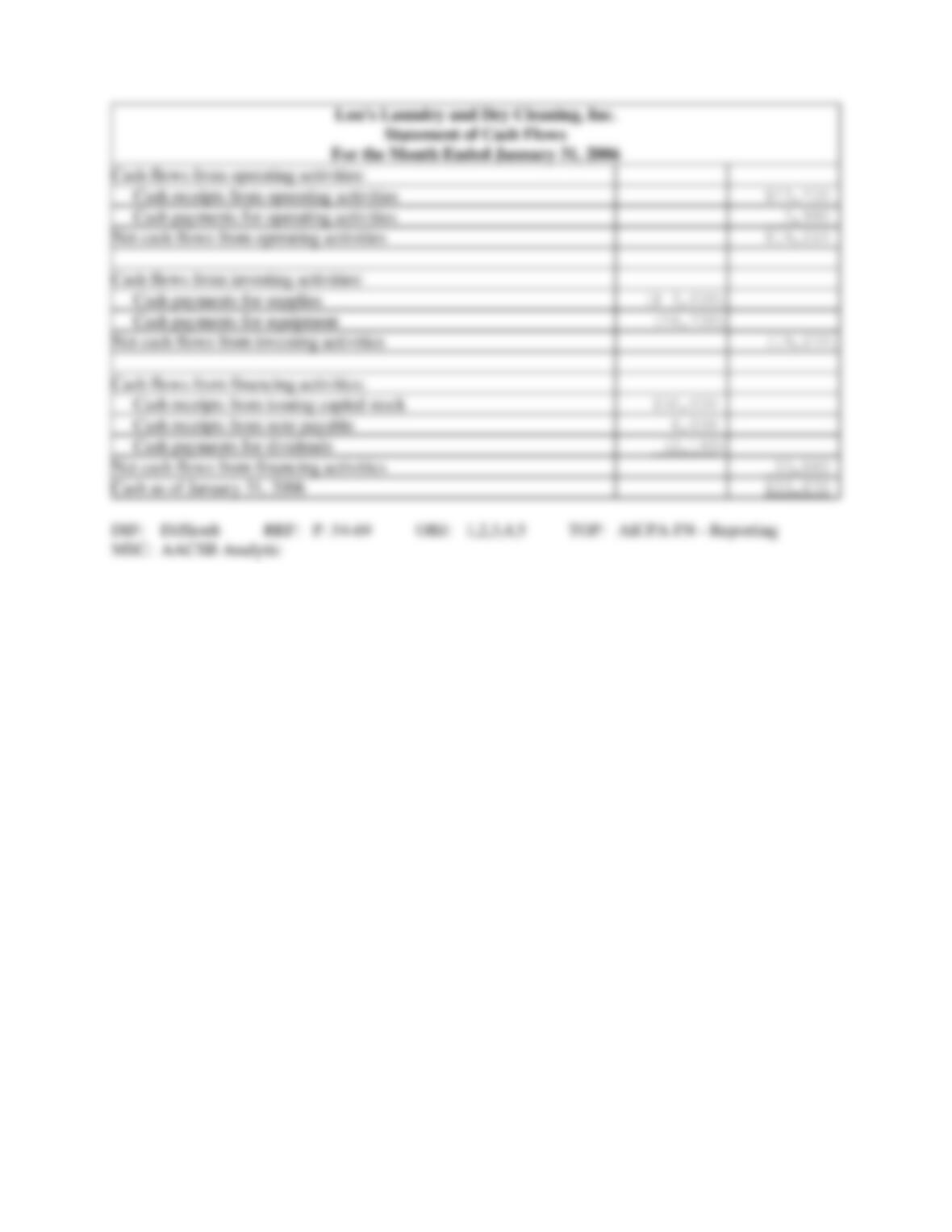
Lou’s Laundry and Dry Cleaning, Inc.
Statement of Cash Flows
Basic Accounting Concepts ♦ 91
92 ♦ Chapter 2
7. Mac’s Mobile Wash incorporated and started business on September 1, 2006. Mac brings his big
rig truck to companies to wash their semi-trucks. Although excellent with washing semis, the
owner knows nothing about accounting. The owner has hired you to perform the accounting and
record-keeping for his business.
Part A
Enter the following transactions into the accounting equation provided.
Sep.
2
Mac’s Mobile Wash began business by depositing $50,000 in a checking account in the name
of Mac’s Mobile Wash, Inc. Capital stock was issued.
2
Borrowed $8,000 from City Bank for 5 years and signed a promissory note with an annual
interest rate of 9%.
3
Purchased equipment from Washers Wholesale, $26,200.
3
Purchased supplies costing $3,000 from Suds ‘n Stuff for cash.
4
Paid one month’s rent for business space in U-STOR-IT, $1,000 (record this as an expense, ).
5
Paid $4,200 for advertising to appear in the Pine Press newspaper this month.
12
Services provided to customers during the first half of September totaled $7,700 cash.
12
Paid employees for hours worked during the first two weeks of September, $1,500.
20
Borrowed another $4,000 from City Bank.
28
Paid wages for September 15 – 28, $1,500.
30
Services provided the second half of September totaled $16,500 cash.
30
Received and paid the water bill, $750.
30
Declared and paid dividends to the stockholders, $2,000.
Cash flows from operating activities:
Cash receipts from operating activities
Cash payments for operating activities
Net cash flows from operating activities
Cash flows from investing activities:
Cash payments for supplies
Cash payments for equipment
Cash receipts from issuing capital stock
Cash receipts from note payable
Cash payments for dividends
Net cash flows from financing activities
Cash as of January 31, 2006