Introduction to Financial Accounting, 10e (Horngren)
Chapter 2 Measuring Income to Assess Performance
Learning Objective 2.1 Questions
2.1-1) Net income is
A) the only way to evaluate for–profit corporations.
B) not appropriate for individuals.
C) not applicable to not–for–profit entities.
D) the bottom line according to IRS accounting.
E) the primary way of evaluating the financial performance for an entity.
2.1-2) Revenues are
A) increases in liabilities resulting from delivering goods or services to customers.
B) decreases in assets resulting from delivering goods or services to customers.
C) increases in retained earnings resulting from delivering goods or services to customers.
D) decreases in retained earnings resulting from delivering goods or services to customers.
E) another term for assets.
2.1-3) For which company would it seem sensible to use a fiscal year ending on June 1?
A) A landscaping company
B) A clothing retailer
C) A swimming pool retailer
D) A snow blower seller
E) A law firm
2.1-4) Alfano Industries sold inventory costing $300 for $500 on account. If Alfano Industries operates
under the accrual basis, what effect will this transaction have on the owners’ equity side of the balance
sheet?
A) None, since the customer to whom the inventory was sold has not yet paid
B) None, since sales and/or cost of goods sold are income statement accounts
C) Decrease owners’ equity by $300
D) Increase owners’ equity by $200
E) Increase owners’ equity by $800
2.1-5) An accountant records a transaction when cash is paid or received under which basis of
accounting?
A) Cash
B) Accrual
C) Deferral
D) Prepaid
E) Cost recovery
2.1-6) Which of the following circumstances would result in a decrease in income under the accrual basis
but would not result in a decrease in income under the cash basis?
A) Purchase of inventory on account
B) Payment of 2 months’ rent in advance
C) The expiration of prepaid rent
D) The return of defective inventory purchased on account, where full credit was given
E) The payment of the current period’s utility bill
2.1-7) Bairas Salon records revenue as cash is received. Which method of income measurement is Bairas
Salon using?
A) The accrual basis
B) The cash basis
C) The recognition basis
D) The revenue basis
E) The realization basis
2.1-8) Which of the following circumstances would result in an increase in income under the cash basis
and an increase in income under the accrual basis?
A) The return of defective inventory purchased on account, where full credit was given
B) Cash collection from a credit customer
C) The cash sale of inventory at a sales price in excess of cost
D) The expiration of prepaid rent
E) The sale of inventory on account, at a sales price in excess of cost
2.1-9) Which of the following circumstances would result in a decrease in income under both the accrual
and cash basis?
A) The payment of last period’s utilities
B) The payment of this period’s utilities
C) The payment of next period’s utilities
D) The cash purchase of inventory
E) The purchase of inventory on account
2.1-10) The operating cycle is the time it takes for a company to buy goods.
2.1-11) Because of the difficulty of measuring income, there is no reason to compare income levels
between different companies.
2.1-12) The additional owners’ equity generated by income or profits is known as retained earnings.
2.1-13) Because net income is the excess of revenues over expenses, retained earnings increases by the
amount of net income reported during the period less any dividends.
2.1-14) Net income is a measure of the entity’s performance in generating net assets.
2.1-15) According to accounting rules, fiscal years are required to be established over calendar years.
2.1-16) An interim period is a time span that is less than a year and is established for accounting
purposes.
2.1-17) For revenue to be earned under the cash basis of accounting, the cash from the customer must be
received.
2.1-18) Cash for services performed in 20X8 is received in 20X9. Using the accrual basis of accounting, the
revenue would appear on the 20X9 income statement.
2.1-19) Revenue is produced when accounts receivable are collected under the cash basis of accounting.
2.1-20) Under the accrual method, revenue is produced when cash is collected.
2.1-21) The accrual basis of accounting is a better measure of economic performance than the cash basis.
2.1-22) Why doesn’t the cash basis of accounting require adjusting accounts with accruals?
2.1-23) Describe the advantages of the accrual basis of accounting and the cash basis of accounting.
Learning Objective 2.2 Questions
2.2-1) The recognition of revenues requires that
A) revenue be earned and realized.
B) revenue be realized only.
C) revenue be earned only.
D) revenue be received in the form of cash.
E) revenue be received in a timely fashion.
2.2-2) Which of the following is an example of revenue that may be realized but not yet earned?
A) A customer paying in advance for services to be performed in the future
B) A credit sale made to a customer who has a prior history of previous sales and collection of the cash
from those sales
C) A credit sale made to a customer with a weak credit history such that the collection of the outstanding
receivable is questionable
D) The cash sale of a fixed asset, as opposed to the sale of inventory
E) It is impossible to have revenue which is realized but not earned.
2.2-3) Performing a service and immediately collecting the cash would
A) increase net income.
B) decrease assets.
C) increase liabilities.
D) decrease expenses.
E) decrease revenue.
2.2-4) Better Mulch Services is a local landscaping company specializing in mulching outdoor
landscaping beds. When should Better Mulch Services recognize revenue from its mulching service?
A) When the customer calls for mulch delivery
B) When the invoice is mailed to the customer
C) When the mulch is delivered to the customer
D) When the payment is received from the customer
E) When the financial statements are prepared that includes this sale
2.2-5) Weber Phone Company sells phones and related accessories. Which of these situations demonstrate
proper revenue recognition for Weber Phone Company?
A) Rent is paid a month in advance of the due date because the accountant will be on vacation when the
next rent payment should be made.
B) Phones are sold to customers, but customers can opt to have the additional charges added to their next
monthly bill.
C) Phones are purchased for sale to customers, but the accountant has not yet paid the bill.
D) An interest bearing certificate of deposit is purchased. Interest will be paid at the end of 60–day note.
E) Employees are paid for hours worked last month.
Learning Objective 2.3 Questions
2.3-1) Nordmann, Inc., purchased equipment for $18,000 on January 1, 20X9, and believes the equipment
has a useful life of 72 months. What will be the effect of the equipment’s depreciation on the balance sheet
equation?
A) Decreases the asset account of Equipment and decreases Stockholders’ Equity
B) Decreases the asset account of Equipment and increases Stockholders’ Equity
C) Increases the asset account of Equipment and decreases Stockholders’ Equity
D) Increases the asset account of Equipment and increases Stockholders’ Equity
E) There is no effect on the balance sheet equation.
2.3-2) Expenses are
A) increases in assets resulting from operations.
B) decreases in retained earnings resulting from operations.
C) increases in liabilities resulting from purchasing assets.
D) increases in retained earnings resulting from operations.
E) increases in equity resulting from operations.
2.3-3) The recording of expenses in the same time period as the related revenues are recognized is known
as
A) cost recovery.
B) realization.
C) matching.
D) recognition.
E) period costs.
2.3-4) Which of the following costs are identified directly as expenses of the time period in which they are
incurred?
A) Product costs
B) Period costs
C) Both product and period costs
D) Neither product nor period costs
E) Period costs as long as the goods have not been sold
2.3-5) One year’s worth of insurance is paid in advance. The accountant records the payment as an asset,
Prepaid Insurance, and expenses 1/12 of the amount each month as Insurance Expense. This is an
example of which of the following concepts?
A) Recognition
B) Neutrality
C) Realization
D) Matching
E) Product costs
2.3-6) Which of the following accounts may be thought of as stored costs that are carried forward to
future periods rather than immediately charged against revenue?
A) Prepaid rent
B) Rent expense
C) Advertising expense
D) Depreciation expense
E) Cost of goods sold
2.3-7) What is the effect on a company‘s balance sheet equation when depreciation expense is recognized?
A) This transaction affects only the income statement, so no change on the balance sheet will occur.
B) Total assets and total stockholders’ equity will decrease by the same amount.
C) There will be no change in the total assets, liabilities, and stockholders’ equity account.
D) Total liabilities will increase and total stockholders’ equity will decrease by the same amount.
E) Without knowing the exact dollar amount of depreciation, the effect on the balance sheet cannot be
determined.
2.3-8) When a portion of prepaid rent expires, what will be the effect on the balance sheet equation?
A) This transaction affects only the income statement, so there will be no effect on the balance sheet.
B) There will be no overall effect on total assets, because two different asset accounts will change by the
exact dollar amount, with one increasing and the other decreasing.
C) Total assets and total liabilities will go down by the exact same dollar amount.
D) Total assets and total stockholders’ equity will go down by the exact same dollar amount.
E) Without knowing the dollar amount of the transaction, the effect on the balance sheet equation cannot
be determined.
2.3-9) Which of the following costs may be shown on the balance sheet?
A) Product costs
B) Period costs
C) Both product and period costs
D) R&D costs
E) Product costs, as long as the goods have been sold
2.3-10) On September 1, 20X9, Beard Entertainment paid $4,000 for September, October, November and
December’s rent in advance. The company recorded this transaction by increasing the balance in the
Prepaid Rent account. The balance in the Prepaid Rent account as of October 31, 20X9, will be
A) $–0–.
B) $1,000.
C) $2,000.
D) $3,000.
E) $4,000.
2.3-11) On May 1, 20X9, the Brock Company paid 6 months’ insurance in advance, covering the period of
May 1 to October 31, 20X9. The total payment was $5,400. At the time of the payment, the entire amount
was used to increase the balance in the Prepaid Insurance account. What will be the balance in the
Prepaid Insurance account as of May 31, 20X9?
A) $–0–
B) $900
C) $3,600
D) $4,500
E) $5,400
2.3-12) Which situation violates the matching principle?
A) Employees are paid for wages worked in a previous month.
B) Consulting fees incurred have been recognized even though a bill has not yet been received.
C) Depreciation was recorded for equipment even though the equipment was purchased on a date other
than January 1.
D) A 1–year insurance policy was paid in full on January 1 and the total amount of the bill was recognized
in January.
E) Customers are billed for services even though the company knows a portion of the customers will
never pay.
2.3-13) Accrual accounting uses the matching principle.
2.3-14) The matching concept is closely related to the cash basis of accounting.
2.3-15) Expenses, such as utilities, whose benefit is consumed by the passage of time rather than by the
level of sales, are known as period costs.
2.3-16) Costs that are linked with revenues and are charged as expenses when the related revenue is
recognized are known as product costs.
2.3-17) The process of allocating the cost of long–lived or fixed assets to expense is referred to as
depreciation.
2.3-18) Assets such as prepaid rent may be thought of as costs that are stored to be carried forward to
future periods and recorded as expenses in the future.
10
2.3-19) Under the accrual basis of accounting, prepaid assets become expenses when they expire.
2.3-20) Use the following balance sheet equation format to show the effect of the following transactions.
Write the account names that will be used for each transaction.
Account name
Total assets
Total
liabilities
Paid–in
capital
Retained
Earnings
1. The owners invest $30,000 in the company.
2. The company purchases equipment costing $4,000, paying $1,000 with the remainder as a note payable.
3. The company acquires inventory costing $2,500, paying $1,500 with the remainder on account.
4. Depreciation on the equipment was $300.
Answer:
Item
Account name
Total assets
Total
liabilities
Paid–in
capital
Retained
Earnings
30,000
Equipment
4,000
Note payable
3,000
Cash
(1,500)
payable
1,000
expense
(300)
Depreciation–
2.3-21) Specify whether each of the following terms belong on the balance sheet, income Statement, or
statement of retained earnings and whether each is an asset, liability, revenue, expense, or neither.
1. operating cycle
2. sales
3. trade receivables
4. note payable
5. cost of sales
6. prepaid rent
7. equipment
8. net earnings
9. dividends
10. predictive value
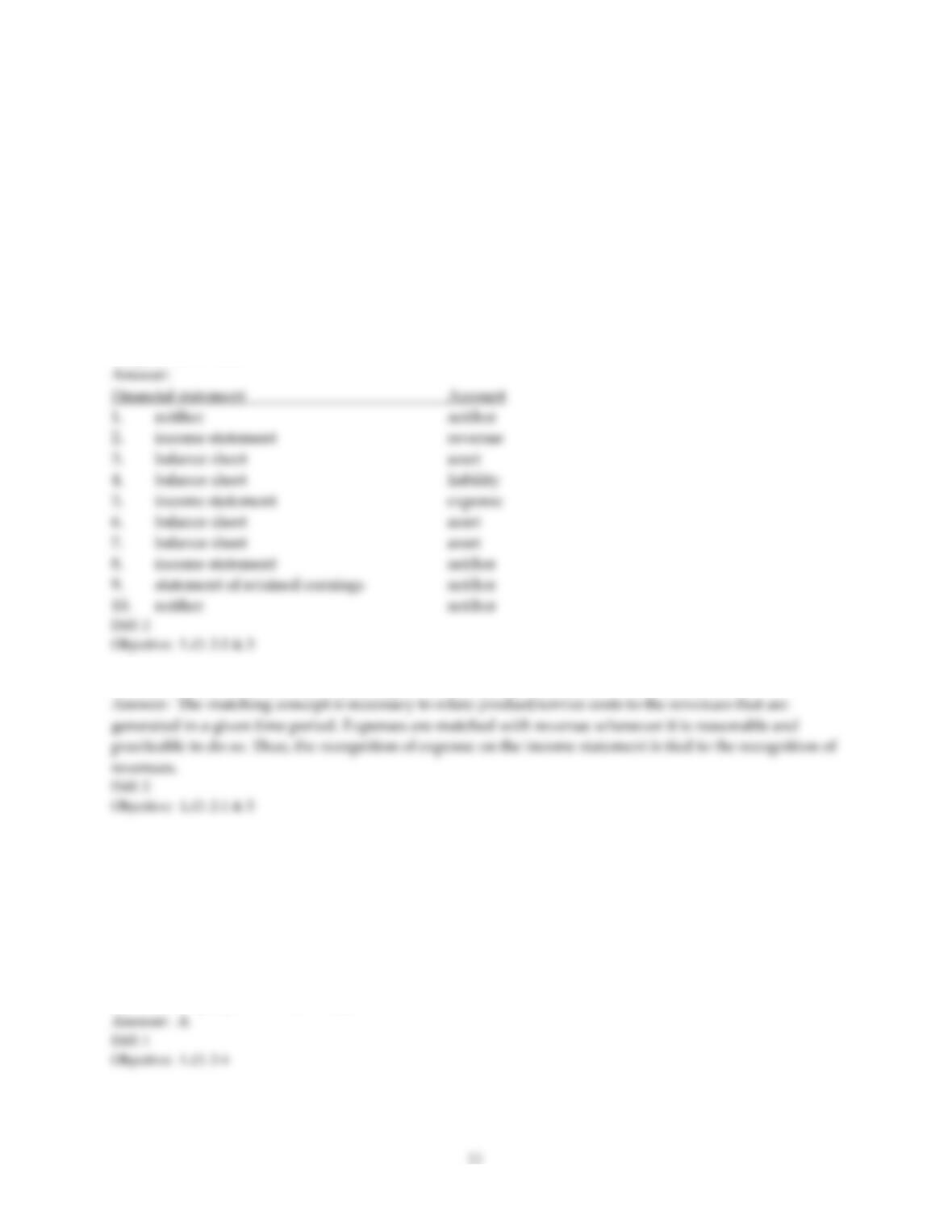
2.3-22) Describe how the matching concept is necessary to produce an income statement.
Learning Objective 2.4 Questions
2.4-1) Net income is defined as
A) revenues minus expenses.
B) expenses minus revenues.
C) assets minus revenues.
D) assets plus revenues.
E) owners’ equity assets minus expenses.
2.4-2) Under cash basis accounting, the payment of salaries to employees would
A) increase assets.
B) increase owners’ equity.
C) increase net income.
D) decrease net income.
E) decrease revenue.
2.4-3) The ________ account links the income statement with the balance sheet.
A) Paid–in capital
B) Retained earnings
C) Dividends
D) Net income
E) Stockholders’ equity
Table 2–1
The following data pertains to Cavalier Corporation. Total assets at January 1, 20X9, were $290,000; at
December 31, 20X9, total assets were $334,000. During 20X9, sales were $995,000; cash dividends were
$10,000; and operating expenses (exclusive of cost of goods sold) were $545,000. Total liabilities at
December 31, 20X9, were $128,000; at January 1, 20X9, total liabilities were $105,000. There was no
additional paid–in capital during 20X9.
2.4-4) Referring to Table 2–1, what was the amount of stockholders’ equity as of January 1, 20X9?
A) $450,000
B) $440,000
C) $185,000
D) $635,000
E) $175,000
2.4-5) Referring to Table 2–1, what was net income for 20X9?
A) $26,000
B) $31,000
C) $201,000
D) $440,000
E) $450,000
2.4-6) Referring to Table 2–1, what was cost of goods sold for 20X9?
A) $450,000
B) $435,000
C) $429,000
D) $419,000
E) $440,000
2.4-7) Sency Karate Company’s January 1, 2009, balance sheet showed total assets of $500,000, total
liabilities of $400,000, and total stockholders’ equity of $100,000. There were no beginning retained
earnings. During the month of January, Sency Karate Company earned revenues of $120,000 and incurred
expenses of $30,000. No other transactions occurred. What amount did Sency Karate Company’s
stockholders’ equity account increase by in January?
A) $90,000
B) $120,000
C) $100,000
D) $70,000
E) $190,000
2.4-8) An income statement is a report of all revenues and expenses pertaining to a specific date.
2.4-9) Net income appears on the income statement and balance sheet.
2.4-10) The balance sheet provides a snapshot of an entity’s financial position at an instant of time, while
the income statement provides a moving picture of events over a span of time.
2.4-11) The ending balance in retained earnings appears on the income statement.
2.4-12) The Clardy Company began business operations on May 1, 20X9. The following transactions
occurred during May 20X9:
1. The owner invested $32,000 in the company.
2. Inventory costing $13,000 was purchased. $900 in cash was paid; the remainder was put on account.
3. Equipment costing $18,000 was purchased, of which one–fourth was paid in cash. The remainder was
paid with a note payable. Ignore interest expense. Depreciation for the month relating to the equipment
was $500.
4. The rent for May, June, and July 20X9 was paid. The rent payment was $1,800.
5. Cash sales during the month totaled $5,900. The cost of the inventory sold was $3,100.
6. Credit sales during the month totaled $7,800. The cost of the inventory sold was $4,200.
7. The wages earned by the employees for the month were $4,000, although only $3,500 had been paid as
of the end of the month.
Given the previous transactions, determine the net income or loss using the accrual basis for the Clardy
Company for the month of May, 20X9.
2.4-13) Doyle Drycleaners had the following transactions during April 20X9:
Inventory purchases: on account $ 6,800
cash 2,800
Sales: on account 15,000
cash 3,500
1. Cost of goods sold on cash and credit sales 9,200
2. Payment of 3 months’ rent in advance (1
Month’s rent should be recognized in April) 2,100
3. Payment of inventory purchased on account 3,000
4. Collections from credit customers 9,900
5. Wages earned and paid during April 5,000
6. Wages earned but not paid during April 3,200
7. Credit purchases of supplies 1,200
8. Supplies used during April 200
Prepare an income statement for Doyle Drycleaners for the month of April, 20X9, under
a. the accrual basis.
b. the cash basis.
16
2.4-14) Following is the balance sheet for Evans Manufacturing as of May 31, 20X9:
Evans Manufacturing
Balance Sheet
May 31, 20X9
Assets Liabilities
Cash $ 7,100 Accounts Payable $ 6,200
Accounts Receivable 4,000 Notes Payable 8,300
Merchandise Inventory 13,500 Total Liab. and
Stockholders’Equity 14,500
Prepaid Rent 3,300 Paid–in Capital $17,600
Store Equipment 15,600 Retained Earnings 11,400
Total Stockholders’ equity 29,000
Total Assets $43,500 Total Liab. and Stockholders’ Equity $43,500
The following transactions occurred during June:
1. The company paid $2,100 of the accounts payable.
2. The company acquired $3,500 of merchandise inventory, paying 40% in cash and the remainder on
open account.
3. The utility bill of $600 for the month of June was paid.
4. The company received $2,200 from its credit customers.
5. Sales of merchandise inventory for the month of June totaled $12,900, of which $5,400 was paid in cash
and the remaining amount was on open account. The cost of the merchandise sold was $8,100.
6. The company paid $1,600 of the note payable. Ignore interest expense.
7. Depreciation on the store equipment was $600 for the month.
8. Additional store equipment of $1,700 was acquired. Of this amount, $700 was paid in cash and the
remainder was added to the note payable balance.
9. The balance in the prepaid rent account represented 3 months’ worth of rent paid in advance as of May
31, 20X9.

Prepare an income statement for the month ended May 31, 20X9.
2.4-15) Following is the balance sheet for the Gormley Company as of March 31, 20X9:
Gormley Company
Balance Sheet
March 31, 20X9
Assets Liabilities
Cash $ 7,100 Accounts Payable $ 6,200
Accounts Receivable 4,000 Notes Payable 8,300
Merchandise Inventory 13,500 Total Liab. 14,500
Prepaid Rent 3,300 Paid–in Capital $17,600
Store Equipment 15,600 Retained Earnings 11,400
Total Stockholders’ equity 29,000
Total Assets $43,500 Total Liab. and Stockholders’ Equity $43,500
The following transactions occurred during April:
1. The company paid $2,100 of the accounts payable.
2. The company acquired $3,500 of merchandise inventory, paying 40% in cash and the remainder on
open account.
3. The utility bill of $600 for the month of April was paid.
4. The company received $2,200 from its credit customers.
5. Sales of merchandise inventory for the month of April totaled $12,900, of which $5,400 was paid in cash
and the remaining amount was on open account. The cost of the merchandise sold was $8,100.
6. The company paid $1,600 of the note payable.
7. Depreciation on the store equipment was $600 for the month.
8. Additional store equipment of $1,700 was acquired. Of this amount, $700 was paid in cash and the
remainder was added to the note payable balance.
9. The balance in the prepaid rent account represented 3 months’ worth of rent paid in advance as of
March 31, 20X9.
10. Net income for the month ended April, 20X9, was $2,500.