53
Chapter 2— Basic Accounting Concepts
Multiple
Choice
Learning
Goal(s)
Level of
Difficulty
AACSB
Tag
AICPA
Tag
Multiple
Choice
Learning
Goal(s)
Level of
Difficulty
AACSB
Tag
AICPA
Tag
1
1
Easy
Communication
Reporting
37
2
Moderate
Analytic
Reporting
2
1
Easy
Communication
Reporting
38
2
Moderate
Reflective
Reporting
3
1
Moderate
Communication
Reporting
39
2
Moderate
Analytic
Reporting
4
1
Easy
Communication
Reporting
40
2
Moderate
Reflective
Reporting
5
1
Easy
Reflective
Reporting
41
2
Moderate
Reflective
Reporting
6
1
Moderate
Reflective
Reporting
42
2
Difficult
Reflective
Reporting
7
1
Moderate
Analytic
Reporting
43
2
Difficult
Reflective
Reporting
8
1
Moderate
Analytic
Reporting
44
2
Difficult
Reflective
Reporting
9
1
Moderate
Analytic
Reporting
45
2
Moderate
Reflective
Reporting
10
1
Moderate
Analytic
Reporting
46
3
Easy
Reflective
Reporting
11
2
Moderate
Reflective
Reporting
47
2
Easy
Reflective
Reporting
12
2
Moderate
Analytic
Reporting
48
3
Moderate
Reflective
Reporting
13
2
Moderate
Reflective
Reporting
49
3
Moderate
Reflective
Reporting
14
2
Moderate
Analytic
Reporting
50
3
Moderate
Reflective
Reporting
15
2
Moderate
Analytic
Reporting
51
3
Moderate
Reflective
Reporting
16
2
Moderate
Reflective
Reporting
52
3
Moderate
Reflective
Reporting
17
2
Moderate
Analytic
Reporting
53
3
Moderate
Reflective
Reporting
18
2
Moderate
Reflective
Reporting
54
3
Moderate
Reflective
Reporting
19
2
Moderate
Reflective
Reporting
55
3
Moderate
Analytic
Reporting
20
2
Moderate
Reflective
Reporting
56
4
Moderate
Reflective
Reporting
21
2
Moderate
Reflective
Reporting
57
5
Difficult
Analytic
Reporting
22
2
Moderate
Reflective
Reporting
58
5
Difficult
Analytic
Reporting
23
2
Moderate
Reflective
Reporting
59
5
Difficult
Analytic
Reporting
24
2,4
Moderate
Reflective
Reporting
60
5
Difficult
Analytic
Reporting
25
2,4
Moderate
Reflective
Reporting
61
2
Easy
Reflective
Reporting
26
2,4
Moderate
Reflective
Reporting
62
2
Moderate
Reflective
Reporting
27
2,4
Moderate
Reflective
Reporting
63
2
Moderate
Reflective
Reporting
28
2
Moderate
Reflective
Reporting
64
2
Moderate
Reflective
Reporting
29
2
Moderate
Analytic
Reporting
65
2
Moderate
Reflective
Reporting
30
2
Moderate
Analytic
Reporting
66
5
Easy
Reflective
Reporting
31
2
Moderate
Analytic
Reporting
67
5
Moderate
Analytic
Reporting
32
2
Moderate
Analytic
Reporting
68
5
Moderate
Reflective
Reporting
33
2
Moderate
Analytic
Reporting
69
5
Moderate
Reflective
Reporting
34
2
Moderate
Analytic
Reporting
70
6
Easy
Analytic
Risk
35
2
Moderate
Analytic
Reporting
71
6
Easy
Analytic
Reporting
36
2
Moderate
Reflective
Reporting
72
6
Moderate
Analytic
Risk
54 ♦ Chapter 2
True/
False
Learning
Goal(s)
Level of
Difficulty
AACSB
Tag
AICPA
Tag
1
1
Moderate
Reflective
Reporting
2
1
Moderate
Analytic
Reporting
3
1
Moderate
Analytic
Reporting
4
1
Moderate
Analytic
Reporting
5
1
Moderate
Reflective
Reporting
6
1
Moderate
Analytic
Reporting
7
1
Moderate
Analytic
Reporting
8
1
Moderate
Reflective
Reporting
9
1
Moderate
Analytic
Reporting
10
1
Moderate
Analytic
Reporting
11
2
Moderate
Analytic
Reporting
12
2
Moderate
Reflective
Reporting
13
2
Moderate
Reflective
Reporting
14
2
Moderate
Reflective
Reporting
15
2
Moderate
Reflective
Reporting
16
2
Moderate
Reflective
Reporting
17
2
Moderate
Reflective
Reporting
18
2
Moderate
Reflective
Reporting
19
2
Moderate
Reflective
Reporting
20
2
Moderate
Reflective
Reporting
21
2
Moderate
Reflective
Reporting
22
2
Moderate
Reflective
Reporting
23
2
Moderate
Reflective
Reporting
24
2
Moderate
Reflective
Reporting
25
3
Moderate
Reflective
Reporting
26
3
Moderate
Reflective
Reporting
27
3
Moderate
Reflective
Reporting
28
3
Moderate
Reflective
Reporting
29
3
Moderate
Reflective
Reporting
30
3
Moderate
Reflective
Reporting
31
3
Moderate
Reflective
Reporting
32
3
Moderate
Reflective
Reporting
33
4
Moderate
Reflective
Reporting
34
5
Moderate
Reflective
Reporting
35
5
Moderate
Reflective
Reporting
36
6
Moderate
Analytic
Reporting
37
6
Moderate
Analytic
Reporting
Essay
Learning
Goal(s)
Level of
Difficulty
AACSB
Tag
AICPA
Tag
1
1
Moderate
Reflective
Reporting
2
1
Difficult
Reflective
Reporting
3
1
Moderate
Reflective
Reporting
4
2,3,5
Moderate
Reflective
Reporting
5
2,3,4,5
Difficult
Reflective
Reporting
6
2,3,4,5
Difficult
Reflective
Reporting
7
2,3,4,5
Difficult
Reflective
Reporting
8
6
Moderate
Reflective
Risk
Problem
(s)
Learning
Goal(s)
Level of
Difficulty
AACSB
Tag
AICPA
Tag
1
1
Moderate
Analytic
Reporting
2
1
Difficult
Analytic
Reporting
3
1,2,3,4
Difficult
Analytic
Reporting
4
3,5
Difficult
Analytic
Reporting
5
3,5
Difficult
Analytic
Reporting
6
1,2,3,4,5
Difficult
Analytic
Reporting
7
1,2,3,4,5
Difficult
Analytic
Reporting
8
2,4
Moderate
Analytic
Reporting
9
2,3,4,5
Difficult
Analytic
Reporting
Case
Learning
Goal(s)
Level of
Difficulty
AACSB
Tag
AICPA
Tag
1
6
Difficult
Analytic
Risk
2
6
Difficult
Analytic
Risk
3
3,4,5
Difficult
Reflective
Reporting
4
2,3,4,5
Difficult
Reflective
Reporting
Difficulty Ratings
Guide:
Easy
Taken nearly verbatim
from the text
Moderate
Using different expression
or application of concept
Difficult
Several reasoning steps
Basic Accounting Concepts ♦ 55
MULTIPLE CHOICE
1. The basic financial statements do NOT include __________.
a.
Income statement
b.
Tax return
c.
Balance Sheet
d.
Statement of cash flows
2. Which of the following is NOT an element of the financial accounting system?
a.
A set of rules for determining the recording of economic events
b.
A framework for preparing financial statements
c.
A set of rules for the stock exchange
d.
Controls to determine whether errors occur during recording
3. The set of rules for determining the recording of economic events are generally referred to as
a.
the financial accounting rule book
b.
generally accepted accounting principles
c.
the accounting equation
d.
accounting controls
4. A __________ is an economic event that under generally accepted accounting principles affects an
element of the financial statements and must be recorded.
a.
Framework
b.
Controls
c.
Set of rules
d.
Transaction
5. The statement of cash flows is integrated with the balance sheet because
a.
the cash at the beginning of the period plus or minus the cash flows from operating,
investing and financing activities equals the end of period cash reported on the balance
sheet
b.
the cash at the beginning of the period plus or minus the net income equals the end of
period cash reported on the balance sheet
c.
the cash at the beginning of the period plus or minus assets and liabilities equals the end of
period cash reported on the balance sheet
d.
the cash at the beginning of the period plus or minus the cash flows from operating,
activities equals the end of period cash reported on the balance sheet
56 ♦ Chapter 2
6. Which of the following transactions changes the mix of assets only?
a.
Paid for supplies with cash
b.
Borrowed money from Second National Bank
c.
Received money for fees earned
d.
Received a utility bill
7. Better Belly, Inc. had the following assets and liabilities as of September 30, 2003.
Assets $54,433
Liabilities $28,416
What is the stockholders’ equity of Better Belly as of September 30, 2003?
a.
$0
b.
$26,017
c.
$82,849
d.
cannot be determined with this information
8. Better Belly, Inc. had the following assets and liabilities as of September 30, 2003.
Assets $54,433
Liabilities $28,416
If assets increased by $3,914 and equity increased by $2,290, what is the increase or decrease in
liabilities of Better Belly as of September 30, 2003?
a.
($1,624)
b.
$1,624
c.
$6,204
d.
($6,204)
Basic Accounting Concepts ♦ 57
9. Better Belly, Inc. had the following assets and liabilities as of September 30, 2006.
Assets $54,433
Liabilities $28,416
If assets increased by $3,914 and equity increased by $2,290 during the year, what is the
accounting equation of Better Belly as of September 30, 2007?
a.
($1,624)
b.
$1,624
c.
$6,204
d.
($6,204)
10. If Assets have a balance of $50,000, and Stockholders’ Equity has a balance of $40,000, then
Liabilities must have a balance of __________.
a.
$90,000
b.
$20,000
c.
$40,000
d.
$10,000
11. An increase in Stockholders’ Equity from revenues earned will result in an increase also in
__________.
a.
Liabilities
b.
Assets
c.
Stockholders’ equity
d.
No financial statement element
12. If Liabilities have a balance of $10,000 and Stockholders’ Equity has a balance of $70,000, then
Assets must have a balance of __________.
a.
$80,000
b.
$60,000
c.
$70,000
d.
$10,000
58 ♦ Chapter 2
13. One built in control that transactions are analyzed, recorded, and summarized correctly is the
accounting equation must
a.
never change its values.
b.
be independent of the statement of cash flows.
c.
remain in balance.
d.
always add up to one.
14. The payment of $10,000 for expenses was recorded by Spears Co. as an increase in cash of
$10,000, and a decrease in retained earnings of $10,000. What is the effect of this error on the
accounting equation?
a.
Total assets will exceed total liabilities and stockholders’ equity by $20,000
b.
Total assets will exceed total liabilities and stockholders’ equity by $10,000
c.
Total assets will be less than total liabilities and stockholders’ equity by $20,000
d.
The error will not affect the accounting equation.
15. If a $20,000 purchase of equipment for cash is incorrectly recorded as an increase to equipment
and as an increase to cash, at the end of the period, assets will __________.
a.
Exceed liabilities and stockholders’ equity by $10,000
b.
Equal liabilities and stockholders’ equity
c.
Exceed liabilities and stockholders’ equity by $20,000
d.
Exceed liabilities and stockholders’ equity by $40,000
16. XYZ Company deposited $15,000 in a bank account in return for issuing shares in the corporation.
This transaction would affect which two financial statement elements?
a.
Assets and stockholders’ equity
b.
Assets and liabilities
c.
Liabilities and stockholders‘ equity
d.
None of the above
17. A to Z Corporation engaged in the following transaction “Issue shares of stock for $5,000 .” On
the Statement of Cash Flows, the transaction would be classified as __________.
a.
Cash Flows from Operating Activities.
b.
Cash Flows from Investing Activities.
c.
Cash Flows from Financing Activities.
Basic Accounting Concepts ♦ 59
18. For EFG Co., the transaction “Borrowing cash from the bank on a note” would __________.
a.
Increase the assets
b.
Decrease the assets
c.
Have no effect on the assets
19. For EFG Co., the transaction “Purchase of capital stock in a new start-up business with cash”
would __________.
a.
Increase the assets
b.
Decrease the assets
c.
Have no effect on the assets
20. For EFG Co., the transaction “Purchase of land with cash” would __________.
a.
Increase the assets
b.
Decrease the assets
c.
Have no effect on the assets
21. For EFG Co., the transaction “Cash sales to customers” would __________.
a.
Increase the assets
b.
Decrease the assets
c.
Have no effect on the assets
22. For EFG Co., the transaction “Payment of dividends” would __________.
a.
Increase the assets
b.
Decrease the assets
c.
Have no effect on the assets
23. For EFG Co., the transaction “Payment of expenses with cash” would __________.
a.
Increase the assets
b.
Decrease the assets
c.
Have no effect on the assets
24. For EFG Co., the transaction “Purchase of store equipment for cash” would __________.
a.
Increase the assets
b.
Decrease the assets
c.
Have no effect on the assets
60 ♦ Chapter 2
25. For EFG Co., the transaction “Payment of quarterly taxes” would __________.
a.
Increase the assets
b.
Decrease the assets
c.
Have no effect on the assets
26. For EFG Co., the transaction “Receipt of interest income” would __________.
a.
Increase the assets
b.
Decrease the assets
c.
Have no effect on the assets
27. For EFG Co., the transaction “Payment of store rent” would __________.
a.
Increase the assets
b.
Decrease the assets
c.
Have no effect on the assets
28. For EFG Co., the transaction “Received dividend income” would __________.
a.
Increase the assets
b.
Decrease the assets
c.
Have no effect on the assets
29. A to Z Corporation engaged in the following transaction “Issued a $30,000 note payable to borrow
cash from the bank.” On the Statement of Cash Flows, the transaction would be classified as
__________.
a.
Cash Flows from Operating Activities.
b.
Cash Flows from Investing Activities.
c.
Cash Flows from Financing Activities.
30. Blue Spas Inc. borrows $25,000 cash from the bank on a note. The net affect on assets is
__________.
a.
$25,000 increase
b.
$0
c.
$25,000 decrease
d.
$12,500 increase
Basic Accounting Concepts ♦ 61
31. Allen Rebozo creates a new accounting firm, Tax Tips Inc. by giving $30,000 cash for capital
stock. The net affect on assets is __________.
a.
$30,000 increase
b.
$0
c.
$30,000 decrease
d.
$15,000 increase
32. A to Z Corporation engaged in the following transaction “Purchased land for $80,000 cash.” On
the Statement of Cash Flows, the transaction would be classified as __________.
a.
Cash Flows from Operating Activities.
b.
Cash Flows from Investing Activities.
c.
Cash Flows from Financing Activities.
33. Martha Stewart, Inc. buys land for $50,000 cash. The net affect on assets is __________.
a.
$50,000 increase
b.
$0
c.
$50,000 decrease
d.
$25,000 increase
34. A to Z Corporation engaged in the following transaction “Paid $1,000 of expenses.” On the
Statement of Cash Flows, the transaction would be classified as __________.
a.
Cash Flows from Operating Activities.
b.
Cash Flows from Investing Activities.
c.
Cash Flows from Financing Activities.
35. A to Z Corporation engaged in the following transaction “Earned patient fees of $5,000 .” On the
Statement of Cash Flows, the transaction would be classified as __________.
a.
Cash Flows from Operating Activities.
b.
Cash Flows from Investing Activities.
c.
Cash Flows from Financing Activities.
36. CXN Company earns revenues and as a result collects cash. Which of the following financial
statement elements are increased?
a.
Cash only
b.
Stockholders’ equity only
c.
Liabilities
d.
Cash and stockholders’ equity
62 ♦ Chapter 2
37. YUT Company paid a utility bill of $500 and paid rent of $700 in December. By how much would
these events reduce stockholders’ equity?
a.
$1,200
b.
$500
c.
$850
d.
$700
38. Dividends paid would be an
a.
operating activity
b.
investing activity
c.
financing activity
d.
not be on the statement of cash flows
39. A to Z Corporation engaged in the following transaction “Paid a $10,000 cash dividend.” On the
Statement of Cash Flows, the transaction would be classified as __________.
a.
Cash Flows from Operating Activities.
b.
Cash Flows from Investing Activities.
c.
Cash Flows from Financing Activities.
40. Every cash transaction .
a.
Increases or decreases the asset cash.
b.
Increases or decreases an operating, investing,or financing activity on the statement of
cash flow.
c.
Always affects at least one balance sheet account and the statement of cash flows.
d.
A, b, and c are all correct.
41. The income statement is linked to the balance sheet through the _________ account. .
a.
Accounts payable account
b.
Capital stock account
c.
Cash account
d.
Retained earnings account
42. Which of the following would result in the accounting equation to be in balance but would still be
incorrect?
a.
The purchase of land for cash, with the land recorded in the equipment account
b.
The purchase of land for cash with the land not recorded
c.
Cash collected for fees earned
d.
Equipment purchased for cash with the equipment recorded as an asset
Basic Accounting Concepts ♦ 63
43. Which of the following would result in no net change of assets?
a.
Stock issued for cash
b.
Expenses paid with cash
c.
Cash collected for fees earned
d.
Land purchased for cash
44. Which of the following would decrease stockholders’ equity?
a.
Stock issued for cash
b.
Expenses paid with cash
c.
Repayment of notes payable
d.
Land purchased for cash
45. Which of the following are true?
a.
The effect of every transaction is an increase or a decrease in one or more the accounting
equation elements
b.
The two sides of the accounting equation are always equal
c.
Stockholders’ equity is increased by amounts invested by stockholders
d.
All are true
46. _____________ are accounting reports that provide summarized information of the transactions of
a company.
a.
accounting equation
b.
economic events
c.
financial statements
d.
transactions
47. A business increases stockholders’ equity by __________.
a.
Earning revenues in excess of expenses
b.
Paying dividends
c.
Buying more assets
d.
Having more expenses than revenues
48. The order in which the financial statements are normally prepared would be.
a.
balance sheet, cash flows, income statement, retained earnings
b.
income statement, retained earnings, balance sheet, cash flows
c.
cash flows, balance sheet, income statement, retained earnings
d.
balance sheet, income statement, retained earnings, cash flows
64 ♦ Chapter 2
49. The order in which expenses are listed on the income statement is determined by
a.
size with the largest expense listed first.
b.
size with the smallest expense listed first.
c.
alphabetical order starting with the a’s and moving down the alphabet.
d.
alphabetical order starting with the z’s and moving up the alphabet.
50. The effect of net income will be to
a.
increase operating activities in the statement of cash flows
b.
increase cash and stockholders’ equity
c.
increase retained earnings and stockholders’ equity
d.
increase cash and operating activities in the statement of cash flows
51. The company has been in operation for only one month and during the month the revenues were
$15,642 and operating expenses were $9,425. If the ending balance in retained earnings is $2,717,
then the amount of dividends paid was
a.
$3,500
b.
$6,217
c.
$8,934
d.
cannot be determined with the information given
52. The order in which liabilities on the balance sheet should be listed would be
a.
the order that they will be paid in cash
b.
alphabetical order
c.
the size of the liability with the smallest first
d.
the size of the liability with the largest first
53. Which of the following liabilities should be listed first on the balance sheet?
Accounts payable due in one month $2,000
Note due within 5 days $1,000
Note payable due in 6 months $4,000
a.
Accounts payable
b.
Note due in 5 days
c.
Note payable due in 6 months
d.
any order
Basic Accounting Concepts ♦ 65
54. The first month of operation showed the net cash from operating activities to be $3760, the net
cash from investing activities to be ($5415), and the ending cash balance to be $2,425. The net
cash from financing activities must be
a.
$770
b.
$4,080
c.
($11,600)
d.
$11,600
55. The income statement for August indicates net income of $50,000. The corporation also paid
$10,000 in dividends during the same period. If there was no beginning balance in stockholders’
equity, what is the ending balance in stockholders’ equity?
a.
$40,000
b.
$50,000
c.
$10,000
d.
$60,000
56. The balance sheet reports the _________ of the entity’s assets, liabilities, and stockholders’
equity.
a.
accounting period total
b.
cumulative total
c.
transaction total
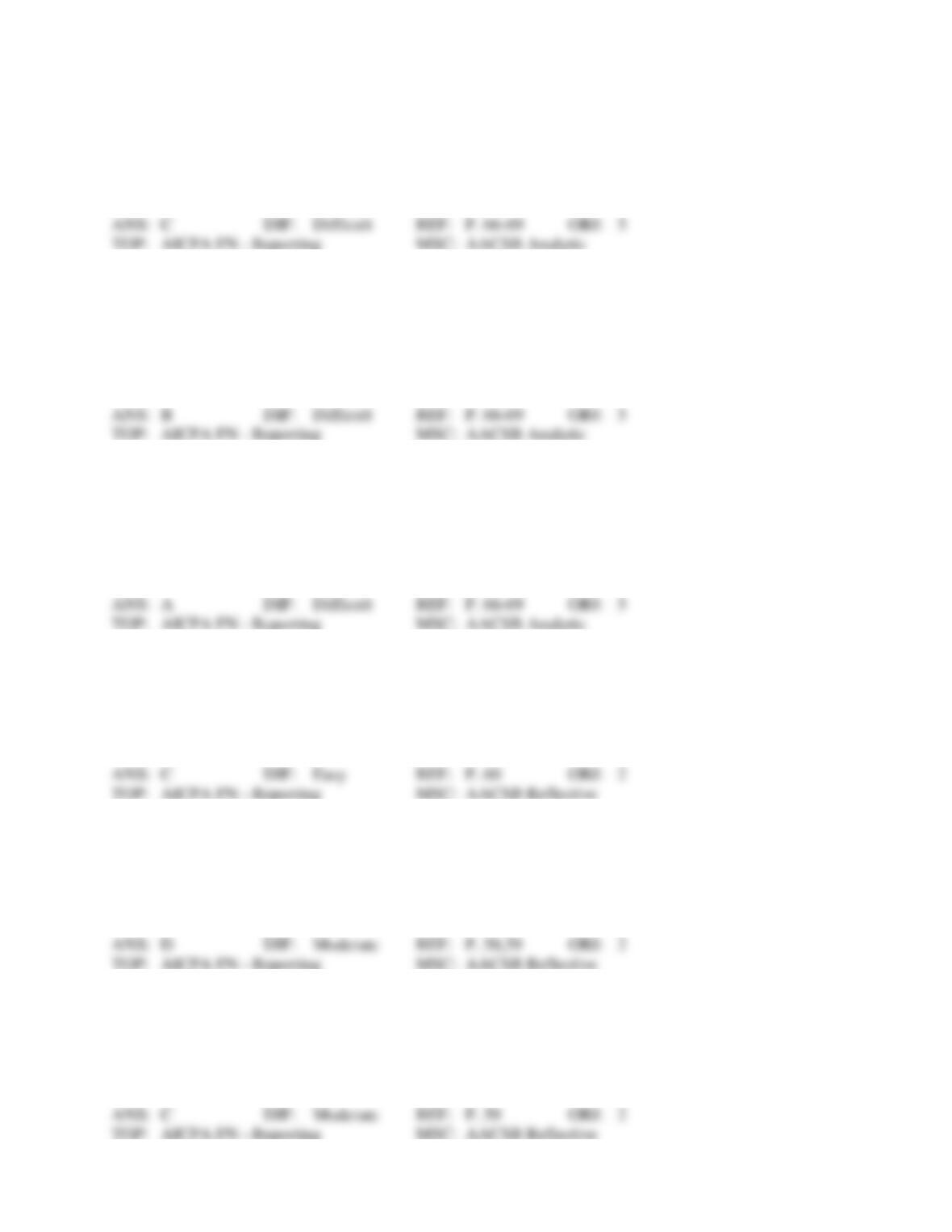
57. Refer to Exhibit 2-1. What is net income assuming no stock was issued, and no dividends were
paid?
a.
$100,000
b.
$300,000
c.
$150,000
d.
$50,000
66 ♦ Chapter 2
58. Refer to Exhibit 2-1. What is net income assuming no stock was issued, and dividends of $25,000
were paid?
a.
$10,000
b.
$60,000
c.
$125,000
d.
$300,000
59. Refer to Exhibit 2-1. What is net income assuming $50,000 of stock was issued, and no dividends
were paid?
a.
$100,000
b.
$50,000
c.
$70,000
d.
$10,000
60. Refer to Exhibit 2-1. What is net income assuming $50,000 of stock was issued, and $25,000 of
dividends were paid?
a.
$75,000
b.
$50,000
c.
$70,000
d.
$10,000
61. Declaring and paying cash dividends affects which balance sheet accounts?
a.
Cash only
b.
Stockholders’ equity only
c.
Cash and stockholders’ equity
d.
Cash and capital stock
62. Buying land for cash affects which balance sheet accounts?
a.
Cash only
b.
Stockholders’ equity only
c.
Cash and stockholders’ equity
d.
Cash and land
63. Receiving cash for fees earned affects which balance sheet accounts?
a.
Cash only
b.
Stockholders’ equity only
c.
Cash and stockholders’ equity
d.
Cash and capital stock
Basic Accounting Concepts ♦ 67
64. At the end of the period, ABC Co. pays dividends. The effect of this transaction is to __________.
a.
Decrease retained earnings and capital stock
b.
Decrease cash and retained earnings
c.
Decrease cash only
d.
Decrease retained earnings only
65. Paying expenses affects which financial statement elements?
a.
Cash only
b.
Stockholders’ equity only
c.
Cash and stockholders’ equity
d.
Cash and capital stock
66. When revenues for a period exceed the expenses used to earn the revenues, the financial condition
of the business __________.
a.
May improve in the future
b.
Has remained unchanged
c.
Has declined
d.
Has improved
67. Young Company has $16,000 in Retained Earnings, $27,000 in Assets, and $5,000 in Liabilities.
How much is in Common Stock?
a.
$36,000.
b.
$15,000.
c.
$5,000.
d.
$6,000.
68. The payment of a liability __________.
a.
Decreases assets and stockholders’ equity
b.
Increases assets and decreases liabilities
c.
Decreases assets and increase liabilities
d.
Decreases assets and decreases liabilities
69. Which of the following transactions results in an increase in revenues?
a.
Sale of land for cash equal to the land’s historical cost
b.
Sale of merchandise inventory for cash
c.
Receipt of cash from the sale of stock
d.
Receipt of cash from a bank loan
68 ♦ Chapter 2
70. Analyzing comparative financial statements by computing percentages of each item is called
__________.
a.
The income statement
b.
Horizontal analysis
c.
Percentage basis accounting
d.
Vertical analysis
71. ___________ computes the percentages of each item within a statement to a total within the
statement.
a.
Vertical analysis
b.
Horizontal analysis
c.
Accounting equation
d.
Balance sheet analysis
72. Which type of analysis might indicate whether the cost of sales had increase as a percentage of
sales from one year to another?
a.
Horizontal analysis
b.
Vertical analysis
c.
Accounting equation
d.
Balance sheet analysis
TRUE/FALSE
1. The basic elements of a financial accounting system include a framework for preparing financial
statements.
2. The accounting equation is expressed as follows: Assets = Liabilities – Stockholders’ Equity
3. Any given transaction must affect all three parts of the accounting equation.
4. The accounting equation can be expressed: Assets – Liabilities = Stockholders’ Equity
Basic Accounting Concepts ♦ 69
5. The two sides of the accounting equation do NOT have to be equal.
6. The effect of every transaction is an increase or a decrease in one or more of the accounting
equation elements.
7. A transaction can affect at most two elements of the accounting equation.
8. A company may show a positive net income but be headed for bankruptcy.
9. A business receives $10,000 cash for a sale of merchandise, and records this receipt of cash as an
increase in equipment by mistake. The accounting equation is still in balance.
10. It is possible for a transaction to change the makeup of assets, but to NOT affect assets in total.
11. Equality of the accounting equation means that no errors have occurred.
12. When capital stock is issued by a corporation for cash, both the income statement and the balance
sheet are affected.
13. Borrowing money from the bank will increase liabilities.
14. Purchasing land for cash will have no effect on stockholders’ equity.
70 ♦ Chapter 2
15. Fees earned and paid in cash will increase operating activity cash flows as well as retained
earnings..
16. Miscellaneous expenses are expenses that have an undetermined amount to be paid.
17. Dividends are distributions of business earnings to stockholders.
18. The payment of utilities expense in cash would affect the operating activities in the statement of
cash flows and the income statement but not the balance sheet.
19. The payment of a cash dividend increases total assets.
20. International accounting standards require the same four financial statements that are required
under U.S. GAAP.
21. International accounting standards require two years of historical information be provided while
three years are required under U.S. GAAP.
22. Revenues increase stockholders’ equity.
23. Stockholders’ equity is decreased by stockholders’ investments.
24. Normally, the first financial statement to be prepared is the cash flows statement
Basic Accounting Concepts ♦ 71
25. Normally, the last financial statement to be prepared is the statement of retained earnings.
26. The income statement is prepared before the balance sheet.
27. The statement of retained earnings must be prepared before the balance sheet.
28. Normally expenses are reported under the heading “Miscellaneous Expenses”.
29. The beginning balance of the retained earnings is zero when a company is beginning operations.
30. Accounts payable is always listed first under the liabilities section of the balance sheet.
31. The statement of cash flows lists the net cash from operating activities, net cash from research
activities and net cash from financing activities to determine the net change in cash.
32. The cash flows from operating activities and net income are related and are not normally equal..
33. The ending balances of the accounts from one accounting period become the beginning balances
of the next period.
34. An increase in net income suggests that a company’s operations are profitable and that the
company is growing.
72 ♦ Chapter 2
35. By keeping a running total of the effects of transactions, the accounting equation provides a
framework for summarizing the effects of a series of transactions.
36. In vertical analysis, each item on the income statement is shown a s a percentage of total assets..
37. Horizontal analysis shows the percentage of each item within a statement to a total in the
statement.
ESSAY
1. What are the basic elements of a financial accounting system?
2. The accounting equation “Assets = Liabilities + Stockholders’ Equity” is affected by transactions.
Is it possible to have a transaction that only impacts one financial element of the equation? Two
elements? Give examples.