Chapter 2
A Closer Look at the Financial Statements
MULTIPLE CHOICE QUESTIONS
1. When an entrepreneur wishes to start a business, capital must be attracted in the form
of:
a. net income.
b. cost of goods sold.
c. operating activities.
d. equity or debt financing.
2. The acquisition of equity and debt financing is considered:
a. a financing activity.
b. net income.
c. an investing activity.
d. an operating activity.
3. Which one of the following is considered an operating activity?
a. Payment to a vendor for supplies.
b. Purchase of company trucks for cash.
c. Payment of dividends to shareholders.
d. Issuing stock to investors.
4. Your bank loaned ten million dollars to Hamilton Stores to finance the construction of a
manufacturing plant. In which section of Hamilton’s statement of cash flows would you
be able to determine whether the company used the cash to build the new plant?
a. Operating activities
b. Owner activities
c. Financing activities
d. Investing activities
2-2 Test Bank – Chapter 2 – The Financial Statements
5. Garrison Corporation has the following transactions:
1. Dividends are paid to the shareholders.
2. A utility bill for July is paid in August.
3. A new warehouse facility is purchased.
4. Principal payments on outstanding debt are paid.
5. Employee wages are paid.
6. Forty-five units of inventory are sold for $100 each.
7. Common stock is issued for $230,000 in cash.
8. A delivery van used for 5-years is sold for $12,000, which is its book value.
Which of the above transaction(s) are examples of financing activities?
a. 1,4,7
b. 1,7,8
c. 3,8
d. 1,3,4,7,8
6. Garrison Corporation has the following transactions:
1. Dividends are paid to the shareholders.
2. A utility bill for July is paid in August.
3. A new warehouse facility is purchased.
4. Principal payments on outstanding debt are paid.
5. Employee wages are paid.
6. Forty-five units of inventory are sold for $100 each.
7. Common stock is issued for $230,000 in cash.
8. A delivery van used for 5-years is sold for $12,000, which is its book value.
Which of the above transaction(s) are examples of investing activities?
a. 3,4,7,8
b. 1,4,7
c. 4,7
d. 3,8
Test Bank – Chapter 2 – The Financial Statements 2-3
7. Garrison Corporation has the following transactions:
1. Dividends are paid to the shareholders.
2. A utility bill for July is paid in August.
3. A new warehouse facility is purchased.
4. Principal payments on outstanding debt are paid.
5. Employee wages are paid.
6. Forty-five units of inventory are sold for $100 each.
7. Common stock is issued for $230,000 in cash.
8. A delivery van used for 5-years is sold for $12,000, which is its book value.
Which of the above transaction(s) are examples of operating activities?
a. 2,3,5
b. 5,6,8
c. 2,3,5,6,8
d. 2,5,6
8. Current assets are:
a. all assets except inventory.
b. all assets that provide benefits extending beyond one year.
c. cash, accounts receivable, and buildings.
d. all assets that are expected to be converted to cash in the near future.
9. Intangible assets are:
a. goodwill, patents, copyrights, and trademarks.
b. property, plant, and equipment.
c. all assets except current assets.
d. those assets that an owner can purchase with cash only.
10. Long-term investments can include all of the following except:
a. notes receivable maturing in nine months.
b. equity securities of another company to be held for more than a year.
c. ten-year debt securities of another company.
d. land to be held beyond one year.
2-4 Test Bank – Chapter 2 – The Financial Statements
11. Which one of the following is an asset?
a. A patent of a company’s secret formula for reverse osmosis.
b. Retained earnings.
c. Notes payable.
d. Accounts payable.
12. Which one of the following groups of accounts contains only assets?
a. Equipment, patents, accounts receivable.
b. Accounts receivable, building, retained earnings.
c. Accounts payable, notes payable, contributed capital.
d. Retained earnings, goodwill, and accounts payable.
13. Which one of the following groups of accounts contains only assets?
a. Contributed capital, retained earnings, revenues.
b. Cash, contributed capital, retained earnings.
c. Prepaid expenses, land, accounts receivable.
d. Building, equipment, depreciation expense.
14. Which one of the following is a liability?
a. Interest receivable.
b. Contributed capital.
c. Retained earnings.
d. Wages payable.
15. Which one of the following groups of accounts contains only current assets?
a. Inventory, accounts receivable, equipment.
b. Cash, equipment, copyrights.
c. Cash, accounts receivable, merchandise inventory.
d. Patents, copyrights, and trademarks.
Test Bank – Chapter 2 – The Financial Statements 2-5
16. Which one of the following creates a decrease in retained earnings?
a. Prepaid assets.
b. Equipment.
c. Dividends.
d. Merchandise inventory not sold.
17. Which account is associated with the sale of inventory?
a. Cost of goods sold.
b. Depreciation.
c. Inventory expense.
d. Equipment.
18. Which account is associated with borrowing money?
a. Interest expense.
b. Goodwill.
c. Cost of goods sold.
d. Depreciation.
19. Which expense is associated with long-term assets?
a. Dividends.
b. Depreciation.
c. Cost of goods sold.
d. Interest.
20. Which expense is associated with the use of patents?
a. Interest.
b. Amortization.
c. Cost of goods sold.
d. Depreciation.
2-6 Test Bank – Chapter 2 – The Financial Statements
21. The major accounting difference between interest expense for creditors and dividends
declared and paid to shareholders is that interest expense:
a. decreases retained earnings and dividends increase retained earnings.
b. impacts cash flows, while dividends do not.
c. is not on the income statement while dividends declared and paid are.
d. is on the income statement and dividends declared and paid are not.
22. Which one of the following equations represents retained earnings activity for a year?
a. Beginning balance + expenses – dividends = ending balance.
b. Beginning balance + cash receipts – cash payments = ending balance.
c. Beginning balance + dividends – net income = ending balance.
d. Beginning balance + net income – dividends = ending balance.
23. Which one of the following appears on the income statement?
a. Inventory.
b. Retained earnings.
c. Dividends.
d. Interest revenue.
24. Which one of the following groups of accounts contains only liabilities?
a. Accounts payable, retained earnings, notes payable.
b. Supplies expense, cost of goods sold, interest expense.
c. Wages payable, mortgage payable, taxes payable.
d. Contributed capital, accounts payable, retained earnings.
25. Smith Corp. earned $300,000 profit during 2018. On which financial statement(s) will the
exact dollar amount of the profit be clearly stated?
a. Statement of shareholders’ equity and income statement.
b. Income statement only.
c. Balance sheet and income statement.
d. Statement of shareholders’ equity, income statement, and the balance sheet.
Test Bank – Chapter 2 – The Financial Statements 2-7
26. On which financial statements will you find a company’s financial position at a specific
point in time?
a. All financial statements combined.
b. Income statement and balance sheet.
c. Balance sheet and statement of shareholders’ equity.
d. Balance sheet only.
27. Why are liabilities separated into current and long-term?
a. Users want to know which amounts will be paid using current assets.
b. Because current and long-term classifications are just common sense.
c. This format helps a company determine how much profit was made.
d. The SEC requires companies to do so.
28. Which one of the following statements is true?
a. A company’s own stock is its most liquid asset.
b. Profits are normally kept in a company’s retained earnings until distributed as
dividends.
c. Long-term investments will be used to pay current liabilities.
d. Current assets have no physical substance.
29. Cash reported on a company’s balance sheet represents
a. the profit a company made during the current year.
b. the amount the President of the Company has in his or her personal account.
c. the amount collected from customers during the current year less the amount paid
for expenses.
d. the currency a company has access to at the balance sheet date.
30. The amount a company expects to collect from its customers is:
a. accounts receivable.
b. short-term equity securities.
c. inventory.
d. accounts payable.
2-8 Test Bank – Chapter 2 – The Financial Statements
31. As used in accounting, “notes” may be reported:
a. only as company debt offerings.
b. only as assets on the balance sheet.
c. as either assets or liabilities.
d. on the income statement or the balance sheet.
32. Property, plant and equipment may include which of the following?
a. Intangible assets and land.
b. Inventory and equipment.
c. Buildings and cash.
d. Land and office buildings.
33. On the balance sheet, a company should report the cost of intangible assets:
a. in the current assets section.
b. as an amount owed to shareholders.
c. as an amount that is estimated by the CFO.
d. at acquired cost less any accumulated amortization.
34. The most common revenue account is:
a. cash.
b. sales.
c. shareholders’ equity.
d. liabilities.
35. Most investors believe that the statement of cash flows is
a. a useful source of information regarding the cash flow of an entity.
b. the only statement in an annual report whose results correlates to stock price value.
c. too complicated.
d. a useful measure of a company’s profit.
Test Bank – Chapter 2 – The Financial Statements 2-9
36. The amount reported on a company’s balance sheet as retained earnings is the same as
the amount reported on the company’s:
a. income statement as net income.
b. statement of shareholders’ equity as beginning retained earnings.
c. statement of cash flows as cash received from operating activities.
d. statement of shareholders’ equity as ending retained earnings.
37. Which one of the following is not an asset?
a. A company’s equity in the common stock of another company.
b. A company’s trademarked name for a process.
c. Retained earnings.
d. Notes receivable.
38. Baron Company has six major headings in its income statement, which include Sales,
Fees Earned, Other Revenues, Cost of Goods Sold, Operating Expenses, and Other
Expenses. Below are some of the income statement accounts for Baron:
1. Sales of inventories
2. Depreciation expense
3. Income from interest on savings
account
4. Income from dividends on
investments
5. Advertising expense.
6. Loss on sale of building
7. Salespeople commission expense
8. Office salary expense
9. Gain on sale of short-term
investments
10. Sales of services provided
11. Cost of sold inventories
12. Interest expense on outstanding
loans
Which of these would be found under the heading “Other Revenues”?
a. 1,10
b. 1,3,4
c. 3,4,10
d. 3,4,9
2-10 Test Bank – Chapter 2 – The Financial Statements
39. Baron Company has six major headings in its income statement, which include Sales,
Fees Earned, Other Revenues, Cost of Goods Sold, Operating Expenses, and Other
Expenses. Below are some of the income statement accounts for Baron:
1. Sales of inventories
2. Depreciation expense
3. Income from interest on savings
account
4. Income from interest on
investments
5. Advertising expense.
6. Loss on sale of building
7. Salespeople commission
expense
8. Insurance expense
9. Gain on sale of short-term
investments
10. Sales of services provided
11. Cost of sold inventories
12. Interest expense on outstanding
loans
Which of these would be found under the heading “Operating Expenses”?
a. 2,8,12
b. 2,7,8,12
c. 2,5,7,8,11
d. 2,5,11
40. Hsu Company has eight major section headings in its balance sheet, which include
Current Assets, Long–Term Investments, Property, Plant, and Equipment, Intangible
Assets, Current Liabilities, Long-Term Liabilities, and Shareholders’ Equity. Below are
some of the balance sheet accounts for Hsu:
1. Dividends Payable
2. Prepaid Rent
3. Trademarks
4. Bonds Payable
5. Investment Funds for Plant
Expansion
6. Inventories
7. Wages Payable
8. Deferred Revenues
9. Accumulated Depreciation –
Building
10. Accounts Receivable
11. Accounts Payable
Which of these would be found under the heading “Current Assets”?
a. 2,10
b. 2,6,8,10
c. 2,6,10
d. 2,5,10
Test Bank – Chapter 2 – The Financial Statements 2-11
41. Hsu Company has eight major section headings in its balance sheet, which include
Current Assets, Long–Term Investments, Property, Plant, and Equipment, Intangible
Assets, Current Liabilities, Long-Term Liabilities, and Shareholders’ Equity. Below are
some of the balance sheet accounts for Hsu:
1. Dividends Payable
2. Prepaid Rent
3. Trademarks
4. Bonds Payable
5. Investment Funds for Plant
Expansion
6. Inventories
7. Wages Payable
8. Deferred Revenues
9. Accumulated Depreciation –
Building
10. Accounts Receivable
11. Accounts Payable
Which of these would be found under the heading “Property, Plant, and Equipment”?
a. 5,9
b. 5,6,9
c. 3,5,6,9
d. 9
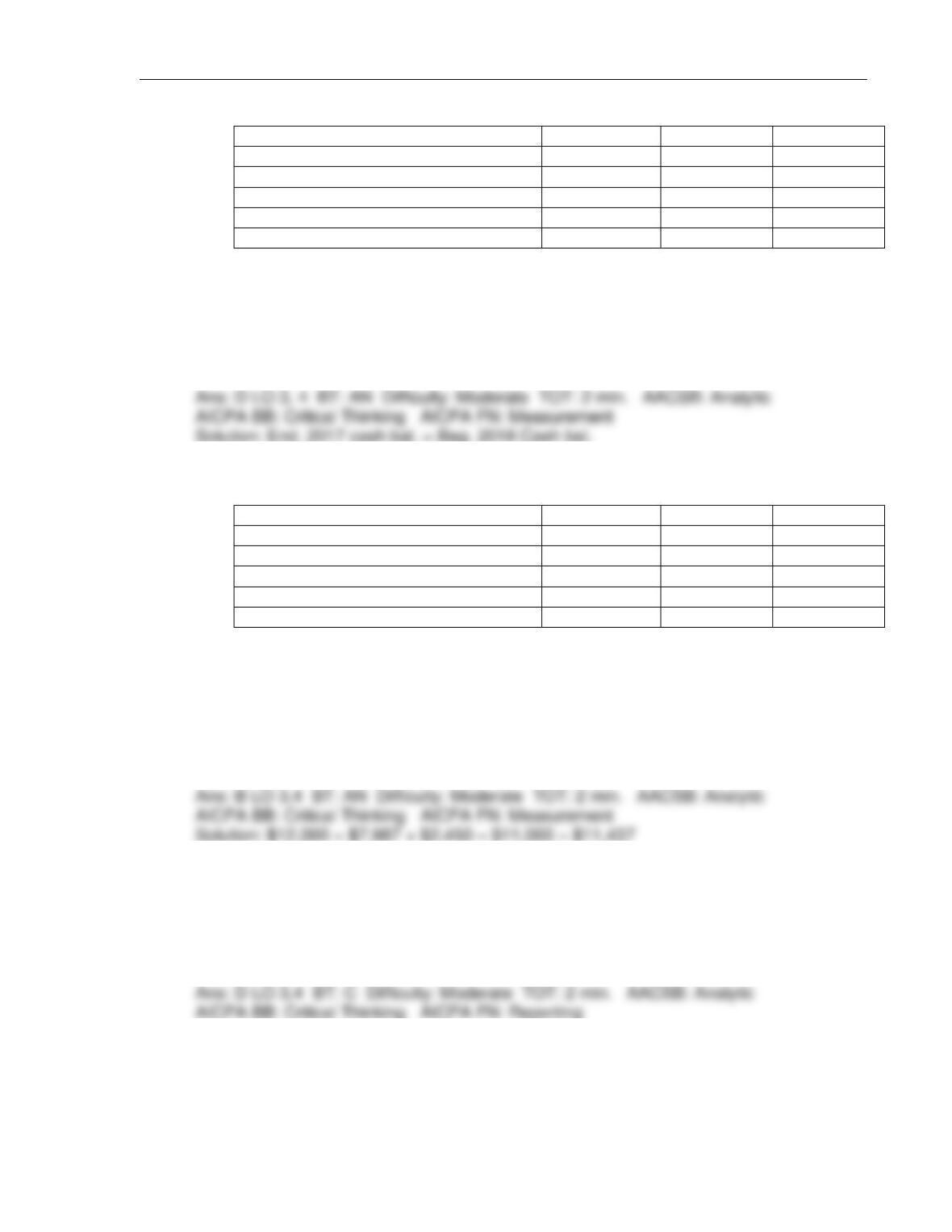
42. The information below was taken from the 2018 annual report of Jena Corporation.
2018
2017
2016
Beginning cash balance
$ 12,000
?
$5,000
Net cash flow from operating activities
7,987
?
9,100
Net cash flow from investing activities
2,450
4,330
?
Net cash flow from financing activities
?
(9,612)
(7,500)
Ending cash balance
$11,000
?
$12,500
Which of the following is the missing amount for the net cash flow from investing
activities for 2016?
a. $5,900
b. $10,900
c. $15,000
d. $4,450
2-12 Test Bank – Chapter 2 – The Financial Statements
43. The information below was taken from the 2018 annual report of Jena Corp.
2018
2017
2016
Beginning cash balance
$ 12,000
?
$5,000
Net cash flow from operating activities
7,987
?
9,100
Net cash flow from investing activities
2,450
4,330
?
Net cash flow from financing activities
?
(9,612)
(7,500)
Ending cash balance
$11,000
?
$12,500
Which of the following is the missing amount for the beginning cash balance for 2017?
a. $5,925
b. $8,741
c. $12,500
d. $5,282
44. The information below was taken from the 2018 annual report of Jena Corp.
2018
2017
2016
Beginning cash balance
$ 12,000
?
$5,000
Net cash flow from operating activities
7,987
?
9,100
Net cash flow from investing activities
2,450
4,330
?
Net cash flow from financing activities
?
(9,612)
(7,500)
Ending cash balance
$11,000
?
$12,500
Which of the following is the missing amount for the net cash flow from operating
activities for 2017?
a. $8,110
b. $4,782
c. $8,475
d. $3,874
Test Bank – Chapter 2 – The Financial Statements 2-13
45. The information below was taken from the 2018 annual report of Jena Corp.
2018
2017
2016
Beginning cash balance
$12,000
?
$5,000
Net cash flow from operating activities
7,987
?
9,100
Net cash flow from investing activities
2,450
4,330
?
Net cash flow from financing activities
?
(9,612)
(7,500)
Ending cash balance
$11,000
?
$12,500
Which of the following is the missing amount for the ending cash balance for 2017?
a. $2,759
b. $7,158
c. $12,703
d. $12,000
46. The information below was taken from the 2018 annual report of Jena Corp.
2018
2017
2016
Beginning cash balance
$12,000
?
$5,000
Net cash flow from operating activities
7,987
?
9,100
Net cash flow from investing activities
2,450
4,330
?
Net cash flow from financing activities
?
(9,612)
(7,500)
Ending cash balance
$11,000
?
$12,500
Which of the following is the missing amount for the net cash flow from financing
activities for 2018?
a. ($22,437)
b. ($11,437)
c. ($563)
d. ($14,450)
47. Which of the above transaction(s) are examples of operating activities?
e. 2,3,5
f. 5,6,8
g. 2,3,5,6,8
h. 2,5,6
2-14 Test Bank – Chapter 2 – The Financial Statements
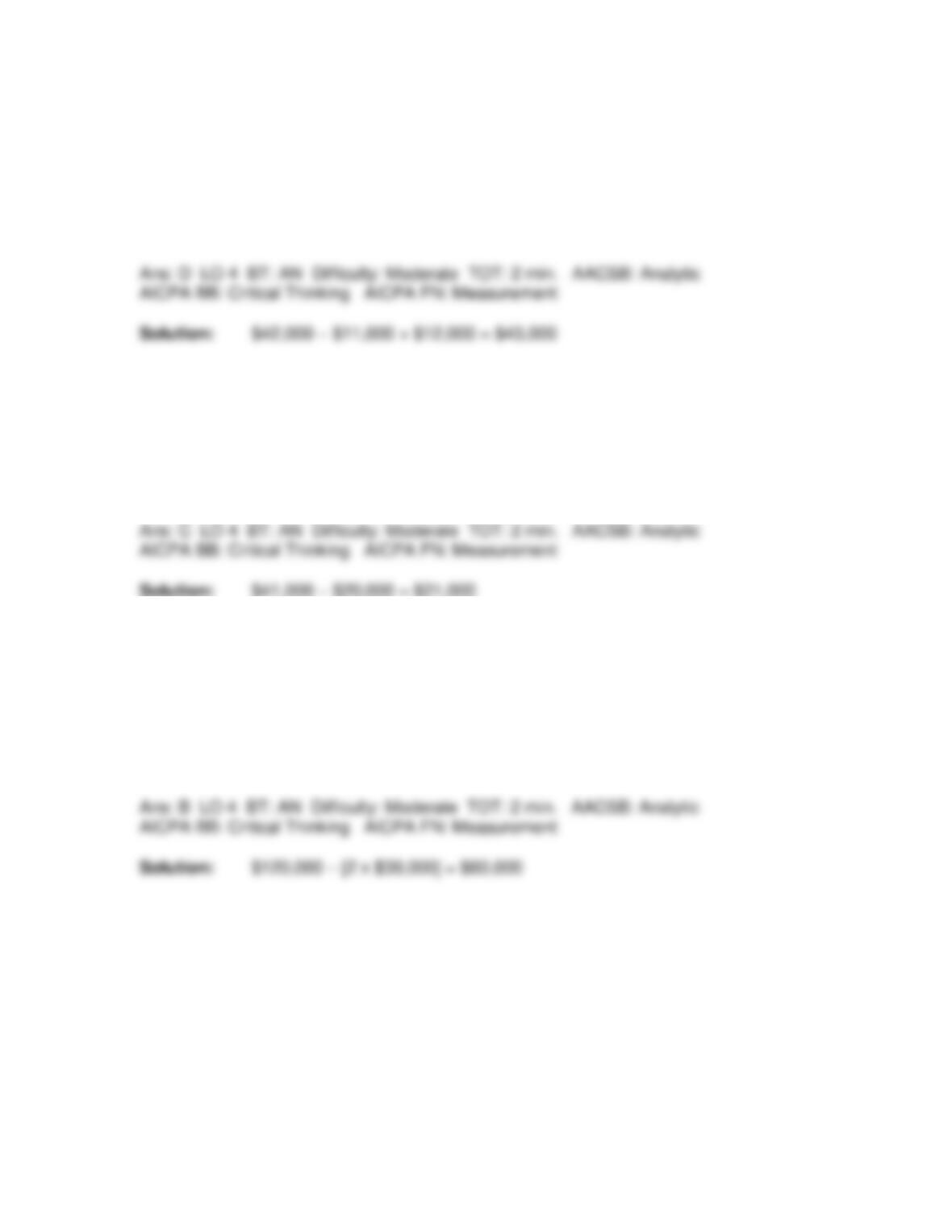
48. At the end of 2017, Campbell Company has total assets and liabilities at $42,000 and
$11,000, respectively. Campbell reported net income for 2018 in the amount of $12,000.
How much is shareholders’ equity at the end of 2018?
a. $30,000
b. $22,000
c. $31,000
d. $43,000
49. Desert Company has retained earnings of $11,000, total assets totaling $41,000, and
total liabilities of $20,000. How much is total shareholders’ equity?
a. $8,000
b. $19,000
c. $21,000
d. $27,000
50. Valley Company has cash, current liabilities, and long-term liabilities of $120,000,
$30,000, and $31,000, respectively. Valley has no current assets other than cash. How
much cash can Valley use to acquire equipment so that amount of current assets is
double the amount of current liabilities?
a. $30,000
b. $60,000
c. $15,000
d. $90,000
Test Bank – Chapter 2 – The Financial Statements 2-15
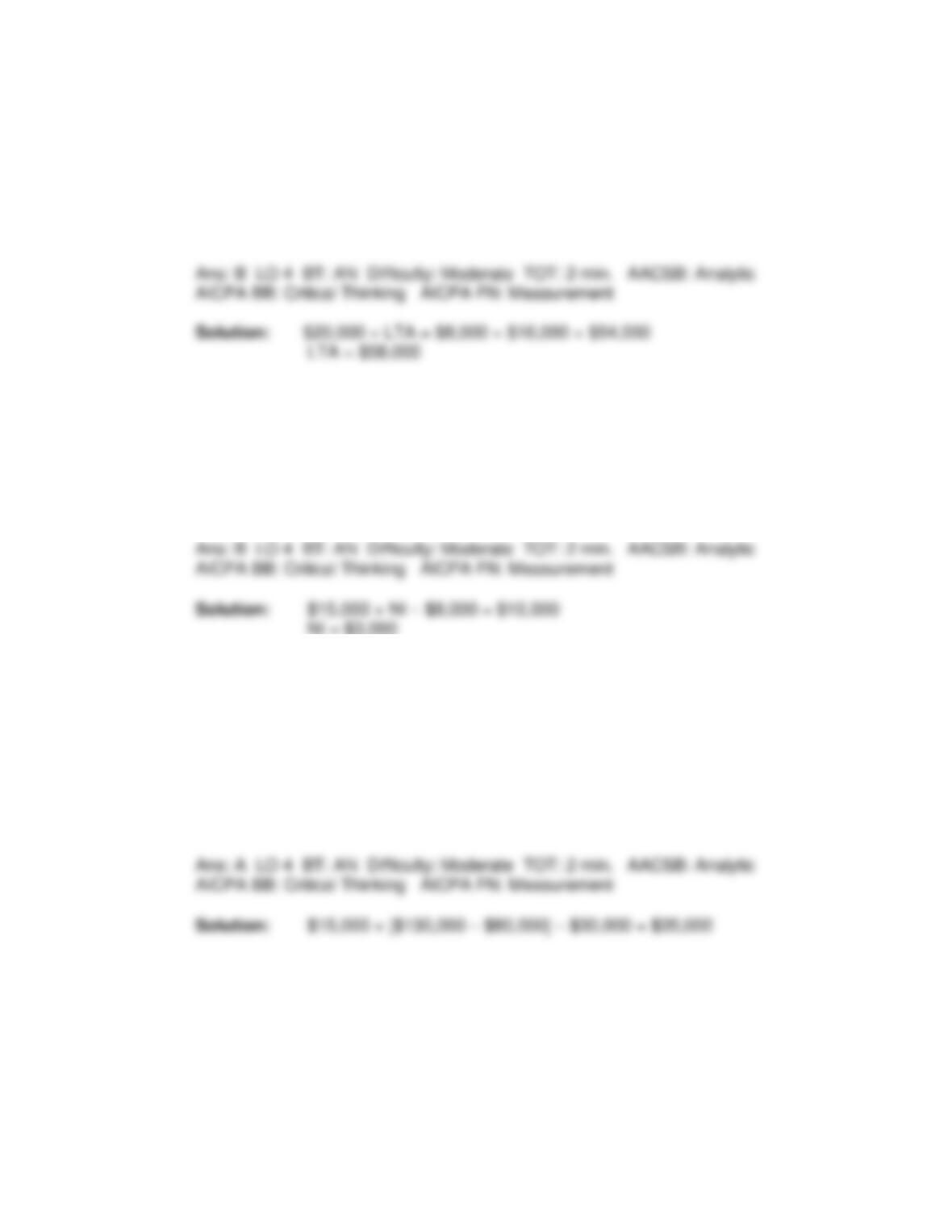
51. Favre Company has current assets, shareholders’ equity, current liabilities, and long-
term liabilities of $20,000, $54,000, $8,000, and $16,000, respectively. How much are
long-term assets?
a. $24,000
b. $58,000
c. $64,000
d. $92,000
52. If the beginning and ending balances in retained earnings are $15,000 and $10,000,
respectively, and dividends during the year are $8,000, then net income for the year is:
a. $10,000.
b. $3,000.
c. $18,000.
d. $32,000.
53. Kelly Company has total assets, liabilities, and shareholders’ equity of $32,000, $17,000,
and $15,000, respectively at the beginning of 2018. If Kelly reports revenues of
$130,000, expenses of $80,000, and pays dividends of $30,000, how much is
shareholders’ equity at the end of 2018?
a. $35,000
b. $53,000
c. $44,000
d. Not enough information to determine.
2-16 Test Bank – Chapter 2 – The Financial Statements
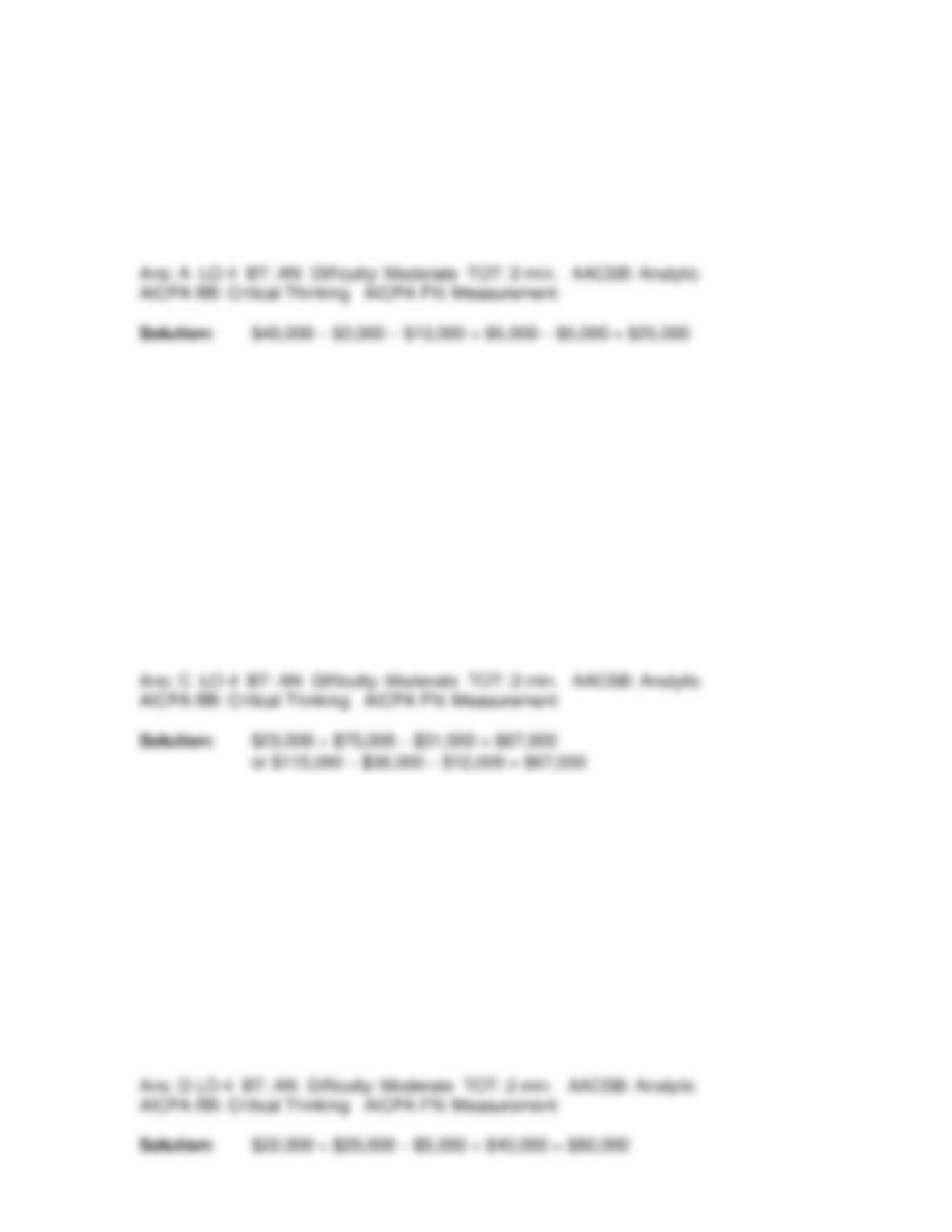
54. Sanchez Corporation has total assets, current liabilities, and long-term liabilities of
$40,000, $2,000, and $13,000, respectively. If Sanchez purchases equipment for $5,000
for cash, how much would shareholders’ equity be?
a. $25,000
b. $10,000
c. $29,000
d. $11,000
55. Below are several accounts from Norel Company’s accounting records.
Total assets, end of year $115,000
Total liabilities, end of year 36,000
Contributed capital, end of year 12,000
Retained earnings, beginning of year 23,000
Dividends for the period 31,000
Net income 75,000
The amount of retained earnings at the end of the year is:
a. $39,000.
b. $45,000.
c. $67,000.
d. $69,000.
56. Given below are several accounts from Caterpillar Company’s accounting records.
Cash $ 15,000
Accumulated depreciation 7,000
Retained earnings, beginning of year 22,000
Contributed capital 25,000
Patents 2,000
Dividends 5,000
Net income for the year was $40,000. How much is total shareholders’ equity at the end
of the year?
a. $86,000.
b. $88,000.
c. $87,000.
d. $82,000.
Test Bank – Chapter 2 – The Financial Statements 2-17
57. Seuss Company determined its total sales were $500,000, salaries expense was
$210,000, dividends paid were $15,000, rent expense was $25,000, other operating
expenses were $13,000, and customers still owed $4,000 at the end of the year. How
much is net income for the year?
a. $267,000.
b. $252,000.
c. $263,000.
d. $530,000.
58. A partnership and a corporation differ in that:
a. a partnership is a legal entity, while a corporation is not.
b. the equity sections of partnership and corporation balance sheets report different
items.
c. partnerships always have more cash than corporations.
d. a corporation has an income statement and a partnership does not.
2-18 Test Bank – Chapter 2 – The Financial Statements
MATCHING QUESTIONS
1. For each statement listed in 1 through 5 below, state whether it is correct or not by
writing ‘Yes’ or ‘No’ in the space provided.
1. Property differs from plant and equipment in that property has no
physical substance, while plant and equipment does.
2. Current assets of a major retailer, such as Sears, typically exceed 50
percent of total assets because of merchandise inventory.
3. Goodwill is common on many major U.S. companies’ balance sheets
because of the numerous mergers and acquisitions that occur.
4. Yard Mart Company owes $4,700. If Yard Mart uses assets listed in
the current asset section of the balance sheet to pay off this debt next
year, Yard Mart must report the $4,700 in the current liability section
of its current year balance sheet.
5. Haloid, Inc. issued common stock for cash. This is an investing
activity.
.
2. For each item numbered 1 through 6 below, identify which accounting element(s) listed
in A through H each statement describes. You may use each letter more than once or
not at all.
Accounting Elements
A. Assets
E. Revenues
B. Liabilities
F. Expenses
C. Contributed capital
G. Net income
D. Retained earnings
H. Dividends
1.
Total past earnings not distributed to the owners
2.
Inflow of assets from the regular operating activities
3.
Obligations which must be met at some future date
4.
That which will be used to generate future economic benefits
5.
The net growth during a period of time measured as revenues less expenses
6.
Amount invested by equity investors
Test Bank – Chapter 2 – The Financial Statements 2-19
3. For each financial statement item listed in 1 through 5 below, identify the best
description by selecting from items a through f below. You may use each letter more
than once or not at all. Write the letter ‘X’ for each item for which no description is listed.
Descriptions
a. Amount of net income or loss less distributions to the owners of the company
b. Must be settled within one year
c. Converted to cash within one year
d. Amount of owners’ investment
e. Portion of equity to which dividends reduce
f. Land used as a site for production
1.
Current liability
2.
The property part of property, plant, and equipment
3.
Retained earnings
4.
Contributed capital
5.
Current asset
4. For items 1 through 3, select the appropriate section of the balance sheet in which the
item would be reported.
Sections
A Long-term Investments
B Property, Plant, & Equipment
C Current Liabilities
D Long-term Liabilities
E Shareholders’ Equity
Section
Balance Sheet Item
1. Amounts owed for purchasing inventory from creditors (due next month).
2. Cumulative profits retained by the company since operations began.
3. Cost of a building expected to be used by the company for ten more years.