Exam
Name___________________________________
MULTIPLE CHOICE. Choose the one alternative that best completes the statement or answers the question.
Provide an appropriate response.
1)
If f(x) =x2+ 3x– 8, then f(x+h) –f(x)
h=
1)
A)
0.
B)
4x+ 3h– 2.
C)
h2+ 3h– 8
h.
D)
1.
E)
2x+h+ 3.
2)
If f(x) =21 – 2x+x, then f(–2) =
2)
A)
3.
B)
7.
C)
0.
D)
–7.
E)
17 –2.
3)
The graph of y=x3 is symmetric about the
3)
A)
origin only.
B)
x–axis only.
C)
y–axis only.
D)
x–axis, y–axis, the origin, and the line y=x.
E)
none of the above
4)
To obtain a graph of y= 7(x– 1)2 from the graph of y= 7x2, which of the following statements is
true?
4)
A)
shift 1 unit up
B)
shift 1 unit down
C)
shift 1 unit to the left
D)
shift 1 unit to the right
E)
none of the above
5)
If f(x) = – x2– 2x– 6, then f(2) –f(t) =
5)
A)
t2+ 2t– 8.
B)
–4t2– 4t+ 6.
C)
t2– 2t+ 4.
D)
–t2+ 6t– 2.
E)
–t2– 2t+ 4.
6)
The graph of y=x2
x4– 1 is symmetric about the
6)
A)
origin only.
B)
y–axis only.
C)
x–axis only.
D)
x–axis, y–axis, the origin, and the line y=x.
E)
none of the above
7)
An equation of the plane that is parallel to the x, y–plane and that passes through (2, 7, 3) is
7)
A)
x= 7.
B)
x= 2.
C)
y= 7.
D)
y= 3.
E)
z= 3.
8)
If f(x) = 4x+ 5, then f(x+h) –f(x)
h=
8)
A)
1.
B)
4.
C)
4h.
D)
4x+h+ 5
h.
E)
0.
9)
The domain of f(q) =q2– 1
q2+ 4 is
9)
A)
all real numbers except –4
B)
all real numbers except 1 and –1
C)
all real numbers except –2 and 2
D)
all real numbers
E)
all real numbers except –1, 1, and –2
10)
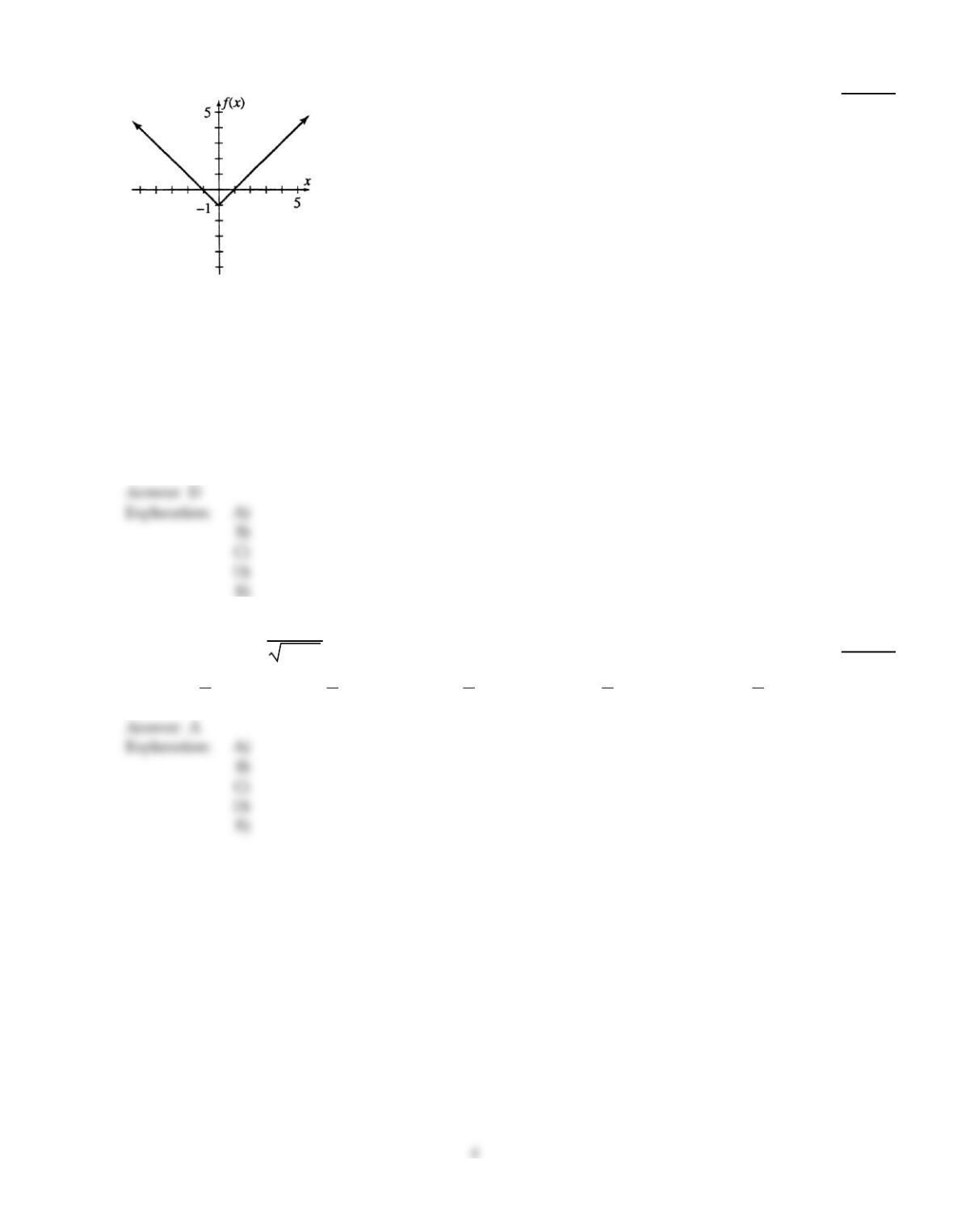
The domain and range of the function f whose graph appears below is
10)
A)
Domain: all real numbers greater than or equal to –1
Range: all real numbers
B)
Domain: all real numbers
Range: all nonnegative real numbers
C)
Domain: all nonnegative real numbers
Range: all real numbers less than or equal to –1
D)
Domain: all real numbers
Range: all real numbers greater than or equal to –1
E)
Domain: all real numbers
Range: all real numbers
11)
The domain of f(x) =1
2x+ 3 consists of all real numbers x such that
11)
A)
x> – 3
2.
B)
x>2
3.
C)
x3
2.
D)
x2
3.
E)
x–3
2.
12)
Which equation below defines y as a function of x?
12)
A)
3x–y2= 0
B)
x
y=y
C)
y=±4 –x2
D)
x2+y2= 9
E)
3y–x2= 0
13)
The x– and y–intercepts of the graph of y=3
x2– 1 are
13)
A)
(1,0), (0, 3).
B)
(0, –3).
C)
(±1, 0), (0, 3).
D)
(3, 0).
E)
(0, 0), (±1, 0), (0, –3).
B
14)
If F(t) = (t2+4)3, then F(t2+ 1) =
14)
A)
(t2+5)3 .
B)
(t2+5)3+ 1.
C)
(t2+1)3 .
D)
(t4+2t2+5)3.
E)
(t2+1)3+ 4.
D
5
E
15)
If f(x) =x2+ 1 and g(x) =x3, then (f
g)(x) =
15)
A)
(x2+1)3.
B)
(x2+1)3+ 1.
C)
x6 .
D)
x5+ 1.
E)
x6+ 1.
16)
If f(x) = 2x2– 3x+ 4, then f(x+ 1) =
16)
A)
2x2+x+ 3.
B)
2x2+x+ 6.
C)
2x2– 3x.
D)
2x2– 3x+ 5.
E)
2x2+ 4x+ 7.
A
17)
The x– and y–intercepts of the graph of x2
4+y2
9= 1 are
17)
A)
(± 2, 0) (0, ± 3).
B)
(4, 0), (0, 9).
C)
(0, 4), (9, 0).
D)
(0, 0), (2, 0), (0, 3).
E)
(0, ± 2) (± 3, 0).
A
E
18)
If f(t) = (t+4)2, then f(t– 3) =
18)
A)
t2+ 4t+ 13.
B)
t2+ 8t+ 13.
C)
t2+ 1 + 1.
D)
t2+ 8t+ 19
E)
t2+ 2t+ 1.
19)
The domain of f(x) =x2– 3x
6 is
19)
A)
all real numbers except 0
B)
all real numbers except 6
C)
all real numbers except 0, 3, and 6
D)
all real numbers except 0 and 3
E)
all real numbers
20)
The domain of f(t) =2
t – 4 is
20)
A)
all real numbers except 4
B)
all real numbers except 0
C)
all real numbers except 2
D)
all real numbers except 2 and 4
E)
all real numbers
21)
If f(x) = 4 – 3x, then (f
f)(x) =
21)
A)
16 – 9x2.
B)
9x– 8.
C)
16 – 24x+ 9x2.
D)
8 – 6x.
E)
6x– 8.
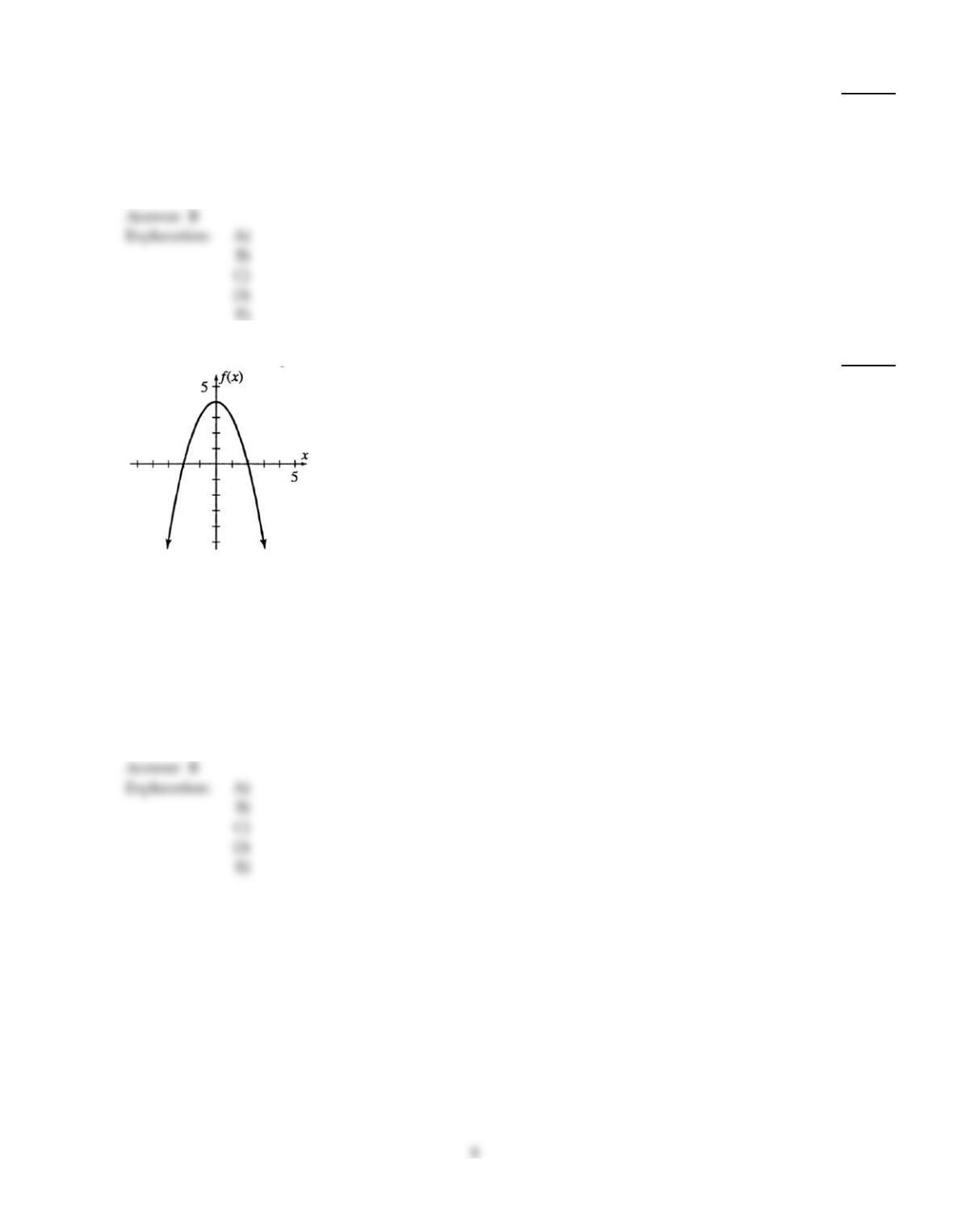
22)
The domain and range of the function f whose graph appears below is
22)
A)
Domain: all nonnegative real numbers
Range: all real numbers less than or equal to 4
B)
Domain: all real numbers
Range: all real numbers less than or equal to 4
C)
Domain: all real numbers less than or equal to 4
Range: all real numbers
D)
Domain: all real numbers
Range: all real numbers
E)
Domain: all real numbers less than or equal to 4
Range: all nonnegative real numbers
23)
To obtain a graph of y= 7x2+ 3 from the graph of y= 7x2, which of the following statements is
true?
23)
A)
shift 3 units to the left
B)
shift 3 units up
C)
shift 3 units down
D)
shift 3 units to the right
E)
none of the above
24)
If f(x) =x+ 5 and g(x) =x2– 3x– 5, then the value of (f
g)(4) is
24)
A)
2 3.
B)
–4.
C)
2.
D)
–3.
E)
5.
25)
The domain of f(s) =9 – 5s is all real numbers s such that
25)
A)
s –5
9.
B)
s5
9.
C)
s 5
9.
D)
s9
5.
E)
s 9
5.
26)
The domain of the function f(x) =x + 2
x2– 16 is
26)
A)
all real numbers
2
B)
all real numbers
2 except 4
C)
all real numbers –2
D)
all real numbers except 4 and –4
E)
all real numbers –2 except 4
9
27)
If f(x) = 4x– 5 and g(x) =x2+ 3x– 1, then f(g(x)) =
27)
A)
4x2+ 12x– 9.
B)
x2+ 7x– 6.
C)
4x3+ 7x2– 19x+ 5.
D)
x2+ 4x+ 5.
E)
16x2– 28x+ 9.
28)
If g(x) = 2x2– 3x+ 4, then g(0) –g(2) =
28)
A)
–2.
B)
14.
C)
–14.
D)
2.
E)
0.
29)
If f(x) = (4x2+1)2, then f–1
2=
29)
A)
–1.
B)
4.
C)
0.
D)
3.
E)
2.
30)
If f(x) =x– 3 and g(x) =x2– 7, then f(g(7)) =
30)
A)
81.
B)
42.
C)
39.
D)
84.
E)
–3.
31)
If f(x) =x2– 3x+ 4, then f (2 +h) –f(2) =
31)
A)
h2– 3h– 4.
B)
h2– 3h+ 4.
C)
h2+h.
D)
h.
E)
h2+h– 4.
32)
If f(x) = 2x– 1 and g(x) = 4x+ 8, then g(f(x)) =
32)
A)
8x+ 4.
B)
8x+ 15.
C)
16x– 8.
D)
16x+ 7.
E)
16x2+ 12x– 8.
33)
Exactly how many of the following equations define y as a function of x?
(a) y= 7 –x
(b) y2= 4x
(c) y=x
(d) x2=y+ 4
33)
A)
none
B)
one
C)
two
D)
three
E)
all
34)
An equation fo the plane that is parallel to the y, z–plane and that passes through (4, 6, 9) is
34)
A)
x= 4.
B)
x= 6.
C)
z= 4.
D)
z= 9.
E)
y= 6.
SHORT ANSWER. Write the word or phrase that best completes each statement or answers the question.
35)
Determine the x–intercepts if they exist. Also determine whether the graph is symmetric
about the x–axis, y–axis, the origin, or the line y=x for y=x.
35)
36)
The Cobb–Douglas production function for a company is given by P= 70l1/4 k3/4 where P
is the monthly production value when k is the amount of the company’s capital investment
(in dollars per month) and l is the size of the labor force (in work hours per month). What
is the production value when l= 2401 hours and k= $10,000 per month?
36)
Explanation:
37)
Determine the x– and y–intercepts of the graph of y=4
x2– 3x+ 2 .
37)
Explanation:
38)
Determine: (a) 5!; (b) 5!
3!2!
38)
Explanation:
39)
If f(x) = 2x + 3 and g(x) =x2– 4x– 2, find:
(a) (f+g)(x)
(b) (f – g)(x)
(c) (fg)(x)
(d) f
g(x)
(e) f(g(x))
(f) g(f(x))
(g) f(g(1))
(h) g(f(1))
39)
Explanation:
40)
Is 3x–2+x–1+ 5 + 6x+11x2 a polynomial function or a rational function? Why?
40)
Answer:
Rational function, since it has negative exponents.
Explanation:
12
Explanation:
41)
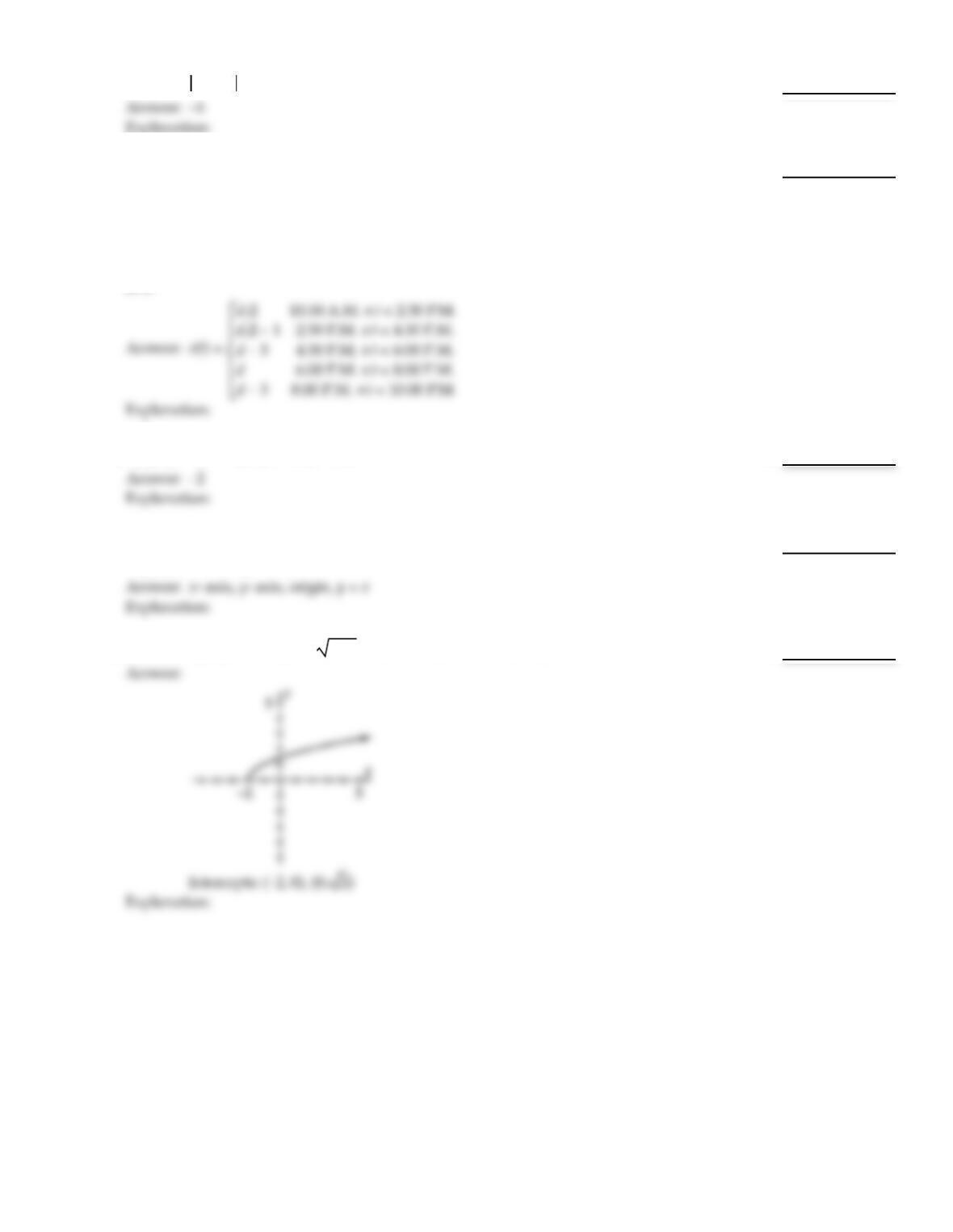
Let f(x) =2x– 3 . Find f(4) –f(–4)
41)
42)
To encourage an even flow of customers, a restaurant varies the price of an item
throughout the day. From 6:00 P.M. to 8:00 P.M. customers pay full price. At lunch from
10:30 A.M. until 2:30 P.M. customers pay half price. From 2:30 until 4:30 customers get a
dollar off the lunch price. From 4:30 P.M. until 6:00 P.M. customers get $5.00 off the dinner
price. From 8:00 until closing time at 10:00 customers get $5.00 off the dinner price. Write a
compound function to represent the cost of an item throughout the day for a dinner price
of d.
42)
43)
If f(p, q) = 3p2– 2q+p, find f(–1, 2).
43)
44)
Determine whether the graph of y2= 4 –x2 is symmetric about the x–axis, the y–axis, the
origin, or the line y=x.
44)
45)
Sketch the graph of s=f(t) =t+ 2. Also determine the intercepts.
45)
13
46)
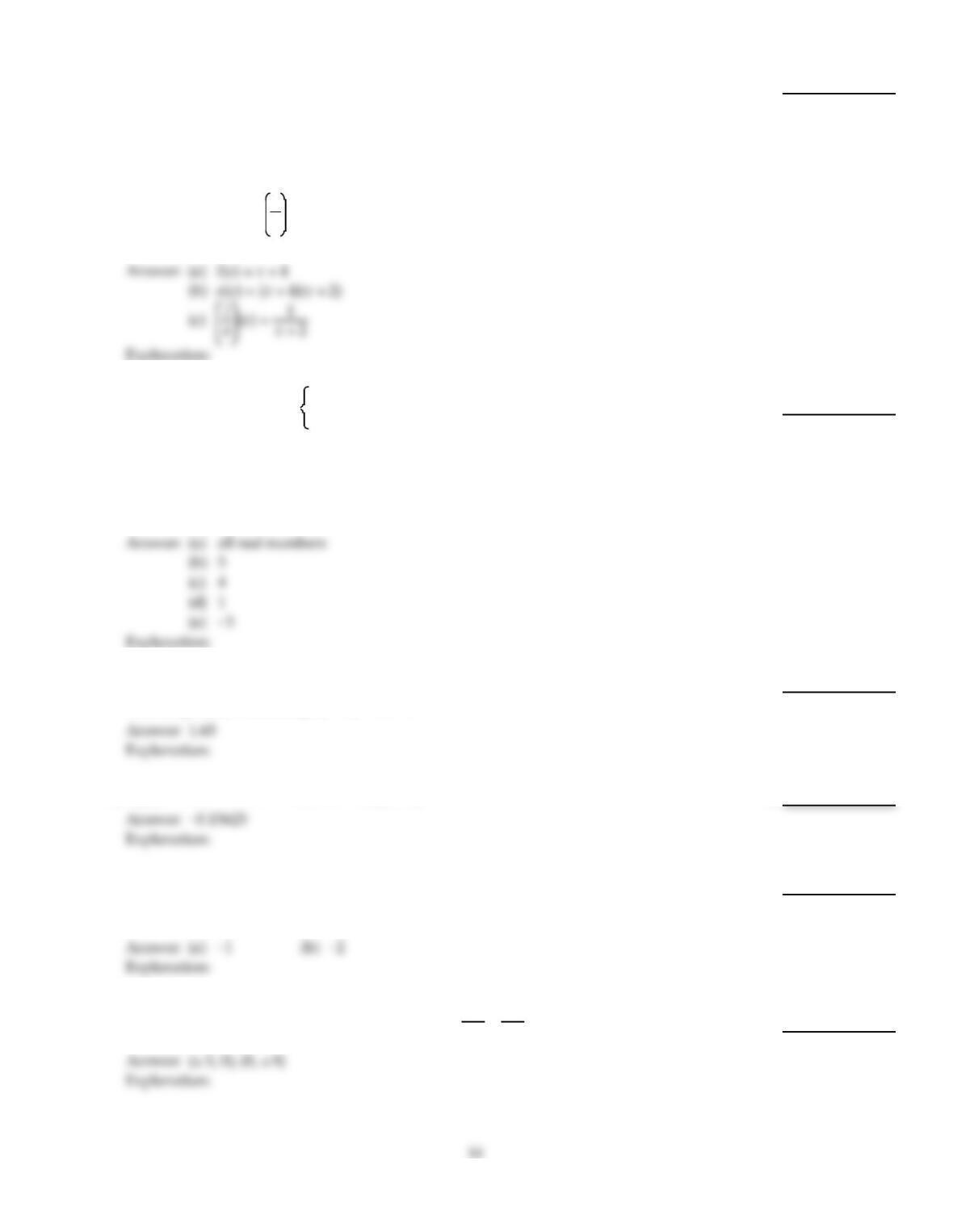
Suppose an artist always paints rectangular pictures using a square of unknown length as
a reference. She always makes the length 4 units longer than the square, and the width is 2
units longer than the square.
(a) Write a function l(x) for the length of a painting as a function of the length of the
square.
(b) Write a function a(x) for the area of a painting as a function of the length of the square.
(c) Write a function l
a(x) for the ratio of the length to the area as a function of the length
of the square.
46)
47)
Given the function G(x) = 4, if x> 0
x+ 5, if x
0, find:
(a) the domain
(b) G(0)
(c) G(6)
(d) G(–4)
(e) G(–10)
47)
48)
Use a graphing calculator to find all real roots of the equation. Round answers to two
decimal places, if necessary: (x – 1)3= 3 –x2
48)
49)
If f(x) = 1.05x3+ 7.5x2– 1.9, then find f(–0.5)
49)
50)
Let f(x) =x2+ 3x+ 1 and g(x) = – 2.
(a) Find: (f
g)(x)
(b) Find: (g
f)(x)
50)
51)
Determine the x– and y–intercepts of the graph of x2
25 +y2
64 = 1.
51)
52)
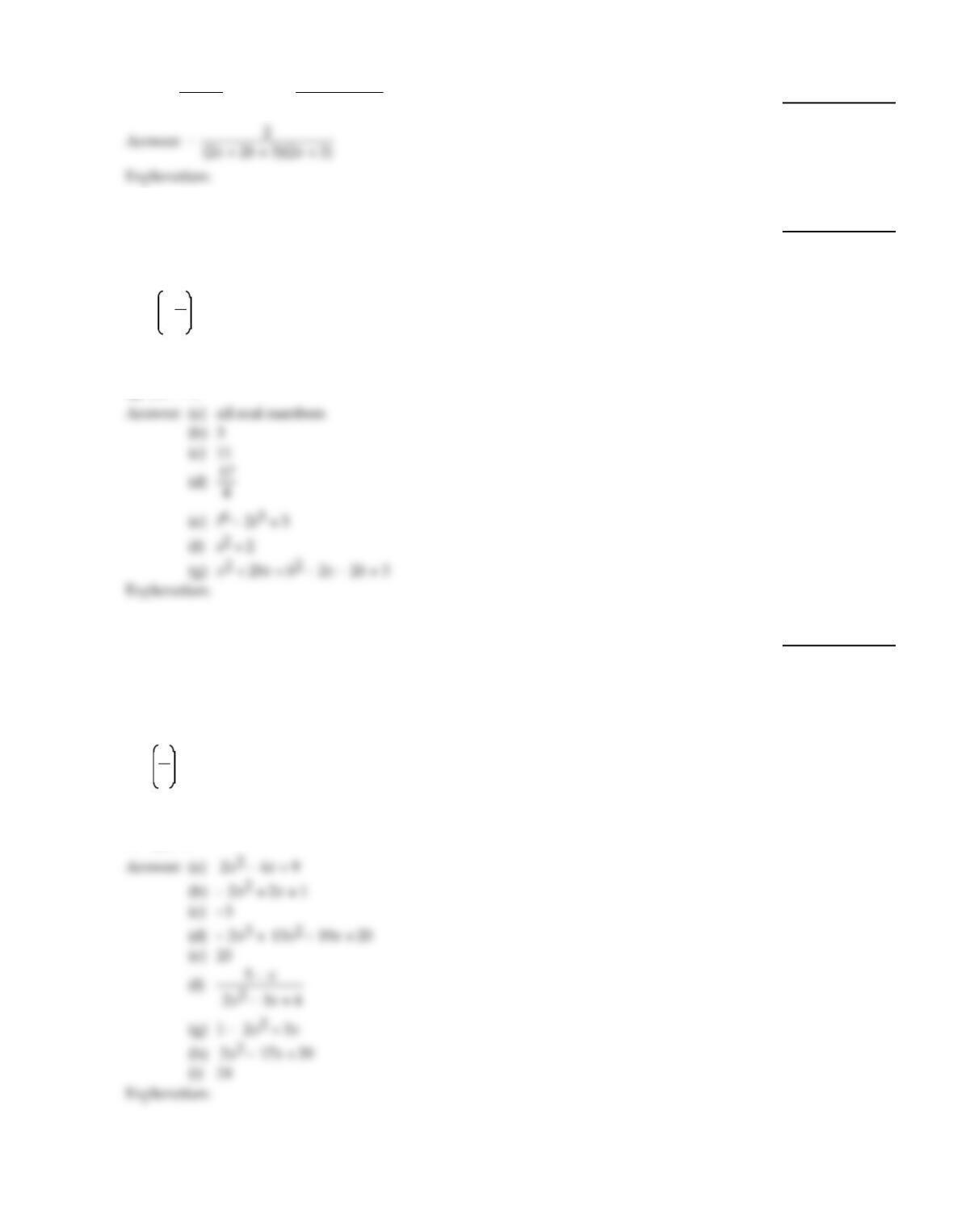
If f(x) =1
2x+ 3 , then find f(x+h) –f(x)
h and simplify.
52)
53)
If f(x) =x2– 2x+ 3, find:
(a) the domain
(b) f(2)
(c) f(–2)
(d) f–1
2
(e) f(t3)
(f) f(s+ 1)
(g) f(x+h)
53)
54)
If f(x) = 5 –x and g(x) =2x2– 3x+ 4, find:
(a) (f +g)(x)
(b) (f–g)(x)
(c) (f – g)(2)
(d) (fg)(x)
(e) (fg)(0)
(f) f
g(x)
(g) f(g(x))
(h) g(f(x))
(i) g(f(1))
54)
15
55)
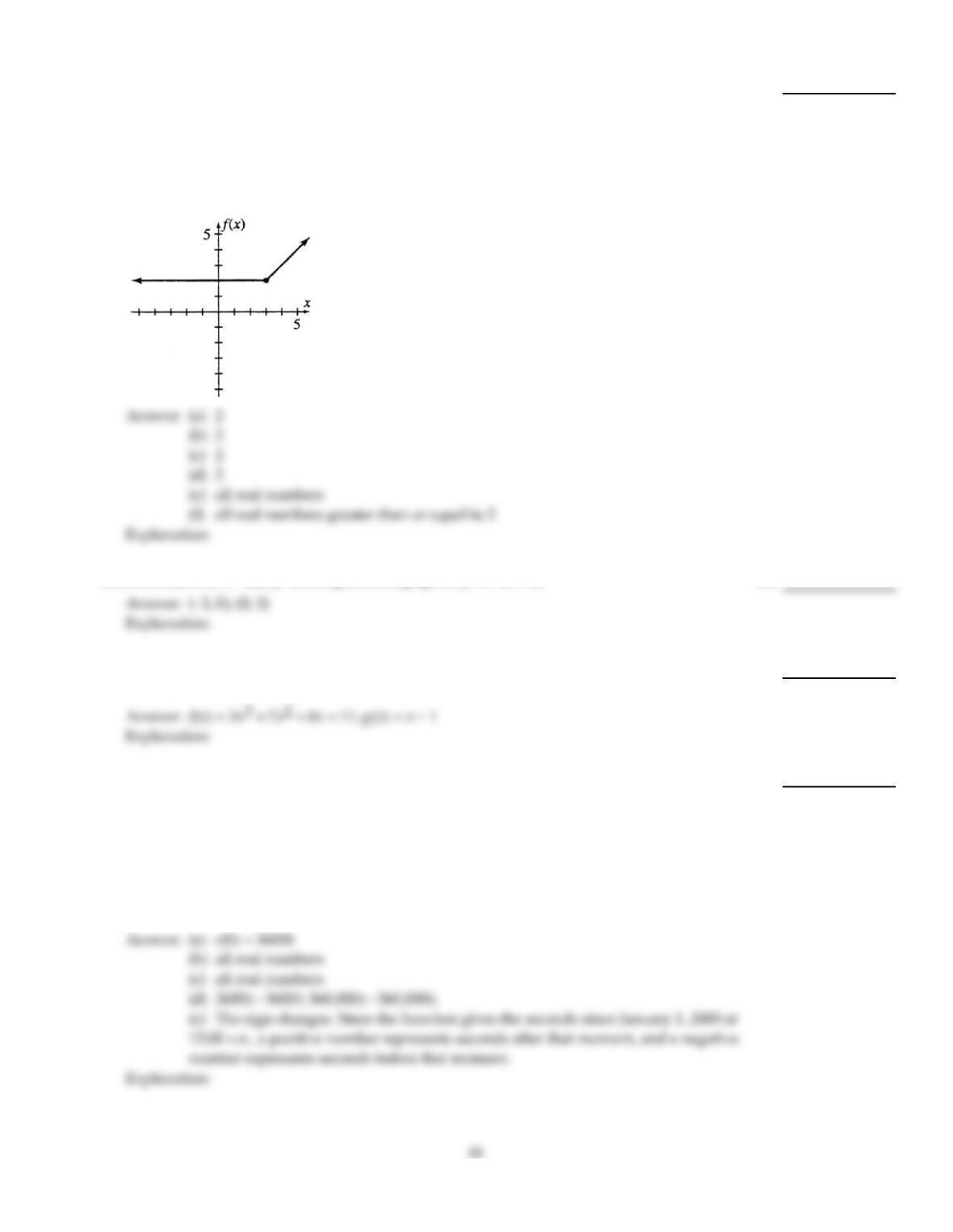
The graph of y=f(x) is shown below. Estimate:
(a) f(–1)
(b) f(0)
(c) f(2)
(d) f(3)
(e) What is the domain of f?
(f) What is the range of f?
55)
56)
Determine the x– and y–intercepts of the graph of y=ex(x+ 3).
56)
57)
Let h(x) = 3(x–1)3+ 7(x –1)2+ 8(x– 1) + 11. Find functions f and g such that
h=f
g.
57)
58)
The elapsed time in seconds since January 1, 2000 at 12:00 A.M. depends on the elapsed
hours since January 1, 2000 at 12:00 A.M.
(a) Write a function e(h) for the elapsed seconds since January 1, 2000 at 12:00 A.M. when
the elapsed hours are h.
(b) What is the domain of the function out of context?
(c) What is the domain of this function in the given context?
(d) Find e(t), e(–t), e(100t), and e(–100t).
(e) What does multiplying the elapsed hour by –1 mean?
58)
59)
If f(x) =1
x+ 1 and g(x) =x+ 1, find: (a) f(g(x)) and (b) g(f(x)).
59)
60)
Determine the x–intercepts and y–intercepts if they exist. Also determine whether the
graph is symmetric about the x–axis, y–axis, the origin, or the line y=x for 3y3=x.
60)
61)
In the equation x2+y2= 17; (a) Is x a function of y? (b) Is y a function of x?
61)
62)
If f(x, y, z) =2x
x+y, find f(1, 2, –3).
62)
63)
Sketch the graph of f(x) =x2– 2x. Also determine the intercepts.
63)
64)
If f(x) =2x2+ 1 and g(x) =x – 1, find (f
g)(x)– (g
f)(x)
64)
65)
A shirt costs x wholesale. The price the store pays is given by the function s(x) =3
2x+ 5,
where x is the wholesale price. The price the customer pays is c(x) = 2(x+ 1) where x is the
price the store pays. Write a composite function to find the customer’s price as a function of
the wholesale price.
65)
66)
Find an equation of the plane that is parallel to the y, z–plane and that passes through the
point (1, 2, 3).
66)
67)
Given the function F(x) =
2 +x, if x> 3
5, if x= 2
4 –x, if x< 2 ,
find:
(a) the domain
(b) F(2)
(c) F(–2)
(d) F(5)
67)
68)
Find the inverse of the function: f(x) =8x +3
68)
18
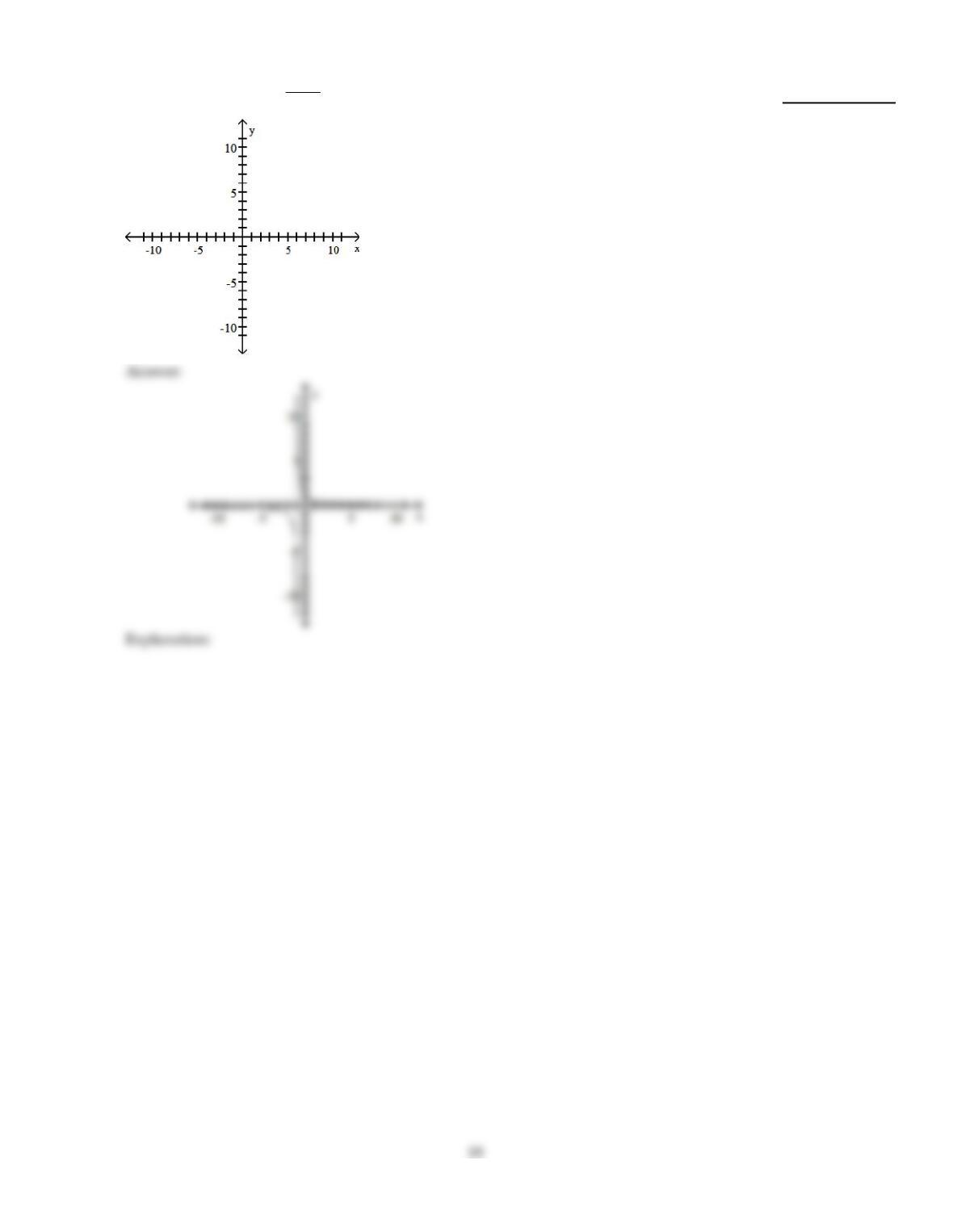
69)
Sketch a graph of f(x) =1
x+ 1
69)
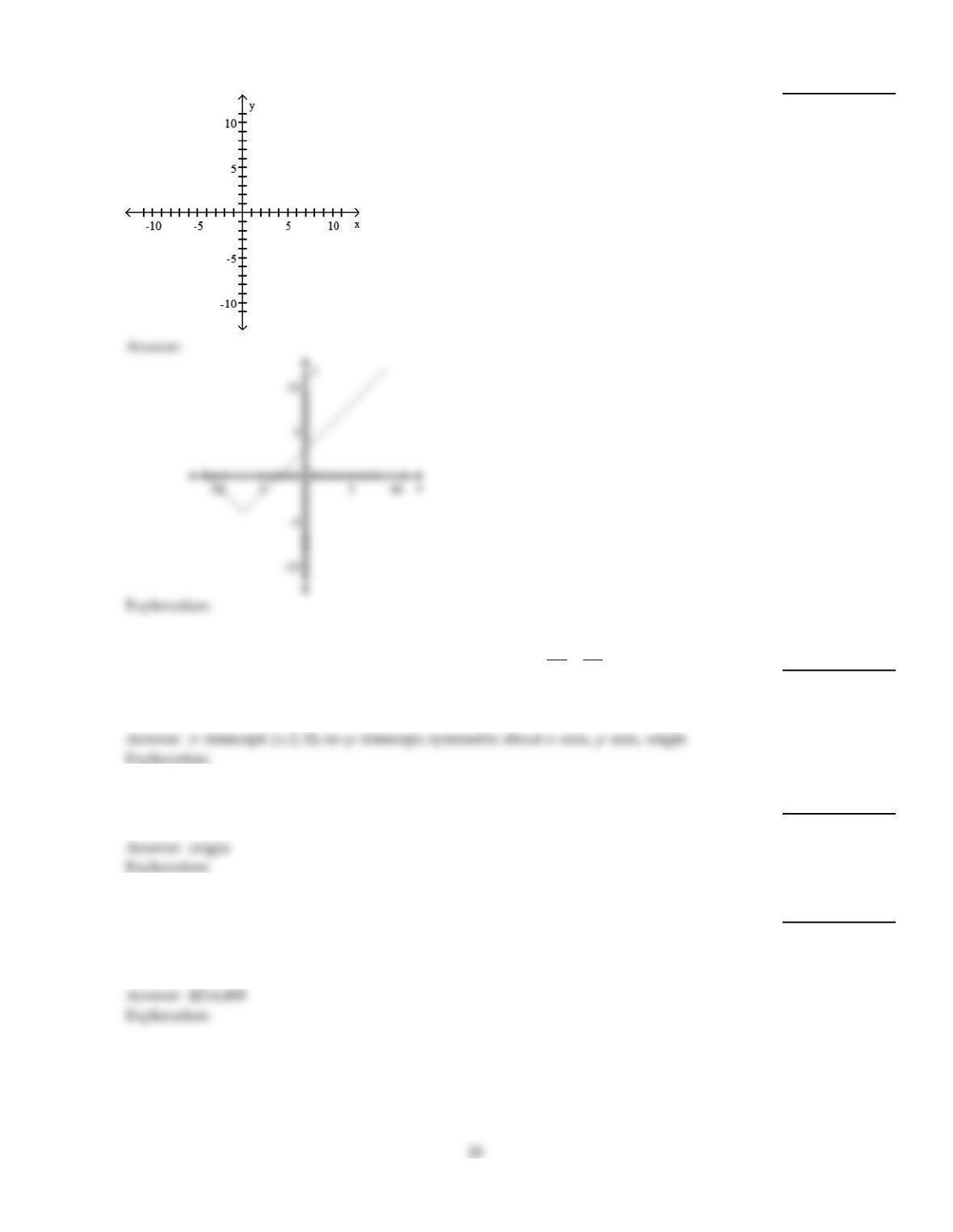
70)
Sketch a graph of f(x) = |x+ 7| – 4
70)
71)
Determine the x–and y–intercepts, if they exist, of the graph of x2
4–y2
9= 1. Also
determine whether the graph is symmetric about the x–axis, the y–axis, the origin, or the
line y=x.
71)
72)
Determine whether the graph of x2–xy = 1 is symmetric about the x–axis, the y–axis, the
origin, or the line y=x.
72)
73)
The Cobb–Douglas production function for a company is given by P= 20l1/3k2/3 where P
is the monthly production value when k is the amount of the company’s capital investment
(in dollars per month) and l is the size of the labor force (in work hours per month). What
is the production value when l= 1728 hours and k= $27,000 per month?
73)