CHAPTER 2: INTRODUCTION TO NUMBER THEORY
TRUE OR FALSE
T F 1. The algorithm credited to Euclid for easily finding the greatest
common divisor of two integers has broad significance in
cryptography.
T F 2. Unlike ordinary addition, there is not an additive inverse to each
integer in modular arithmetic.
T F 3. The scheme where you can find the greatest common divisor of
two integers by repetitive application of the division algorithm is
known as the Brady algorithm.
T F 4. Two integers a and b are said to be congruent modulo n, if
(a mod n) = (b mod n).
T F 5. Basic concepts from number theory that are needed for
understanding finite fields include divisibility, the Euclidian
algorithm, and modular arithmetic.
T F 6. If b|a we say that b is a divisor of a.
T F 7. The notation a|b is commonly used to mean b divides a.
T F 8. The rules for ordinary arithmetic involving addition, subtraction,
and multiplication carry over into modular arithmetic.
T F 9. Two theorems that play important roles in public-key
cryptography are Fermat’s theorem and Euler’s theorem.
T F 10. One of the useful features of the Chinese remainder theorem is
that it provides a way to manipulate potentially very large
numbers mod M in terms of tuples of smaller numbers.
T F 11. For many cryptographic algorithms, it is necessary to select one or
more very large prime numbers.
T F 12. The Chinese Remainder Theorem is believed to have been
discovered by the Chinese mathematician Agrawal in 100 A.D.

T F 13. The primitive roots for the prime number 19 are 2, 3, 10, 13, 14
and 15.
T F 14. The first assertion of the CRT, concerning arithmetic operations,
follows from the rules for modular arithmetic.
T F 15. All integers have primitive roots.
MULTIPLE CHOICE
1. An integer p >1 is a _________ number if and only if its only divisors are + 1 and + p.
A) prime B) composite
C) indexed D) positive
2. Two integers are __________ if their only common positive integer factor is 1.
A) relatively prime B) congruent modulo
C) polynomials D) residual
3. The __________ of two numbers is the largest integer that divides both numbers.
A) greatest common divisor B) prime polynomial
C) lowest common divisor D) integral divisor
4. An important quantity in number theory referred to as __________ is defined as the
number of positive integers less than n and relatively prime to n.
A) CRT B) Miller-Rabin
C) Euler’s totient function D) Fermat’s theorem
5. Prime numbers play a __________ role in number theory.
A) minor B) nonessential
C) critical D) abbreviated
6. If p is prime and a is a positive integer, then ap = a(mod p) is an alternative form
of _________ theorem.
A) Rijndael’s B) Vignere’s
C) Euler’s D) Fermat’s
7. Two numbers are relatively prime if they have ________ prime factors in common.
A) some B) no
C) multiple D) all
8. For given integers a and b, the extended __________ algorithm not only calculates
the greatest common divisor d but also two additional integers x and y.
A) modular B) Euclidean
C) associative D) cyclic
9. The procedure TEST takes a candidate integer n as input and returns the
result __________ if n is definitely not a prime.
A) discrete B) composite
C) inconclusive D) primitive
10. If a number is the highest possible exponent to which a number can belong, it is
referred to as a _________ of n.
A) primitive root B) composite
C) discrete logarithm D) bijection
11. For any integer b and a primitive root a of prime number p we can find a unique
exponent i. This exponent i is referred to as the ___________ .
A) order B) discrete logarithm
C) bijection D) primitive root
12. Discrete logarithms are fundamental to a number of public–key algorithms
including __________ key exchange and the DSA.
A) Diffie-Hellman B) Rijndael-Fadiman
C) Fermat-Euler D) Miller-Rabin
13. The congruence relation is used to define __________ .
A) finite groups B) greatest common divisor
C) lowest common divisor D) residue classes
14. As a _________ relation, mod expresses that two arguments have the same
remainder with respect to a given modulus.
A) finite B) monic
C) congruence D) cyclic
15. A one-to-one correspondence is called __________.
A) a bijection B) an inclusive
C) an index D) a composite
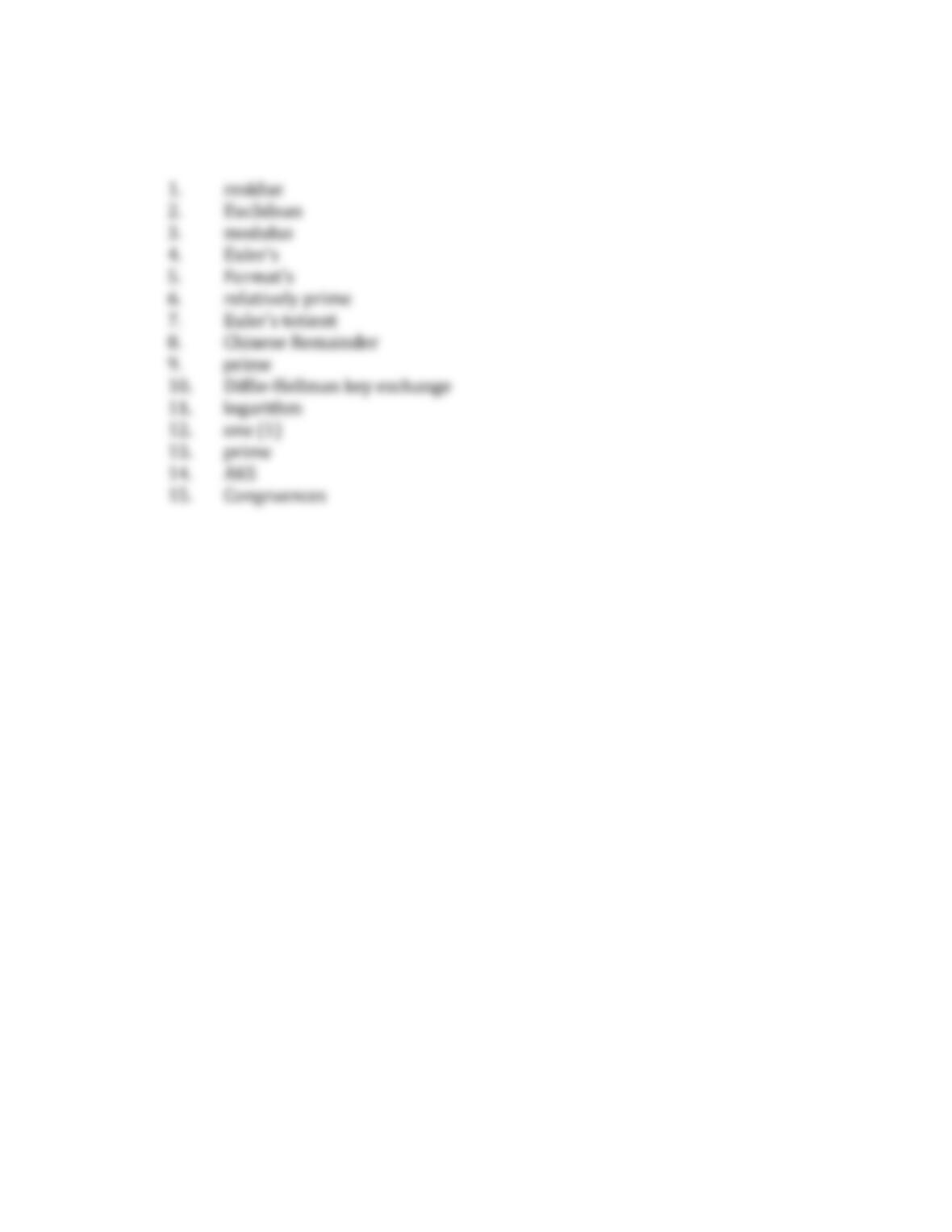
SHORT ANSWER
1. The remainder r in the division algorithm is often referred to as a __________ .
2. One of the basic techniques of number theory is the __________ algorithm
which is a simple procedure for determining the greatest common divisor of
two positive integers.
3. If a is an integer and n is a positive integer, we define a mod n to be the
remainder when a is divided by n. The integer n is called the __________ .
4. Two theorems that play important roles in public-key cryptography are
Fermat’s theorem and __________ theorem.
5. __________ theorem states the following: If p is prime and a is a positive
integer not divisible by p, then ap–1 = 1(mod p).
6. Two numbers are __________ if their greatest common divisor is 1.
7. The number of positive integers less than n and relatively prime to n is
referred to as __________ function.
8. The __________ theorem states that it is possible to reconstruct integers in a
certain range from their residues modulo a set of pairwise relatively prime
moduli.
9. Two integers are relatively _________ if and only if their only common positive
integer factor is 1.
10. Discrete logarithms are fundamental to the digital signature algorithm (DSA)
and the _________ algorithm.

11. The _________ of a number is defined to be the power to which some positive
base (except 1) must be raised in order to equal the number.
12. Two numbers are relatively prime if their greatest common divisor is ______.
13. An integer p > 1 is a __________ number if and only if its only divisors are + 1
and + p.
14. Although it does not appear to be as efficient as the Miller-Rabin algorithm,
in 2002 a relatively simple deterministic algorithm that efficiently
determines whether a given large number is a prime was developed. This
algorithm is known as the _________ algorithm
15. ____________ have the following properties:
1. a = b (mod n) if n| (a – b)
2. a = b (mod n) implies b = a (mod n)
3. a = b (mod n) and b = c (mod n) imply a = c (mod n)

CHAPTER 2: INTRODUCTION TO NUMBER THEORY
TRUE OR FALSE
MULTIPLE CHOICE
SHORT ANSWER