Chapter 2 Data Modeling
Last Update: November 17, 2011 — 9PM
Chapter 2: Data Modeling
Multiple Choice
1. The Entity-Relationship (E-R) model is _____.
a. a diagramming technique that describes record structures (i.e. the fields that make
up the records of a file)
b. an alternative to indexing and hashing as a means for providing direct access in
files
c. a diagramming technique that describes entities, their attributes, and the
relationships between them
d. an alternative to file design in which attributes are used instead of fields
e. a diagramming technique that relates entities to each other, attributes to each
other, and relationships to each other
2. An association between entities is a(n) _____.
a. entity type
b. entity occurence
c. record
d. attribute
e. relationship
3. A binary relationship is a relationship between two _____.
a. entity types
b. attribute types
c. associations
d. files
e. cardinalities
4. The term “binary” in binary relationship indicates that the relationship is between
Chapter 2 Data Modeling
a. two halves of an entity type
b. two entity types
c. two divisions of an entity’s attributes
d. two attributes
e. two relationships
5. The cardinality of a relationship is _____.
a. The minimum number of entities that can be involved in the relationship.
b. The maximum number of entities that can be involved in the relationship.
c. The minimum number of attributes that can be in the entity types in a relationship.
d. The maximum number of attributes that can be in the entity types in a
relationship.
e. The minimum number of associations that can be involved in the relationship.
6. The modality of a relationship is _____.
a. The minimum number of entities that can be involved in the relationship.
b. The maximum number of entities that can be involved in the relationship.
c. The minimum number of attributes that can be in the entity types in a relationship.
d. The maximum number of attributes that can be in the entity types in a
relationship.
e. The minimum number of associations that can be involved in the relationship.
7. A one-to-one binary relationship _____.
a. involves a single entity type
b. involves two entity types
c. allows an occurrence of one entity type to be associated with several occurrences
of another entity type
d. allows an occurrence of one entity type to be associated with several occurrences
of another entity type and vice versa
e. restricts the number of attributes that an entity has
8. A one-to-many binary relationship allows an occurrence of the entity type on the “one
side” of the relationship to be associated with _____.
a. a single occurrence of the same entity type
b. multiple occurrences of the same entity type
c. a single occurrence of the entity type on the “many side” of the relationship
d. multiple occurrences of the entity type on the “many side” of the relationship
e. multiple occurrences of the entity type on the “one side” of the relationship
9. A many-to-many binary relationship allows an occurrence of one entity type to be
associated with _____.
a. a single occurrence of the same entity type
b. multiple occurrences of the same entity type
c. a single occurrence of another entity type
d. multiple occurrences of another entity type
e. multiple occurrences of three entity types
10. A business school’s faculty parking lot has assigned parking spaces. Each professor
is entitled to one parking space. This is an example of a _____ relationship.
a. one-to-one binary
b. one-to-many binary
c. many-to-many binary
d. one-to-one unary
e. one-to-many unary
11. Each building on a university campus has several faculty offices. Each professor has
one office. The relationship between campus buildings and professors is a _____
relationship.
a. one-to-one binary
b. one-to-many binary
c. many-to-many binary
d. one-to-one unary
e. one-to-many unary
Chapter 2 Data Modeling
12. In a university, the relationship between courses and their sections can best be
described as a _____ relationship.
a. one-to-one binary
b. one-to-many binary
c. many-to-many binary
d. one-to-one unary
e. one-to-many unary
13. In a university setting, the relationship between students and the professors who have
been their instructors is a _____ relationship.
a. one-to-one binary
b. one-to-many binary
c. many-to-many binary
d. one-to-one unary
e. one-to-many unary
14. Intersection data _____.
a. is an attribute of the entity on the “one side” of a one–to-many relationship
b. is an attribute of the entity on the “many side” of a one–to-many relationship
c. describes the relationship between two entities in a many-to-many relationship
d. describes one of the entities in a many-to-many relationship
e. describes one of the entities in a ternary relationship
15. Each student at a university takes many courses; each course is taken by many
students. The semester that a student took a course and the grade that the student
received in the course is called _____ data.
a. index
b. key
c. pointer
d. direct access
Chapter 2 Data Modeling
e. intersection
16. An associative entity is an alternate way of expressing a(n) _____.
a. one-to-one binary relationship
b. one-to-many binary relationship
c. many-to-many binary relationship
d. entity that has no attributes other than the unique identifier or key
e. entity that has no unique identifiers or keys
17. Depending on the attributes and circumstances present, the unique identifier of an
associative entity could be any of the following, except _____.
a. the combination of the unique identifiers of the entities in the many-to-many
relationship consisting of exactly one field from each entity
b. the combination of the unique identifiers of the entities in the many-to-many
relationship consisting of several fields
c. the combination of the unique identifiers of the entities in the many-to-many
relationship plus one or more additional fields that express times or dates
d. a single field that is associated with the associative entity and provides unique
values
e. a unique combination of fields from one of the two entities in the many-to-many
relationship
18. A one-to-one unary relationship _____.
a. involves a single entity type
b. involves two entity types
c. allows an occurrence of one entity type to be associated with several occurrences
of another entity type
d. allows an occurrence of one entity type to be associated with several occurrences
of another entity type and vice versa
e. allows an occurrence of one entity type to be associated with several occurrences
of the same entity type
19. A one-to–many unary relationship allows an occurrence of the entity type on the “one
side” of the relationship to be associated with _____.
a. a single occurrence of the same entity type
b. multiple occurrences of the same entity type
c. a single occurrence of the different entity type on the “many side” of the
relationship
d. multiple occurrences of the different entity type on the “many side” of the
relationship
e. multiple occurrences of the different entity type on the “one side” of the
relationship
20. A many-to-many unary relationship allows an occurrence of one entity type to be
associated with _____.
a. a single occurrence of the same entity type
b. multiple occurrences of the same entity type
c. a single occurrence of another entity type
d. multiple occurrences of another entity type
e. multiple occurrences of three entity types
21. A ternary relationship allows an occurrence of one entity type to be associated with
_____.
a. a single occurrence of the same entity type
b. multiple occurrences of the same entity type
c. a single occurrence of only one other entity type
d. multiple occurrences of only one other entity type
e. multiple occurrences of two other entity types
22. In a university setting, each student is paired with another student for the purpose of
getting assignments and turning in work for the other if he is out of school for any
reason. This is a _____ relationship.
a. one-to-one binary
b. one-to-many binary
Chapter 2 Data Modeling
c. many-to-many binary
d. one-to-one unary
e. one-to-many unary
23. In a university setting, every professor reports to another professor who is the
department chair. This is a _____ relationship.
a. one-to-one binary
b. one-to-many binary
c. many-to-many binary
d. one-to-one unary
e. one-to-many unary
24. A university wants to keep track of which professor taught which subject to which
student. This is a _____ relationship.
a. one-to-many unary
b. many-to-many unary
c. one-to-many binary
d. many-to-many binary
e. ternary
25. A dependent entity _____.
a. is the same as an associative entity
b. can only exist as part of a many-to-many binary relationship
c. can only be present if the entity it depends on is present
d. requires intersection data if it is part of a many-to-many binary relationship
e. requires intersection data if it is part of a ternary relationship
True/False
1. The Entity-Relationship (E-R) model is designed to diagram entity types that are
independent of each other.
2. The Entity-Relationship (E-R) model is designed to diagram entity types and the
relationships between them.
3. A binary relationship is one in which each entity occurrence is associated with
exactly two other entity occurrences.
4. A binary relationship is a relationship between two entity types.
5. A one-to-one binary relationship involves a single entity type.
6. A one-to-one binary relationship associates one occurrence of an entity type with one
occurrence of another entity type.
7. The cardinality of a relationship is the maximum number of entity occurrences that
can be involved in it.
8. The cardinality of a relationship is the maximum number of entity types that can be
involved in it.
9. In a one-to-many binary relationship an occurrence of one entity type can be
associated with many occurrences of the same entity type.
10. In a one-to-many binary relationship an occurrence of one entity type can be
associated with many occurrences of another entity type.
11. In a one-to-many binary relationship an occurrence of one entity type can be
associated with many occurrences of another entity type while each occurrence of the
second entity can be associated with only one occurrence of the first.
12. In a many-to–many binary relationship an occurrence of one entity type can be
associated with many occurrences of another entity type while each occurrence of the
second entity type can be associated with only one occurrence of the first.
13. In a many-to–many binary relationship an occurrence of one entity type can be
associated with many occurrences of another entity type while each occurrence of the
second entity type can be associated with many occurrences of the first.
14. The modality of a relationship is the minimum number of entity occurrences that can
be involved in a relationship.
15. Intersection data describes the many-to-many relationship between two entities.
16. Intersection data is associated with one of the two entities in a many-to-many
relationship.
17. An associative entity is an alternate way of describing a one-to-one binary
relationship.
18. An associative entity is an alternate way of describing a many-to-many binary
relationship.
19. It is possible to have a many-to-many binary relationship without intersection data.
20. It is not necessary to have an associative entity describe a many-to-many binary
relationship if there is not intersection data.
21. A one-to-one unary relationship involves a single entity type.
22. A one-to-one unary relationship associates one occurrence of an entity type with one
occurrence of another entity type.
23. In a one-to-many unary relationship an occurrence of one entity type can be
associated with many occurrences of the same entity type.
24. In a one-to-many unary relationship an occurrence of one entity type can be
associated with many occurrences of another entity type while each occurrence of the
second entity can be associated with only one occurrence of the first.
25. In a many-to–many unary relationship an occurrence of one entity type can be
associated with many occurrences of another entity type while each occurrence of the
second entity type can be associated with only one occurrence of the first.
26. In a many-to–many unary relationship an occurrence of one entity type can be
associated with many occurrences of another entity type while each occurrence of the
second entity type can be associated with many occurrences of the first.
27. In a many-to–many unary relationship an occurrence of one entity type can be
associated with many occurrences of the same entity type.
28. A ternary relationship involves three different entity types.
29. In a ternary relationship, an occurrence of one entity type is associated with exactly
three occurrences of another entity type.
30. A dependent entity would be of no use to a business environment if the entity that it
depends on is no longer of use.
Problems
1. Draw an entity-relationship diagram that describes the following business environment.
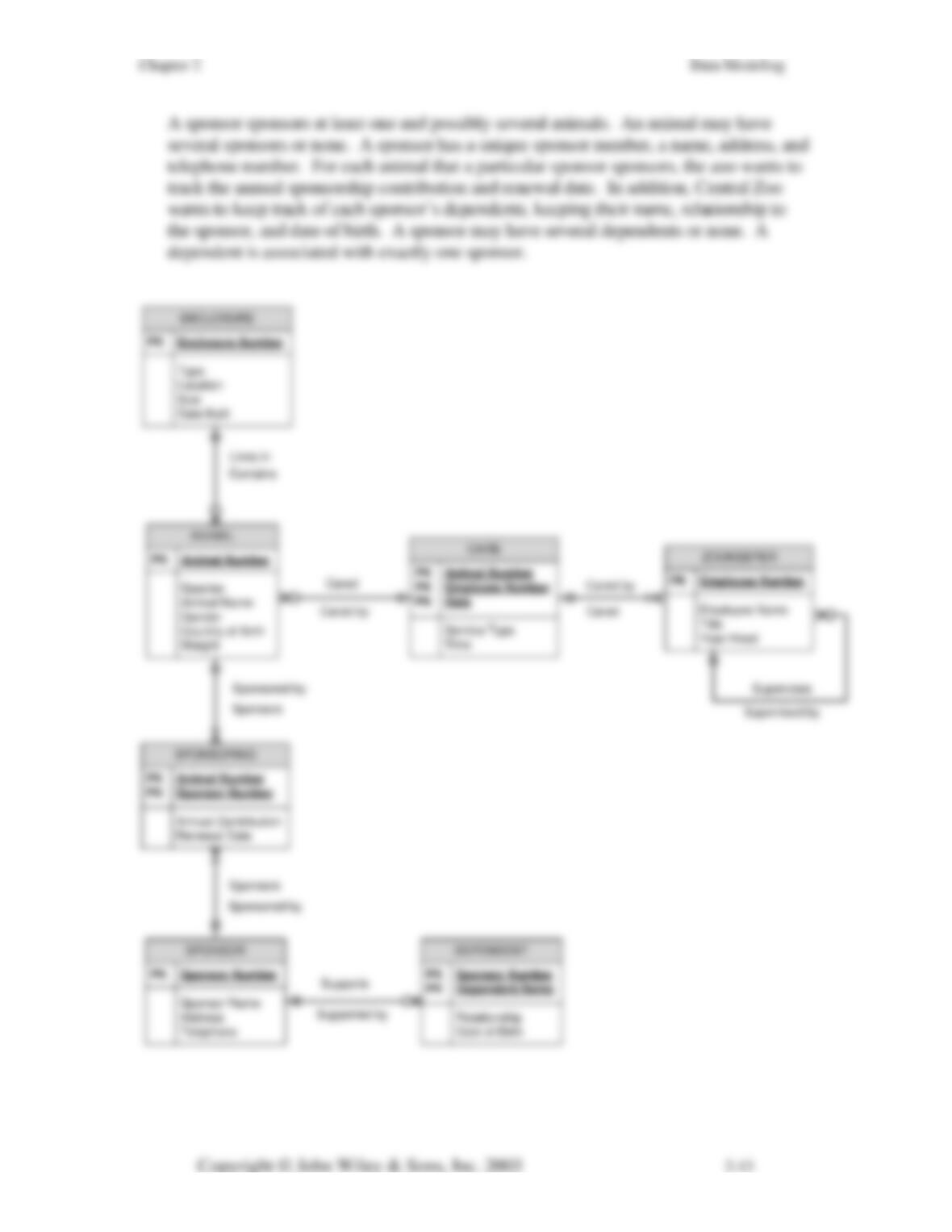
Central Zoo wants to maintain information about its animals, the enclosures in which
they live, and its zookeepers and the services they perform for the animals. In addition,
Central Zoo has a program by which people can be sponsor of animals. Central Zoo
wants to track its sponsors, their dependents, and associated data.
Each animal has a unique animal number, species, name (Jumbo, Fred, etc.), gender,
country of birth, and weight. Enclosures have a unique enclosure number, type (cage,
fenced field, etc.), location, size, and date built. An animal can live in only one
enclosure. An enclosure can have several animals in it or it can be currently empty. A
zookeeper has a unique employee number, employee name, title, and year hired. Some
zookeepers supervise other zookeepers. Every animal has been cared for by at least one
and generally many zookeepers; each zookeeper has cared for at least one and generally
many animals. Each time a zookeeper performs a specific, significant service for an
animal the service type, date, and time are recorded.
2. Draw an entity-relationship diagram that describes the following business environment.
Grand Travel Airlines has to keep track of its flight and airplane history. A flight is
uniquely identified by the combination of a flight number and a date. In addition,
every flight has an actual departure time and an actual arrival time. Every passenger
who has flown on Grand Travel has a unique passenger number plus their name,
address, and telephone number. For a particular passenger who has taken a particular
flight, the company wants to keep track of the fare that she paid for it and the date