Chemistry, 7e (McMurry/Fay)
Chapter 2 Atoms, Molecules, and Ions
2.1 Multiple-Choice Questions
1) What is the chemical symbol for manganese?
A) Hg
B) Mg
C) Mn
D) Na
2) Which element has the chemical symbol, P?
A) lead
B) phosphorus
C) platinum
D) potassium
3) According to history, the concept that all matter is composed of atoms was first proposed by
A) the Greek philosopher Democritus, but not widely accepted until modern times.
B) Dalton, but not widely accepted until the work of Mendeleev.
C) Dalton, but not widely accepted until the work of Einstein.
D) Dalton, and widely accepted within a few decades.
4) Mendeleev arranged the elements according to
A) atomic number and atomic weight.
B) atomic weight and chemical reactivity.
C) electron configuration and atomic weight.
D) physical state and relative abundance.
5) Which is not true?
A) Mendeleev ended each row in his periodic table with an inert gas.
B) Mendeleev left gaps in his periodic table for undiscovered elements.
C) Mendeleev ordered the elements in his periodic table by atomic weight.
D) Mendeleev’s periodic table predated the concept of electron configuration.
6) The horizontal rows of the periodic table are called
A) groups.
B) periods.
C) triads.
D) elements.
7) The vertical columns of the periodic table are called
A) groups.
B) periods.
C) triads.
D) elements.
8) Most elements in the periodic table are
A) metals.
B) non-metals.
C) noble gases.
D) semi-metals.
9) Elements in a periodic group have similar
A) chemical properties.
B) densities.
C) masses.
D) physical properties.
10) Which horizontal row of the periodic table contains the most elements?
A) row 4
B) row 5
C) row 6
D) They all contain the same number of elements.
11) Which of the following statements does not describe a physical property of chlorine?
A) Chlorine combines with sodium to form table salt.
B) The color of chorine gas is green.
C) The density of chlorine gas at standard temperature and pressure is 3.17 g/L.
D) The freezing point of chlorine is -101°C.
12) Which of the following statements does not describe a chemical property of oxygen?
A) Iron will rust in the presence of oxygen.
B) Oxygen combines with carbon to form carbon dioxide gas.
C) The pressure is caused by collision of oxygen molecules with the sides of a container.
D) When coal is burned in oxygen, the process is called combustion.
13) Which group 5A element is most metallic?
A) N
B) P
C) Sb
D) Bi
14) Which group of elements reacts violently with water?
A) halogens
B) noble gases
C) alkali metals
D) alkaline earth metals
15) Gaseous elements characterized by low reactivity are found in group ________ of the periodic table.
A) 5A
B) 6A
C) 7A
D) 8A
16) The observation that 15.0 g of hydrogen reacts with 120.0 g of oxygen to form 135.0 g of water is
evidence for the law of
A) definite proportions.
B) energy conservation.
C) mass conservation.
D) multiple proportions.
17) The observation that 4.0 g of hydrogen reacts with 32.0 g of oxygen to form a product with O:H mass
ratio = 8:1, and 6.0 g of hydrogen reacts with 48.0 g of oxygen to form the same product with O/H mass
ratio = 8:1 is evidence for the law of
A) definite proportions.
B) energy conservation.
C) mass conservation.
D) multiple proportions.
18) Methane and oxygen react to form carbon dioxide and water. What mass of water is formed if 3.2 g of
methane reacts with 12.8 g of oxygen to produce 8.8 g of carbon dioxide?
A) 7.2 g
B) 8.8 g
C) 14.8 g
D) 16.0 g
19) Sodium metal and water react to form hydrogen and sodium hydroxide. If 5.98 g of sodium react with
water to form 0.26 g of hydrogen and 10.40 g of sodium hydroxide, what mass of water was consumed in
the reaction?
A) 4.68 g
B) 5.98 g
C) 10.14 g
D) 10.66 g
6
20) A sample of pure lithium carbonate contains 18.8% lithium by mass. What is the % lithium by mass in
a sample of pure lithium carbonate that has twice the mass of the first sample?
A) 9.40%
B) 18.8%
C) 37.6%
D) 75.2%
21) A sample of pure calcium fluoride with a mass of 15.0 g contains 7.70 g of calcium. How much
calcium is contained in 45.0 g of calcium fluoride?
A) 2.56 g
B) 7.70 g
C) 15.0 g
D) 23.1 g
22) The observation that hydrogen and oxygen can react to form two compounds with different chemical
and physical properties, one having an O:H mass ratio = 8:1 and the other having an O:H mass ratio =
16:1 is consistent with the law of
A) definite proportions.
B) energy conservation.
C) mass conservation.
D) multiple proportions.
23) Which of the following statements is not a postulate of Dalton’s atomic theory?
A) Each element is characterized by the mass of its atoms.
B) Atoms are composed of protons, neutrons, and electrons.
C) Chemical reactions only rearrange atomic combinations.
D) Elements are composed of atoms.
24) Which of the following is a part of Dalton’s atomic theory?
A) Atoms are rearranged but not changed during a chemical reaction.
B) Atoms break down during radioactive decay.
C) Atoms contain protons, neutrons, and electrons.
D) Isotopes of the same element have different masses.
25) Which of the following is not explained by Dalton’s atomic theory?
A) conservation of mass during a chemical reaction
B) the existence of more than one isotope of an element
C) the law of definite proportions
D) the law of multiple proportions
26) Elements A and Q form two compounds, AQ and A2Q3. The mass ratio (mass Q)/(mass A) for AQ is
0.574. What is the mass ratio (mass Q)/(mass A) for A2Q3?
A) 0.383
B) 0.861
C) 1.16
D) 2.61
27) Elements A and Q form two compounds, AQ and A2Q. Which of the following must be true?
A) (mass Q)/(mass A) is one for AQ, and 1/2 for A2Q.
B) (mass Q)/(mass A) for AQ must equal (mass Q)/(mass A) for A2Q.
C) (mass Q)/(mass A) for AQ must be 2 times (mass Q)/(mass A) for A2Q.
D) (mass Q)/(mass A) for AQ must be 1/2 (mass Q)/(mass A) for A2Q.
28) Elements A and Q form two compounds. The ratio (mass Q)/(mass A) for compound one is 0.271 and
ratio (mass Q)/(mass A) for compound two is 0.362. If compound one has the chemical formula AQ, what
is the chemical formula for compound two?
A) A3Q4
B) A2Q3
C) AQ2
D) AQ3
29) The existence of electrons in atoms of all elements was demonstrated by
A) Millikan’s oil drop experiment.
B) Rutherford’s gold foil experiment.
C) Thomson’s cathode ray tube experiment.
D) None of these
30) The charge–to-mass ratio of an electron was established by
A) Millikan’s oil drop experiment.
B) Rutherford’s gold foil experiment.
C) Thomson’s cathode ray tube experiment.
D) None of these
31) The current model of the atom in which essentially all of an atom’s mass is contained in a very small
nucleus, whereas most of an atom’s volume is due to the space in which the atom’s electrons move was
established by
A) Millikan’s oil drop experiment.
B) Rutherford’s gold foil experiment.
C) Thomson’s cathode ray tube experiment.
D) None of these
32) The existence of neutrons in the nucleus of an atom was demonstrated by
A) Millikan’s oil drop experiment.
B) Rutherford’s gold foil experiment.
C) Thomson’s cathode ray tube experiment.
D) None of these
33) Most of the alpha particles directed at a thin gold foil in Rutherford’s experiment
A) bounced directly back from the foil.
B) passed directly through the foil undeflected.
C) passed through the foil but were deflected at an angle.
D) were absorbed by the foil.
34) Which subatomic particle has the smallest mass?
A) a proton
B) a neutron
C) an electron
D) an alpha particle
35) The symbol that is usually used to represent atomic number is
A) A.
B) N.
C) X.
D) Z.
36) The mass number of an atom is equal to the number of
A) electrons.
B) neutrons.
C) protons.
D) protons plus neutrons.
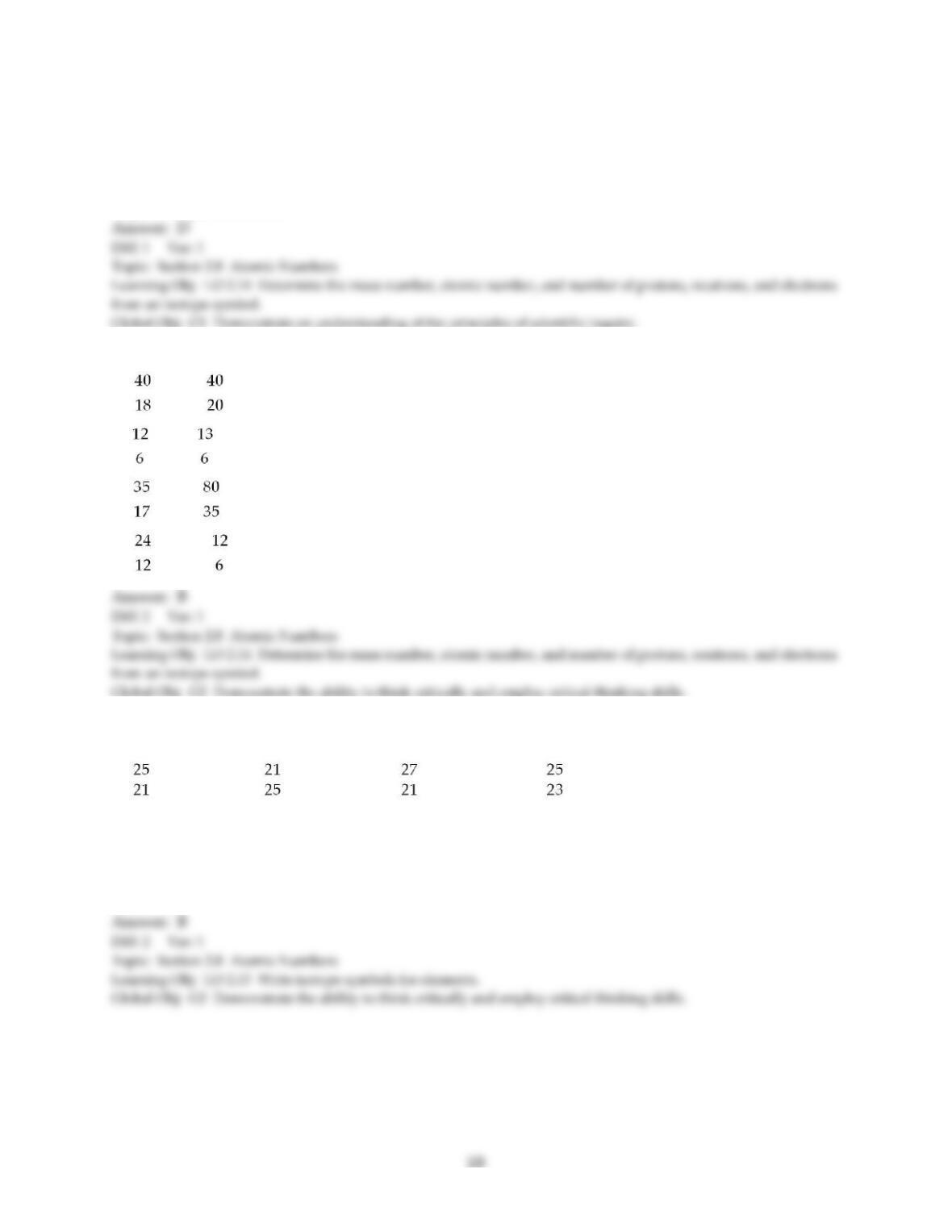
37) Which of the following two atoms are isotopes?
A) Ar and Ca
B) C and C
C) Cl and Br
D) Mg and C
38) Which of the following represent isotopes?
A: [ ] B: [ ] C: [ ] D: [ ]
A) A and B
B) A and C
C) A and D
D) C and D
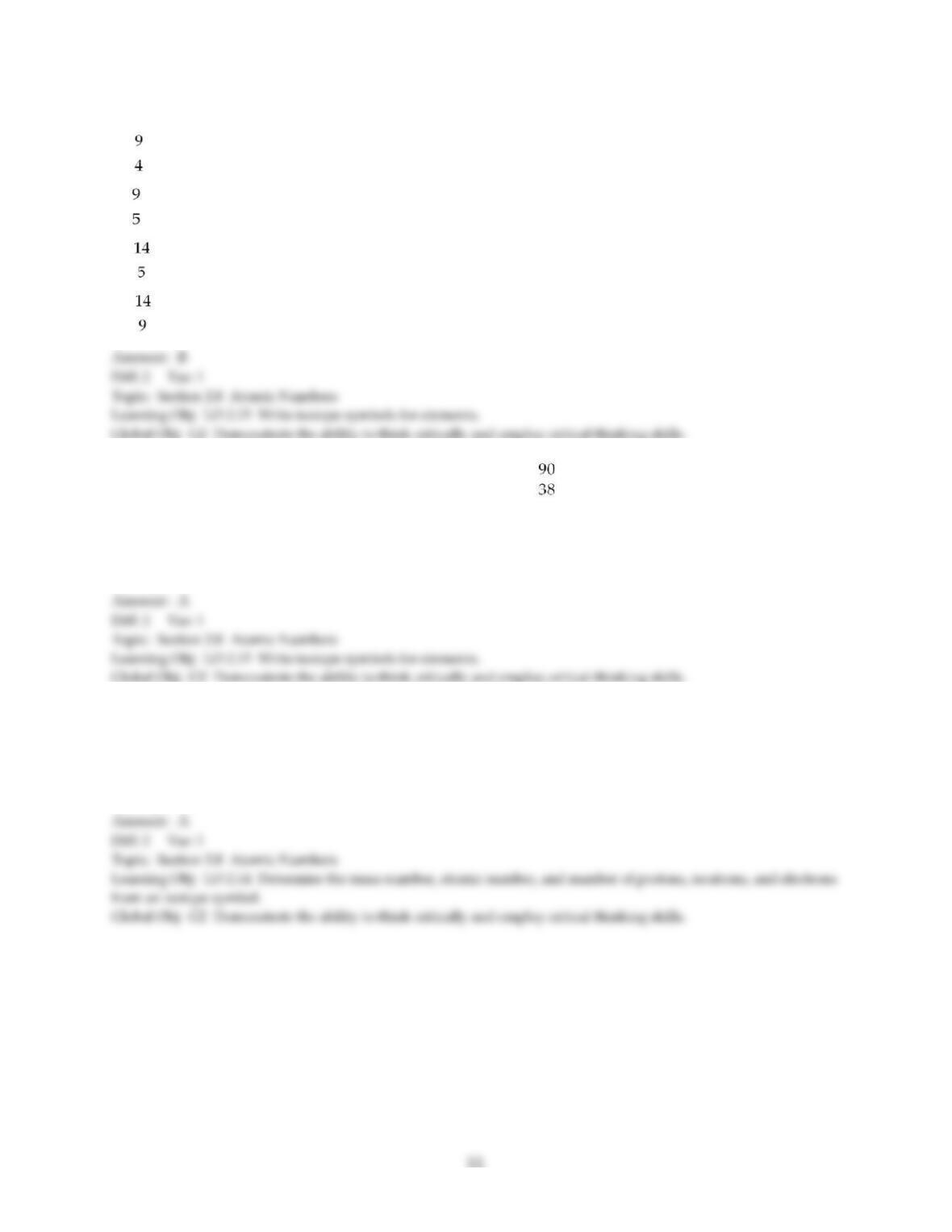
39) Boron-9 can be represented as
A) Be.
B) B.
C) B.
D) B.
40) How many protons (p) and neutrons (n) are in an atom of Sr?
A) 38 p, 52 n
B) 38 p, 90 n
C) 52 p, 38 n
D) 90 p, 38 n
41) How many protons (p) and neutrons (n) are in an atom of calcium–46?
A) 20 p, 26 n
B) 20 p, 46 n
C) 26 p, 20 n
D) 46 p, 60 n
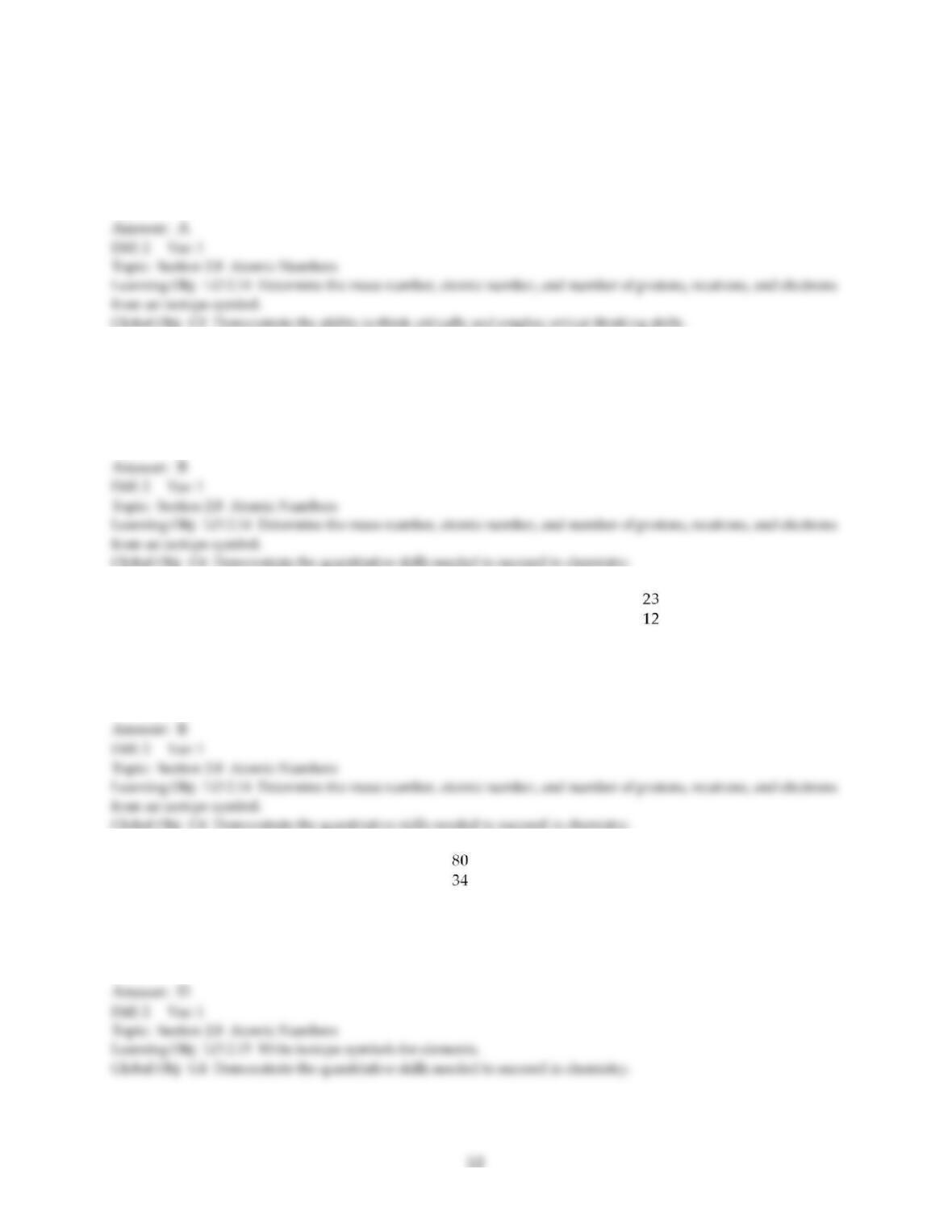
42) What is the chemical symbol for an atom that has 29 protons and 36 neutrons?
A) Cu
B) Kr
C) N
D) Tb
43) How many electrons are in a neutral atom of iodine–131?
A) 1
B) 53
C) 54
D) 131
44) How many protons (p), neutrons (n), and electrons (e) are in one atom of Mg?
A) 12 p, 12 n, 12 e
B) 12 p, 11 n, 12 e
C) 12 p, 11 n, 10 e
D) 12 p, 11 n, 14 e
45) Identify the chemical symbol of element Q in Q.
A) Br
B) Hg
C) Pd
D) Se
46) The atoms of a particular element all have the same number of protons as neutrons. Which of the
following must be true?
A) The atomic weight must be a whole number.
B) The mass number for each atom must equal the atomic weight of the element.
C) The mass number must be exactly twice the atomic number for each atom.
D) All of these are true.
47) Three atoms have the following properties.
Proton
Neutron
Electron
Atom X
119
119
119
Atom Y
119
118
119
Atom Z
118
118
119
The elements X and Y are best described as
A) isotopes.
B) cations.
C) different elements.
D) anions.
48) Three atoms have the following properties.
Proton
Neutron
Electron
Atom X
119
119
119
Atom Y
119
118
119
Atom Z
118
118
119
The elements Y and Z are best described as
A) isotopes.
B) cations.
C) different elements.
D) anions.
49) Three atoms have the following properties.
Proton
Neutron
Electron
Atom X
119
119
119
Atom Y
119
119
118
Atom Z
118
118
119
Which of the following statements is true?
A) Element Y and Z are isotopes of X.
B) Element Y is an isotope of Z.
C) Element Y is an ion of X.
D) Element Z is an ion of Y.
50) What is the identity of the element with 6 protons, 7 neutrons, and 6 electrons?
A) C
B) N
C) Al
D) Mg
51) The smallest sample of carbon atoms that can be observed with the naked eye has a mass of
approximately 2 × 10⁻⁸ g. Given that 1 g = 6.02 × 10²³ amu, and that carbon has an atomic weight of 12.01
amu, determine the number of carbon atoms present in the sample.
A) 1 × 10¹⁵
B) 1 × 10¹⁶
C) 1 × 10¹⁷
D) 6 × 10²³
52) An element has two naturally occurring isotopes. One has an abundance of 37.4% and an isotopic
mass of 184.953 amu, and the other has an abundance of 62.6% and a mass of 186.956 amu. What is the
atomic weight of the element?
A) 185.702 amu
B) 185.954 amu
C) 186.207 amu
D) 186.956 amu
53) The element antimony has an atomic weight of 121.757 amu and only two naturally-occurring
isotopes. One isotope has an abundance of 57.3% and an isotopic mass of 120.904 amu. Based on these
data, what is the mass of the other isotope?
A) 121.757 amu
B) 122.393 amu
C) 122.610 amu
D) 122.902 amu
16
54) What is the mass of one atom of the element hydrogen?
A) 2.0 g
B) 1.0 g
C) 3.4 × 10⁻²⁴ g
D) 1.7 × 10⁻²⁴ g
55) How many moles and how many atoms of zinc are in a sample weighing 34.9 g?
A) 0.533 mol, 8.85 × atoms
B) 0.533 mol, 3.21 × atoms
C) 1.87 mol, 3.10 × atoms
D) 1.87 mol, 1.13 × atoms
56) Steel is galvanized by giving it a surface coating of zinc. Galvanized steel is an example of
A) a compound.
B) an element.
C) a mixture.
D) an ion.
57) How many electrons are in the ion, Zn2+?
A) 28
B) 30
C) 32
D) 65
58) How many electrons are in the ion, P3-?
A) 12
B) 18
C) 28
D) 34
59) What is the identity of element Q if the ion Q2+ contains 10 electrons?
A) C
B) O
C) Ne
D) Mg
60) How many electrons are in the ion, CO32-?
A) 16
B) 28
C) 30
D) 32
61) What type of bonding is found in the compound PCl5?
A) covalent bonding
B) hydrogen bonding
C) ionic bonding
D) metallic bonding
62) Which of the species below has 28 protons and 26 electrons?
A) Fe2+
B) Ni2+
C) Fe
D) Ni
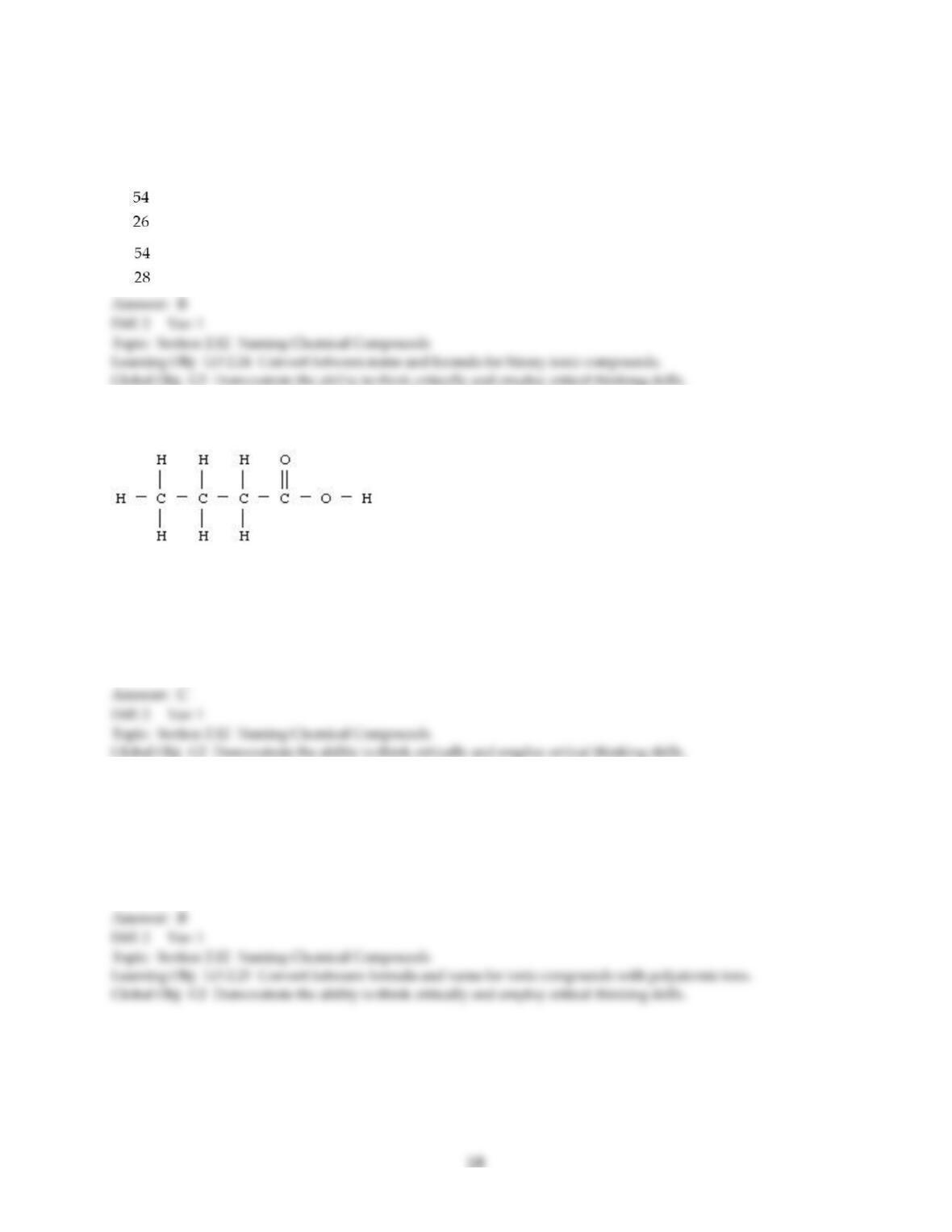
63) Butyric acid has the structural formula given below.
What is the molecular or chemical formula for butyric acid?
A) CHO
B) C2H4O
C) C4H8O2
D) C5H8O3
64) The solid compound, Na2CO3, contains
A) Na+, C4+, and O2- ions.
B) Na+ ions and CO32–ions.
C) Na2+ and CO32- ions.
D) Na2CO3 molecules.
65) Which of the following statements concerning ionic compounds is true?
A) Essentially all ionic compounds are solids at room temperature and pressure.
B) Ionic compounds do not contain any covalent bonds.
C) Ionic compounds contain the same number of positive ions as negative ions.
D) The chemical formula for an ionic compound must show a nonzero net charge.
66) The gas Freon-11, CCl3F, contains
A) C4+, Cl–, and F– ions.
B) C4+, Cl3–, and F– ions.
C) C4+ and Cl3F4– ions.
D) CCl3F molecules.
67) The definitive distinction between ionic bonding and covalent bonding is that
A) ionic bonding involves a sharing of electrons and covalent bonding involves a transfer of electrons.
B) ionic bonding involves a transfer of electrons and covalent bonding involves a sharing of electrons.
C) ionic bonding requires two nonmetals and covalent bonding requires a metal and a nonmetal.
D) covalent bonding requires two nonmetals and ionic bonding requires a metal and a nonmetal.
68) The formula for dinitrogen trioxide is
A) N(OH)3.
B) (NO3)2.
C) N2O3.
D) N3O2.
69) The chemical formula for potassium peroxide is
A) KOH.
B) KO2.
C) K2O.
D) K2O2.
70) By analogy with the oxoanions of sulfur, H2TeO3 would be named
A) hydrotellurous acid.
B) pertelluric acid.
C) telluric acid.
D) tellurous acid.
71) The ions ClO4–, ClO3–, ClO2–, and ClO– are named respectively
A) hypochlorate, chlorate, chlorite, perchlorite.
B) hypochlorite, chlorite, chlorate, perchlorate.
C) perchlorate, chlorate, chlorite, hypochlorite.
D) perchlorite, chlorite, chlorate, hypochlorate.
72) The compound, NO2, is named
A) nitrate.
B) nitrite.
C) nitrogen dioxide.
D) nitrogen(IV) oxide.