ch2 Key
1. Product costs are costs assigned to goods that were either purchased or manufactured for resale.
2. Product costs become expenses in the period they are purchased.
3. The product cost of merchandise inventory acquired by a retailer consists of the purchase cost of the
inventory plus any shipping charges.
4. Inventoriable cost is another term for product costs.
5. Period costs are recognized as expenses by retailers, but are included in inventory by manufacturers.
6. The difference between sales revenue and cost of goods sold is called contribution margin.
7. The basic formula used to compute cost of goods sold is beginning inventory plus purchases plus ending
inventory.
8. Marketing costs are considered period costs for retailers and product costs for manufacturers.
9. Cost of goods sold does not include the costs of selling merchandise.
10. Theoretically, the cost of employer paid health insurance premiums for direct labor personnel should be
considered a manufacturing overhead cost.
11. Factory heating and air conditioning should be considered a product cost in a manufacturing operation.
12. Depreciation of office equipment is a manufacturing overhead cost at Dell Computer, a large manufacturer
of personal computers.
13. Maintenance workers in the factory are considered a direct labor cost at Hewlett–Packard, a leading
manufacturer of computers and computer equipment.
14. Lubricants used for production machinery should be considered a direct material cost at General Motors
Corporation.
15. Before materials enter the production process, they are called raw materials.
16. After materials enter the production process, those used in products are called direct materials.
17. Employees who handle materials in the factory of a manufacturing plant are considered direct labor costs.
18. Overtime premium costs should theoretically be considered part of direct labor cost.
19. Prime costs include direct materials and direct labor costs.
20. Conversion costs equal direct materials and manufacturing overhead costs.
21. Nonmanufacturing costs include selling and adminstrative costs, which are not used to produce products.
22. Work-in–process inventory refers to partially completed units.
23. The cost of direct materials placed into production is computed by adding the cost of purchases to the
ending inventory of raw materials.
24. In a manufacturing company, cost of goods manufactured consists of direct materials put into production,
direct labor and manufacturing overhead incurred plus the beginning inventory of finished goods less the ending
inventory of finished goods
25. A cost driver is a characteristic of an activity or event that causes that activity or event to incur cost.
26. Variable costs change in total direct proportion to a change in the activity of a cost driver.
27. Fixed costs per unit remain the same as volume of production increases.
28. As the volume of production increases, fixed costs per unit remain unchanged, while variable costs per unit
will decrease.
29. The identification of a cost as fixed or variable is valid only within a specified range of output volume.
30. Unit-level costs are incurred for every unit of product manufactured or service performed.
31. Batch-level costs are incurred for each line of product service.
32. Facility–level costs are incurred to maintain the organization’s overall facility and infrastructure.
33. All unit–level costs are variable costs.
34. All variable costs are unit-level costs.
35. Electricity and welding materials used by robotic welders would be considered unit–level costs.
36. The costs of equipment, buildings, and purchased technology should be considered when making production
decisions.
37. Most management systems measure both opportunity costs and out of pocket costs.
38. Opportunity cost is the current value of the foregone, next best alternative use of whatever is supplied or
used.
39. It is possible for a cost to be a direct cost of one cost object and an indirect cost of another.
40. If a manager can control or heavily influence the level of a cost, then that cost is classified as a controllable
cost.
41. Tracing costs means attaching or assigning indirect costs by some reasonable but imprecise method of
averaging.
42. Tracing costs is generally considered a more accurate method of cost assignment than allocating costs.
43. A committed cost may be changed quickly and easily.
44. Sunk costs are past resource payments that cannot be changed by any current or future decision.
45. Absorption costing uses sales less variable costs to measure the contribution to profit.
46. Absorption costing measures use gross margin as the contribution to profit.
47. Gross margin is sales less variable production costs.
48. Throughput costing inventory contains no conversion and indirect costs.
49. When inventory levels increase, absorption costing will result in a higher operating income than direct
costing.
AASCB: Analytic
50. When inventory levels remain constant, absorption and direct costing will result in the same operating
income.
AASCB: Analytic
51. When inventory levels decrease absorption costing will result in a higher operating income than direct
costing.
AASCB: Analytic
52. The difference in the amount of fixed overhead cost that is expensed to the income statement under
absorption and variable costing is solely attributable to the difference between the number of units produced
during the period and the number of units sold.
AASCB: Analytic
53. Absorption costing can distort the costs to provide products and services if they represent greatly different
levels of support from indirect resources.
54. Throughout costing assigns only batch-level spending for direct costs of products or services.
55. Throughout costing considers only unit–level spending for direct costs of products or services.
Use the following to answer questions 56-59:
Crowley Company has gathered the following data related to its production process of two of its products for
the week ended April 30:
Hilton – Chapter 02
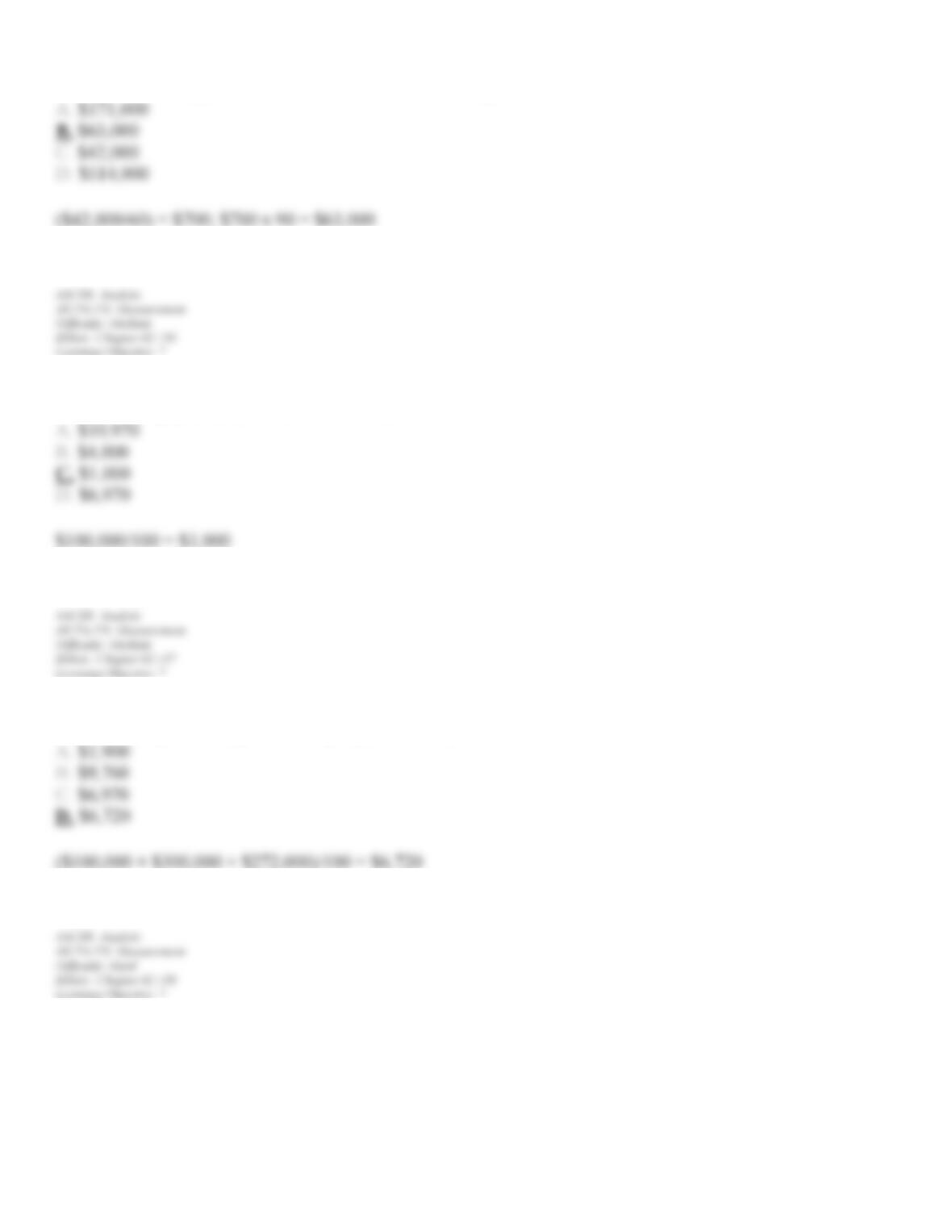
56. If the cost behaviors exhibited in this chart continue and the company produces 90 units of product 100B
during May, the expected total unit–level material cost of product 100 B would be:
57. The throughput cost per unit for Product 250C is:
58. The absorption cost per unit for product 250C was:
59. The costs above that appear to be allocated rather than traced are:
60. Which of the following is not a name for indirect resources?
61. Which of the following should be considered part of a manufacturing company’s direct labor cost?
Use the following to answer questions 62-71:
Hilton – Chapter 02
62. The throughput product cost of goods sold is:
63. The variable cost of goods sold is:
64. The absorption cost of goods sold is:
65. The throughput operating income is:
66. The variable operating income is:
67. The absorption operating income is:
68. The throughput ending inventory is:
69. The variable ending inventory is:
70. The absorption ending inventory is:
71. The difference between the variable ending inventory cost and the absorption ending inventory cost is:
72. Throughput costing:
73. Absorption costing measures contribution to profit as:
74. Under variable costing, operating income is measured by:
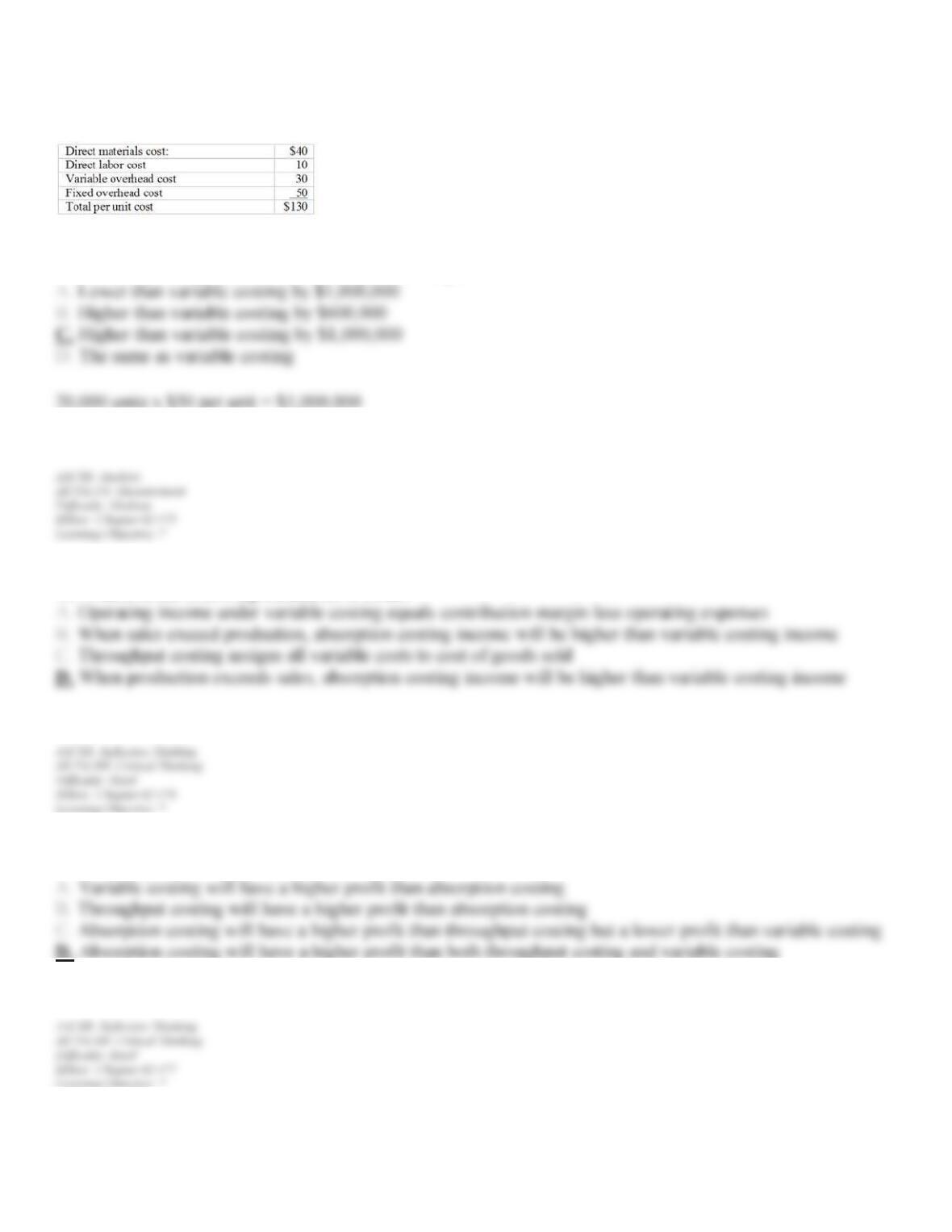
75. In its first month of operations, Oliveira Corporation produced 100,000 units. 80,000 units were sold. The
manufacturing cost per unit was as follows:
Oliveira”s operating income under absorption costing will be:
76. Which of the following statements is True?
77. If units produced are greater than units sold:
78. Under throughput costing:
79. Which of the following is not an argument in favor of throughput costing?
80. Period costs
81. Which of the following would be considered an indirect product cost?
82. Wages paid to supervisors in the factory are typically classified as:
83. Which of the following is a fixed cost?
84. Which of the following is not a conversion resource?
85. Which of the following is not a material resource?