CHAPTER 2
Describing the Goals of Instruction
ITEMS
1. What is a learning objective?
(a) What students should know at the end of an instructional segment.
(b) What students can do at the end of an instructional segment.
(c) What teachers should do to help students learn during an instructional segment.
2. Which of the following best explains the importance of using statements of learning objectives in
the assessment of students?
(a) The teacher becomes aware of students’ weaknesses and emphasizes those areas in his/her
assessment.
(b) The teacher gets a better understanding of the material (subject matter) he/she is teaching
through assessment.
(c) The teacher knows the specific outcomes students should attain and develops appropriate
assessment procedures to assess them.
3. Which of the following is a general learning goal?
(a) Students should be able to measure the length of the classroom using a ruler.
(b) Students should be able to add two digit numbers accurately.
(c) Students should be able to measure things accurately.
4. Which of the following best illustrates an appropriately stated learning objective?
(a) The student will know the parts of an airplane.
(b) The student will understand the parts of an airplane.
(c) The student will explain how airplanes fly.
5. Which of the following statements is an example of a developmental learning objective?
(a) To write a persuasive essay.
(b) To compute the average of a set of scores.
(c) To state the Pythagorean theorem.
6. The sequence of the Cognitive Process dimension of the revised Bloom’s taxonomy is
(a) remember, understand, create, apply, analyze, and evaluate.
(b) remember, understand, apply, analyze, evaluate, and create.
(c) remember, understand, analyze, apply, create, and evaluation.
7. When planning an instructional unit, which of the following is the BEST source for a teacher to
find ideas about good general learning goals?
(a) The practices of experienced teachers in the field
(b) The published standards of the state
(c) The list of topics covered in a textbook in the content area
8. Taxonomy means the same as
(a) classification.
(b) selection.
(c) organization.
9. Which of the following item formats is the best to use to assess “analyze” types of learning
objectives?
(a) Essay items.
(b) Multiple-choice items.
(c) Short-answer items.
10. One of the important teaching uses for taxonomies of thinking skills is to
(a) ensure the complexity of learning outcomes.
(b) divide up cognitive thinking into small, teachable segments.
(c) check whether what is to be taught and assessed covers the most important cognitive skills.
11. The hierarchical nature of taxonomies of learning objectives implies that each teacher should teach
lower level skills before moving on to teach higher level skills.
(a) True
(b) False
12. With regard to the revised Bloom’s taxonomy of learning objectives, the statement, “The student
will be able to distinguish between evaluation and measurement,” is an example of what cognitive
process?
(a) Apply
(b) Analyze
(c) Understand
13. With regard to the revised Bloom’s taxonomy of learning objectives, the statement, “The student
will be use the Pythagorean theorem to solve right triangle problems,” is an example of what
cognitive process?
(a) Apply
(b) Analyze
(c) Understand
14. Among the following, which is the BEST way for a teacher to improve the validity of classroom
assessment results?
(a) Assess students on the same learning outcome using several different procedures.
(b) Ensure that all students take part in the assessment.
(c) Use only performance assessments.
15. Which criterion for stating specific learning objectives is missing in the following statement of a
learning objective? “The student should be able to read well.”
(a) The content
(b) The performance
(c) The student
16. What is missing from the following statement of a specific learning objective? “The student
should understand the functions of the parts of a flower.”
(a) The content
(b) The performance
(c) The student
17. Which of the following is LEAST desirable for a list of learning objectives for a unit you plan to
teach?
(a) The learning objectives are relevant to your state’s published standards.
(b) The learning objectives fit with your school’s philosophy.
(c) The list includes all desirable outcomes for the course, including minor ones.
(d) The list includes only objectives that you have the resources available to teach.
18. A major reason for stating learning objectives at the planning stage of teaching is to make sure
(a) no important topics of the subject-matter content are left out.
(b) items based on the subject-matter content are not too difficult.
(c) the level of achievement students should attain by the end of the instructional period is
clear.
19. Statements of mastery learning objectives are broader than statements of developmental learning
objectives.
(a) True
(b) False
20. One reason why teachers have to formulate learning objectives before teaching is to ensure that
each student is taught and achieves the most important points of the lesson.
(a) True
(b) False
21. When a teacher selects a taxonomy of cognitive skills for use in planning instruction, which of the
following is probably the LEAST important consideration?
(a) The most important learning objectives can be classified with the taxonomy.
(b) The taxonomy can be used to help explain the teacher’s methods or instructional outlook.
(c) The taxonomy is simple to explain to parents and students.
(d) The taxonomy can be used to prepare official government reports.
22. You know that your classroom assessment matches the corresponding mastery learning objective
when the assessment requires students to do everything stated in the learning objective.
(a) True
(b) False
23. Which of the following is the major difference between the original Bloom’s taxonomy and its
revision in 2001?
(a) The revision separates learning into two dimensions; the original used one dimension.
(b) The revision simplifies the classification of learning objectives so it is easier to use.
(c) The revision uses an entirely different approach to categorizing thinking skills than the
original.
(d) The revision was not written by Benjamin Bloom.
24. What is the best way to align instruction with state standards?
(a) The school evaluates teachers based on students’ performance on state standards.
(b) The district chooses textbooks based on the content of state standards.
(c) The teacher breaks each state standard down into specific learning objectives for lessons.
(d) The teacher groups several state standards into a specific learning objective for a lesson.
25. For planning assessments, state performance standards are more relevant that state content
standards.
(a) True
(b) False
CHAPTER 2
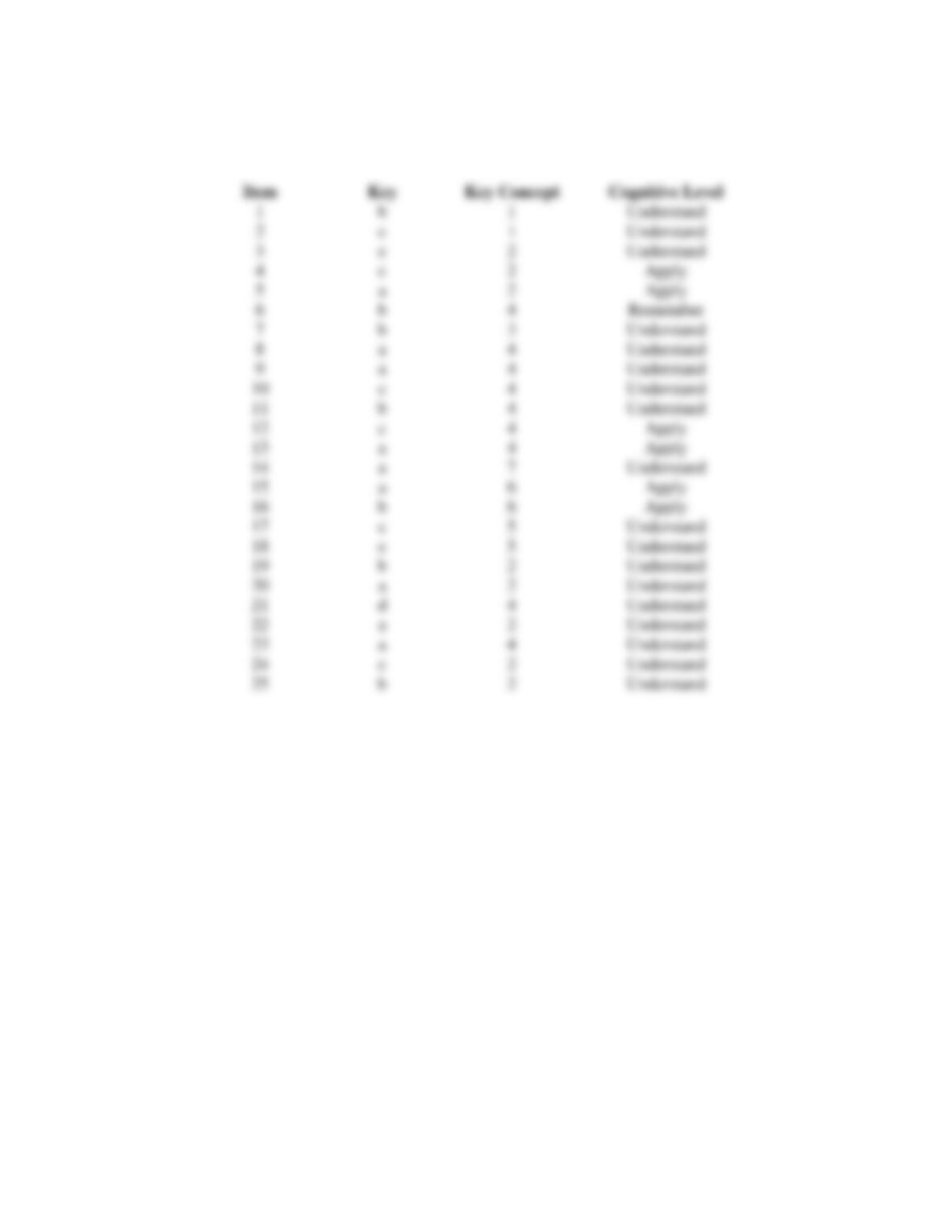
Answers and Classification of Items