Chapter 02 Reviewing Financial Statements Answer Key
Multiple Choice Questions
1.
Which financial statement reports a firm’s assets, liabilities, and equity at a particular
point in time?
2.
Which financial statement shows the total revenues that a firm earns and the total
expenses the firm incurs to generate those revenues over a specific period of time—
generally one year?
A.
Balance sheet
3.
Which financial statement reports the amounts of cash that the firm generated and
distributed during a particular time period?
A.
Balance sheet
Income statement
Statement of retained Earnings
Statement of cash Flows
Income statement
Statement of retained earnings
Statement of cash flows
4.
Which financial statement reconciles net income earned during a given period and any
cash dividends paid within that period using the change in retained earnings between the
beginning and end of the period?
5.
On which of the four major financial statements would you find the common stock and
paid-in surplus?
6.
On which of the four major financial statements would you find the increase in inventory?
7.
On which of the four major financial statements would you find net plant and equipment?
8.
Financial statements of publicly traded firms can be found in a number of places. Which of
the following is NOT an option for finding publicly traded firms’ financial statements?
9.
For which of the following would one expect the book value of the asset to differ widely
from its market value?
10.
Common stockholders’ equity divided by number of shares of common stock outstanding
is the formula for calculating
11.
When a firm alters its capital structure to include more or less debt (and, in turn, less or
more equity), it impacts which of the following?
12.
This is the amount of additional taxes a firm must pay out for every additional dollar of
taxable income it earns.
13.
An equity-financed firm will:
14.
Deferred taxes occur when a company postpones taxes on profits pertaining to:
15.
Net operating profit after taxes (NOPAT) is defined as which of the following?
16.
This is cash flow available for payments to stockholders and debt holders of a firm after
the firm has made investments in assets necessary to sustain the ongoing operations of
the firm.
17.
Which of the following activities result in an increase in a firm’s cash?
18.
These are cash inflows and outflows associated with buying and selling of fixed or other
long-term assets.
19.
If a company reports a large amount of net income on its income statement during a year,
the firm will have:
20.
Free cash flow is defined as:
21.
The Sarbanes-Oxley Act requires public companies to ensure which of the following
individuals have considerable experience applying generally accepted accounting
principles (GAAP) for financial statements.
22.
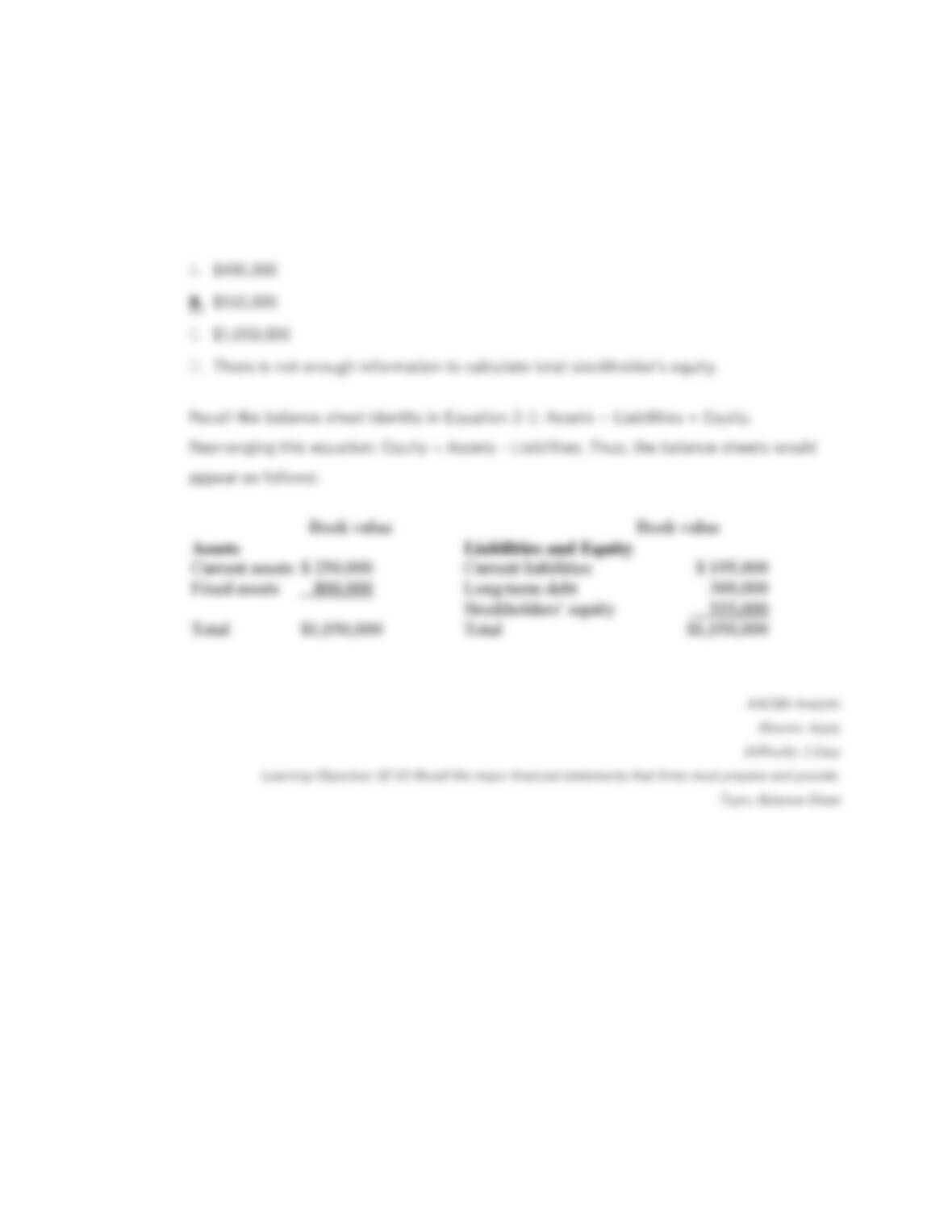
Balance Sheet You are evaluating the balance sheet for Campus Corporation. From the
balance sheet you find the following balances: cash and marketable securities = $400,000,
accounts receivable = $200,000, inventory = $100,000, accrued wages and taxes =
$10,000, accounts payable = $300,000, and notes payable = $600,000. What is Campus’s
net working capital?
23.
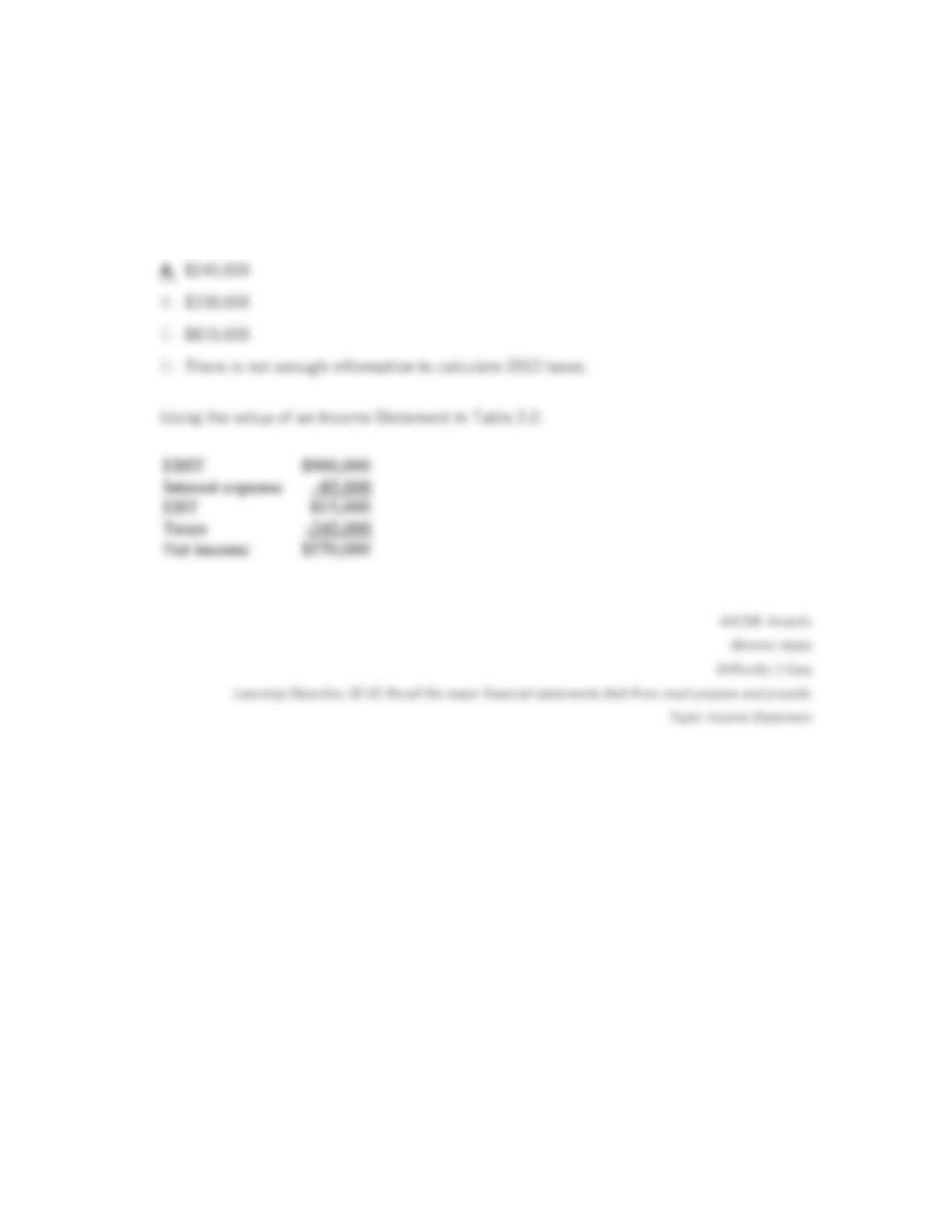
Balance Sheet Jack and Jill Corporation’s year-end 2013 balance sheet lists current
assets of $250,000, fixed assets of $800,000, current liabilities of $195,000, and long-term
debt of $300,000. What is Jack and Jill’s total stockholders’ equity?
24.
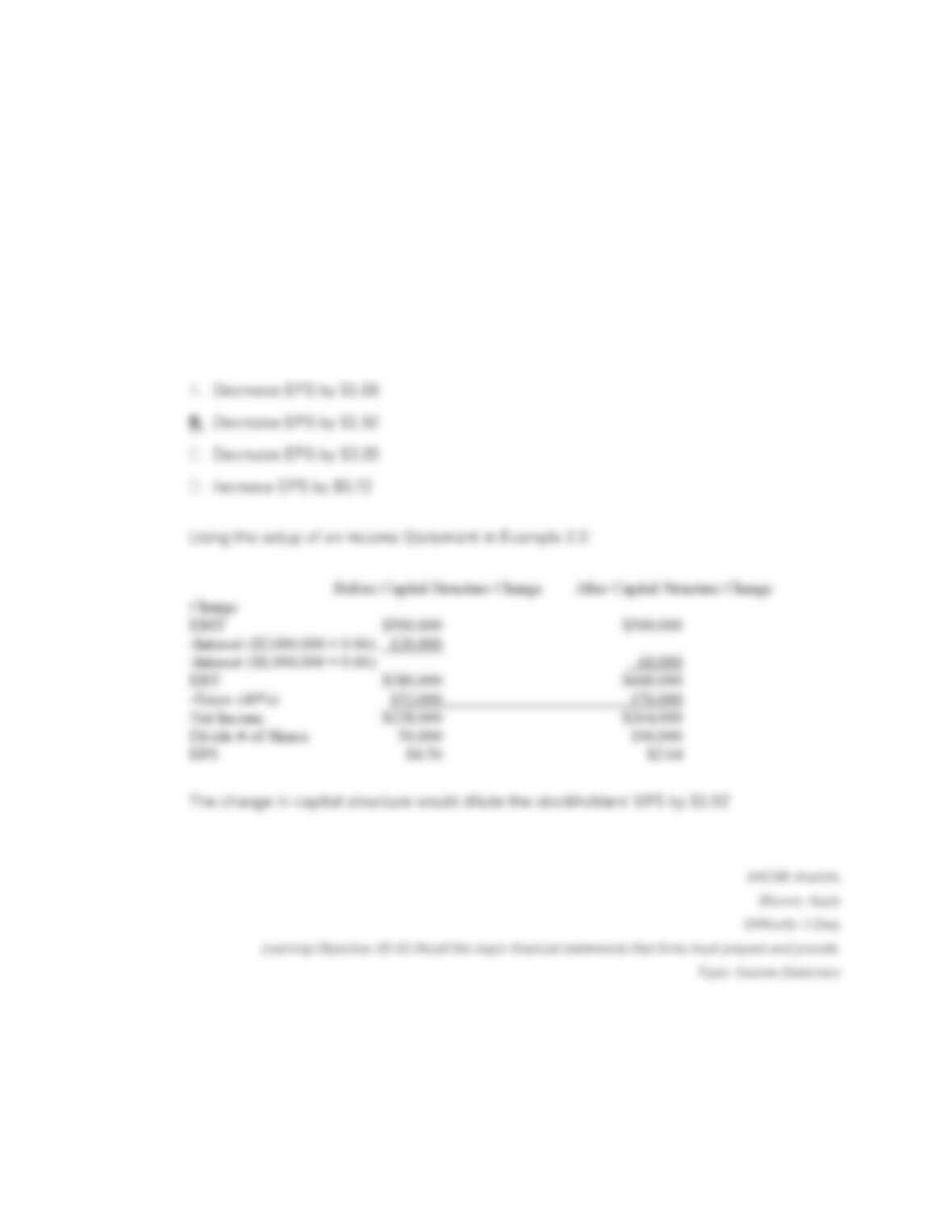
Income Statement Bullseye, Inc.’s 2013 income statement lists the following income and
expenses: EBIT = $900,000, interest expense = $85,000, and net income = $570,000. What
are the 2013 taxes reported on the income statement?
25.
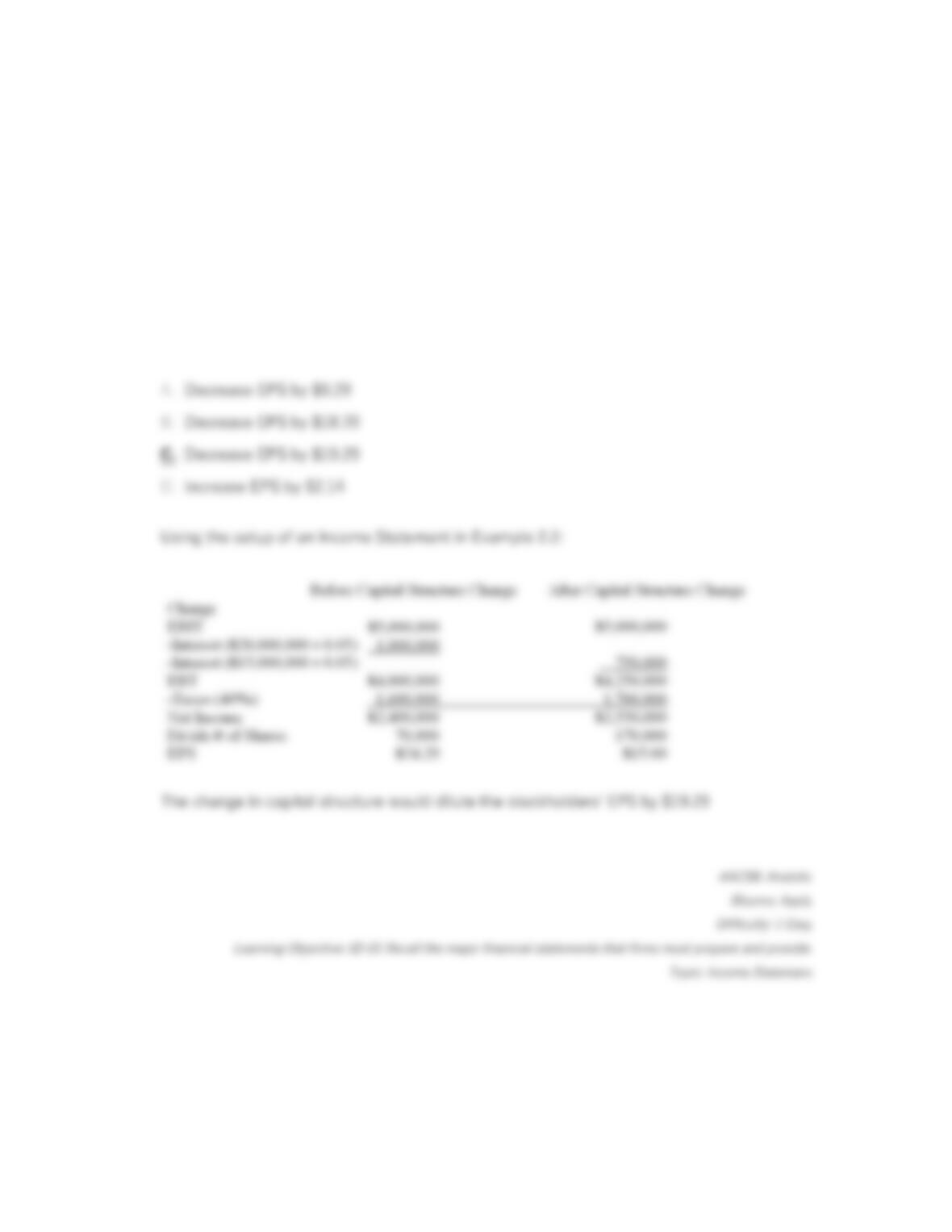
Income Statement Consider a firm with an EBIT of $500,000. The firm finances its assets
with $2,000,000 debt (costing 6 percent) and 50,000 shares of stock selling at $20.00 per
share. To reduce the firm’s risk associated with this financial leverage, the firm is
considering reducing its debt by $1,000,000 by selling an additional 50,000 shares of stock.
The firm is in the 40 percent tax bracket. The change in capital structure will have no
effect on the operations of the firm. Thus, EBIT will remain $500,000. What is the change
in the firm’s EPS from this change in capital structure?
26.
Income Statement Consider a firm with an EBIT of $5,000,000. The firm finances its
assets with $20,000,000 debt (costing 5 percent) and 70,000 shares of stock selling at
$50.00 per share. To reduce the firm’s risk associated with this financial leverage, the firm
is considering reducing its debt by $5,000,000 by selling an additional 100,000 shares of
stock. The firm is in the 40 percent tax bracket. The change in capital structure will have
no effect on the operations of the firm. Thus, EBIT will remain $5,000,000. What is the
change in the firm’s EPS from this change in capital structure?
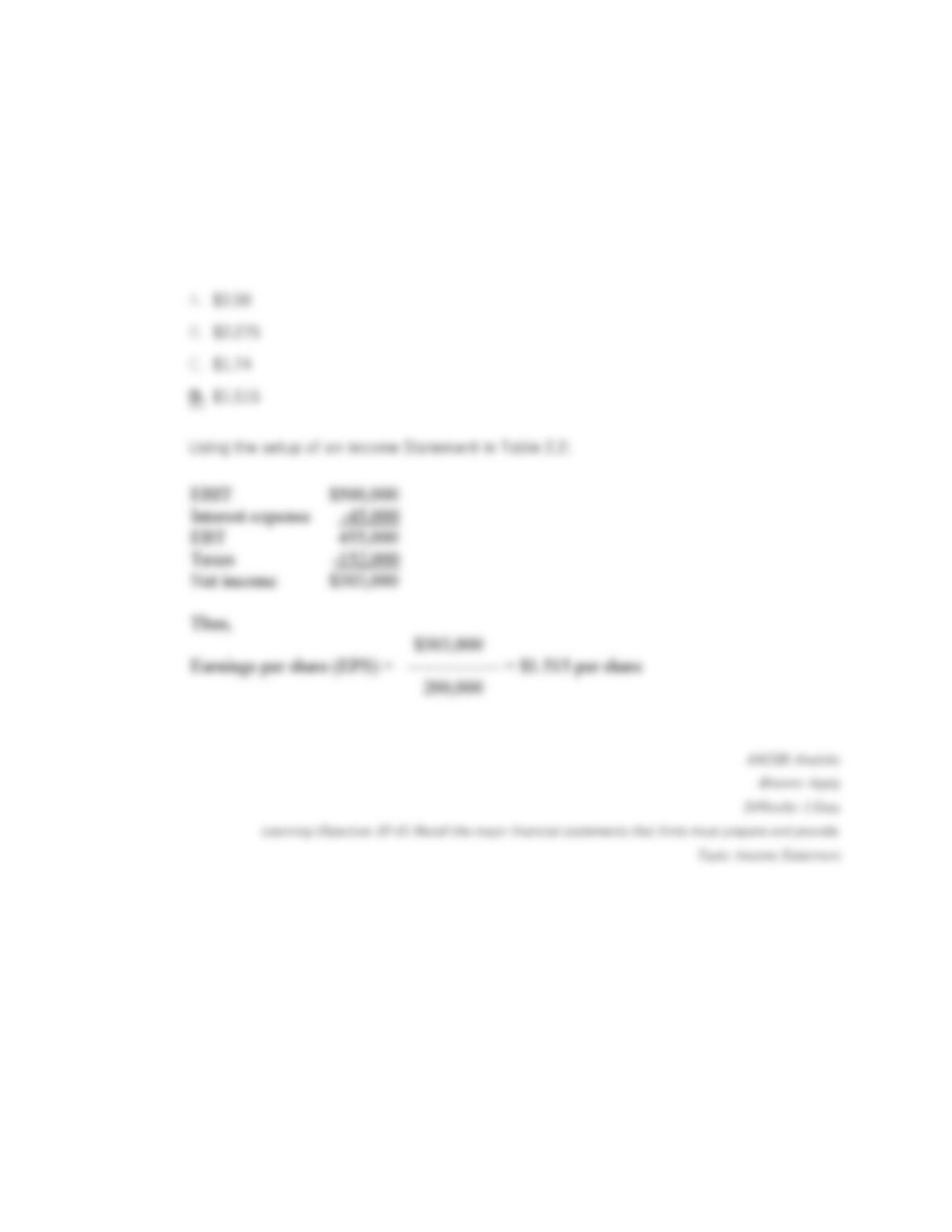
27.
Income Statement Barnyard, Inc.’s 2013 income statement lists the following income and
expenses: EBIT = $500,000, interest expense = $45,000, and taxes = $152,000. Barnyard’s
has no preferred stock outstanding and 200,000 shares of common stock outstanding.
What are its 2013 earnings per share?
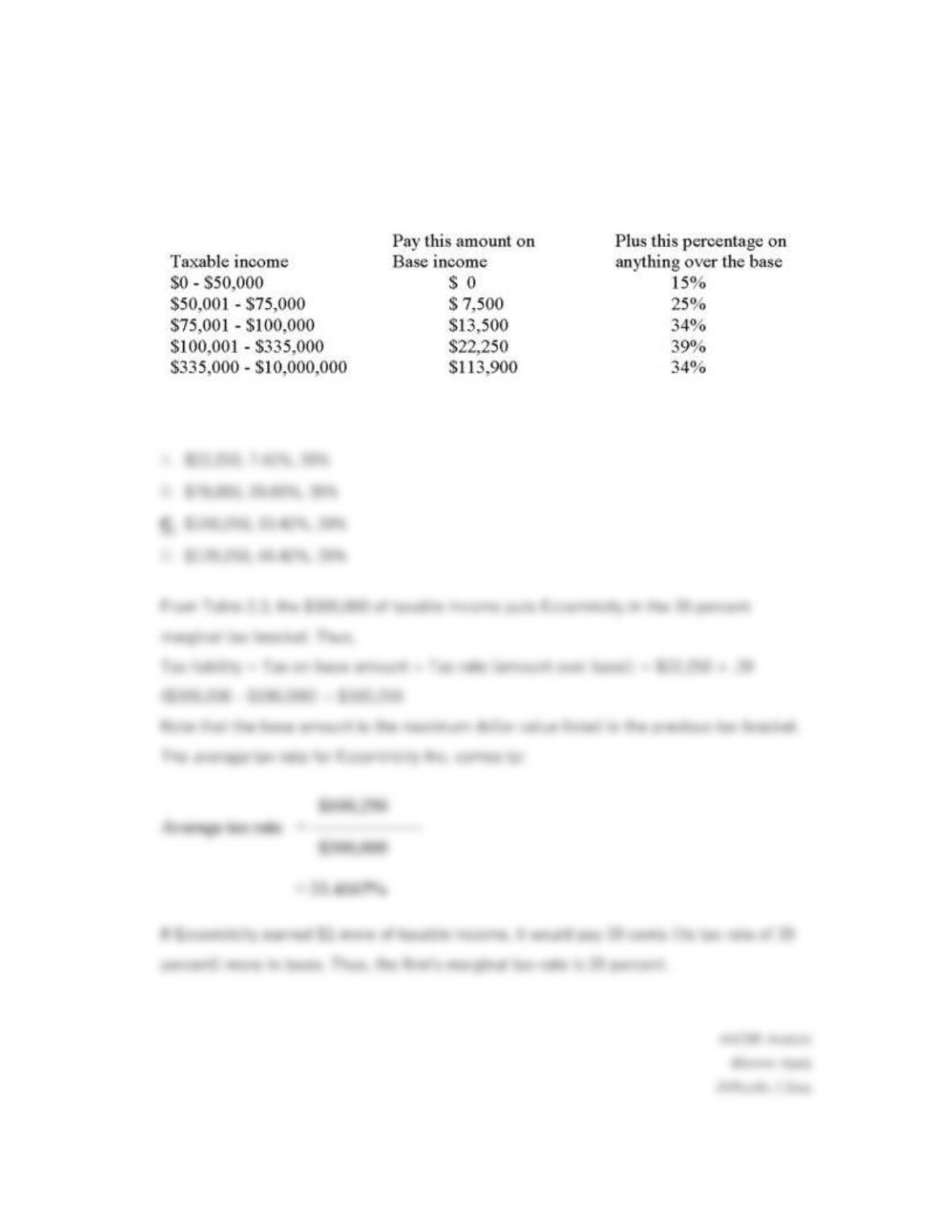
28.
Corporate Taxes Eccentricity, Inc. had $300,000 in 2013 taxable income. Using the tax
schedule from Table 2-3, what are the company’s 2013 income taxes, average tax rate,
and marginal tax rate, respectively?
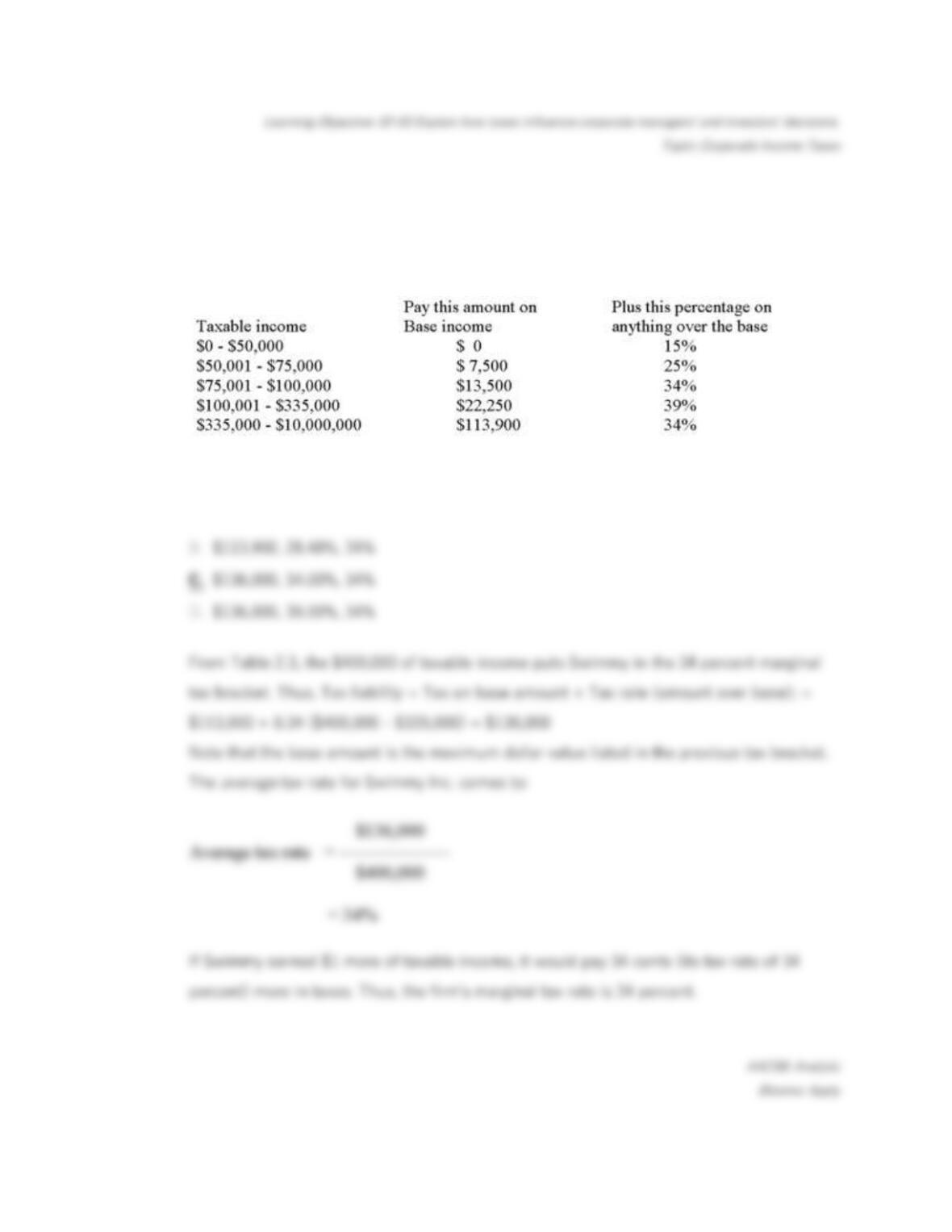
29.
Corporate Taxes Swimmy, Inc. had $400,000 in 2013 taxable income. Using the tax
schedule from Table 2-3, what are the company’s 2013 income taxes, average tax rate,
and marginal tax rate, respectively?
A.
$22,100, 5.53%, 34%
$113,900, 28.48%, 34%
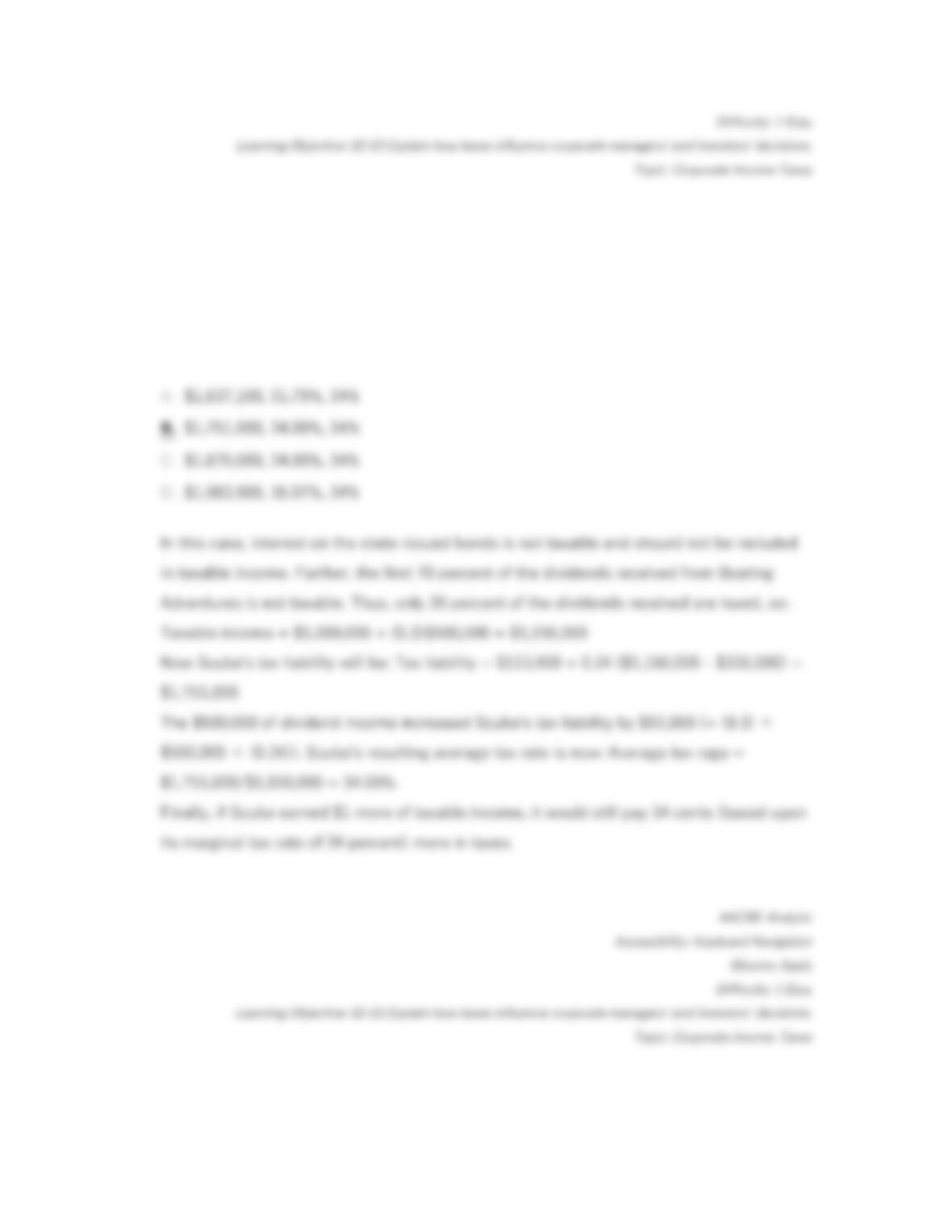
30.
Corporate Taxes Scuba, Inc. is concerned about the taxes paid by the company in 2013. In
addition to $5 million of taxable income, the firm received $80,000 of interest on state–
issued bonds and $500,000 of dividends on common stock it owns in Boating Adventures,
Inc. What are Scuba’s tax liability, average tax rate, and marginal tax rate, respectively?