Exam
Name___________________________________
MULTIPLE CHOICE. Choose the one alternative that best completes the statement or answers the question.
1)
The division of productive activities among persons and regions so that no one individual or area is
totally self–sufficient is known as
1)
A)
specialization.
B)
advantage–taking.
C)
comparative value.
D)
outsourcing.
2)
Steve and Karen decide to attend the same concert when they are each given free tickets to it. We
know that
2)
A)
neither bears an opportunity cost since the tickets were given free to them.
B)
both bear an opportunity cost that depends on what each person is giving up to attend the
concert.
C)
both bear the same opportunity cost because they are seeing the same thing.
D)
both bear the same opportunity cost because the tickets have the same face value.
3)
The tasks performed by the chef at your favorite restaurant could be categorized as
3)
A)
a service or intangible good.
B)
an economic good.
C)
a good.
D)
All of the above are correct.
4)
Opportunity cost is illustrated on the production possibilities curve by a
4)
A)
shift to the right of the curve.
B)
shift to the left of the curve.
C)
bowed–out shape of the curve.
D)
movement along the curve.
5)
The most basic concept of economics is
5)
A)
demand.
B)
self–interest.
C)
rationality.
D)
scarcity.
6)
If the production of capital goods is shown along the horizontal axis of a production possibilities
curve, and the production of consumer goods is shown along the vertical axis of a production
possibilities curve, and the economy desires to have a rapid rate of economic growth, then the
economy should produce at a point
6)
A)
at a point inside the curve allowing the economy to adjust rapidly to changes in economic
activity.
B)
near the middle of the curve dividing resources equally between the production of consumer
and capital goods.
C)
at a point near the horizontal axis concentrating on the production of capital goods.
D)
at a point near the vertical axis concentrating on the production of consumer goods.
C
7)
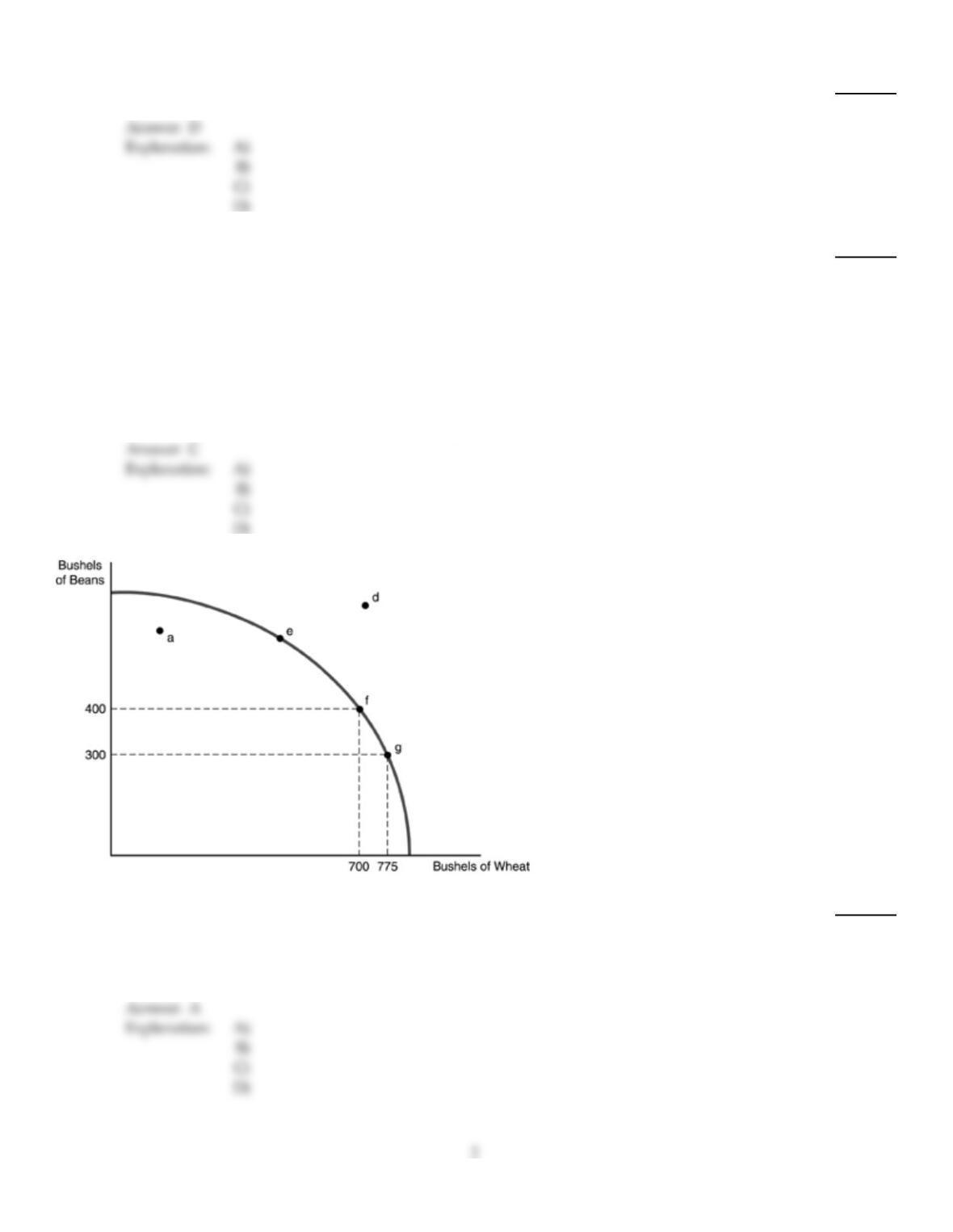
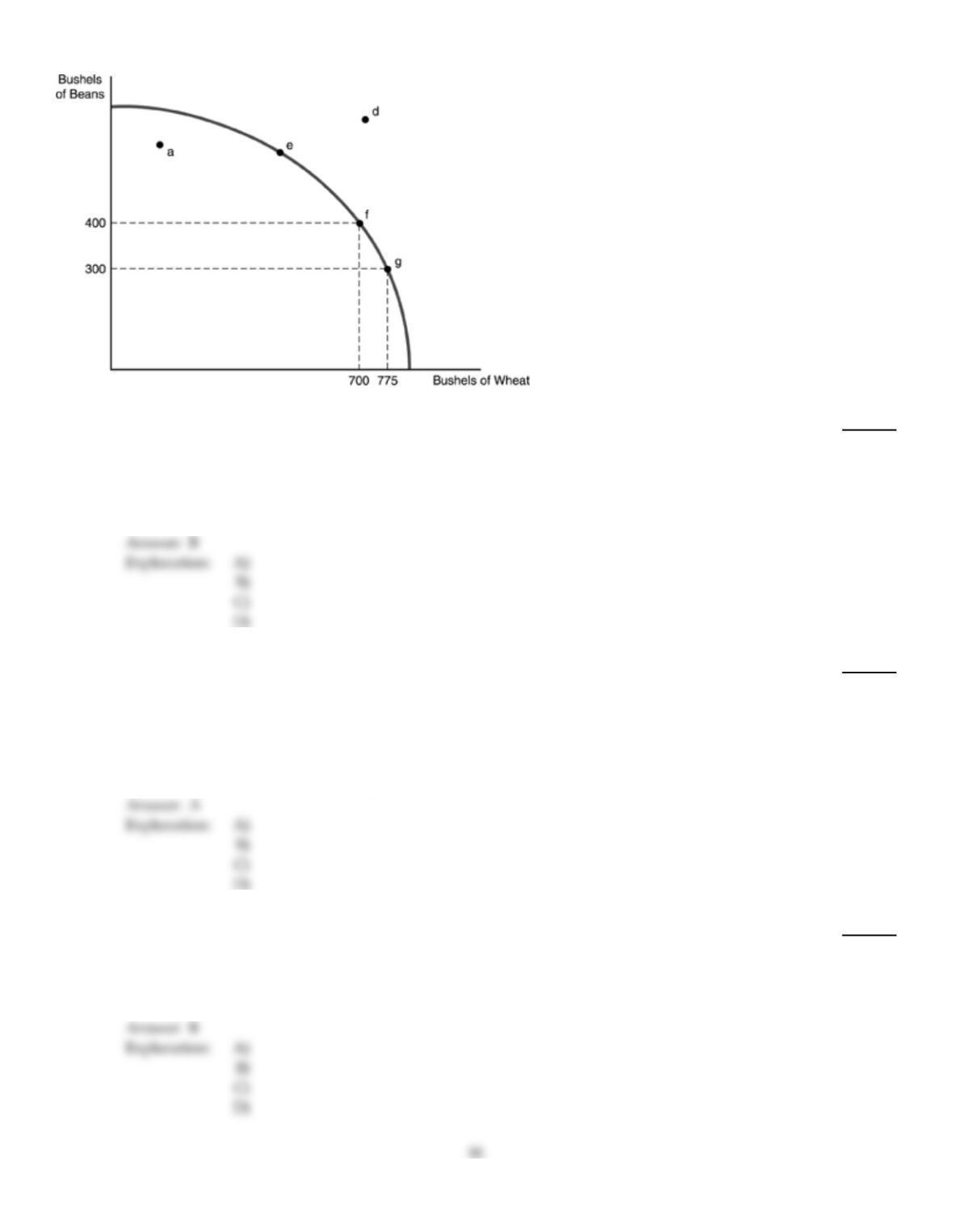
Refer to the above figure. Which of the following points indicates an inefficient use of resources?
7)
A)
a
B)
d
C)
e
D)
More information is needed to answer the question.
A
D

8)
The division of labor refers to
8)
A)
workers being assigned specific tasks.
B)
creating jobs that all people can perform at the same level.
C)
separating men and women in the workforce.
D)
workers performing multiple tasks.
9)
Opportunity cost is
9)
A)
the value of the next–best alternative that must be sacrificed to satisfy a want.
B)
the cost of producing all goods and services in the United States.
C)
the value of the most useful alternative that must be sacrificed to obtain something or satisfy a
want.
D)
the fixed cost of production.
10)
Capital goods
10)
A)
are a special type of consumption goods.
B)
are goods used to make consumer goods and services.
C)
lead to inward shifts of a production possibilities curve.
D)
are consumed because they enhance the enjoyment consumers obtain from other goods and
services.
11)
A straight–line production possibilities curve takes this shape because
11)
A)
resources are fixed.
B)
the opportunity cost of producing more of a good is decreasing.
C)
the opportunity cost of producing a good is constant.
D)
resources are better suited for producing one output than another.

12)
Why specialize?
12)
A)
because assigning each worker a variety of tasks makes her more productive
B)
There is no economic rationale for specialization.
C)
to decrease our dependence on each other
D)
It usually increases productivity.
13)
The opportunity cost of going to college full time away from home includes
13)
A)
the funds you would have saved if you had not paid the tuition.
B)
the time you could have spent with friends back home.
C)
the income you could have earned from a full–time job.
D)
All of the above are correct.
14)
A bowed production possibilities curve is consistent with
14)
A)
a technologically inefficient society.
B)
an unchanged opportunity cost.
C)
the underutilization of productive resources.
D)
highly specialized resources.
15)
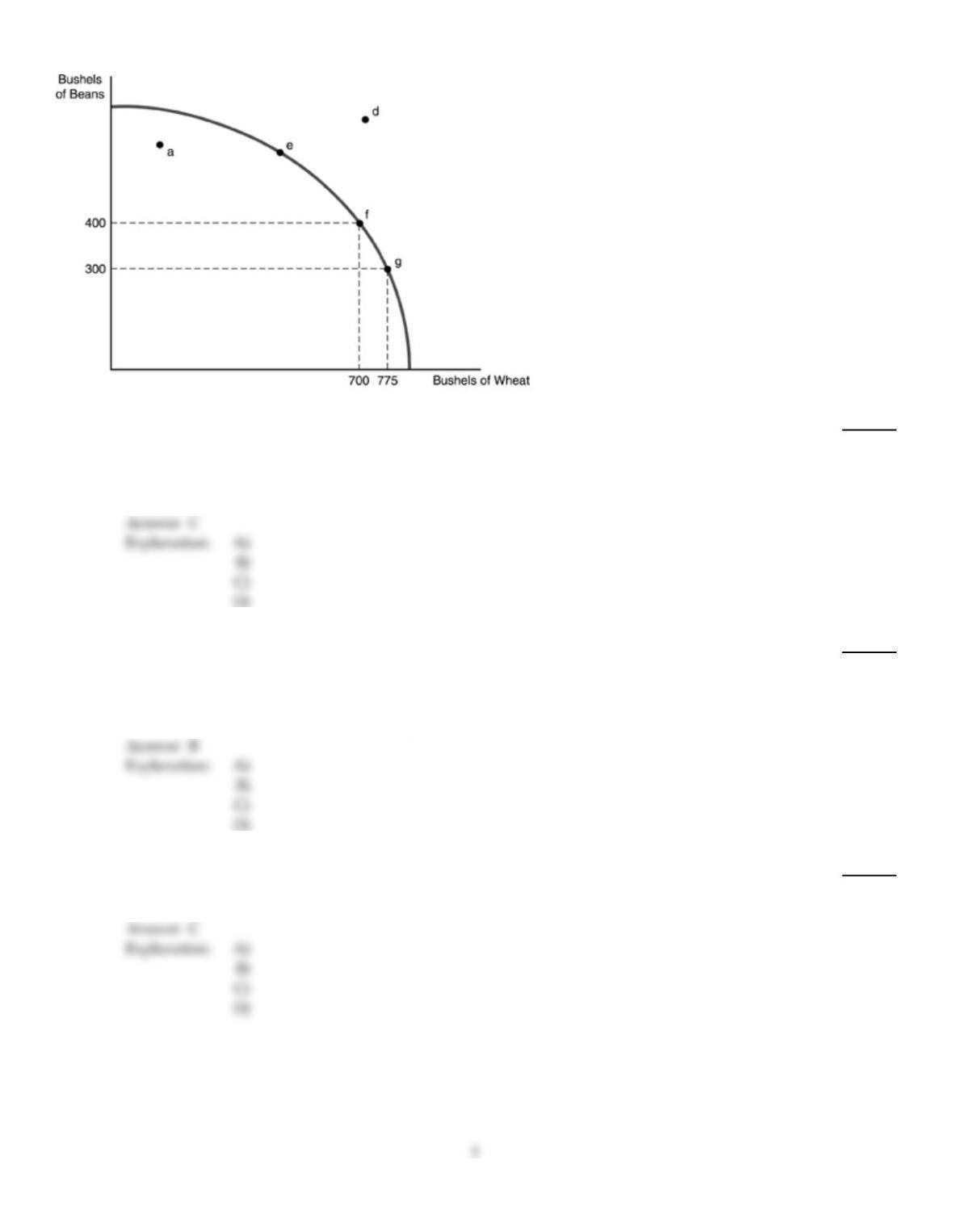
Refer to the above figure. Which of the following would allow society to move to point d?
15)
A)
concentrating production in wheat
B)
producing efficiently
C)
increasing the quantity of labor
D)
using the best land to produce wheat and the lower quality land to produce beans
16)
When deriving the production possibilities curve, it is assumed that
16)
A)
most resources can be used to produce only one good.
B)
resources are efficiently used.
C)
the amount of each good that is to be produced is fixed.
D)
the prices of resources are fixed along the curve.
17)
In economic terminology, when a resource is used to produce output it is referred to as
17)
A)
an intangible.
B)
a service.
C)
a factor of production.
D)
a fifth element.

18)
The law of increasing additional cost exists because
18)
A)
the demand for the product increases.
B)
the cost of resources of the products decrease.
C)
the cost of resources of the products increase.
D)
resources are not perfectly adaptable to both production processes.
19)
Which of the following is the best example of scarcity?
19)
A)
Fred only gets a 10–hour lunch break and each day must decide between working out at the
gym or socializing with his colleagues.
B)
There is a bumper crop of strawberries, and stores have more berries than they can sell.
C)
The local market’s buy–one–get–one–free sale on strawberries results in more people
wanting the berries than producers are able and willing to supply.
D)
The Talking Teddy is a surprise holiday hit, resulting in long lines of consumers trying to
purchase the limited number of available Teddies.
Explanation:
20)
Which of the following is the LEAST scarce?
20)
A)
air
B)
housing
C)
medicine
D)
college education
Explanation:
21)
Opportunity cost
21)
A)
can only be measured as a paid cost.
B)
does not exist since there are no receipts.
C)
is always the value of the next best forgone opportunity.
D)
is always the lowest valued alternative.
Explanation:
Explanation:
22)
An improvement in technology will shift the production possibilities curve
22)
A)
to the left.
B)
to the right.
C)
inward.
D)
along the curve.
23)
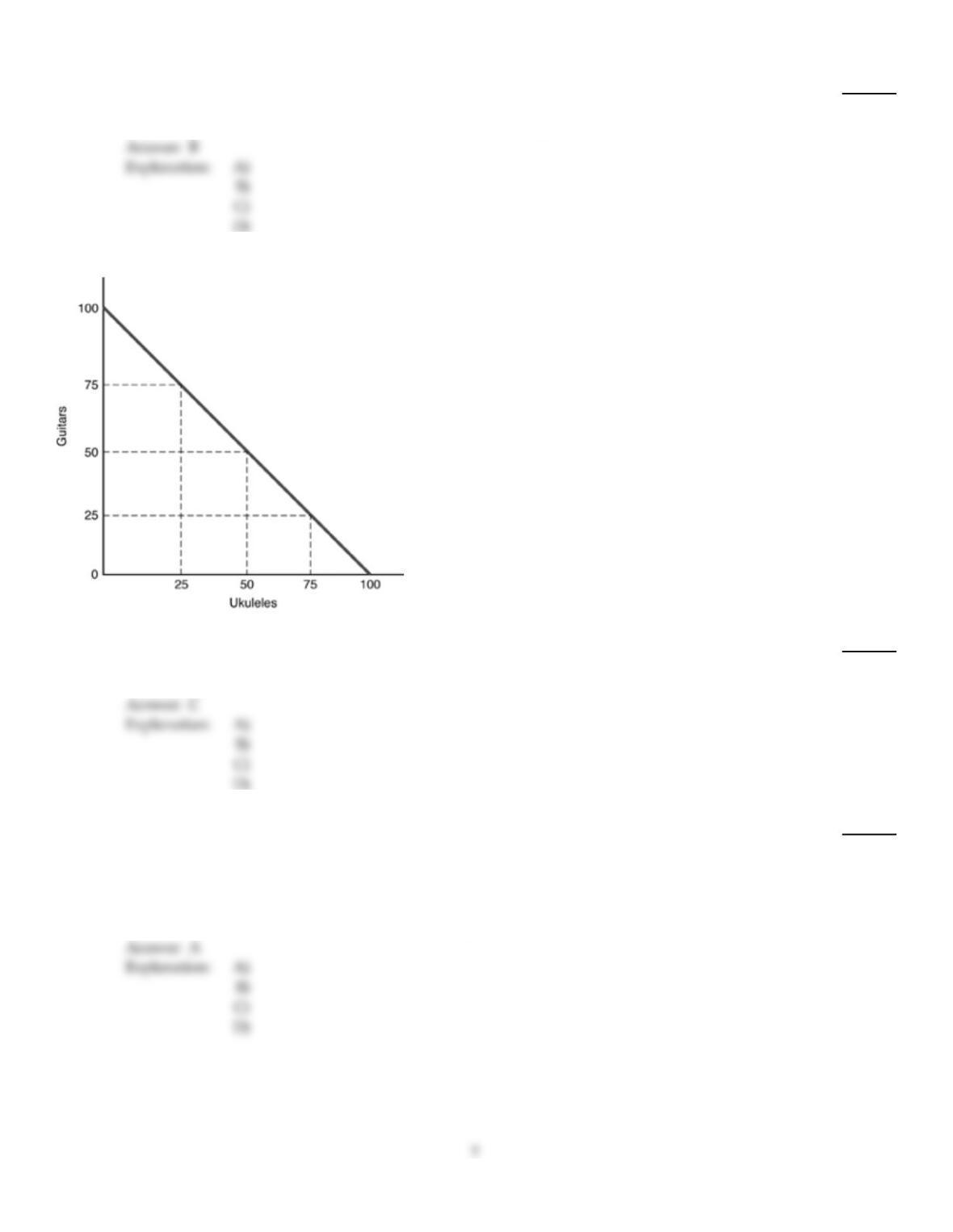
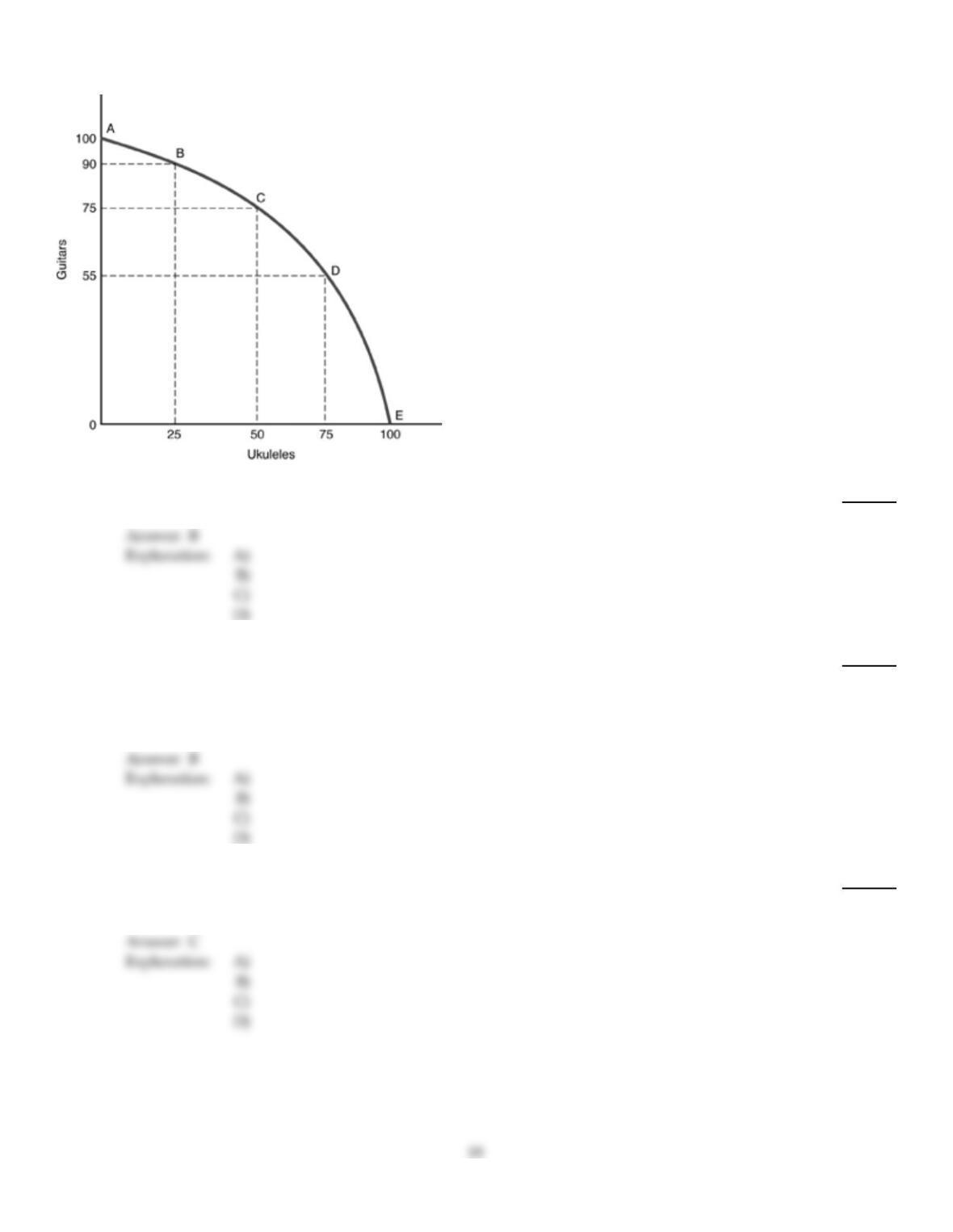
In the above figure, the opportunity cost of moving from producing 75 guitars and 25 ukuleles to
producing 50 guitars and 50 ukuleles is
23)
A)
100 guitars.
B)
50 guitars.
C)
25 guitars.
D)
25 ukuleles.
24)
The production possibilities curve represents
24)
A)
the maximum combination of goods and services that can be produced with fixed resources
and technology, given efficient use of the resources.
B)
the maximum rate of growth of capital and labor in a country.
C)
the maximum amount of labor and capital available to society.
D)
the combinations of goods and services among which consumers are indifferent.

25)
Suppose that at a bicycle shop, instead of having each worker assemble an entire bicycle
themselves, one person welds the frames, another person works on the braking system, another
person works on the tires, and another person works on the gears. This best demonstrates the
concept of
25)
A)
comparative advantage.
B)
absolute advantage.
C)
division of labor.
D)
microeconomics.
26)
Using productive resources to make capital goods requires that we
26)
A)
get government approval of our plan to make capital goods.
B)
forgo some level of current consumption.
C)
get everyone to agree on the best use of those resources.
D)
prove that the existence of the capital goods will not cause any environmental damage.
Explanation:
Explanation:
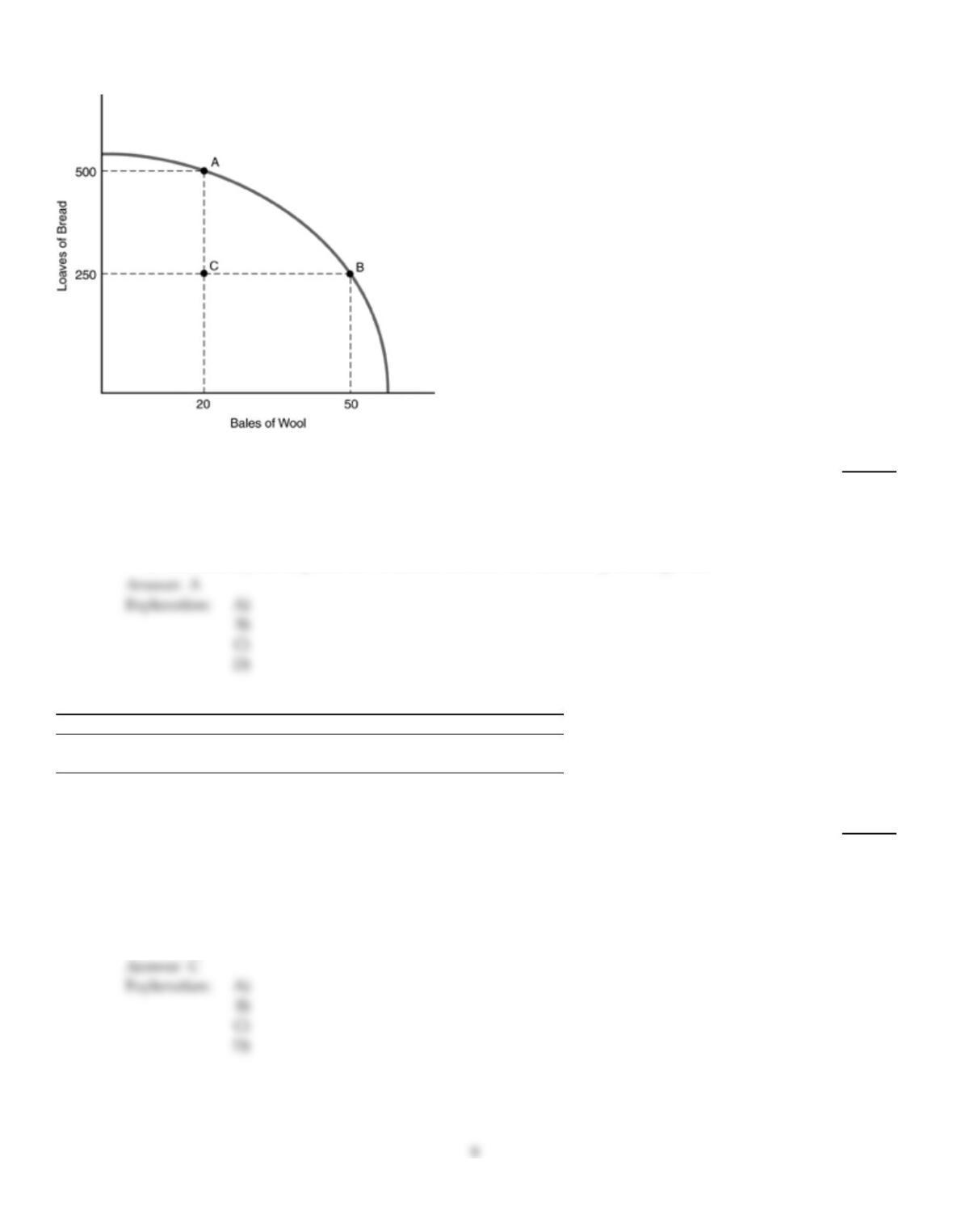
27)
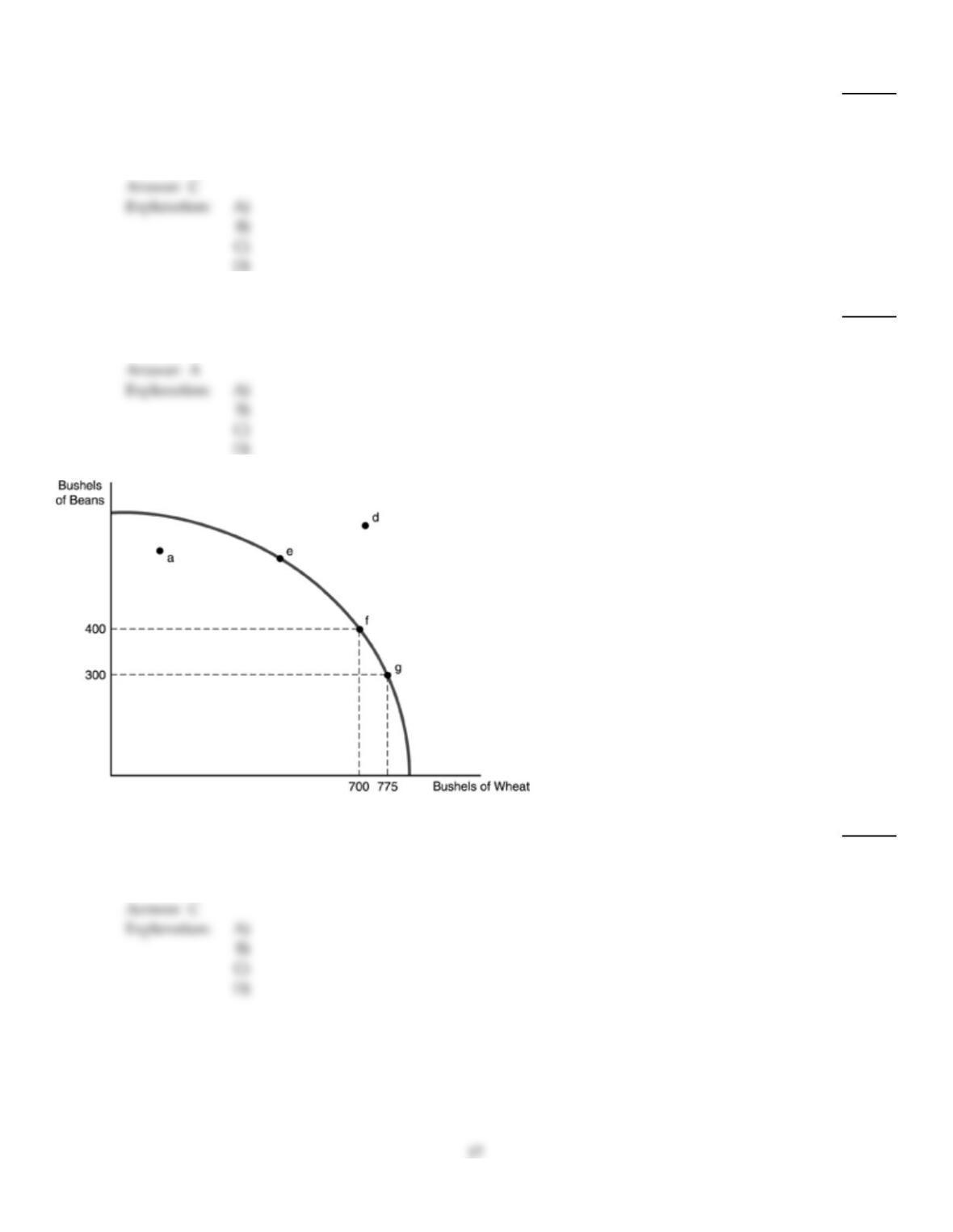
Refer to the above figure. How do you describe what is happening as the economy moves from
point A to point B?
27)
A)
Land that was once used to grow wheat is now being used to graze sheep.
B)
The technology for growing wheat has improved.
C)
The economy is producing more bread by choosing to produce less wool.
D)
The economy has acquired new resources that are well suited for producing wool.
A B C D E
Televisions 100 90 75 55 0
Computers 025 50 75 100
The above table shows the daily production possibilities for a nation.
28)
Given the production possibilities schedule in the above table, a combination of 75 televisions and
60 personal computers
28)
A)
can be produced only if society is willing to have some of its resources used inefficiently.
B)
clearly illustrates the trade–off between televisions and computers.
C)
cannot be produced by society, given its current level of resources and production
technology.
D)
is attainable but involves the unemployment of some of society’s resources.
29)
An efficient point of production is
29)
A)
the point where we are currently producing.
B)
a point inside the production possibilities curve.
C)
a point on the production possibilities curve.
D)
the point where scarcity no longer exists.
30)
The conversion of resources into consumer goods or services is called
30)
A)
human capital.
B)
production.
C)
absolute advantage.
D)
opportunity cost.
31)
You like to sleep until 11:00 am during the semester. What is the opportunity cost of attending an
8:00 am class?
31)
A)
sleep
B)
nothing, since you can go back to bed later
C)
the money you spend on coffee to stay awake
D)
obtaining the notes from the 8:00 am class
32)
Trading off capital goods for increasing amounts of consumer goods today will most likely result in
32)
A)
decreased long–term growth.
B)
decreased prices in consumer goods.
C)
increases in the quantity of consumer goods.
D)
increased long–term growth.
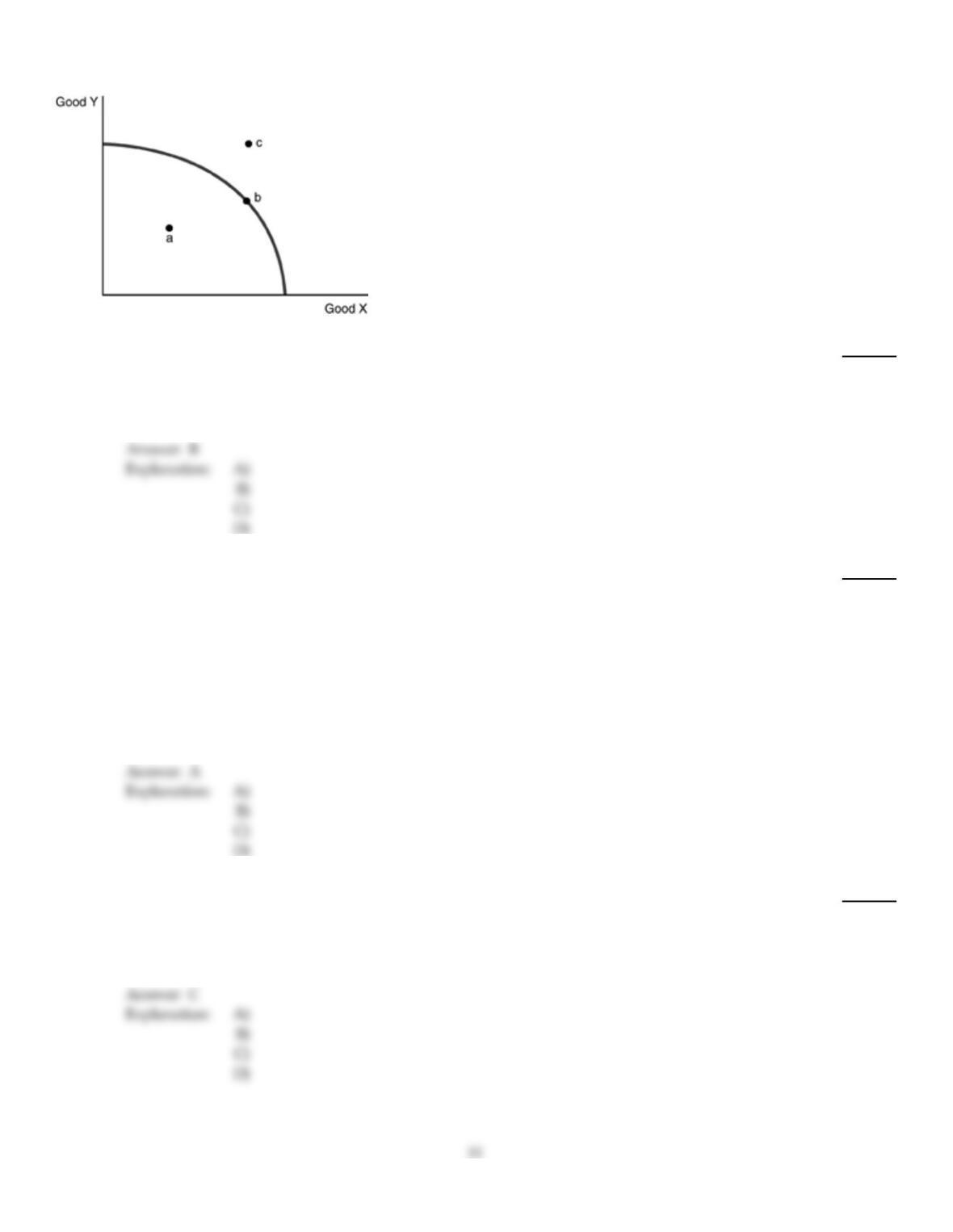
33)
Refer to the above figure. Which of the following statements is TRUE?
33)
A)
Point a is unobtainable, point b is efficient and point c is inefficient.
B)
Point a is inefficient, point b is efficient and point c is unobtainable.
C)
Point a is efficient, Point b is efficient, point c is inefficient.
D)
All of the points are efficient.
34)
A student has a job that pays a wage rate of $10 per hour. The night before an economics exam, the
student has set aside four hours to study for the exam, estimating that for each hour spent studying,
her grade will rise by 5 points. That night, she gets a call from her employer to come to work for a
wage rate of $15 per hour for that night. She decides to work for three hours and earn an extra
$45.00. The next day she takes the test and gets a grade of 75. The opportunity cost for her work is
34)
A)
the 15 extra points she estimates that she could have earned on the exam if she had studied
the extra three hours.
B)
the $45.00 she earned.
C)
the entire four hours she set aside for studying.
D)
the three hours she did not study.
A
35)
All of the following are resources EXCEPT
35)
A)
the computer in the student computer lab.
B)
doctors because they perform services.
C)
money.
D)
the land the Statue of Liberty sits on.
C
B

36)
Efficiency is achieved
36)
A)
when prices of all goods and services go to zero.
B)
when output is being produced at a point inside a production possibilities curve.
C)
when consumers are able to buy everything that they want.
D)
when producers are getting the maximum possible output from the available resources.
37)
A bowed Production Possibilities Curve (PPC) indicates
37)
A)
only 1 good is always being produced.
B)
changing technology.
C)
inefficient production.
D)
that the trade–off between the 2 goods is not constant.
38)
A point outside a production possibilities curve indicates
38)
A)
an output combination that is unobtainable with the current resource and technology levels.
B)
that resources are not being used efficiently.
C)
opportunity costs are constant.
D)
that resources are being used very efficiently.
39)
Human resources that perform the functions of organizing, managing, and assembling the other
factors of production are called
39)
A)
physical capital.
B)
entrepreneurs.
C)
venture capital.
D)
productive capital.
40)
Which of the following is NOT considered to be an economic resource?
40)
A)
the telephone company repair truck
B)
your economics professor
C)
the local gas station
D)
a view of the stars on a clear night

41)
The production possibilities curve demonstrate which of the following concepts?
41)
A)
scarcity
B)
trade–offs
C)
choice
D)
all of the above
A B C D E
Pizza (Pies) 030 60 90 120
Bread (Loaves) 300 240 180 120 60
The above table shows the daily production possibilities for a bakery.
Currently the bakery bakes 60 pizzas and 180 loaves of bread, that is at alternative C.
42)
Using the above table, moving from alternative C to alternative B, what is the opportunity cost of
one loaf of bread?
42)
A)
0.5 pizza pie
B)
2 pizza pies
C)
30 pizza pies
D)
1 pizza pie
43)
When a country specializes and trades with other countries, it is most likely that it specializes in
goods for which
43)
A)
it has no advantage.
B)
it has a comparative advantage.
C)
it has an absolute advantage.
D)
are very costly to produce.
44)
“Wants” as an economic concept includes
44)
A)
only those goods that can be purchased with one‘s paycheck.
B)
only the desire for luxury goods.
C)
both material and nonmaterial desires.
D)
only the purchase of necessary basic goods.
45)
A production possibilities curve with quantities of clothing and food on the axes shows which of
the following?
I. A society cannot have an unlimited amount of each good.
II. For an efficient society, an increase in clothing production will necessitate a decrease in food
production.
III. A society will always produce the maximum amount of both clothing and food.
45)
A)
I only
B)
II only
C)
III only
D)
Both I and II
46)
The production possibilities curve (PPC) illustrates economic growth by a(n)
46)
A)
inward shift of the PPC.
B)
movement along the PPC.
C)
bowed–out shape of the PPC.
D)
outward shift of the PPC.
47)
Look at the following production possibilities table for smartphones and tablets. The table shows
the maximum combination of smartphones and tablets of corn that can be produced, when all
resources are fully employed.
Production Possibilities
Good A B C D E
Smartphones 10 20 30 40 50
Tablets 150 140 120 90 50
Based on the above information
47)
A)
the opportunity cost of producing 30 instead of 20 smartphones is 120 tablets.
B)
the opportunity cost of producing 40 instead of 30 smartphones is 30 tablets.
C)
the opportunity cost of producing 90 instead of 50 tablets is 50 smartphones.
D)
there is no trade–off between smartphones and tablets.

A B C D E
Pizza (Pies) 030 60 90 120
Bread (Loaves) 300 240 180 120 60
The above table shows the daily production possibilities for a bakery.
Currently the bakery bakes 60 pizzas and 180 loaves of bread, that is at alternative C.
48)
Using the above table but now the bakery bakes 30 pizzas and 240 loaves of bread (alternative B),
moving from alternative B to alternative D, what is the opportunity cost of one pizza pie?
48)
A)
150 loaves of bread
B)
2.5 loaves of bread
C)
2 loaves of bread
D)
0.5 loaf of bread
49)
To an economist, the term “needs”
49)
A)
is objectively undefinable.
B)
identifies the purchases of basic goods and services.
C)
refers to the purchase of goods by the poor.
D)
means the purchase of necessary goods.
50)
International trade between two nations increases the standard of living of both nations due to
50)
A)
specialization and gains from absolute advantage.
B)
specialization and gains from comparative advantage.
C)
political intervention.
D)
high tariffs.
51)
Refer to the above figure. Which of the following points indicates an unobtainable point of
production?
51)
A)
a
B)
d
C)
e
D)
More information is needed to answer the question.
52)
John and Mary work eight hours at a bakery. John can decorate either 10 ice–cream cakes or 4
wedding cakes; Mary can decorate either 8 ice–cream cakes or 2 wedding cakes. According to this
scenario
52)
A)
Mary has the comparative advantage in decorating ice–cream cakes.
B)
John has the comparative advantage in decorating ice–cream cakes.
C)
Mary has the absolute advantage in decorating ice–cream cakes.
D)
Mary has the absolute advantage in decorating wedding cakes.
A
53)
The reason the production possibilities curve is bowed outward (concave) is
53)
A)
that the number of resources is increasing.
B)
the law of increasing additional cost.
C)
that the economy has more capital goods than entrepreneurial effort.
D)
that technology is constantly changing.
B
B
54)
An example of an entrepreneur would be
54)
A)
a Greyhound bus driver.
B)
the cashier at your local supermarket.
C)
the owner of a new Indian food restaurant.
D)
the cafeteria employee who won the employee of the month award.
55)
In economics, resources are also known as
55)
A)
factors of production.
B)
factories.
C)
human capital.
D)
minerals.
56)
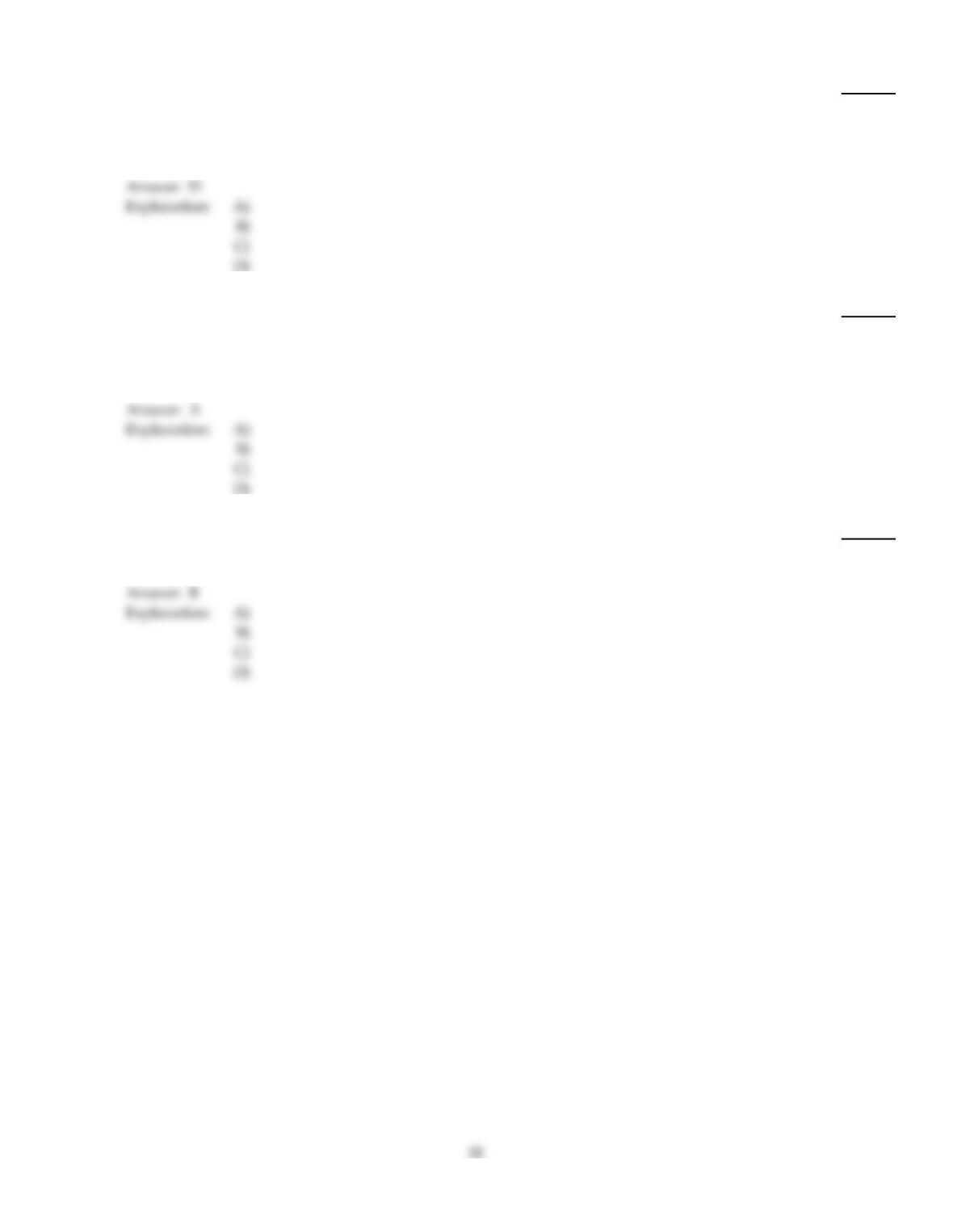
Refer to the above figure. Between points f and g, the opportunity cost of producing 75 more
bushels of wheat is
56)
A)
1 bushel of beans.
B)
4 bushels of beans.
C)
100 bushels of beans.
D)
25 bushels of beans.
57)
Scarcity arises because
57)
A)
a large number of people live in poverty.
B)
production of goods and services is always slow.
C)
companies are slow to explore for new resources.
D)
resources are finite and are inadequate to meet all human wants.
58)
When determining the production possibilities curve
58)
A)
the amount of productive resources remains constant.
B)
the trade–off between the goods in the economy remains constant.
C)
the prices of resources are used.
D)
the prices of the goods are used.
59)
The saying that “You cannot have your cake and eat it too” illustrates the economic concept of
59)
A)
a normative statement.
B)
opportunity cost.
C)
physical capital.
D)
a positive statement.
60)
In the above figure, the opportunity cost of moving from point D to point C is
60)
A)
50 ukuleles.
B)
25 ukuleles.
C)
55 guitars.
D)
20 guitars.
61)
Why is efficiency desirable?
61)
A)
It results in an equal distribution of income.
B)
It makes best use of the finite resources we have.
C)
It results in zero unemployment.
D)
It is the most politically popular solution.
62)
The basic problem in economics is
62)
A)
unlimited needs.
B)
limited resources.
C)
scarcity.
D)
demand.

63)
Scarcity
63)
A)
does not exist in the United States.
B)
is caused by production problems.
C)
applies only to developing countries.
D)
is not a shortage.
64)
When a society takes increasing amounts of resources and applies them to the production of a
specific good, resulting in increasing opportunity costs for each additional unit produced, which of
the following applies?
64)
A)
the law of scarcity
B)
the law of supply
C)
the law of demand
D)
the law of increasing additional costs
65)
If Irene can make either four chairs or one table in an hour and Greg can make either three chairs or
two tables in an hour, then
65)
A)
Greg has the comparative advantage in the production of chairs.
B)
Greg has the absolute advantage in the production of chairs.
C)
Irene has the absolute advantage in the production of tables.
D)
Irene has the comparative advantage in the production of chairs.