Microeconomics, 4e (Hubbard/O’Brien)
Chapter 2 Trade-offs, Comparative Advantage, and the Market System
2.1 Production Possibilities Frontiers and Opportunity Costs
1) Scarcity
A) stems from the incompatibility between limited resources and unlimited wants.
B) can be overcome by discovering new resources.
C) can be eliminated by rationing products.
D) is a bigger problem in market economies than in socialist economies.
2) BMW recently decided to build a manufacturing plant in Shenyang, China. At this plant,
BMW is able to take advantage of paying lower wages to its Chinese workers than it pays its
German workers, but it also sacrifices the high levels of technical training possessed by its
German workers. In deciding to open the Shenyang plant, BMW
A) faced no trade-offs because employing lower-wage workers increased efficiency.
B) faced a trade-off between higher cost and lower precision.
C) adopted a negative technological change because it replaced high-skilled workers with low-
skilled workers.
D) eroded some of its competitiveness in the luxury car market because of its decreased cost of
production.
3) The principle of opportunity cost is that
A) in a market economy, taking advantage of profitable opportunities involves some money cost.
B) the economic cost of using a factor of production is the alternative use of that factor that is
given up.
C) taking advantage of investment opportunities involves costs.
D) the cost of production varies depending on the opportunity for technological application.
4) The production possibilities frontier shows the ________ combinations of two products that
may be produced in a particular time period with available resources.
A) minimum attainable
B) maximum attainable
C) only
D) equitable
5) The production possibilities frontier model shows that
A) if consumers decide to buy more of a product its price will increase.
B) a market economy is more efficient in producing goods and services than is a centrally
planned economy.
C) economic growth can only be achieved by free market economies.
D) if all resources are fully and efficiently utilized, more of one good can be produced only by
producing less of another good.
6) The production possibilities frontier model assumes which of the following?
A) Labor, capital, land and natural resources are unlimited in quantity.
B) The economy produces only two products.
C) Any level of the two products that the economy produces is currently possible.
D) The level of technology is variable.
7) The attainable production points on a production possibility curve are
A) the horizontal and vertical intercepts.
B) the points along the production possibilities frontier.
C) the points outside the area enclosed by the production possibilities frontier.
D) the points along and inside the production possibility frontier.
8) The points outside the production possibilities frontier are
A) efficient.
B) attainable.
C) inefficient.
D) unattainable.
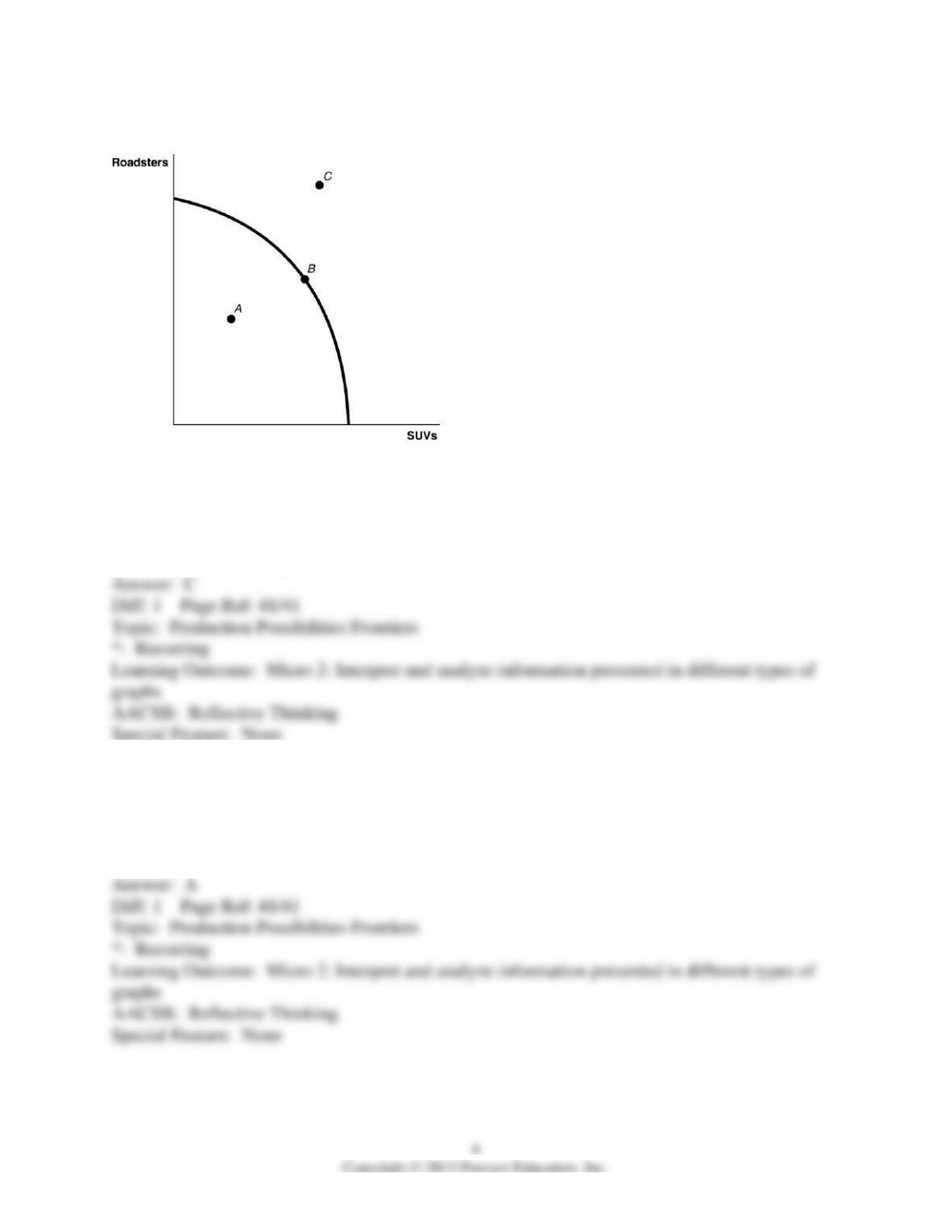
Figure 2-1
9) Refer to Figure 2-1. Point A is
A) technically efficient.
B) unattainable with current resources.
C) inefficient in that not all resources are being used.
D) the equilibrium output combination.
10) Refer to Figure 2-1. Point B is
A) technically efficient.
B) unattainable with current resources.
C) inefficient in that not all resources are being used.
D) the equilibrium output combination.
11) Refer to Figure 2-1. Point C is
A) technically efficient.
B) unattainable with current resources.
C) inefficient in that not all resources are being used.
D) is the equilibrium output combination.
12) In a production possibilities frontier model, a point ________ the frontier is productively
inefficient.
A) along
B) inside
C) outside
D) at either intercept of
13) Bella can produce either a combination of 60 silk roses and 80 silk leaves or a combination
of 70 silk roses and 55 silk leaves. If she now produces 60 silk roses and 80 silk leaves, what is
the opportunity cost of producing an additional 10 silk roses?
A) 2.5 silk leaves
B) 10 silk leaves
C) 25 silk leaves
D) 55 silk leaves
14) If the production possibilities frontier is ________, then opportunity costs are constant as
more of one good is produced.
A) bowed out
B) bowed in
C) non-linear
D) linear
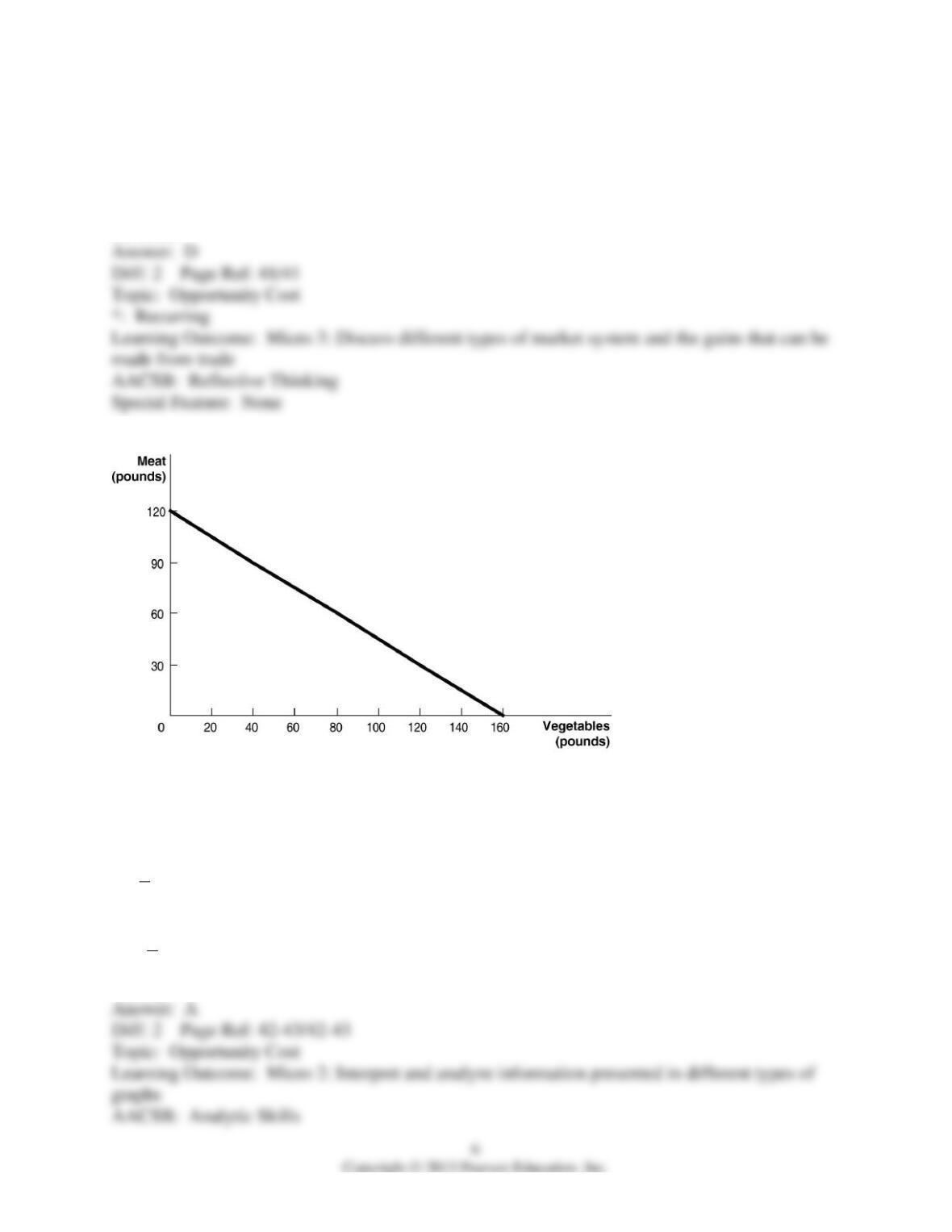
Figure 2-2
Figure 2-2 above shows the production possibilities frontier for Mendonca, an agrarian nation
that produces two goods, meat and vegetables.
15) Refer to Figure 2-2. What is the opportunity cost of one pound of vegetables?
A)
4
3
pound of meat
B) 1.2 pounds of meat
C) 1
3
1
pounds of meat
D) 12 pounds of meat
16) Refer to Figure 2-2. What is the opportunity cost of one pound of meat?
A)
4
3
pound of vegetables
B) 1
3
1
pounds of vegetables
C) 1.6 pounds of vegetables
D) 16 pounds of vegetables
17) Refer to Figure 2-2. Suppose Mendonca is currently producing 60 pounds of vegetables per
period. How much meat is it also producing, assuming that resources are fully utilized?
A) 45 pounds of meat
B) 75 pounds of meat
C) 80 pounds of meat
D) 100 pounds of meat
18) Refer to Figure 2-2. The linear production possibilities frontier in the figure indicates that
A) Mendonca has a comparative advantage in the production of vegetables.
B) Mendonca has a comparative disadvantage in the production of meat.
C) the tradeoff between meat and vegetables is constant.
D) it is progressively more expensive to produce meat.
19) A production possibilities frontier with a bowed outward shape indicates
A) the possibility of inefficient production.
B) constant opportunity costs as more and more of one good is produced.
C) increasing opportunity costs as more and more of one good is produced.
D) decreasing opportunity costs as more and more of one good is produced.
20) Increasing opportunity cost is represented by a ________ production possibilities frontier.
A) linear
B) bowed in
C) bowed out
D) vertical
21) The slope of a production possibilities frontier
A) has no economic relevance or meaning.
B) is always constant.
C) is always varying.
D) measures the opportunity cost of producing one more unit of a good.
22) ________ marginal opportunity cost implies that the more resources already devoted to any
activity, the payoff from allocating yet more resources to that activity increases by progressively
smaller amounts.
A) Increasing
B) Decreasing
C) Constant
D) Negative
23) If opportunity costs are constant, the production possibilities frontier would be graphed as
A) a ray from the origin.
B) a positively sloped straight line.
C) a negatively sloped curve bowed in toward the origin.
D) a negatively sloped straight line.
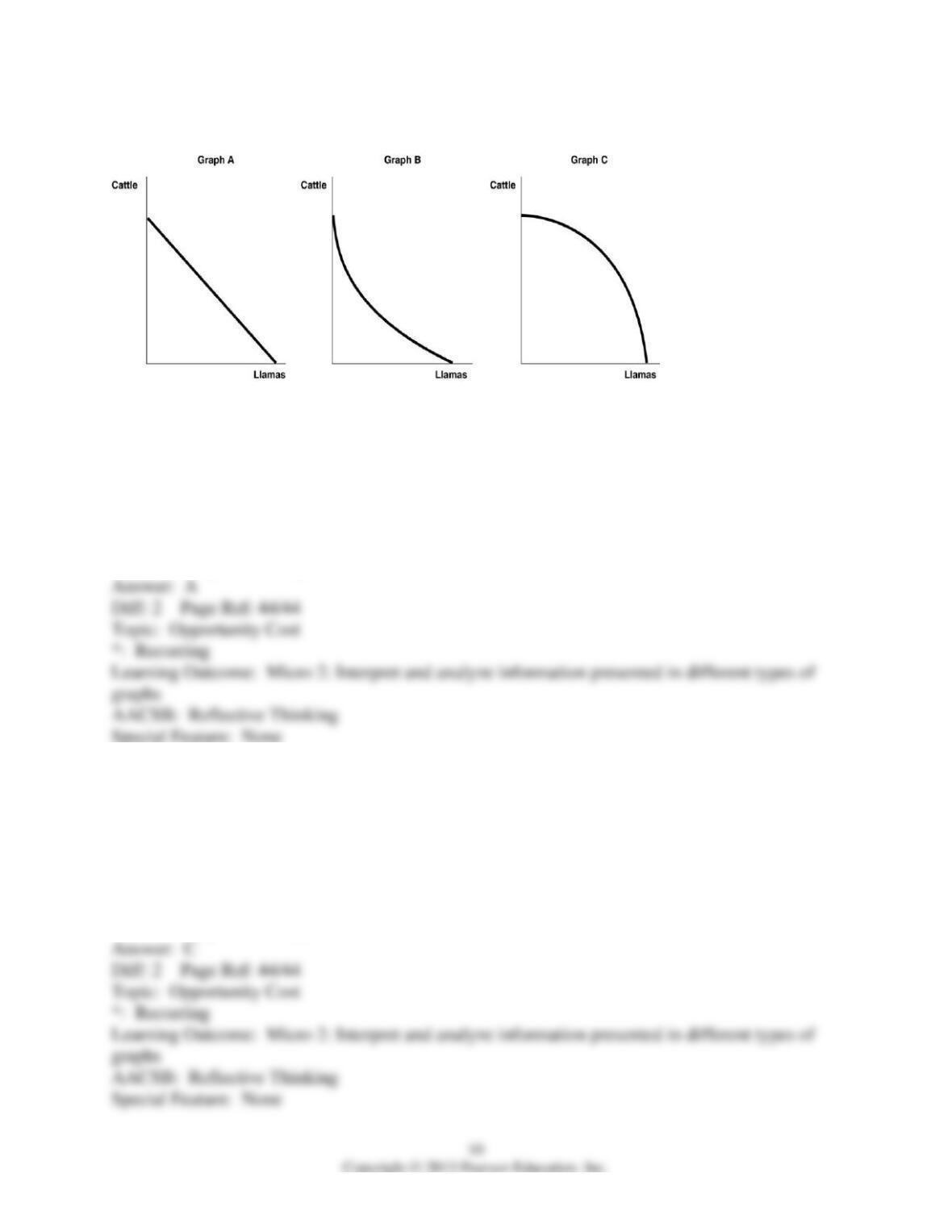
Figure 2-3
24) Refer to Figure 2-3. Sergio Vignetto raises cattle and llamas on his land. His land is equally
suitable for raising either animal. Which of the graphs in Figure 2-3 represent his production
possibilities frontier?
A) Graph A
B) Graph B
C) Graph C
D) either Graph A or Graph C
E) either Graph B or Graph C
25) Refer to Figure 2-3. Sergio Vignetto raises cattle and llamas on his land. A portion of his
land is more suitable for raising cattle, and the other portion is better suited for raising llamas.
Which of the graphs in Figure 2-3 represent his production possibilities frontier?
A) Graph A
B) Graph B
C) Graph C
D) either Graph A or Graph C
E) either Graph B or Graph C
Table 2-1
Production choices for Tomaso’s Trattoria
Choice
Quantity of
Pizzas
Produced
Quantity of
Calzones
Produced
A
48
0
B
36
15
C
24
30
D
12
45
E
0
60
26) Refer to Table 2-1. Assume Tomaso’s Trattoria only produces pizzas and calzones. A
combination of 24 pizzas and 30 calzones would appear
A) along Tomaso’s production possibilities frontier.
B) inside Tomaso’s production possibilities frontier.
C) outside Tomaso’s production possibilities frontier.
D) at the horizontal intercept of Tomaso’s production possibilities frontier.
27) Refer to Table 2-1. Assume Tomaso’s Trattoria only produces pizzas and calzones. A
combination of 36 pizzas and 30 calzones would appear
A) along Tomaso’s production possibilities frontier.
B) inside Tomaso’s production possibilities frontier.
C) outside Tomaso’s production possibilities frontier.
D) at the horizontal intercept of Tomaso’s production possibilities frontier.
28) Refer to Table 2-1. Assume Tomaso’s Trattoria only produces pizzas and calzones. A
combination of 24 pizzas and 15 calzones would appear
A) along Tomaso’s production possibilities frontier.
B) inside Tomaso’s production possibilities frontier.
C) outside Tomaso’s production possibilities frontier.
D) at the horizontal intercept of Tomaso’s production possibilities frontier.
29) Refer to Table 2-1. Assume Tomaso’s Trattoria only produces pizzas and calzones. Tomaso
faces ________ opportunity costs in the production of pizzas and calzones.
A) increasing
B) decreasing
C) constant
D) negative
30) An inward shift of a nation’s production possibilities frontier can occur due to
A) a reduction in unemployment.
B) a natural disaster like a hurricane or bad earthquake.
C) a change in the amounts of one good desired.
D) an increase in the labor force.
31) An outward shift of a nation’s production possibilities frontier represents
A) economic growth.
B) rising prices of the two goods on the production possibilities frontier model.
C) an impossible situation.
D) a situation in which a country produces more of one good and less of another.
32) Economic decline (negative growth) is represented on a production possibilities frontier
model by the production possibility frontier
A) shifting outward.
B) shifting inward.
C) becoming steeper.
D) becoming flatter.
33) Without an increase in the supplies of factors of production, how can a nation achieve
economic growth?
A) by producing more high-value goods and less of low-value goods
B) through technological advancement which enables more output with the same quantity of
resources
C) by lowering the prices of factors of production
D) by increasing the prices of factors of production
34) Which of the following would shift a nation’s production possibilities frontier outward?
A) discovering a cheap way to convert sunshine into electricity
B) an increase in demand for the nation’s products
C) a decrease in the unemployment rate
D) a law requiring workers to retire at age 50
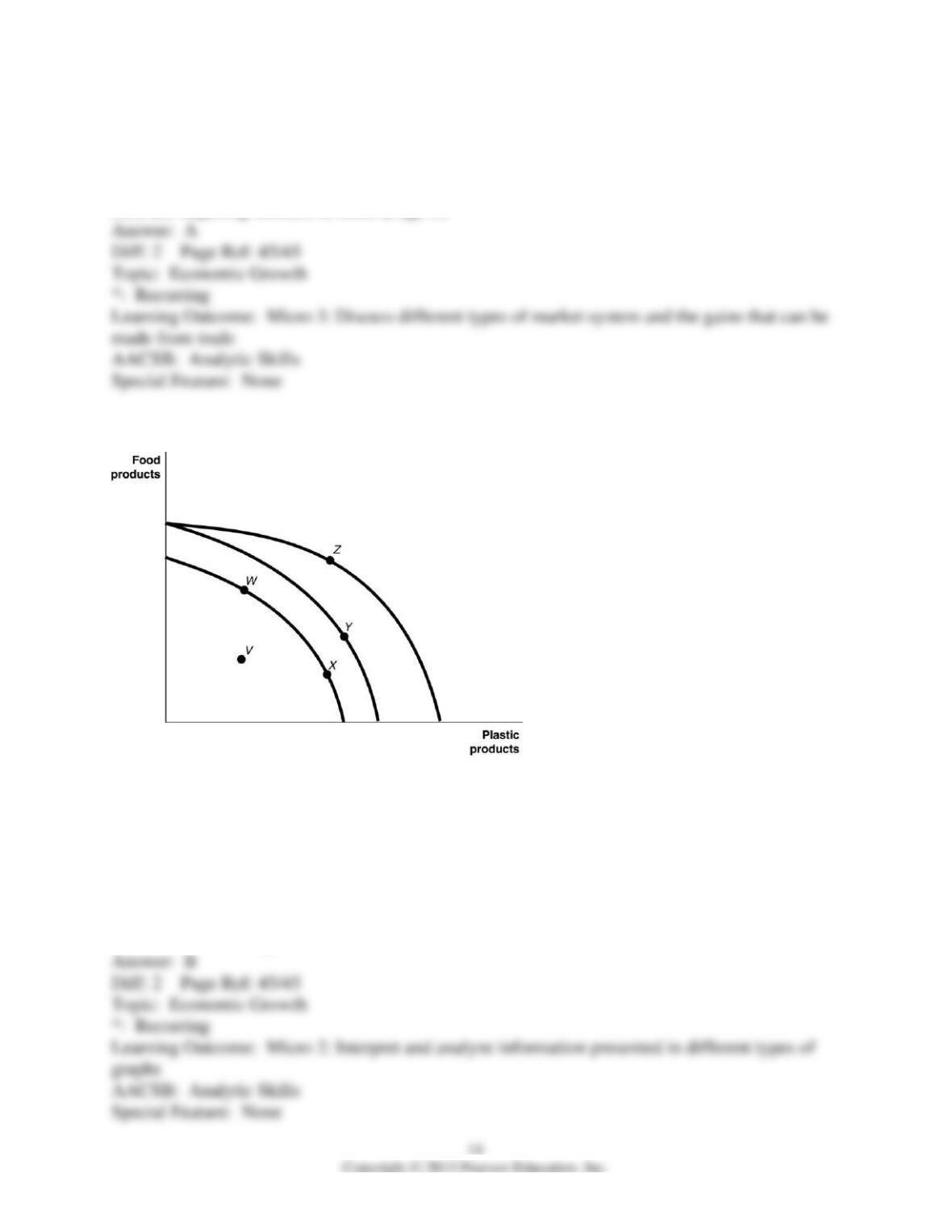
Figure 2-4
Figure 2-4 shows various points on three different production possibilities frontiers for a nation.
35) Refer to Figure 2-4. A movement from X to Y
A) could be due to a change in consumers’ tastes and preferences.
B) could occur because of an influx of immigrant labor.
C) is the result of advancements in food production technology only, with no change in the
technology for plastic production.
D) is the result of advancements in plastic production technology only, with no change in food
production technology.
36) Refer to Figure 2-4. A movement from Y to Z
A) represents an increase in the demand for plastic products.
B) could occur because of general technological advancements.
C) is the result of advancements in food production technology.
D) is the result of advancements in plastic production technology.
37) Refer to Figure 2-4. Consider the following events:
a. an increase in the unemployment rate
b. a decrease in a nation’s money supply
c. a war that kills a significant portion of a nation’s population
Which of the events listed above could cause a movement from Y to W ?
A) a, b and c
B) a and b only
C) a and c only
D) a only
E) c only
38) Refer to Figure 2-4. Consider the following movements:
a. from point V to point W
b. from point W to point Y
c. from point Y to point Z
Which of the movements listed above represents economic growth?
A) a, b, and c
B) b and c only
C) a only
D) b only
39) Refer to Figure 2-4. Consider the following events:
a. a decrease in the unemployment rate
b. general technological advancement
c. an increase in consumer wealth
Which of the events listed above could cause a movement from V to W ?
A) a only
B) a and b only
C) b and c only
D) a, b, and c
40) Refer to Figure 2-4. Consider the following events:
a. a reduction in the patent protection period to no more than 2 years
b. a war that destroys a substantial portion of a nation’s capital stock
c. the lack of secure and enforceable property rights system
Which of the events listed above could cause a movement from W to V?
A) a only
B) a and b only
C) a and c only
D) b and c only
E) a, b, and c
41) The Great Depression of the 1930s with a large number of workers and factories unemployed
would be represented in a production possibilities frontier graph by
A) a point inside the frontier.
B) a point outside the frontier.
C) a point on the frontier.
D) an intercept on either the vertical or the horizontal axis.
42) Suppose there is no unemployment in the economy and society decides that it wants more of
one good. Which of the following statements is true?
A) It can only achieve this with an advance in technology.
B) It can increase output without giving up another good.
C) It can only achieve this with an increase in resource supplies.
D) It will have to give up production and consumption of some other good.
43) If society decides it wants more of one good and all resources are fully utilized, then
A) it is unable to do this unless technology advances.
B) additional resource supplies will have to be found.
C) it has to give up some of another good and incur some opportunity costs.
D) more unemployment will occur.
44) According to the production possibility model, if more resources are allocated to the
production of physical and human capital, then which of the following is likely to happen?
A) fewer goods will be produced for consumption today.
B) the production possibilities frontier will be shift inward in the future
C) future economic growth will decline.
D) the country’s total production will fall.
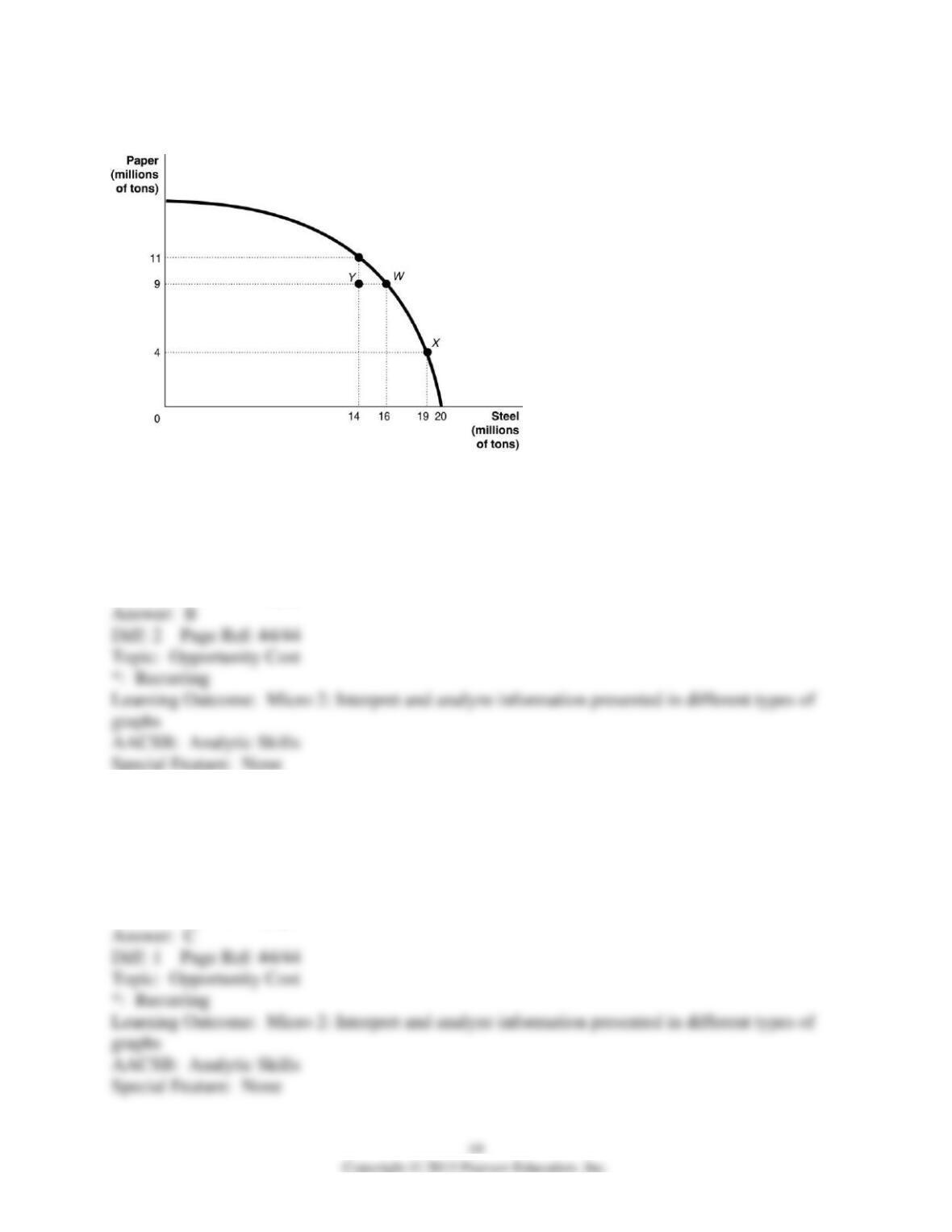
Figure 2-5
45) Refer to Figure 2-5. If the economy is currently producing at point Y, what is the
opportunity cost of moving to point W?
A) 2 million tons of steel
B) zero
C) 9 million tons of paper
D) 16 million tons of paper
46) Refer to Figure 2-5. If the economy is currently producing at point W, what is the
opportunity cost of moving to point X?
A) 3 million tons of steel
B) 19 million tons of steel
C) 5 million tons of paper
D) 9 million tons of paper
47) In a report made to the U.S. Congress in 2001, the National Academy of Sciences cautioned
that if fuel economy encourages the production of smaller and lighter cars, “Some additional
traffic fatalities would be expected.” This statement suggests that
A) U.S. auto manufacturers are more concerned about producing fuel efficient cars to compete
with their Japanese and South Korean rivals than about consumer safety.
B) there is a tradeoff between safety and fuel economy.
C) society should value safety more highly than fuel economy.
D) society should value fuel economy more highly than consumer safety because of the long
term environment benefits generated by less gasoline use.
48) Suppose your expenses for this term are as follows: tuition: $12,000, room and board:
$6,500, books and other educational supplies: $1,500. Further, during the term, you can only
work part-time and earn $3,500 instead of your full-time salary of $14,000. What is the
opportunity cost of going to college this term, assuming that your room and board expenses
would be the same even if you did not go to college?
A) $13,500
B) $20,000
C) $24,000
D) $30,500