Exam
Name___________________________________
SHORT ANSWER. Write the word or phrase that best completes each statement or answers the question.
Solve the problem.
1)
One Internet service provider has the following rate schedule for high–speed Internet
service:
Monthly service charge $18.00
1st 50 hours of use free
Next 50 hours of use $0.25/hour
Over 100 hours of use $1.00/hour
What is the charge for 50 hours of high–speed Internet use in one month?
What is the charge for 75 hours of high–speed Internet use in one month?
What is the charge for 135 hours of high–speed Internet use in one month?
1)
2)
A cellular phone plan had the following schedule of charges:
Basic service, including 100 minutes of calls $20.00 per month
2nd 100 minutes of calls $0.075 per minute
Additional minutes of calls $0.10 per minute
What is the charge for 200 minutes of calls in one month?
What is the charge for 250 minutes of calls in one month?
Construct a function that relates the monthly charge C for x minutes of calls.
2)
3)
An electric company has the following rate schedule for electricity usage in single–family
residences:
Monthly service charge $4.93
Per kilowatt service charge
1st 300 kilowatts $0.11589/kW
Over 300 kilowatts $0.13321/kW
What is the charge for using 300 kilowatts in one month?
What is the charge for using 375 kilowatts in one month?
Construct a function that gives the monthly charge C for x kilowatts of electricity.
3)
4)
A gas company has the following rate schedule for natural gas usage in single–family
residences:
Monthly service charge $8.80
Per therm service charge
1st 25 therms $0.6686/therm
Over 25 therms $0.85870/therm
What is the charge for using 25 therms in one month?
What is the charge for using 45 therms in one month?
Construct a function that gives the monthly charge C for x therms of gas.
4)
5)
The wind chill factor represents the equivalent air temperature at a standard wind speed
that would produce the same heat loss as the given temperature and wind speed. One
formula for computing the equivalent temperature is
W(t) =
t
33 –(10.45 + 10 v– v)(33 – t )
22.04
33 – 1.5958(33 – t)
if 0
v < 1.79
if 1.79
v < 20
if v 20
where v represents the wind speed (in meters per second) and t represents the air
temperature (°C). Compute the wind chill for an air temperature of 15°C and a wind speed
of 12 meters per second. (Round the answer to one decimal place.)
5)
MULTIPLE CHOICE. Choose the one alternative that best completes the statement or answers the question.
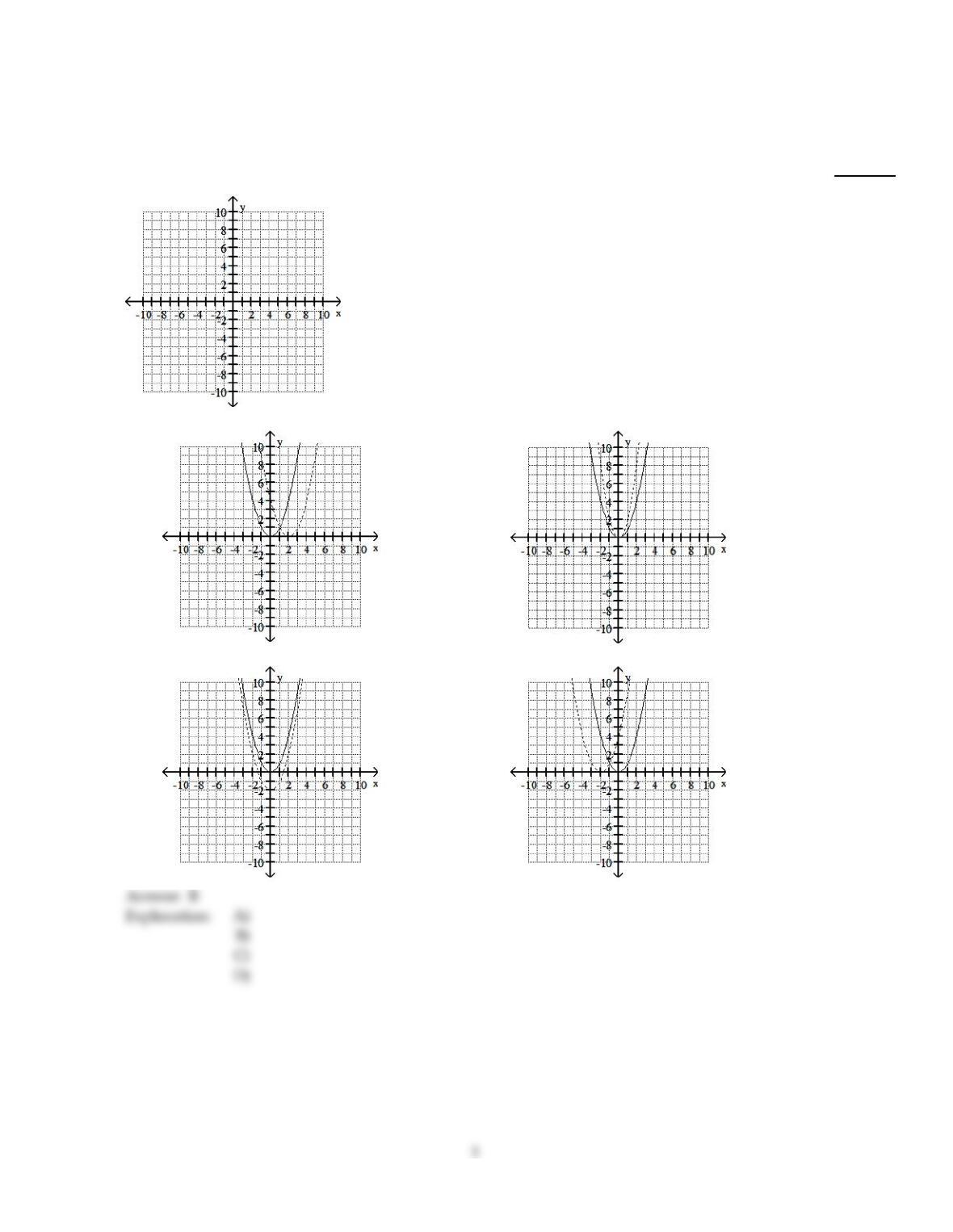
Begin by graphing the standard quadratic function f(x) =x2 . Then use transformations of this graph to graph the given
function.
6)
g(x) =2x2
6)
A)
B)
C)
D)
Write the standard form of the equation of the circle with the given center and radius.
7)
(3, 8); 19
7)
A)
(x + 3)2+ (y + 8)2=19
B)
(x + 8)2+ (y + 3)2=361
C)
(x – 3)2+ (y – 8)2=19
D)
(x – 8)2+ (y – 3)2=361
Find the center and the radius of the circle.
8)
(x + 2)2+ (y – 6)2=81
8)
A)
(2, –6), r =81
B)
(–6, 2), r =81
C)
(6, –2), r =9
D)
(–2, 6), r =9
Determine which two functions are inverses of each other.
9)
f(x) =x + 4
2g(x) =2x + 4 h(x) =x –2
4
9)
A)
None
B)
f(x) and h(x)
C)
g(x) and h(x)
D)
f(x) and g(x)
4
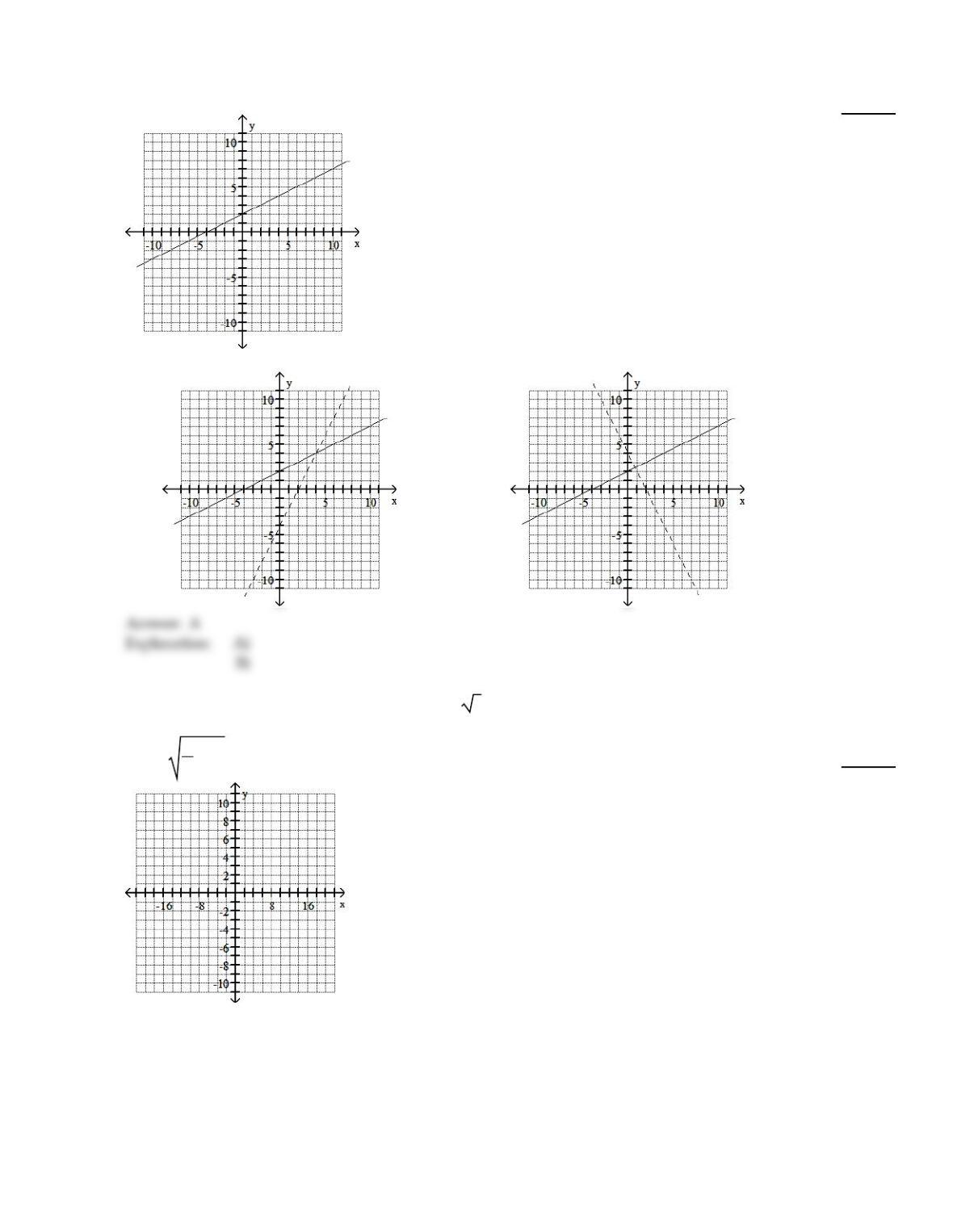
Use the graph of f to draw the graph of its inverse function.
10)
10)
A)
B)
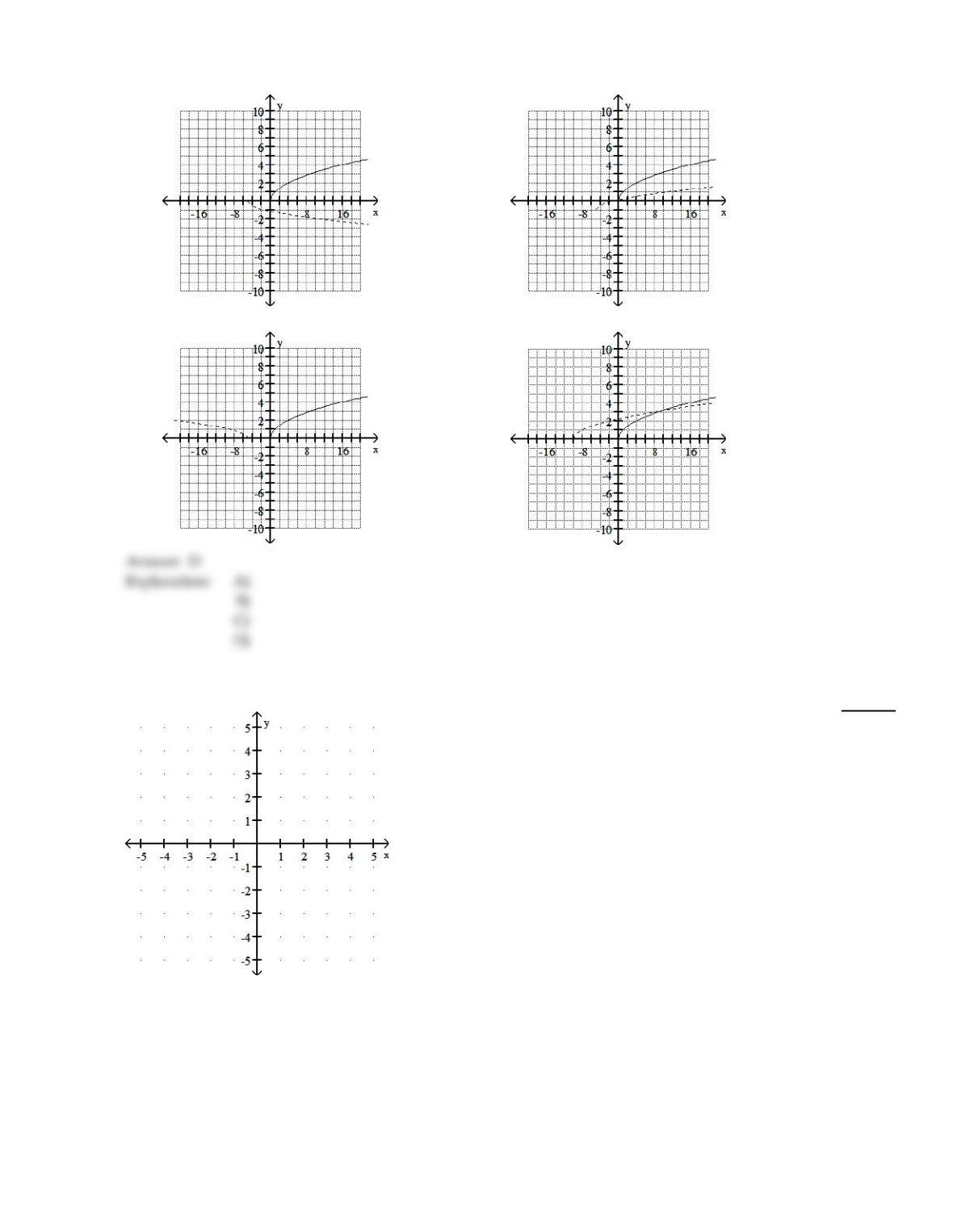
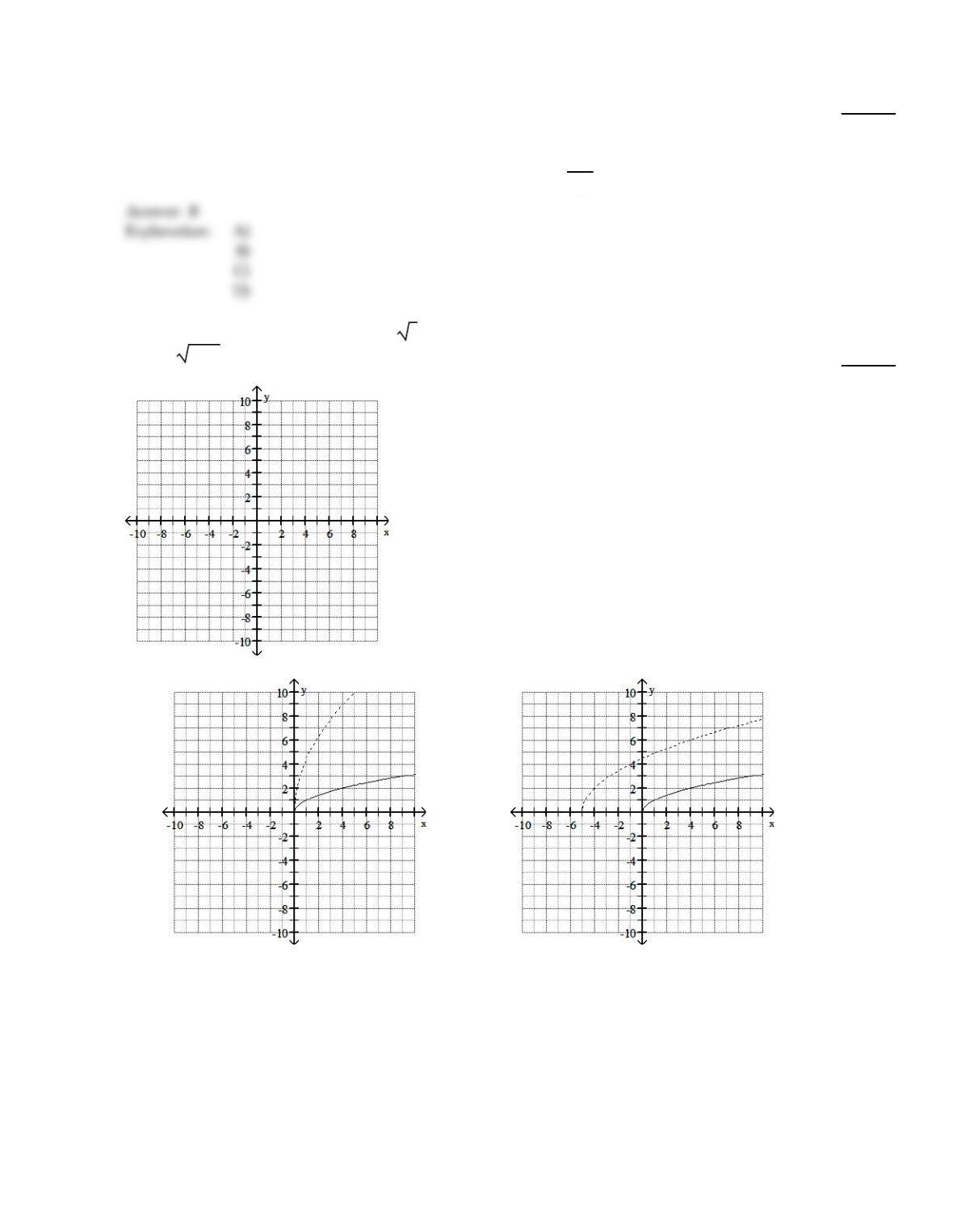
Begin by graphing the standard square root function f(x) =x . Then use transformations of this graph to graph the given
function.
11)
g(x) =1
2x + 5
11)
5
A)
B)
C)
D)
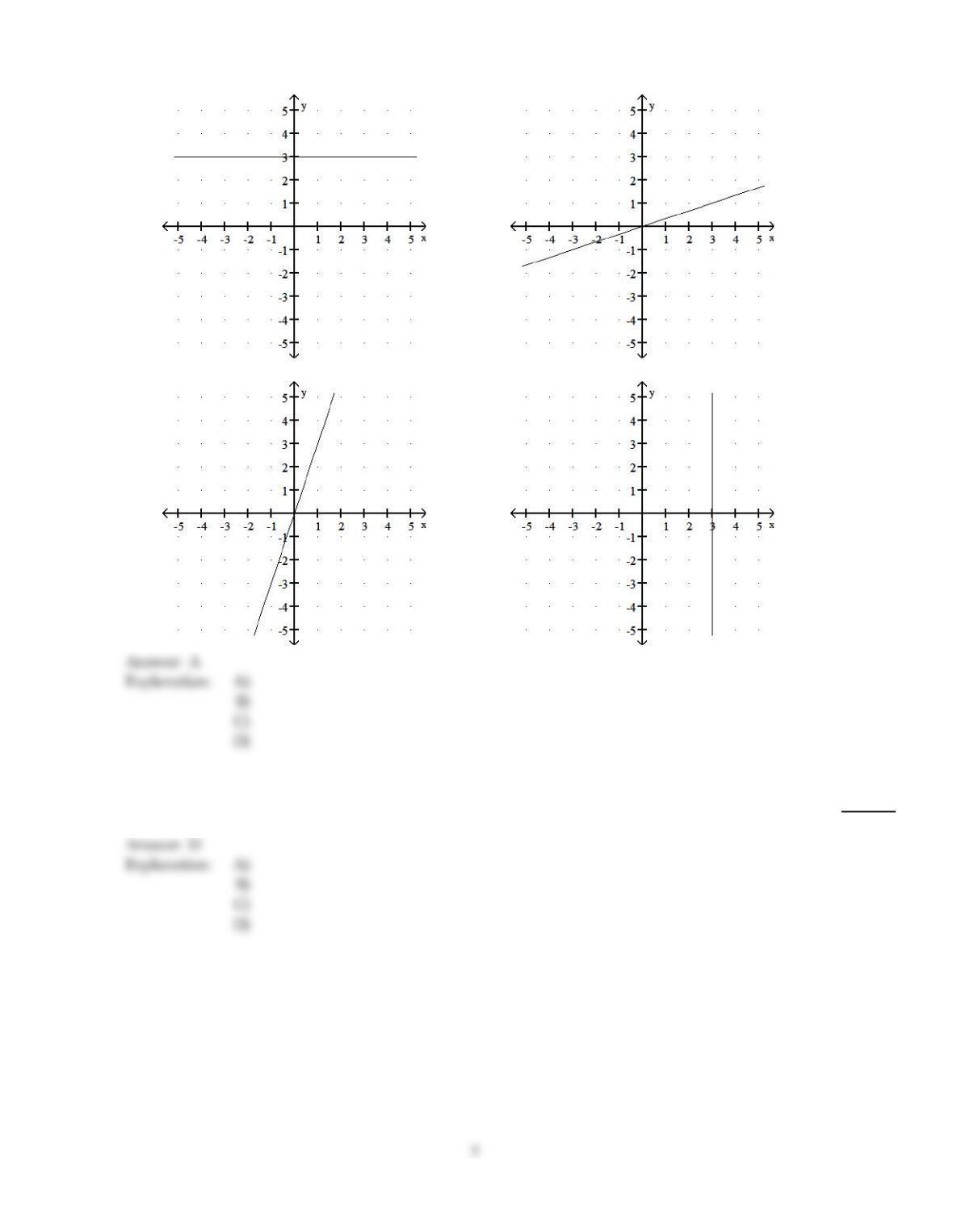
Graph the equation in the rectangular coordinate system.
12)
f(x) =3
12)
6
A)
B)
C)
D)
Use the given conditions to write an equation for the line in point–slope form.
13)
Slope =3, passing through (5, 8)
13)
A)
y =3x – 7
B)
y + 8 =3(x + 5)
C)
x – 8 =3(y – 5)
D)
y – 8 =3(x – 5)
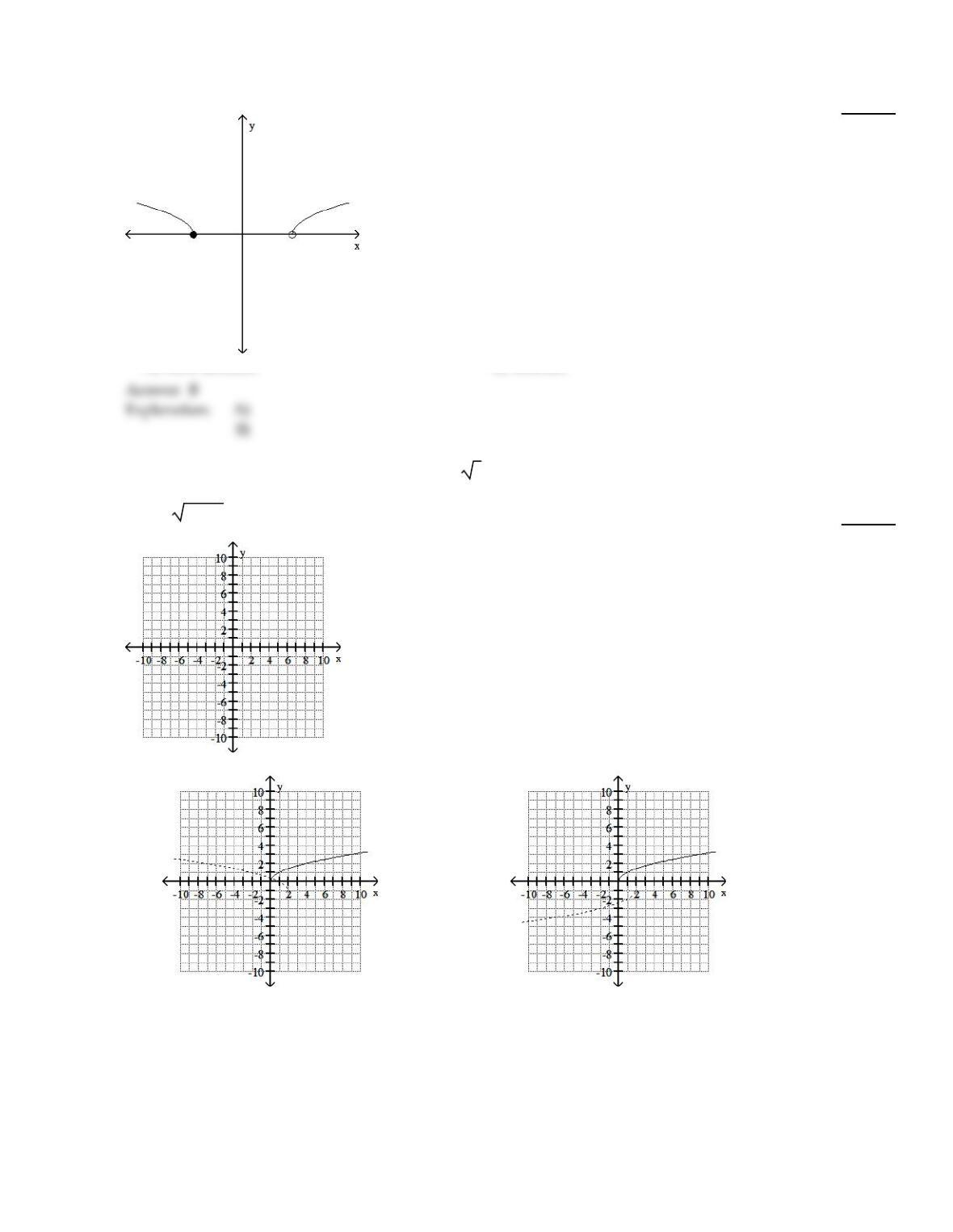
Use the vertical line test to determine whether or not the graph is a graph in which y is a function of x.
14)
14)
A)
not a function
B)
function
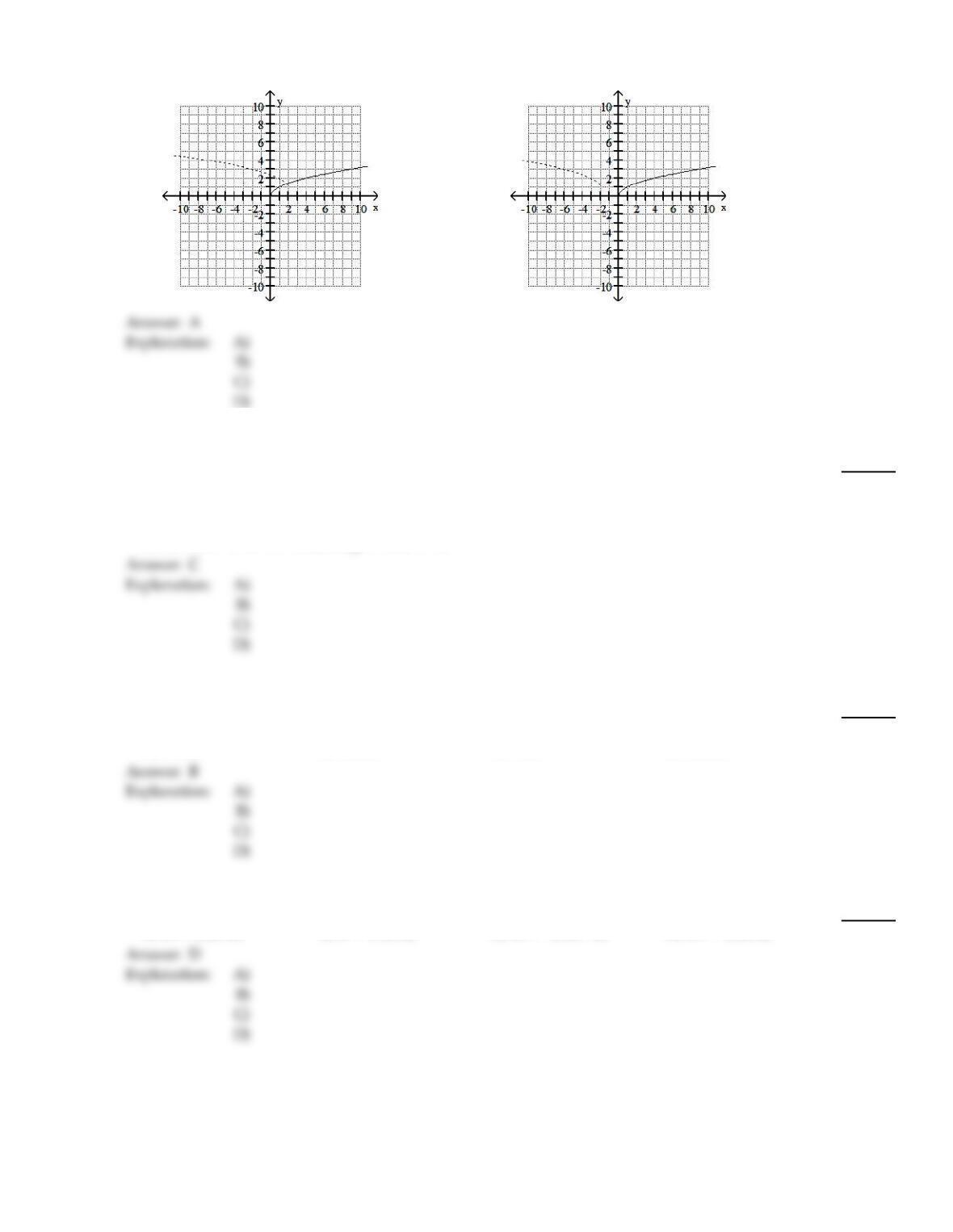
Begin by graphing the standard square root function f(x) =x . Then use transformations of this graph to graph the given
function.
15)
h(x) = – x +2– 1
15)
A)
B)
8
C)
D)
Give the domain and range of the relation.
16)
{(–6, –2), (10, –6), (9, –5), (9, 8)}
16)
A)
domain = {10, 9, –6, 19}; range = {–6, –5, –2, 8}
B)
domain = {10, 9, –6, –9}; range = {–6, –5, –2, 8}
C)
domain = {10, 9, –6}; range = {–6, –5, –2, 8}
D)
domain = {–6, –5, –2, 8}; range = {10, 9, –6}
For the given functions f and g , find the indicated composition.
17)
f(x) =14x2– 10x, g(x) =7x – 8
(f
g)(9)
17)
A)
57,420
B)
41,800
C)
7300
D)
34,500
Determine the slope and the y–intercept of the graph of the equation.
18)
x + y – 2 = 0
18)
A)
m = 0; (0, 2)
B)
m = 1; (0, 2)
C)
m = – 1; (0, –2)
D)
m = – 1; (0, 2)
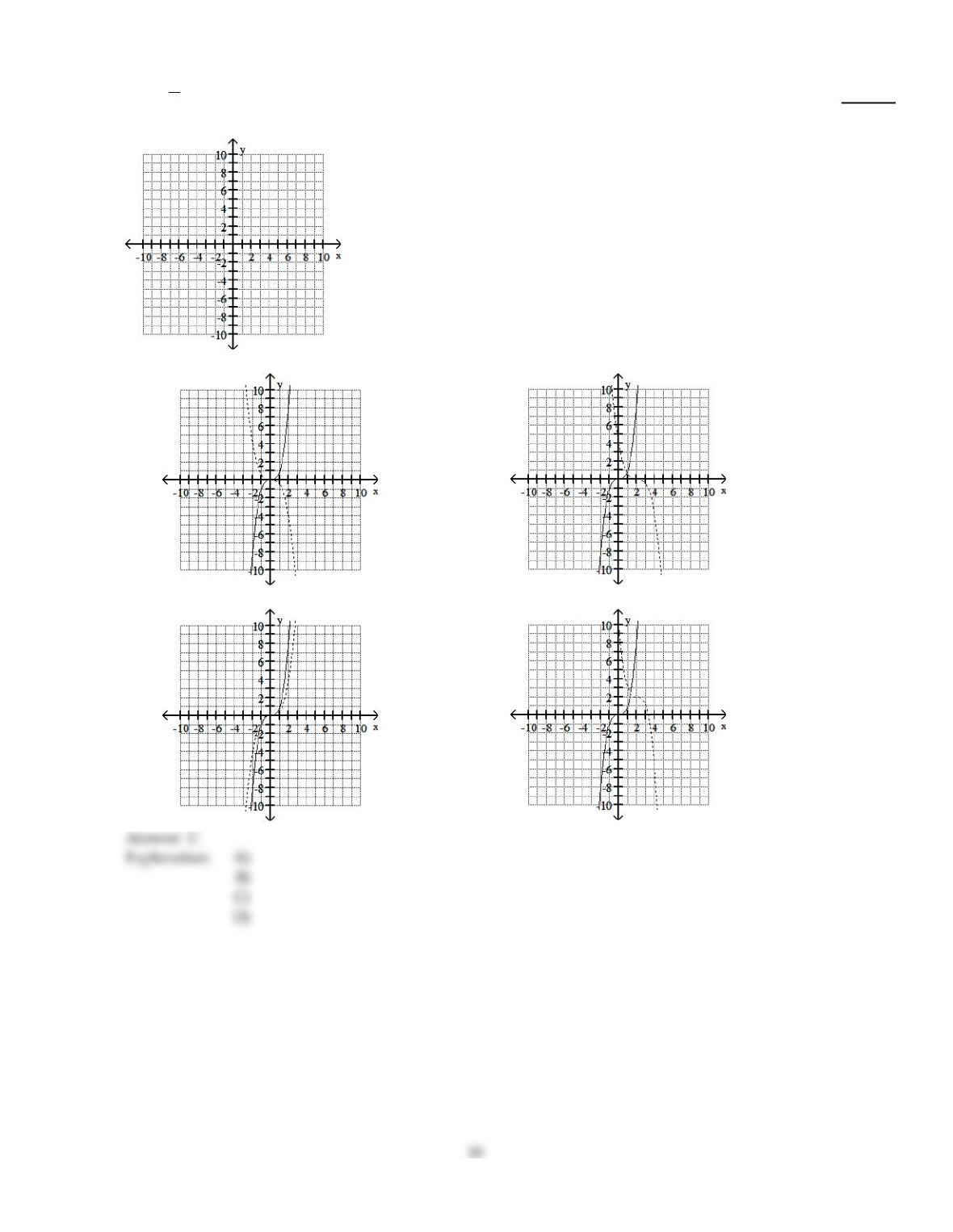
Begin by graphing the standard cubic function f(x) =x3. Then use transformations of this graph to graph the given
function.
9
19)
g(x) =1
2x3
19)
A)
B)
C)
D)
Evaluate the function at the given value of the independent variable and simplify.
20)
f(x) =x3+ 3
x2– 5 ;f(5)
20)
A)
7
5
B)
32
5
C)
25
4
D)
128
25
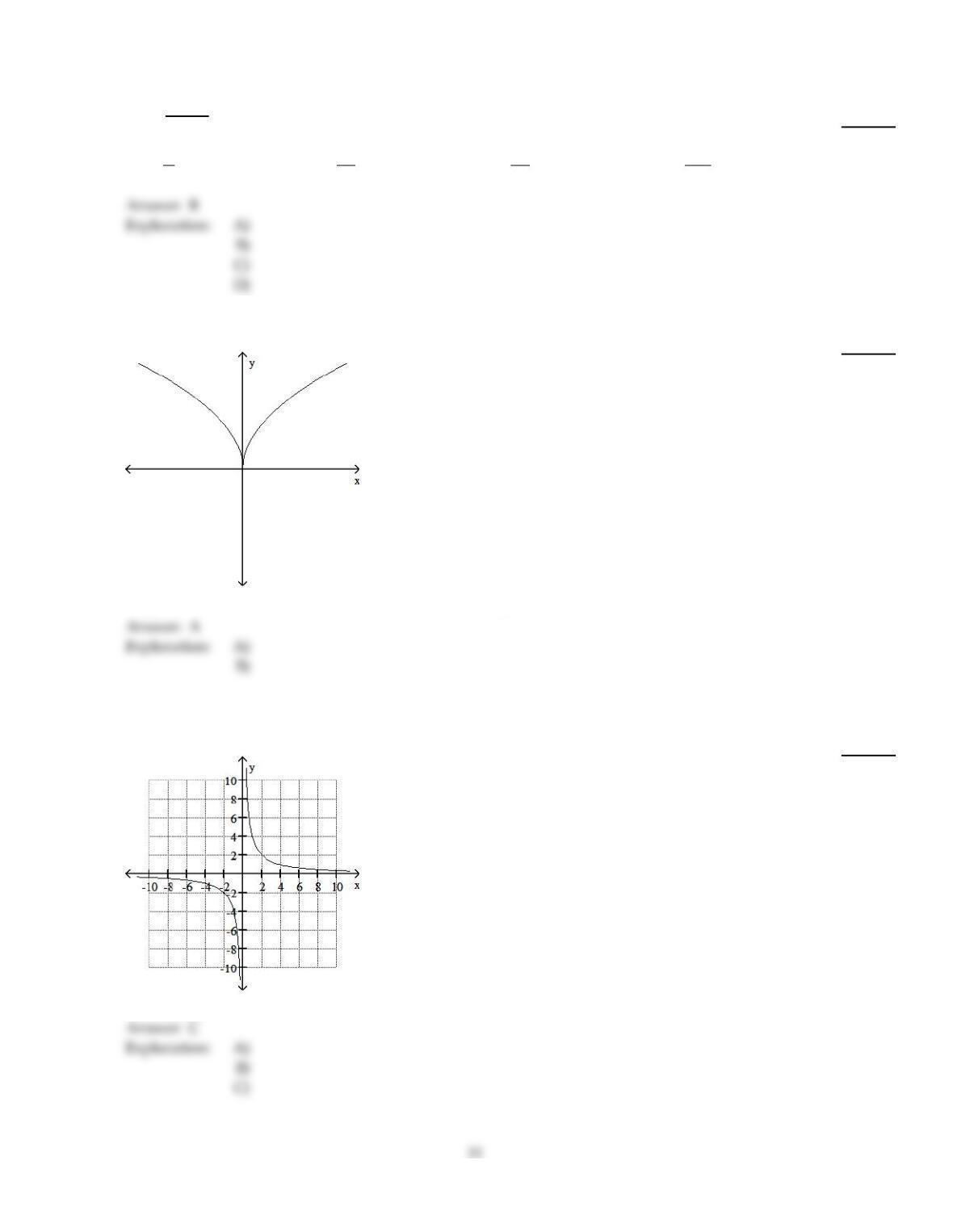
Does the graph represent a function that has an inverse function?
21)
21)
A)
No
B)
Yes
Use possible symmetry to determine whether the graph is the graph of an even function, an odd function, or a function
that is neither even nor odd.
22)
22)
A)
Even
B)
Neither
C)
Odd
Use the given conditions to write an equation for the line in the indicated form.
23)
Passing through (5, –4) and parallel to the line whose equation is y = – 2x + 3 ;
point–slope form
23)
A)
y = 2x
B)
y + 4 = x –5
C)
y –5= – 2(x + 4)
D)
y + 4 = – 2(x –5)
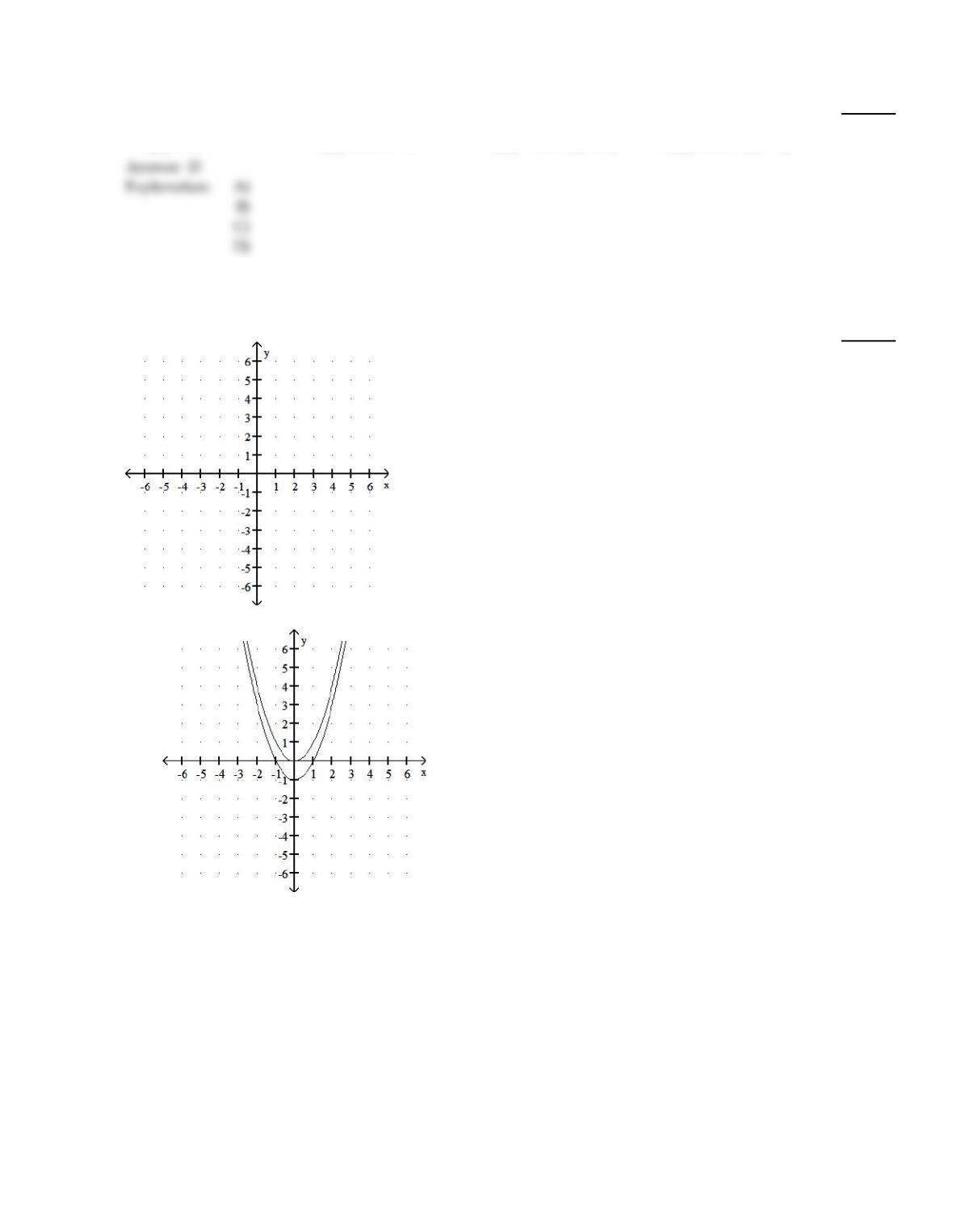
Graph the given functions on the same rectangular coordinate system. Describe how the graph of g is related to the graph
of f.
24)
f(x) =x2, g(x) =x2+1
24)
A)
g shifts the graph of f vertically down 1unit
12
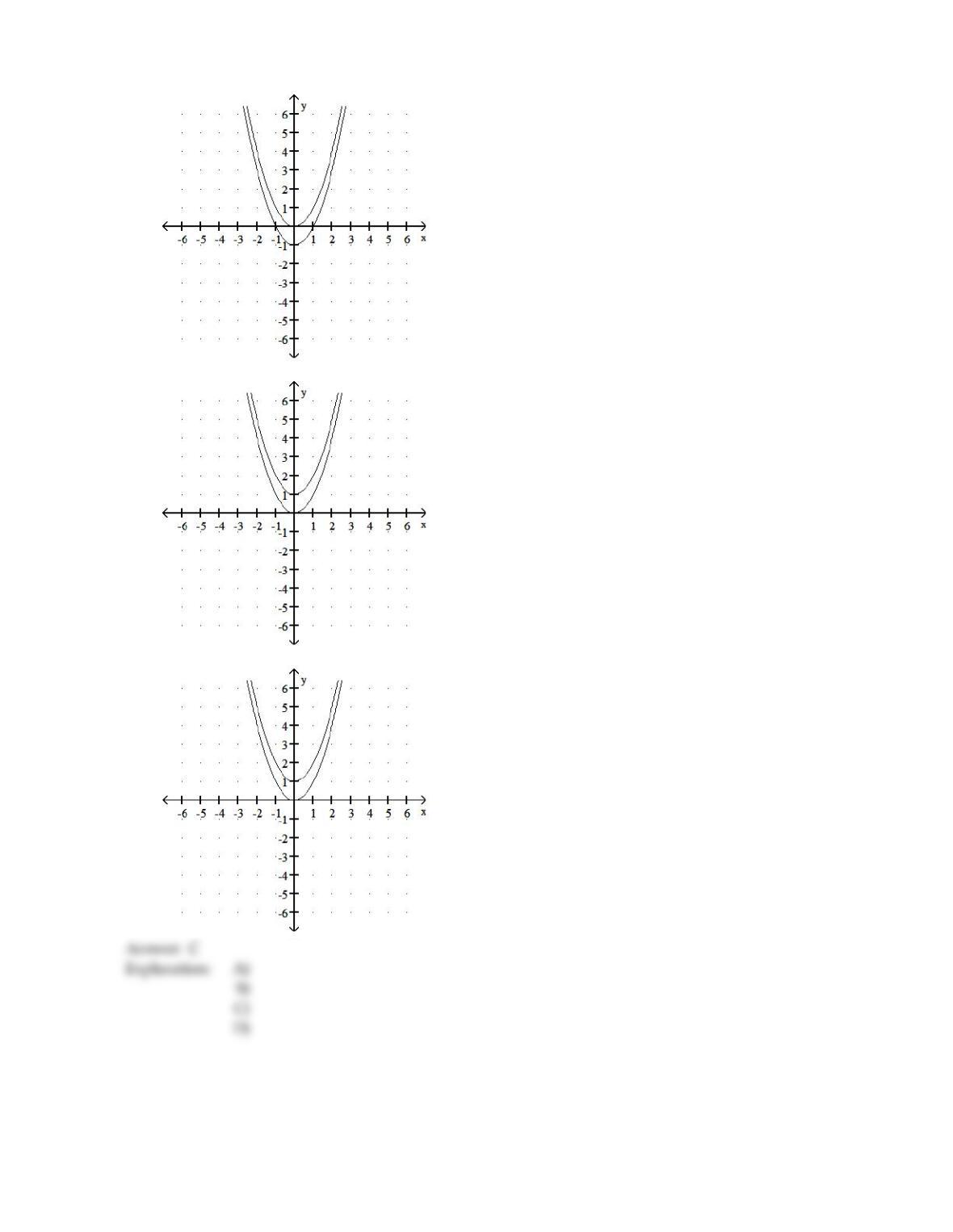
B)
g shifts the graph of f vertically up 1unit
C)
g shifts the graph of f vertically up 1unit
D)
g shifts the graph of f vertically down 1unit
13
Find the inverse of the one–to–one function.
25)
f(x) =x – 8
25)
A)
f–1(x) =x2– 8
B)
f–1(x) = x + 8
C)
f–1(x) =x2+ 8
D)
f–1(x) =1
x2+ 8
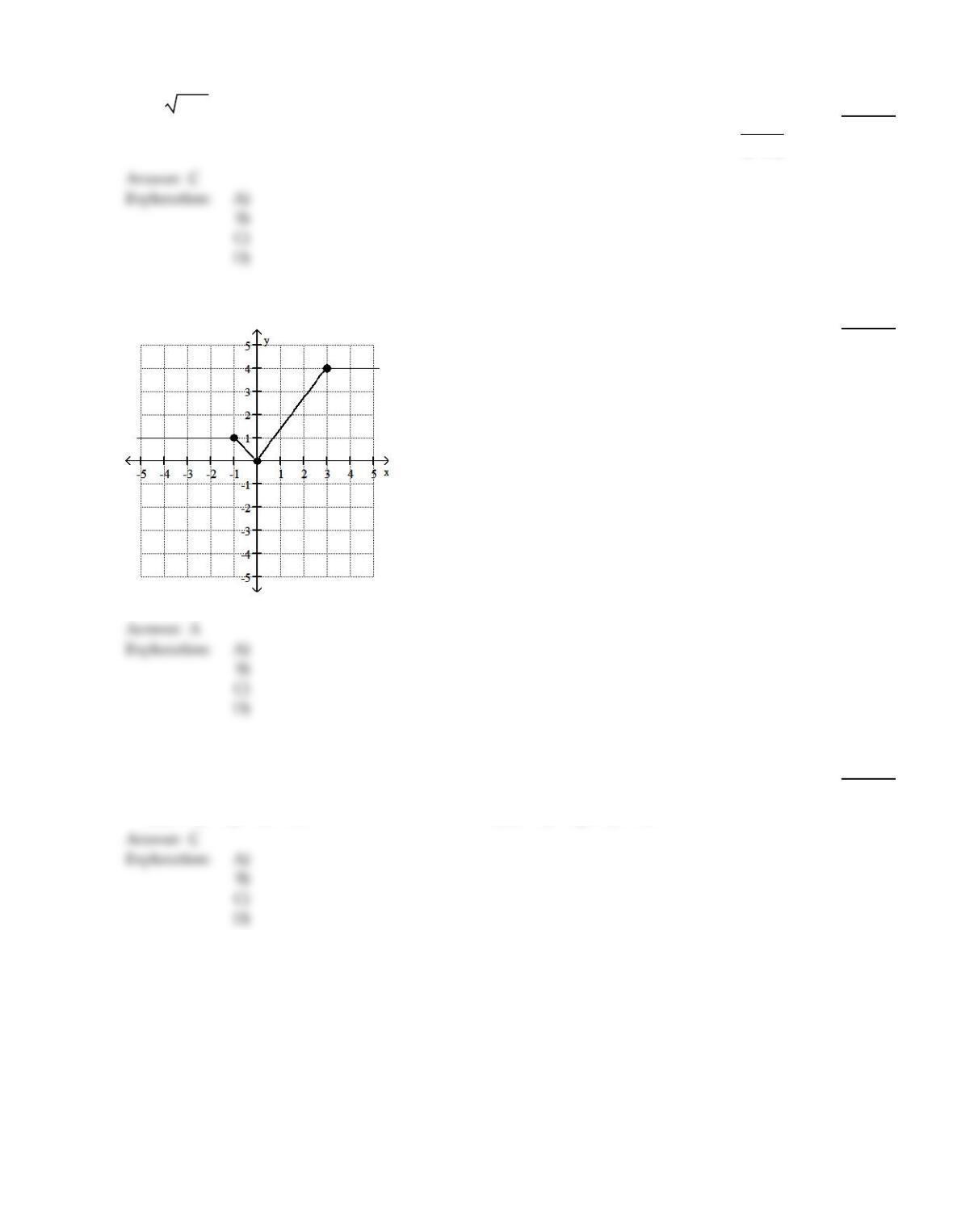
Identify the intervals where the function is changing as requested.
26)
Increasing
26)
A)
(0, 3)
B)
(–, –1)
C)
(–1, 0)
D)
(–, 0)
A
Write the standard form of the equation of the circle with the given center and radius.
27)
(–8, 8); 5
27)
A)
(x – 8)2+ (y + 8)2=5
B)
(x + 8)2+ (y – 8)2=5
C)
(x + 8)2+ (y – 8)2=25
D)
(x – 8)2+ (y + 8)2=25
C
Graph the line whose equation is given.
14
C
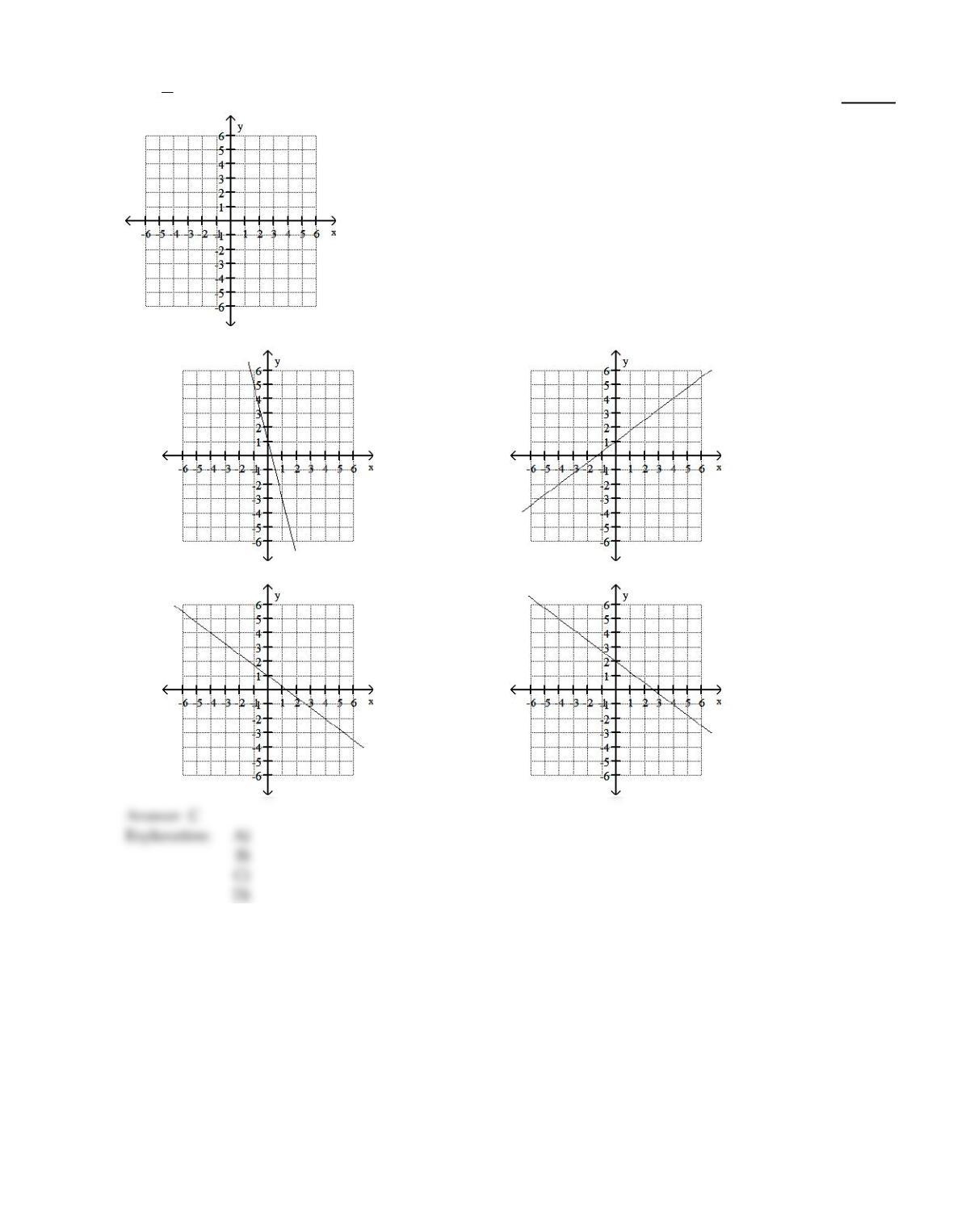
28)
y = – 3
4x + 1
28)
A)
B)
C)
D)
Begin by graphing the standard cubic function f(x) =x3. Then use transformations of this graph to graph the given
function.
15
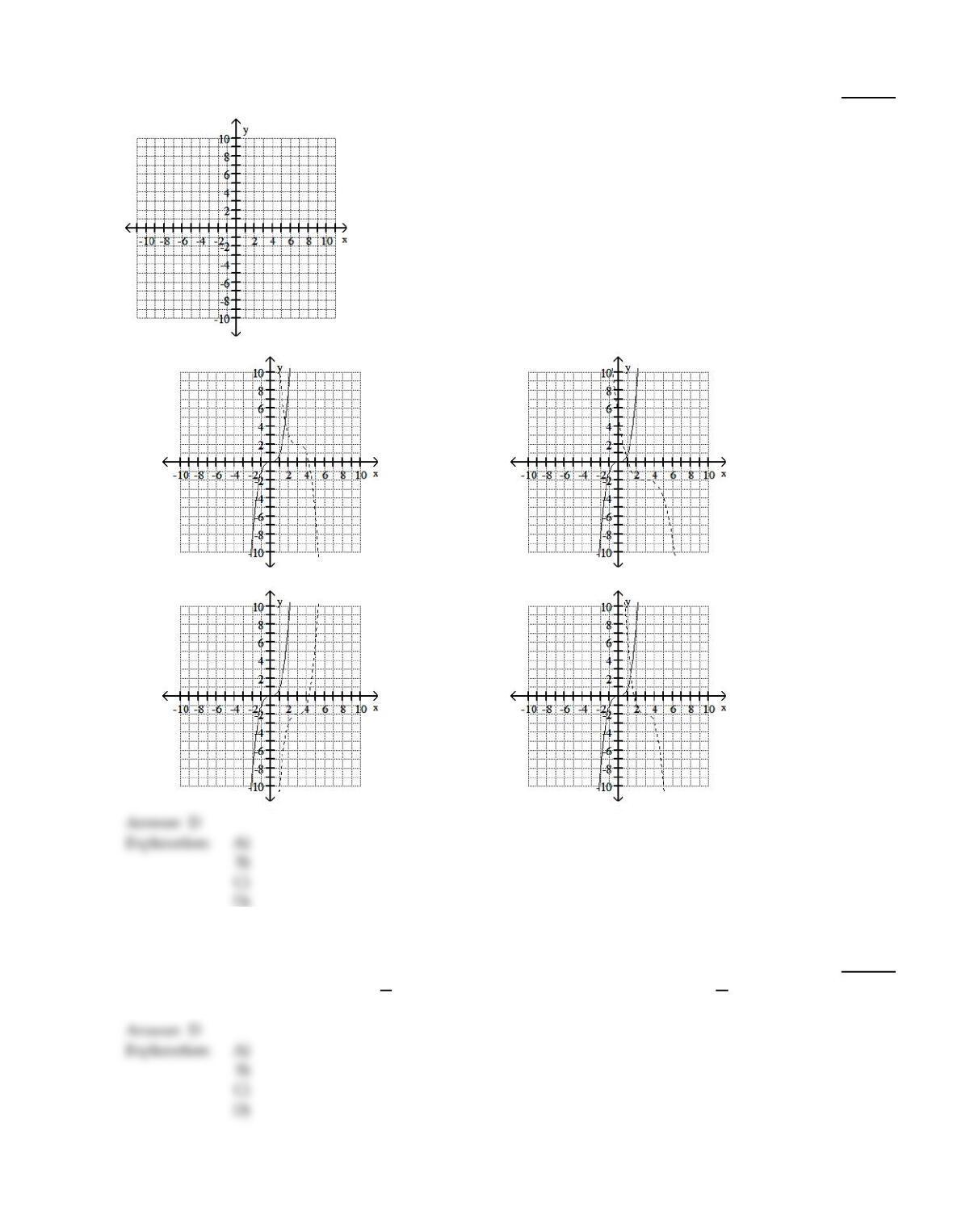
29)
g(x) = – (x – 3)3– 2
29)
A)
B)
C)
D)
Find the midpoint of the line segment whose end points are given.
30)
(5, –4) and (7, –1)
30)
A)
(–2, –3)
B)
(– 1, –3
2)
C)
(12, –5)
D)
(6, –5
2)
D
16
D
Solve.
31)
When making a telephone call using a calling card, a call lasting 3 minutes cost $0.95. A call lasting
11 minutes cost $2.55. Let y be the cost of making a call lasting x minutes using a calling card.
Write a linear equation that models the cost of a making a call lasting x minutes.
31)
A)
y = – 0.2x +1.55
B)
y =0.2x +0.35
C)
y =5x –281
20
D)
y =0.2x – 8.45
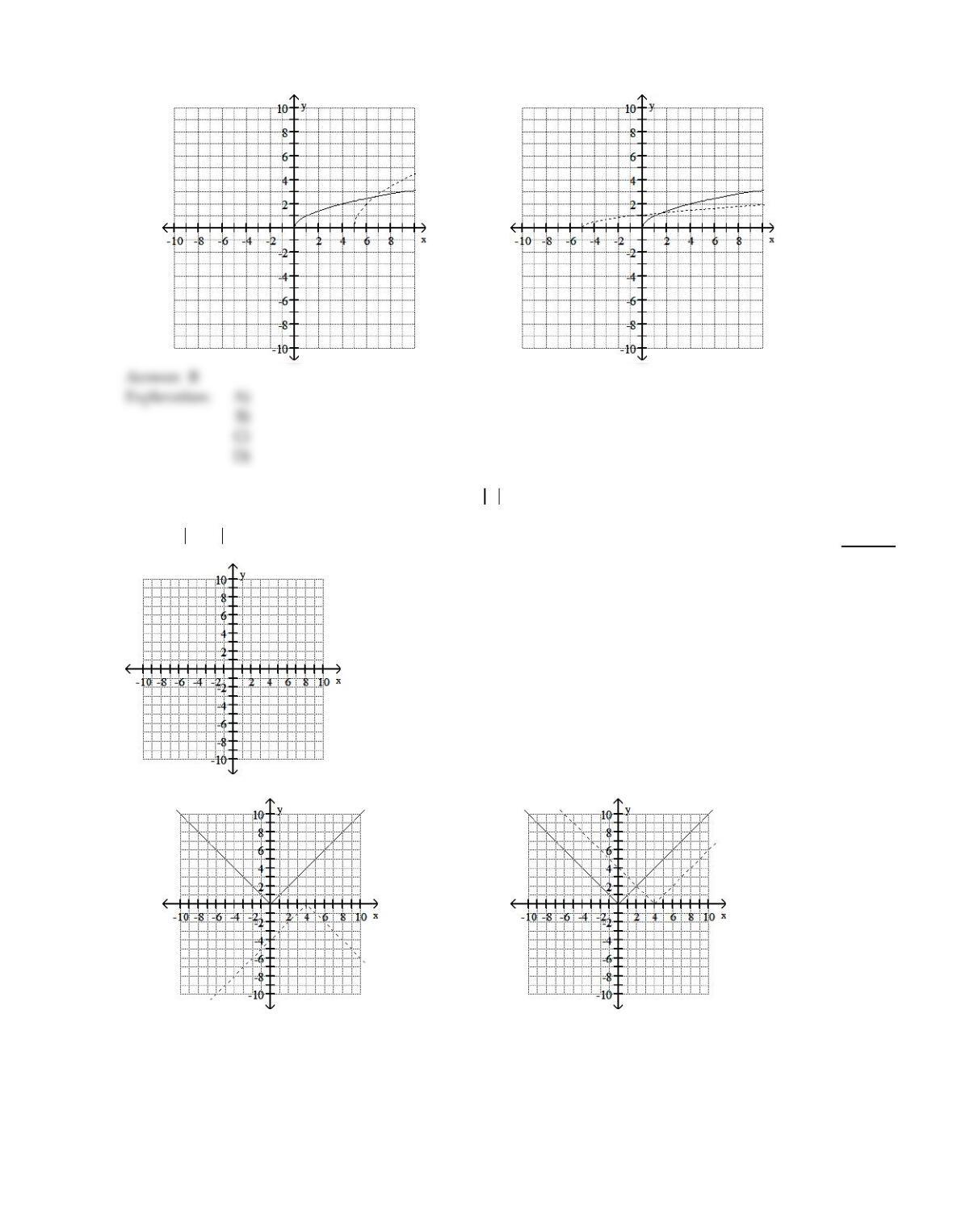
Begin by graphing the square root function f(x) =x Then use transformations of this graph to graph the given function.
32)
g(x) =2x +5
32)
A)
B)
17
C)
D)
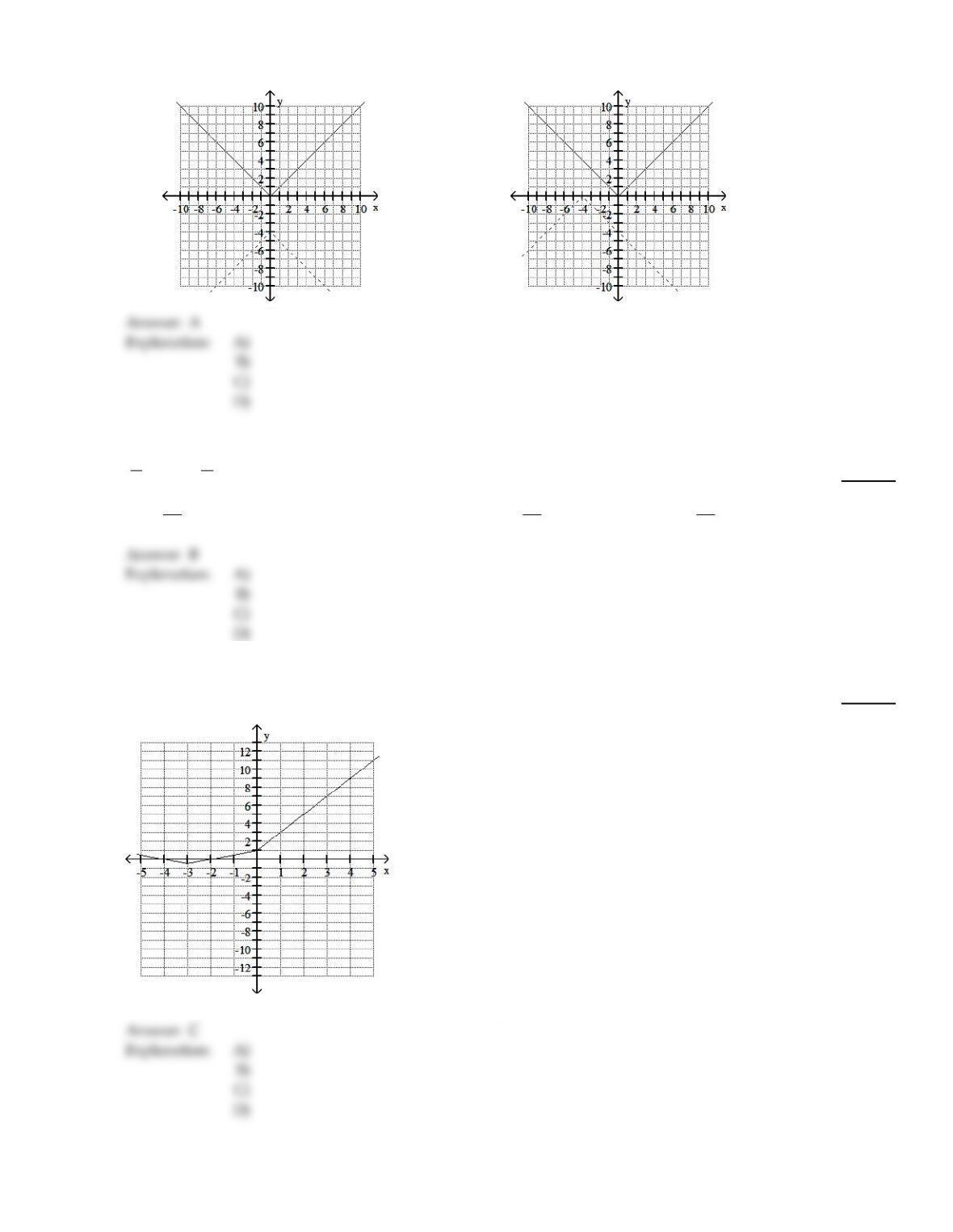
Begin by graphing the standard absolute value function f(x) =x. Then use transformations of this graph to graph the
given function.
33)
h(x) = – x – 4
33)
A)
B)
18
C)
D)
Find the slope of the line that goes through the given points.
34)
(1
5, 3) and ( 1
5, 0)
34)
A)
15
7
B)
Undefined
C)
–7
15
D)
–15
7
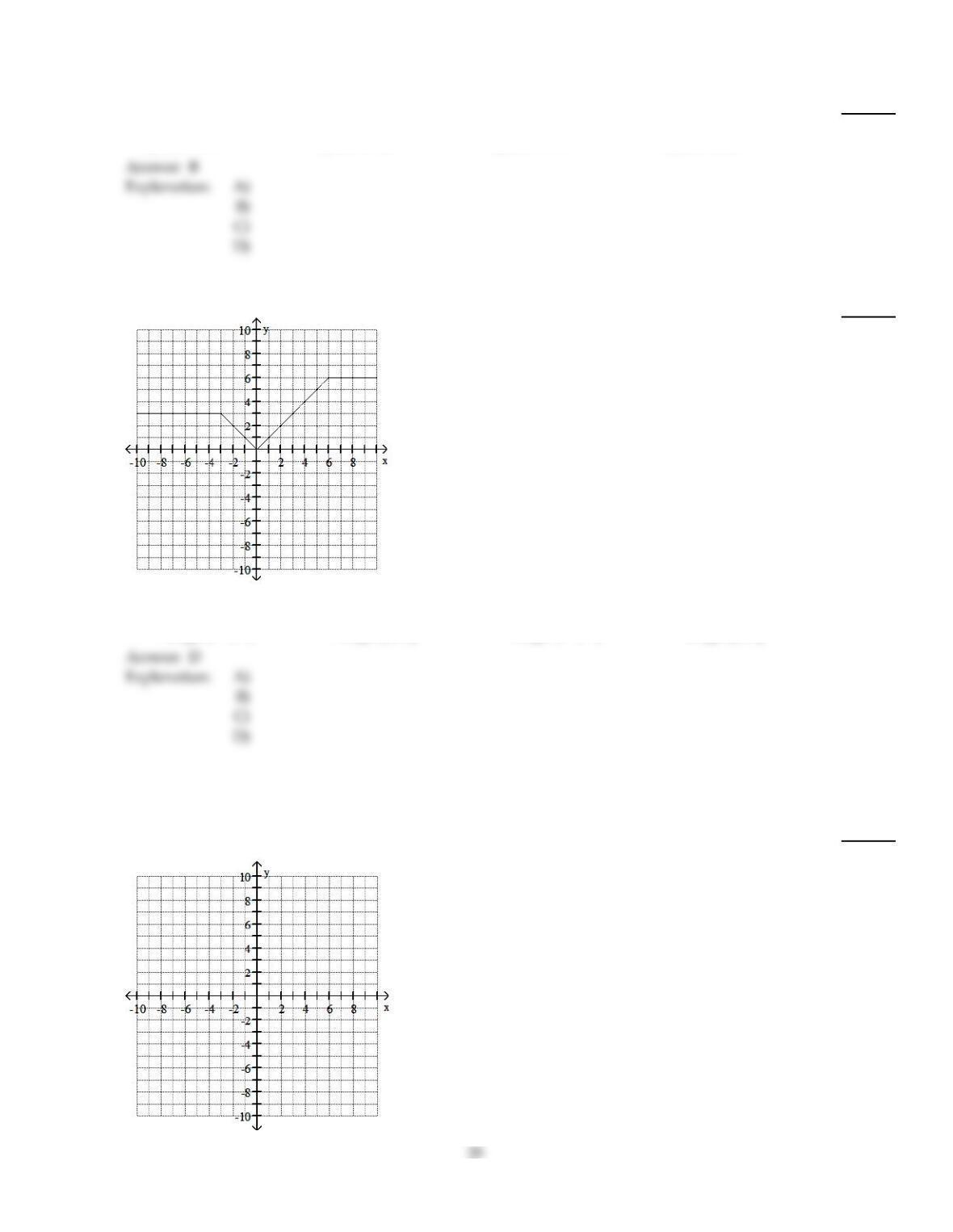
Use the graph to find the indicated function value.
35)
y = f(x). Find f(5)
35)
A)
9
B)
2
C)
11
D)
–11
19
For the given functions f and g , find the indicated composition.
36)
f(x) =5x + 15,g(x) =5x – 1
(f
g)(x)
36)
A)
25x + 74
B)
25x + 10
C)
25x + 14
D)
25x + 20
Use the graph to determine the function’s domain and range.
37)
37)
A)
domain: [0, 6]
range: (–, )
B)
domain: (–, )
range: [3, 6]
C)
domain: [3, 6]
range: (–, )
D)
domain: (–, )
range: [0, 6]
Graph f as a solid line and f–1 as a dashed line in the same rectangular coordinate space. Use interval notation to give the
domain and range of f and f–1.
38)
f(x) =x2–1, x
0
38)