2.1 The Principle of Opportunity Cost
1) The opportunity cost of something is
A) the cost of the labor used to produce it.
B) what you sacrifice to get it.
C) the price charged for it.
D) the search cost required to find it.
2) The principle of opportunity cost
A) is more relevant for firms than for individuals.
B) only refers to monetary payments.
C) is only relevant in economics.
D) is applicable to all decision-making.
3) The principle that the cost of something is equal to what is sacrificed to get it is known as the
A) marginal principle.
B) principle of opportunity cost.
C) principle of diminishing returns.
D) reality principle.
4) The saying that “There’s no such thing as a free lunch” refers to the
A) marginal principle.
B) spillover principle.
C) principle of opportunity cost.
D) reality principle.
5) Jacinda quit her job as a blackjack dealer where she made $42,000 per year to start her own
florist business. Her business expenses are $14,000 per year on rent, $21,000 per year on
supplies, and $9,000 per year on part time help. As for her personal expenses, her apartment
costs her $12,000 per year and her personal bills are an extra $6,000 per year. What is Jacinda’s
opportunity cost of running the business?
A) $104,000
B) $86,000
C) $62,000
D) $44,000
6) An unemployed individual decides to spend the day fishing. The opportunity cost of fishing is
A) the cost of bait and any other monetary expenses.
B) zero, because the person doesn’t have a job.
C) the cost of bait, any other monetary expenses, and the value of the individual’s wages while he
was working.
D) the cost of bait, any other monetary expenses, and the value of the best alternative use of the
individual’s time.
7) Suppose that you own a house. What is the opportunity cost of living in the house?
A) There is no opportunity cost because you own the house.
B) There is no opportunity cost unless you could set up a business in the house.
C) The opportunity cost is the rent you could have received from a tenant if you didn’t live there.
D) The opportunity cost is the cost of your monthly mortgage payment plus bills.
8) Steven lives in a big city where there is a shortage of parking. He has a parking spot in his
driveway where he parks his car. Which of the following statements is most correct?
A) Steven has a lower opportunity cost of owning a car than his neighbor, who must rent a
parking spot.
B) The opportunity cost of using the spot is zero, because Steven owns the house.
C) The opportunity cost of using the parking spot is the price he could charge someone else for
using the spot.
D) The opportunity cost depends on how much Steven’s mortgage payment is.
9) You rent a DVD of The Dark Knight Rises. The rental is for seven days and you watch the
movie on the first day. You tell a friend about the film and your friend asks to come over and
watch the movie with you before it is due back. What is your opportunity cost if you decide to
watch the movie a second time instead of going to a football game?
A) the entire cost of the movie rental, since you have already watched the movie
B) one half the rental cost, because you have already watched the movie one time
C) the answer depends on how much you liked the movie in the first place
D) the football game you forego by watching the movie again
10) Angelina, age seven, decides to dress up like Princess Fiona for Halloween. What is the
opportunity cost of her decision?
A) the cost of the costume
B) the fact that she can’t dress up like Dora the Explorer, her second choice
C) zero, because seven-year-olds don’t have opportunity costs
D) the cost of the Lady Gaga costume which she did not want
11) Spending money on a new car instead of a used car when you are on a fixed budget is an
example of
A) the incursion of an opportunity cost.
B) isolating variables.
C) a bad thing to do because you run out of money.
D) living on the edge.
12) Suppose that your tuition to attend college is $24,000 per year and you spend $8,000 per year
on room and board. If you were working full time, you could earn $30,000 per year. What is
your opportunity cost of attending college for one year?
A) $32,000
B) $38,000
C) $54,000
D) $62,000
13) Suppose that your tuition to attend college is $14,000 per year and you spend $5,000 per year
on room and board. If you were working full time, you could earn $26,000 per year. What is
your opportunity cost of attending college?
A) $19,000
B) $31,000
C) $40,000
D) $45,000
14) The opportunity cost of going to college
A) is zero if your parents pay your tuition.
B) is equal to the cost of tuition, room and board, and other expenses.
C) includes wages you lose by going to school instead of working.
D) is the same for all students at a particular school who pay full tuition.
15) You have an hour between your economics and math classes. What is the opportunity cost of
that time if you use it to complete your math homework instead of your economics homework?
A) the economics homework you could have completed
B) the math homework you chose to complete
C) the cost of your calculator and math textbook
D) zero, because it doesn’t cost any money to do your math homework
16) The sacrifices made by societies in order to engage in military spending represent
A) the nominal costs of military spending.
B) the real costs of military spending.
C) the opportunity costs of military spending.
D) the excessive costs of military spending.
17) The trade-offs made by the U.S. government to fund the war in Iraq
A) prove that the government is spending too much on the war.
B) show that the government is justified in its war spending.
C) exceed the benefits derived from the war.
D) represent what was potentially sacrificed to engage in the war.
18) According to the possible trade-off example between warships and drinking water in the text,
the policy question that should be considered in Malaysia is
A) do the opportunity costs of the warships exceed their nominal costs?
B) do the nominal costs of the warships exceed their real costs?
C) do the benefits of the warships exceed their opportunity costs?
D) do the real costs of the warships exceed their nominal costs?
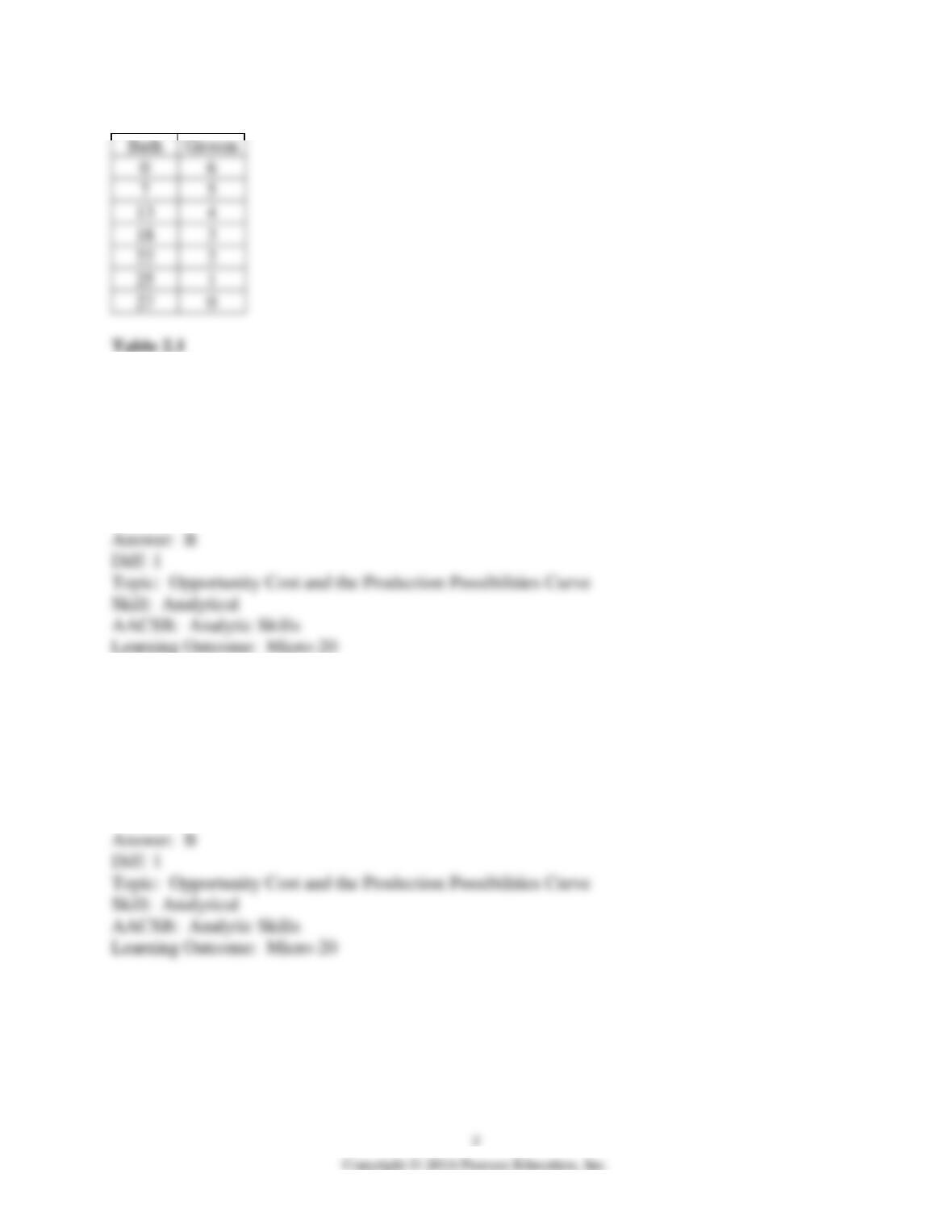
19) Kaitlyn and Larissa have formed a dog bathing and grooming business. The number of dogs
they can bathe or groom in any given day is depicted in Table 2.1. The opportunity cost of
grooming the first dog in a day is bathing ________ dog(s).
A) 1
B) 2
C) 24
D) 25
20) Kaitlyn and Larissa have formed a dog bathing and grooming business. The number of dogs
they can bathe or groom in any given day is depicted in Table 2.1. The opportunity cost of
grooming the third dog in a day is bathing ________ dog(s).
A) 3
B) 4
C) 5
D) 18
21) Kaitlyn and Larissa have formed a dog bathing and grooming business. The number of dogs
they can bathe or groom in any given day is depicted in Table 2.1. The opportunity cost of
grooming the sixth dog in a day is bathing ________ dog(s).
A) 0
B) 5
C) 6
D) 7
22) Kaitlyn and Larissa have formed a dog bathing and grooming business. The number of dogs
they can bathe or groom in any given day is depicted in Table 2.1. As they groom more dogs, the
opportunity cost of grooming additional dogs
A) falls.
B) rises.
C) remains constant.
D) depends on the prices being charged.
23) Kaitlyn and Larissa have formed a dog bathing and grooming business. The number of dogs
they can bathe or groom in any given day is depicted in Table 2.1. As they groom more dogs, the
opportunity cost of bathing additional dogs
A) falls.
B) rises.
C) remains constant.
D) depends on the prices being charged.
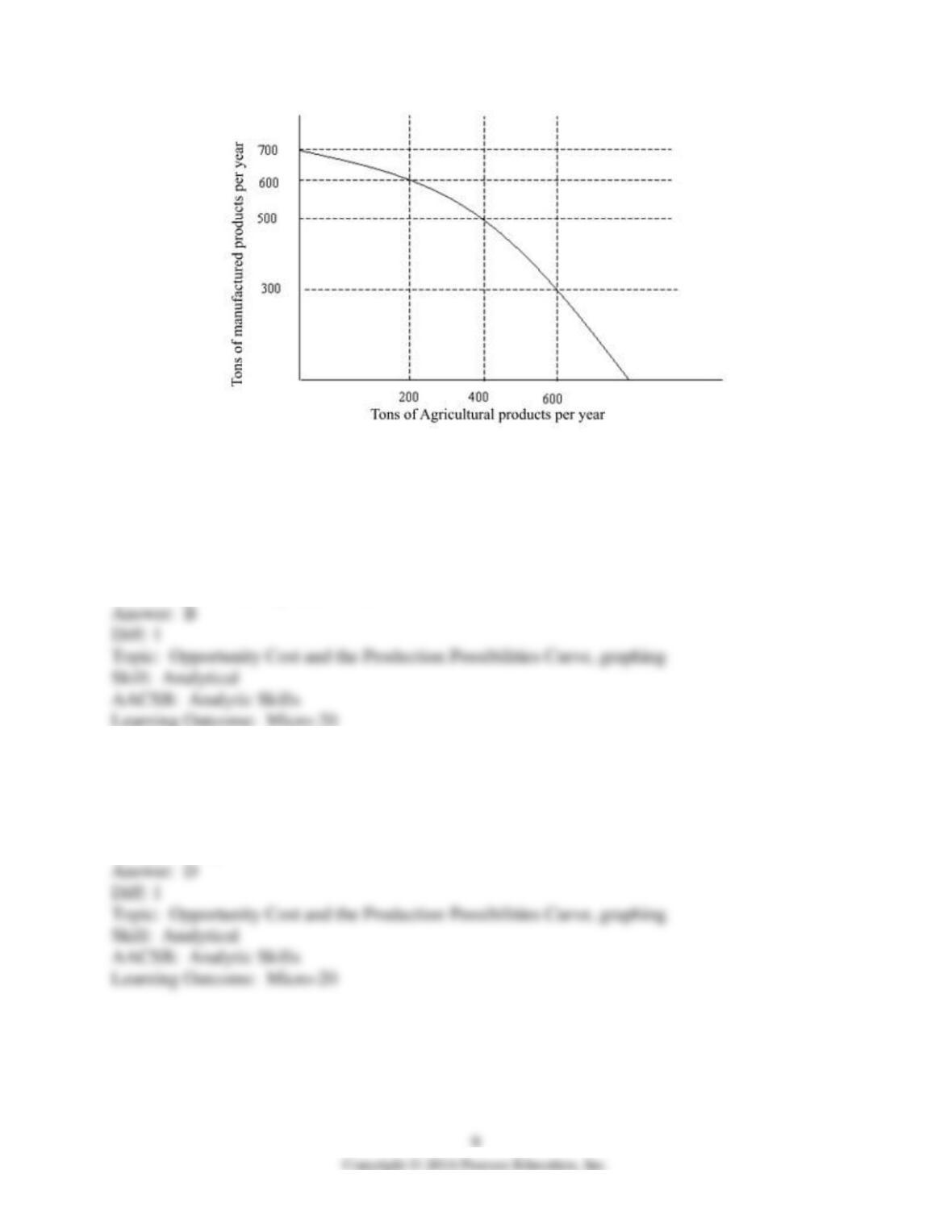
Figure 2.1
24) Referring to Figure 2.1, if you increase the production of farm goods, what other area is
affected?
A) the price of produce
B) the production of manufactured goods
C) how much people can purchase
D) the wages earned by farm workers
25) The production possibilities curve in Figure 2.1 illustrates the notion of
A) increased factory goods production.
B) increased farm produce production.
C) diminishing resources.
D) opportunity cost.
26) Refer to Figure 2.1. If you are producing 600 tons of agricultural products per year, what is
the maximum amount of manufactured products you can produce per year?
A) 300 tons
B) 500 tons
C) 600 tons
D) 700 tons
27) Refer to Figure 2.1. If you choose to produce only agricultural products, what is the
maximum quantity you can produce per year?
A) 200 tons
B) 400 tons
C) 600 tons
D) > 600 tons
28) Refer to Figure 2.1. What is the opportunity cost of increasing production of manufactured
products from 500 tons to 600 tons per year?
A) 200 tons of agricultural products per year
B) 400 tons of agricultural products per year
C) 500 tons of agricultural products per year
D) 600 tons of agricultural products per year
29) If an economy is fully utilizing its resources, it can produce more of one product only if it
A) doubles manufacturing of the product.
B) produces less of another product.
C) adds more people to the labor force.
D) reduces the prices of the most expensive products.
30) If you remove resources from factory production, the quantity of factory goods will
A) increase.
B) decrease.
C) remain the same but their price will decrease.
D) be diverted to other production.
31) If an economy is represented by a point inside its production possibilities curve,
A) it can produce more of one product even if it does not produce less of another product.
B) it can produce more of one product only if it produces less of another product.
C) it cannot produce more of one product unless it stops producing the other product entirely.
D) it cannot possibly produce more of one product, even if it produces less of another product.
32) If an economy is represented by a point along its production possibilities curve,
A) it can produce more of one product even if it does not produce less of another product.
B) it can produce more of one product only if it produces less of another product.
C) it cannot produce more of one product unless it stops producing the other product entirely.
D) it cannot possibly produce more of one product, even if it produces less of another product.
33) Points outside the production possibilities curve represent combinations of products that are
A) attainable only if the economy’s resources are fully employed.
B) attainable only if the economy’s resources are not fully employed.
C) attainable if the economy’s resources are either fully employed or not fully employed.
D) unattainable.
Recall the Application about running a lawn-cutting business using solar-powered
equipment to answer the following question(s).
34) Recall the application. The time and invested funds involved in starting a lawn-cutting
business address the economic concept of
A) the marginal principle.
B) opportunity cost.
C) the real-nominal principle.
D) the principle of diminishing returns.
35) Recall the application. The current income you would sacrifice to start your own lawn-
cutting business is part of the
A) opportunity cost of invested funds.
B) opportunity cost of starting a business.
C) cost of doing business.
D) present value of your initial investment.
36) Recall the application. If you have $10,000 to start a lawn-cutting business, the interest rate
is 4%, your cost of equipment is $3,000, and the earnings you sacrifice from working at another
job are $32,000, your yearly cost of doing business would be
A) $13,000.
B) $13,400.
C) $35,400.
D) $45,000.
37) A principle is a self-evident truth that most people readily understand and accept.
38) Opportunity cost is the difference between the nominal and real cost of some action.
39) The opportunity cost of something is the gain you receive as a result of your sacrifice.
40) The opportunity cost of something is the nominal price paid for the product.
41) Tradeoffs involve an exchange of one thing for another because resources are limited and
can be used in different ways.
42) The notion of opportunity cost allows the measurement of tradeoffs.
43) In order to get his bachelor’s degree, Timothy gave up an offer for a full time job as a
bartender. Therefore, Timothy incurred an opportunity cost.
44) The opportunity cost of going to a particular college is not the same for everyone.
45) The cost of a bachelor’s degree in philosophy equals the tuition plus the cost of room and
board.
46) What is an opportunity cost?
47) Suppose that you lend $5,000 to a friend who pays you back $5,400 the next year. Suppose
that prices that year rose by 6% and the real rate of return in the stock market was 5%. Your
friend says that he or she was being more than fair by giving you more than the rate of inflation
as a return. What do you think?
48) What is the opportunity cost of investing $10,000 of your own money in a business you wish
to start?
49) What do economists mean when they say that there is no such thing as a free lunch?
50) What is the opportunity cost of your college degree?
2.2 The Marginal Principle
1) The extra benefit resulting from a small increase in an activity is called the
A) opportunity cost.
B) marginal benefit.
C) marginal cost.
D) diminishing returns of the activity.
2) The additional cost resulting from a small increase in some activity is called the
A) opportunity cost.
B) marginal benefit.
C) marginal cost.
D) diminishing returns of the activity.
3) The principle that individuals and firms pick the activity level where the incremental benefit
of that activity equals the incremental cost of that activity is known as the
A) marginal principle.
B) principle of opportunity cost.
C) principle of diminishing returns.
D) spillover principle.
4) The marginal principle implies that an individual should produce or consume where
A) marginal benefit exceeds marginal cost.
B) marginal benefit is less than marginal cost.
C) marginal benefit equals marginal cost.
D) total benefit equals total cost.
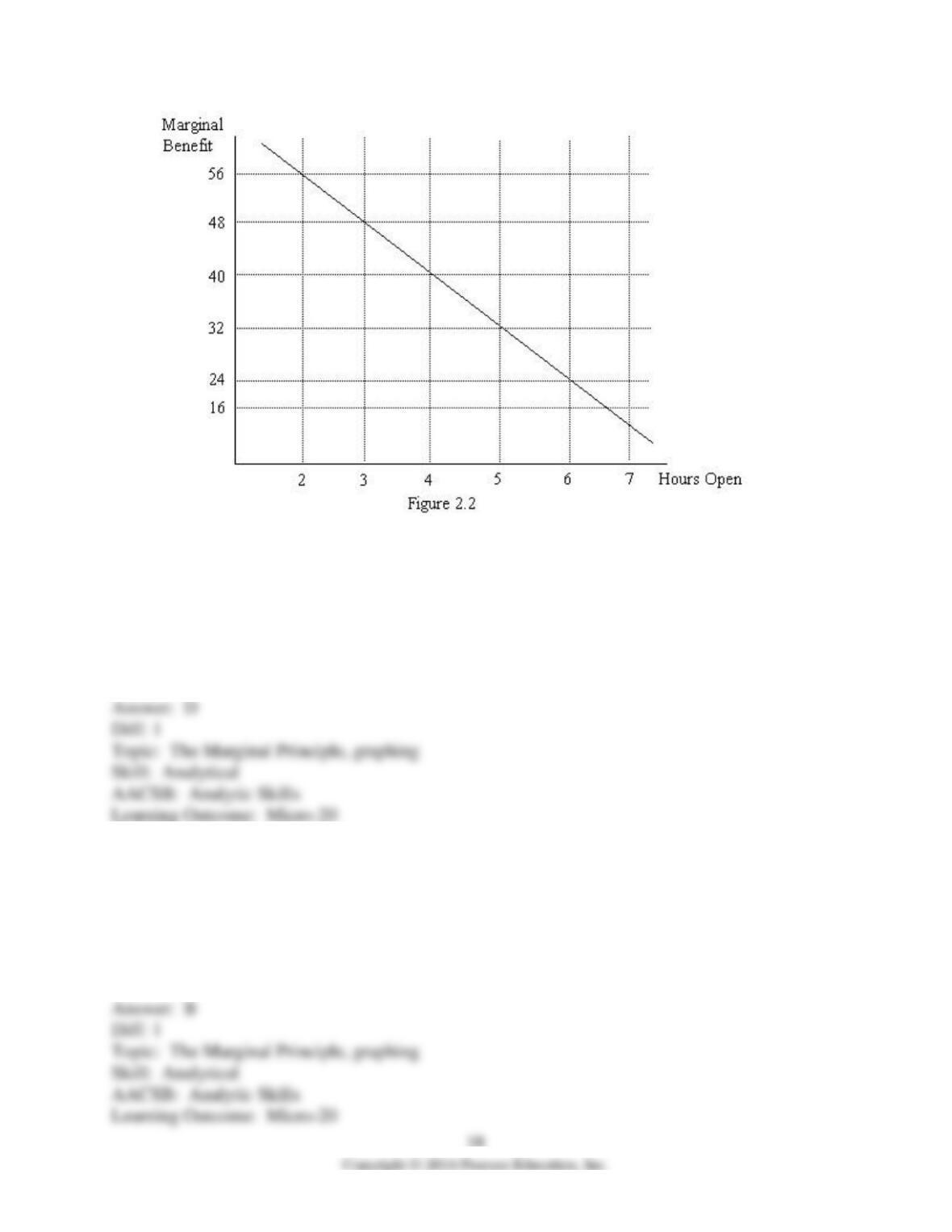
5) Joe runs a business and needs to decide how many hours to stay open. Figure 2.2 illustrates his
marginal benefit of staying open for each additional hour. Suppose that Joe’s marginal cost of
staying open per hour is $24. How many hours should Joe stay open?
A) 3 hours
B) 4 hours
C) 5 hours
D) 6 hours
6) Joe runs a business and needs to decide how many hours to stay open. Figure 2.2 illustrates his
marginal benefit of staying open for each additional hour. Suppose that Joe’s marginal cost of
staying open per hour is $32. How many hours should Joe stay open?
A) 4 hours
B) 5 hours
C) 6 hours
D) 7 hours
7) Joe runs a business and needs to decide how many hours to stay open. Figure 2.2 illustrates his
marginal benefit of staying open for each additional hour. Suppose that we observe Joe staying
open 5 hours per day. If he is following the marginal principle, what must his marginal cost per
hour be?
A) $16
B) $24
C) $32
D) $40
8) Joe runs a business and needs to decide how many hours to stay open. Figure 2.2 illustrates his
marginal benefit of staying open for each additional hour. Suppose that we observe Joe staying
open 3 hours per day. If he is following the marginal principle, what must his marginal cost per
hour be?
A) $24
B) $32
C) $40
D) $48
9) Joe runs a business and needs to decide how many hours to stay open. Figure 2.2 illustrates his
marginal benefit of staying open for each additional hour. Suppose that we observe Joe staying
open 6 hours per day. If he is following the marginal principle, what must his marginal cost per
hour be?
A) $16
B) $24
C) $32
D) $48
Hours of Operation
Marginal Cost
1
6
2
12
3
18
4
24
5
30
6
36
7
42
Table 2.2
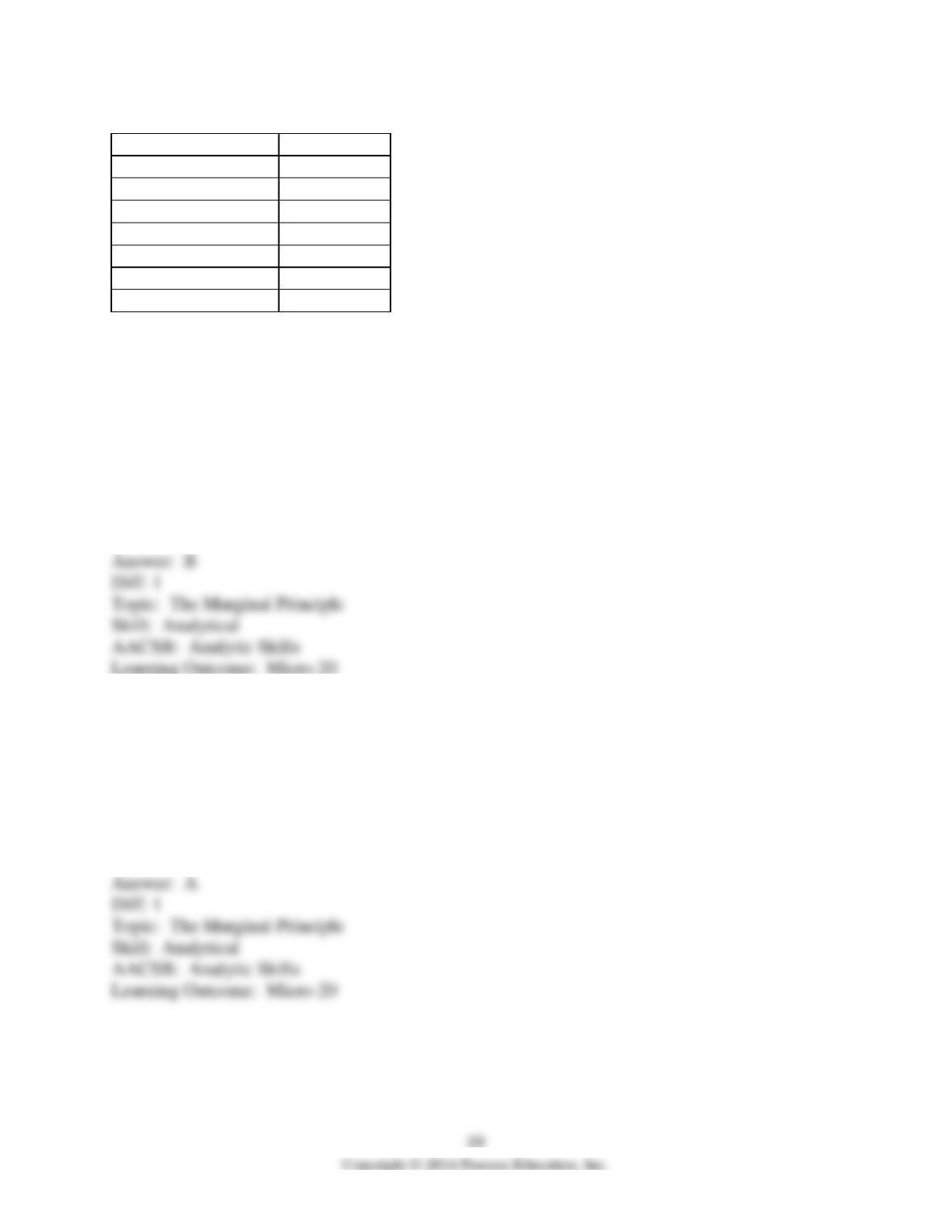
10) Krystal runs a nail salon and needs to decide how many hours to stay open. Table 2.2
illustrates her marginal costs of staying open for each additional hour. Suppose that Krystal’s
marginal benefit of staying open per hour is $30. If she is following the marginal principle, how
many hours should Krystal stay open?
A) 4 hours
B) 5 hours
C) 6 hours
D) 7 hours
11) Krystal runs a nail salon and needs to decide how many hours to stay open. Table 2.2
illustrates her marginal costs of staying open for each additional hour. Suppose that Krystal’s
marginal benefit of staying open per hour is $18. If she is following the marginal principle, how
many hours should Krystal stay open?
A) 3 hours
B) 4 hours
C) 6 hours
D) 7 hours