Exam
Name___________________________________
MULTIPLE CHOICE. Choose the one alternative that best completes the statement or answers the question.
1)
Scarcity arises because
1)
A)
import taxes depress the rate of growth of goods and services production.
B)
resources are finite and are inadequate to meet all human wants and needs.
C)
international companies are slow to explore for new resources.
D)
many countries waste goods because of inefficient political systems.
2)
Which is the best example of an intangible good?
2)
A)
The textbook study guide you hope will prepare you to perform well on examinations.
B)
The advice and expertise provided by the music store clerk who sold you that CD.
C)
The suit you hope will make a good impression when you go on job interviews.
D)
The car you dream of owning but cannot afford.
3)
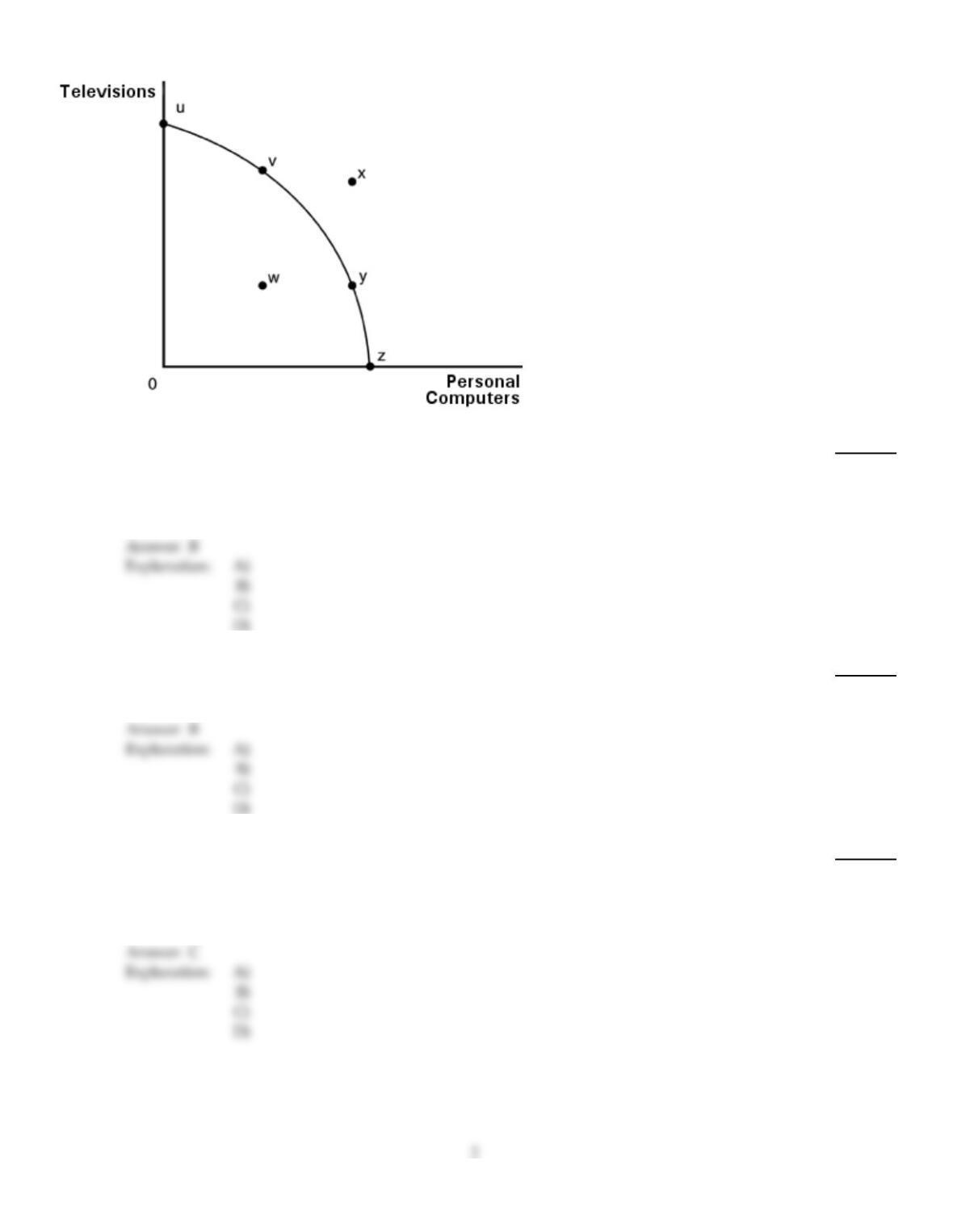
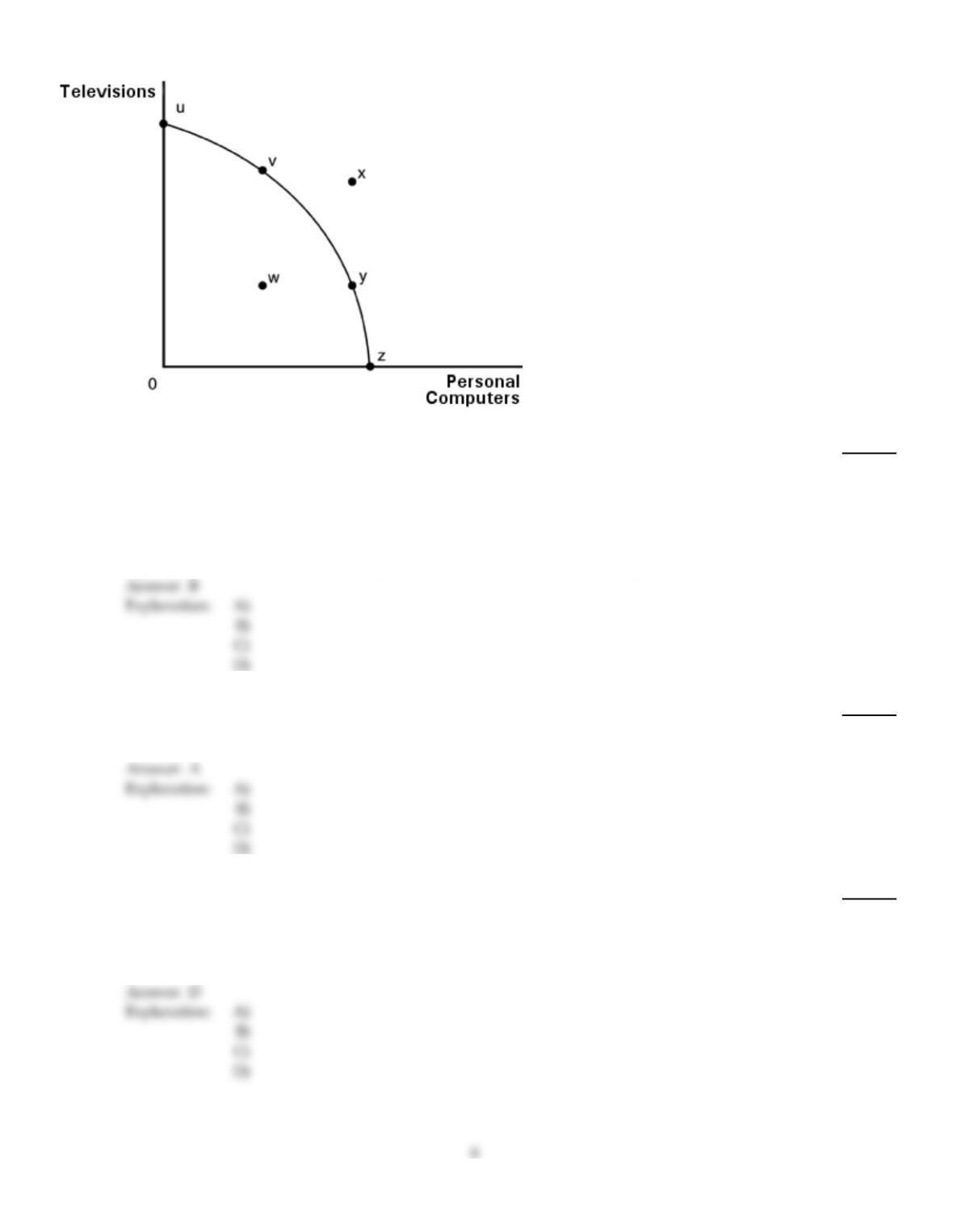
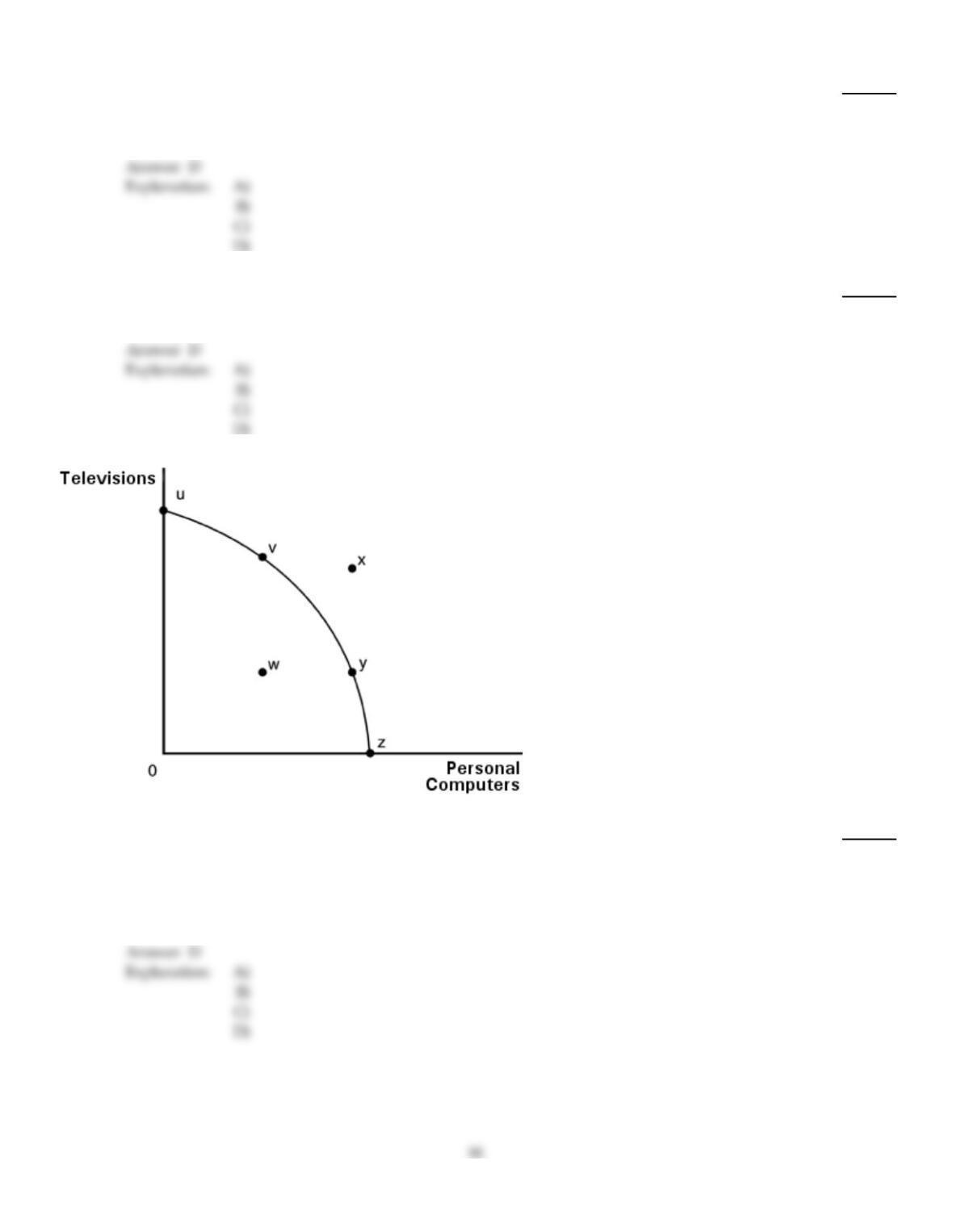
In the above figure, the combination of computers and televisions shown by point x
3)
A)
can be attained only if some of society’s resources are unemployed.
B)
is not attainable at the point in time for which the graph is drawn.
C)
suggests that the law of increasing relative costs does not hold.
D)
results only because society allocates its resources inefficiently.
4)
If a country wants to promote future growth, it should
4)
A)
produce only economic goods.
B)
produce more capital goods today.
C)
produce only needed goods.
D)
produce more consumer goods today.
5)
A technological improvement can cause the production possibilities curve to shift outward because
5)
A)
it causes increases in unemployment.
B)
it increases costs and contributes to lower production rates.
C)
maximum feasible outputs of both goods increase.
D)
production will fall, but jobs will be saved.
6)
The more society consumes today,
6)
A)
the easier it will be to consume less in the future.
B)
the harder it will be to consume less in the future because people will find it hard to adjust to
less.
C)
the more it consumes next year.
D)
the less society can consume in the future.
7)
Specialization and the division of labor typically result in
7)
A)
a greater reliance upon imports.
B)
cost overruns.
C)
decreased output.
D)
increased output.
8)
Jane is a top–level executive and is very rich. Jane just ordered a car only to be told that she will
have to wait three weeks for it to be delivered. Which of the following statements is true?
8)
A)
Jane paid too much for a car that wasn’t ready on time.
B)
The car is a scarce good.
C)
The car is not a scarce good.
D)
Because Jane has unlimited funds, she incurs no opportunity cost in buying the car.
9)
Suppose that Canadian farmers can grow wheat more cheaply than can U.S. farmers. In the
interest of efficiency, what is the desirable outcome?
9)
A)
Allow the Canadian farmers to sell their wheat for a lower price.
B)
Pass a law in the United States mandating a maximum price for wheat equal to what is
charged by Canadian farmers.
C)
Pass a law in Canada mandating a minimum price for wheat equal to what is charged by U.S.
farmers.
D)
Have U.S. citizens boycott Canadian wheat.
10)
Which of the following are considered factors of production?
I. Land
II. Labor
III. Physical capital
IV. Entrepreneurship
10)
A)
I, II, III and IV
B)
I and II only
C)
I and III only
D)
I, II and III only
11)
Services can be thought of as
11)
A)
free goods.
B)
unvalued goods.
C)
intangible goods.
D)
unwanted goods.
12)
Division of labor means that
12)
A)
the production process is divided into smaller tasks.
B)
the labor market in the United States is geographically segmented.
C)
some employees join labor unions and others do not.
D)
management and labor are always in conflict.
13)
Assume that Economy A and Economy B have the same resources, but that individuals in Economy
A have specialized whereas individuals in Economy B have not. Given this information, you can
determine that
13)
A)
Individuals in Economy A will have lower incomes than individuals in Economy B.
B)
Economy A will have a lower output than Economy B.
C)
Economy A and Economy B will have identical outputs.
D)
Economy A will have a higher output than Economy B.
14)
All of the following are resources EXCEPT
14)
A)
money.
B)
the computer in the student computer lab.
C)
doctors because they perform services.
D)
the land the Statue of Liberty sits on.
15)
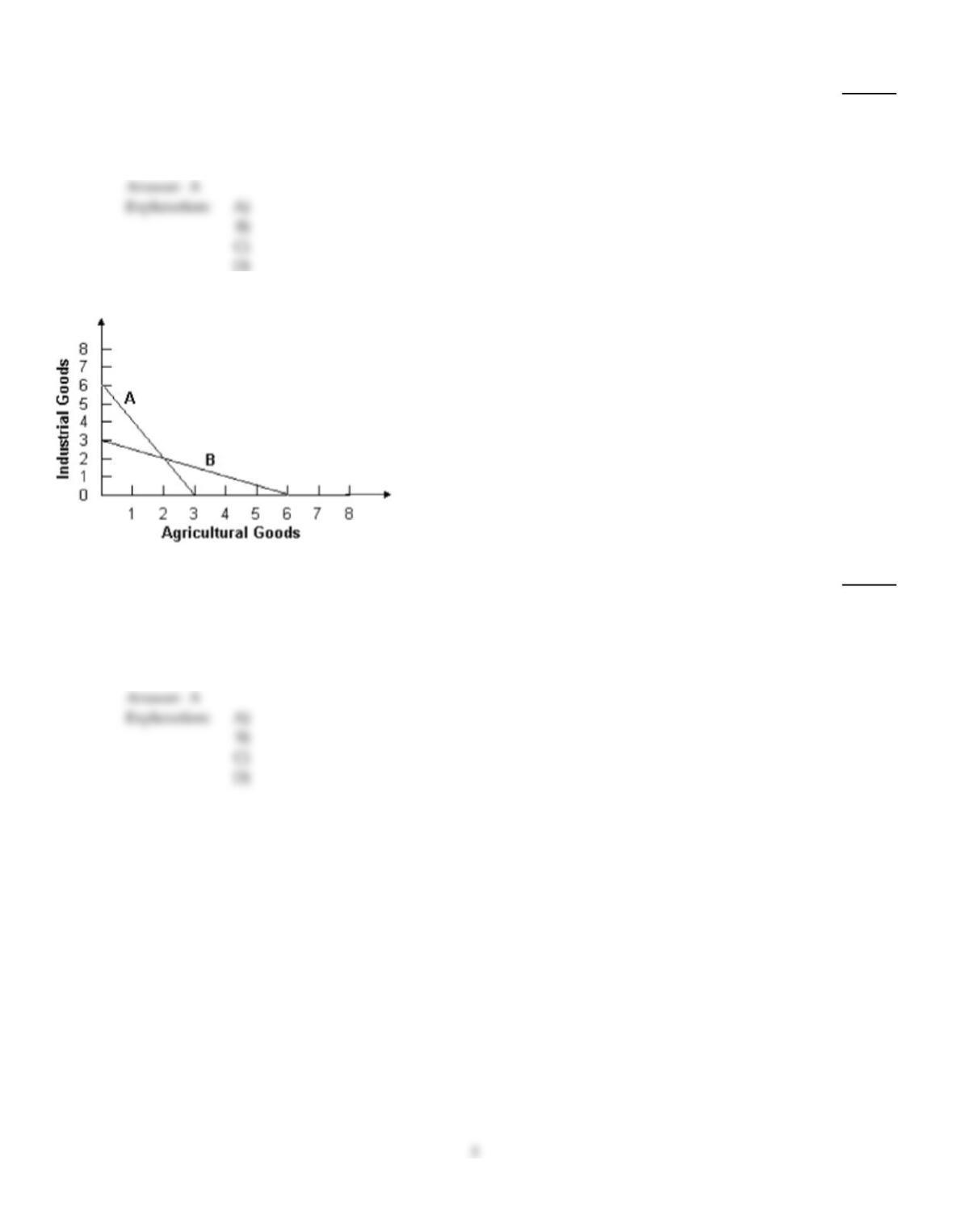
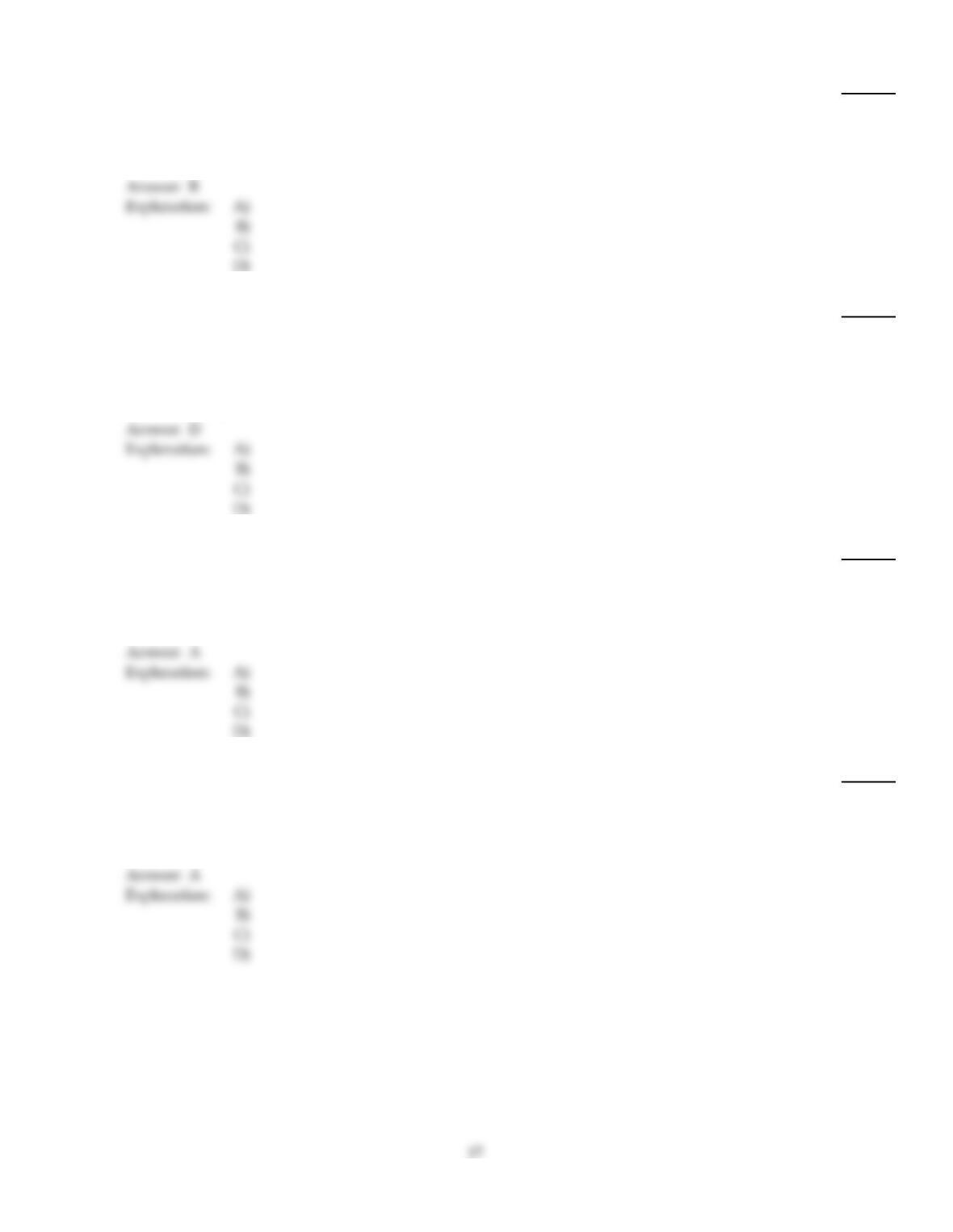
Based on the above figure, if countries “A” and “B” faced the production possibilities curves above,
both countries would benefit if
15)
A)
“A” produced industrial goods, and “B” produced agricultural goods.
B)
they both produced both industrial and agricultural goods.
C)
they did not trade.
D)
“B” produced industrial goods, and “A” produced agricultural goods.
A
A
16)
Which of the following statements about a movement along the production possibilities curve in
the above figure is FALSE?
16)
A)
Society cannot have more of both goods at the same time.
B)
There are no opportunity costs involved in choosing one point on the curve over all other
points.
C)
The trade–off between computers and televisions is not constant.
D)
An additional computer can be produced only if fewer televisions are produced.
17)
In order for a production possibilities curve to shift to the right, which of the following must occur?
17)
A)
economic growth
B)
government involvement
C)
reductions in the supply of resources
D)
increasing consumer wants
18)
When determining the production possibilities curve
18)
A)
the trade–off between the goods in the economy remains constant.
B)
the prices of resources are used.
C)
the prices of the goods are used.
D)
the amount of productive resources remains constant.
19)
John and Mary work at a bakery. John can decorate either 10 ice–cream cakes or 4 wedding cakes;
Mary can decorate either 8 ice–cream cakes or 2 wedding cakes. According to this scenario,
19)
A)
the opportunity cost of decorating a wedding cake for Mary is 1/4 ice–cream cake.
B)
the opportunity cost of decorating a wedding cake for Mary is 2/5 ice–cream cake.
C)
the opportunity cost of decorating a wedding cake for Mary is 4 ice–cream cakes.
D)
the opportunity cost of decorating a wedding cake for Mary is 2 1/2 ice–cream cakes.
20)
Scarcity is
20)
A)
a situation in which the resources required to produce the goods and services that people
desire are insufficient to satisfy all wants.
B)
a situation in which the resources for producing the goods and services that people desire are
sufficient to satisfy people’s desires.
C)
poverty and misery.
D)
a shortage of goods and services.
A
21)
Which of the following statements indicates the idea of trade–offs?
21)
A)
“Always give it the best that you can.”
B)
“The devil made me do it.”
C)
“I chose the road less traveled.“
D)
“You’ve got me under your spell.”
C
22)
How does an economy represented by a straight–line production possibilities curve differ from one
represented by a traditional production possibilities curve with a bowed shape?
22)
A)
In the economy represented by a straight–line production possibilities curve, the law of
increasing relative cost does not apply.
B)
In the economy represented by a straight–line production possibilities curve, changing the
amount of resources devoted to the production of each good will not alter the amount of each
good actually produced.
C)
In the economy represented by a straight–line production possibilities curve, neither good is
scarce.
D)
In the economy represented by a straight–line production possibilities curve, there is no
opportunity cost.
A
C
23)
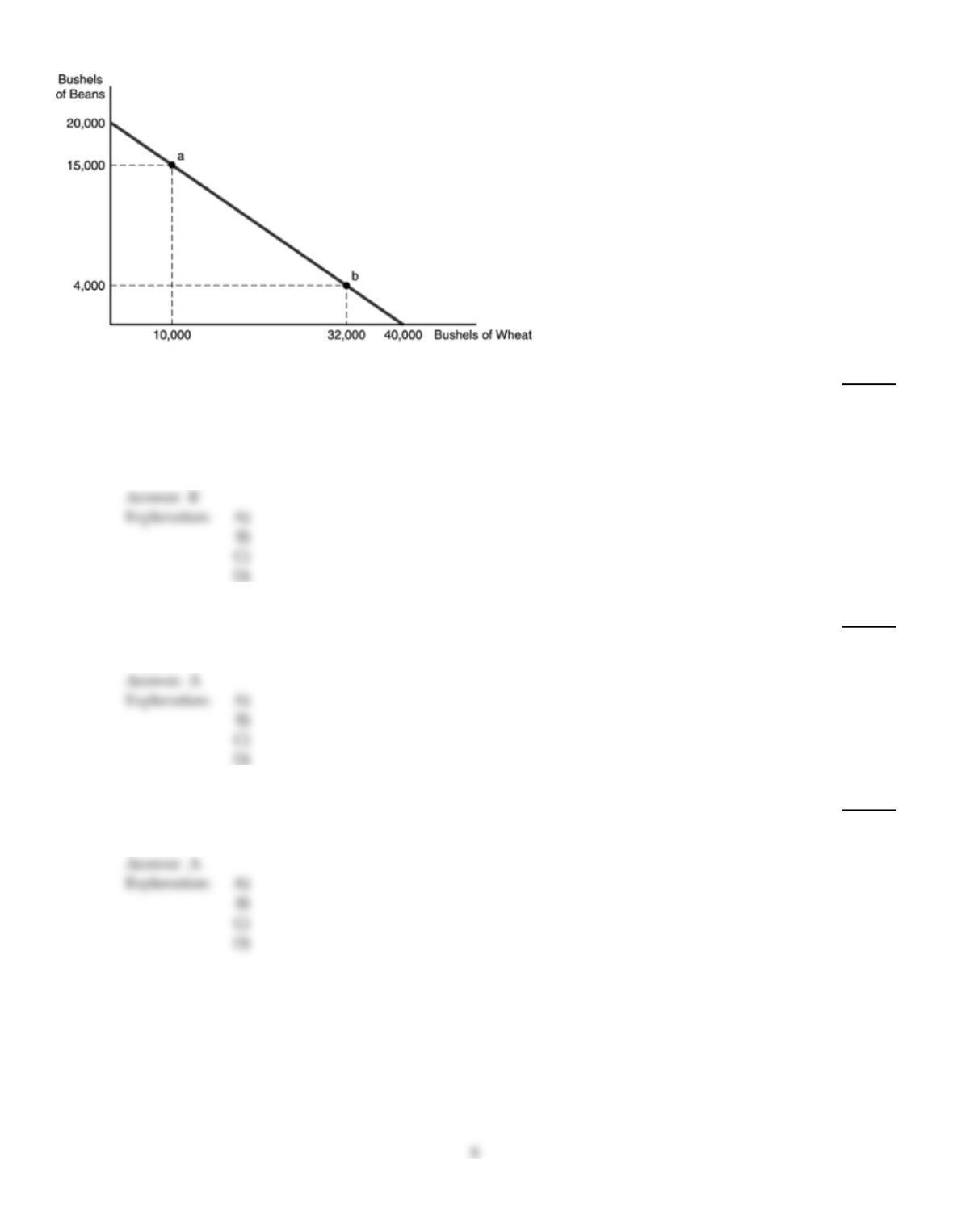
Refer to the above figure. If the farmer is producing 4,000 bushels of beans and 38,000 bushels of
wheat, then we know the farmer
23)
A)
is producing too much wheat.
B)
must be using more resources than were assumed available in constructing the graph.
C)
is inefficient because point a is the most efficient point on the curve.
D)
is using resources efficiently.
24)
The ability to produce a good at a lower opportunity cost that others is known as
24)
A)
comparative advantage.
B)
absolute advantage.
C)
marginal cost production.
D)
specialization.
25)
Generally, specialization leads to
25)
A)
greater productivity.
B)
constant opportunity costs.
C)
greater self–reliance.
D)
the production of fewer capital goods.
26)
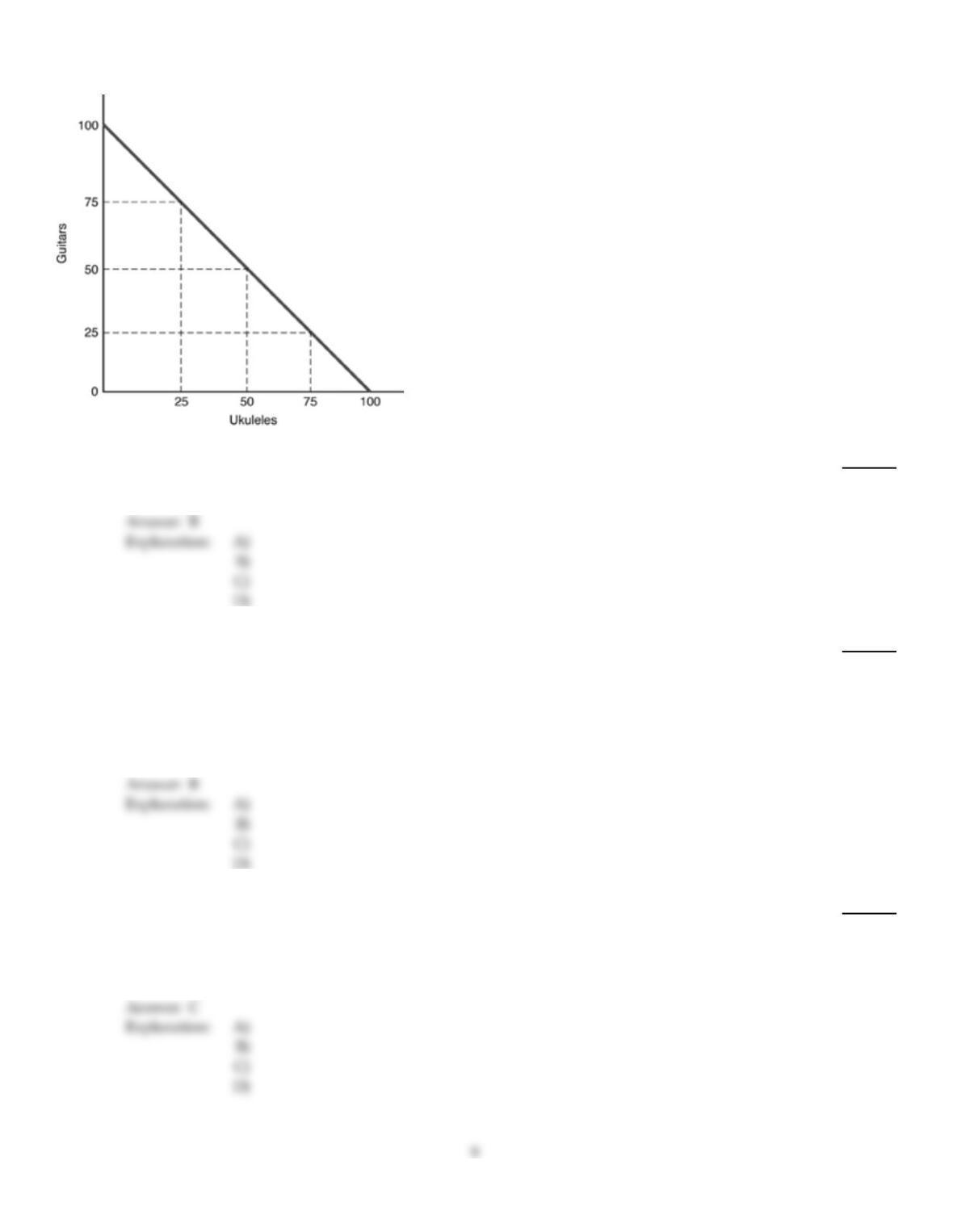
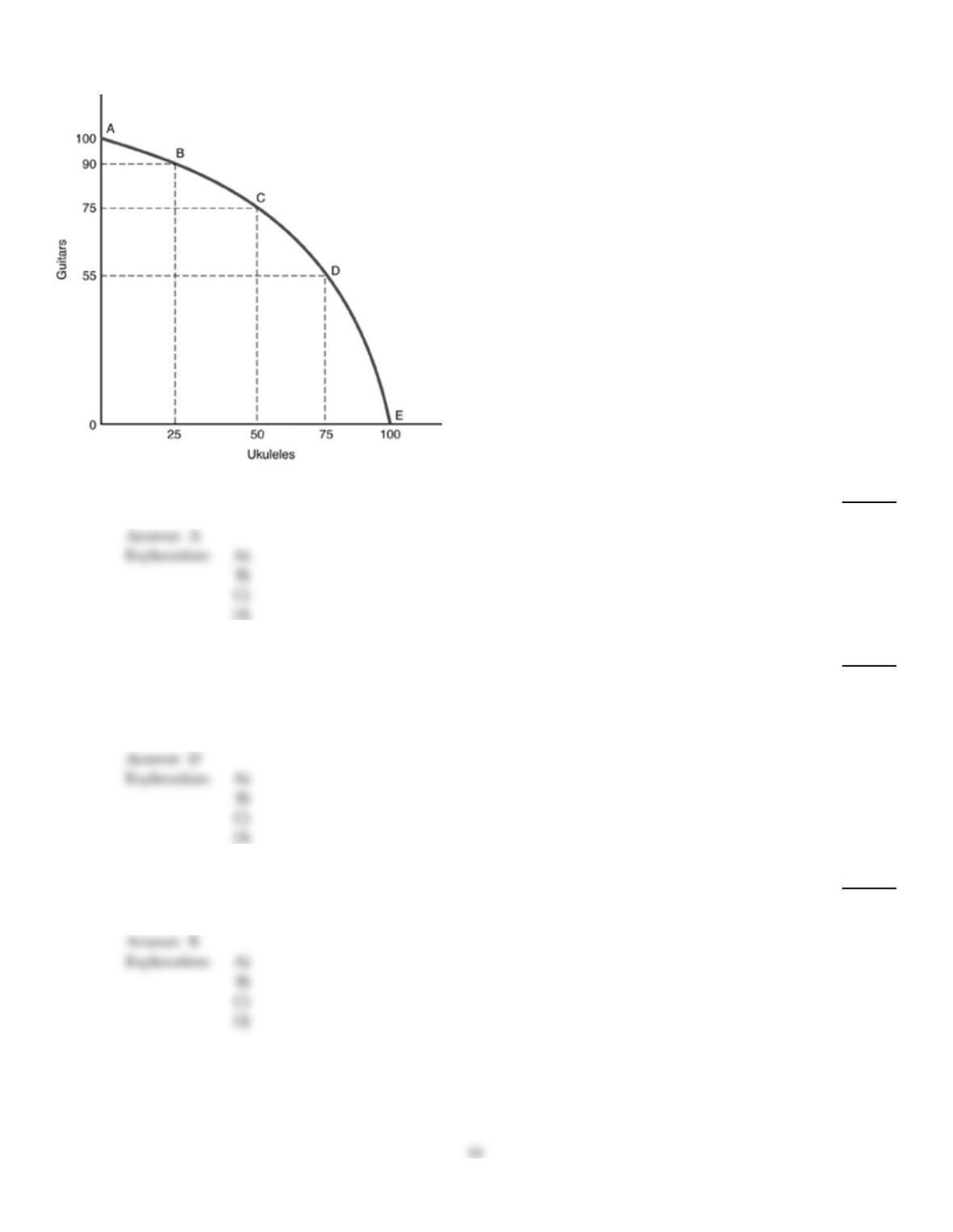
In the above figure, the opportunity cost of moving from producing 75 guitars and 25 ukuleles to
producing 25 guitars and 75 ukuleles is
26)
A)
25 guitars.
B)
50 guitars.
C)
75 ukuleles.
D)
25 ukuleles.
27)
John and Mary work eight hours at a bakery. John can decorate either 10 ice–cream cakes or 4
wedding cakes; Mary can decorate either 8 ice–cream cakes or 2 wedding cakes. According to this
scenario,
27)
A)
Mary has the comparative advantage in decorating wedding cakes.
B)
John has the absolute advantage in decorating wedding cakes.
C)
Mary has the absolute advantage in decorating wedding cakes.
D)
John has the comparative advantage in decorating ice–cream cakes.
28)
Efficiency is achieved
28)
A)
when output is being produced at a point inside a production possibilities curve.
B)
when consumers are able to buy everything that they want.
C)
when producers are getting the maximum possible output from the available resources.
D)
when prices of all goods and services go to zero.
29)
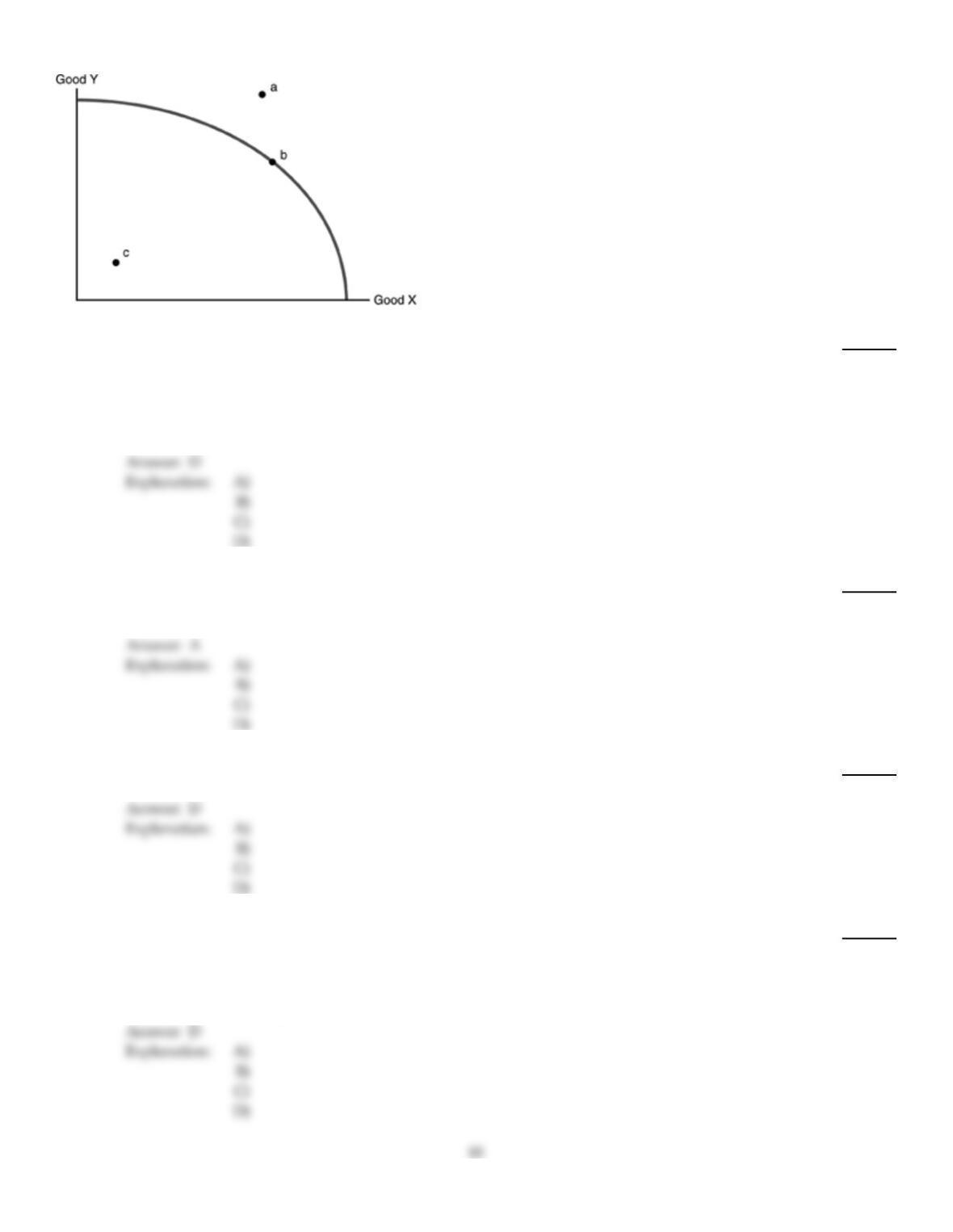
Refer to the above figure. Assume that only two goods can be produced in the economy. Which of
the following statements is true?
29)
A)
Only point b is an obtainable and efficient point of production.
B)
Points a, b, and c are all obtainable points of production.
C)
Points a and b are obtainable points of production.
D)
Points b and c are obtainable points of production.
30)
Which of the following is NOT an economic resource?
30)
A)
Money
B)
Coal
C)
An engineer
D)
Low–skilled labor
31)
By going to school an individual will obtain which resource?
31)
A)
Physical capital
B)
Knowledge
C)
Money
D)
Human capital
32)
Comparative advantage implies choosing the activity that
32)
A)
does not demand any specialization.
B)
has a high opportunity cost.
C)
is inside the production possibilities frontier.
D)
has the lowest opportunity cost.
33)
The law of increasing additional cost is due to
33)
A)
the fact that resources are not perfectly adaptable for alternative uses.
B)
inefficient use of technology.
C)
the fact that there are always alternatives and it is costly to figure out which alternative is
best.
D)
scarcity.
34)
All of the following are economic resources, or factors of production EXCEPT
34)
A)
entrepreneurship.
B)
land.
C)
physical capital.
D)
money.
D
35)
The discovery of new natural resources will cause
35)
A)
the curve to shift back and to the left.
B)
the production possibilities curve to shift up and to the right.
C)
the economy to move closer to the production possibilities curve.
D)
an upward movement along the curve.
B
36)
Which of the following would result in a movement along the production possibilities curve?
36)
A)
A change in the outputs of two goods that a society chooses to produce
B)
Population growth
C)
A fall in the unemployment rate
D)
Growth in the capital stock
A
A
37)
Scarcity refers to
37)
A)
the inability of society to satisfy all human wants because of limited resources.
B)
the ability of society to employ all of its resources.
C)
the inability of society to eliminate poverty.
D)
the ability of society to consume all that it produces.
38)
The reason the production possibilities curve is bowed outward (concave) is
38)
A)
that technology is constantly changing.
B)
that the number of resources is increasing.
C)
that the economy has more capital goods than entrepreneurial effort.
D)
the law of increasing additional cost.
39)
Some resources are better suited to produce certain goods than other resources. This fact leads to
39)
A)
a linear production possibilities curve.
B)
inefficiency in the economy.
C)
increases in technology.
D)
the law of increasing additional cost.
40)
If a country is currently producing inside its production possibilities curve,
40)
A)
it is experiencing efficient production of one good but not the other.
B)
it can increase the production of one of the goods only if it reduces the production of the other
good.
C)
it can increase the production of both goods by putting unemployed resources to work.
D)
None of the above are correct.
41)
If Irene can make either four chairs or one table in an hour and Greg can make either three chairs or
two tables in an hour, then
41)
A)
Irene has the comparative advantage in the production of chairs.
B)
Greg has the comparative advantage in the production of chairs.
C)
Irene has the absolute advantage in the production of tables.
D)
Greg has the absolute advantage in the production of chairs.
42)
Scarcity implies that
42)
A)
people should limit their wants, since shortages exist.
B)
people must make choices.
C)
nonrenewable resources should never be used.
D)
firms should be more efficient when producing goods.
43)
Generally, if a nation produces more consumer goods than capital goods
43)
A)
society will have to forego future consumption of capital goods .
B)
less of all goods may be produced in the future.
C)
about the same amount of capital goods may be produced in the future as are being produced
today.
D)
more of all goods may be produced in the future.
44)
In the above figure, as more ukuleles are produced, the opportunity cost in terms of guitars is
44)
A)
increasing.
B)
constant.
C)
zero.
D)
decreasing.
45)
Scarcity is caused by
45)
A)
lazy workers.
B)
mechanical breakdowns at factories.
C)
shortages.
D)
unlimited wants running up against limited economic resources.
D
46)
Bonnie volunteers to help make floral arrangements at a flower shop. She is an example of
46)
A)
Physical capital
B)
Labor
C)
Human capital
D)
Entrepreneurial ability
B
A
47)
Specialization occurs because
47)
A)
society trades current consumption for future consumption.
B)
people have different skills.
C)
society produces made the production possibilities curve.
D)
the production possibilities curve tends to be linear.
48)
In economic terminology, the accumulated training and education that workers receive to increase
their productivity is referred to as
48)
A)
physical capital.
B)
human capital.
C)
labor.
D)
entrepreneurship.
49)
Tiger Woods, a professional golfer, pays a garage mechanic to change the motor oil of his car even
though he can do the work himself. Which of the following best explains why Tiger Woods does
not change the oil himself?
49)
A)
The opportunity cost of changing oil is higher for Tiger Woods than for the garage mechanic.
B)
There is no opportunity cost for the garage mechanic to change oil.
C)
Tiger Woods has an absolute advantage in changing oil.
D)
Tiger Woods has a comparative advantage in changing oil.
50)
Opportunity cost
50)
A)
does not exist since there are no receipts.
B)
is always the value of the next best forgone opportunity.
C)
can only be measured as a paid cost.
D)
is always the lowest valued alternative.
51)
The division of productive activities among persons and regions so that no one individual or area is
totally self–sufficient is known as
51)
A)
comparative value.
B)
outsourcing.
C)
advantage–taking.
D)
specialization.
52)
The tasks performed by the chef at your favorite restaurant could be categorized as
52)
A)
an economic good.
B)
a service or intangible good.
C)
a good.
D)
All of the above are correct.
53)
In the above figure, the combination of personal computers and televisions shown by point w
53)
A)
is an efficient use of society’s resources because it is below the production possibilities curve.
B)
is more desirable than point x because producing at point w does not put a strain on society’s
resources.
C)
is beyond the capacity of society to produce.
D)
is attainable but involves the inefficient use of some of society’s resources.
54)
Opportunity cost is defined as
54)
A)
the return from a given unit of labor.
B)
the value of the next–best alternative that must be sacrificed to attain a want.
C)
the value of the output currently received by an individual or a corporation.
D)
the least–costly means to produce output.
55)
Division of labor refers to
55)
A)
separating union workers from nonunion workers.
B)
dividing tasks up into several subtasks and having one person perform these subtasks in a
certain order.
C)
the separation of hourly workers from salaried workers.
D)
assigning different workers to different tasks.
56)
The opportunity cost of a decision is the
56)
A)
value of the best alternative not chosen.
B)
cost of making the wrong choice.
C)
value of all the alternatives not chosen.
D)
cost incurred by others who are unhappy with your decision.
57)
Which of the following is NOT an assumption used in deriving a production possibilities curve?
57)
A)
The labor force is growing at a constant rate.
B)
The quantity of resources is constant.
C)
Technology is constant.
D)
Resources are fully employed.
58)
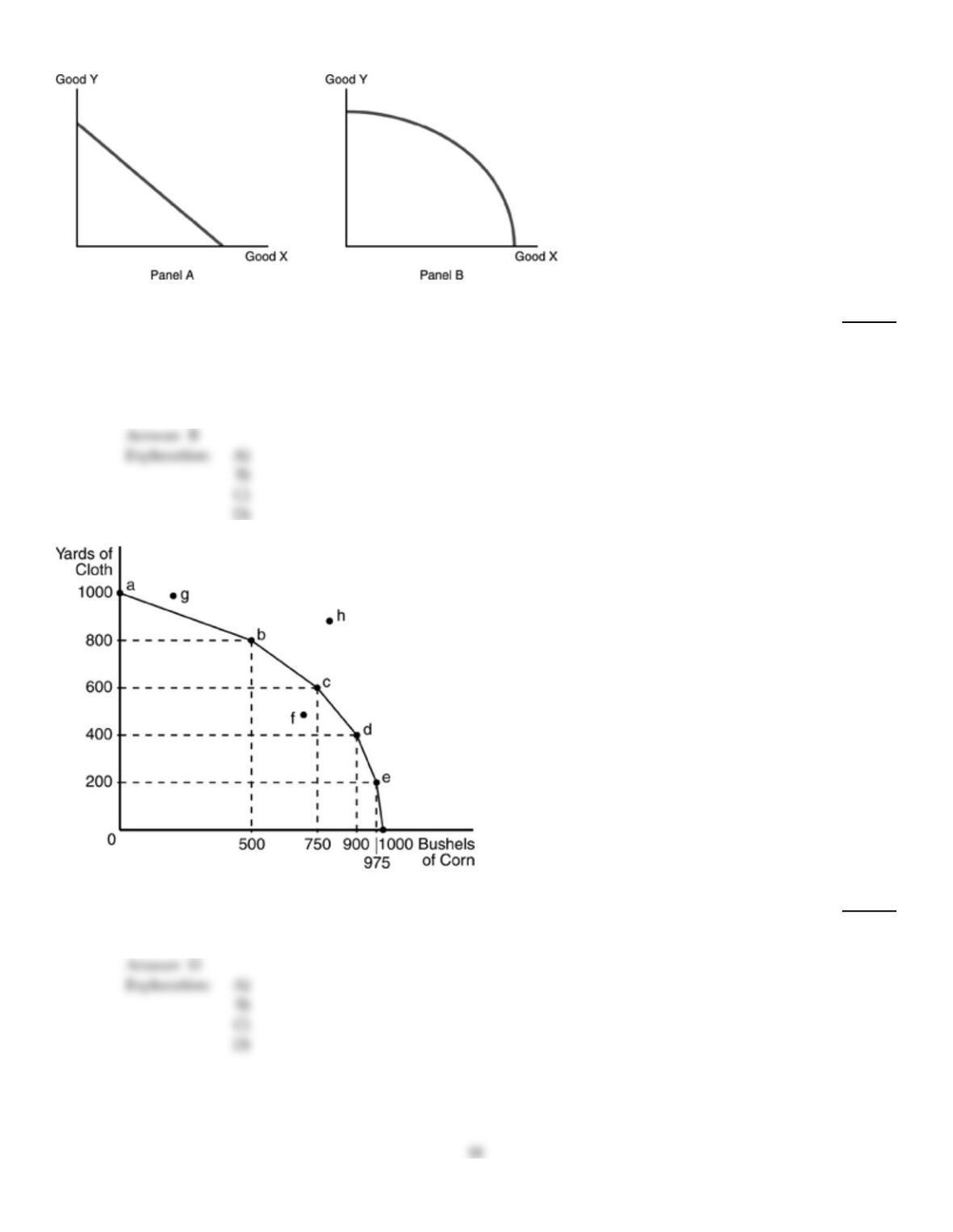
Refer to the above figure. Which of the following statements is true?
58)
A)
Panel A represents an economy that has a lower level of technology than Panel B.
B)
In Panel A, equal amounts of Y must be given up to obtain equal increments of X while in
Panel B increasingly greater amounts of Y must be given up to obtain equal increments of X.
C)
Opportunity costs do not apply to Panel A but apply to Panel B.
D)
Panel A does not represent an economy that is producing efficiently while Panel B does.
59)
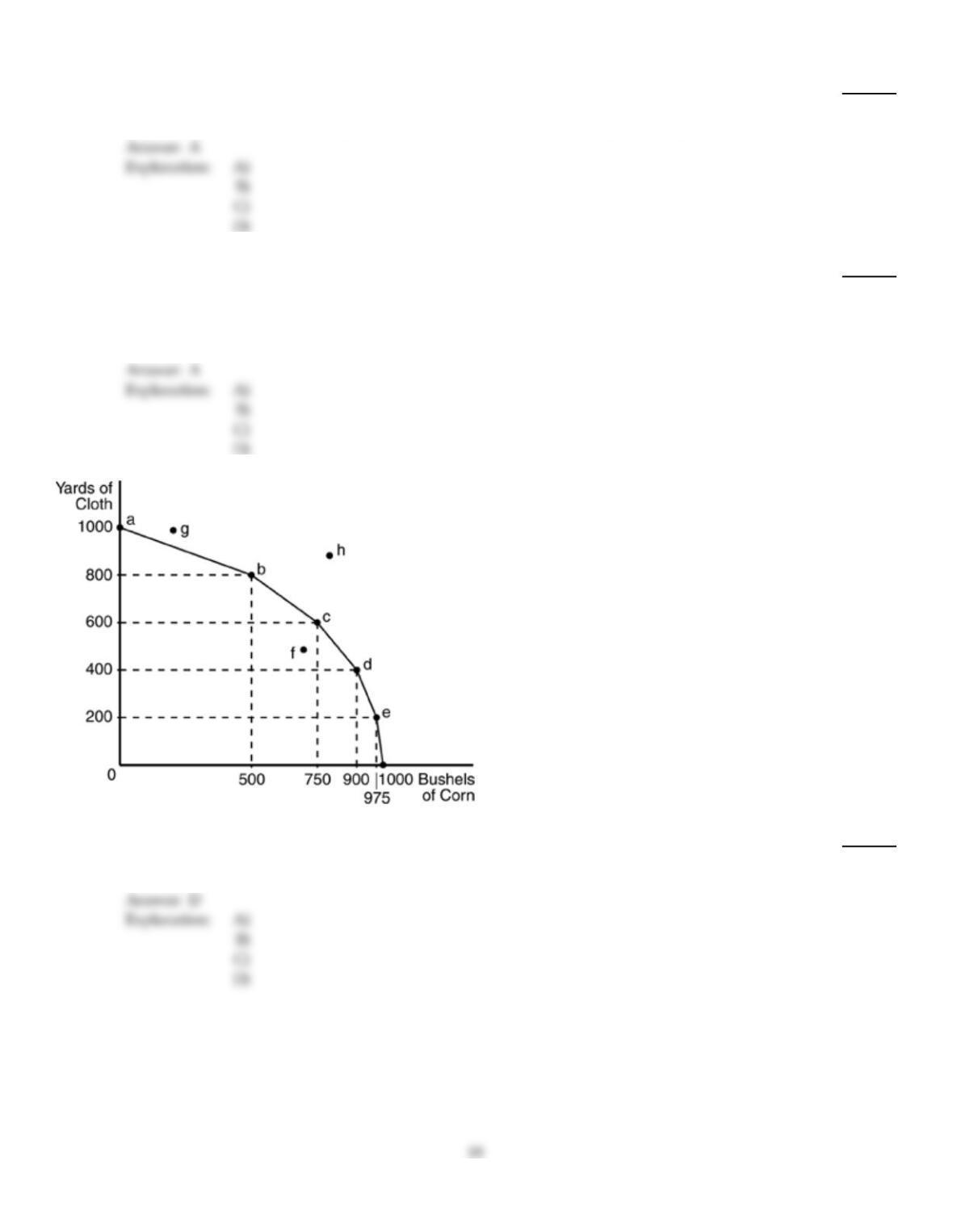
Between points “b” and “c” in the above figure, the opportunity cost of 250 more bushels of corn is
59)
A)
250 yards of cloth.
B)
800 yards of cloth.
C)
600 yards of cloth.
D)
200 yards of cloth.
60)
A person goes to college to become an engineer. This is an example of an
60)
A)
investment in human capital.
B)
increase in labor.
C)
increase in entrepreneurship.
D)
investment in physical capital.
61)
Division of labor
61)
A)
leads to an increase in the amount of output in the economy.
B)
increases the amount of capital in the economy.
C)
makes economic goods possible.
D)
is not possible for service goods.
A
62)
Which of the following would NOT allow society to move to point “h” in the above figure?
62)
A)
An improvement in technology
B)
An increase in quantity of capital
C)
An increase in quantity of labor
D)
More efficient use of current resources
D
A