2
Basic Tools of Writing
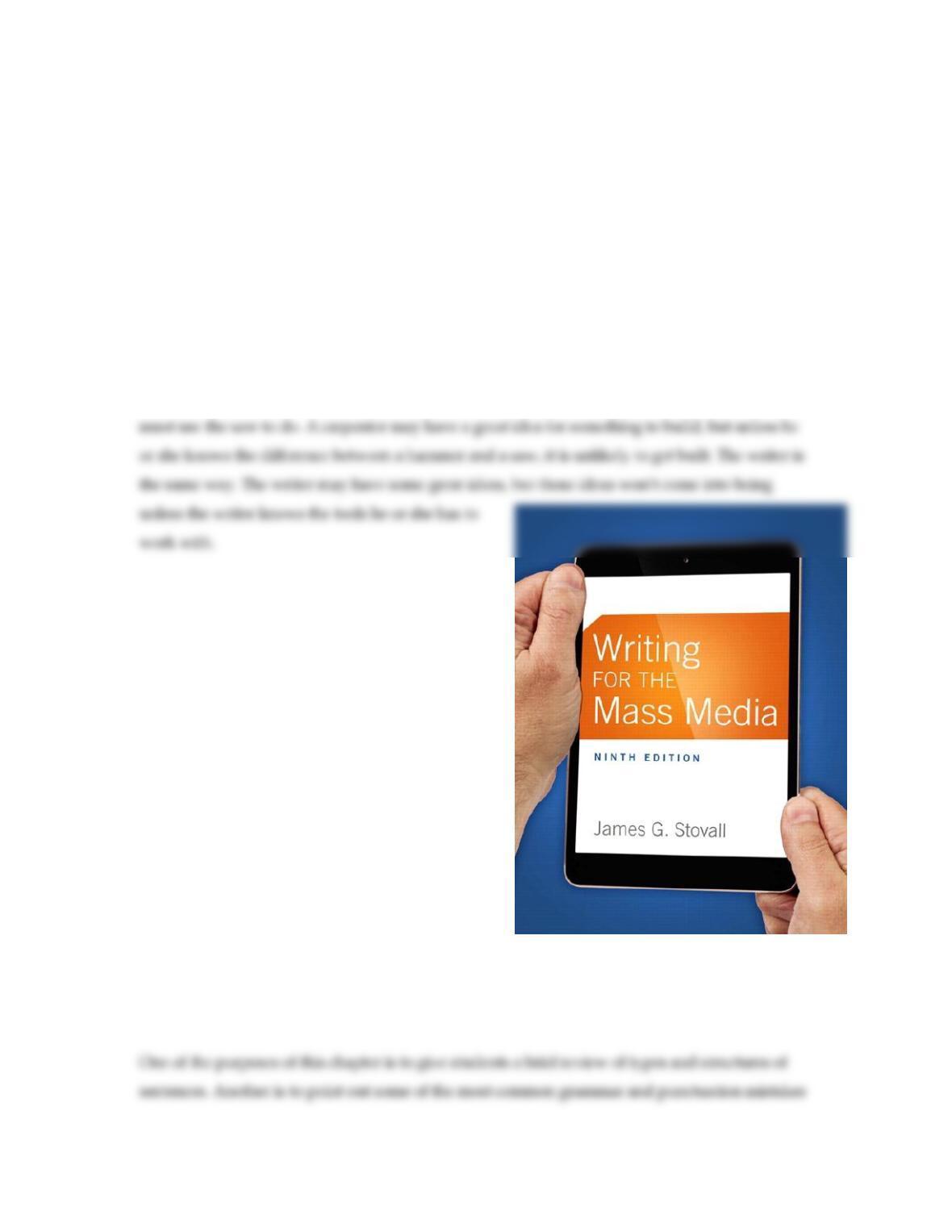
This chapter attempts to make the point that a good writer knows the tools he or she has to work
with. The basic analogy in the text is with the carpenter, who has a hammer and a saw. The
carpenter must know what tasks he or she can accomplish with a hammer and what he or she
This chapter is a brief review of some of the basic
tools a writer must work with. You may feel that
grammar and punctuation are not subjects you wish
to spend time on in your course. If that is the case, I
would strongly recommend that you have your
students read those sections and that you spend
some time on the word usage section. This is an
area I have found consistently that students have
difficulty with. Knowing when to use a word for its
precise and generally accepted meaning is
particularly important in writing for the mass
media.
Key terms and concepts
that students make. Instructors should use this chapter to their best advantage by deciding what
emphasis needs to be placed on these subjects. The exercises at the end of the chapter and the
grammar exam and diagnostic exam in the appendices of the textbook could help you in making
this assessment. Students should leave this chapter with an understanding of the following:
Use of the comma — Overuse and underuse of the comma are both problems that students have.
Commas should be used for clarity; that is, to separate items that would be confusing if they were
not separated.
Agreement — Getting verbs and subjects to agree in number, and especially getting pronouns to
agree with their antecedents, are among the most common problems that students have with
their writing.
Apostrophe — Proper use of the apostrophe is the mark of an intelligent and well-educated
writer. The apostrophe is most often used to indicate possession. It is only rarely used to create a
plural.
Links and resources
Guide to grammar and writing. The guide to grammar and writing contains scores of digital
handouts on grammar and English usage. This site is a general guide to producing accurate
Professor Gibson’s wonderful world of editing. The site offers an all-around guide to editing
complete with grammar and media writing particulars such as attribution, writing headlines and
Hypergrammar at the University of Ottawa. One of handful of online writing labs, visitors of
this site may find grammar tips based on parts of speech, parts of a sentence, punctuation and
Chapter notes
Rules for using commas. Ever wish you had a single sheet with all the basic rules for using
commas on it? You could hand that to your students and say something like, “Here, learn this.
We’ll have a test next week. You won‘t ever have an excuse for misusing a comma again.” Well,
your dream has been fulfilled. JPROF.com offers a single-sheet (HTML or PDF file) that contains
Grammar terms and rules. Just as any competent artisan knows the tools of his or her trade, the
professional writer should know the basics of the English language. That includes knowing the
terms of grammar (verbal, antecedent, etc.) as well as the rules. How is the writer to avoid a run-
on sentence if he or she doesn’t know what it is? To learn these things, students must do the ditch
digging of the intellectual process: repeated study and memorization. JPROF.com contains a
thorough (but not overly long) list of terms and rules for using the language that the professional
Exercises
2-1 Writing skills
1. He is one of the greatest choreographers who has ever lived. Correct
2. The general assumed what was then described as dictatorial powers.
3. The couple has two children. Correct
8. Only two in four were urgent cases, a group that included cardiacs,
asthmatics and those found unconscious. Correct
9. The chairman stated that response to the committee’s activities has
convinced him that the money for renovation can be raised. Correct
10. Business administration and journalism courses provide the student
with good background for work in public relations. Correct
11. Here come the famous Kilgore College Rangerettes onto the field to
perform at halftime.
12. Leading the United States’ show of strength were Arthur Ashe and
Clarke Graebner. Correct
2-2 Writing skills
1. Their rival forces, meanwhile, prepared to meet Wednesday to patch up
peace. (Add commas)
2. Pasadena, Calif., is the site of the Rose Bowl.
3. It was O. J. Simpson (who, whom) the coach praised so highly.
4. The tomb of the pharaoh had (laid, lain) buried in the desert for
centuries.
10. Come here, Mary, and help us.
11. I know she (swum, swims) the channel regularly in this weather.
12. The children looked forward for several weeks to celebrating
Christmas.
2-3 Punctuation
1. I subscribe to the New Yorker, Harper’s Magazine and the New
Republic.
2. Seven legislators from the southern part of the state changed their
votes, and with their help, the bill was passed.
7. Light entered the room through cracks in the walls, through holes in
the roof and through one small window.
8. Hundreds of church bells, ringing loudly after years of silence,
announced the end of the war.
9. The book was lying where I left it.
10. The advisor who is never in his office makes registration
difficult.*
11. Some years ago, I lived in a section of town where almost everyone
was a Republican.
2-4 Pronouns and verbs
1. He is the player (who, whom) probably will play shortstop.
2. Is this the person (who, whom) you want?
3. Each of the three quarterbacks (is, are) good runners.
when the session began.
7. (Who, Whom), then, would the tax hurt?
8. Do you know to (who, whom) that notebook belongs?
9. (Who, Whom) is going with the reporter to get a picture of the
crash?
10. He declared that everybody must play (his [or her], their) part.
2-5 Verbs
1. What (lays, lies) in the future for Alaska?
2. He had been (lain, laid) on a stretcher.
3. “(Lay, Lie) down and be quiet for an hour,” he ordered.
4. The 6-year-old boy was just (setting, sitting) there in the ruins,
trying not to cry.
5. The Ohio State football team (sat, set) back and enjoyed the movie
of its game with Michigan.
6. The men worked all night (raising, rising) a monument in spite of
the (raising, rising) tide of the river.
7. After lunch she had (laid, lain) down for a nap.
8. The hard tackling by the Georgia Bulldogs had really (began, begun)
to tell.
9. Suddenly a cloud of dust (rises, raises) in the west.
2-6 Clauses
The independent clauses are underlined and the subordinate clauses are in italics.
1. They agreed to open negotiations when both sides ceased fire.
2. If he had known, he would never have said that.
off.
5. This is called the cryptozoite stage, after which the plasmodia break
out of the liver cells and float about in the blood stream.
6. An especially big wave rolled in, when I finally managed to get my
line unsnagged.
7. While walking past the building, the night watchman noticed the door
was unlocked.
2-7 Punctuation
1. Nobody knows the trouble I’ve seen; nobody knows but Jesus. (This is
a line from a Negro spiritual. Punctuate it as if it were in the
middle of a paragraph.)
2. The responsible reporter, one who is scrupulously honest, will still
encounter problems.
3. Abraham Lincoln died on April 15, 1865, after being shot while
attending a play at Ford’s Theater.
7. Wow, I couldn’t think of any place better to eat myself.
8. According to my professor, the world is absolutely, positively flat,
and you should never forget it.
9. Where are the carpenters, where are the bricklayers, and most of all,
where are the gardeners when we need them the most.
10. I couldn’t come to class today, Joe said, because I had the flu.
2-8 Word choice
1. _There__ are good reasons why _they’re_ about to sell _their___
house.(there, their, they’re)
2. _It’s__ not _too__ late _to__ give the cat milk.(its, it’s, to, too)
3. If _you’re__ going home, take _your__ books with you. (your, you’re)
holding on to _their____ own; and while there are several scientific
explanations for stubbornness, ___there’ll____ be few changes unless
we can convince men that they ought to be more open-minded. (there,
their, they’re, there’ll)
7. My __principal_____ objection to the __principal___ of that school is
that he is a man of no ___principle___. (principal, principle)
8. Not until __then___ will you be able to tell whether you have more
__than__ you need. (than, then)
9. If _your___ strap is __loose___ , you may __lose___ your books.
(lose, loose, you’re, your)
10. Not even in the __desert__ would I __desert___ the table before
eating _dessert__. (desert, dessert)
2-9 Word choice
1. The bomb, which was to _wreak__ havoc on the whole block, killed so
many people that their bodies soon began to _reek__. (reek, wreak)
2. The newsmagazine _that__ she subscribed to never seemed to tell her
all that she needed to know. (that, which)
3. When he put the book down, he decided that he had just read something
very _unusual___. (unique, unusual)
4. The __reign__ of Queen Victoria was a long and prosperous one. (rein,
reign)
5. He decided to _pedal___ his bike down to the town square to see if he
could _peddle__ the things that he had made. (peddle, pedal)
1. Gilligan was so charmed by the desert isle that he decided to marry
the movie star.
2. As that nice professor said, we should always study for our exams.
3. The cantaloupe-throwing contest was canceled because of adverse
weather.
8. Fewer than 100 pumpkins were piled in Smith’s car.
9. Hurricane Bubba ravaged the Gulf Coast, causing $10 billion in
damages. Correct
10. The dancing troupe refused to buy their tights at wholesale.
Correct
2-11 Agreement
1. The team, consisting of three boys and three girls, _has__ (has,
have) a tough schedule this season.
2. None of the candidates _has__ (has, have) accepted the invitation to
the forum.
6. The neighborhood association had certain issues __it__ (it, they)
wanted to address at the city council meeting.
7. Every journalist should try to write news stories that are as
accurate as _he or she___ (they, he or she) can make them.
8. The U.S. Supreme Court normally begins _its___ (its, their) annual
session on the first Monday of October.
2-11 Comma splices and run-on sentences
In some of these sentences, you can correct them by turning the comma into a semicolon or you
can make them into two sentences. There are examples of each below.
1. I don’t know of anyone who went. I didn’t go myself.
2. The horses came loping into the barn, but there was no food for them.
6. The St. Louis Cardinals won the National League pennant, while the
New York Yankees triumphed in the American League; they will meet in
this year’s World Series.
7. Where was the truck going? Which direction was it heading?
8. He has just finished his seventh mystery novel, and he has yet to
Question bank
1. Choose the correct word that should begin the following sentence:
_____ time to feed the cat.
2. The major use of punctuation in writing is to
3. Choose the sentence that is correct:
4. Which of the following sentences uses the active voice?
5. Which of the following sentences is correctly punctuated?
6. The underlined phrase in the following sentence is an example of what?
John, my brother, left home for the Army.
7. What kind of error is contained in the sentence below?
The polise arrived just as the shooting ended.
8. What is the correct punctuation for a direct quote?
9. Which of the following sentences is punctuated correctly?
10. Dr. Smith, an all-around nice guy, lectures on Monday mornings.
The underlined material is:
11. Which of the sentences below represents a comma splice.
12. Looking through the window, the couch is on the left.
The sentence above is an example of
13. What is the definition of a non-essential clause?
14. What is wrong with the sentence below?
Having just finished the exam, George saw the sky and it looked bright and wonderful.
15. Which of the statements below is correct?
16. In which voice is the verb in the sentence below?
Jim was asked by his closet friend to be a groomsman.