
Chapter 2—Analyzing Transactions Key
1. Accounts are records of increases and decreases in individual financial statement items.
2. A chart of accounts is a listing of accounts that make up the journal.
3. The chart of accounts should be the same for each business.
4. Accounts payable are accounts that you expect will be paid to you.
5. Consuming goods and services in the process of generating revenues results in expenses.
6. Prepaid expenses are an example of an expense.
7. Unearned Revenues account is an example of a liability.
8. The Drawings account is an example of an expense.
9. Accounts in the ledger are usually maintained in alphabetical order.

10. Depending on the account title, the right side of the account is referred to as the credit side.
11. To determine the balance in an account, always subtract credits from debits.
12. The double-entry accounting system records each transaction twice.
13. The increase side of all accounts is the normal balance.
14. Transactions are initially entered into a record called a journal.
15. The process of recording a transaction in the journal is called journalizing.
16. Journalizing is the process of entering amounts in the ledger.
17. Transactions are listed in the journal chronologically.
18. Journalizing transactions using the double-entry bookkeeping system will eliminate fraud.
19. Liability accounts are increased by debits.

20. Expense accounts are increased by credits.
21. Revenue accounts are increased by credits.
22. The normal balance of a capital account is a debit.
23. The normal balance of the drawing account is a debit.
24. The normal balance of an expense account is a credit.
25. The normal balance of revenue accounts is a credit.
26. Withdrawals decrease owner’s equity and are listed on the income statement as a deduction from revenue.
27. For a month’s transactions for a typical medium-sized business, the salary expense account is likely to have
only credit entries.
28. For a month’s transactions for a typical medium-sized business, the accounts payable account is likely to
have only credit entries.
29. When a business receives a bill from the utility company, no entry should be made until the invoice is paid.

30. An account has three parts to it; a title, an increase side, and a decrease side.
31. The T account got its name because it resembles the letter “T.”
32. The right hand side of a T account is known as a debit and the left hand side is known as a credit.
33. A debit is abbreviated as Db and a credit is abbreviated as Cr.
34. Debiting the cash account will increase the account.
35. A credit to the cash account will increase the account.
36. The cash account will always be debited.
37. The recording of cash receipts to the cash account will be done by debiting the account.
38. The recording of cash payments from the cash account is done by entering the amount as a credit.
39. The balance of the account can be determined by adding all of the debits, adding all of the credits, and
adding the amounts together.

40. When an owner contributes equipment to the business, he or she retains ownership of the property.
41. Liabilities are debts owed by the business entity.
42. The accounts payable account is listed in the chart of accounts as an asset.
43. A drawing account represents the amount of withdrawals made by the owner.
44. Revenues are equal to the difference between cash receipts and cash payments.
45. Expenses use up assets or consume services in the process of generating revenues.
46. Owner’s capital will be reduced by the amount in the drawing account.
47. The journal includes both debit and credit accounts for each transaction.
48. A transaction that is recorded in the journal is called a journal entry.
49. Assets are increased with debits and decreased with credits.

50. Liabilities are increased with debits and decreased with credits.
51. Debits will increase Unearned Revenues and Revenues.
52. All owner’s equity accounts record increases to the accounts with credits.
53. Journal entries can have more than two accounts as long as the debits equal the credits.
54. Normal balances are the side that increase the account balance.
55. When an owner invests assets in the business, the capital account increases due to revenue being earned.
56. When an accounts payable account is paid in cash, the owner’s equity in the business decreases.
57. When an account receivable is collected in cash, the total assets of the business increase.
58. The process of transferring the data from the journal to the ledger accounts is posting.
59. The post reference notation used in the ledger is the account number.

60. The post reference notation used in the journal is the page number.
61. A notation in the post reference column of the general journal indicates that the amount has been posted to
the ledger.
62. The order of the flow of accounting data is (1) record in the ledger, (2) record in the journal, (3) prepare the
financial statements.
63. The process of transferring the debits and credits from the journal entries to the accounts is known as
“updating the accounts”.
64. Journalizing eliminates fraud.
65. Once journal entries are posted to accounts, each account will show a new balance after each entry.
66. A group of related accounts that make up a complete unit is called a trial balance.
67. A trial balance determines the accuracy of the numbers.
68. Even when a trial balance is in balance, there may be errors in the individual accounts.

69. The totals at the bottom of the trial balance and the totals at the bottom of the balance sheet both show
equality and balancing, and therefore should be equal.
70. A proof of the equality of debits and credits in the ledger at the end of an accounting period is called a
balance sheet.
71. If the trial balance is in balance, it can be assumed that all journal entries were posted correctly and no
errors were made.
72. Posting a part of a transaction to the wrong account will cause the trial balance totals to be unequal.
73. The erroneous arrangement of digits, such as writing $45 as $54, is called a slide.
74. Journalizing a transaction with both the debit and the credit for $69 instead of $96 will cause the trial
balance to be out of balance.
75. Posting a transaction twice will cause the trial balance totals to be equal.
76. The erroneous moving of an entire number one or more spaces to the right or left, such as writing $85 as
$850, is called a transposition.
77. Accounts
78. Accounts are classified in the ledger
79. Revenue should be recognized when
80. Which of the following accounts is an owner’s equity account?
81. The gross increases in owner’s equity attributable to business activities are called
82. A chart of accounts is
83. The debit side of an account
86. A debit may signify a(n)
87. Which of the following types of accounts have a normal credit balance?
88. Which of the following groups of accounts have a normal debit balance?
89. Which one of the statements below is not a purpose for the journal?
90. A credit may signify a
91. A debit signifies a decrease in
92. Which of the following applications of the rules of debit and credit is true?
93. Which of the following describes the classification and normal balance of the fees earned account?
94. The classification and normal balance of the accounts payable account is
95. The classification and normal balance of the drawing account is
96. Which of the following accounts are debited to record increase in balances?
97. In which of the following types of accounts are increases recorded by credits?
98. In which of the following types of accounts are decreases recorded by debits?
99. In which of the following types of accounts are decreases recorded by credits?
100. A credit balance in which of the following accounts would indicate a likely error?
101. A debit balance in which of the following accounts would indicate a likely error?
102. Randomly listed below are the steps for preparing a trial balance:
(1)
Verify that the total of the Debit column equals the total of the Credit column.
(2)
List the accounts from the ledger and enter their debit or credit balance in the Debit or Credit column of the trial balance.
(3)
List the name of the company, the title of the trial balance, and the date the trial balance is prepared.
(4)
Total the Debit and Credit columns of the trial balance.
What is the proper order of these steps?
103. Which of the following entries records the payment of an account payable?
104. Which of the following entries records the investment of cash by Ron York, owner of a proprietorship?
105. Which of the following entries records the receipt of a utility bill from the water company?
106. Which of the following entries records the withdrawal of cash by Sue Martin, owner of a proprietorship,
for personal use?
107. Office supplies were sold by Ari’s Alarm Service at cost to another repair shop, with cash
received. Which of the following entries for Ari’s Alarm Service records this transaction?
108. Office supplies purchased by Ari’s Alarm Service on account were returned. Which of the following
entries for Ari’s Alarm Service records this transaction?
109. Cash was paid by Ari’s Alarm Service to creditors on account. Which of the following entries for Ari’s
Alarm Service records this transaction?
110. The process of initially recording a business transaction is called
111. Which of the following entries records the acquisition of office supplies on account?
112. Which of the following entries records the payment of rent for the current month?
113. Which of the following entries records the receipt of cash from patients on account?
114. Which of the following entries records the collection of cash from cash customers?
115. Which of the following entries records the receipt of cash for two months’ rent? The cash was received in
advance of providing the service.
116. A patient has a physical examination and asks the bookkeeper to mail the bill. The bookkeeper should
117. Proof that the dollar amount of the debits equals the dollar amount of the credits in the ledger means
118. Which of the following is true about a T-Account?
119. Which of the following abbreviations is correct?
120. Which side of the account increases a cash account?
121. A cash payment is recorded on the cash account as a
122. The balance of the account is determined by
123. A list of the accounts is called
124. On the chart of accounts, the balance sheet accounts are normally listed in the following order
125. In which order are the accounts listed in the chart of accounts?
126. Which are the parts of the T account?
127. Which of the following is not a correct rule of debits and credits?
128. Prarie Clinic purchased X-ray equipment for $7,500, paid $2,250 down, with the remainder to be paid
later. The correct entry would be
129. The chart of accounts is designed to
130. Which group of accounts is comprised of only assets?
131. Of the following which istrue about assets?
132. Which of the following is not considered to be a liability?
133. Which of the following statements is not true about liabilities?
134. The owner’s equity will be reduced by all of the following accounts except:
135. Expenses can result from:
136. The chart of accounts classify the accounts to make identification of the accounts easier. This is done by
way of assigning a number to each account. The first number identifies the classification of the type of
account. Which of the following indicates the use of this classification?
137. The ____ is where a transaction can first be found on the accounting records.
138. The process of recording a transaction in the journal is called
139. Joshua Scott invests $40,000 into his new business. How would the journal entry for this transaction be
entered in the journal?
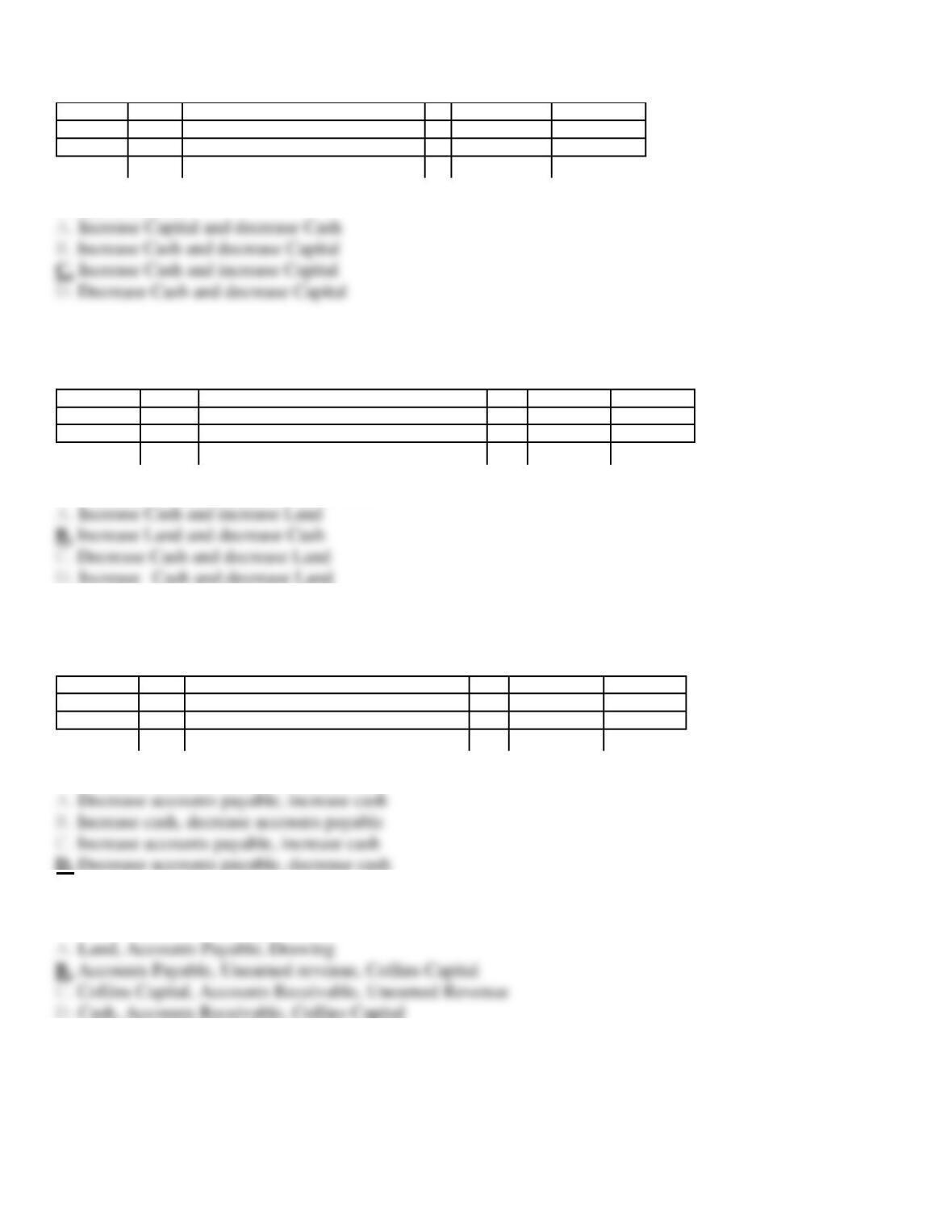
140.
April
23
Cash
26,000
Jim Xu, Capital
26,000
Invest cash in Xu Co.
The journal entry will:
141.
May
24
Land
105,000
Cash
105,000
Purchased land for business
What effects does this journal entry have on the accounts?
142.
March
10
Accounts Payable
800
Cash
800
Paid creditors on account
What effect does this journal entry have on the accounts?
143. Which of the following accounts would be increased with a credit?