1.4 Microeconomics and Macroeconomics
1) Which of the following is a microeconomics question?
A) Why do economies experience periods of recession?
B) Will government intervention lower the unemployment rate?
C) Why has growth in the economy slowed down over the past decade?
D) How will Apple decide on a selling price for the iPad?
2) The branch of economics which studies how households and firms make choices, interact in
markets and how government attempts to influence their choices is called
A) macroeconomics.
B) microeconomics.
C) positive economics.
D) normative economics.
3) Which of the following is a macroeconomics question?
A) What determines the unemployment rate?
B) How is the production quantity of digital cameras determined?
C) What factors determine the price of iPhones?
D) What determines the wages and benefits of flight attendants?
4) The branch of economics which studies the behavior of entire economies and policies that
affect the economy as a whole is called
A) public economics.
B) microeconomics.
C) macroeconomics.
D) normative economics.
5) When Dr. Goldfinger decides on the companies in which he will invest, a ________ issue is
being addressed.
A) microeconomic
B) macroeconomic
C) positive economic
D) normative economic
6) Examining the conditions that could lead to inflation in an economy is an example of
microeconomics topic.
7) Suppose that to move more people off the wait list for organ donations, surgeons and hospitals
are developing a market for organ swapping. This is an example of a macroeconomics topic.
8) How does the study of microeconomics differ from that of macroeconomics? Give one
example each of an issue studied in microeconomics and in macroeconomics.
1.5 A Preview of Important Economic Terms
1) Which of the following statements is true about revenue?
A) Revenue is the total amount received for selling a good or service.
B) Revenue is calculated by dividing the price per unit by the number of units sold.
C) The terms “revenue” and “profit” can be used interchangeably.
D) A firm’s revenue will increase as its costs increase.
2) Human capital refers to
A) the money people have.
B) the machines workers have to work with.
C) the accumulated skills and training workers have.
D) the wealth people have.
3) Which of the following is an example of an activity undertaken by an entrepreneur?
A) choosing the color scheme for your renovated kitchen
B) being promoted to the position of Chief of Police
C) being appointed to the U.S. Supreme Court
D) starting your own snow cone business
4) Which of the following is counted as “capital” in economics?
A) the money people have
B) the machines workers have to work with
C) the accumulated skills and training workers have
D) the wealth people have
5) The processes used to produce goods and services describes
A) innovation.
B) entrepreneurship.
C) technology.
D) capital.
6) Which of the following statements about economic resources is false?
A) Economic resources include financial capital and money.
B) Economic resources are also called factors of production.
C) Economic resources are used to produce goods and services.
D) Some economic resources are human-made while others are found in nature.
7) The U.S. Bureau of Labor Statistics predicts that four of the six fastest growing occupations
over the next ten years will be in
A) the medical field.
B) the travel and leisure industry.
C) education.
D) construction.
8) According to census figures, between 1970 and 2007 the number of doctors who described
themselves as self-employed
A) fell for male doctors and rose for female doctors.
B) fell for female doctors and rose for male doctors.
C) fell for both male and female doctors.
D) rose for both male and female doctors.
9) In the market for factors of production, households earn income by supplying factors of
production to firms.
10) One example of human capital is the amount of savings that you have.
11) What is the difference between physical capital and human capital?
12) What is the difference between accounting profit and economic profit?
13) What is a household? How do households interact with firms in a market?
14) According to census figures, what has been the trend in the United States since 1970 of
doctors choosing to operate a private practice versus choosing to work for a hospital or group
practice?
1.6 Appendix: Using Graphs and Formulas
1) If a graph has a line that shows the quantity of flat-screen televisions sold in the last five
years, it is known as
A) a pie chart.
B) a time-series graph.
C) a demand curve for outsourcing.
D) a supply curve of outsourcing.
2) Two-dimensional graphs have a horizontal and a vertical axis and are used in economics to
illustrate
A) relationships between two economic variables.
B) one variable.
C) a flow chart.
D) a pie chart.
3) How can the influence of a third variable be shown on a two-dimensional graph?
A) by allowing the relationship to be nonlinear
B) by allowing the position of the relationship line or curve to shift on the graph
C) by drawing a third axis coming out of the two axes
D) by super-imposing the third variable on the two-dimensional graph
4) Which of the following statements is true?
A) An inverse relationship has a positive slope value.
B) A direct relationship has a negative slope value.
C) A curved line has slope values that change at every point.
D) A straight line has a slope of one.
5) The relationship between sales and revenue is
A) an inverse relationship.
B) a direct relationship.
C) a negative relationship.
D) independent.
6) Suppose when the price of hybrid automobiles rises, consumers buy fewer hybrid
automobiles. This implies that
A) there is a positive relationship between hybrid automobile prices and quantities purchased by
consumers.
B) there is a negative relationship between hybrid automobile prices and quantities purchased by
consumers.
C) there is a direct relationship between hybrid automobile prices and quantities purchased by
consumers.
D) there is a one-to-one relationship between hybrid automobile prices and quantities purchased
by consumers.
7) In 2010, Smileytown consumed 50,000 tubes of toothpaste. In 2011, toothpaste consumption
rose to 62,000 tubes. Calculate the percentage change in toothpaste consumption.
A) 12%
B) 16.42%
C) 19.35%
D) 24%
8) If a straight line passes through the point x = 12 and y = 4 and also through the point x = 4 and
y = 8, the slope of this line is
A) negative 8 divided by 4.
B) seven tenths.
C) negative one half.
D) one and one half.
9) If the price of milk was $1.25 a gallon and it is now $2.25 a gallon, what is the percentage
change in price?
A) 4.4 percent
B) 8 percent
C) 44 percent
D) 80 percent
10) At a recent company meeting, Geraldine Erwin, sales manager of Dastoria, a flavored
beverage producer announced, “We have increased our sales by 8 percent in just six months.”
Suppose six months ago, its sales amounted to $452,000, what is the value of its sales today?
A) $36,160
B) $415,840
C) $488,160
D) $565,000
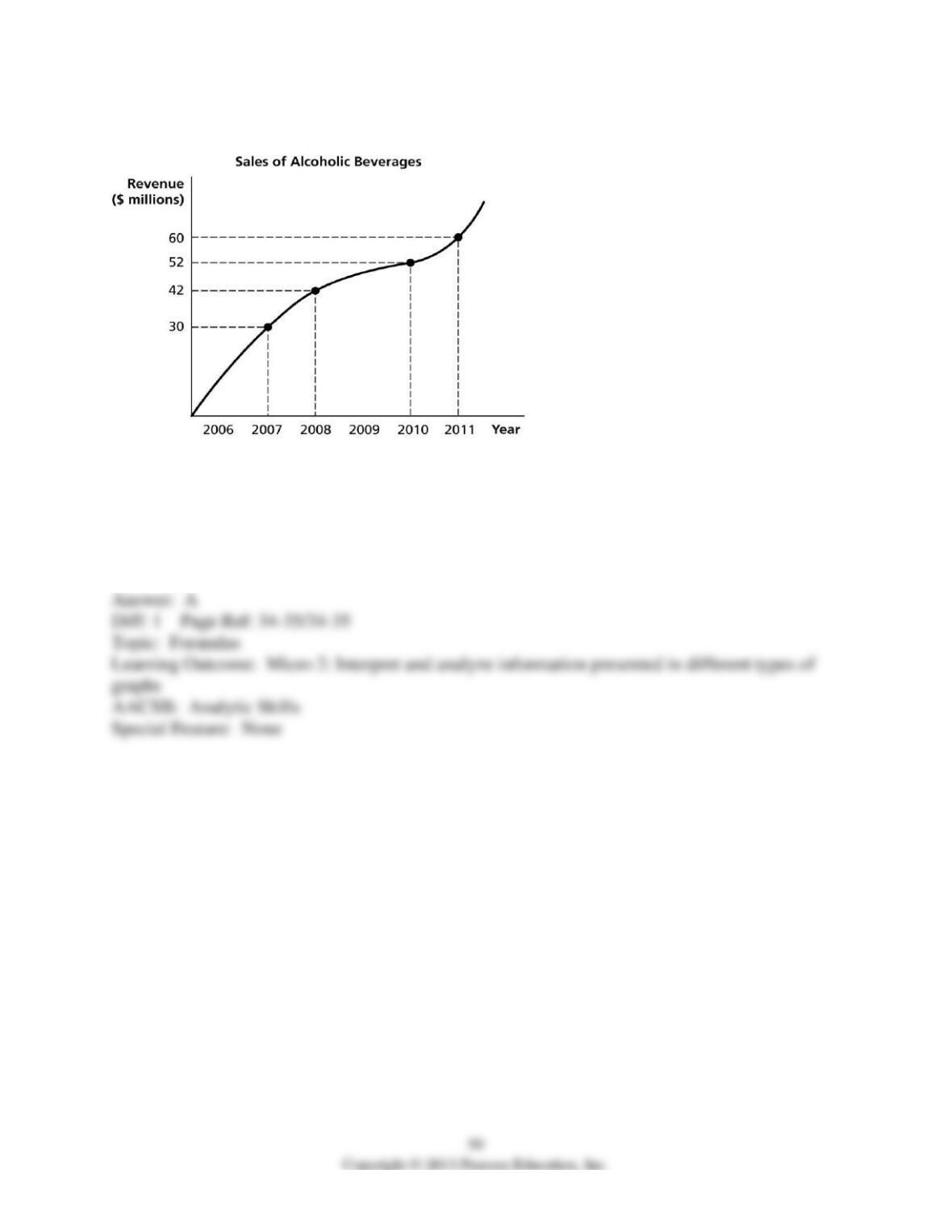
Figure 1-1
11) Refer to Figure 1-1. Using the information in the figure above, calculate the percentage
change in sales of alcoholic beverages between 2008 and 2010.
A) 23.8%
B) 40%
C) 42.9%
D) 73.3%
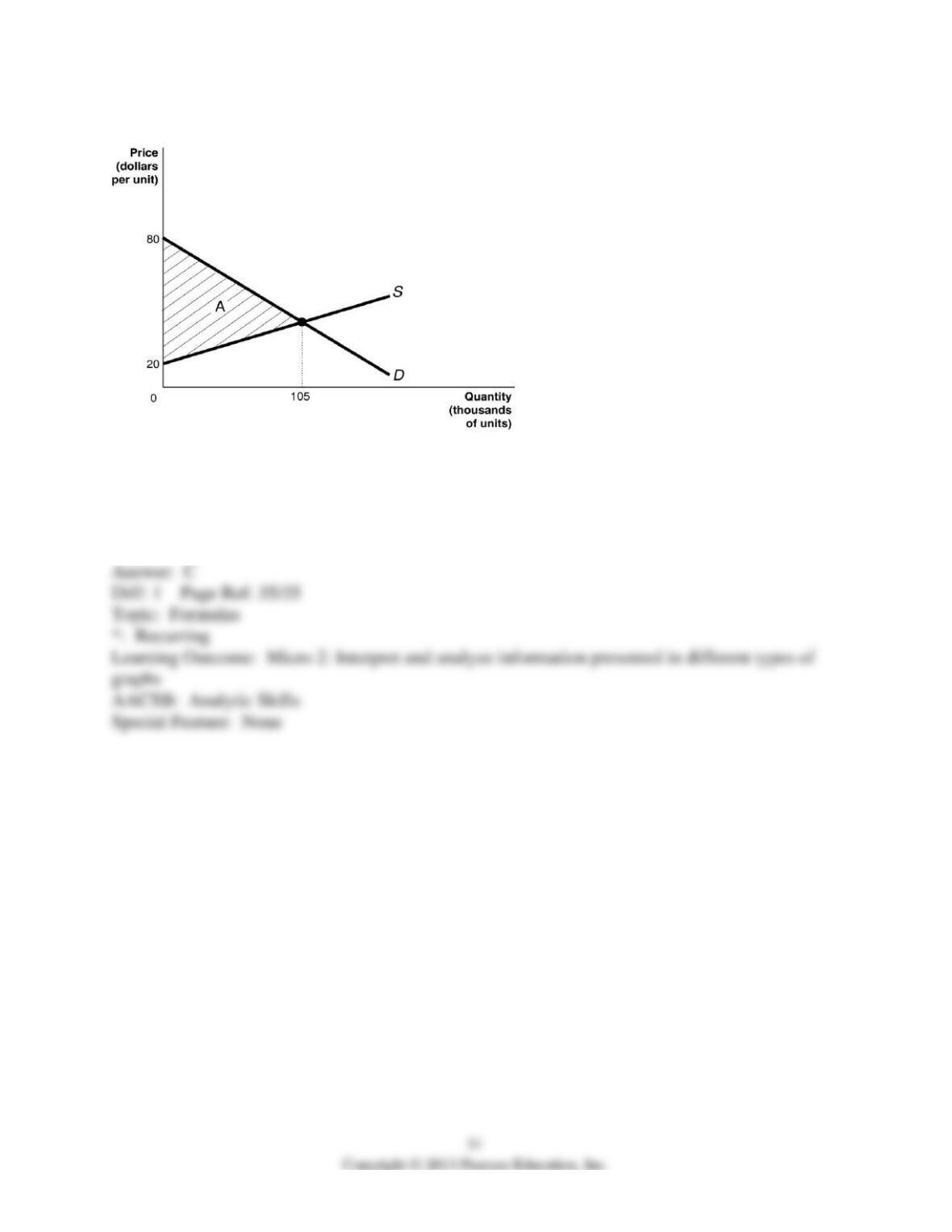
Figure 1-2
12) Refer to Figure 1-2. Calculate the area of the triangle A.
A) $8.4 million
B) $6.3 million
C) $3.15 million
D) $2.1 million
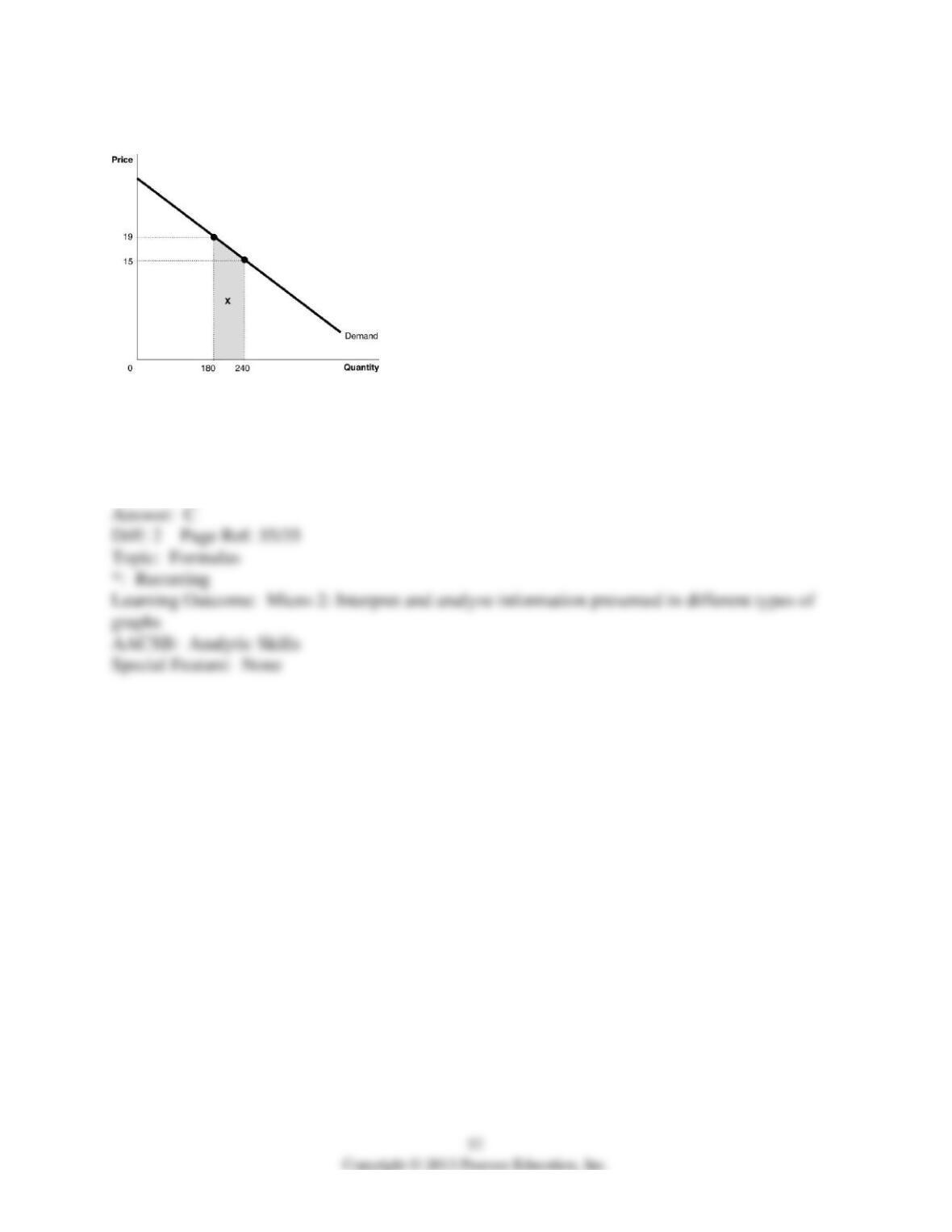
Figure 1-3
13) Refer to Figure 1-3. Calculate the area of the trapezoid X.
A) $361
B) $450
C) $1,020
D) $1,140
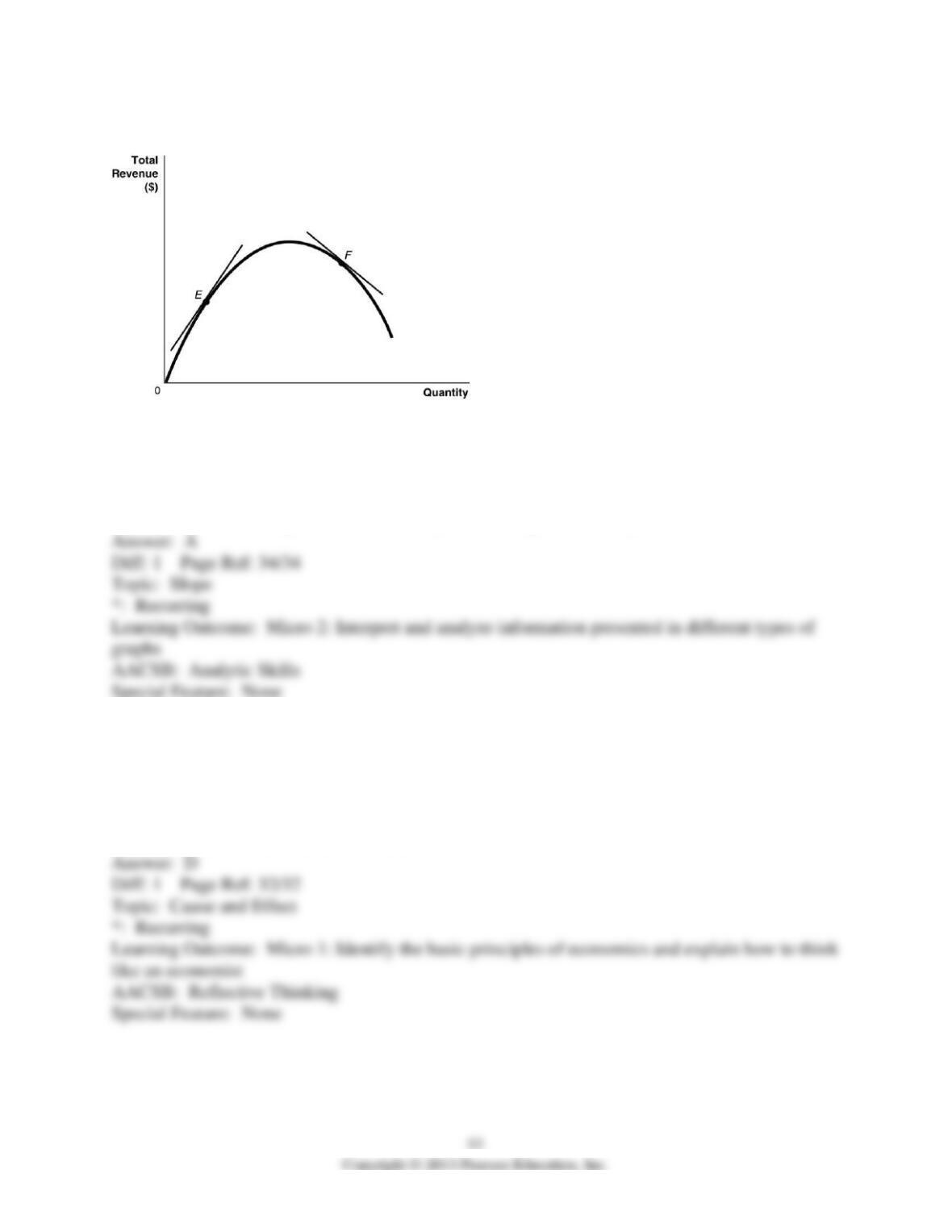
Figure 1-4
14) Refer to Figure 1-4. Which of the following statements is true?
A) The slope of the tangent at E is positive and the slope of the tangent at F is negative.
B) The slope of the tangent at E is negative and the slope of the tangent at F is positive.
C) The slope of the tangent at E and the slope of the tangent at F are negative.
D) The slope of the tangent at E and the slope of the tangent at F are positive.
15) An “omitted variable” is
A) a variable which is purposely omitted from an economic analysis.
B) a variable which is inadvertently omitted from an economic analysis.
C) a variable that has no impact on other variables in an economic analysis.
D) a variable that affects other variables and its omission from economic analysis can lead to
false conclusions about cause and effect.
16) What is the “reverse causality” problem in determining cause and effect?
A) It is a problem that occurs when one concludes that a change in variable X caused a change in
variable Y when in actual fact, it is a change in variable Z that caused a change in variable Y.
B) It is a problem that occurs when one observes that a change in variable X caused a change in
variable Y which caused a change in variable Z and concludes that a change in variable X caused
a change in variable Z.
C) It is a problem that occurs when one concludes that a change in variable X caused a change in
variable Y when in actual fact, it is a change in variable Y that caused a change in variable X.
D) It is a problem that arises when two variables are inter-connected so that a change in variable
X causes a change in variable Y, and a change in variable Y causes a change in variable X.
17) The number of people who have gray hair is very high among residents living in Florida. A
student concludes that living in Florida causes hair to turn gray. What is the flaw in this student’s
reasoning?
A) The student is drawing a false conclusion by making the mistake of omitting critical variables
such as the age and gender of the residents.
B) The student is using an inadequate sample size.
C) The student is drawing a false conclusion; he is confusing cause and effect.
D) The student has failed to take into account other causes of gray hair.
18) You explain to your friend Haslina, who runs a catering service called “Meals in a Zip”,
about an economic theory which asserts that consumers will purchase less of a product at higher
prices than they will at lower prices. She contends that the theory is incorrect because over the
past two years she has raised the price of her catered meals and yet has seen a brisk increase in
sales. How would you respond to Haslina?
A) Haslina is right; she has evidence to back her claim. The theory must be erroneous.
B) I will explain to her that she is making the error of reverse causality: it is the increase in
demand that has enabled her to raise her prices
C) I will explain to her that there are some omitted variables that have contributed to an increase
in her sales such as changes in income.
D) Haslina is making the mistake of assuming that correlation implies causation.
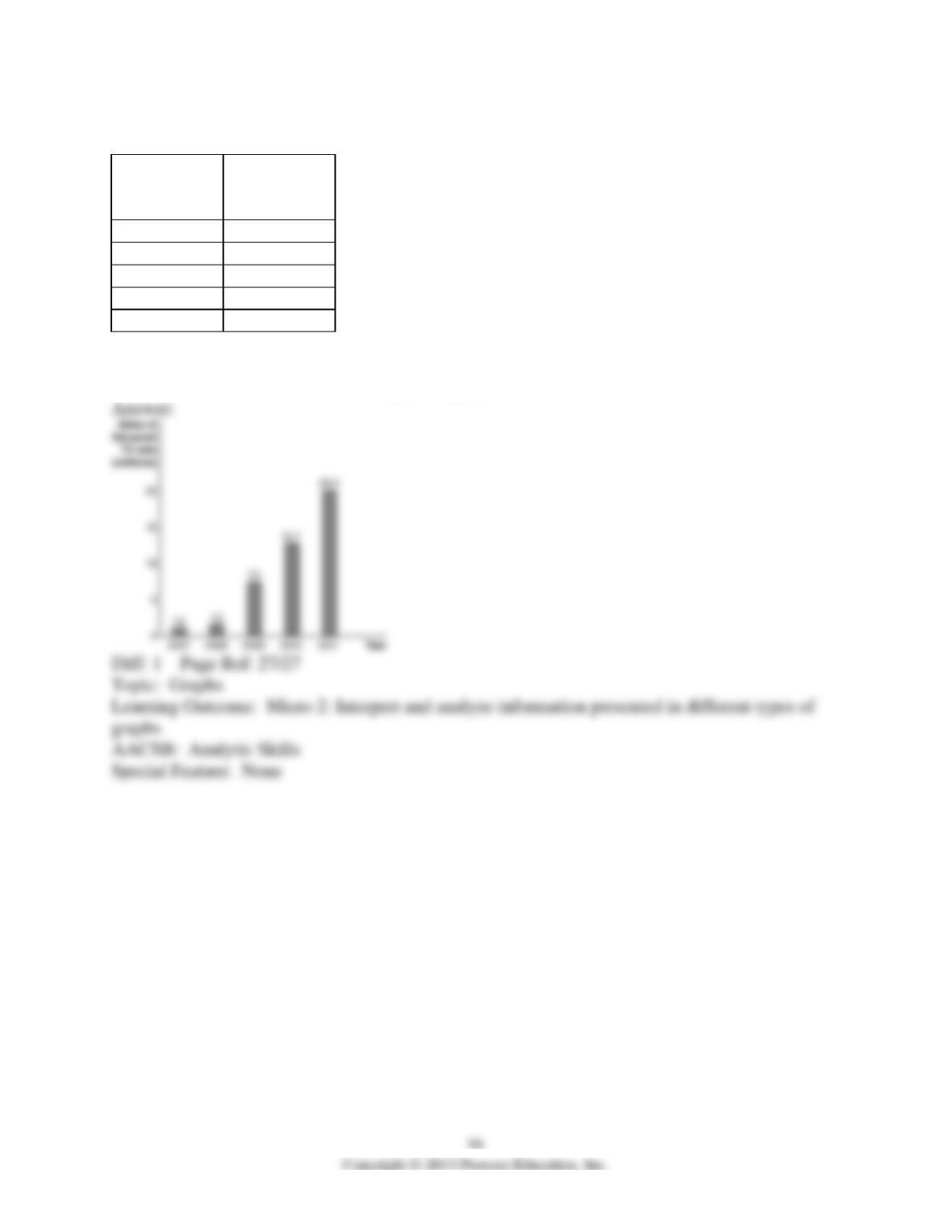
Table 1-2
Year
Flat-Panel
TV Sets
(millions)
2007
1.0
2008
1.5
2009
7.3
2010
12.7
2011
20.0
19) Refer to Table 1-2. The table above shows the sales of flat-panel television sets in Central
America. Present the information using a bar graph.