Microeconomics, 4e – Testbank 2 (Hubbard)
Chapter 1 Economics: Foundations and Models
1.1 Three Key Economic Ideas
1) As recently as 2002, ________ medical practices were owned by doctors as by hospitals, and
by 2008, ________ medical practices were owned by doctors as by hospitals.
A) less than half as many; less than one-quarter as many
B) more than three times as many; less than half as many
C) more than half as many; more than five times as many
D) less than one-third as many; more than half as many
2) The study of economics arises due to
A) money.
B) scarcity.
C) greed.
D) resources.
3) Scarcity refers to the situation in which
A) unlimited wants exceed limited resources.
B) unlimited resources exceed limited wants.
C) a country’s population is larger than its resource base.
D) a nation’s poverty level increases faster than its population.
4) The basic economic problem of scarcity
A) has always existed and will continue to exist.
B) will eventually disappear as technology continues to advance.
C) is a problem only in developing economies.
D) does not apply to the wealthy in society.
5) Economics is the study of the ________ people make to attain their goals, given their
________ resources.
A) purchases; unlimited
B) choices; scarce
C) income; available
D) decisions; household
6) What is an economic model?
A) It is a description of an economic issue that includes all possible related information.
B) It is a description of an economic issue based on official government information.
C) It is a detailed version of some aspect of economic life used to analyze an economic issue.
D) It is a simplified version of some aspect of economic life used to analyze an economic issue.
7) The term “market” in economics refers to
A) a place where money changes hands.
B) a legal institution where exchange can take place.
C) a group of buyers and sellers of a product and the arrangement by which they come together
to trade.
D) an organization which sells goods and services.
8) Economists assume that
A) individuals behave in unpredictable ways.
B) consumer behavior is explained by the existence of unlimited resources.
C) people put other people’s interests ahead of their own.
D) optimal decisions are made at the margin.
9) Which of the following best describes an assumption economists make about human
behavior?
A) They assume that individuals act rationally all the time in all circumstances.
B) They assume that rational behavior is useful in explaining choices people make even though
people may not behave rationally all the time.
C) They assume that people take into account the question of fairness in all decisions they make.
D) They assume that individuals act randomly.
10) Economists assume that rational people
A) never use all available information as they act to achieve their goals.
B) undertake activities that benefit others and hurt themselves.
C) only weigh the benefits and costs of the most desirable alternative actions.
D) respond to economic incentives.
11) Your roommate, Serafina, a psychology major, said, “The problem with economics is that it
assumes that consumers and firms always make the correct decision. But we know that
everyone’s human, and we all make mistakes.” Do you agree with her comment?
A) Yes, I agree with her. One cannot make predictions about economic behavior because in
reality people make incorrect choices in many situations.
B) I disagree with her. Economics does not study correct or incorrect behaviors but rather it
assumes that economic agents behave rationally, meaning they make the best decisions given
their knowledge of the costs and benefits.
C) Yes, I agree with her. Economic theory should allow for irrational behavior so that we can
have more reliable predictions.
D) I disagree with her. If we cannot assume that decisions are correct, then we will not be able to
examine the moral implications of these decisions.
12) Consider the following statements:
a. Consumers rent more DVDs from a video store that rents DVDs at a lower price than other
rival video stores in the area.
b. Department stores take steps to increase security since they believe it is more costly to allow
shoplifting than to install expensive security monitoring equipment.
c. Farmers produce more cotton when its selling price falls.
Which of the above statements demonstrates that economic agents respond to incentives?
A) a only.
B) b only.
C) c only.
D) a and b.
E) a, b, and c.
13) In the first six months of 2003, branches of Commerce Bank in New York City were robbed
14 times. The New York City Police recommended steps the bank could take to deter robberies,
including the installation of plastic barriers called “bandit barriers.” The police were surprised
the bank did not take their advice. According to a deputy commissioner of police, “Commerce
does very little of what we recommend. They’ve told our detectives they have no interest in ever
putting in the barriers.”
It would seem that Commerce bank would have a strong incentive to install “bandit barriers” to
deter robberies. Why wouldn’t they do it?
A) The banks would rather delay installation of any theft deterring equipment in anticipation of
new lower cost innovations in the security devices market.
B) The banks must have weighed the cost of installing bandit barriers against the benefits and
decided that they have “no interest in ever putting in the barriers.”
C) The banks are concerned that “bandit barriers” would send the wrong message to customers —
that the bank is unsafe.
D) The banks probably resent any interference from the police department.
14) Holding all other personal characteristics-such as age, gender, and income-constant,
economists would expect that
A) people without health insurance will be less likely to be overweight than people with health
insurance.
B) people without health insurance will be more likely to be overweight than people with health
insurance.
C) people without health insurance will be equally likely to be overweight as people with health
insurance.
D) there is no correlation between not having health insurance and being overweight.
15) According to the Centers for Disease Control and Prevention, the only state in 2009 in which
less than 20 percent of the population was considered obese was
A) Colorado.
B) Maine.
C) Missouri.
D) Oregon.
16) What does the term “marginal” mean in economics?
A) the edge of a market
B) an additional or extra
C) illegal
D) secondary
E) trivial
17) An office supply store sells a ream of printer paper at a fixed price of $4.50. Which of the
following is a term used by economists to describe the money received from the sale of an
additional ream of paper?
A) marginal revenue
B) gross earnings
C) pure profit
D) marginal costs
E) net benefit
18) Economics promotes which of the following as the way to make the best decision?
A) Continue an enjoyable activity as long as you do not have to pay for it.
B) Continue an enjoyable activity until it is no longer enjoyable.
C) Continue an enjoyable activity until you cannot afford to pursue it.
D) Continue an enjoyable activity up to the point where its marginal benefit equals its marginal
cost.
19) ________ involves undertaking an activity until its marginal benefits equal marginal costs.
A) Scarcity reduction
B) Central planning
C) Marginal analysis
D) Market intervention
20) The revenue received from the sale of an additional unit of a product
A) is a marginal benefit to the firm.
B) is called profit.
C) is called gross sales.
D) is called a net gain.
21) The cost incurred from the production of an additional unit of a product
A) is a marginal cost to the firm.
B) is called a loss.
C) is called opportunity cost.
D) must be zero for a firm to be efficient.
22) Before a doctor decides to keep her office open on Saturdays, she should
A) make sure that the marginal cost of doing so will exceed the marginal benefit.
B) only consider the increase in total profit from doing so.
C) weigh the costs and benefits of staying open on Saturdays before deciding if she should go
through with this idea.
D) only look at the marginal benefit of doing so, because marginal cost will not change.
23) If the marginal cost of producing a television is constant at $200, then a firm should produce
this item
A) only if the marginal benefit it receives is greater than $200 plus an acceptable profit margin.
B) as long as the marginal benefit it receives is just equal to or greater than $200.
C) as long as its marginal cost does not rise.
D) until the marginal benefit it receives reaches zero.
24) Which of the following is an example of a “how much” decision?
A) The Pleasantville movie theatre is open only in the evenings. The theatre’s manager is
debating whether to add daily matinee shows.
B) The Zhous have demolished their old home and are debating whether to build a ranch-style
house or a Craftsman home.
C) You’re planning to hold a graduation party and must decide between having your party
catered or having a pot-luck.
D) Chelsea has withdrawn from the swim team to take up a full-time job.
25) Marginal cost is the ________ associated with undertaking an activity.
A) total cost
B) extra cost.
C) opportunity cost.
D) foregone cost.
26) Cassie’s Quilts alters, reconstructs and restores heirloom quilts. Cassie has just spent $800
purchasing, cleaning and reconstructing an antique quilt which she expects to sell for $1,500
once she is finished. After having spent $800, Cassie discovers that she would need some special
period fabric that would cost her $200 in material and time in order to complete the task.
Alternatively, she can sell the quilt “as is” now for $900. What is her marginal benefit if she sells
the quilt “as is” now?
A) $100
B) $900
C) She makes a marginal loss of $600, not a marginal benefit.
D) The marginal benefit cannot be determined.
27) Cassie’s Quilts alters, reconstructs and restores heirloom quilts. Cassie has just spent $800
purchasing, cleaning and reconstructing an antique quilt which she expects to sell for $1,500
once she is finished. After having spent $800, Cassie discovers that she would need some special
period fabric that would cost her $200 in material and time in order to complete the task.
Alternatively, she can sell the quilt “as is” now for $900. What is the marginal cost of
completing the task?
A) $200
B) $500
C) $1,000
D) $1,000 plus the value of her time
28) Cassie’s Quilts alters, reconstructs and restores heirloom quilts. Cassie has just spent $800
purchasing, cleaning and reconstructing an antique quilt which she expects to sell for $1,500
once she is finished. After having spent $800, Cassie discovers that she would need some special
period fabric that would cost her $200 in material and time in order to complete the task.
Alternatively, she can sell the quilt “as is” now for $900. What should she do?
A) She should cut her losses and sell the quilt now.
B) It does not matter what she does; she is going to take a loss on her project.
C) She should purchase the period fabric, complete the task and then sell the quilt.
D) She should not do anymore work on the quilt because she has already spent too much time on
it and has not been paid for that time.
Scenario 1-1
Suppose a t-shirt manufacturer currently sells 5,000 t-shirts per week and makes a profit of
$10,000 per week. A manager at the plant observes, “Although the last 400 t-shirts we produced
and sold increased our revenue by $4,000 and our costs by $4,800, we are still making an overall
profit of $10,000 per week so I think we’re on the right track. We are producing the optimal
number of t-shirts.”
29) Refer to Scenario 1-1. Using marginal analysis terminology, what is another economic term
for the incremental revenue received from the sale of the last 400 t-shirts?
A) gross earnings
B) marginal revenue
C) sales revenue
D) gross profit
30) Refer to Scenario 1-1. Using marginal analysis terminology, what is another economic term
for the incremental cost of producing the last 400 t-shirts?
A) marginal cost
B) operating cost
C) explicit cost
D) Any of the above terms are correct.
31) Refer to Scenario 1-1. Had the firm not produced and sold the last 400 t-shirts, would its
profit be higher or lower, and if so by how much?
A) Its profit will be $4,800 higher.
B) Its profit will be $800 higher.
C) Its profit will be $800 lower.
D) Its profit will be $4,000 lower.
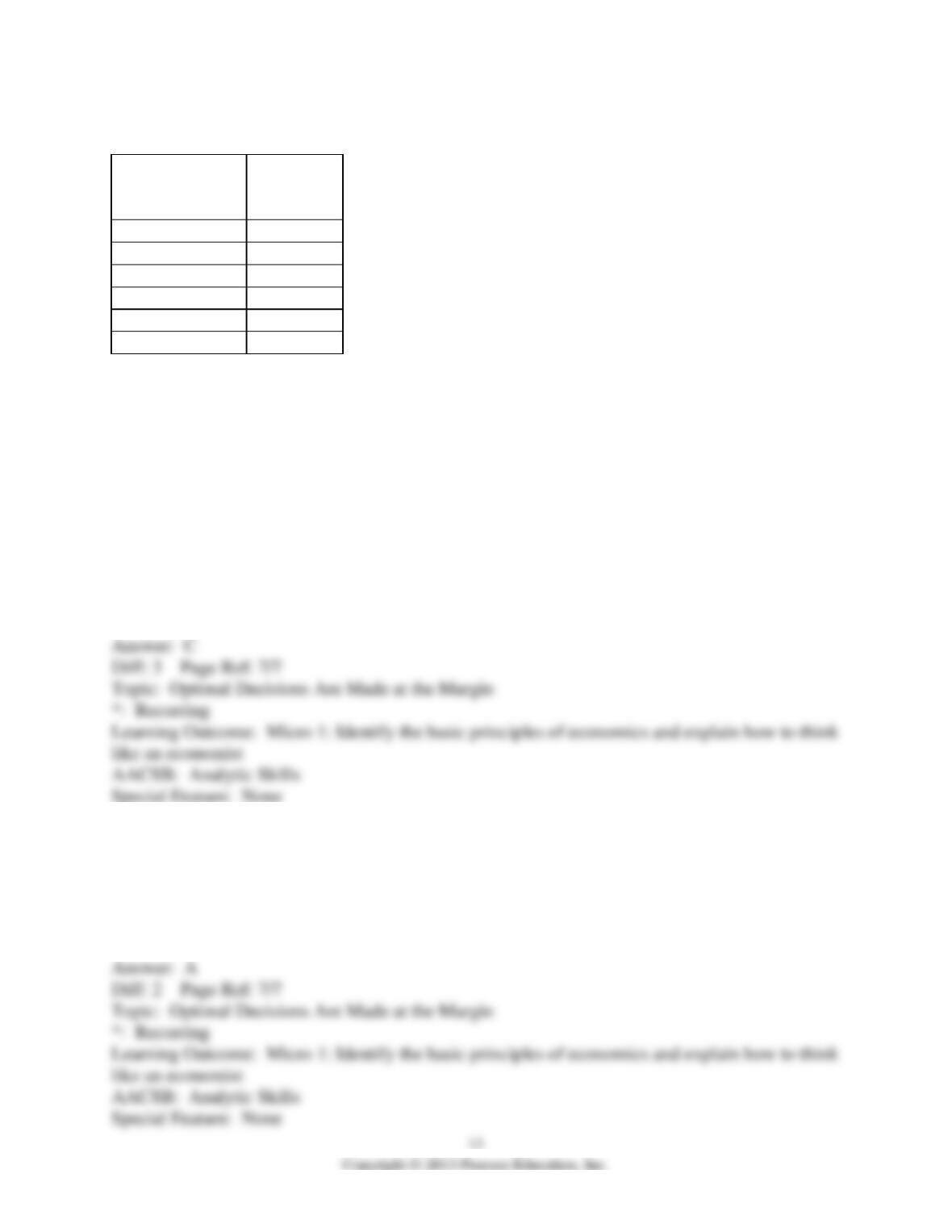
Table 1-1
Hours
Open
Total
Revenue
(dollars)
1
$35
2
60
3
80
4
92
5
100
6
105
Eva runs a small bakery in the village of Roggerli. She is debating whether she should extend her
hours of operation. Eva figures that her sales revenue will depend on the number of hours the
bakery is open as shown in the table above. She would have to hire a worker for those hours at a
wage rate of $12 per hour.
32) Refer to Table 1-1. Using marginal analysis, determine how many hours should Eva extend
her bakery’s hours of operations?
A) 2 hours
B) 3 hours
C) 4 hours
D) 5 hours
E) 6 hours
33) Refer to Table 1-1. What is Eva’s marginal benefit if she decides to stay open for two hours
instead of one hour?
A) $25
B) $36
C) $60
D) $95
34) Refer to Table 1-1. What is Eva’s marginal cost if she decides to stay open for two hours
instead of one hour?
A) $12
B) $24
C) $36
D) $71
35) Tabitha shares a flea market booth with her sister. Her share of the rent is $150 per month.
She is considering moving to her own, larger booth which she will not have to share with
anyone. The larger booth rents for $450 per month. Recently, you ran into Tabitha in the grocery
store and she tells you that she has rented the larger booth. Tabitha is as rational as any other
person. As an economics major, you rightly conclude that
A) Tabitha did not have a choice; her sister was overcharging her.
B) Tabitha figures that the additional benefit of having her own booth (as opposed to sharing) is
at least $300.
C) Tabitha figures that the benefit of having her own booth (as opposed to sharing) is at least
$450.
D) the cost of having one’s own booth outweighs the benefits.
36) All economic questions arise from the fact that resources are scarce.
37) As population declines, scarcity eventually disappears.
38) The term “market” refers only to trading arrangements that have been approved by the
government.
39) The sales revenue a seller receives from the sale of an additional unit of goods is called the
marginal cost.
40) Marginal benefit is the benefit that your activity provides to someone else.
41) If it costs Vijay $150 to design 5 websites and $175 to design 6 websites, then $175 is the
marginal cost of producing the 6th Websites.
42) Suppose the extra cost to a doctor of keeping her office open on Saturdays is $800. Then, the
doctor should not stay open on Saturdays if keeping the office open can only bring in additional
revenue of $800.
43) What is scarcity, and why is it a fundamental concept in economics?
44) What is an economic market?
45) What does the word “marginal” mean in economics? What is a marginal benefit? What is a
marginal cost? What is marginal analysis?
46) Suppose a doctor can earn an additional $10,000 in revenue per year from keeping her office
open on Saturdays. What must the additional cost of keeping the office open on Saturdays be to
make this decision economically rational?
1.2 The Economic Problem That Every Society Must Solve
1) Trade-offs force society to make choices when answering what three fundamental questions?
A) What will be the prices of goods and services; how will these goods and services be
produced; and who will receive them?
B) What goods and services to produce; how will these goods and services be produced; and who
receives them?
C) Who gets jobs; what wages do workers earn; and who owns what property?
D) How much will be saved; what will be produced; and how can these goods and services be
fairly distributed?
2) Every society faces economic trade-offs. This means
A) some people live better than others do.
B) not everyone can have enough goods to survive.
C) producing more of one good means less of another good can be produced.
D) society’s output cannot be made available to all.
3) Which of the following statements is false?
A) Anytime you have to decide which action to take you are facing an economic trade-off.
B) Trade-offs do not apply when the consumers purchase a product for which there is excess
supply, such as a stock clearance sale.
C) Every individual, no matter how rich or poor, is faced with making trade-offs.
D) Economics is a social science that studies the trade-offs we are forced to make because of
scarcity.
4) Which of the following is an example of an economic trade-off that a firm has to make?
A) whether it is cheaper to produce with more machines or with more workers
B) deciding why consumers want its products
C) whether or not consumers will buy its products
D) deciding what profit margin it desires for its products
5) Opportunity cost is defined as
A) the benefit of an activity.
B) the monetary expense associated with an activity.
C) the highest valued alternative that must be given up to engage in an activity.
D) the total value of all alternatives that must be given up to engage in an activity.
6) The Stogie Shop, a cigar store in the mall, sells hand-rolled cigars for $10.00 and machine-
made cigars for $2.50 each. What is the opportunity cost of buying a hand-rolled cigar?
A) 4 machine-made cigars
B) 1/4 of a machine-made cigar
C) $10.00
D) $2.50
7) Ted quits his $60,000-a-year job to be a stay-at-home dad. What is the opportunity cost of his
decision?
A) 0 since he will no longer be earning a salary
B) depends on the “going rate” for stay-at-home dads
C) at least $60,000
D) the value he attributes to the joy of parenting
8) Who receives the goods and services produced in the United States depends largely on
A) how income is distributed.
B) how the goods and services are produced.
C) what goods and services are produced.
D) government redistribution.