
Exam
Name___________________________________
MULTIPLE CHOICE. Choose the one alternative that best completes the statement or answers the question.
1)
Which of the following statements about type I reactions is FALSE?
1)
A)
The symptoms are due to histamine.
B)
They involve helper T cells.
C)
Antibodies bind to mast cells and basophils.
D)
The symptoms occur soon after exposure to an antigen.
E)
They involve IgE antibodies.
2)
All of the following regarding “privileged sites” are true EXCEPT
2)
A)
they include corneal and brain tissue.
B)
they do not have lymphatic vessels.
C)
they include any tissue transplanted from a pig.
D)
they explain how animals tolerate pregnancies without rejecting the fetus.
E)
they are rarely rejected.
3)
Which of the following types of transplant is least compatible?
3)
A)
autograft
B)
allograft
C)
xenotransplant
D)
isograft
E)
All of these types of tranplant are equally compatible.

4)
Immunodeficiencies are a result of all of the following EXCEPT
4)
A)
DiGeorge syndrome.
B)
autoimmune diseases.
C)
cyclosporine.
D)
Hodgkin‘s disease.
E)
HIV infection.
5)
HIV spikes attach to CD4+ receptors found on
5)
A)
macrophages.
B)
dendritic cells.
C)
T helper cells.
D)
T helper cells and macrophages.
E)
T helper cells, macrophages, and dendritic cells.
Explanation:
6)
The process of desensitization to prevent allergies involves the injection of increasing amounts of
6)
A)
RhoGAM.
B)
antihistamine.
C)
IgE.
D)
antigen.
E)
IgG.
Explanation:
7)
The initial symptom of HIV infection is
7)
A)
high viral load.
B)
appearance of thrush.
C)
significant weight loss
D)
loss of T cells.
E)
lymphadenopathy
Explanation:
Explanation:

8)
The number of T cells drops to below 200 cells/microliter in which phase of HIV infection?
8)
A)
phase 1
B)
phase 2
C)
phase 3
D)
initial phase
E)
asymptomatic phase
9)
Which of the following describes a cytotoxic autoimmune reaction?
9)
A)
Antibodies are not made.
B)
Antibodies react to cell–surface antigens.
C)
Mediate by T cells.
D)
Cells are killed.
E)
Immune complexes form.
10)
Which of the following statements about type IV reactions is FALSE?
10)
A)
Reactions are not apparent for a day or more.
B)
Reactions are primarily due to T cell proliferation.
C)
Cytokines initiate tissue damage.
D)
Allergic contact dermatitis is an example.
E)
Hemolytic disease of the newborn is an example.
11)
Worldwide, the primary method of transmission of HIV is
11)
A)
heterosexual intercourse.
B)
blood transfusions.
C)
intravenous drug use.
D)
homosexual intercourse.
E)
nosocomial.

12)
All of the following are used to determine relatedness between a donor and a recipient for
transplants EXCEPT
12)
A)
HLA antigens.
B)
ABO blood group antigens.
C)
MHC antigens.
D)
HLA and MHC antigens.
E)
HLA, MHC, and ABO blood group antigens.
13)
Symptoms of delayed cell–mediated reactions are due to
13)
A)
IgG antibodies.
B)
neutrophils.
C)
cytokines.
D)
IgE antibodies.
E)
antigens.
14)
All of the following pertain to serological tests EXCEPT
14)
A)
they can detect antibodies but not antigens.
B)
they can be used to diagnose various diseases.
C)
they are used to test for specific HLAs on lymphocytes.
D)
reactions can be detected by uptake of trypan blue by damaged cells.
E)
they are used to detect compatible tissues for transplantation.
15)
The symptoms of an immune complex reaction are due to
15)
A)
complement fixation.
B)
cytokines.
C)
destruction of the antigen.
D)
phagocytosis.
E)
antibodies against self.

16)
Graft–versus–host disease will most likely be a complication of a(n)
16)
A)
blood transfusion.
B)
corneal transplant.
C)
skin graft.
D)
bone marrow transplant.
E)
Rh incompatibility between mother and fetus.
17)
Allergic contact dermatitis is due to
17)
A)
activated macrophages.
B)
sensitized T cells.
C)
IgM antibodies.
D)
IgG antibodies.
E)
IgE antibodies.
B
18)
A healthy immune system destroys cancer cells with
18)
A)
CTLs.
B)
activated macrophages.
C)
CD+ T cells.
D)
CTLs and activated macrophages.
E)
tumor–specific antigens.
D
19)
All of the following are false regarding Herceptin EXCEPT
19)
A)
it neutralizes the growth factor EGF.
B)
it is a vaccine to prevent the development of cancer.
C)
it acts as an immunotoxin to target and kill cancer cells.
D)
it is an endotoxin that stimulates TNF by macrophages.
E)
it is used to treat some breast cancer patients.
E
D

20)
All of the following lead to drug–induced thrombocytopenic purpura. Which occurs first?
20)
A)
Drug binds to platelets.
B)
Antibodies against haptens are formed.
C)
Platelets are destroyed.
D)
Antibodies and complement react with platelets.
E)
Purpura occurs on the skin.
21)
Which of the following is a possible outcome of an HIV infection?
21)
A)
Infection may initially be asymptomatic.
B)
The disease does not progress to AIDS.
C)
Virions may remain latent.
D)
There may be persistent yeast infections .
E)
All of the answers are correct.
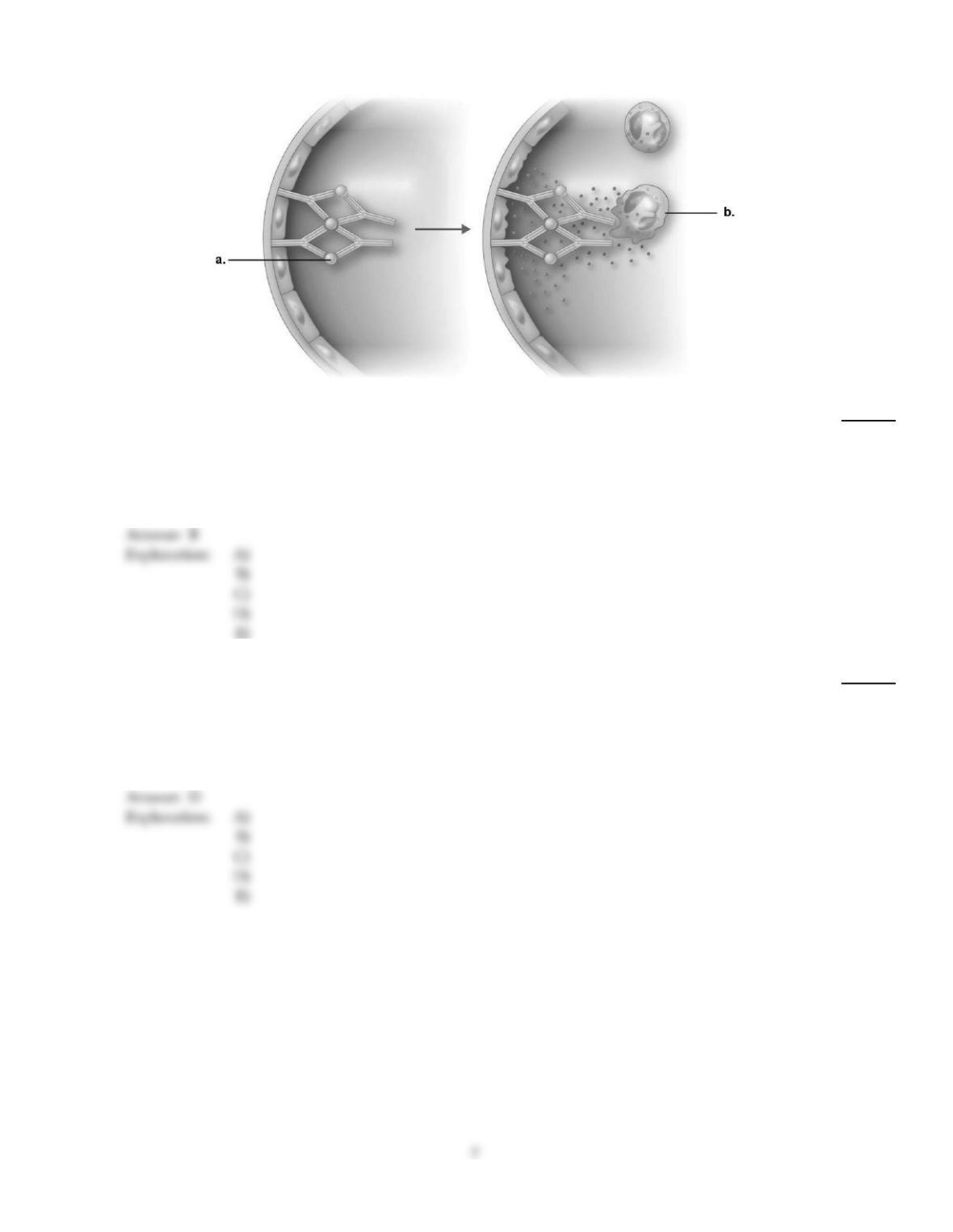
Figure 19.1
22)
In immune complex reaction shown in Figure 19.1, what is the end result of the reaction?
22)
A)
IgG is directed against cell membrane antigens.
B)
Endothelial cells are damaged.
C)
Antibodies destroy neutrophils.
D)
Complement is activated.
E)
Neutrophils are attracted and release enzymes.
23)
The chemical mediators of anaphylaxis are
23)
A)
antigens.
B)
the proteins of the complement system.
C)
antibodies.
D)
found in basophils and mast cells.
E)
antigen–antibody complexes.

24)
Which of the following is the least likely vaccine against HIV?
24)
A)
subunit
B)
glycoprotein
C)
protein core
D)
attenuated virus
E)
All of these vaccines are equally likely.
25)
Anaphylaxis is the term for reactions caused when certain antigens combine with
25)
A)
complement.
B)
IgG antibodies.
C)
IgE antibodies.
D)
histamine.
E)
macrophages.
C
26)
All of the following are true of hypersensitivity EXCEPT
26)
A)
it occurs when an individual is exposed to an allergen for the first time.
B)
it is synonymous with “allergy.”
C)
it requires previous exposure to an antigen.
D)
it occurs in the presence of an antigen.
E)
it is due to an altered immune response.
A
D

Table 19.1
Donor Recipient
1. AB, Rh–AB, Rh+
2. A, Rh+A, Rh–
3. A, Rh+O, Rh+
4. B, Rh–B, Rh+
5. B, Rh+A, Rh+
27)
Which blood transfusions in Table 19.1 are incompatible?
27)
A)
1, 2, and 3
B)
3 and 4
C)
1 and 2
D)
2 and 5
E)
2, 3, and 5
28)
The following events occur if human cells expressing HLA–I are mixed with anti–HLA–I,
complement, and trypan blue. What step indicates the cells are HLA–I?
28)
A)
Anti–HLA antibodies bind to HLAs on lymphocytes.
B)
Trypan blue enters the cells.
C)
Cells are damaged by complement.
D)
Enzyme is released from neutrophils.
E)
None of the answers are correct; the T cells are missing.
29)
Which of the following statements about human embryonic stem cells is FALSE?
29)
A)
They express few MHC I antigens.
B)
They are pluripotent.
C)
They express no MHC II antigens.
D)
They are typically obtained from the blastocyst stage of embryonic development.
E)
They are undifferentiated.

30)
A positive tuberculin skin test is an example of
30)
A)
innate immunity.
B)
acute contact dermatitis.
C)
psoriasis.
D)
delayed cell–mediated immunity.
E)
autoimmunity.
31)
Which of the following may result from systemic anaphylaxis?
31)
A)
hives
B)
immunodeficiency
C)
hay fever
D)
shock
E)
asthma
D
32)
All of the following are reasons why an HIV vaccination has not been developed EXCEPT
32)
A)
use of a weakened virus would potentially transmit the infection.
B)
there is no known organism that can provide a model of natural immunity.
C)
small and inexpensive animals for vaccine research are not available.
D)
vaccines are not effective against viral infections.
E)
HIV has a high mutation rate so one vaccination would not be effective to treat the
world–wide pandemic.
D
D

33)
Chemotherapy to inhibit the progression of HIV infection utilizes all of the following mechanisms
EXCEPT
33)
A)
destruction of viral ribosomes.
B)
inhibition of viral proteases.
C)
termination of viral DNA.
D)
blockage of viral attachment.
E)
prohibition of viral integration into host cell DNA.
34)
Attachment of HIV to the target cell depends on
34)
A)
gp120 combining with the chemokine receptor CCR5.
B)
gp120 combining with the CD4+ receptor.
C)
CXCR4 binding to the CD4+ receptor.
D)
gp120 binding to the CD4+ plasma membrane.
E)
gp41 binding to the CD4+ receptor.
35)
Rheumatoid arthritis is due to deposition of
35)
A)
IgG and IgA complexes in joints.
B)
IgD and IgE complexes in joints.
C)
IgA antibodies in joints.
D)
complement in joints.
E)
complexes of IgM and IgG and also complement in joints.
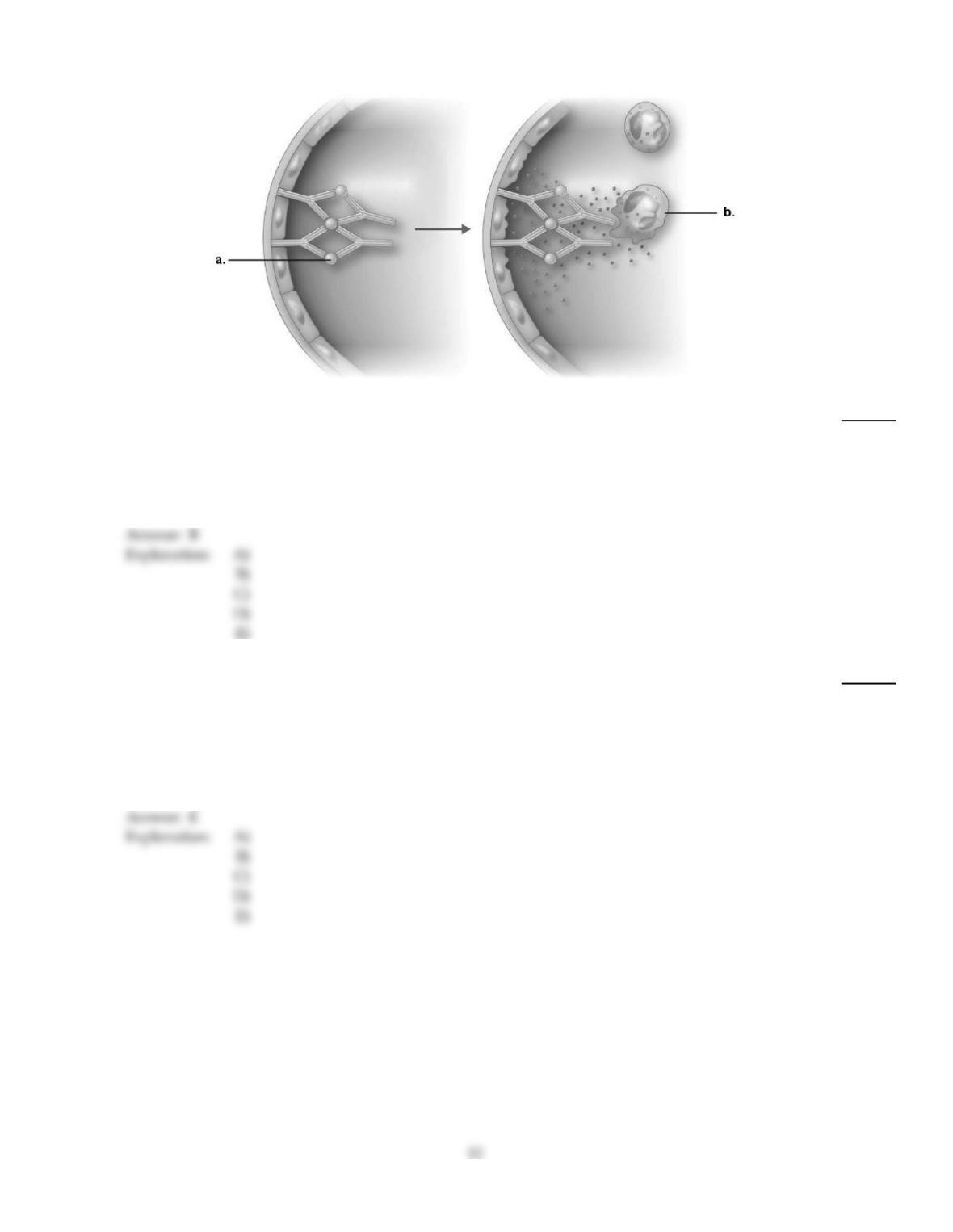
Figure 19.1
36)
In immune complex reaction shown in Figure 19.1, what is the structure labeled “a”?
36)
A)
complement
B)
antigen
C)
mast cell
D)
antibody
E)
neutrophil
37)
Which of the following regions has the greatest distribution of HIV infection and AIDS in the
world?
37)
A)
Eastern Europe and Central Asia
B)
North America
C)
South and Southeast Asia
D)
Latin America
E)
sub–Saharan Africa

38)
Treatment with certain drugs to reduce transplant rejection can cause
38)
A)
immunologic surveillance.
B)
immunotherapy.
C)
immunologic enhancement.
D)
immunosuppression.
E)
autoimmunity.
39)
Which antibodies will be in the serum of a person with blood type B, Rh+?
39)
A)
anti–B
B)
anti–B, anti–Rh
C)
anti–A, anti–Rh
D)
anti–A, anti–B, anti–Rh
E)
anti–A
40)
Desensitization involves injection of
40)
A)
IgE antibodies.
B)
antigens.
C)
histamine.
D)
IgG antibodies.
E)
antihistamine.
41)
During asymptomatic phase I of HIV disease, HIV infection is diagnosed by
41)
A)
counting CD4+ T cells.
B)
measuring viral RNA.
C)
testing for seroconversion.
D)
measuring antibodies against HIV.
E)
counting CD8+ T cells.

42)
All of the following are considered examples of type I hypersensitivity EXCEPT
42)
A)
pollen allergies.
B)
penicillin allergic reactions.
C)
asthma.
D)
transplant rejections.
E)
dust allergies.
43)
In rheumatoid arthritis, IgM, IgG, and complement deposit in joints. This is an example of
43)
A)
cytotoxic autoimmunity.
B)
immunosuppression.
C)
immune complex autoimmunity.
D)
acquired immunodeficiency.
E)
cell–mediated autoimmunity.
44)
Which of the following utilizes a combination of monoclonal antitumor antibody and
immunotoxin?
44)
A)
immunologic enhancement
B)
immune complex
C)
immunologic surveillance
D)
immunotherapy
E)
immunosuppression

45)
Hemolytic disease of the newborn can result from an
45)
A)
Rh– mother with an Rh+ fetus.
B)
AB mother with an O fetus.
C)
Rh+ mother with an Rh– fetus.
D)
Rh– mother and an A fetus.
E)
AB mother with a B fetus.
TRUE/FALSE. Write ‘T’ if the statement is true and ‘F’ if the statement is false.
46)
Cancer is similar to an infectious disease in that it is due to a failure of the body’s defenses.
46)
47)
Skin tests are reliable indicators for the diagnosis of food–related allergies.
47)
48)
Xenotransplantation is an effective alternative to using isografts.
48)
49)
All hypersensitivities involve antibody–antigen reactions.
49)
50)
Autoimmune diseases occur when the immune system is unable to discriminate “self” from
“nonself.”
50)
51)
Individuals who do not express CCR5 are highly resistant to infection by HIV.
51)
52)
Vaccines against HIV have proven to be very effective in halting the spread of disease.
52)
53)
HIV is a retrovirus with single–stranded RNA.
53)

54)
All stem cells are derived from embryonic stem cells.
54)
55)
HIV attack of CD4+ T cells causes suppression of both cell–mediated and humoral immune
responses.
55)
ESSAY. Write your answer in the space provided or on a separate sheet of paper.
56)
What is desensitization? Explain how this treatment can induce systemic anaphylaxis. How is systemic
anaphylaxis treated?
57)
Explain why a transplant tissue would be rejected if that tissue had different HLAs compared to the HLAs of
the recipient. How can this rejection be decreased?
58)
Differentiate type II from type III hypersensitivity reactions.
59)
A health care worker had a needlestick injury while drawing blood from an AIDS patient. Lab tests on the
worker’s serum were negative. Explain why the worker can still be infected even though her lab tests were
negative. How should her health care be monitored?
60)
Even though AIDS is an infectious disease caused by a virus, why is it also considered an immunodeficiency
disease?

Answer Key
Testname: C19

Answer Key
Testname: C19