Fundamentals of Corporate Finance 3e Test Bank
57.
A firm paid out $163,961.60 as dividends on net income of $298,112. What is the firm’s
retention ratio?
A)
55%
B)
45%
C)
50%
D)
None of these
Fundamentals of Corporate Finance 3e Test Bank
58.
Drekker, Inc. has revenues of $312,766, costs of $220,222, interest payment of $31,477, and a
tax rate of 34 percent. It paid dividends of $34,125 to shareholders. Find the firm’s dividend
payout ratio and retention ratio. (Round your percentage answers to nearest whole number.)
A)
85%, 15%
B)
45%, 55%
C)
55%, 45%
D)
15%, 85%
Fundamentals of Corporate Finance 3e Test Bank
59.
Comacho Traders has total assets of $513,480 and sales of $723,062. What is the firm’s capital
intensity ratio? (Round to two decimal places.)
A)
1.41
B)
0.71
C)
1.23
D)
None of these
AICPA: Industry/Sector Perspective
60.
Michael Holdings, Inc. has total assets of $1,480,072 and sales of $2,236,625. What is the
firm’s capital intensity ratio? (Round to two decimal places.)
A)
66.17%
B)
53.73%
C)
151.14%
D)
None of these
Ans:
A
Fundamentals of Corporate Finance 3e Test Bank
61.
Dennis Compton, Inc. has total assets of $5,335,901 and a capital intensity of 53.9%. What is
the firm’s sales? (Round to nearest whole dollar.)
A)
$5,335,901
B)
$2,828,028
C)
$9,899,631
D)
None of these
62.
Which of the following statements in using more sophisticated planning models is NOT true?
A)
Current liabilities are likely to vary directly with sales.
B)
Long-term liabilities and equity accounts change as a direct result of managerial
decisions.
C)
Retained earnings will vary directly as sales changes.
D)
All of these
Fundamentals of Corporate Finance 3e Test Bank
AICPA: Industry/Sector Perspective
63.
Which of the following statements in using more sophisticated planning models is true?
A)
Current liabilities are likely to vary directly with sales.
B)
Long-term liabilities and equity accounts change as a direct result of managerial
decisions.
C)
Retained earnings will vary as sales changes but not directly as it is affected by the firm’s
dividend payout policy.
D)
All of these
Ans:
D
AICPA: Industry/Sector Perspective
64.
Which of the following includes weaknesses in financial planning models?
A)
Interest expense is not accounted.
B)
All working capital accounts do not necessarily vary directly with sales, especially cash
and inventory.
C)
The way fixed assets are handled as lumpy assets, leaving the company with excess
capacity.
D)
All of these
Ans:
D
Fundamentals of Corporate Finance 3e Test Bank
65.
Which of the following statements in accounting for changes in fixed assets is NOT true?
A)
When a firm is not operating at full capacity, sales may be increased without adding any
new fixed assets.
B)
Since it requires time to get new assets operational, they are added in small discrete
quantities.
C)
Fixed assets are added in large discrete units called lumpy assets.
D)
All of these
AICPA: Industry/Sector Perspective
66.
Which of the following statements in accounting for changes in fixed assets is NOT true?
A)
When a firm is not operating at full capacity, sales may be decreased without adding any
new fixed assets.
B)
Since it requires time to get new assets operational, they are added as the firm nears full
capacity.
C)
Fixed assets are added in large discrete units called lumpy assets.
D)
All of these
Ans:
D
Fundamentals of Corporate Finance 3e Test Bank
AICPA: Industry/Sector Perspective
67.
Which of the following is true about the capital budgeting process?
A)
Management identifies a list of potential projects that are consistent with the business
strategy and ranks them according to the value they would create for the shareholders.
B)
Rapid growth is considered a desirable achievement in capital budgeting decisions.
C)
The cost of the projects should comply with the firm’s budget constraints.
D)
All of these
68.
Which of the following is NOT true about the capital budgeting process?
A)
Management identifies a list of potential projects that are consistent with the business
strategy and ranks them according to the value they would create for the shareholders.
B)
Rapid growth is considered a desirable achievement in capital budgeting decisions.
C)
Once the list is made, no management review can change it.
D)
All of these
Ans:
C
AICPA: Industry/Sector Perspective
69.
External funding needed (EFN) is
A)
the additional debt or equity a firm needs to issue so that it can purchase additional assets
to support an increase in sales.
B)
the additional funds raised by a firm to pay off existing short-term debt.
C)
the additional funds raised by a firm to pay off existing long-term debt.
D)
None of these
Ans:
A
Fundamentals of Corporate Finance 3e Test Bank
AICPA: Industry/Sector Perspective
70.
Which of the following statements is NOT true?
A)
The internal growth rate (IGR) is defined as the maximum growth rate that a firm can
achieve without external financing.
B)
The higher the retained earnings generated by a firm, the higher the growth possible
without using external funding.
C)
Given the same level of retained earnings, a firm that has the higher amount of total
assets has a higher growth possibility without using external funding.
D)
All of these
Ans:
C
71.
Firms that achieve higher growth rates without seeking external financing
A)
have a high plowback ratio.
B)
have less equity and/or are able to generate high net income leading to a high ROE.
C)
are not highly leveraged.
D)
All of these
Ans:
D
Fundamentals of Corporate Finance 3e Test Bank
72.
Firms that achieve higher growth rates without seeking external financing
A)
have a low plowback ratio.
B)
have less equity and/or are able to generate high net income leading to a high ROE.
C)
are highly leveraged.
D)
None of these
Ans:
B
73.
The sustainable growth rate (SGR)
A)
is a function of the plowback ratio and the ROE.
B)
the rate of growth that a firm can sustain without selling additional shares of equity.
C)
helps management to determine whether they can avoid issuing new equity.
D)
All of these
Ans:
D
AICPA: Industry/Sector Perspective
74.
Which of the following statements about the sustainable growth rate (SGR) is NOT true?
A)
The SGR is a function of the plowback ratio and the ROE.
B)
The SGR determines the rate of growth that a firm can sustain without selling additional
shares of equity.
C)
The SGR helps management to determine whether they can avoid issuing new debt.
D)
All of these
Ans:
C
Fundamentals of Corporate Finance 3e Test Bank
75.
Which of the following statements about the sustainable growth rate (SGR) is true?
A)
The higher a firm’s ROE, the higher the SGR.
B)
The higher the plowback ratio, the larger the proportion of net income retained in the
firm and the greater the firm’s SGR.
C)
Both A and B are true statements.
D)
None of these are true
76.
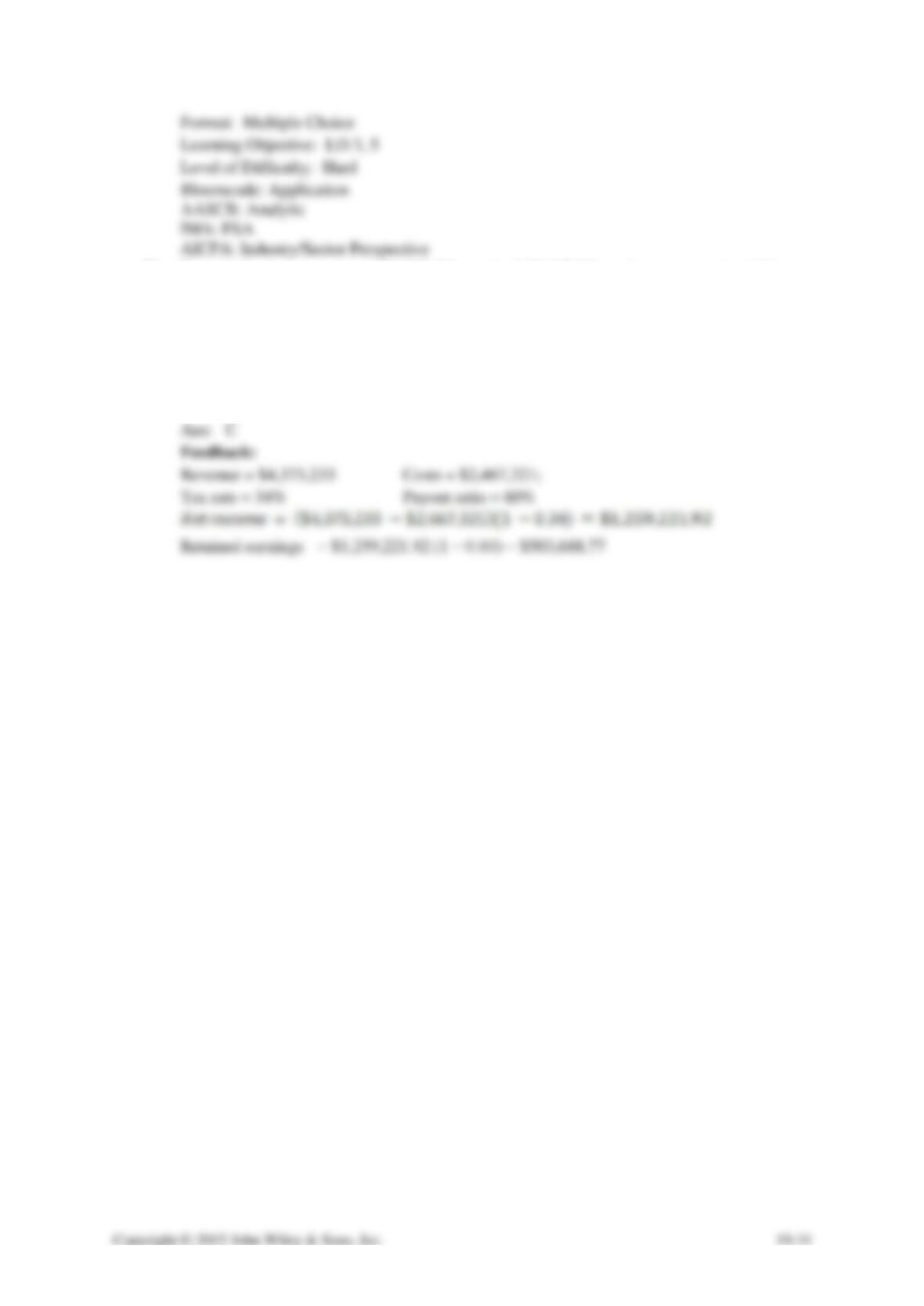
Hilton Corp. has revenues of $1,214,800, costs of $816,355, and pays a tax rate of 32 percent.
If the firm pays out 50 percent of its earnings as dividends every year, what is the amount of
retained earnings?
A)
$135,471.30
B)
$270,942.60
C)
$413,032.00
D)
None of these
Ans:
A
Fundamentals of Corporate Finance 3e Test Bank
77.
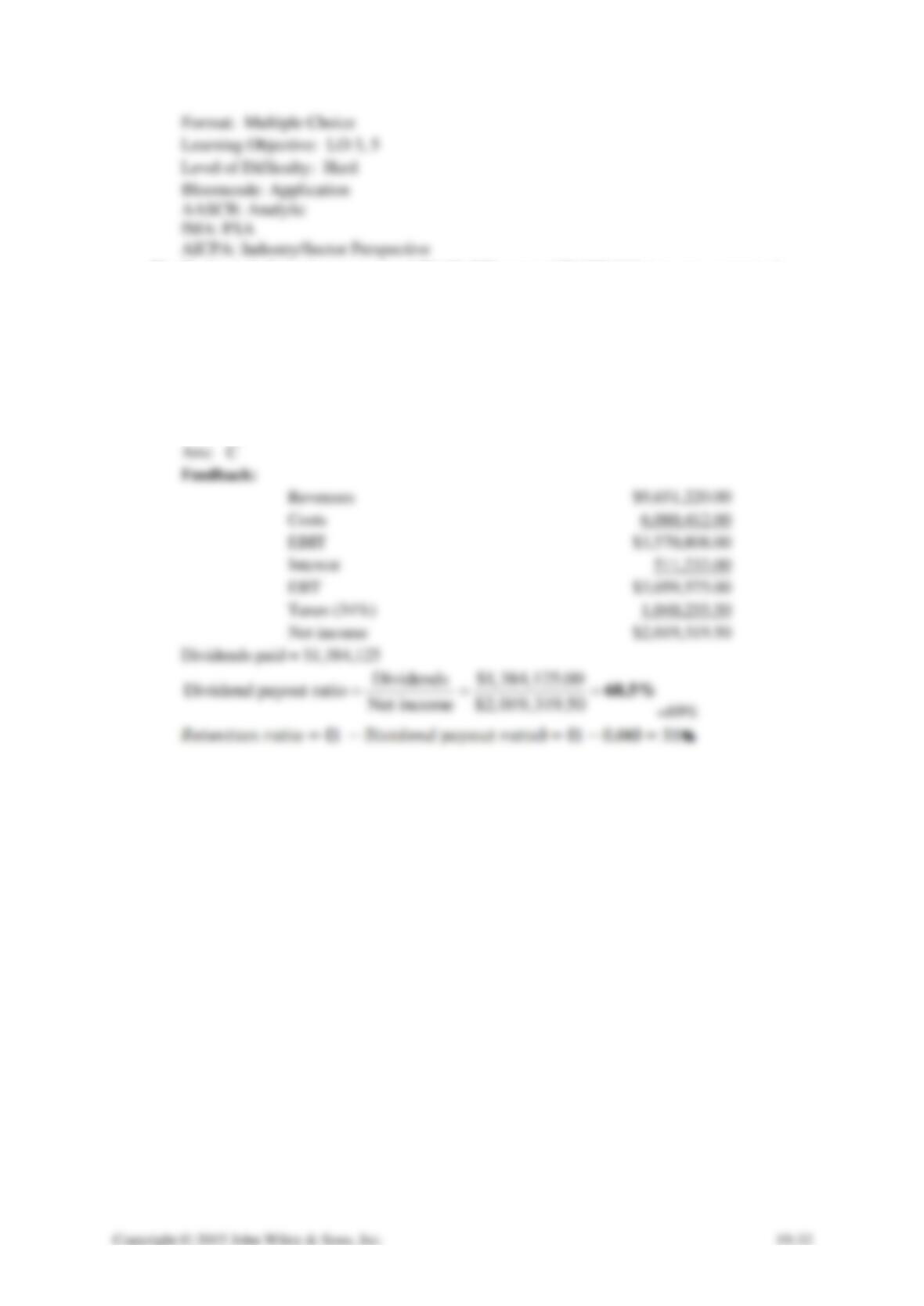
Tangent Inc. has revenues of $4,375,233, costs of $2,467,321, and pays a tax rate of 34
percent. If the firm pays out 60 percent of its earnings as dividends every year, what is the
amount of retained earnings? (Round final answer to two decimal places.)
A)
$171,254.18
B)
$755,533.15
C)
$503,688.77
D)
None of these
Fundamentals of Corporate Finance 3e Test Bank
78.
Tradewinds Corp. has revenues of $9,651,220, costs of $6,080,412, interest payment of
$511,233, and a tax rate of 34 percent. It paid dividends of $1,384,125 to shareholders. Find the
firm’s dividend payout ratio and retention ratio.(Round the percentage answer to nearest whole
number.)
A)
66%, 34%
B)
25%, 75%
C)
69%, 31%
D)
34%, 66%
Ans:
C
Fundamentals of Corporate Finance 3e Test Bank
79.
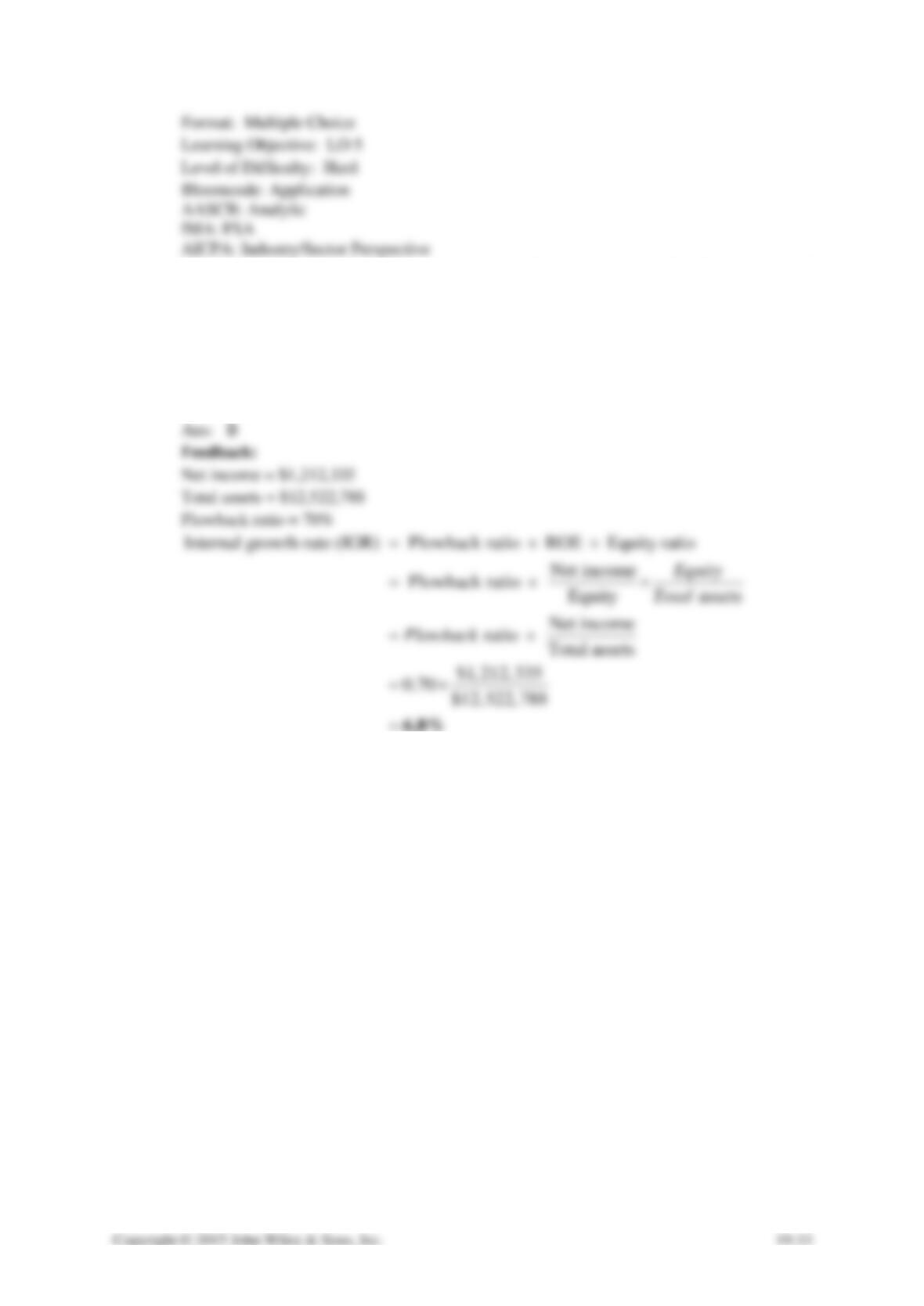
Swan Supply Company has net income of $1,212,335 on assets of $12,522,788 and retains 70
percent of its income every year. What is the company’s internal growth rate? (Do not round
intermediate calculations. Round final answer to one decimal place.)
A)
7.6%
B)
6.8%
C)
8.6%
D)
9.3%