
Elements of Ecology, 9e (Smith)
Chapter 19 Landscape Dynamics
19.1 Short Answer Questions
1) The patchwork of different types of land cover is called a(n) ________.
2) The study of the causes and ecological consequences of spatial patterns on the landscape is
called ________.
3) Within a mosaic, a(n) ________ is a relatively homogeneous community type, differing from
its surroundings in both structure and species composition.
4) Strips of habitat that connect habitat patches are referred to as ________.
5) The ________ effect refers to the rich diversity of life that occurs along the border between
adjacent habitat patches, represented by species from both adjacent patches and species adapted
to edge habitats.
6) A(n) ________ species lives within the borders of a habitat patch, avoiding edges where
habitat change is abrupt.
7) The degree to which the landscape facilitates or impedes the movement of organisms among
patches is referred to as landscape ________.

8) The phenomenon in which different-sized gaps in corridors allow certain organisms to cross
and restrict others is referred to as the ________ effect.
9) The theory of ________ postulates that the number of species on an island represents a
dynamic equilibrium between the immigration of new species and the extinction of previously
established species.
10) A set of spatially separated subpopulations connected by the movement of individuals is
referred to as a(n) ________.
11) The ________ mosaic view of the landscape considers landscapes as composed of multiple
patches or communities, each in a different phase of successional development due to
disturbances.
19.2 Multiple-Choice Questions
1) What is a primary focus of landscape ecology?
A) individual behavior
B) spatial heterogeneity
C) species interactions
D) population growth
2) How do beavers maintain a landscape?
A) massive defoliation of shrubs
B) feeding on roots of graminoid plants
C) feeding on aspen, willow, and birch trees
D) dispersing seeds of mesquite

3) Within a landscape mosaic, patches
A) are composed of relatively heterogeneous communities.
B) typically lack a distinct boundary.
C) tend to be similar in size.
D) tend to vary in shape.
4) Which of the following increase connectivity between patches?
A) edge effects
B) matrixes
C) boundaries
D) corridors
5) Where the edge of one match meets another is referred to as
A) a corridor.
B) a boundary.
C) a shifting mosaic.
D) a metacommunity.
6) Boundaries offer unique habitats
A) that offer relatively easy access to adjacent communities.
B) that do not offer easy access to adjacent communities.
C) that support only species specially adapted to the boundary environment.
D) whose composition is almost exactly the same as adjacent communities.
7) When a forest gradually merges into a grassland over a wide area, the border between the two
landscape patches is referred to as a(n)
A) narrow border.
B) convoluted border.
C) perforated border.
D) ecotone.

8) Plants adapted to edge environments tend to be
A) tolerant of shade and prefer moisture.
B) tolerant of shade and dry conditions.
C) intolerant of shade and prefer moisture.
D) intolerant of shade and tolerant of dry conditions.
9) Which of the following can serve as a boundary?
A) soil type
B) timber harvesting
C) pond edge
D) all of the above
10) Organisms that live at or near boundaries are called
A) boundary species.
B) edge species.
C) patch species.
D) matrix species.
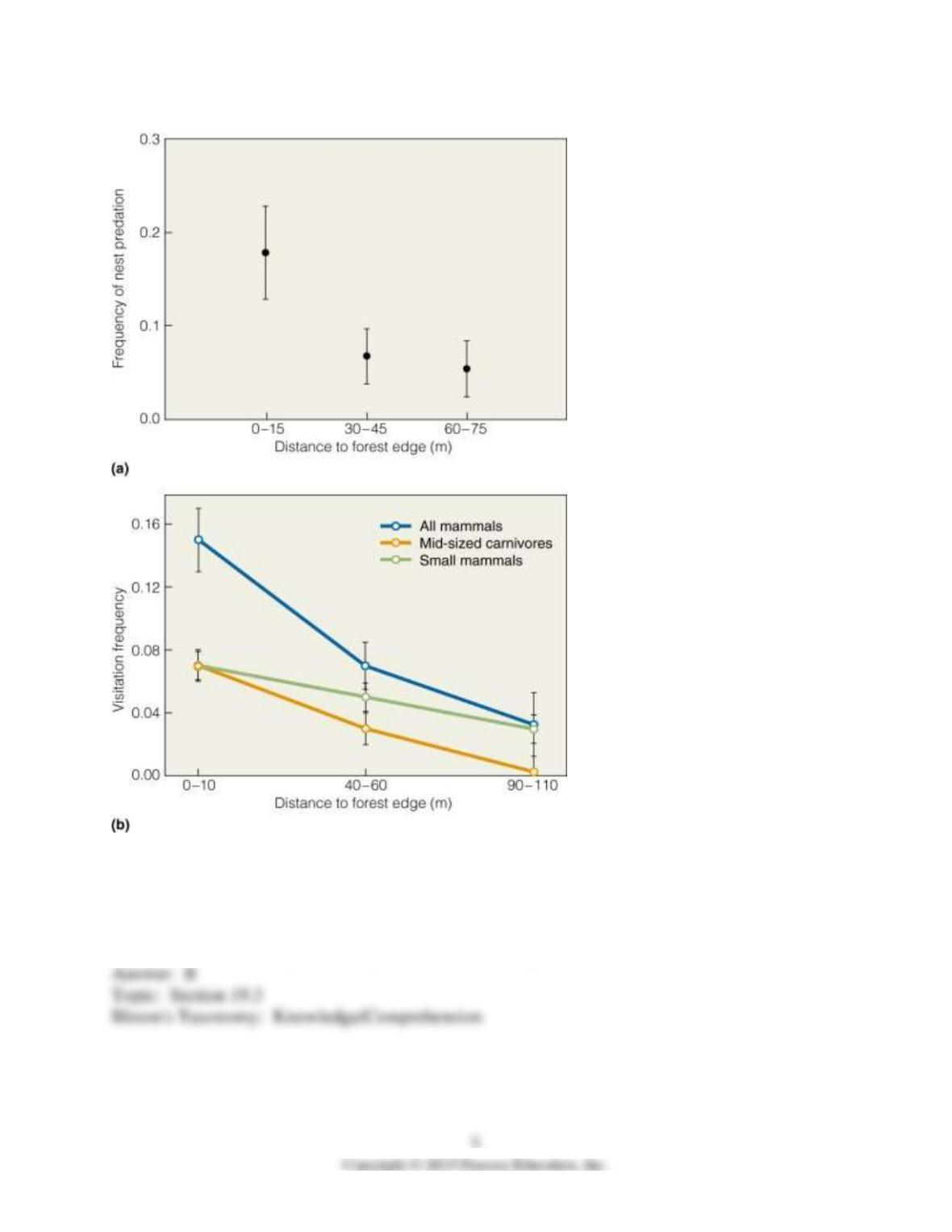
11)
What do these data suggest?
A) increased bird nesting closer to edge habitat
B) increased risk of mammalian predation on nests closer to edge habitat
C) decreased mammalian visitation closer to edge habitat
D) highest level of nest predation by mammals occurring in the interior
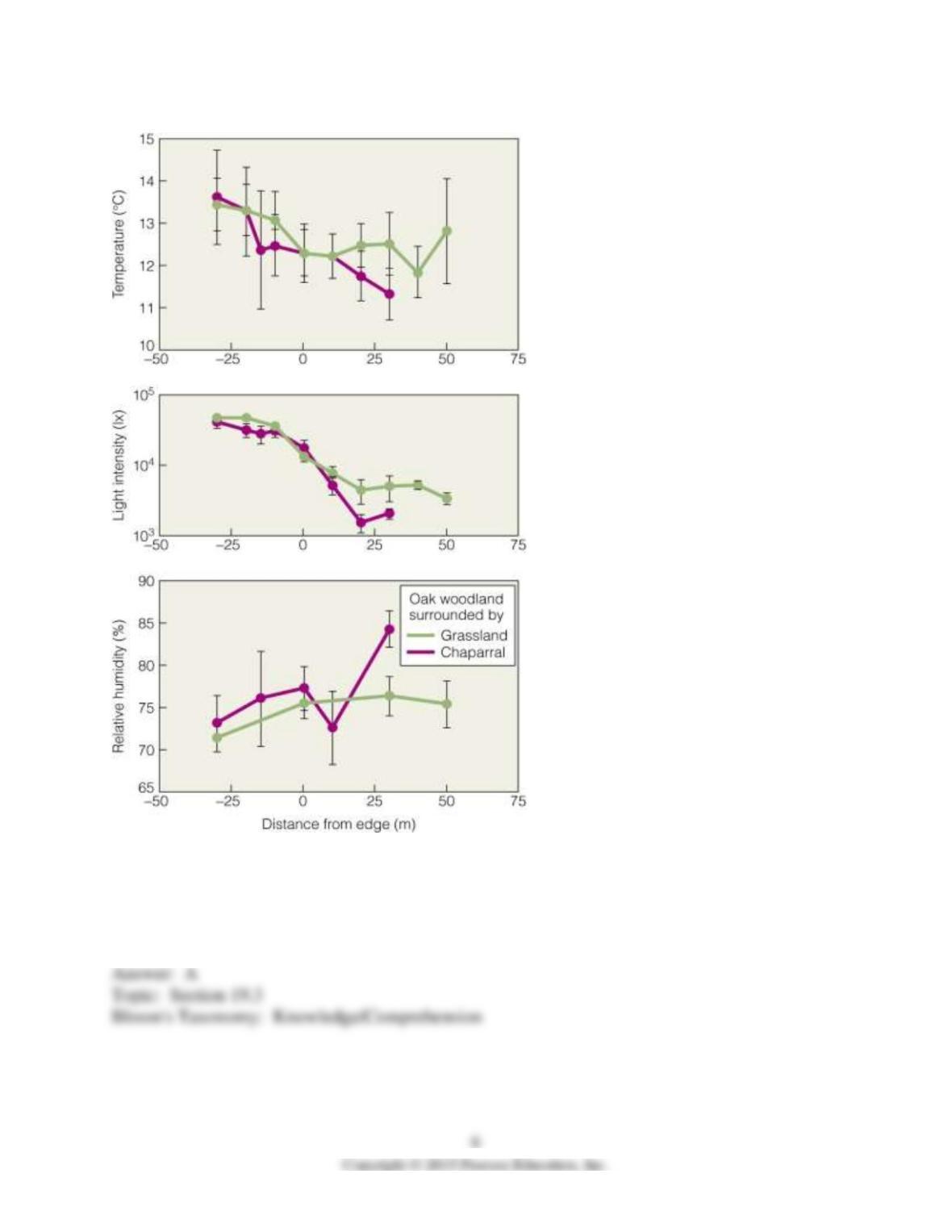
12)
According to the figure, what decreases the most moving away from the edge habitat?
A) light intensity
B) temperature
C) humidity
D) chaparral habitat

13) Which of the following is NOT a general relationship?
A) Increasing patch size is related to increased species diversity.
B) Increasing patch size is related to increased population size.
C) Increasing patch size is related to increased edge-to-core ratio.
D) Increased body size is related to increased home range.
14) With increasing forest area in a patch, what is more likely to occur?
A) interior species
B) edge species
C) boundary species
D) area-insensitive species
15) Which of the following statements is true?
A) Large patches of habitat usually contain fewer species than small patches.
B) Large animals usually have larger home ranges than smaller animals.
C) Carnivore home ranges are usually smaller than herbivore home ranges.
D) Small species are usually limited to small habitat patches.
16) A set of local communities that are linked by the dispersal of multiple, potentially interacting
species is referred to as a(n)
A) ecotone.
B) archipelago.
C) metapopulation.
D) metacommunity.
17) Which of the following can be considered a habitat corridor?
A) a large lake in a city park
B) an abandoned agricultural field in an urban area
C) a strip of forest along the banks of a river flowing from a forested mountain through a city
D) a patch of forest within a city park

18) Two patches are connected by a corridor but a species does not utilize it. This is an example
of
A) high structural connectivity.
B) low structural connectivity.
C) high functional connectivity.
D) low functional connectivity.
19) A corridor wide enough to contain interior habitat is called
A) functional connectivity.
B) a patch.
C) a strip corridor.
D) a filter effect.
20) A corridor with low functional connectivity for certain species undergoes
A) a filter effect.
B) island biogeography.
C) a strip corridor.
D) an edge effect.
21) What is a potential danger of corridor habitat?
A) increased connectivity
B) decreased colonization rates
C) increased extinction risk
D) increased predation risk
22) Island biogeography theory predicts that a 10-fold increase in area results in
A) a 10-fold increase in species number.
B) a doubling of species number.
C) a tripling of species number.
D) no effect on species number.

23) How can one justify using island biogeography theory on the tops of mountains?
A) Metapopulation dynamics are similar.
B) The same species exist in the two habitats.
C) Moving between mountaintops and islands is similarly challenging.
D) The theory does not apply.
24) According to the theory of island biogeography, the islands with the most species will be
A) small and close to the mainland.
B) small and far from the mainland.
C) large and close to the mainland.
D) large and far from the mainland.
25) In metapopulation theory, what does P stand for?
A) population size
B) probability of extinction
C) proportion of patches occupied
D) rate of colonization
26) Which of the following factors is related to patch colonization?
A) size of the patch
B) isolation of the patch
C) number of patches
D) all of the above
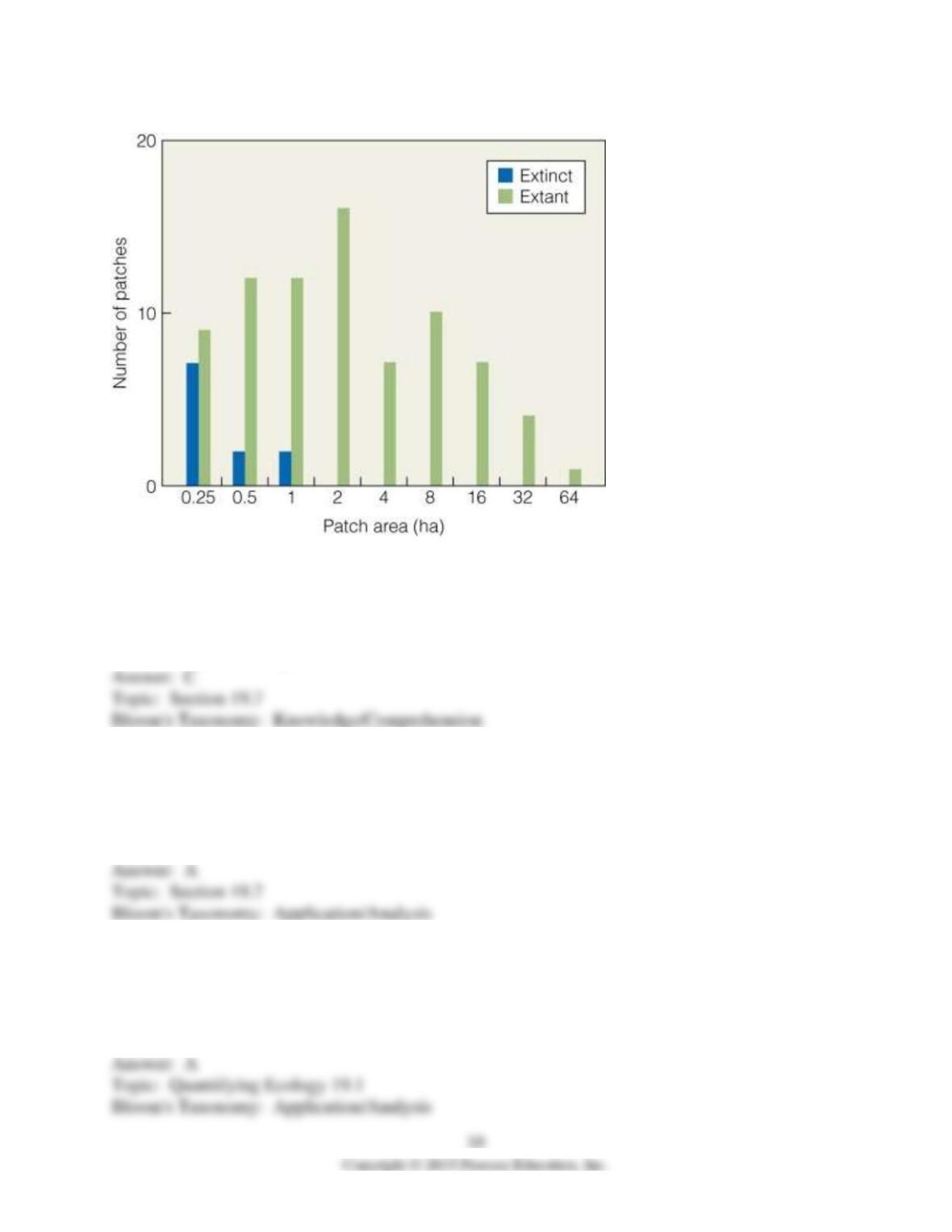
27)
What does this figure suggest?
A) Larger patch size increases extinction risk.
B) Larger number of patches increase extinction risk.
C) Smaller patch size increases extinction risk.
D) Smaller number of patches increase extinction risk.
28) Which of the following factors is related to patch extinction?
A) size of the patch
B) isolation of the patch
C) number of patches
D) all of the above
29) What would likely be true when P = 0.9?
A) Rate of extinction would be high.
B) Rate of colonization would be high.
C) Proportion of patch occupied would be low.
D) Corridor size would be small.

30) For a population to persist, which needs to be true?
A) P = 0
B) P > 0
C) P < 0
D) P < C
31) When metapopulation theory is extended to examining interactions among species, it is
termed
A) edge effect.
B) island biogeography.
C) metacommunity.
D) matrix ecology.
32) The notion that landscapes are continually changing through time is often called
A) a shifting mosaic.
B) a metacommunity.
C) island biogeography.
D) corridor dynamics.
33) What process is likely to be driving changes in landscape over time?
A) disturbance
B) extinctions
C) succession
D) all of the above
34) La Selva Biological Station and the Braulio Carrillo National Park in Costa Rica are an
example of
A) use of corridor theory in guiding conservation.
B) use of metapopulation dynamics in guiding conservation.
C) use of island biogeography theory in guiding conservation.
D) poor planning in conservation efforts.

35) Which of the following would help conservation efforts in terms of increasing corridor use?
A) purchasing larger preserve areas
B) purchasing areas being clear cut
C) purchasing several small areas
D) purchasing areas that connect protected areas
19.3 True/False Questions
1) The size and shape of habitat patches are determined more by the activities of animals than by
the interaction of geology, topography, and climate.
2) Borders between patches that result from natural disturbances typically change over time.
3) Animal species inhabiting edges of habitat patches usually require two or more habitat types
within their home range or territory.
4) Habitat fragmentation is harmful because no species are adapted to living along habitat edges.
5) The greater the contrast between two adjoining habitat patches, the greater is the diversity of
species living along the border between the two patches.
6) Large habitat patches typically contain more individuals and species than smaller habitat
patches.

7) For a given body size, the home range of carnivores is greater than that of herbivores.
8) As a patch increases in size, the ratio of interior to edge increases.
9) Patch size is generally more important for plant populations than for animal populations.
10) Habitat corridors are usually of human origin.
11) Habitat corridors have two roles: providing a unique habitat for some plant and animal
species and providing a means of dispersal between larger patches of habitat.
12) The theory of island biogeography was developed for islands and cannot be applied to
habitat patches within a larger landscape.
13) The theory of island biogeography predicts that large islands have more species than smaller
islands.
14) The theory of island biogeography predicts that the extinction rate is greater on large islands
than on small islands.

15) Subpopulations within a metapopulation are isolated from one another with no movement of
individuals between subpopulations.
16) The landscape can be thought of as a shifting mosaic of habitat patches, each in a phase of
successional development.
19.4 Essay Questions
1) Using an example, explain how human and natural forces can combine to create habitat
patches.
2) Discuss the major ecological differences between edge species and interior species.
3) Discuss the differences in diversity between large and small habitat patches. What are the
reasons for these differences?
4) Explain the potential value of corridors to large-bodied species such as carnivores.
5) Using a graph, illustrate how the number of species on an island can be affected by its size and
distance from a mainland. Which two important demographic variables vary with the size of an
island and its distance from a mainland?
6) Explain the role of disturbances in the shifting-mosaic view of the landscape.